
Ever wondered how your phone, computer, or even a simple...
 Applied Technology1 vues·Mis à jour Jun 19, 2026·7 pages
Understanding Basic Electronic Components

1 / 7
1
of 7
Electronic Components Basics
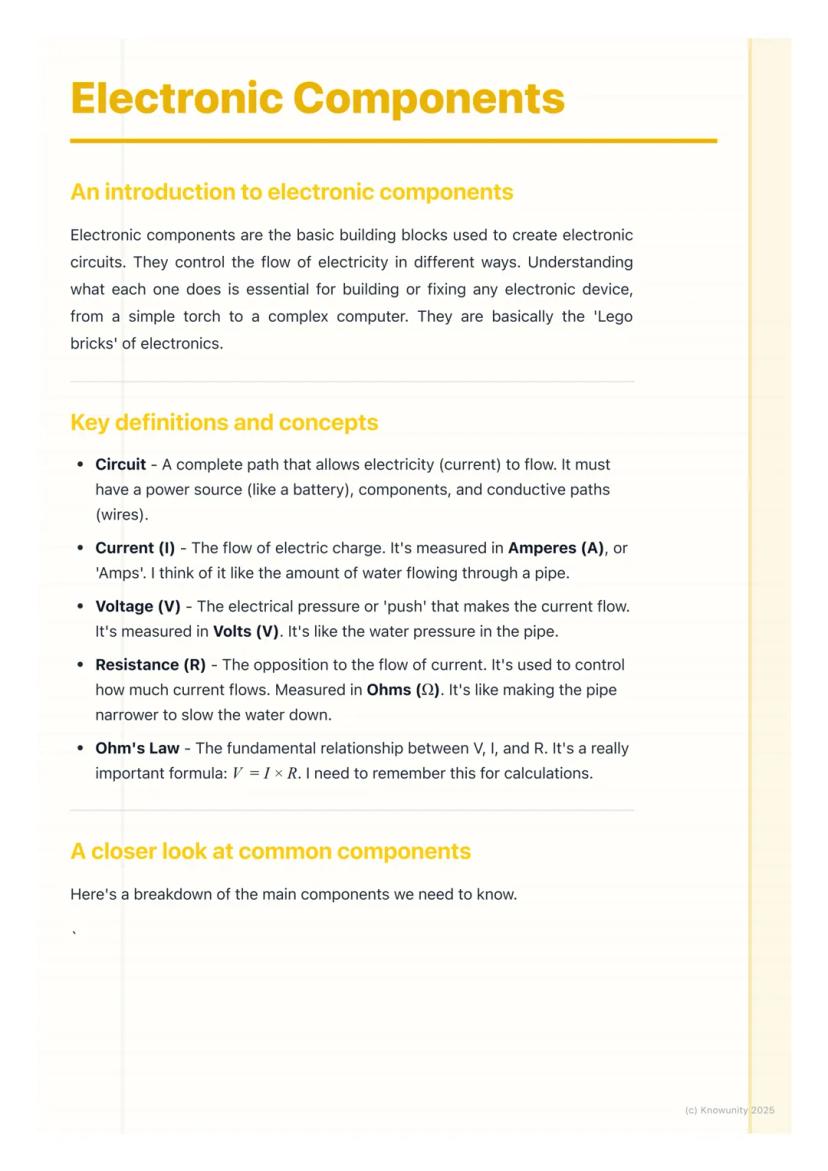
Electronic components are literally everywhere in your daily life - from your gaming console to your car's engine management system. They're the fundamental pieces that control how electricity flows through circuits.
Here's what you absolutely need to know: a circuit is just a complete path that lets electricity flow. Picture it like a race track - you need a starting point (battery), the track itself (wires), and some obstacles or features along the way (the components).
Current flows like water through a pipe, measured in Amperes (A). Voltage is the electrical pressure pushing that current along, measured in Volts (V). Resistance acts like a narrow section in the pipe that slows things down, measured in Ohms (Ω).
Remember This: Ohm's Law is your best friend: V = I × R. Master this formula and you'll ace most electronics calculations!
2
of 7
Resistors - The Current Controllers
Resistors are probably the most common components you'll encounter. Their job is simple: limit the flow of current to protect other components from getting fried.
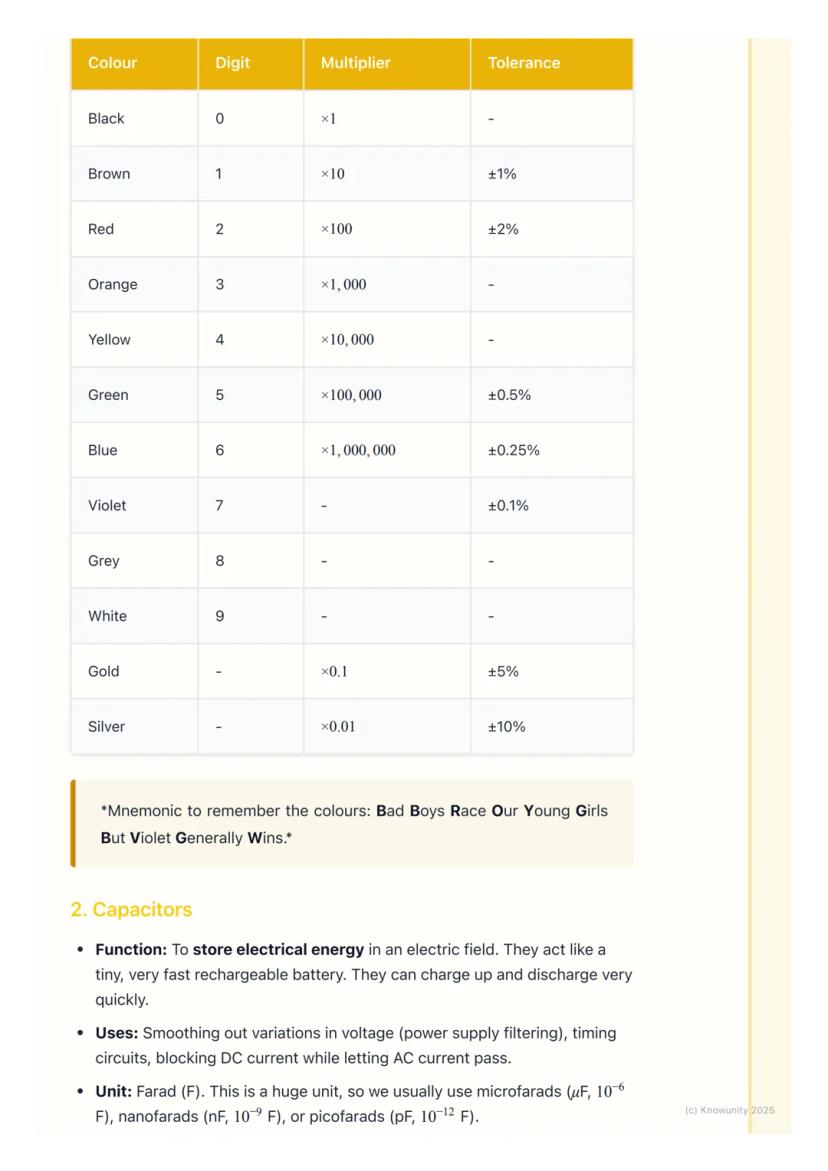
You'll recognise them by their coloured bands - it's like a secret code that tells you their value. The resistor colour code uses the first two bands for digits, the third as a multiplier (how many zeros to add), and the fourth shows tolerance (how accurate the value is).
Here's a memory trick that actually works: "Bad Boys Race Our Young Girls But Violet Generally Wins" for Black, Brown, Red, Orange, Yellow, Green, Blue, Violet, Grey, White. The colours represent numbers 0-9 in that order.
Pro Tip: When you're unsure about a resistor's value, use a multimeter to double-check. It's way faster than squinting at tiny colour bands!
3
of 7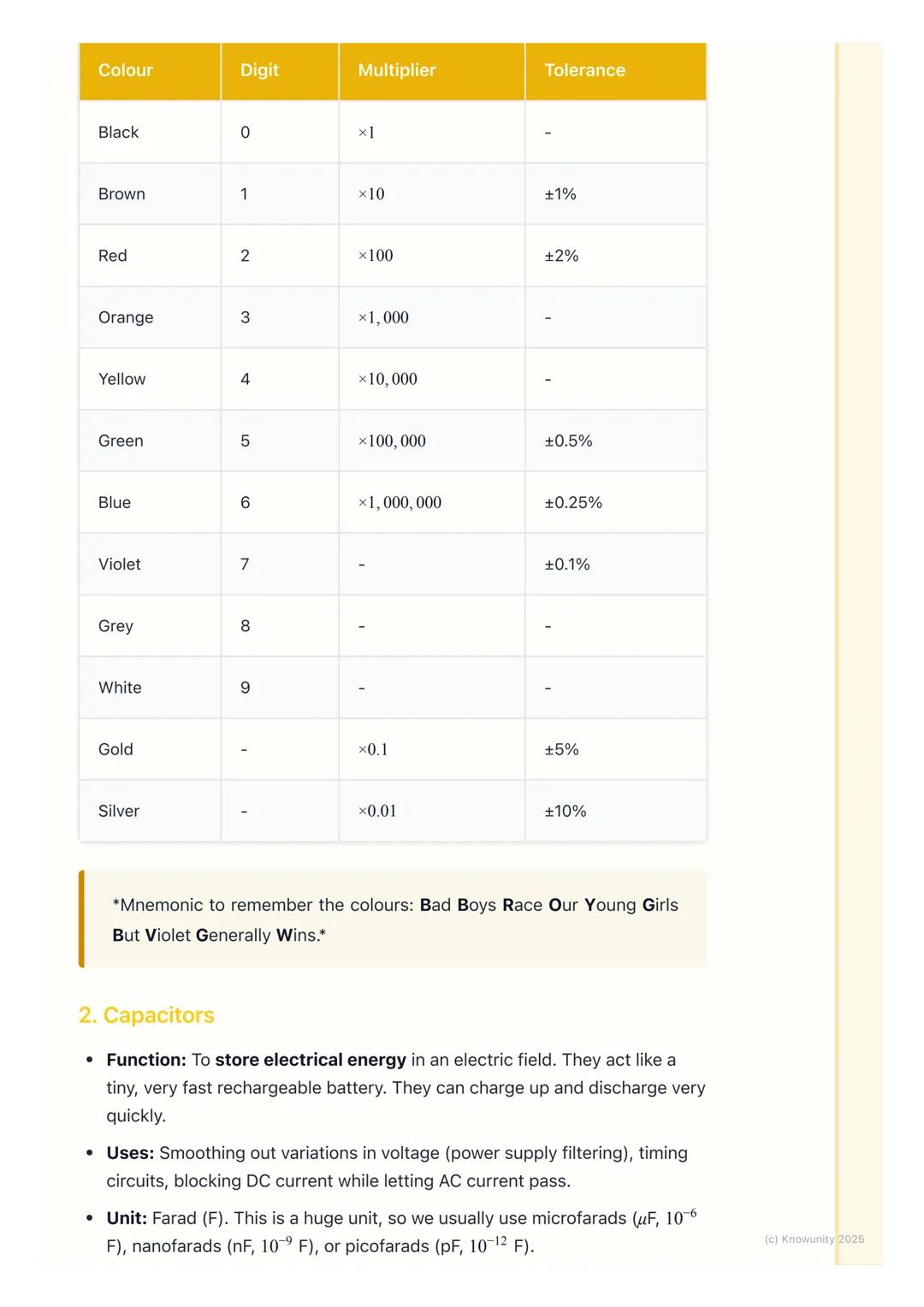
Capacitors and Diodes - Energy Storage and One-Way Streets
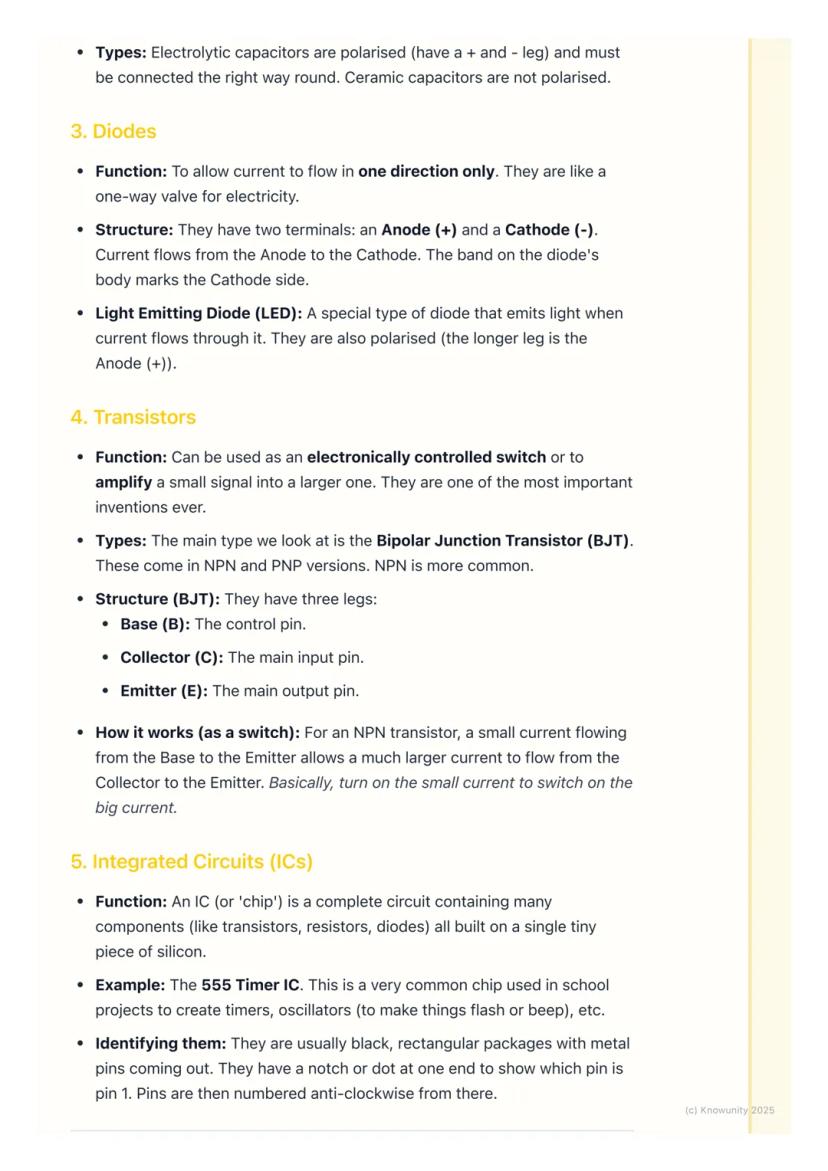
Capacitors are like tiny, super-fast rechargeable batteries. They store electrical energy and release it when needed. You'll find them smoothing out power supplies and creating timing circuits in everything from camera flashes to computer motherboards.
Watch out for electrolytic capacitors - they're polarised, meaning they have a positive and negative side. Connect them backwards and they'll literally explode (well, pop quite dramatically).
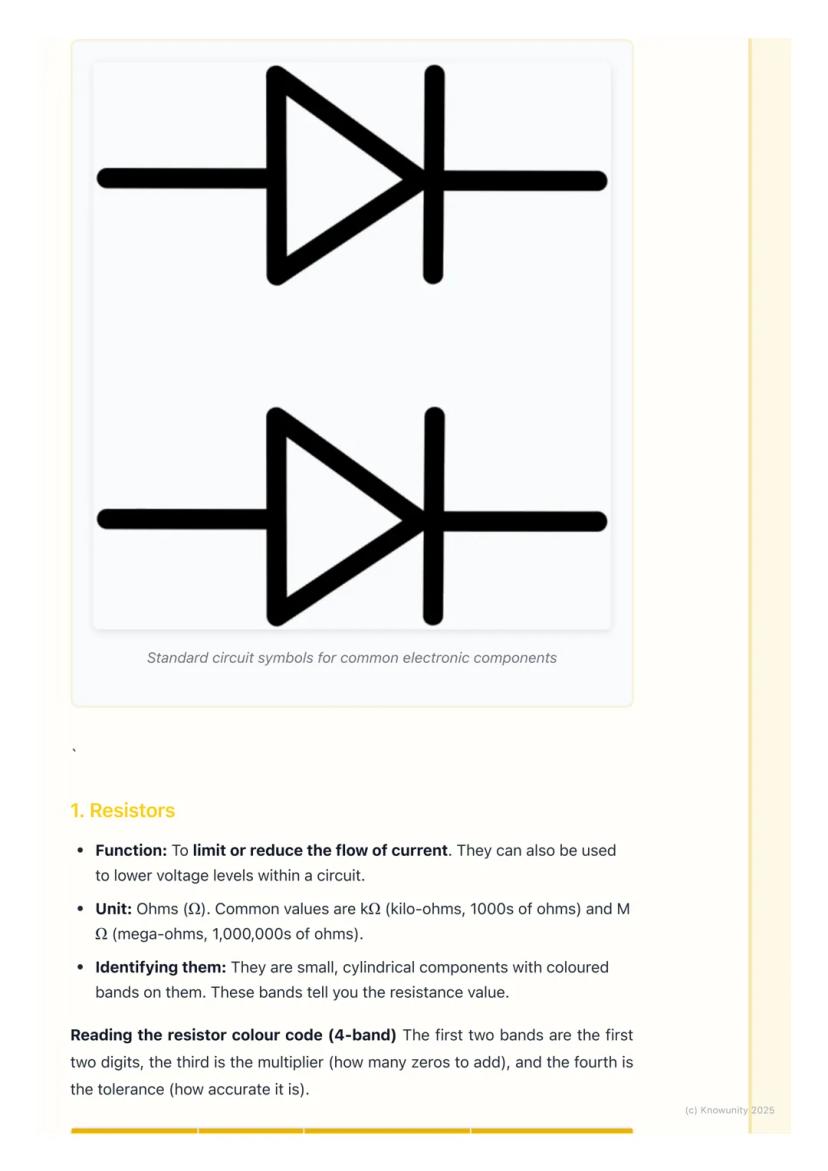
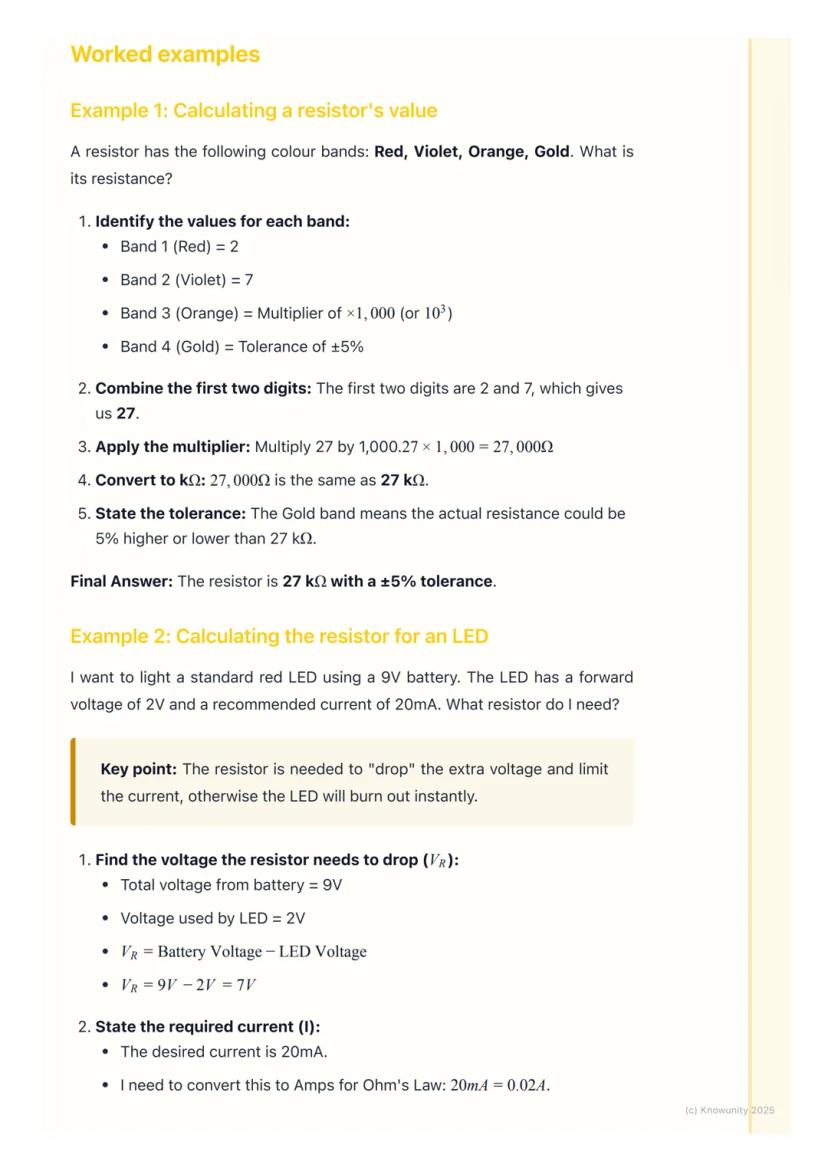
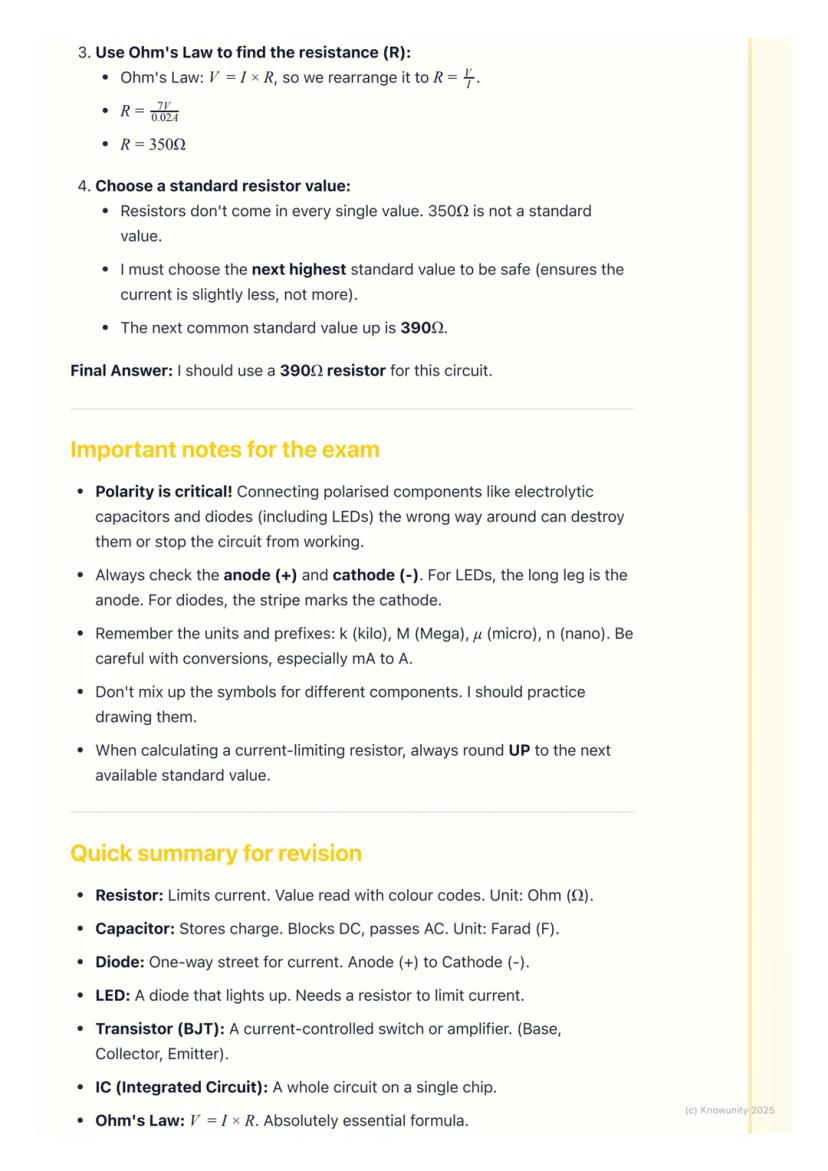
Diodes are the one-way streets of electronics. Current flows from the anode (+) to the cathode (-) and absolutely nowhere else. The stripe on a diode's body always marks the cathode side.
LEDs are special diodes that light up when current flows through them. The longer leg is always positive. Just remember - they need a current-limiting resistor or they'll burn out instantly.
Watch Out: Polarity matters! Getting the positive and negative connections wrong can destroy components or make circuits fail completely.
4
of 7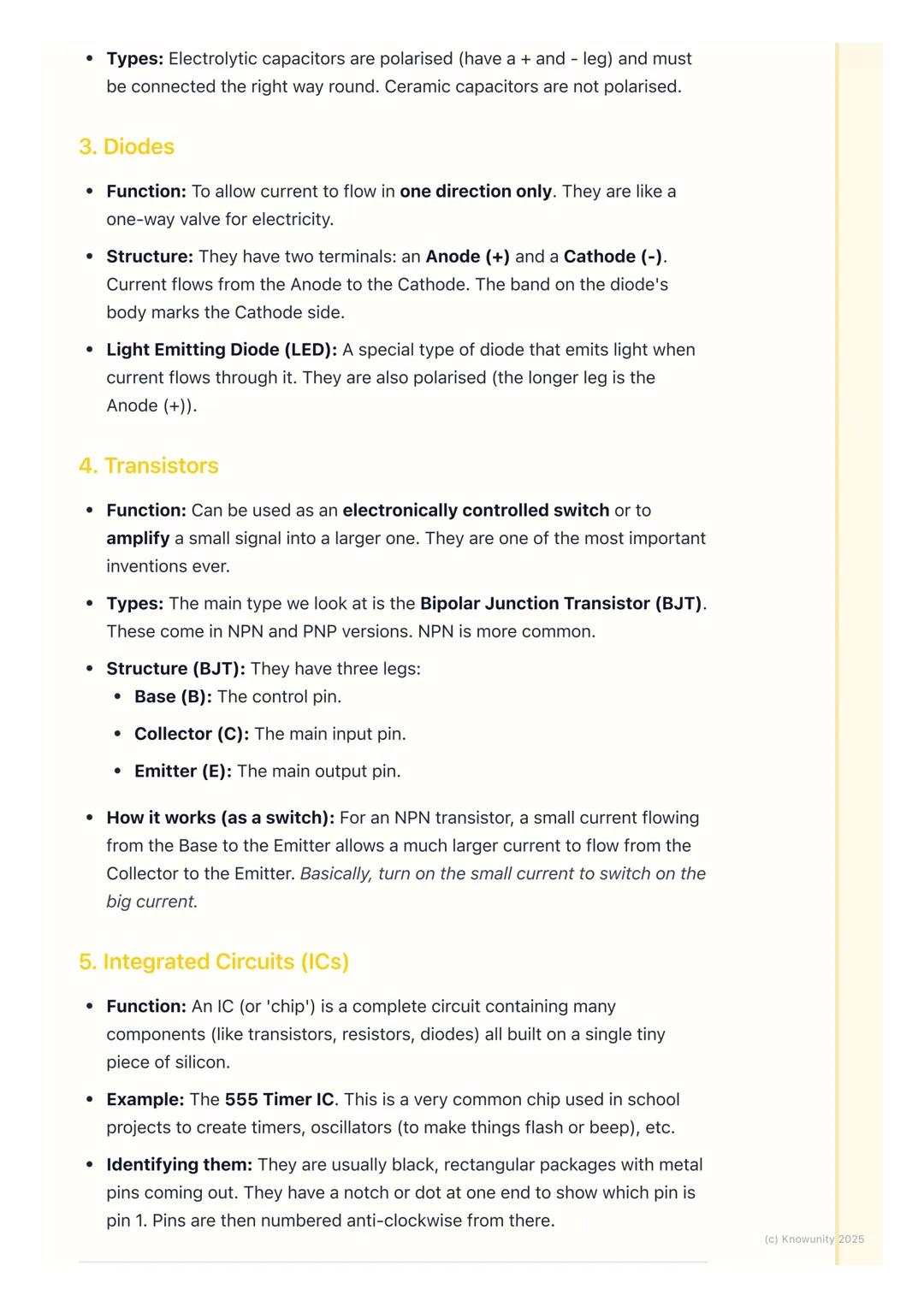
Transistors and Integrated Circuits - The Smart Stuff
Transistors are absolutely revolutionary - they're either electronic switches or amplifiers, depending on how you use them. Think of them as taps that can be turned on or off by applying a small signal to the base, which then controls a much larger current between the collector and emitter.
NPN transistors are the most common type. A small current from base to emitter allows a massive current to flow from collector to emitter. It's like using a tiny key to open a huge floodgate.
Integrated Circuits (ICs) are complete circuits shrunk down onto a single chip. The 555 timer IC is legendary in electronics - it's used in thousands of projects to create timers, flashers, and sound generators.
ICs have a notch or dot marking pin 1, then you count anti-clockwise from there. Get this wrong and your circuit definitely won't work.
Key Insight: Transistors are the foundation of all modern computing - your smartphone has billions of them working together!
5
of 7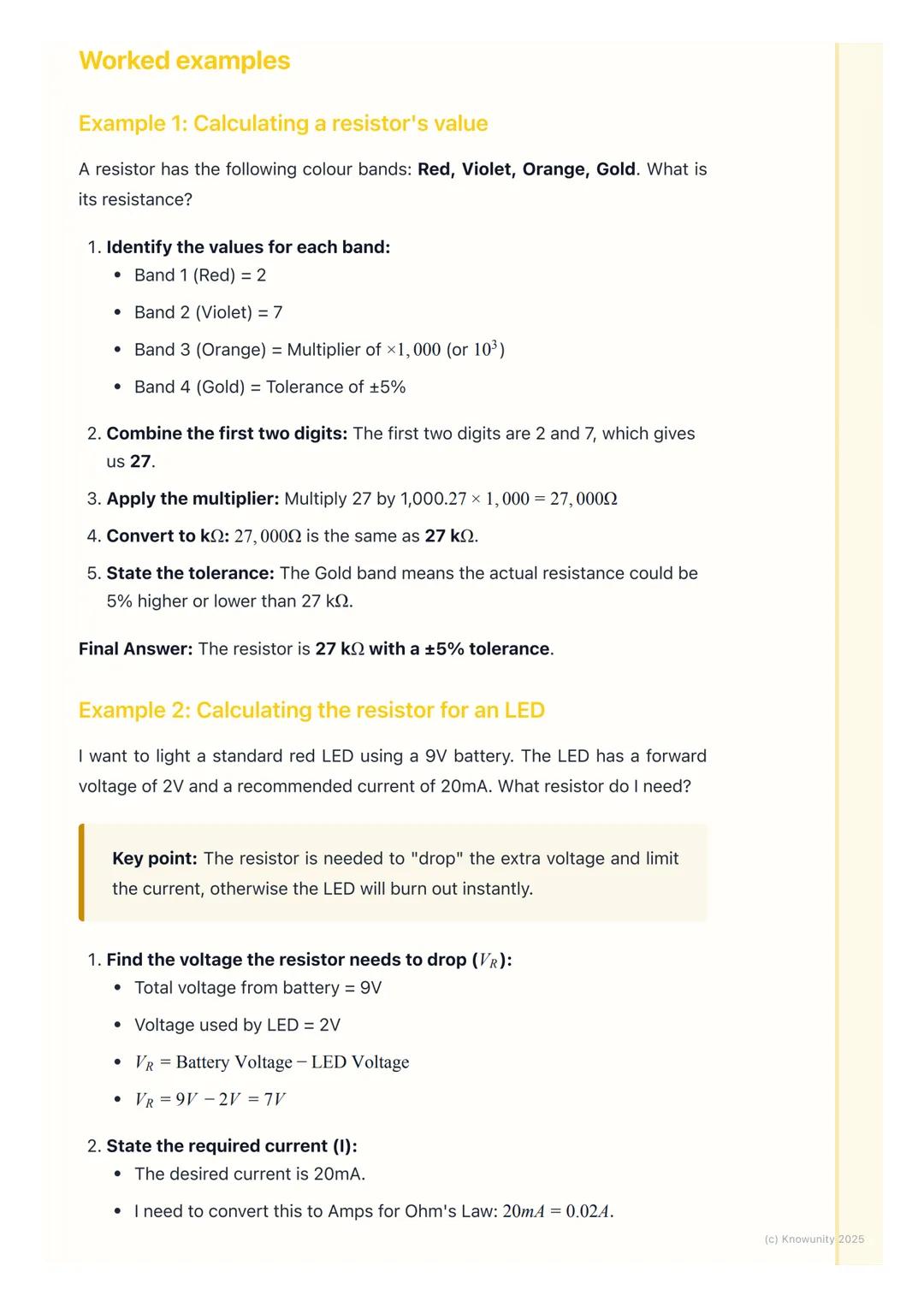
Practical Calculations - Making It Work
Let's crack some real problems you'll face in exams and projects. Resistor colour codes might seem tricky, but they follow a logical pattern.
For a resistor with Red, Violet, Orange, Gold bands: Red (2) + Violet (7) gives 27, Orange means ×1,000, so 27,000Ω or 27kΩ. Gold means ±5% tolerance.
LED circuits need careful calculation. If you're powering a 2V LED from a 9V battery, the resistor must drop 7V. With 20mA current required, use Ohm's Law: R = V/I = 7V/0.02A = 350Ω.
Always choose the next highest standard value (390Ω in this case) to ensure your LED doesn't get too much current and burn out.
Exam Success: Convert mA to A by dividing by 1,000. It's a common mistake that costs marks - 20mA = 0.02A, not 20A!
6
of 7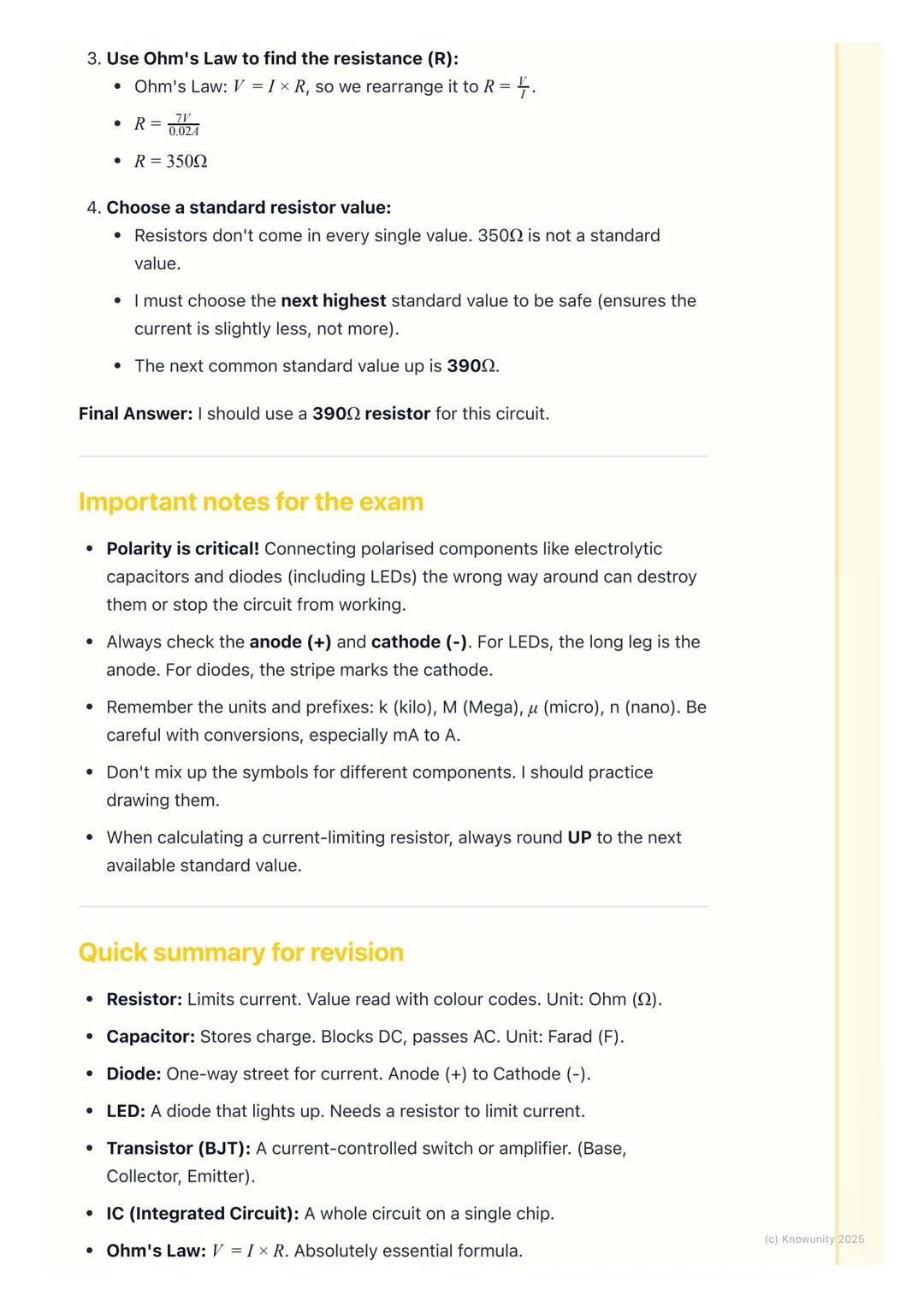
Exam Essentials and Quick Review
Polarity is everything in electronics. LEDs, diodes, and electrolytic capacitors must be connected correctly. For LEDs, long leg = positive. For diodes, the stripe marks negative (cathode).
Unit prefixes will trip you up if you're not careful: k , M , μ , n . Practice converting between them.
When designing circuits, safety first - always calculate resistor values to limit current. Round UP to the next available standard value to protect components.
Your revision checklist: Resistors limit current (Ω), Capacitors store charge (F), Diodes are one-way (anode to cathode), Transistors switch/amplify , ICs are complete circuits on chips.
Final Reminder: Ohm's Law solves most problems. Learn it, love it, use it constantly!
7
of 7
Si on te demande...
Qu'est-ce que le compagnon IA de Knowunity ?
Notre compagnon IA est spécialement conçu pour répondre aux besoins des étudiants. Sur la base des millions d'éléments de contenu que nous avons sur la plateforme, nous pouvons fournir des réponses vraiment significatives et pertinentes aux étudiants. Mais il ne s'agit pas seulement de réponses, le compagnon a encore plus pour but de guider les élèves dans leurs défis d'apprentissage quotidiens, avec des plans d'étude personnalisés, des quiz ou des éléments de contenu dans le chat et une personnalisation à 100% basée sur les compétences et les développements de l'étudiant.
Où puis-je télécharger l'appli Knowunity ?
Tu peux télécharger l'application dans Google Play Store et dans l'App Store d'Apple.
L'application est-elle vraiment gratuite ?
Oui, tu as un accès entièrement gratuit à tous les contenus de l'appli, tu peux chatter ou suivre les créateurs à tout moment. De plus, nous proposons Knowunity Premium, qui te permet de réviser sans limites!
Contenus les plus populaires
9 Irish
IrishIrish oral questions and answers
Questions and answers for the leaving cert oral
5th Year4264
 English
Key Quotes : Sive
Key Quotes and explanations: Sive
6th Year2842
IrishIrish oral questions
Outline of oral questions
5th Year2055
IrishIníon- le hÁine Durkin
Aine Durkin’s poem, Iníon: Themes & summary
5th Year890
IrishIrish poetry 2027
Iníon + Dínit an Bhróin
5th Year1153
IrishLC HL notes- Iníon (poem)
Includes poem in English and Irish, theme, key words & phrases
5th Year2304
EnglishCultural Context : Shawshank Redemption : Sive : Small Things Like These
Comparative Study : Cultural Context : Shawshank Redemption, Sive and Small Things Like These
6th Year1430
IrishMo Ghrá-sa (Idir Lúibíní)
Notes on mo ghrá-sa
5th Year380
IrishAn Gaeilge Aiste
Irish Language essay
6th Year1320
Rien ne te convient ? Explore d'autres matières.
Les étudiants nous adorent — il ne manque plus que toi.
4.6/5App Store
4.7/5Google Play
L'application est très facile d'utilisation et bien conçue. Jusqu'à présent, j'ai trouvé tout ce que je cherchais et j'ai pu apprendre beaucoup de choses grâce aux présentations ! Je vais certainement utiliser l'application pour un travail en classe ! Et comme source d'inspiration personnelle, elle est bien sûr aussi très utile.
Stefan Sutilisateur iOS
Cette application est vraiment super. Il y a tellement de fiches de révision et d'aide, [...]. Par exemple, la matière qui me pose problème est le français et l'appli a un choix d'aide très large. Grâce à cette application, je me suis améliorée en français. Je la recommanderais à tout le monde.
Samantha Klichutilisatrice Android
Waouh, je suis vraiment abasourdi. J'ai essayé l'application parce que je l'avais déjà vue plusieurs fois dans la publicité et j'ai été absolument choquée. Cette appli est L'AIDE dont on rêve pour l'école et surtout, elle propose tellement de choses, comme des rédactions et des fiches qui m'ont personnellement TRÈS bien aidé.
Annautilisatrice iOS
Applied Technology1 vues·Mis à jour Jun 19, 2026·7 pagesUnderstanding Basic Electronic Components
Ever wondered how your phone, computer, or even a simple torch actually works? It all comes down to electronic components - the tiny building blocks that make every electronic device tick. Think of them as the Lego bricks of the...
1
of 7
Inscris-toi pour voir le contenu. C'est gratuit!
- Accès à tous les documents
- Améliore tes notes
- Rejoins des millions d'étudiants
Electronic Components Basics
Electronic components are literally everywhere in your daily life - from your gaming console to your car's engine management system. They're the fundamental pieces that control how electricity flows through circuits.
Here's what you absolutely need to know: a circuit is just a complete path that lets electricity flow. Picture it like a race track - you need a starting point (battery), the track itself (wires), and some obstacles or features along the way (the components).
Current flows like water through a pipe, measured in Amperes (A). Voltage is the electrical pressure pushing that current along, measured in Volts (V). Resistance acts like a narrow section in the pipe that slows things down, measured in Ohms (Ω).
Remember This: Ohm's Law is your best friend: V = I × R. Master this formula and you'll ace most electronics calculations!
2
of 7Inscris-toi pour voir le contenu. C'est gratuit!
- Accès à tous les documents
- Améliore tes notes
- Rejoins des millions d'étudiants
Resistors - The Current Controllers
Resistors are probably the most common components you'll encounter. Their job is simple: limit the flow of current to protect other components from getting fried.
You'll recognise them by their coloured bands - it's like a secret code that tells you their value. The resistor colour code uses the first two bands for digits, the third as a multiplier (how many zeros to add), and the fourth shows tolerance (how accurate the value is).
Here's a memory trick that actually works: "Bad Boys Race Our Young Girls But Violet Generally Wins" for Black, Brown, Red, Orange, Yellow, Green, Blue, Violet, Grey, White. The colours represent numbers 0-9 in that order.
Pro Tip: When you're unsure about a resistor's value, use a multimeter to double-check. It's way faster than squinting at tiny colour bands!
3
of 7Inscris-toi pour voir le contenu. C'est gratuit!
- Accès à tous les documents
- Améliore tes notes
- Rejoins des millions d'étudiants
Capacitors and Diodes - Energy Storage and One-Way Streets
Capacitors are like tiny, super-fast rechargeable batteries. They store electrical energy and release it when needed. You'll find them smoothing out power supplies and creating timing circuits in everything from camera flashes to computer motherboards.
Watch out for electrolytic capacitors - they're polarised, meaning they have a positive and negative side. Connect them backwards and they'll literally explode (well, pop quite dramatically).
Diodes are the one-way streets of electronics. Current flows from the anode (+) to the cathode (-) and absolutely nowhere else. The stripe on a diode's body always marks the cathode side.
LEDs are special diodes that light up when current flows through them. The longer leg is always positive. Just remember - they need a current-limiting resistor or they'll burn out instantly.
Watch Out: Polarity matters! Getting the positive and negative connections wrong can destroy components or make circuits fail completely.
4
of 7Inscris-toi pour voir le contenu. C'est gratuit!
- Accès à tous les documents
- Améliore tes notes
- Rejoins des millions d'étudiants
Transistors and Integrated Circuits - The Smart Stuff
Transistors are absolutely revolutionary - they're either electronic switches or amplifiers, depending on how you use them. Think of them as taps that can be turned on or off by applying a small signal to the base, which then controls a much larger current between the collector and emitter.
NPN transistors are the most common type. A small current from base to emitter allows a massive current to flow from collector to emitter. It's like using a tiny key to open a huge floodgate.
Integrated Circuits (ICs) are complete circuits shrunk down onto a single chip. The 555 timer IC is legendary in electronics - it's used in thousands of projects to create timers, flashers, and sound generators.
ICs have a notch or dot marking pin 1, then you count anti-clockwise from there. Get this wrong and your circuit definitely won't work.
Key Insight: Transistors are the foundation of all modern computing - your smartphone has billions of them working together!
5
of 7Inscris-toi pour voir le contenu. C'est gratuit!
- Accès à tous les documents
- Améliore tes notes
- Rejoins des millions d'étudiants
Practical Calculations - Making It Work
Let's crack some real problems you'll face in exams and projects. Resistor colour codes might seem tricky, but they follow a logical pattern.
For a resistor with Red, Violet, Orange, Gold bands: Red (2) + Violet (7) gives 27, Orange means ×1,000, so 27,000Ω or 27kΩ. Gold means ±5% tolerance.
LED circuits need careful calculation. If you're powering a 2V LED from a 9V battery, the resistor must drop 7V. With 20mA current required, use Ohm's Law: R = V/I = 7V/0.02A = 350Ω.
Always choose the next highest standard value (390Ω in this case) to ensure your LED doesn't get too much current and burn out.
Exam Success: Convert mA to A by dividing by 1,000. It's a common mistake that costs marks - 20mA = 0.02A, not 20A!
6
of 7Inscris-toi pour voir le contenu. C'est gratuit!
- Accès à tous les documents
- Améliore tes notes
- Rejoins des millions d'étudiants
Exam Essentials and Quick Review
Polarity is everything in electronics. LEDs, diodes, and electrolytic capacitors must be connected correctly. For LEDs, long leg = positive. For diodes, the stripe marks negative (cathode).
Unit prefixes will trip you up if you're not careful: k , M , μ , n . Practice converting between them.
When designing circuits, safety first - always calculate resistor values to limit current. Round UP to the next available standard value to protect components.
Your revision checklist: Resistors limit current (Ω), Capacitors store charge (F), Diodes are one-way (anode to cathode), Transistors switch/amplify , ICs are complete circuits on chips.
Final Reminder: Ohm's Law solves most problems. Learn it, love it, use it constantly!
7
of 7Inscris-toi pour voir le contenu. C'est gratuit!
- Accès à tous les documents
- Améliore tes notes
- Rejoins des millions d'étudiants
Si on te demande...
Qu'est-ce que le compagnon IA de Knowunity ?
Notre compagnon IA est spécialement conçu pour répondre aux besoins des étudiants. Sur la base des millions d'éléments de contenu que nous avons sur la plateforme, nous pouvons fournir des réponses vraiment significatives et pertinentes aux étudiants. Mais il ne s'agit pas seulement de réponses, le compagnon a encore plus pour but de guider les élèves dans leurs défis d'apprentissage quotidiens, avec des plans d'étude personnalisés, des quiz ou des éléments de contenu dans le chat et une personnalisation à 100% basée sur les compétences et les développements de l'étudiant.
Où puis-je télécharger l'appli Knowunity ?
Tu peux télécharger l'application dans Google Play Store et dans l'App Store d'Apple.
L'application est-elle vraiment gratuite ?
Oui, tu as un accès entièrement gratuit à tous les contenus de l'appli, tu peux chatter ou suivre les créateurs à tout moment. De plus, nous proposons Knowunity Premium, qui te permet de réviser sans limites!
Contenus les plus populaires
9IrishIrish oral questions and answers
Questions and answers for the leaving cert oral
5th Year4264
EnglishKey Quotes : Sive
Key Quotes and explanations: Sive
6th Year2842
IrishIrish oral questions
Outline of oral questions
5th Year2055
IrishIníon- le hÁine Durkin
Aine Durkin’s poem, Iníon: Themes & summary
5th Year890
IrishIrish poetry 2027
Iníon + Dínit an Bhróin
5th Year1153
IrishLC HL notes- Iníon (poem)
Includes poem in English and Irish, theme, key words & phrases
5th Year2304
EnglishCultural Context : Shawshank Redemption : Sive : Small Things Like These
Comparative Study : Cultural Context : Shawshank Redemption, Sive and Small Things Like These
6th Year1430
IrishMo Ghrá-sa (Idir Lúibíní)
Notes on mo ghrá-sa
5th Year380
IrishAn Gaeilge Aiste
Irish Language essay
6th Year1320
Rien ne te convient ? Explore d'autres matières.
Les étudiants nous adorent — il ne manque plus que toi.
4.6/5App Store
4.7/5Google Play
L'application est très facile d'utilisation et bien conçue. Jusqu'à présent, j'ai trouvé tout ce que je cherchais et j'ai pu apprendre beaucoup de choses grâce aux présentations ! Je vais certainement utiliser l'application pour un travail en classe ! Et comme source d'inspiration personnelle, elle est bien sûr aussi très utile.
Stefan Sutilisateur iOS
Cette application est vraiment super. Il y a tellement de fiches de révision et d'aide, [...]. Par exemple, la matière qui me pose problème est le français et l'appli a un choix d'aide très large. Grâce à cette application, je me suis améliorée en français. Je la recommanderais à tout le monde.
Samantha Klichutilisatrice Android
Waouh, je suis vraiment abasourdi. J'ai essayé l'application parce que je l'avais déjà vue plusieurs fois dans la publicité et j'ai été absolument choquée. Cette appli est L'AIDE dont on rêve pour l'école et surtout, elle propose tellement de choses, comme des rédactions et des fiches qui m'ont personnellement TRÈS bien aidé.
Annautilisatrice iOS