
Your body has a brilliant chemical messaging system called the ...
 Biology6 vues·Mis à jour Jun 7, 2026·6 pages
Understanding the Endocrine System and Its Hormones
1 / 6
1
of 6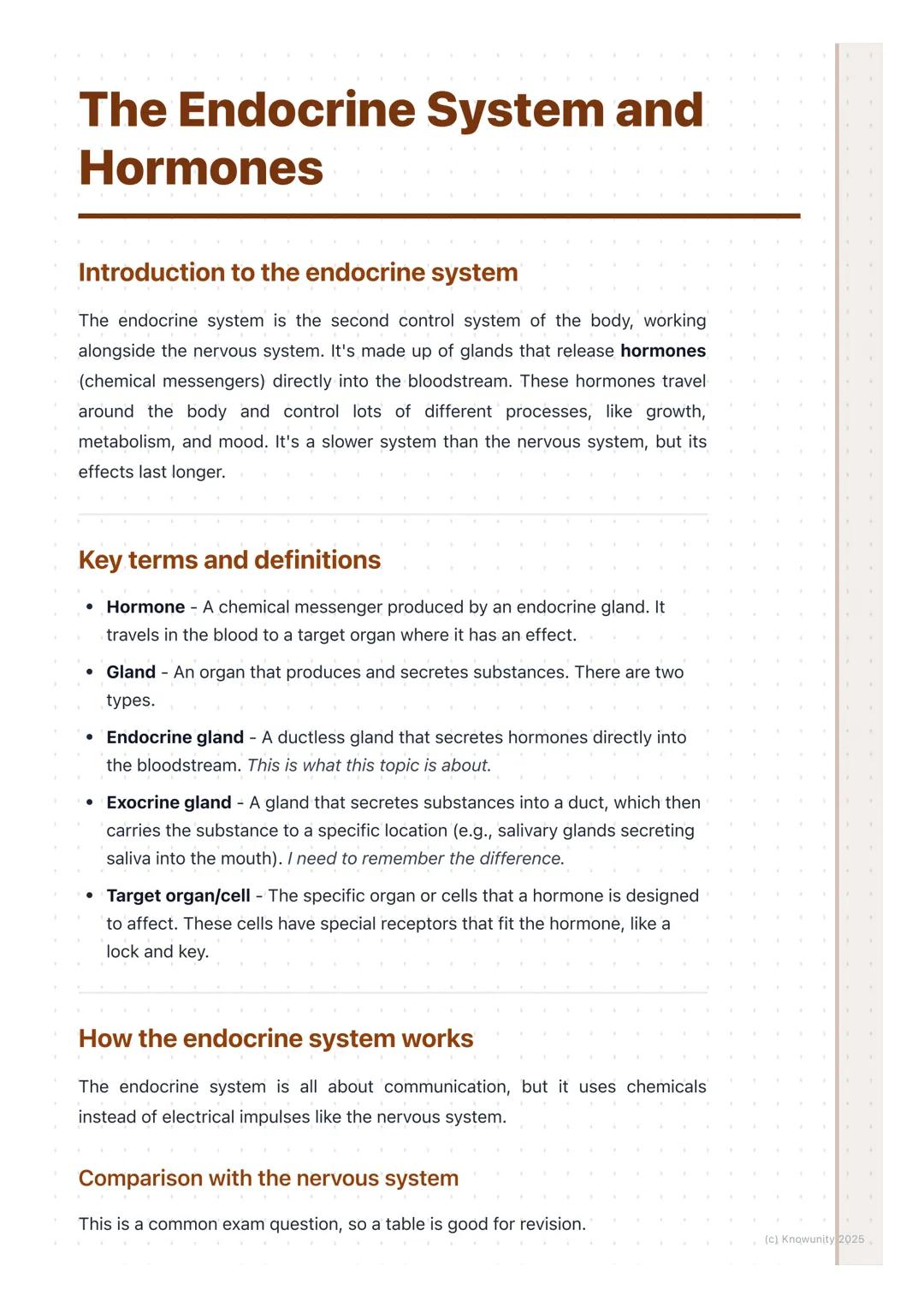
The Endocrine System and Hormones
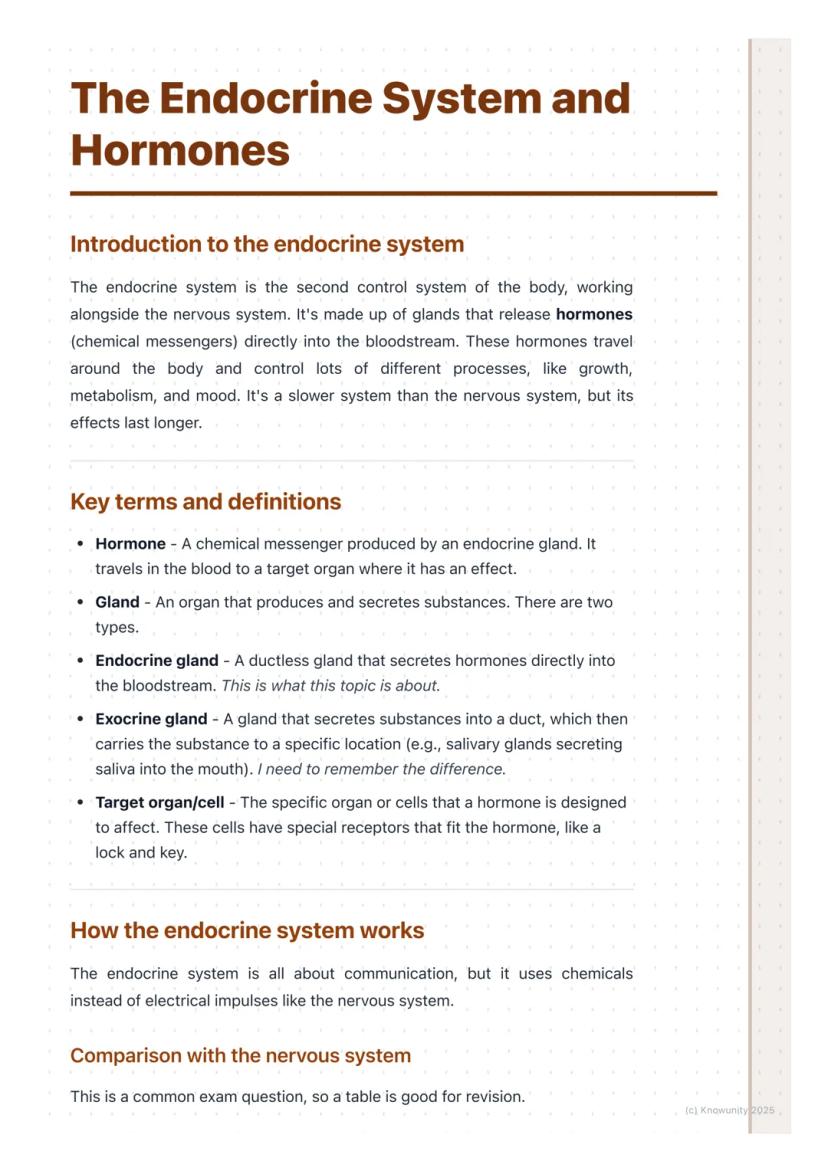
Think of the endocrine system as your body's chemical postal service - it's completely different from the fast electrical messages your nervous system sends. Instead of zapping signals along nerves, it releases hormones (chemical messengers) straight into your bloodstream.
These hormones are dead clever - they travel around your whole body but only affect specific target organs that have the right receptors for them. It's like having a key that only fits certain locks.
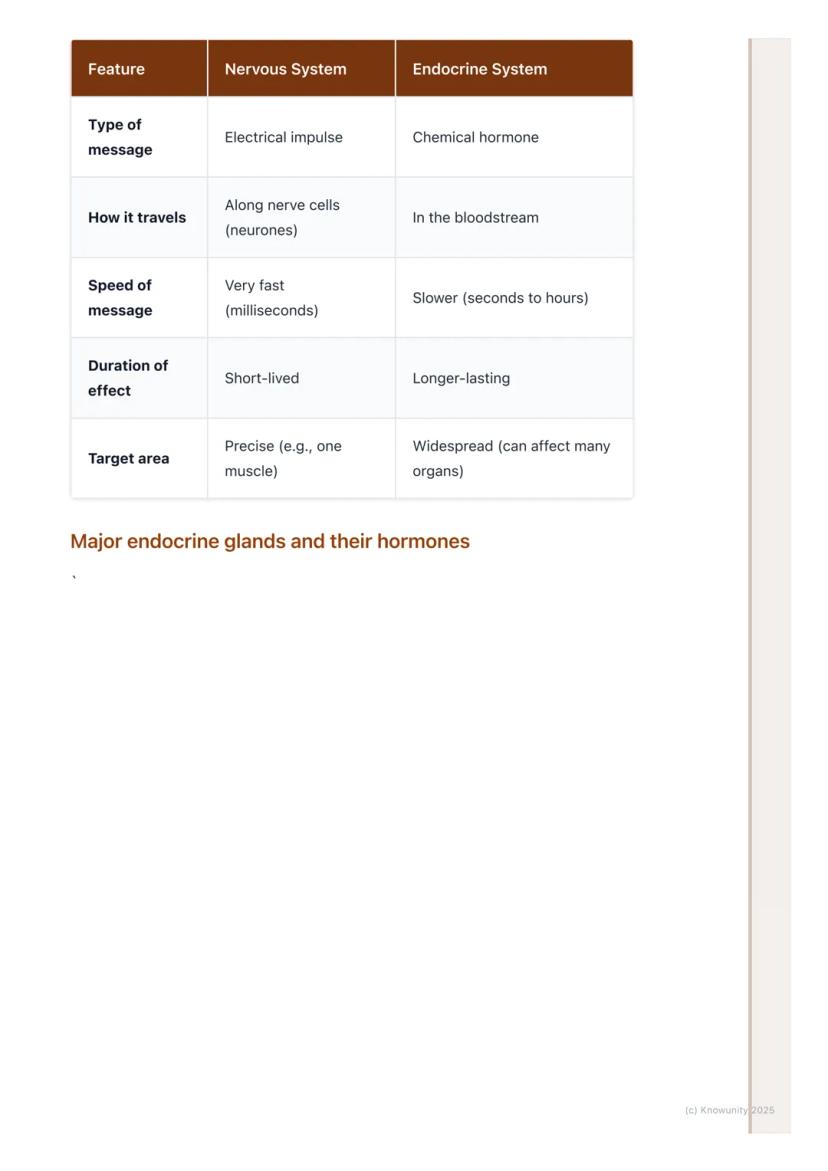
The endocrine system works much slower than your nervous system (we're talking seconds to hours instead of milliseconds), but its effects stick around much longer. Whilst your nervous system handles immediate reactions, the endocrine system manages long-term stuff like growth, metabolism, and keeping your body balanced.
Quick Tip: Remember that endocrine glands release hormones directly into your blood, whilst exocrine glands (like salivary glands) use ducts to get their substances where they need to go.
2
of 6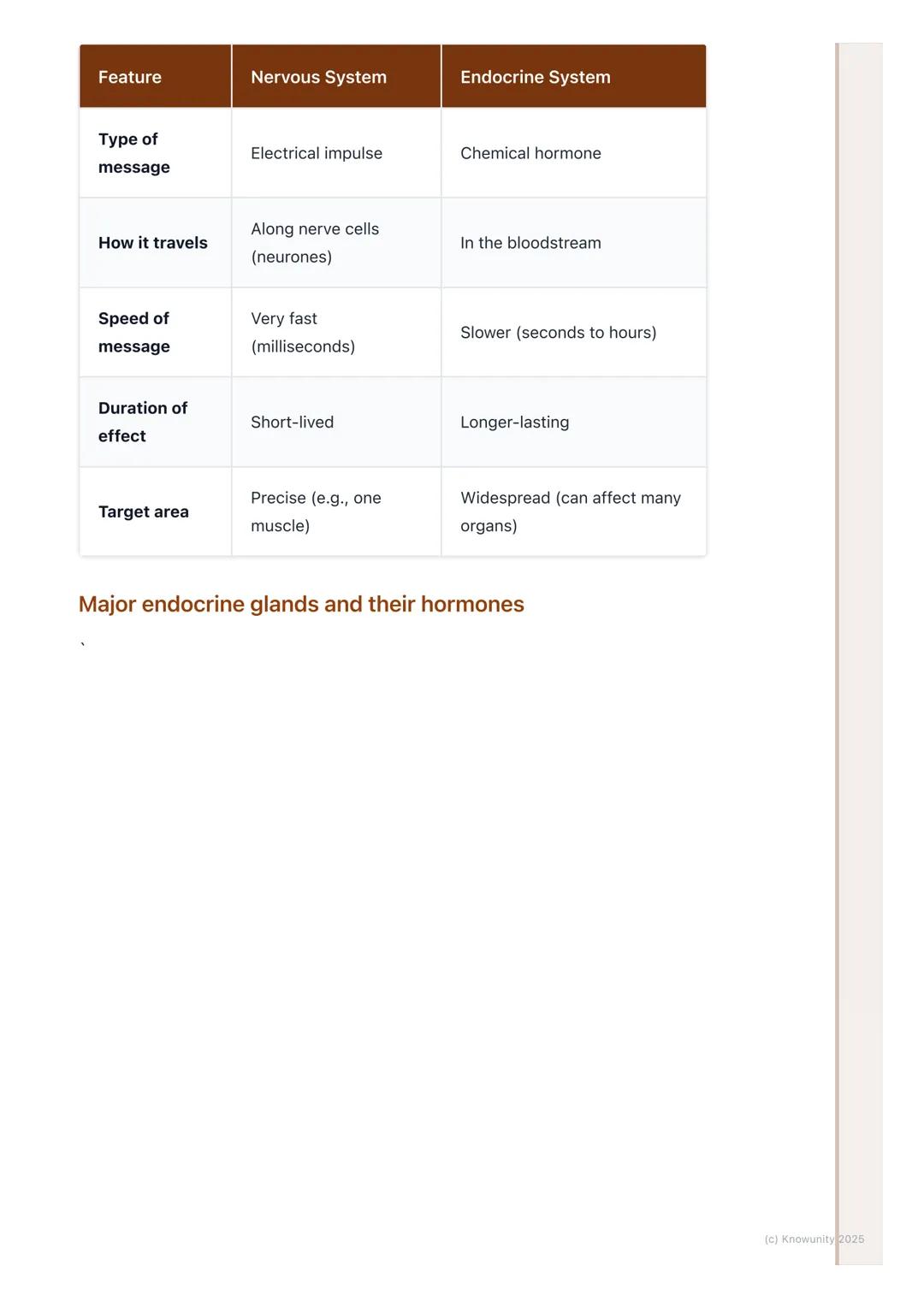
Major Endocrine Glands
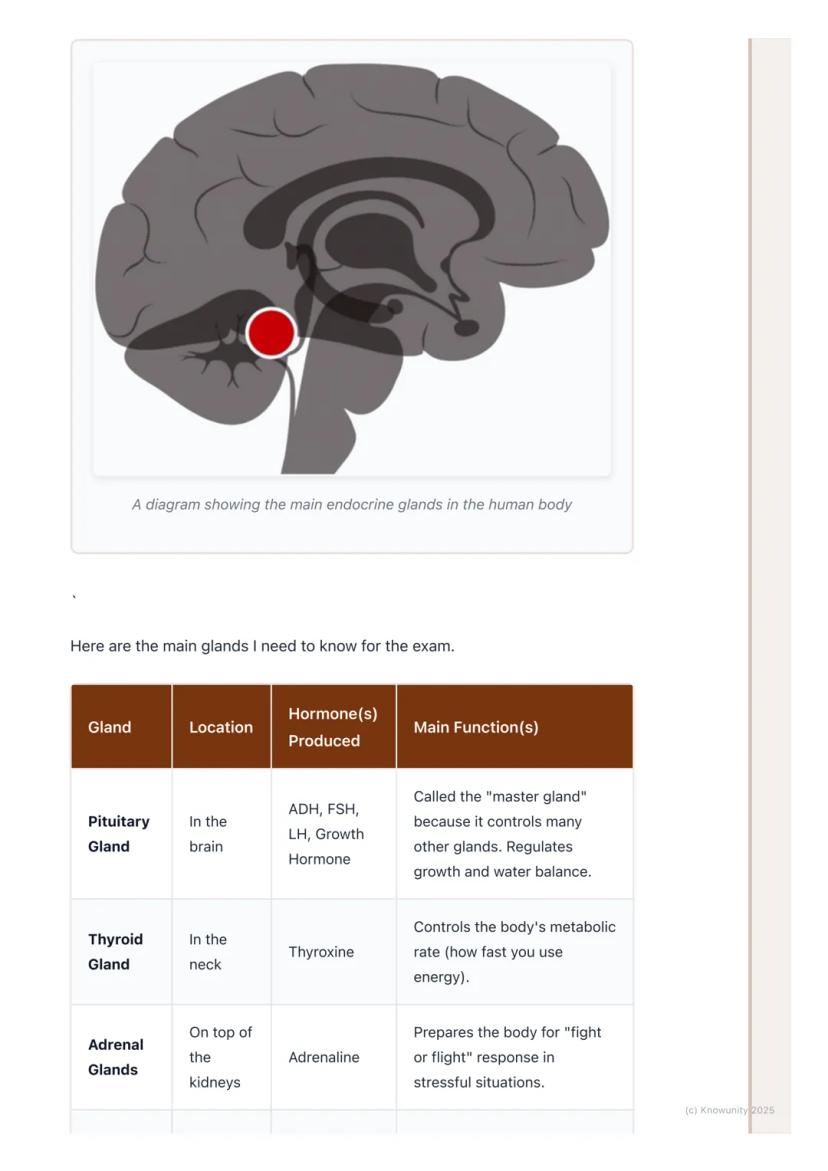
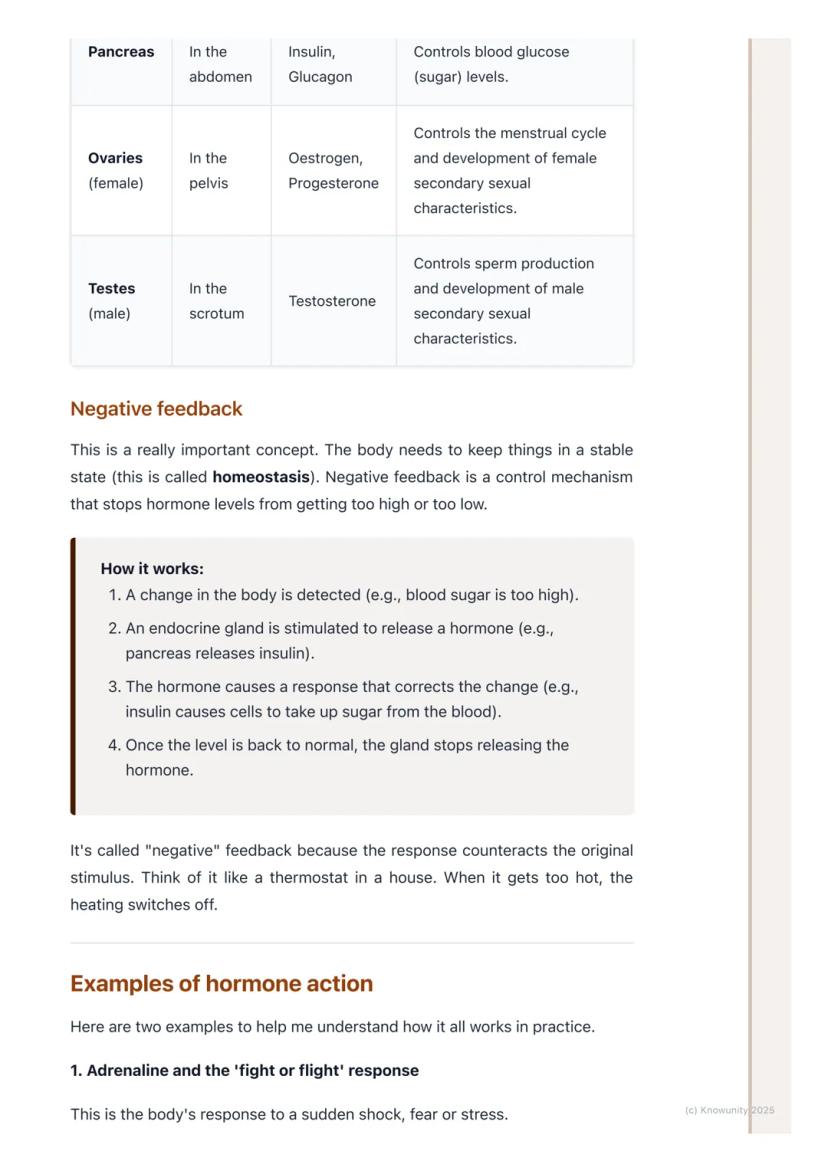
Your body has several important hormone-producing glands scattered around, each with its own special job. The pituitary gland in your brain is the boss - it's called the "master gland" because it controls loads of other glands.
Your thyroid gland in your neck produces thyroxine, which basically controls how fast your body burns energy. The adrenal glands sitting on top of your kidneys pump out adrenaline when you need that superhero boost in dangerous situations.
Your pancreas is multitalented - it makes both insulin and glucagon to keep your blood sugar levels just right. Then you've got your reproductive glands: ovaries produce oestrogen and progesterone, whilst testes make testosterone for all those hormonal changes during puberty.
Exam Alert: You'll definitely get questions comparing the nervous and endocrine systems, so remember: nervous = fast and short-lived, endocrine = slower but longer-lasting!
3
of 6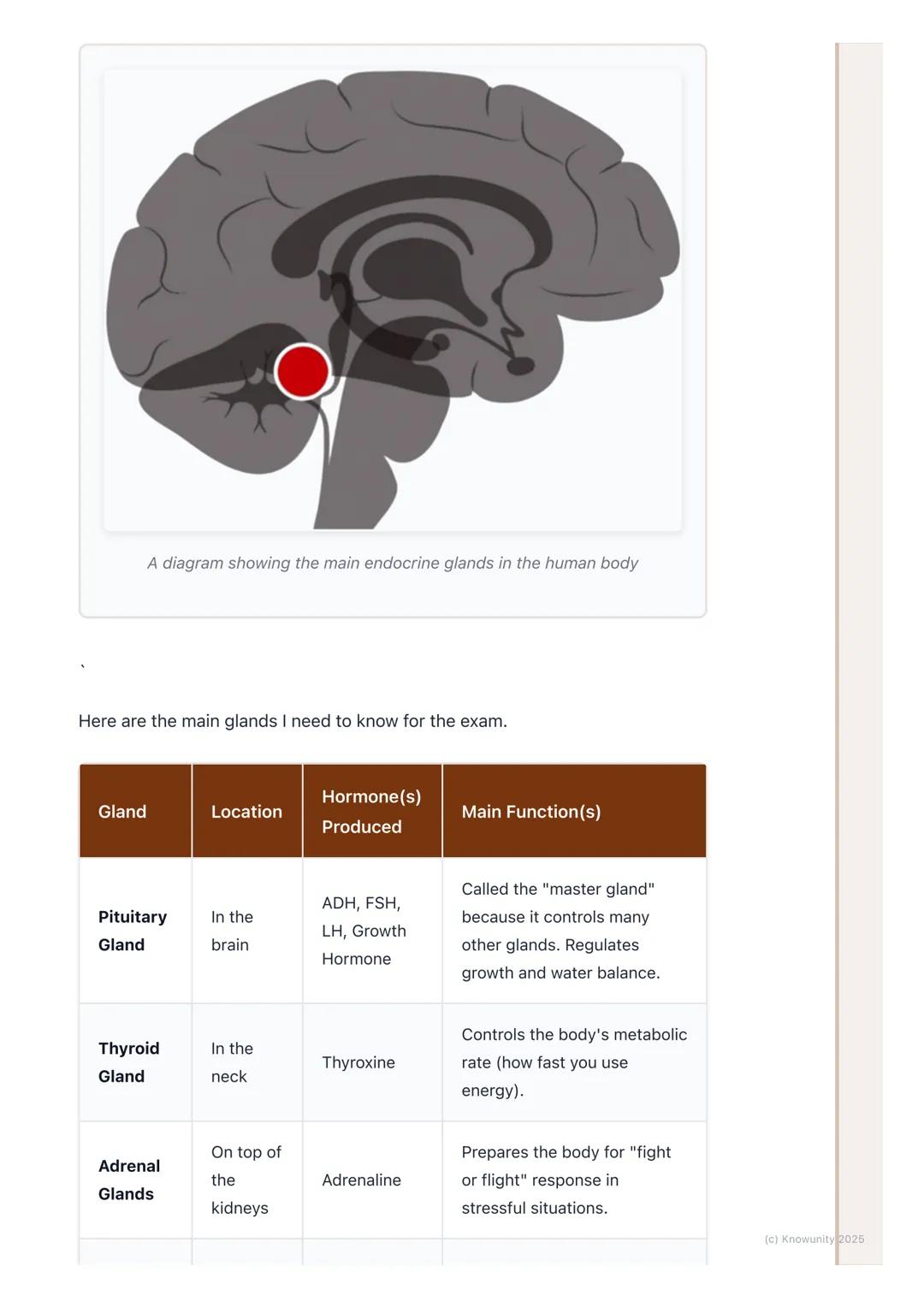
Negative Feedback and Control
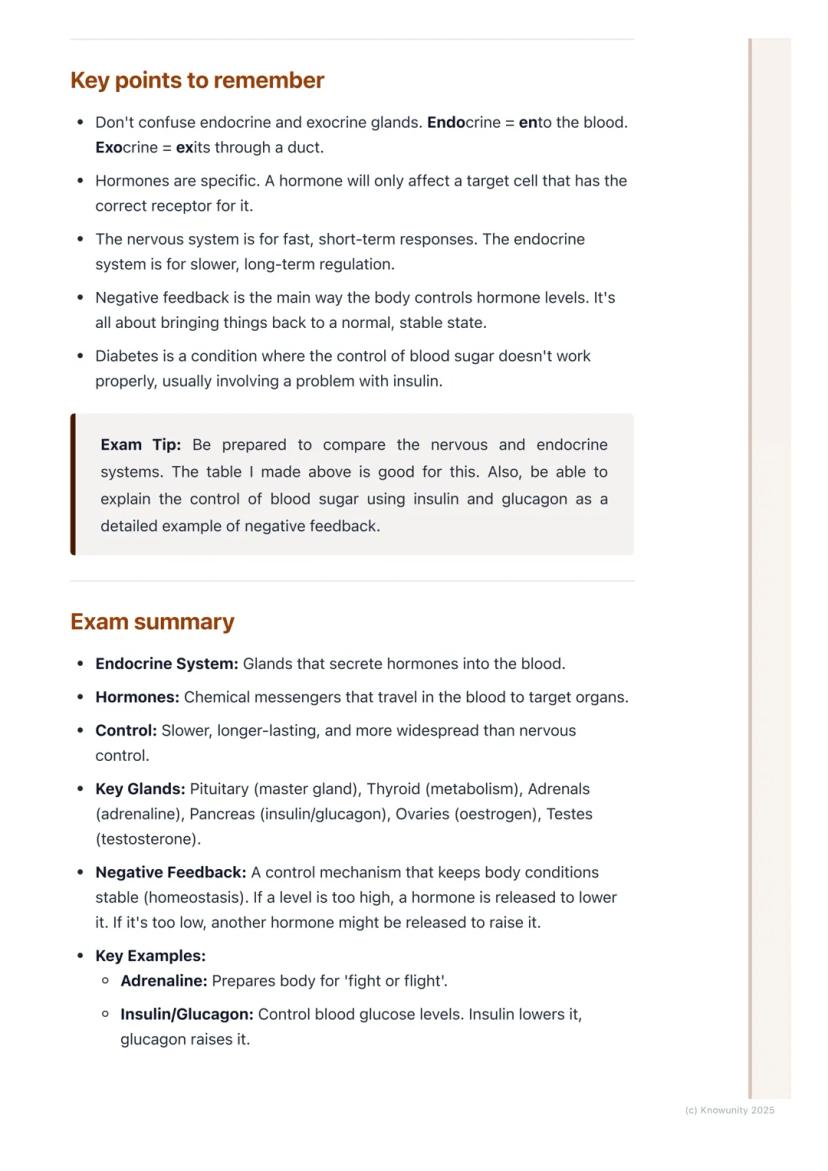
Here's where it gets really smart - your body uses negative feedback to keep everything balanced, which scientists call homeostasis. It's exactly like a thermostat in your house that switches the heating off when things get too warm.
The process is dead simple: your body detects a change (like blood sugar getting too high), releases the right hormone to fix it (insulin), then stops releasing that hormone once everything's back to normal. The "negative" bit just means the response works against the original problem.
This system stops your hormone levels from going completely mad. Without it, you'd have hormones shooting up and down all over the place, which would be a proper disaster for your health.
Real Life: Every time you eat something sugary, your pancreas is doing negative feedback to bring your blood sugar back down - it's happening right now without you even thinking about it!
4
of 6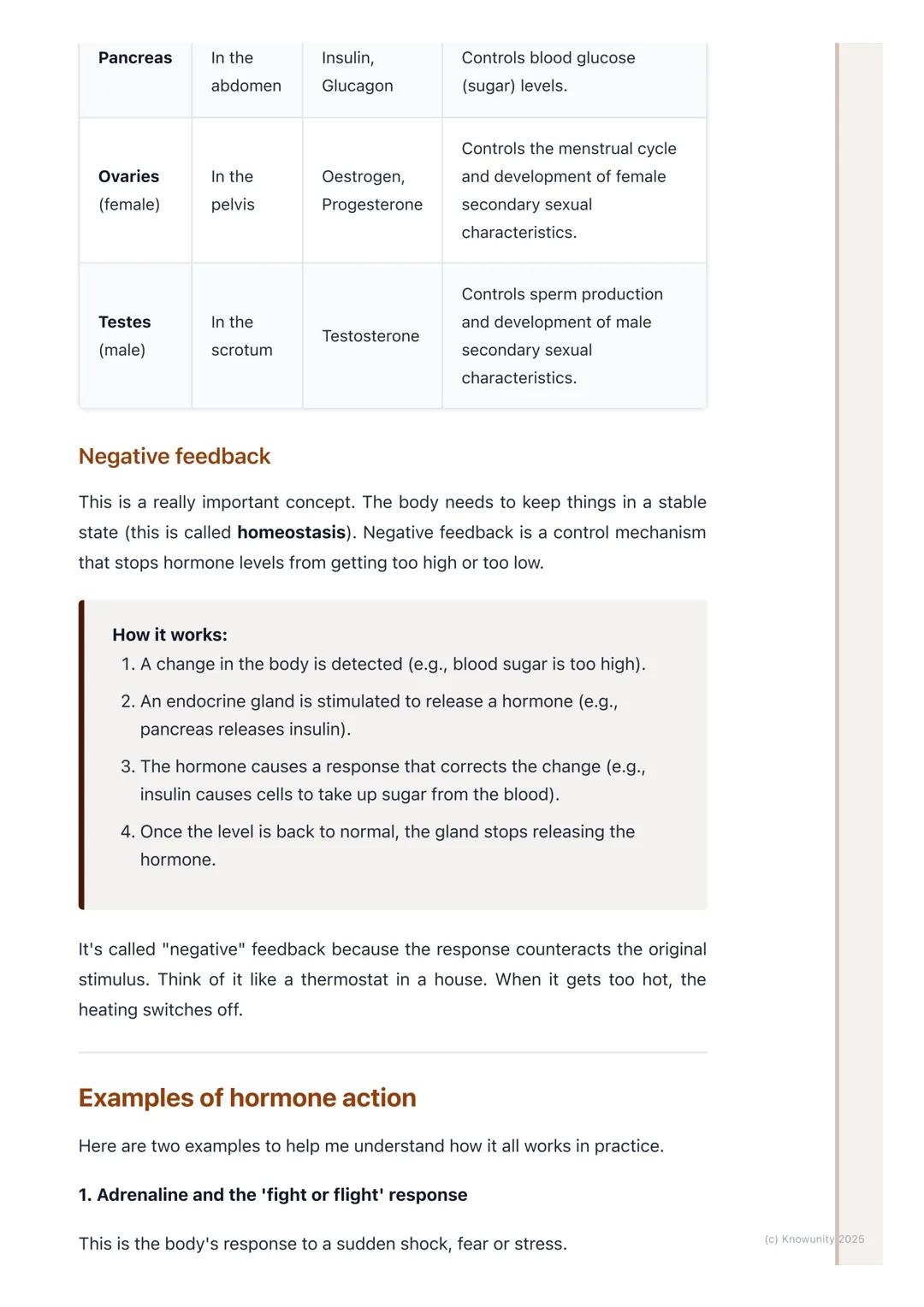
Adrenaline: Fight or Flight Response
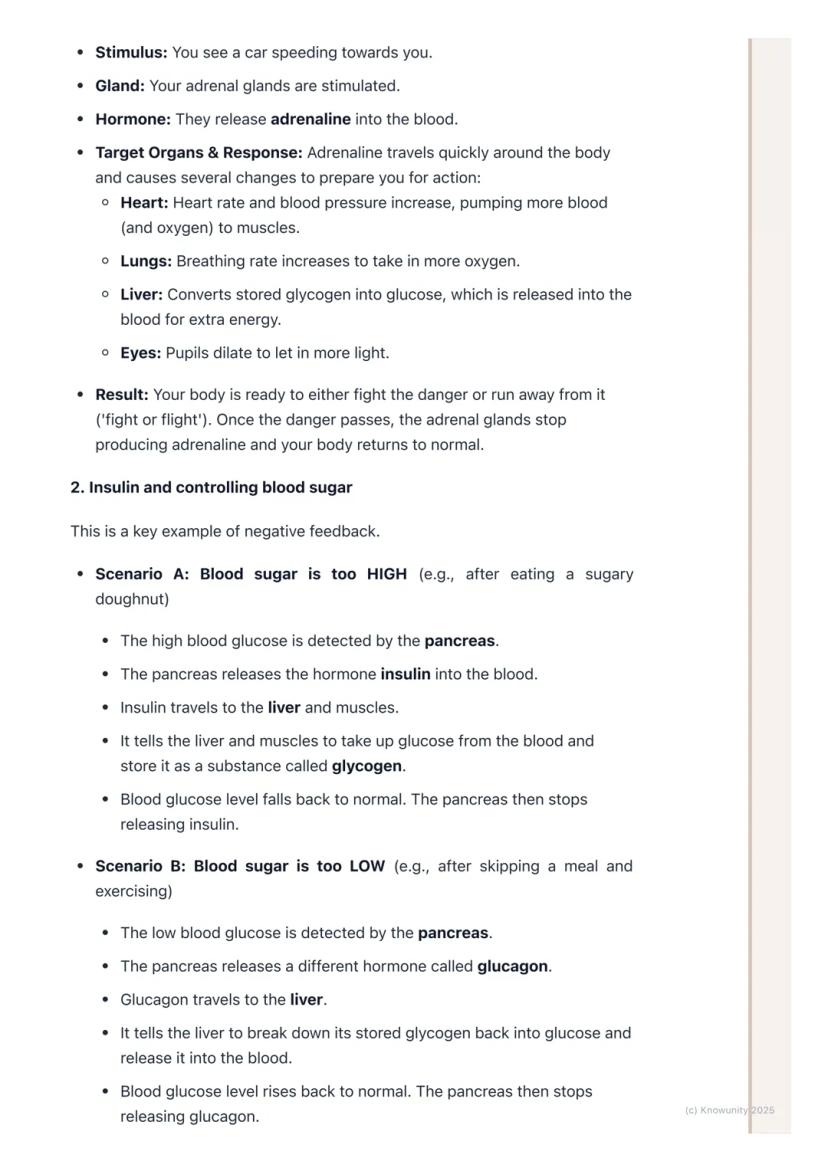
Adrenaline is probably the most dramatic hormone you'll experience. When your brain spots danger (like a car speeding towards you), your adrenal glands instantly flood your bloodstream with this powerful chemical.
The effects are mental - your heart pounds faster, you breathe quicker, your pupils get bigger to let in more light, and your liver dumps glucose into your blood for instant energy. It's like your body's emergency turbo mode.
This "fight or flight" response evolved to help humans survive dangerous situations. Once the threat disappears, your adrenal glands stop pumping out adrenaline and everything returns to normal - though you might feel a bit shaky afterwards!
Fun Fact: Adrenaline is why people can sometimes lift cars in emergencies or run faster than they've ever run before - it's literally a superpower hormone!
5
of 6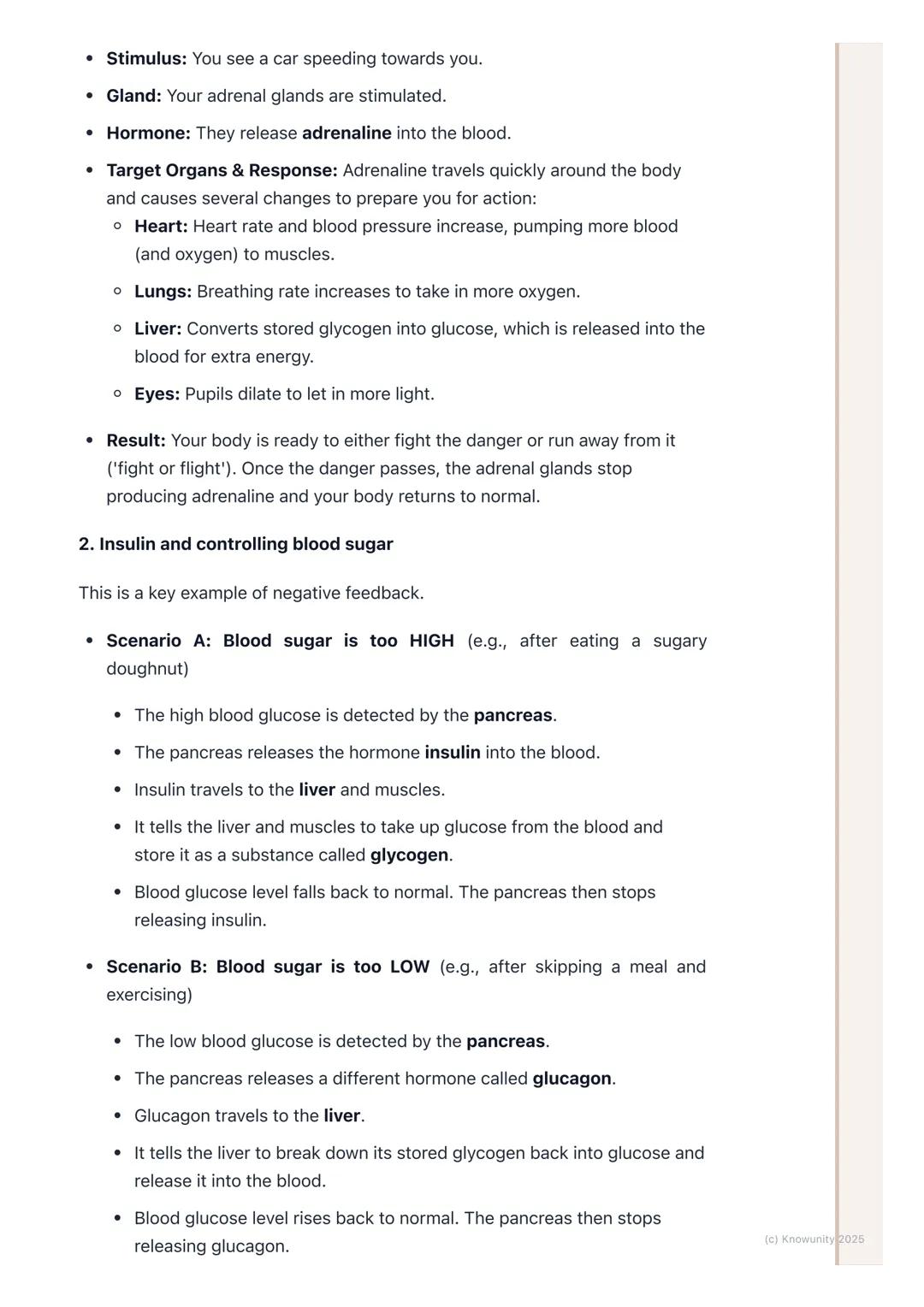
Blood Sugar Control
Your pancreas is constantly playing a balancing act with your blood sugar using two opposing hormones: insulin and glucagon. This is probably the best example of negative feedback in action.
When your blood sugar shoots up (after scoffing a doughnut), your pancreas releases insulin. This hormone tells your liver and muscles to hoover up the excess glucose and store it as glycogen. Job done - blood sugar drops back to normal.
But if your blood sugar gets too low (maybe you've skipped lunch and gone for a run), your pancreas switches tactics and releases glucagon instead. This hormone tells your liver to break down stored glycogen and release glucose back into your blood.
It's like having two different switches - one to lower blood sugar, one to raise it. When people have diabetes, this brilliant system doesn't work properly, usually because there's a problem with insulin.
Exam Gold: This insulin/glucagon example is exam gold - you'll almost certainly need to explain it as a detailed example of how negative feedback works!
6
of 6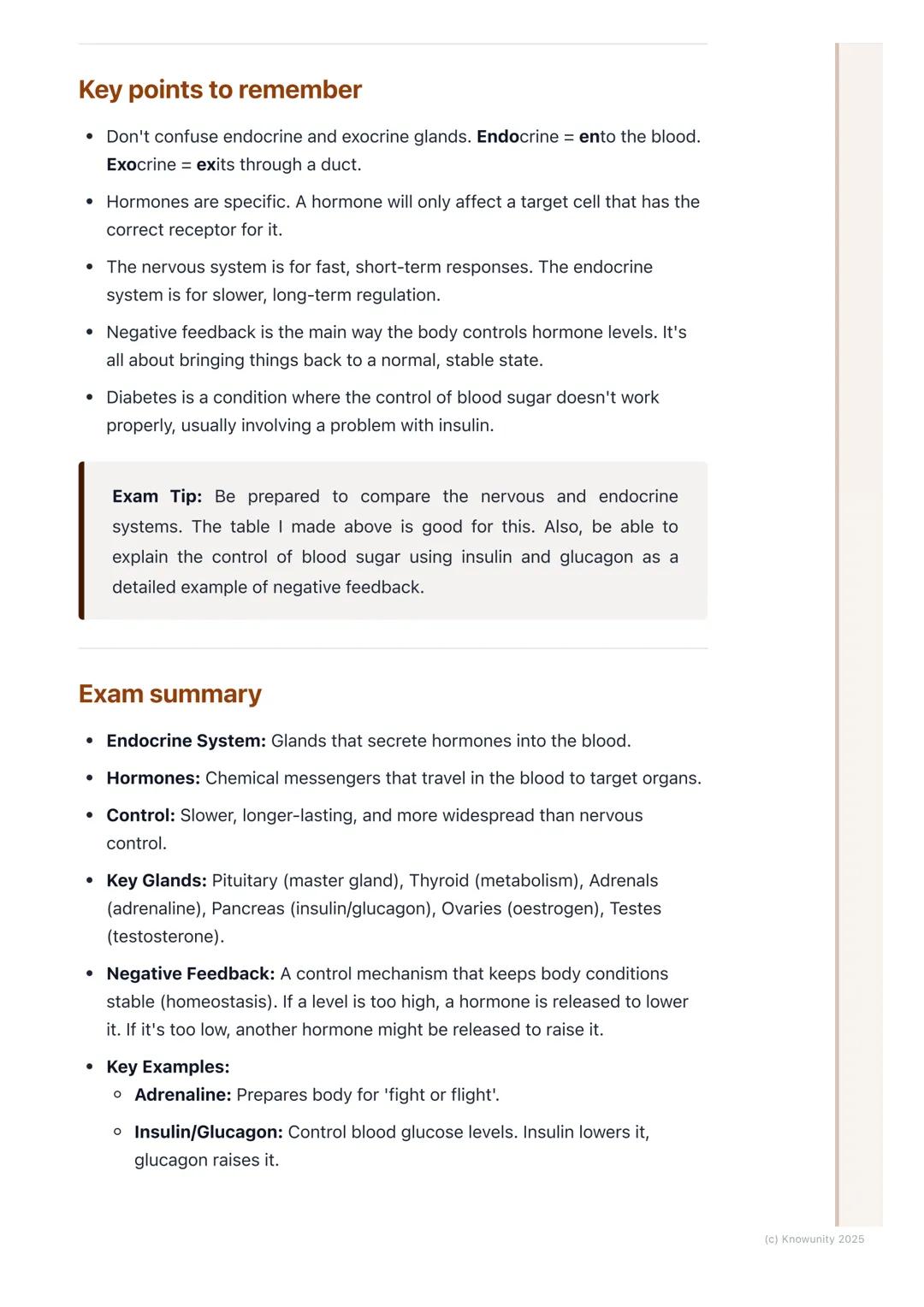
Key Points for Success
The endocrine system might seem complex, but once you get the basics, it's actually quite logical. Remember that endocrine glands release hormones directly into your blood (not through ducts like exocrine glands), and each hormone only affects cells with the right receptors.
Negative feedback is the golden rule - your body is constantly adjusting hormone levels to keep things stable. Whether it's controlling blood sugar, responding to stress, or managing growth, the same basic principle applies: detect change, respond with hormones, return to normal.
For your exams, focus on the major glands and what they do, understand how adrenaline prepares you for action, and be able to explain blood sugar control in detail. The comparison between nervous and endocrine systems is also a dead cert for coming up.
Success Strategy: Make sure you can draw a simple diagram showing the insulin/glucagon cycle - it's worth loads of marks and shows you really understand how hormones work together!
Si on te demande...
Qu'est-ce que le compagnon IA de Knowunity ?
Notre compagnon IA est spécialement conçu pour répondre aux besoins des étudiants. Sur la base des millions d'éléments de contenu que nous avons sur la plateforme, nous pouvons fournir des réponses vraiment significatives et pertinentes aux étudiants. Mais il ne s'agit pas seulement de réponses, le compagnon a encore plus pour but de guider les élèves dans leurs défis d'apprentissage quotidiens, avec des plans d'étude personnalisés, des quiz ou des éléments de contenu dans le chat et une personnalisation à 100% basée sur les compétences et les développements de l'étudiant.
Où puis-je télécharger l'appli Knowunity ?
Tu peux télécharger l'application dans Google Play Store et dans l'App Store d'Apple.
L'application est-elle vraiment gratuite ?
Oui, tu as un accès entièrement gratuit à tous les contenus de l'appli, tu peux chatter ou suivre les créateurs à tout moment. De plus, nous proposons Knowunity Premium, qui te permet de réviser sans limites!
Contenus les plus populaires en Biology
8BiologyEcology introduction notes!
Start of the leaving cert ecology chapter
6th Year131
BiologyDNA & RNA
All notes on DNA & RNA including protein synthesis which is a HL topic
5th Year250
BiologyVertebrates and Invertebrates
Students will distinguish between animals that have a backbone (vertebrates) and those that do not (invertebrates), identifying examples of each.
2nd Year240
BiologyBiomolecules: chapter 8
Summary and easily understandable notes to revise chapter 8 biomolecules. Includes good labelled diagrams for visual learners
5th Year210
BiologyCirculatory System
Students will learn about the heart, blood, and blood vessels, and how this system transports oxygen, nutrients, and waste products around the body.
3rd Year140
BiologyRespiration
All respiration notes including simple diagrams and glycolysis and the Krebs cycle
5th Year120
BiologyPhotosynthesis : Biology
Photosynthesis
6th Year371
BiologyPlant Cells
Learning about the unique structures found in plant cells, such as the cell wall, chloroplasts, and large vacuole, and how they differ from animal cells.
1st Year80
Contenus les plus populaires
9 Irish
IrishIrish oral questions and answers
Questions and answers for the leaving cert oral
5th Year4264
 English
Key Quotes : Sive
Key Quotes and explanations: Sive
6th Year2842
IrishIrish oral questions
Outline of oral questions
5th Year2055
IrishIníon- le hÁine Durkin
Aine Durkin’s poem, Iníon: Themes & summary
5th Year850
IrishIrish poetry 2027
Iníon + Dínit an Bhróin
5th Year1133
IrishLC HL notes- Iníon (poem)
Includes poem in English and Irish, theme, key words & phrases
5th Year2284
EnglishCultural Context : Shawshank Redemption : Sive : Small Things Like These
Comparative Study : Cultural Context : Shawshank Redemption, Sive and Small Things Like These
6th Year1430
IrishMo Ghrá-sa (Idir Lúibíní)
Notes on mo ghrá-sa
5th Year380
IrishAn Gaeilge Aiste
Irish Language essay
6th Year1320
Rien ne te convient ? Explore d'autres matières.
Les étudiants nous adorent — il ne manque plus que toi.
4.6/5App Store
4.7/5Google Play
L'application est très facile d'utilisation et bien conçue. Jusqu'à présent, j'ai trouvé tout ce que je cherchais et j'ai pu apprendre beaucoup de choses grâce aux présentations ! Je vais certainement utiliser l'application pour un travail en classe ! Et comme source d'inspiration personnelle, elle est bien sûr aussi très utile.
Stefan Sutilisateur iOS
Cette application est vraiment super. Il y a tellement de fiches de révision et d'aide, [...]. Par exemple, la matière qui me pose problème est le français et l'appli a un choix d'aide très large. Grâce à cette application, je me suis améliorée en français. Je la recommanderais à tout le monde.
Samantha Klichutilisatrice Android
Waouh, je suis vraiment abasourdi. J'ai essayé l'application parce que je l'avais déjà vue plusieurs fois dans la publicité et j'ai été absolument choquée. Cette appli est L'AIDE dont on rêve pour l'école et surtout, elle propose tellement de choses, comme des rédactions et des fiches qui m'ont personnellement TRÈS bien aidé.
Annautilisatrice iOS
Biology6 vues·Mis à jour Jun 7, 2026·6 pagesUnderstanding the Endocrine System and Its Hormones
Your body has a brilliant chemical messaging system called the endocrine systemthat keeps everything running smoothly. It's like having a slow but steady group chat between your organs, using hormones as the messages to control everything from your growth...
1
of 6
Inscris-toi pour voir le contenu. C'est gratuit!
- Accès à tous les documents
- Améliore tes notes
- Rejoins des millions d'étudiants
The Endocrine System and Hormones
Think of the endocrine system as your body's chemical postal service - it's completely different from the fast electrical messages your nervous system sends. Instead of zapping signals along nerves, it releases hormones (chemical messengers) straight into your bloodstream.
These hormones are dead clever - they travel around your whole body but only affect specific target organs that have the right receptors for them. It's like having a key that only fits certain locks.
The endocrine system works much slower than your nervous system (we're talking seconds to hours instead of milliseconds), but its effects stick around much longer. Whilst your nervous system handles immediate reactions, the endocrine system manages long-term stuff like growth, metabolism, and keeping your body balanced.
Quick Tip: Remember that endocrine glands release hormones directly into your blood, whilst exocrine glands (like salivary glands) use ducts to get their substances where they need to go.
2
of 6Inscris-toi pour voir le contenu. C'est gratuit!
- Accès à tous les documents
- Améliore tes notes
- Rejoins des millions d'étudiants
Major Endocrine Glands
Your body has several important hormone-producing glands scattered around, each with its own special job. The pituitary gland in your brain is the boss - it's called the "master gland" because it controls loads of other glands.
Your thyroid gland in your neck produces thyroxine, which basically controls how fast your body burns energy. The adrenal glands sitting on top of your kidneys pump out adrenaline when you need that superhero boost in dangerous situations.
Your pancreas is multitalented - it makes both insulin and glucagon to keep your blood sugar levels just right. Then you've got your reproductive glands: ovaries produce oestrogen and progesterone, whilst testes make testosterone for all those hormonal changes during puberty.
Exam Alert: You'll definitely get questions comparing the nervous and endocrine systems, so remember: nervous = fast and short-lived, endocrine = slower but longer-lasting!
3
of 6Inscris-toi pour voir le contenu. C'est gratuit!
- Accès à tous les documents
- Améliore tes notes
- Rejoins des millions d'étudiants
Negative Feedback and Control
Here's where it gets really smart - your body uses negative feedback to keep everything balanced, which scientists call homeostasis. It's exactly like a thermostat in your house that switches the heating off when things get too warm.
The process is dead simple: your body detects a change (like blood sugar getting too high), releases the right hormone to fix it (insulin), then stops releasing that hormone once everything's back to normal. The "negative" bit just means the response works against the original problem.
This system stops your hormone levels from going completely mad. Without it, you'd have hormones shooting up and down all over the place, which would be a proper disaster for your health.
Real Life: Every time you eat something sugary, your pancreas is doing negative feedback to bring your blood sugar back down - it's happening right now without you even thinking about it!
4
of 6Inscris-toi pour voir le contenu. C'est gratuit!
- Accès à tous les documents
- Améliore tes notes
- Rejoins des millions d'étudiants
Adrenaline: Fight or Flight Response
Adrenaline is probably the most dramatic hormone you'll experience. When your brain spots danger (like a car speeding towards you), your adrenal glands instantly flood your bloodstream with this powerful chemical.
The effects are mental - your heart pounds faster, you breathe quicker, your pupils get bigger to let in more light, and your liver dumps glucose into your blood for instant energy. It's like your body's emergency turbo mode.
This "fight or flight" response evolved to help humans survive dangerous situations. Once the threat disappears, your adrenal glands stop pumping out adrenaline and everything returns to normal - though you might feel a bit shaky afterwards!
Fun Fact: Adrenaline is why people can sometimes lift cars in emergencies or run faster than they've ever run before - it's literally a superpower hormone!
5
of 6Inscris-toi pour voir le contenu. C'est gratuit!
- Accès à tous les documents
- Améliore tes notes
- Rejoins des millions d'étudiants
Blood Sugar Control
Your pancreas is constantly playing a balancing act with your blood sugar using two opposing hormones: insulin and glucagon. This is probably the best example of negative feedback in action.
When your blood sugar shoots up (after scoffing a doughnut), your pancreas releases insulin. This hormone tells your liver and muscles to hoover up the excess glucose and store it as glycogen. Job done - blood sugar drops back to normal.
But if your blood sugar gets too low (maybe you've skipped lunch and gone for a run), your pancreas switches tactics and releases glucagon instead. This hormone tells your liver to break down stored glycogen and release glucose back into your blood.
It's like having two different switches - one to lower blood sugar, one to raise it. When people have diabetes, this brilliant system doesn't work properly, usually because there's a problem with insulin.
Exam Gold: This insulin/glucagon example is exam gold - you'll almost certainly need to explain it as a detailed example of how negative feedback works!
6
of 6Inscris-toi pour voir le contenu. C'est gratuit!
- Accès à tous les documents
- Améliore tes notes
- Rejoins des millions d'étudiants
Key Points for Success
The endocrine system might seem complex, but once you get the basics, it's actually quite logical. Remember that endocrine glands release hormones directly into your blood (not through ducts like exocrine glands), and each hormone only affects cells with the right receptors.
Negative feedback is the golden rule - your body is constantly adjusting hormone levels to keep things stable. Whether it's controlling blood sugar, responding to stress, or managing growth, the same basic principle applies: detect change, respond with hormones, return to normal.
For your exams, focus on the major glands and what they do, understand how adrenaline prepares you for action, and be able to explain blood sugar control in detail. The comparison between nervous and endocrine systems is also a dead cert for coming up.
Success Strategy: Make sure you can draw a simple diagram showing the insulin/glucagon cycle - it's worth loads of marks and shows you really understand how hormones work together!
Si on te demande...
Qu'est-ce que le compagnon IA de Knowunity ?
Notre compagnon IA est spécialement conçu pour répondre aux besoins des étudiants. Sur la base des millions d'éléments de contenu que nous avons sur la plateforme, nous pouvons fournir des réponses vraiment significatives et pertinentes aux étudiants. Mais il ne s'agit pas seulement de réponses, le compagnon a encore plus pour but de guider les élèves dans leurs défis d'apprentissage quotidiens, avec des plans d'étude personnalisés, des quiz ou des éléments de contenu dans le chat et une personnalisation à 100% basée sur les compétences et les développements de l'étudiant.
Où puis-je télécharger l'appli Knowunity ?
Tu peux télécharger l'application dans Google Play Store et dans l'App Store d'Apple.
L'application est-elle vraiment gratuite ?
Oui, tu as un accès entièrement gratuit à tous les contenus de l'appli, tu peux chatter ou suivre les créateurs à tout moment. De plus, nous proposons Knowunity Premium, qui te permet de réviser sans limites!
Contenus les plus populaires en Biology
8BiologyEcology introduction notes!
Start of the leaving cert ecology chapter
6th Year131
BiologyDNA & RNA
All notes on DNA & RNA including protein synthesis which is a HL topic
5th Year250
BiologyVertebrates and Invertebrates
Students will distinguish between animals that have a backbone (vertebrates) and those that do not (invertebrates), identifying examples of each.
2nd Year240
BiologyBiomolecules: chapter 8
Summary and easily understandable notes to revise chapter 8 biomolecules. Includes good labelled diagrams for visual learners
5th Year210
BiologyCirculatory System
Students will learn about the heart, blood, and blood vessels, and how this system transports oxygen, nutrients, and waste products around the body.
3rd Year140
BiologyRespiration
All respiration notes including simple diagrams and glycolysis and the Krebs cycle
5th Year120
BiologyPhotosynthesis : Biology
Photosynthesis
6th Year371
BiologyPlant Cells
Learning about the unique structures found in plant cells, such as the cell wall, chloroplasts, and large vacuole, and how they differ from animal cells.
1st Year80
Contenus les plus populaires
9IrishIrish oral questions and answers
Questions and answers for the leaving cert oral
5th Year4264
EnglishKey Quotes : Sive
Key Quotes and explanations: Sive
6th Year2842
IrishIrish oral questions
Outline of oral questions
5th Year2055
IrishIníon- le hÁine Durkin
Aine Durkin’s poem, Iníon: Themes & summary
5th Year850
IrishIrish poetry 2027
Iníon + Dínit an Bhróin
5th Year1133
IrishLC HL notes- Iníon (poem)
Includes poem in English and Irish, theme, key words & phrases
5th Year2284
EnglishCultural Context : Shawshank Redemption : Sive : Small Things Like These
Comparative Study : Cultural Context : Shawshank Redemption, Sive and Small Things Like These
6th Year1430
IrishMo Ghrá-sa (Idir Lúibíní)
Notes on mo ghrá-sa
5th Year380
IrishAn Gaeilge Aiste
Irish Language essay
6th Year1320
Rien ne te convient ? Explore d'autres matières.
Les étudiants nous adorent — il ne manque plus que toi.
4.6/5App Store
4.7/5Google Play
L'application est très facile d'utilisation et bien conçue. Jusqu'à présent, j'ai trouvé tout ce que je cherchais et j'ai pu apprendre beaucoup de choses grâce aux présentations ! Je vais certainement utiliser l'application pour un travail en classe ! Et comme source d'inspiration personnelle, elle est bien sûr aussi très utile.
Stefan Sutilisateur iOS
Cette application est vraiment super. Il y a tellement de fiches de révision et d'aide, [...]. Par exemple, la matière qui me pose problème est le français et l'appli a un choix d'aide très large. Grâce à cette application, je me suis améliorée en français. Je la recommanderais à tout le monde.
Samantha Klichutilisatrice Android
Waouh, je suis vraiment abasourdi. J'ai essayé l'application parce que je l'avais déjà vue plusieurs fois dans la publicité et j'ai été absolument choquée. Cette appli est L'AIDE dont on rêve pour l'école et surtout, elle propose tellement de choses, comme des rédactions et des fiches qui m'ont personnellement TRÈS bien aidé.
Annautilisatrice iOS