
Ever wondered how chemists know exactly how strong a solution... Affiche plus
 Chemistry12 vues·Mis à jour Jun 10, 2026·8 pages
Understanding Solution Concentrations: Molarity and Parts per Million
1 / 8
1
of 8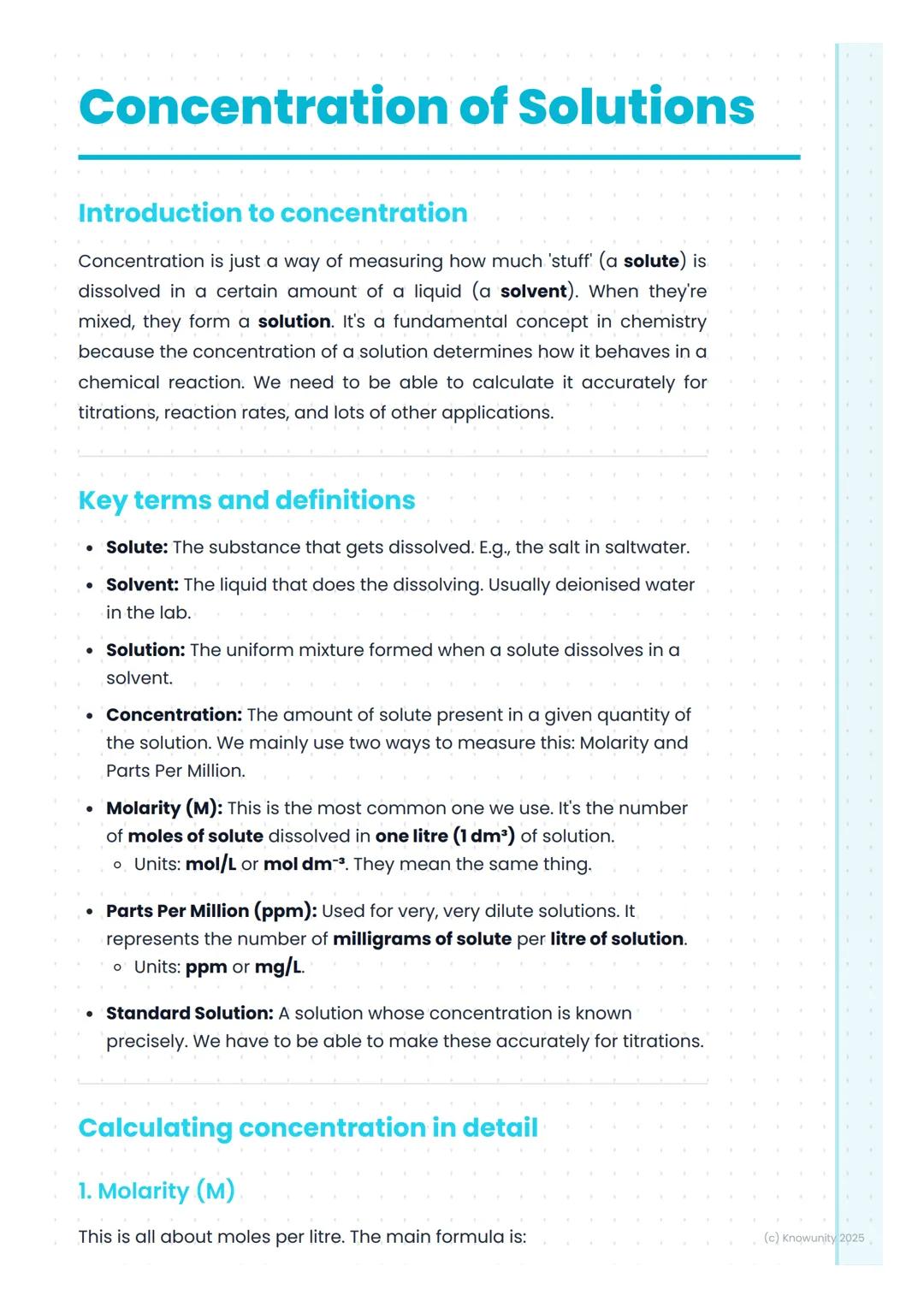
Introduction to Concentration
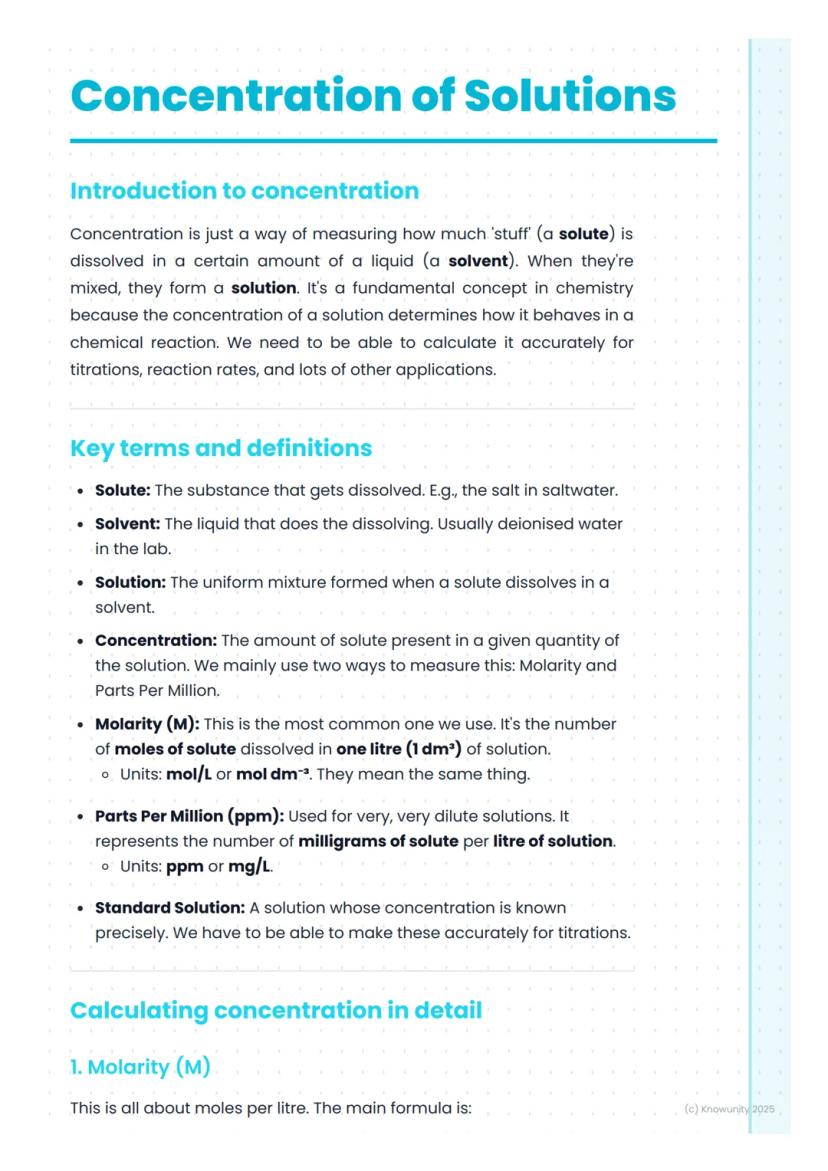
Think of concentration like making squash - the more cordial you add to water, the stronger it tastes. In chemistry, we're measuring how much solute (the thing being dissolved) is packed into a solvent (usually water).
When you mix them together, you get a solution. The concentration tells you exactly how strong that solution is, which determines how it'll behave in chemical reactions.
There are two main ways to measure concentration: Molarity (for most lab work) and Parts Per Million (for really dilute solutions like pollutants in water). You'll also need to know how to make standard solutions - these are solutions where you know the concentration precisely.
Quick Tip: Molarity uses mol/L, whilst ppm uses mg/L - don't mix up your units!
2
of 8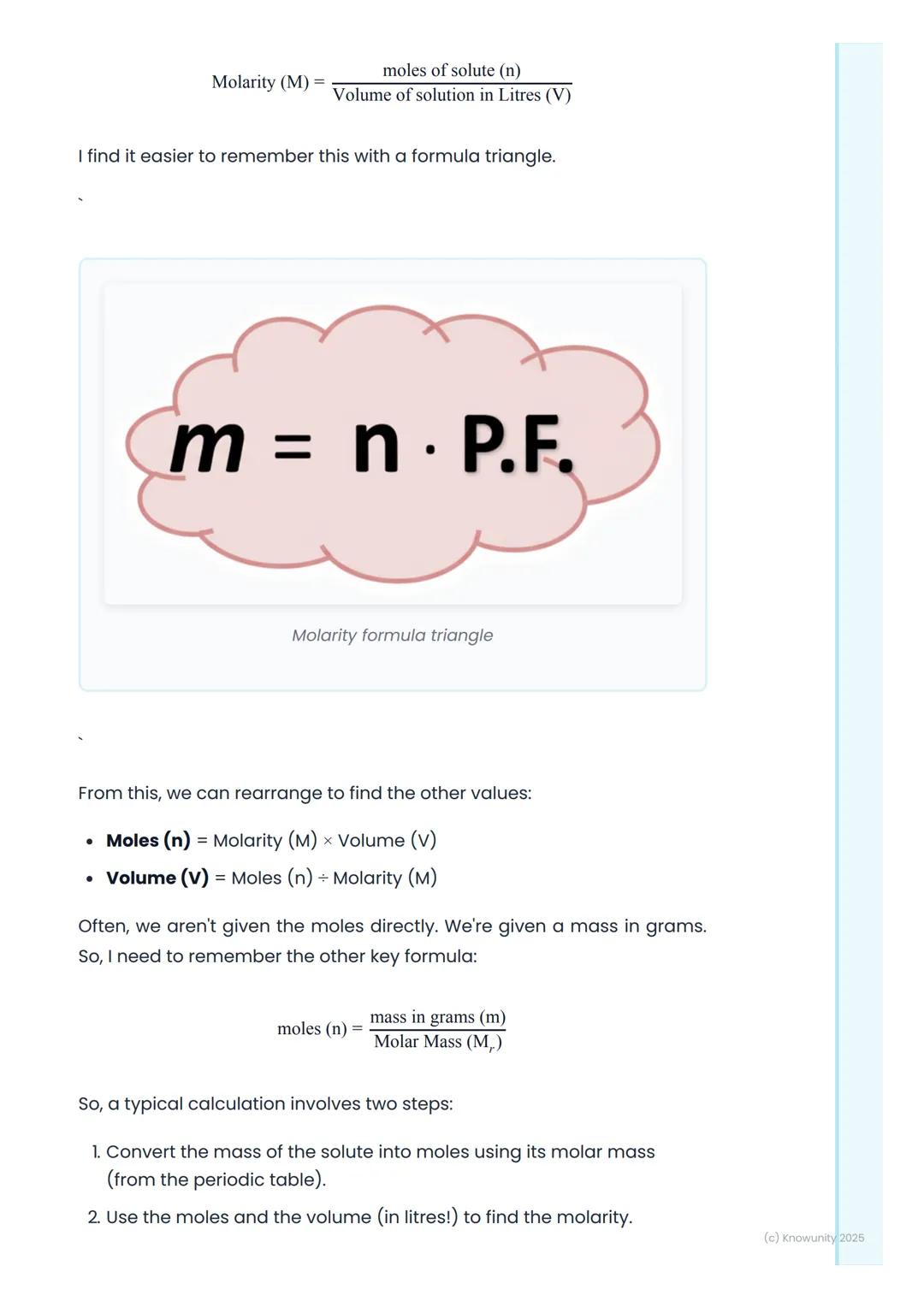
Calculating Molarity
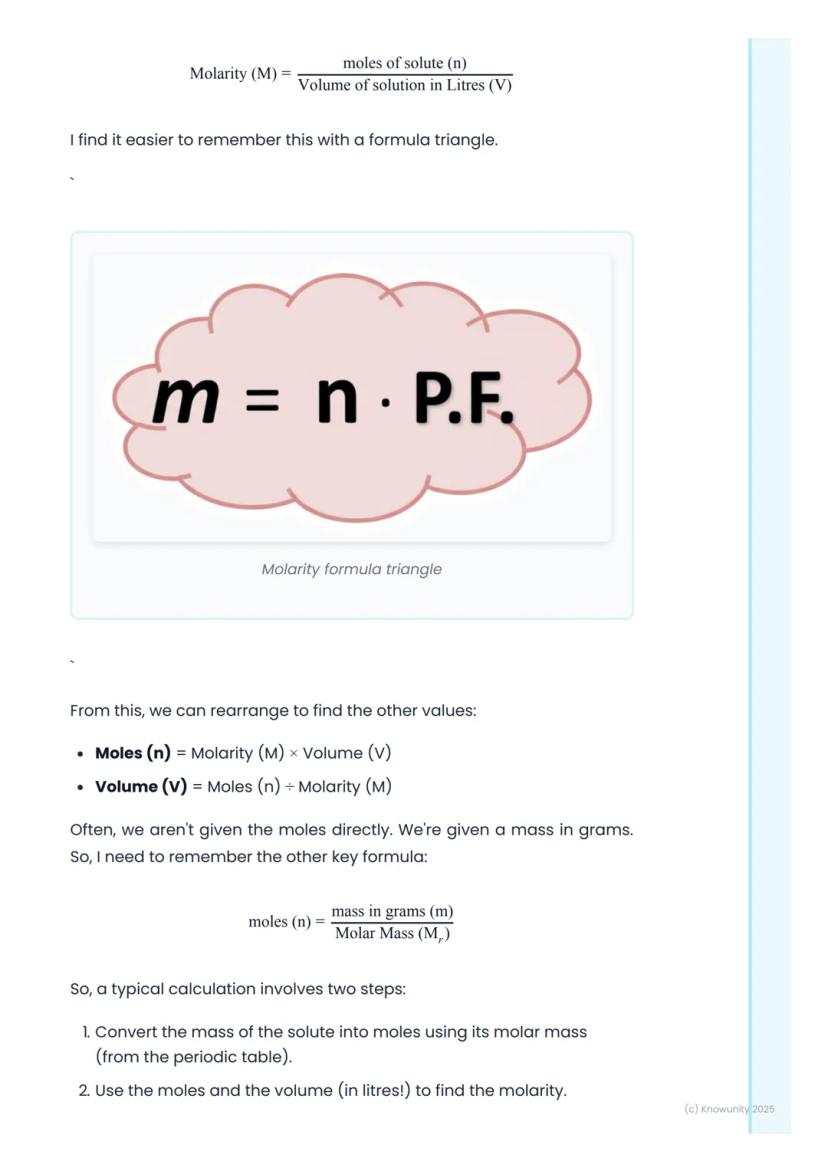
Molarity is your go-to concentration unit. It's simply moles of solute per litre of solution, and the formula is dead easy: M = n/V.
The tricky bit is when you're given mass instead of moles. Then you need two steps: first convert mass to moles using n = m/Mr, then use those moles to find molarity.
Here's the classic setup: you've got some solid chemical, you dissolve it in water, and you need to find the concentration. Convert cm³ to litres (divide by 1000), work out the moles, then divide moles by volume.
Memory Trick: Use the formula triangle - cover what you want to find, and the triangle shows you what to do with the other two values!
3
of 8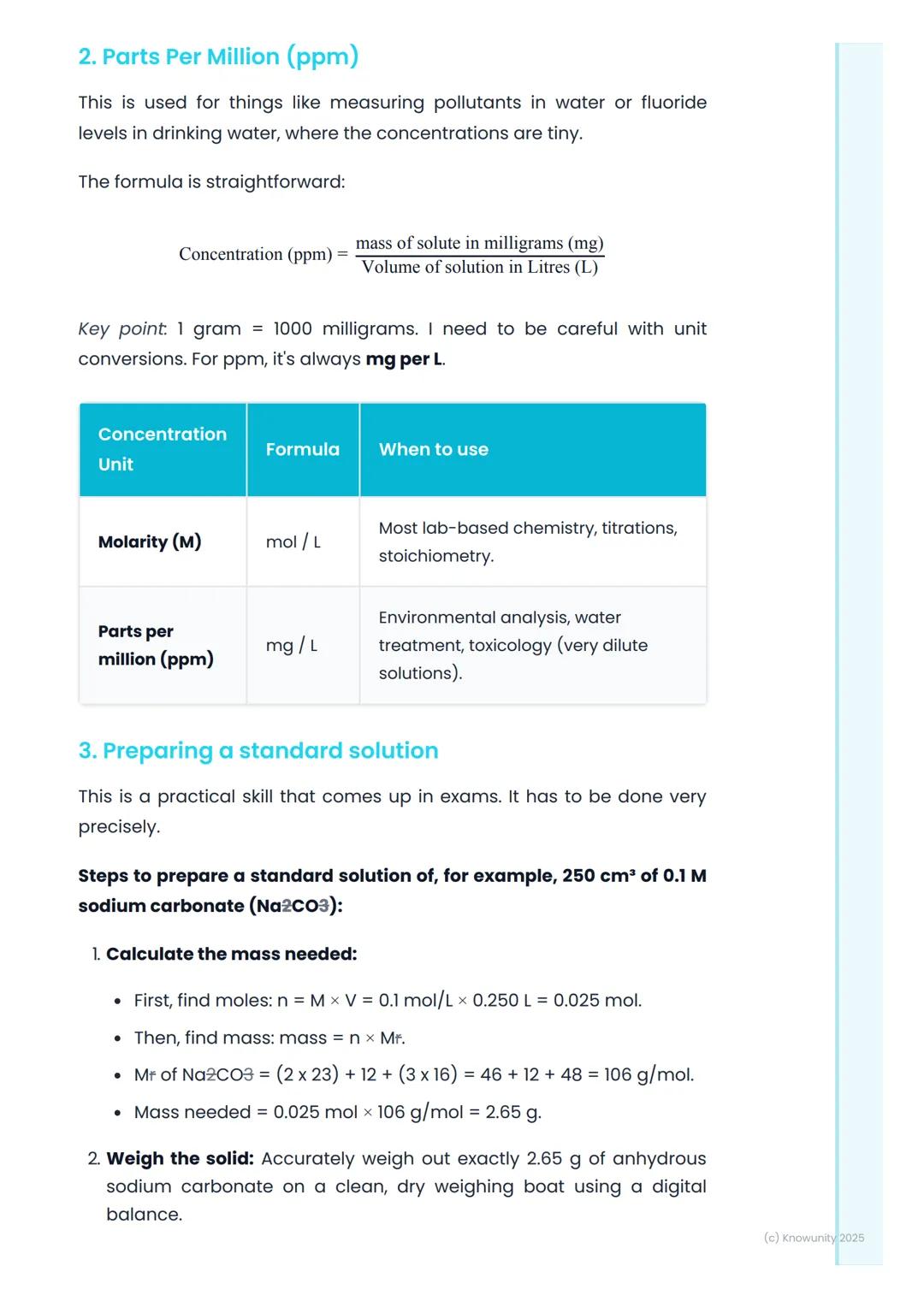
Parts Per Million (ppm)
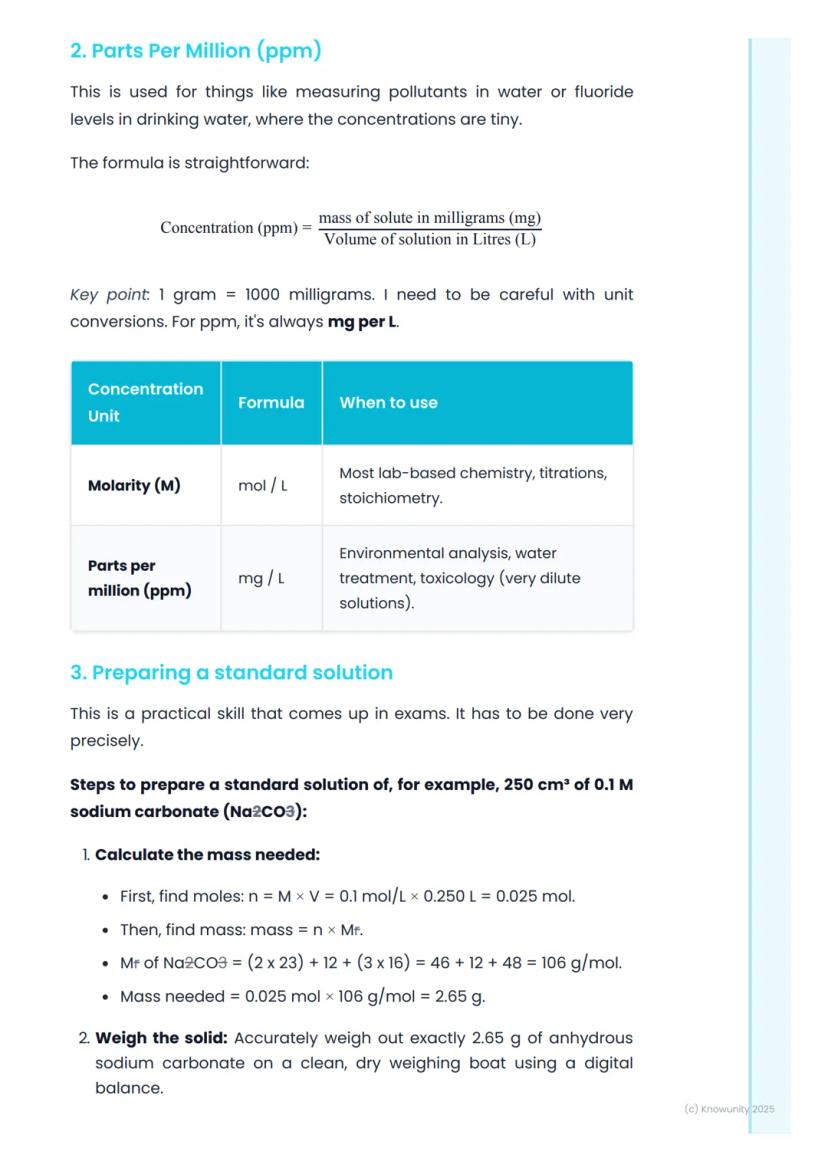
When concentrations are absolutely tiny - think fluoride in drinking water or pollutants - we use Parts Per Million (ppm). It's much simpler than molarity: just mg of solute per litre of solution.
The formula is straightforward: ppm = mass (mg) / Volume (L). Just remember that 1 gram equals 1000 milligrams, so you might need to convert.
You'll see ppm in environmental chemistry, water treatment, and anywhere we're dealing with trace amounts. It's basically saying "out of a million parts of solution, how many parts are my solute?"
Real World: The WHO recommends fluoride levels in drinking water should be between 0.5-1.5 ppm for dental health.
4
of 8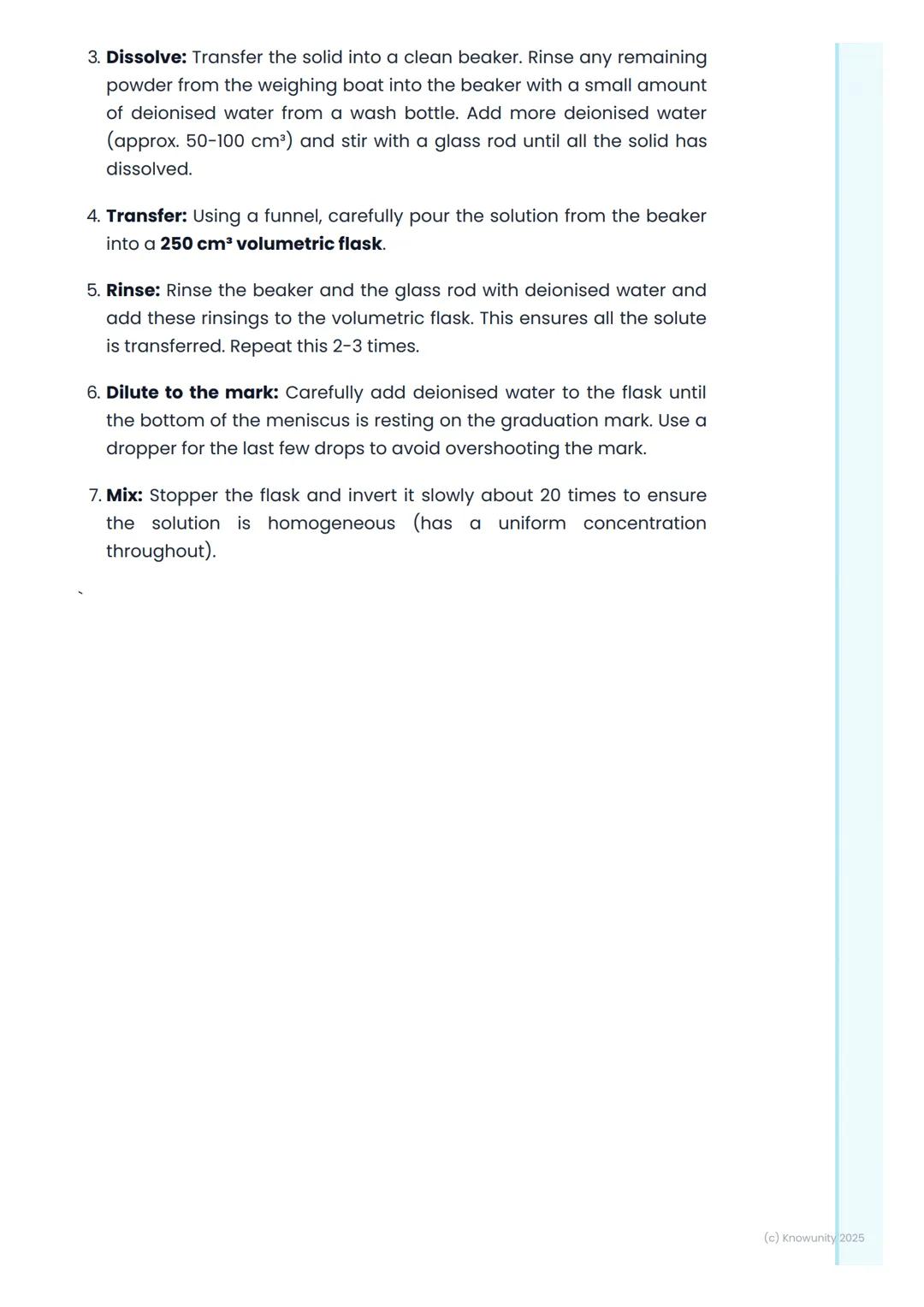
Preparing Standard Solutions
Making a standard solution is a practical skill that'll definitely come up in exams. You need to be absolutely precise because the whole point is knowing the exact concentration.
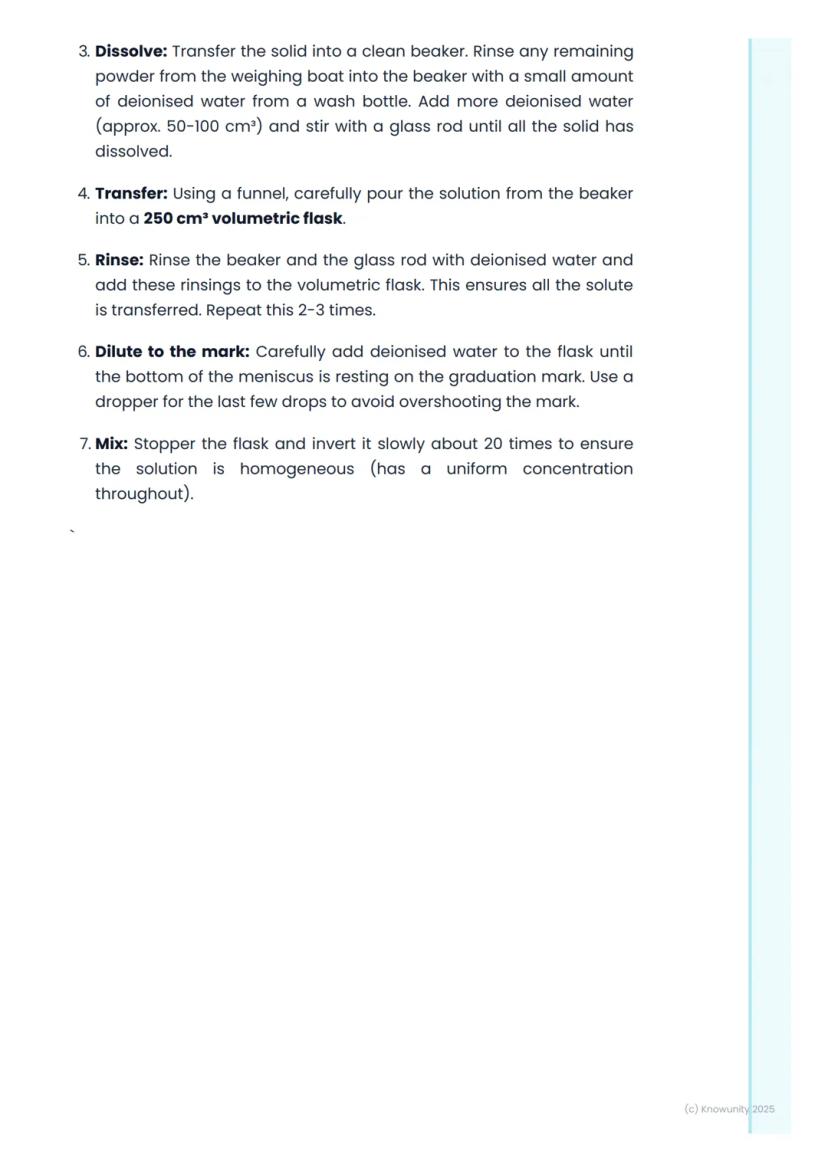
Here's the method: calculate the mass you need (using M × V to get moles, then moles × Mr to get mass). Weigh it accurately, dissolve it in a beaker with some distilled water, then transfer everything to a volumetric flask.
The key bits are rinsing the beaker multiple times (so you don't lose any solute) and filling to the graduation mark carefully. Use a dropper for the last few drops - you can't go back if you overshoot!
Exam Alert: Always use a volumetric flask, not a measuring cylinder or beaker - they're calibrated to be super accurate for one specific volume.
5
of 8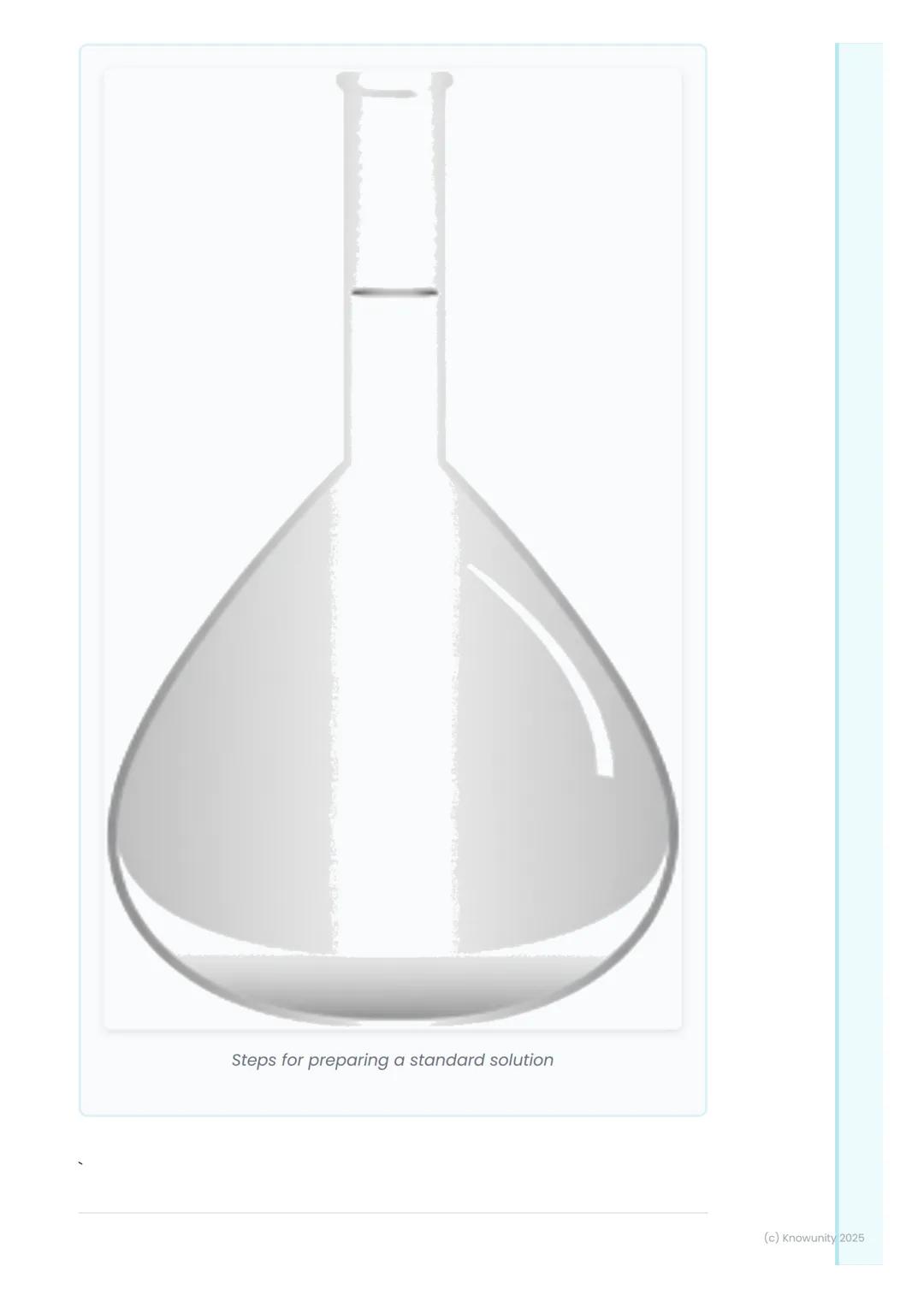
Visual Guide to Standard Solutions
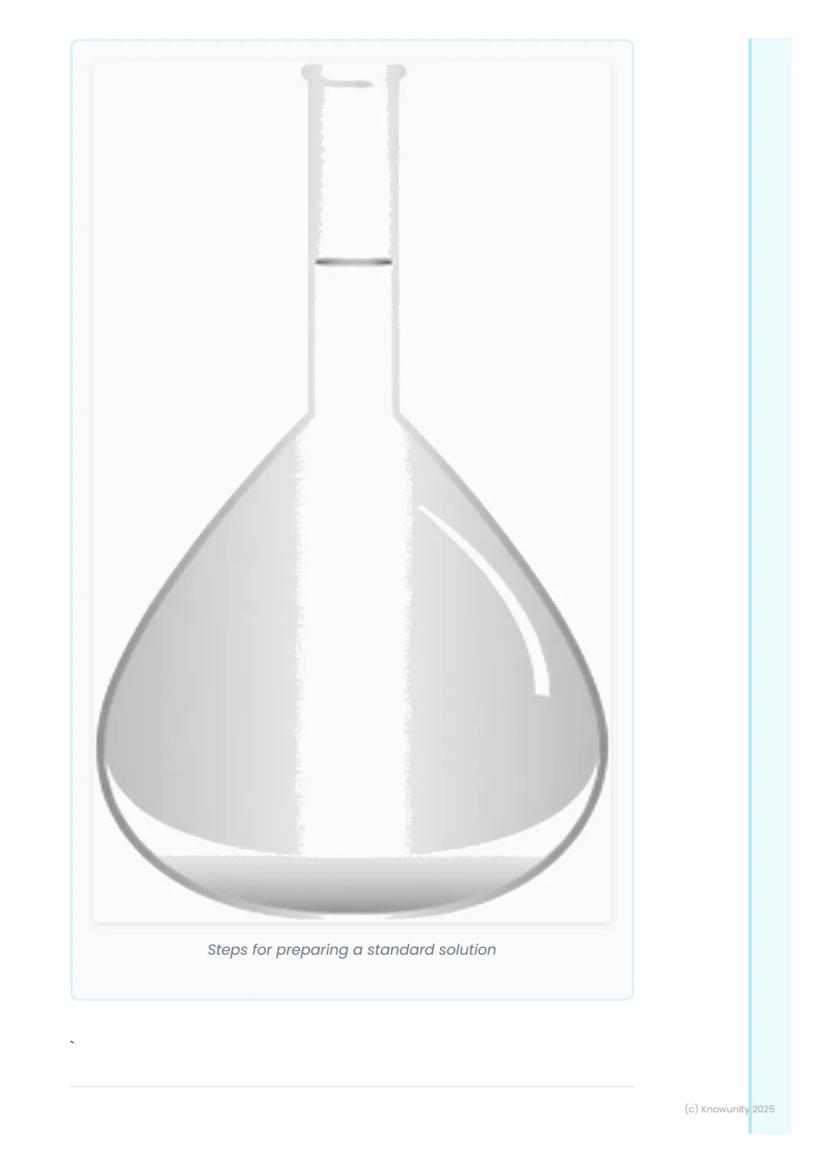
The diagram shows each step clearly: weigh your solid, dissolve it in a beaker, transfer to the volumetric flask with plenty of rinsing, then top up to the mark.
Notice how you rinse the beaker and glass rod multiple times - this ensures every bit of your solute makes it into the final solution. Missing this step will mess up your concentration.
The final step is inverting the stoppered flask about 20 times to mix thoroughly. You want a homogeneous solution - same concentration throughout.
Pro Tip: When reading the meniscus, get your eye level with the graduation mark and read from the bottom of the curve.
6
of 8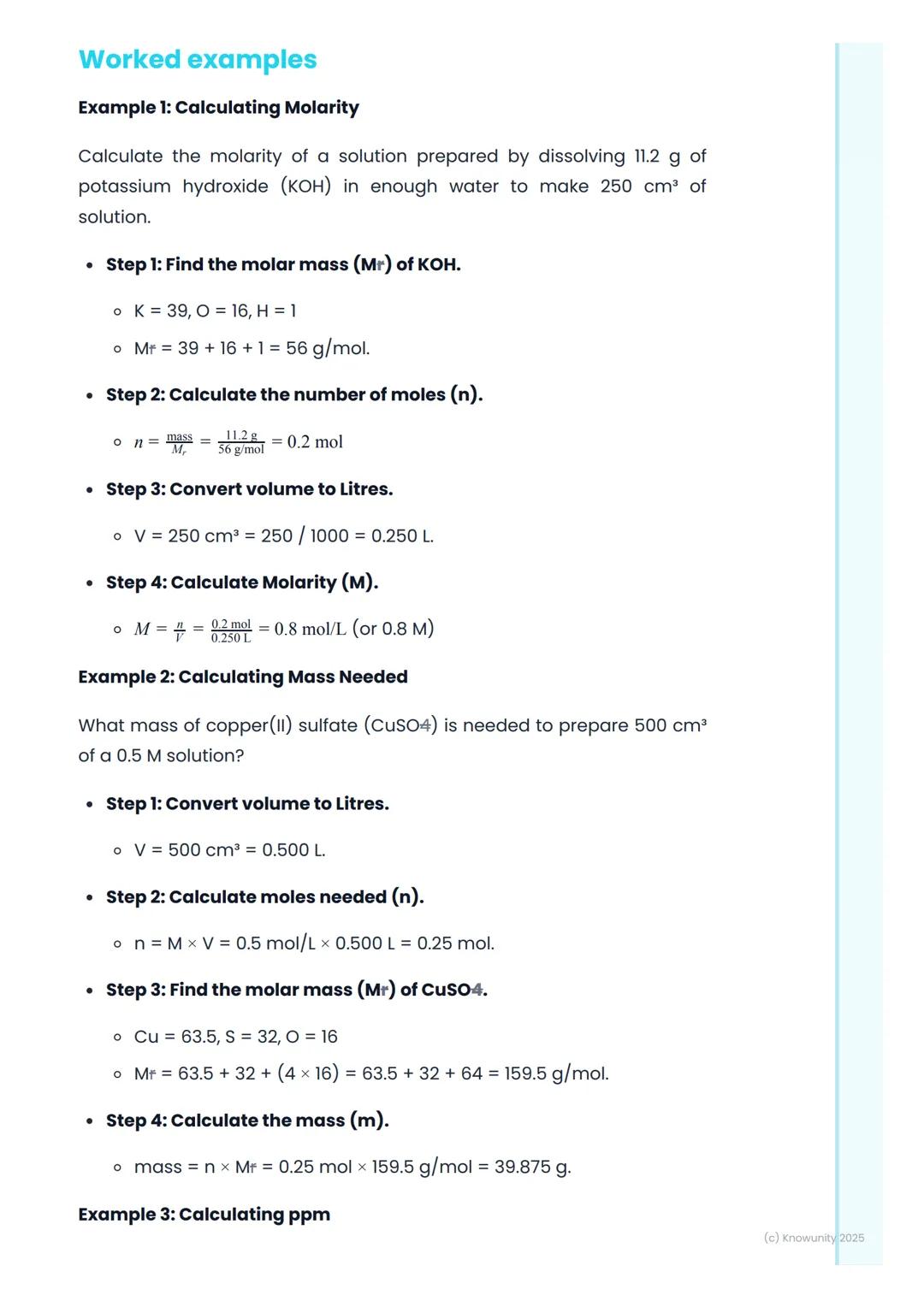
Worked Examples - Molarity and Mass
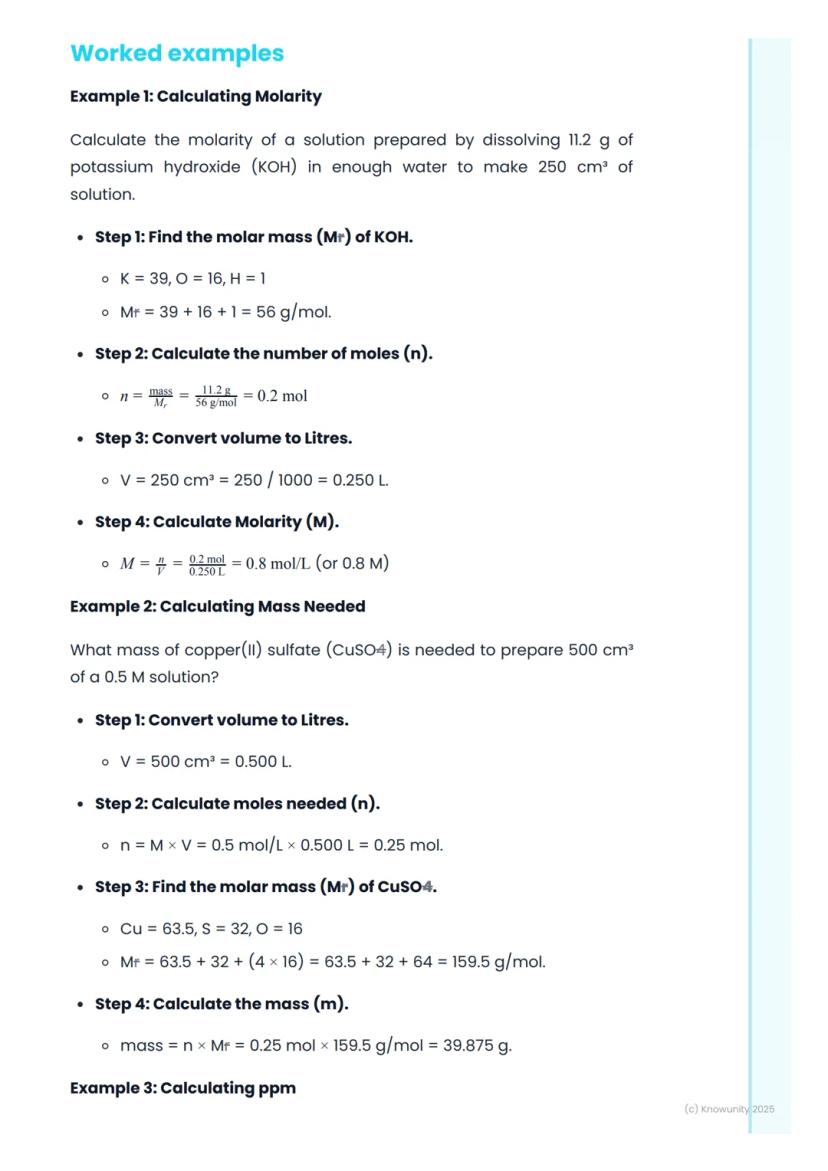
These examples show the step-by-step approach you need for exam success. Notice how every calculation starts by finding the molar mass from the periodic table - get this wrong and everything else falls apart.
For calculating molarity: mass → moles → molarity. Don't forget to convert cm³ to litres! For calculating mass needed: molarity × volume → moles → mass.
The copper sulfate example is typical of what you'll see - they give you a volume in cm³, so immediately convert to litres. Then it's just plugging numbers into formulas.
Common Error: Students often forget the volume conversion. 500 cm³ = 0.500 L, not 0.05 L!
7
of 8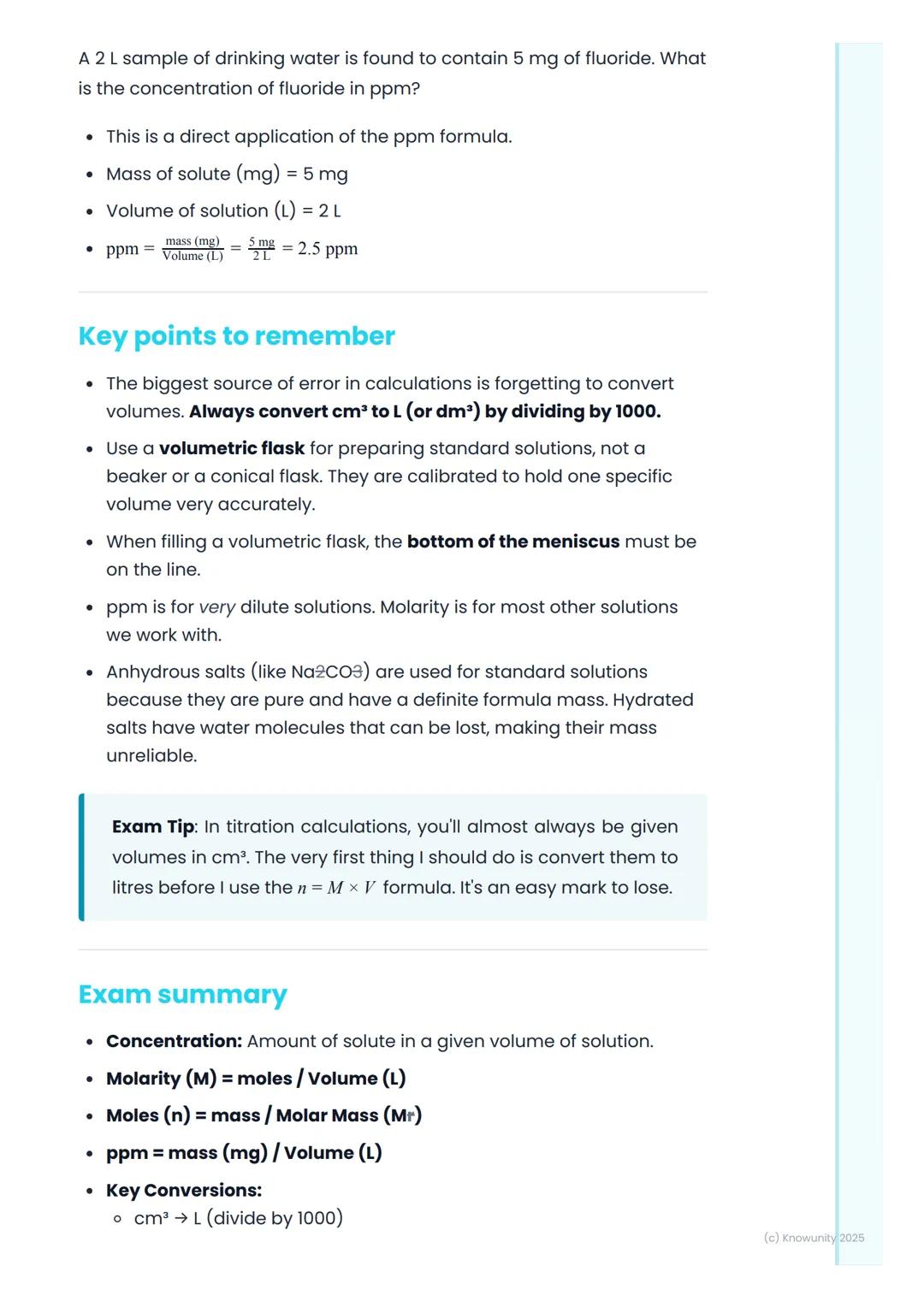
PPM Example and Key Reminders
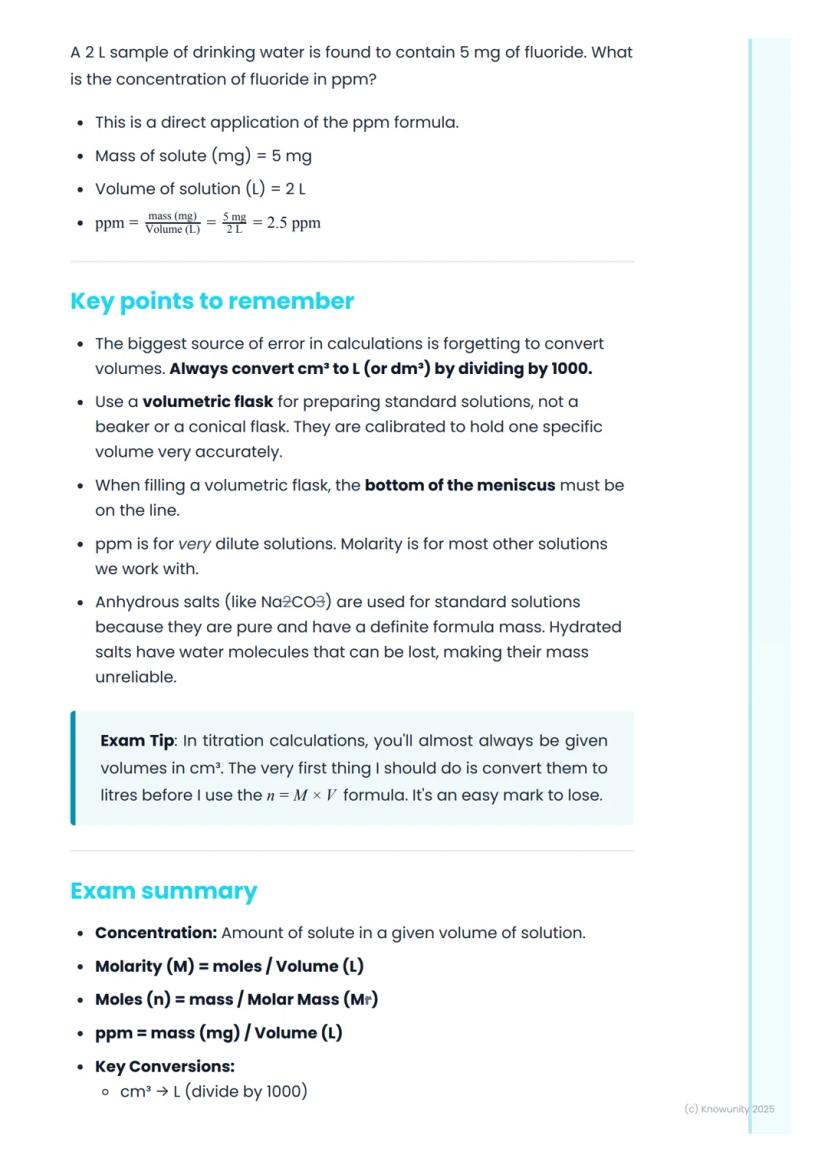
The fluoride example shows how simple ppm calculations can be - just divide mg by litres. No moles or molar masses to worry about.
The key points section highlights the biggest exam traps. Volume conversion trips up loads of students - always convert cm³ to L first thing. Volumetric flasks are essential for accurate standard solutions.
Remember that anhydrous salts are used for standard solutions because they don't have unpredictable water molecules attached. Hydrated salts can lose water, making their mass unreliable.
Exam Strategy: In titration questions, volumes are usually in cm³. Convert to litres before you do anything else - it's an easy mark to lose.
8
of 8
Exam Summary and Quick Reference
This final summary gives you everything you need for quick revision. The key formulas are M = n/V and n = m/Mr - master these and you can handle any concentration calculation.
The conversion reminders are crucial: cm³ to L (÷1000) and g to mg (×1000). Get these wrong and your whole answer is off.
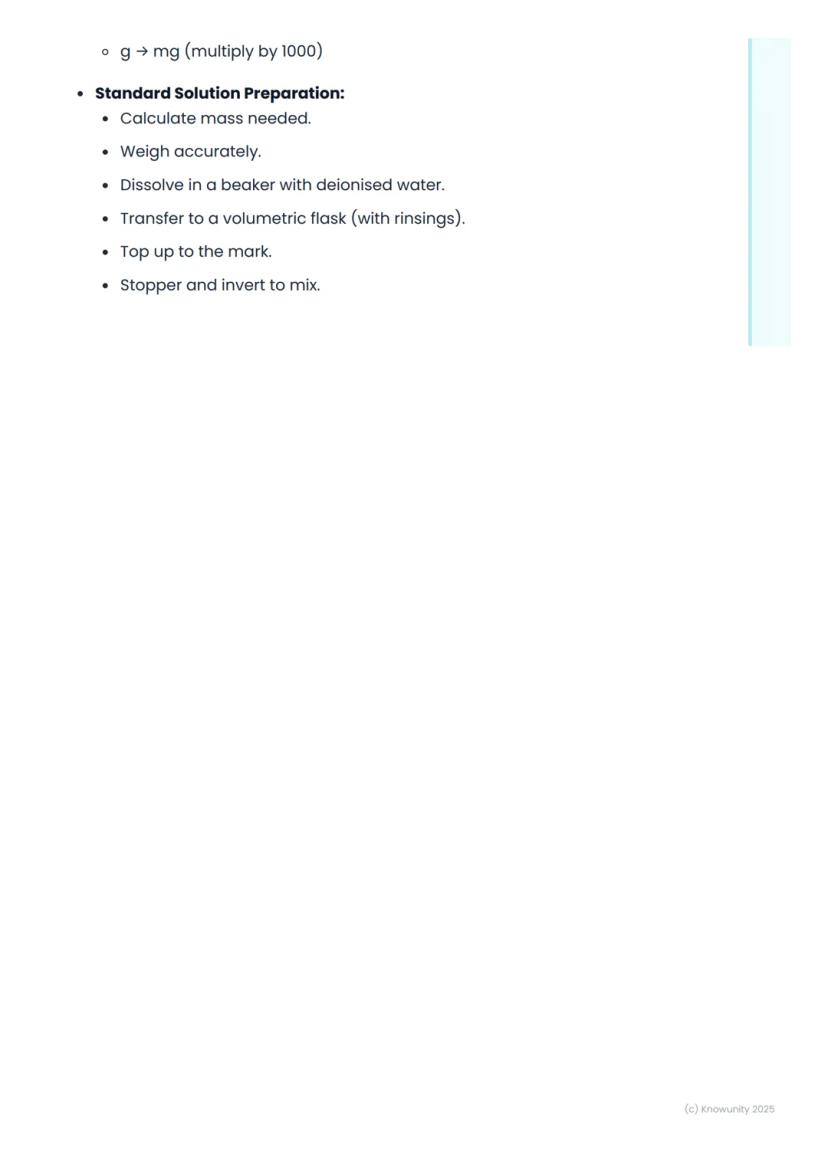
The standard solution steps are always the same: calculate, weigh, dissolve, transfer with rinsings, top up to mark, mix. Learn this sequence and you'll nail any practical question.
Final Tip: Practice switching between mass, moles, and molarity until it's automatic - these calculations come up everywhere in chemistry!
Si on te demande...
Qu'est-ce que le compagnon IA de Knowunity ?
Notre compagnon IA est spécialement conçu pour répondre aux besoins des étudiants. Sur la base des millions d'éléments de contenu que nous avons sur la plateforme, nous pouvons fournir des réponses vraiment significatives et pertinentes aux étudiants. Mais il ne s'agit pas seulement de réponses, le compagnon a encore plus pour but de guider les élèves dans leurs défis d'apprentissage quotidiens, avec des plans d'étude personnalisés, des quiz ou des éléments de contenu dans le chat et une personnalisation à 100% basée sur les compétences et les développements de l'étudiant.
Où puis-je télécharger l'appli Knowunity ?
Tu peux télécharger l'application dans Google Play Store et dans l'App Store d'Apple.
L'application est-elle vraiment gratuite ?
Oui, tu as un accès entièrement gratuit à tous les contenus de l'appli, tu peux chatter ou suivre les créateurs à tout moment. De plus, nous proposons Knowunity Premium, qui te permet de réviser sans limites!
Contenus les plus populaires
9 Irish
IrishIrish oral questions and answers
Questions and answers for the leaving cert oral
5th Year4264
 English
Key Quotes : Sive
Key Quotes and explanations: Sive
6th Year2842
IrishIrish oral questions
Outline of oral questions
5th Year2055
IrishIníon- le hÁine Durkin
Aine Durkin’s poem, Iníon: Themes & summary
5th Year850
IrishIrish poetry 2027
Iníon + Dínit an Bhróin
5th Year1133
IrishLC HL notes- Iníon (poem)
Includes poem in English and Irish, theme, key words & phrases
5th Year2284
EnglishCultural Context : Shawshank Redemption : Sive : Small Things Like These
Comparative Study : Cultural Context : Shawshank Redemption, Sive and Small Things Like These
6th Year1430
IrishMo Ghrá-sa (Idir Lúibíní)
Notes on mo ghrá-sa
5th Year380
IrishAn Gaeilge Aiste
Irish Language essay
6th Year1320
Rien ne te convient ? Explore d'autres matières.
Les étudiants nous adorent — il ne manque plus que toi.
4.6/5App Store
4.7/5Google Play
L'application est très facile d'utilisation et bien conçue. Jusqu'à présent, j'ai trouvé tout ce que je cherchais et j'ai pu apprendre beaucoup de choses grâce aux présentations ! Je vais certainement utiliser l'application pour un travail en classe ! Et comme source d'inspiration personnelle, elle est bien sûr aussi très utile.
Stefan Sutilisateur iOS
Cette application est vraiment super. Il y a tellement de fiches de révision et d'aide, [...]. Par exemple, la matière qui me pose problème est le français et l'appli a un choix d'aide très large. Grâce à cette application, je me suis améliorée en français. Je la recommanderais à tout le monde.
Samantha Klichutilisatrice Android
Waouh, je suis vraiment abasourdi. J'ai essayé l'application parce que je l'avais déjà vue plusieurs fois dans la publicité et j'ai été absolument choquée. Cette appli est L'AIDE dont on rêve pour l'école et surtout, elle propose tellement de choses, comme des rédactions et des fiches qui m'ont personnellement TRÈS bien aidé.
Annautilisatrice iOS
Chemistry12 vues·Mis à jour Jun 10, 2026·8 pagesUnderstanding Solution Concentrations: Molarity and Parts per Million
Ever wondered how chemists know exactly how strong a solution is? Concentrationis basically measuring how much stuff is dissolved in your solution - and it's crucial for everything from titrations to understanding reaction rates. Master this, and you'll ace... Affiche plus
1
of 8Inscris-toi pour voir le contenu. C'est gratuit!
- Accès à tous les documents
- Améliore tes notes
- Rejoins des millions d'étudiants
Introduction to Concentration
Think of concentration like making squash - the more cordial you add to water, the stronger it tastes. In chemistry, we're measuring how much solute (the thing being dissolved) is packed into a solvent (usually water).
When you mix them together, you get a solution. The concentration tells you exactly how strong that solution is, which determines how it'll behave in chemical reactions.
There are two main ways to measure concentration: Molarity (for most lab work) and Parts Per Million (for really dilute solutions like pollutants in water). You'll also need to know how to make standard solutions - these are solutions where you know the concentration precisely.
Quick Tip: Molarity uses mol/L, whilst ppm uses mg/L - don't mix up your units!
2
of 8Inscris-toi pour voir le contenu. C'est gratuit!
- Accès à tous les documents
- Améliore tes notes
- Rejoins des millions d'étudiants
Calculating Molarity
Molarity is your go-to concentration unit. It's simply moles of solute per litre of solution, and the formula is dead easy: M = n/V.
The tricky bit is when you're given mass instead of moles. Then you need two steps: first convert mass to moles using n = m/Mr, then use those moles to find molarity.
Here's the classic setup: you've got some solid chemical, you dissolve it in water, and you need to find the concentration. Convert cm³ to litres (divide by 1000), work out the moles, then divide moles by volume.
Memory Trick: Use the formula triangle - cover what you want to find, and the triangle shows you what to do with the other two values!
3
of 8Inscris-toi pour voir le contenu. C'est gratuit!
- Accès à tous les documents
- Améliore tes notes
- Rejoins des millions d'étudiants
Parts Per Million (ppm)
When concentrations are absolutely tiny - think fluoride in drinking water or pollutants - we use Parts Per Million (ppm). It's much simpler than molarity: just mg of solute per litre of solution.
The formula is straightforward: ppm = mass (mg) / Volume (L). Just remember that 1 gram equals 1000 milligrams, so you might need to convert.
You'll see ppm in environmental chemistry, water treatment, and anywhere we're dealing with trace amounts. It's basically saying "out of a million parts of solution, how many parts are my solute?"
Real World: The WHO recommends fluoride levels in drinking water should be between 0.5-1.5 ppm for dental health.
4
of 8Inscris-toi pour voir le contenu. C'est gratuit!
- Accès à tous les documents
- Améliore tes notes
- Rejoins des millions d'étudiants
Preparing Standard Solutions
Making a standard solution is a practical skill that'll definitely come up in exams. You need to be absolutely precise because the whole point is knowing the exact concentration.
Here's the method: calculate the mass you need (using M × V to get moles, then moles × Mr to get mass). Weigh it accurately, dissolve it in a beaker with some distilled water, then transfer everything to a volumetric flask.
The key bits are rinsing the beaker multiple times (so you don't lose any solute) and filling to the graduation mark carefully. Use a dropper for the last few drops - you can't go back if you overshoot!
Exam Alert: Always use a volumetric flask, not a measuring cylinder or beaker - they're calibrated to be super accurate for one specific volume.
5
of 8Inscris-toi pour voir le contenu. C'est gratuit!
- Accès à tous les documents
- Améliore tes notes
- Rejoins des millions d'étudiants
Visual Guide to Standard Solutions
The diagram shows each step clearly: weigh your solid, dissolve it in a beaker, transfer to the volumetric flask with plenty of rinsing, then top up to the mark.
Notice how you rinse the beaker and glass rod multiple times - this ensures every bit of your solute makes it into the final solution. Missing this step will mess up your concentration.
The final step is inverting the stoppered flask about 20 times to mix thoroughly. You want a homogeneous solution - same concentration throughout.
Pro Tip: When reading the meniscus, get your eye level with the graduation mark and read from the bottom of the curve.
6
of 8Inscris-toi pour voir le contenu. C'est gratuit!
- Accès à tous les documents
- Améliore tes notes
- Rejoins des millions d'étudiants
Worked Examples - Molarity and Mass
These examples show the step-by-step approach you need for exam success. Notice how every calculation starts by finding the molar mass from the periodic table - get this wrong and everything else falls apart.
For calculating molarity: mass → moles → molarity. Don't forget to convert cm³ to litres! For calculating mass needed: molarity × volume → moles → mass.
The copper sulfate example is typical of what you'll see - they give you a volume in cm³, so immediately convert to litres. Then it's just plugging numbers into formulas.
Common Error: Students often forget the volume conversion. 500 cm³ = 0.500 L, not 0.05 L!
7
of 8Inscris-toi pour voir le contenu. C'est gratuit!
- Accès à tous les documents
- Améliore tes notes
- Rejoins des millions d'étudiants
PPM Example and Key Reminders
The fluoride example shows how simple ppm calculations can be - just divide mg by litres. No moles or molar masses to worry about.
The key points section highlights the biggest exam traps. Volume conversion trips up loads of students - always convert cm³ to L first thing. Volumetric flasks are essential for accurate standard solutions.
Remember that anhydrous salts are used for standard solutions because they don't have unpredictable water molecules attached. Hydrated salts can lose water, making their mass unreliable.
Exam Strategy: In titration questions, volumes are usually in cm³. Convert to litres before you do anything else - it's an easy mark to lose.
8
of 8Inscris-toi pour voir le contenu. C'est gratuit!
- Accès à tous les documents
- Améliore tes notes
- Rejoins des millions d'étudiants
Exam Summary and Quick Reference
This final summary gives you everything you need for quick revision. The key formulas are M = n/V and n = m/Mr - master these and you can handle any concentration calculation.
The conversion reminders are crucial: cm³ to L (÷1000) and g to mg (×1000). Get these wrong and your whole answer is off.
The standard solution steps are always the same: calculate, weigh, dissolve, transfer with rinsings, top up to mark, mix. Learn this sequence and you'll nail any practical question.
Final Tip: Practice switching between mass, moles, and molarity until it's automatic - these calculations come up everywhere in chemistry!
Si on te demande...
Qu'est-ce que le compagnon IA de Knowunity ?
Notre compagnon IA est spécialement conçu pour répondre aux besoins des étudiants. Sur la base des millions d'éléments de contenu que nous avons sur la plateforme, nous pouvons fournir des réponses vraiment significatives et pertinentes aux étudiants. Mais il ne s'agit pas seulement de réponses, le compagnon a encore plus pour but de guider les élèves dans leurs défis d'apprentissage quotidiens, avec des plans d'étude personnalisés, des quiz ou des éléments de contenu dans le chat et une personnalisation à 100% basée sur les compétences et les développements de l'étudiant.
Où puis-je télécharger l'appli Knowunity ?
Tu peux télécharger l'application dans Google Play Store et dans l'App Store d'Apple.
L'application est-elle vraiment gratuite ?
Oui, tu as un accès entièrement gratuit à tous les contenus de l'appli, tu peux chatter ou suivre les créateurs à tout moment. De plus, nous proposons Knowunity Premium, qui te permet de réviser sans limites!
Contenus les plus populaires
9IrishIrish oral questions and answers
Questions and answers for the leaving cert oral
5th Year4264
EnglishKey Quotes : Sive
Key Quotes and explanations: Sive
6th Year2842
IrishIrish oral questions
Outline of oral questions
5th Year2055
IrishIníon- le hÁine Durkin
Aine Durkin’s poem, Iníon: Themes & summary
5th Year850
IrishIrish poetry 2027
Iníon + Dínit an Bhróin
5th Year1133
IrishLC HL notes- Iníon (poem)
Includes poem in English and Irish, theme, key words & phrases
5th Year2284
EnglishCultural Context : Shawshank Redemption : Sive : Small Things Like These
Comparative Study : Cultural Context : Shawshank Redemption, Sive and Small Things Like These
6th Year1430
IrishMo Ghrá-sa (Idir Lúibíní)
Notes on mo ghrá-sa
5th Year380
IrishAn Gaeilge Aiste
Irish Language essay
6th Year1320
Rien ne te convient ? Explore d'autres matières.
Les étudiants nous adorent — il ne manque plus que toi.
4.6/5App Store
4.7/5Google Play
L'application est très facile d'utilisation et bien conçue. Jusqu'à présent, j'ai trouvé tout ce que je cherchais et j'ai pu apprendre beaucoup de choses grâce aux présentations ! Je vais certainement utiliser l'application pour un travail en classe ! Et comme source d'inspiration personnelle, elle est bien sûr aussi très utile.
Stefan Sutilisateur iOS
Cette application est vraiment super. Il y a tellement de fiches de révision et d'aide, [...]. Par exemple, la matière qui me pose problème est le français et l'appli a un choix d'aide très large. Grâce à cette application, je me suis améliorée en français. Je la recommanderais à tout le monde.
Samantha Klichutilisatrice Android
Waouh, je suis vraiment abasourdi. J'ai essayé l'application parce que je l'avais déjà vue plusieurs fois dans la publicité et j'ai été absolument choquée. Cette appli est L'AIDE dont on rêve pour l'école et surtout, elle propose tellement de choses, comme des rédactions et des fiches qui m'ont personnellement TRÈS bien aidé.
Annautilisatrice iOS