
Fiscal policy is the government's powerful toolkit for managing the...
 Economics3 vues·Mis à jour Jun 11, 2026·6 pages
Understanding Fiscal Policy: Government Spending and Taxation
1 / 6
1
of 6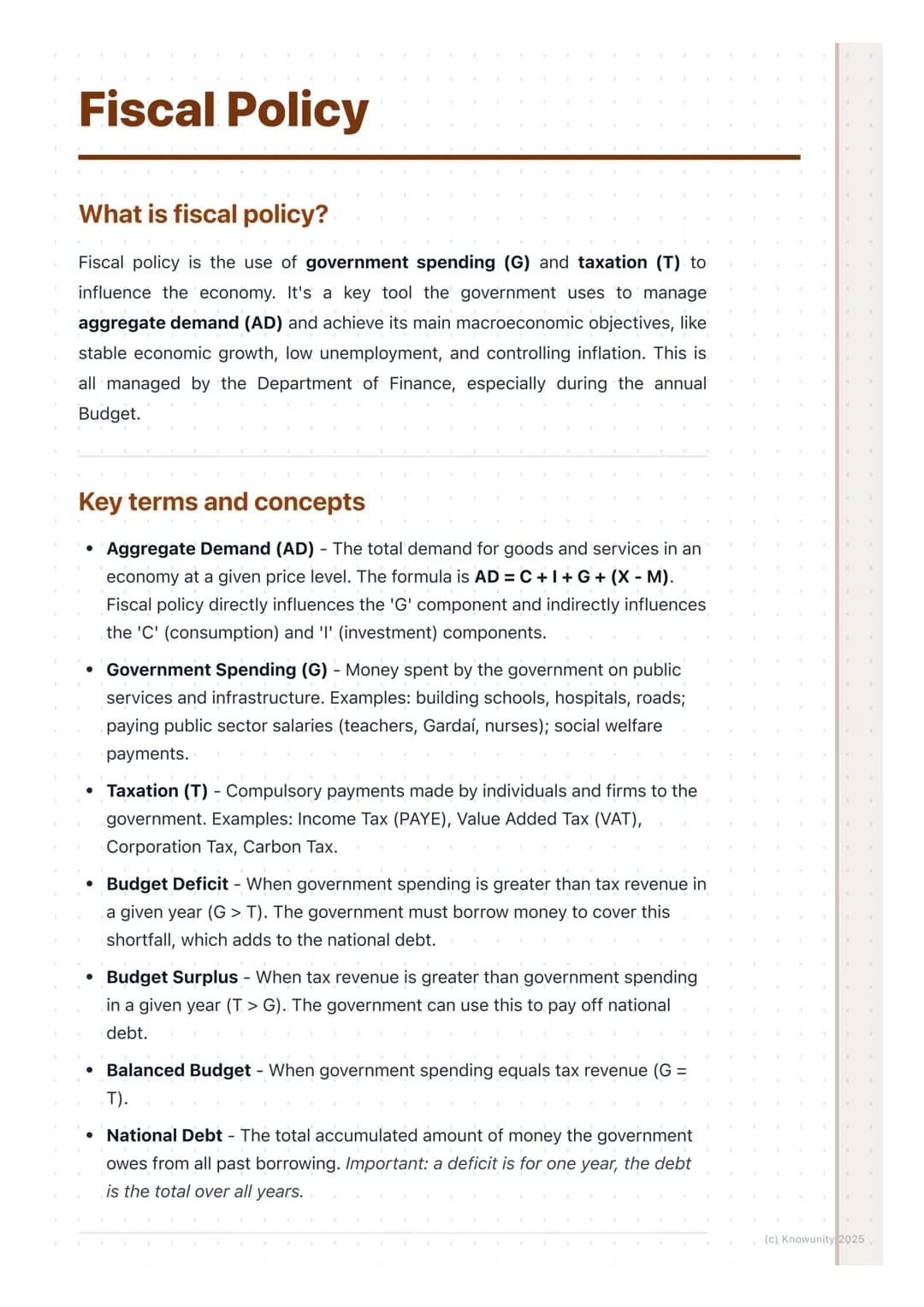
Fiscal Policy Fundamentals
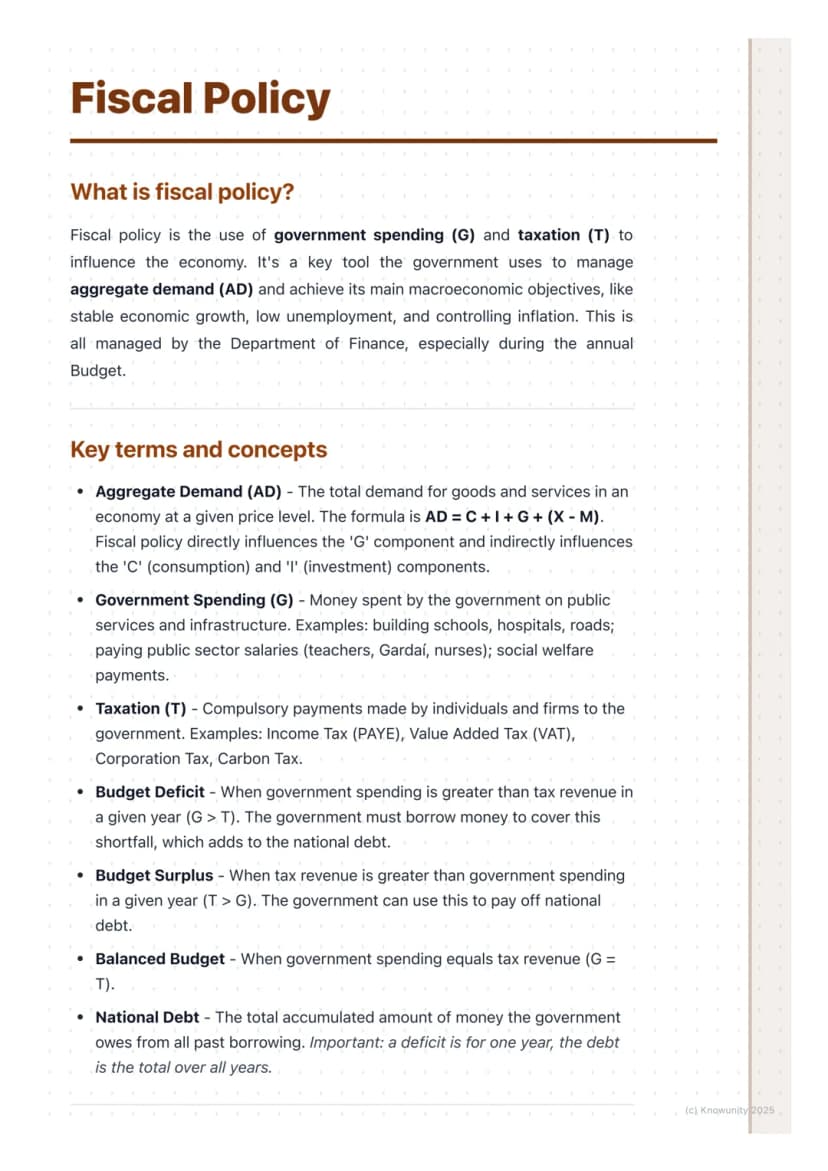
Ever wondered why the government announces tax cuts or spending increases in the budget? That's fiscal policy in action. It's how the government uses its spending (G) and taxation (T) to influence the economy and achieve key goals like economic growth and low unemployment.
The Department of Finance manages this process, making critical decisions during the annual Budget that affect the entire economy. When you hear terms like "budget deficit" or "government stimulus," you're hearing about fiscal policy tools.
At its core, fiscal policy directly influences Aggregate Demand (AD), which represents the total demand for goods and services in the economy . When the government spends on schools, hospitals, or Gardaí salaries, it's increasing the "G" component of this equation.
Quick Tip: Remember the difference between deficit and debt! A budget deficit happens when government spending exceeds tax revenue in a single year (G > T), while national debt is the total accumulated amount owed from all past borrowing.
Understanding key terms like budget surplus (when T > G), balanced budget , and how the government raises revenue through taxes like PAYE, VAT and Corporation Tax will give you a significant advantage in your economics exams.
2
of 6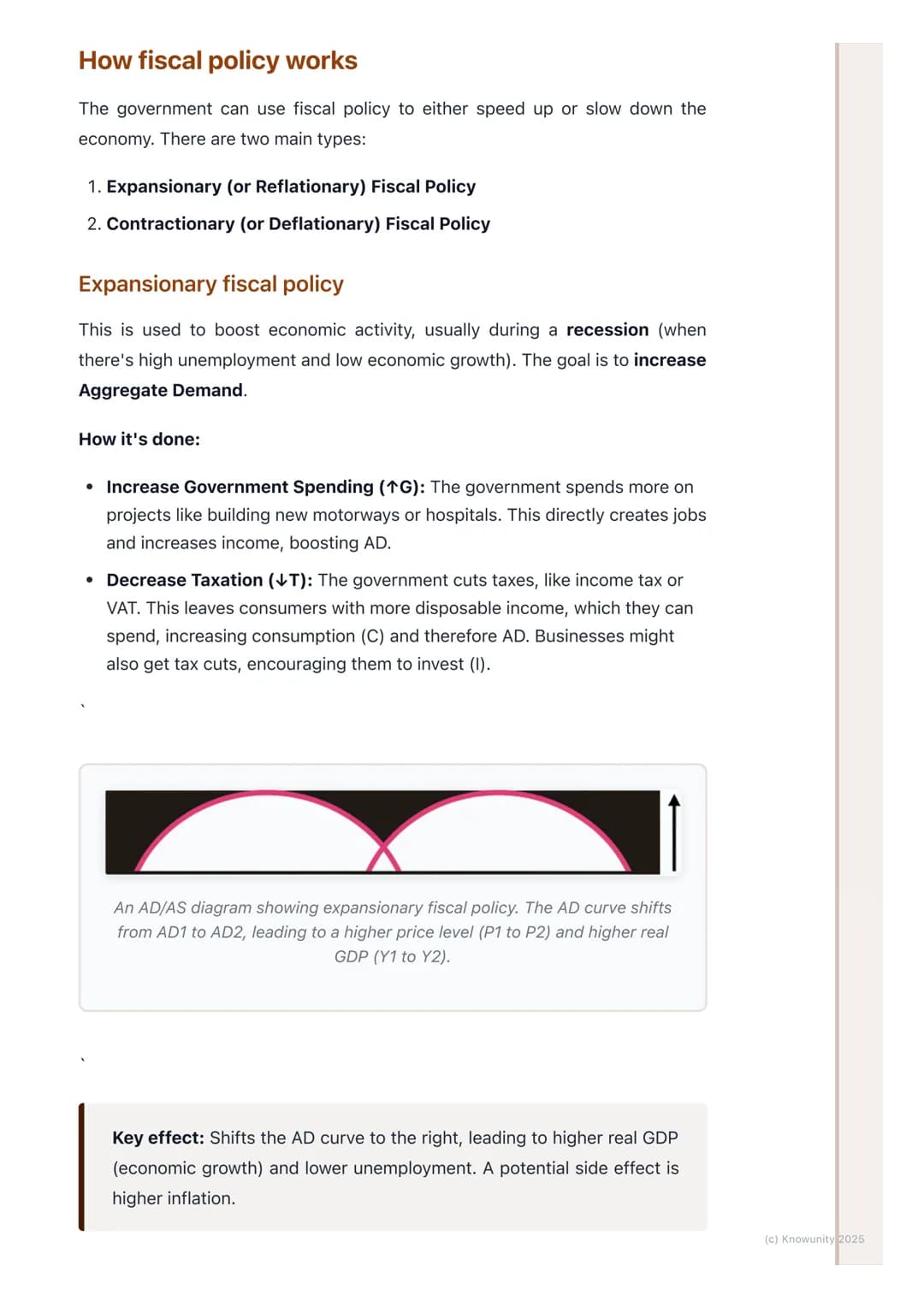
How Fiscal Policy Works
Fiscal policy works like the accelerator and brake pedals in a car, either speeding up or slowing down economic activity. Let's look at how the government uses these tools in different economic situations.
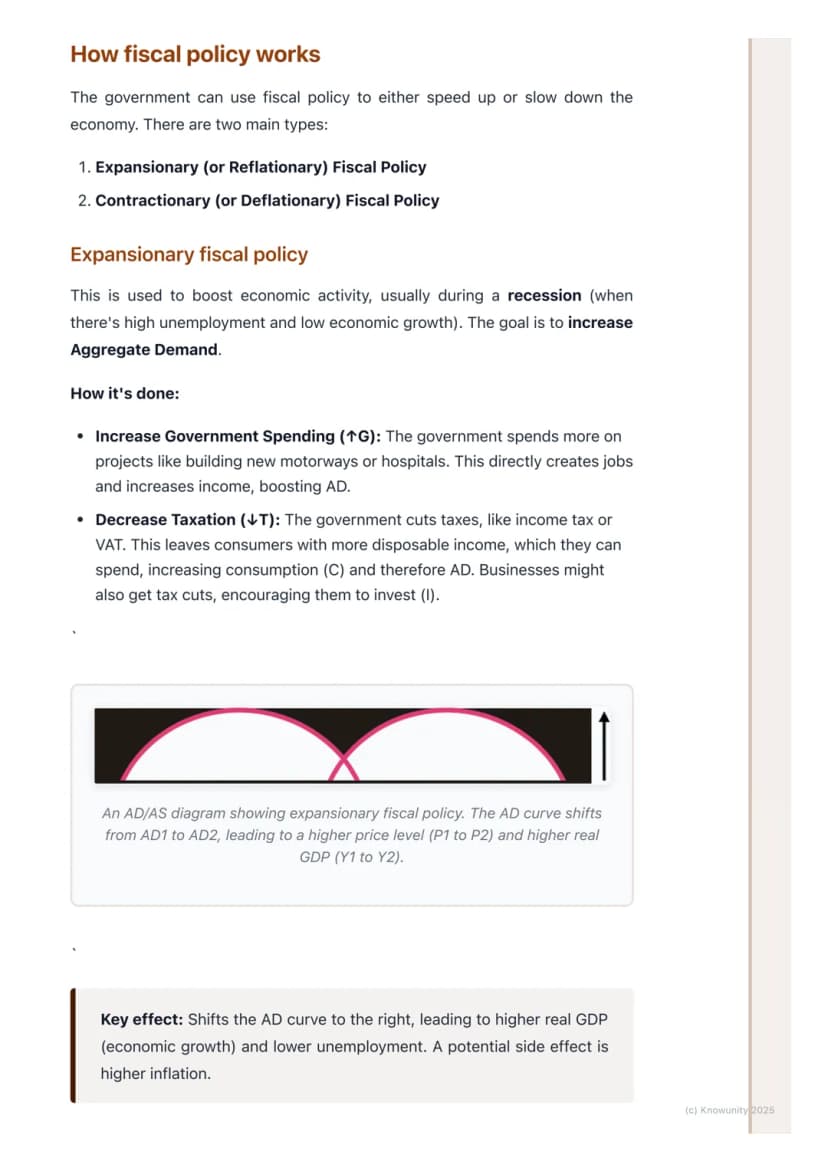
When the economy is struggling with high unemployment and low growth, the government typically deploys expansionary fiscal policy to boost Aggregate Demand. This involves either increasing government spending on projects like motorway construction or hospital building, or decreasing taxation, which leaves both consumers and businesses with more money to spend and invest.
The effect is powerful: the AD curve shifts rightward from AD1 to AD2, leading to higher real GDP and lower unemployment. The economy grows as this new spending creates jobs and generates income. However, this approach isn't without risks – a potential side effect is higher inflation as prices rise (P1 to P2).
Think of expansionary policy as economic medicine during a recession – it stimulates activity when the economy needs a boost. When you see governments announcing infrastructure projects during economic downturns, you're witnessing this policy in action.
Remember: Expansionary fiscal policy typically leads to budget deficits as the government spends more than it collects in taxes, requiring borrowing to make up the difference.
3
of 6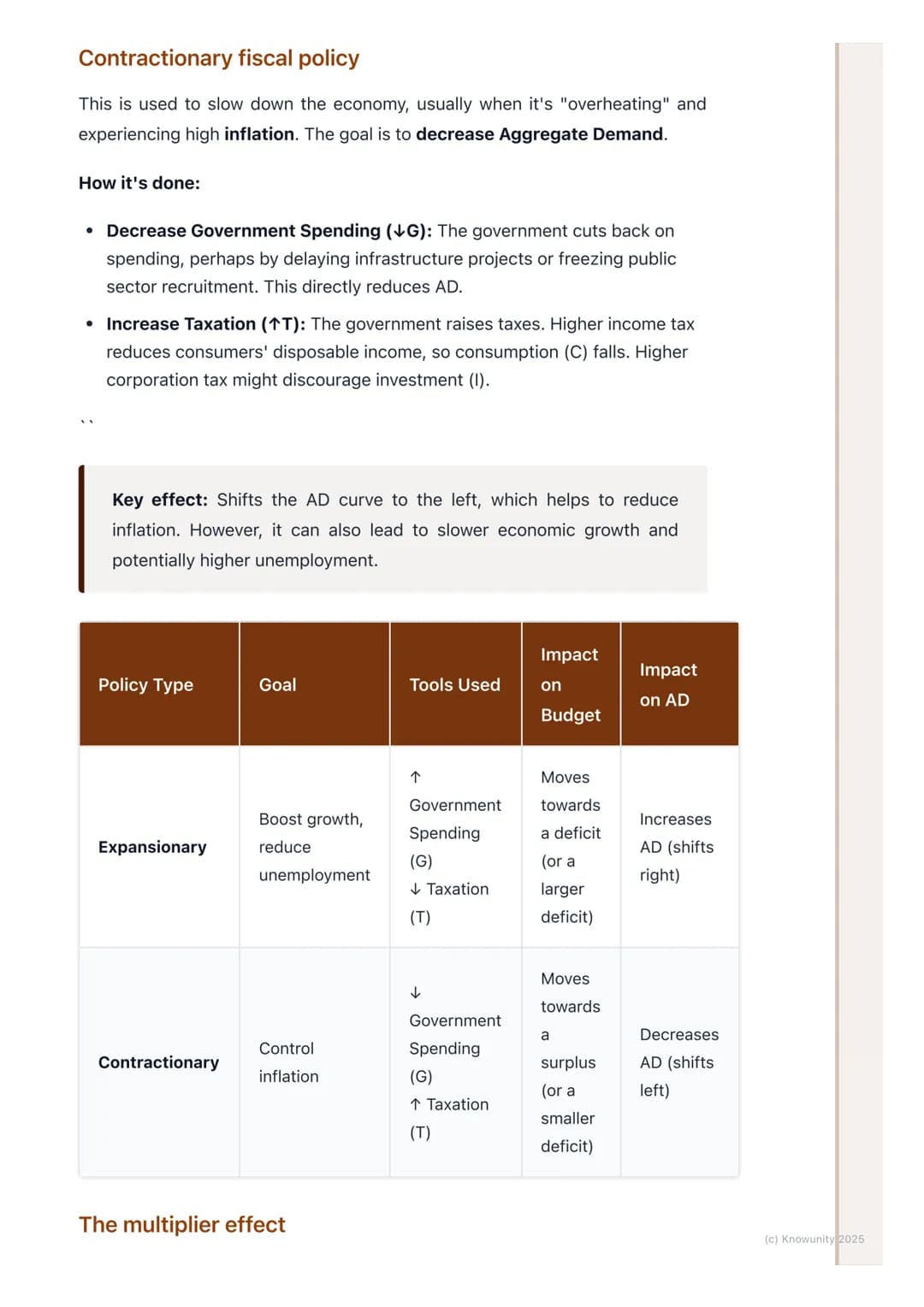
Contractionary Fiscal Policy
When inflation runs hot and the economy is overheating, the government reaches for contractionary fiscal policy to cool things down. Unlike expansionary policy, the goal here is to deliberately decrease Aggregate Demand to reduce inflationary pressures.
The government implements this by either cutting back on spending (postponing infrastructure projects or freezing public sector hiring) or increasing taxes (raising income tax or VAT rates). Higher taxes reduce consumers' disposable income, leading to lower consumption, while business taxes can discourage investment.
The key effect is shifting the AD curve leftward, which helps control inflation. The trade-off, however, is potentially slower economic growth and higher unemployment – a difficult political sell!
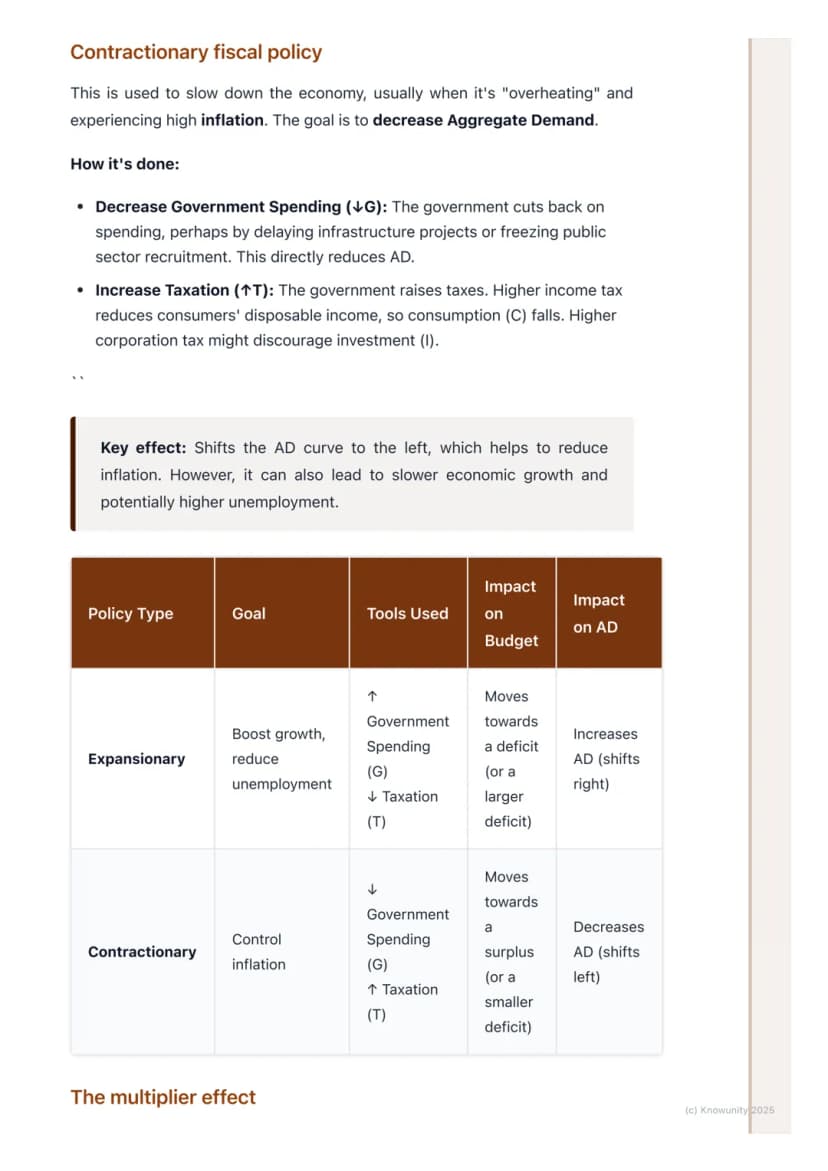
This table shows how the two approaches compare:
| Policy Type | Goal | Tools | Budget Impact | Effect on AD |
|---|---|---|---|---|
| Expansionary | Boost growth, reduce unemployment | ↑ Government Spending, ↓ Taxation | Moves toward deficit | Increases (shifts right) |
| Contractionary | Control inflation | ↓ Government Spending, ↑ Taxation | Moves toward surplus | Decreases (shifts left) |
You'll impress your examiner by showing you understand both approaches and their appropriate applications in different economic scenarios. Each policy type has distinct effects on the economy and represents different priorities for policymakers.
4
of 6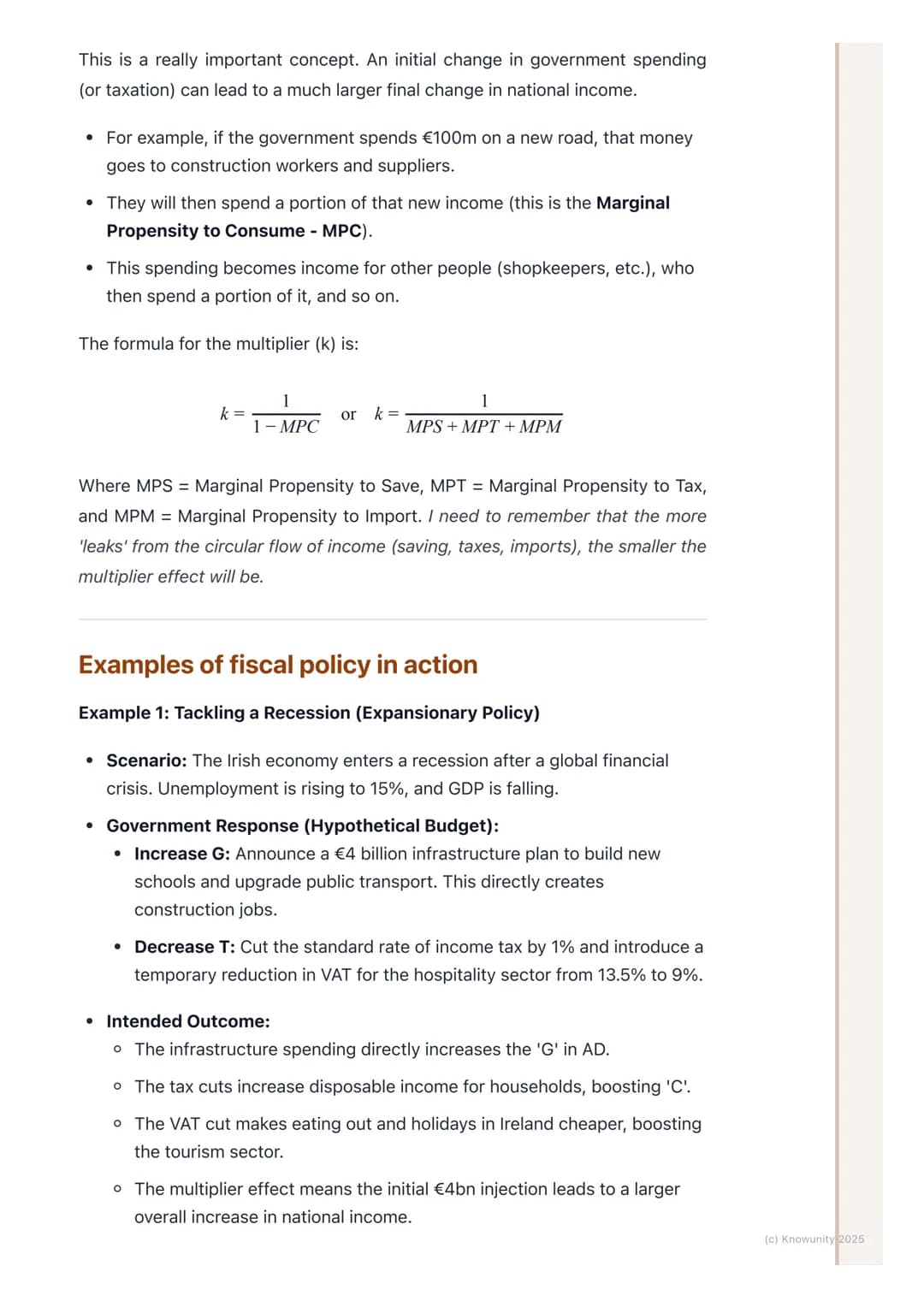
The Multiplier Effect
The multiplier effect explains why government spending packs such a powerful economic punch. An initial injection of spending doesn't just affect the economy once – it creates a ripple effect much larger than the original amount.
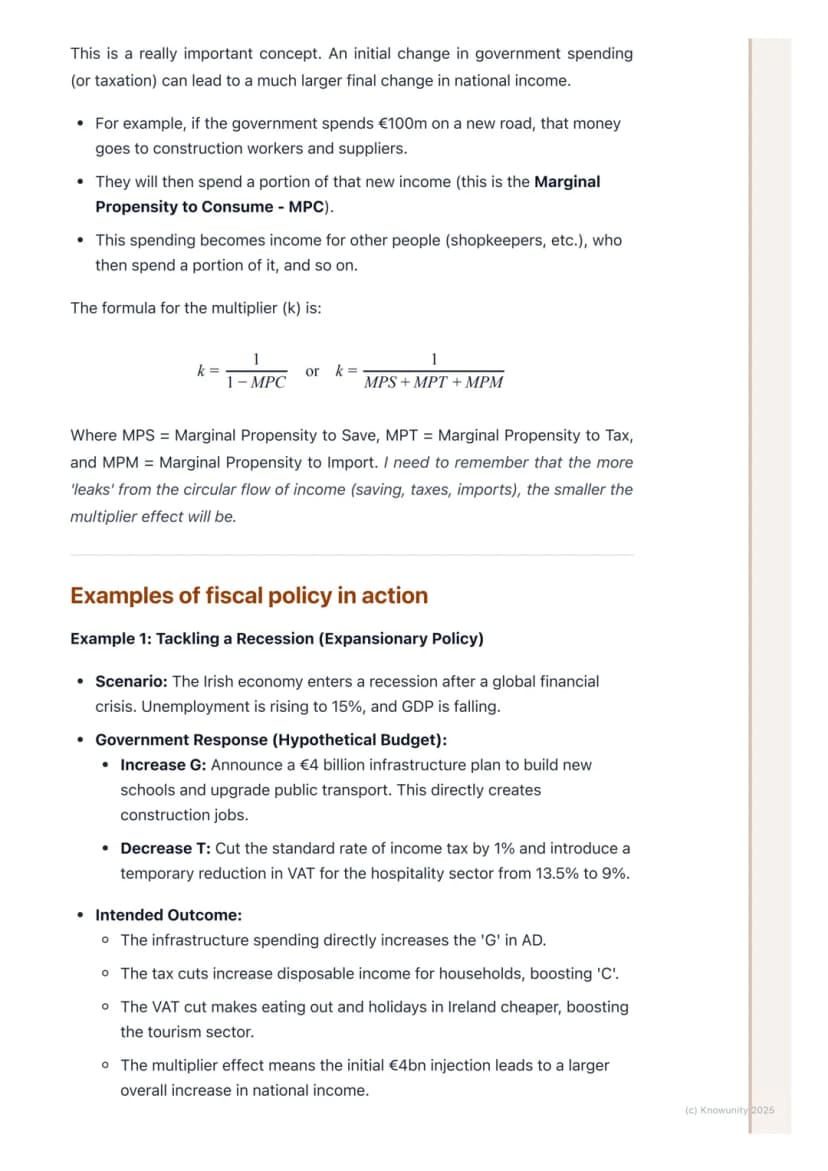
Here's how it works: When the government spends €100 million on a new road project, that money goes to construction workers and suppliers as income. Those people then spend a portion of their new earnings (determined by their Marginal Propensity to Consume or MPC) in shops and restaurants. Those business owners then have more income to spend themselves, and the cycle continues.
The multiplier formula is: k = 1/ or k = 1/. The higher the MPC (the proportion of extra income people spend rather than save), the larger the multiplier effect. Conversely, more "leakages" from the economy through saving, taxation, and imports will reduce the multiplier.
Let's see fiscal policy in action during a recession: Imagine unemployment hits 15% and GDP is falling. The government responds with a €4 billion infrastructure plan while cutting income tax by 1% and reducing VAT for hospitality from 13.5% to 9%. This combination of increased spending and reduced taxation directly boosts AD, creates jobs, increases disposable income, and makes domestic services more attractive.
Exam Tip: The multiplier explains why a €4 billion stimulus package can generate much more than €4 billion in total economic activity. Understanding this concept demonstrates sophisticated economic thinking in your answers!
5
of 6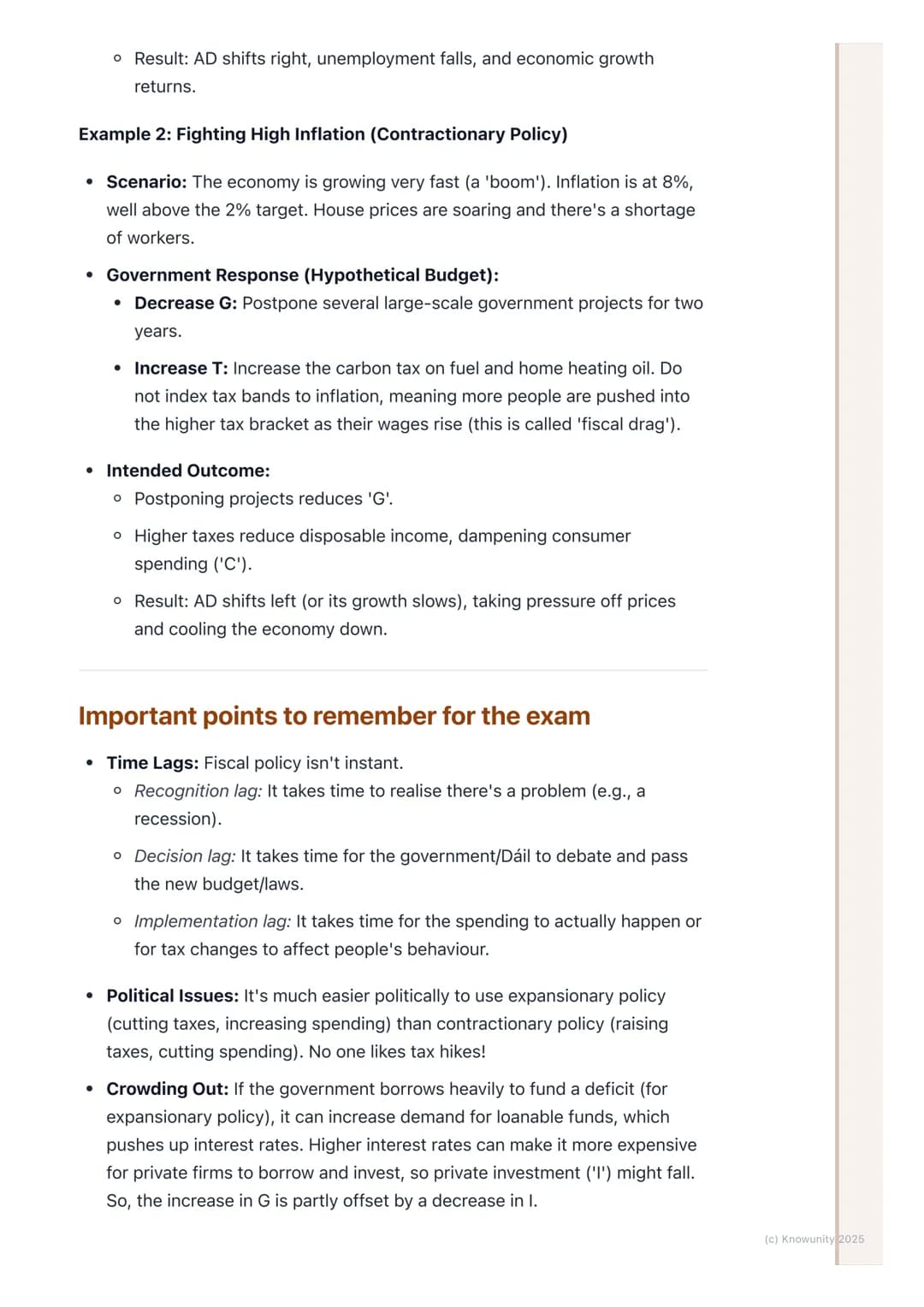
Fiscal Policy in Inflation Scenarios
When inflation becomes problematic, the government must act decisively with contractionary measures. Picture an economy growing too fast with 8% inflation (well above the typical 2% target) and soaring house prices. This requires cooling down through strategic fiscal tightening.
The government might postpone large infrastructure projects to reduce immediate spending. Simultaneously, they could increase carbon taxes on fuel and home heating oil, while allowing "fiscal drag" (not adjusting tax bands for inflation, pushing more people into higher tax brackets). These measures reduce disposable income and dampen consumer spending, shifting AD leftward and easing price pressures.
However, fiscal policy faces important limitations you should acknowledge in exams. Time lags significantly impact effectiveness – recognizing economic problems, debating solutions, and implementing changes all take time. By the time contractionary policy takes effect, the economic situation may have already changed!
Political considerations also matter tremendously. Expansionary policies (tax cuts, spending increases) are politically popular, while contractionary measures (tax hikes, spending cuts) face resistance. No politician wants to be remembered for raising taxes, even when economically necessary.
The crowding out effect presents another challenge. When governments borrow heavily to fund deficits, interest rates may rise, making private investment more expensive. This means increased government spending (G) could be partially offset by decreased private investment (I).
Understanding these real-world complications demonstrates sophisticated economic thinking that will impress examiners.
6
of 6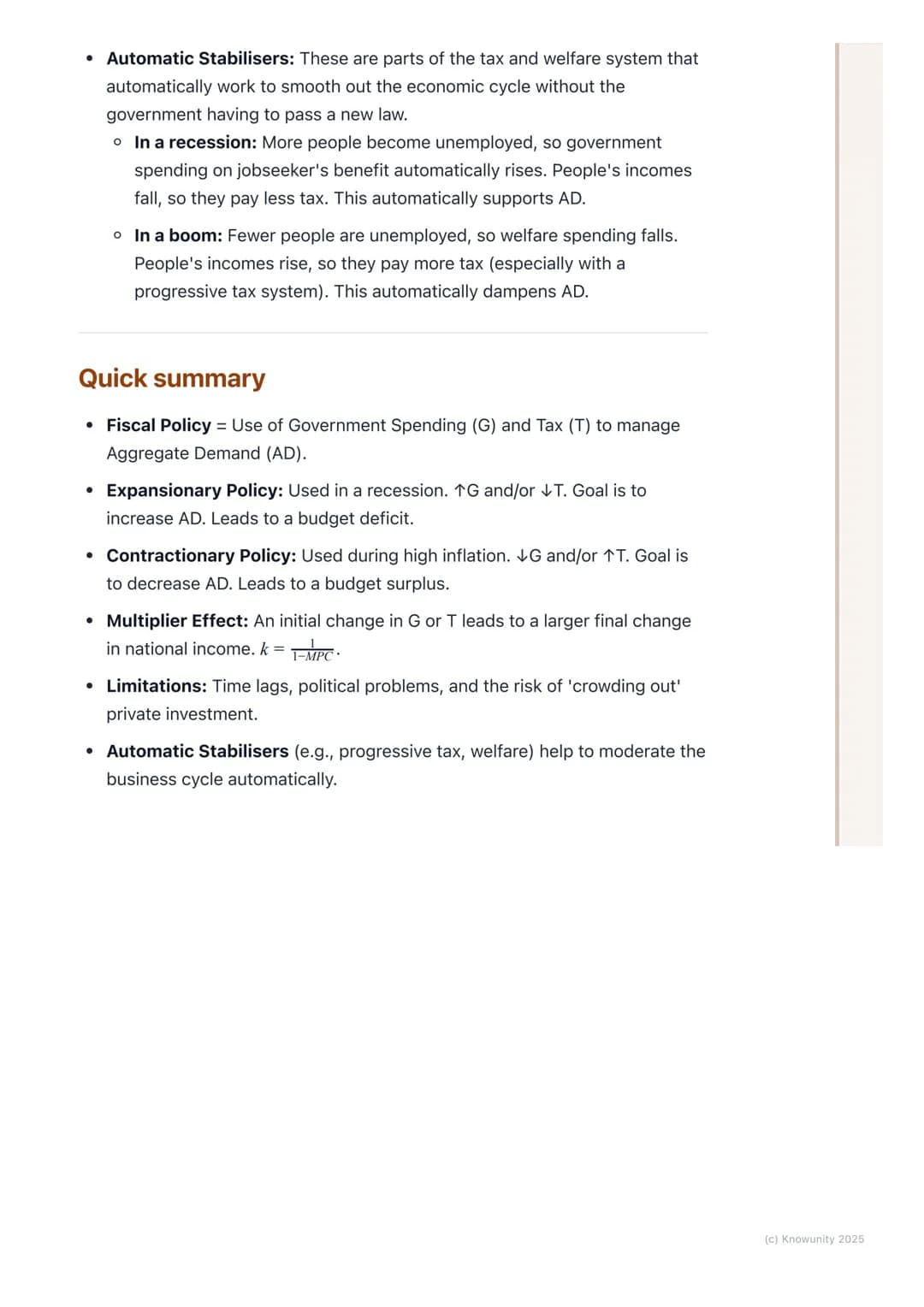
Automatic Stabilisers and Summary
One of fiscal policy's most clever features is the presence of automatic stabilisers - economic mechanisms that help smooth economic cycles without requiring new legislation. These built-in features respond automatically to changing conditions.
During recessions, more people receive unemployment benefits while paying less income tax as earnings fall. This automatically supports Aggregate Demand without requiring a formal budget change. Conversely, during booms, welfare spending naturally decreases while tax revenue rises, helping cool an overheating economy automatically.
The Irish progressive tax system is a perfect example – as incomes rise, people move into higher tax brackets, automatically removing more money from circulation when the economy is strong. This design helps moderate economic cycles without constant government intervention.
To summarise what you've learned:
- Fiscal policy uses government spending (G) and taxation (T) to influence Aggregate Demand
- Expansionary policy (↑G, ↓T) boosts the economy during recessions but creates deficits
- Contractionary policy (↓G, ↑T) fights inflation but can slow growth and increase unemployment
- The multiplier effect explains why initial spending changes lead to larger final income changes
- Automatic stabilisers like progressive taxation help moderate economic cycles naturally
Final Exam Tip: When discussing fiscal policy, always consider its appropriateness to the economic situation. The best policy depends on whether the economy faces recession, inflation, or balanced growth. Showing this contextual understanding will earn you top marks!
Si on te demande...
Qu'est-ce que le compagnon IA de Knowunity ?
Notre compagnon IA est spécialement conçu pour répondre aux besoins des étudiants. Sur la base des millions d'éléments de contenu que nous avons sur la plateforme, nous pouvons fournir des réponses vraiment significatives et pertinentes aux étudiants. Mais il ne s'agit pas seulement de réponses, le compagnon a encore plus pour but de guider les élèves dans leurs défis d'apprentissage quotidiens, avec des plans d'étude personnalisés, des quiz ou des éléments de contenu dans le chat et une personnalisation à 100% basée sur les compétences et les développements de l'étudiant.
Où puis-je télécharger l'appli Knowunity ?
Tu peux télécharger l'application dans Google Play Store et dans l'App Store d'Apple.
L'application est-elle vraiment gratuite ?
Oui, tu as un accès entièrement gratuit à tous les contenus de l'appli, tu peux chatter ou suivre les créateurs à tout moment. De plus, nous proposons Knowunity Premium, qui te permet de réviser sans limites!
Contenus les plus populaires
9 Irish
IrishIrish oral questions and answers
Questions and answers for the leaving cert oral
5th Year4264
 English
Key Quotes : Sive
Key Quotes and explanations: Sive
6th Year2842
IrishIrish oral questions
Outline of oral questions
5th Year2055
IrishIníon- le hÁine Durkin
Aine Durkin’s poem, Iníon: Themes & summary
5th Year850
IrishIrish poetry 2027
Iníon + Dínit an Bhróin
5th Year1133
IrishLC HL notes- Iníon (poem)
Includes poem in English and Irish, theme, key words & phrases
5th Year2284
EnglishCultural Context : Shawshank Redemption : Sive : Small Things Like These
Comparative Study : Cultural Context : Shawshank Redemption, Sive and Small Things Like These
6th Year1430
IrishMo Ghrá-sa (Idir Lúibíní)
Notes on mo ghrá-sa
5th Year380
IrishAn Gaeilge Aiste
Irish Language essay
6th Year1320
Rien ne te convient ? Explore d'autres matières.
Les étudiants nous adorent — il ne manque plus que toi.
4.6/5App Store
4.7/5Google Play
L'application est très facile d'utilisation et bien conçue. Jusqu'à présent, j'ai trouvé tout ce que je cherchais et j'ai pu apprendre beaucoup de choses grâce aux présentations ! Je vais certainement utiliser l'application pour un travail en classe ! Et comme source d'inspiration personnelle, elle est bien sûr aussi très utile.
Stefan Sutilisateur iOS
Cette application est vraiment super. Il y a tellement de fiches de révision et d'aide, [...]. Par exemple, la matière qui me pose problème est le français et l'appli a un choix d'aide très large. Grâce à cette application, je me suis améliorée en français. Je la recommanderais à tout le monde.
Samantha Klichutilisatrice Android
Waouh, je suis vraiment abasourdi. J'ai essayé l'application parce que je l'avais déjà vue plusieurs fois dans la publicité et j'ai été absolument choquée. Cette appli est L'AIDE dont on rêve pour l'école et surtout, elle propose tellement de choses, comme des rédactions et des fiches qui m'ont personnellement TRÈS bien aidé.
Annautilisatrice iOS
Economics3 vues·Mis à jour Jun 11, 2026·6 pagesUnderstanding Fiscal Policy: Government Spending and Taxation
Fiscal policy is the government's powerful toolkit for managing the economy through spending and taxation. When used strategically, it can stimulate growth during downturns or cool an overheating economy. Understanding how these tools work gives you insight into government budgets,...
1
of 6
Inscris-toi pour voir le contenu. C'est gratuit!
- Accès à tous les documents
- Améliore tes notes
- Rejoins des millions d'étudiants
Fiscal Policy Fundamentals
Ever wondered why the government announces tax cuts or spending increases in the budget? That's fiscal policy in action. It's how the government uses its spending (G) and taxation (T) to influence the economy and achieve key goals like economic growth and low unemployment.
The Department of Finance manages this process, making critical decisions during the annual Budget that affect the entire economy. When you hear terms like "budget deficit" or "government stimulus," you're hearing about fiscal policy tools.
At its core, fiscal policy directly influences Aggregate Demand (AD), which represents the total demand for goods and services in the economy . When the government spends on schools, hospitals, or Gardaí salaries, it's increasing the "G" component of this equation.
Quick Tip: Remember the difference between deficit and debt! A budget deficit happens when government spending exceeds tax revenue in a single year (G > T), while national debt is the total accumulated amount owed from all past borrowing.
Understanding key terms like budget surplus (when T > G), balanced budget , and how the government raises revenue through taxes like PAYE, VAT and Corporation Tax will give you a significant advantage in your economics exams.
2
of 6Inscris-toi pour voir le contenu. C'est gratuit!
- Accès à tous les documents
- Améliore tes notes
- Rejoins des millions d'étudiants
How Fiscal Policy Works
Fiscal policy works like the accelerator and brake pedals in a car, either speeding up or slowing down economic activity. Let's look at how the government uses these tools in different economic situations.
When the economy is struggling with high unemployment and low growth, the government typically deploys expansionary fiscal policy to boost Aggregate Demand. This involves either increasing government spending on projects like motorway construction or hospital building, or decreasing taxation, which leaves both consumers and businesses with more money to spend and invest.
The effect is powerful: the AD curve shifts rightward from AD1 to AD2, leading to higher real GDP and lower unemployment. The economy grows as this new spending creates jobs and generates income. However, this approach isn't without risks – a potential side effect is higher inflation as prices rise (P1 to P2).
Think of expansionary policy as economic medicine during a recession – it stimulates activity when the economy needs a boost. When you see governments announcing infrastructure projects during economic downturns, you're witnessing this policy in action.
Remember: Expansionary fiscal policy typically leads to budget deficits as the government spends more than it collects in taxes, requiring borrowing to make up the difference.
3
of 6Inscris-toi pour voir le contenu. C'est gratuit!
- Accès à tous les documents
- Améliore tes notes
- Rejoins des millions d'étudiants
Contractionary Fiscal Policy
When inflation runs hot and the economy is overheating, the government reaches for contractionary fiscal policy to cool things down. Unlike expansionary policy, the goal here is to deliberately decrease Aggregate Demand to reduce inflationary pressures.
The government implements this by either cutting back on spending (postponing infrastructure projects or freezing public sector hiring) or increasing taxes (raising income tax or VAT rates). Higher taxes reduce consumers' disposable income, leading to lower consumption, while business taxes can discourage investment.
The key effect is shifting the AD curve leftward, which helps control inflation. The trade-off, however, is potentially slower economic growth and higher unemployment – a difficult political sell!
This table shows how the two approaches compare:
| Policy Type | Goal | Tools | Budget Impact | Effect on AD |
|---|---|---|---|---|
| Expansionary | Boost growth, reduce unemployment | ↑ Government Spending, ↓ Taxation | Moves toward deficit | Increases (shifts right) |
| Contractionary | Control inflation | ↓ Government Spending, ↑ Taxation | Moves toward surplus | Decreases (shifts left) |
You'll impress your examiner by showing you understand both approaches and their appropriate applications in different economic scenarios. Each policy type has distinct effects on the economy and represents different priorities for policymakers.
4
of 6Inscris-toi pour voir le contenu. C'est gratuit!
- Accès à tous les documents
- Améliore tes notes
- Rejoins des millions d'étudiants
The Multiplier Effect
The multiplier effect explains why government spending packs such a powerful economic punch. An initial injection of spending doesn't just affect the economy once – it creates a ripple effect much larger than the original amount.
Here's how it works: When the government spends €100 million on a new road project, that money goes to construction workers and suppliers as income. Those people then spend a portion of their new earnings (determined by their Marginal Propensity to Consume or MPC) in shops and restaurants. Those business owners then have more income to spend themselves, and the cycle continues.
The multiplier formula is: k = 1/ or k = 1/. The higher the MPC (the proportion of extra income people spend rather than save), the larger the multiplier effect. Conversely, more "leakages" from the economy through saving, taxation, and imports will reduce the multiplier.
Let's see fiscal policy in action during a recession: Imagine unemployment hits 15% and GDP is falling. The government responds with a €4 billion infrastructure plan while cutting income tax by 1% and reducing VAT for hospitality from 13.5% to 9%. This combination of increased spending and reduced taxation directly boosts AD, creates jobs, increases disposable income, and makes domestic services more attractive.
Exam Tip: The multiplier explains why a €4 billion stimulus package can generate much more than €4 billion in total economic activity. Understanding this concept demonstrates sophisticated economic thinking in your answers!
5
of 6Inscris-toi pour voir le contenu. C'est gratuit!
- Accès à tous les documents
- Améliore tes notes
- Rejoins des millions d'étudiants
Fiscal Policy in Inflation Scenarios
When inflation becomes problematic, the government must act decisively with contractionary measures. Picture an economy growing too fast with 8% inflation (well above the typical 2% target) and soaring house prices. This requires cooling down through strategic fiscal tightening.
The government might postpone large infrastructure projects to reduce immediate spending. Simultaneously, they could increase carbon taxes on fuel and home heating oil, while allowing "fiscal drag" (not adjusting tax bands for inflation, pushing more people into higher tax brackets). These measures reduce disposable income and dampen consumer spending, shifting AD leftward and easing price pressures.
However, fiscal policy faces important limitations you should acknowledge in exams. Time lags significantly impact effectiveness – recognizing economic problems, debating solutions, and implementing changes all take time. By the time contractionary policy takes effect, the economic situation may have already changed!
Political considerations also matter tremendously. Expansionary policies (tax cuts, spending increases) are politically popular, while contractionary measures (tax hikes, spending cuts) face resistance. No politician wants to be remembered for raising taxes, even when economically necessary.
The crowding out effect presents another challenge. When governments borrow heavily to fund deficits, interest rates may rise, making private investment more expensive. This means increased government spending (G) could be partially offset by decreased private investment (I).
Understanding these real-world complications demonstrates sophisticated economic thinking that will impress examiners.
6
of 6Inscris-toi pour voir le contenu. C'est gratuit!
- Accès à tous les documents
- Améliore tes notes
- Rejoins des millions d'étudiants
Automatic Stabilisers and Summary
One of fiscal policy's most clever features is the presence of automatic stabilisers - economic mechanisms that help smooth economic cycles without requiring new legislation. These built-in features respond automatically to changing conditions.
During recessions, more people receive unemployment benefits while paying less income tax as earnings fall. This automatically supports Aggregate Demand without requiring a formal budget change. Conversely, during booms, welfare spending naturally decreases while tax revenue rises, helping cool an overheating economy automatically.
The Irish progressive tax system is a perfect example – as incomes rise, people move into higher tax brackets, automatically removing more money from circulation when the economy is strong. This design helps moderate economic cycles without constant government intervention.
To summarise what you've learned:
- Fiscal policy uses government spending (G) and taxation (T) to influence Aggregate Demand
- Expansionary policy (↑G, ↓T) boosts the economy during recessions but creates deficits
- Contractionary policy (↓G, ↑T) fights inflation but can slow growth and increase unemployment
- The multiplier effect explains why initial spending changes lead to larger final income changes
- Automatic stabilisers like progressive taxation help moderate economic cycles naturally
Final Exam Tip: When discussing fiscal policy, always consider its appropriateness to the economic situation. The best policy depends on whether the economy faces recession, inflation, or balanced growth. Showing this contextual understanding will earn you top marks!
Si on te demande...
Qu'est-ce que le compagnon IA de Knowunity ?
Notre compagnon IA est spécialement conçu pour répondre aux besoins des étudiants. Sur la base des millions d'éléments de contenu que nous avons sur la plateforme, nous pouvons fournir des réponses vraiment significatives et pertinentes aux étudiants. Mais il ne s'agit pas seulement de réponses, le compagnon a encore plus pour but de guider les élèves dans leurs défis d'apprentissage quotidiens, avec des plans d'étude personnalisés, des quiz ou des éléments de contenu dans le chat et une personnalisation à 100% basée sur les compétences et les développements de l'étudiant.
Où puis-je télécharger l'appli Knowunity ?
Tu peux télécharger l'application dans Google Play Store et dans l'App Store d'Apple.
L'application est-elle vraiment gratuite ?
Oui, tu as un accès entièrement gratuit à tous les contenus de l'appli, tu peux chatter ou suivre les créateurs à tout moment. De plus, nous proposons Knowunity Premium, qui te permet de réviser sans limites!
Contenus les plus populaires
9IrishIrish oral questions and answers
Questions and answers for the leaving cert oral
5th Year4264
EnglishKey Quotes : Sive
Key Quotes and explanations: Sive
6th Year2842
IrishIrish oral questions
Outline of oral questions
5th Year2055
IrishIníon- le hÁine Durkin
Aine Durkin’s poem, Iníon: Themes & summary
5th Year850
IrishIrish poetry 2027
Iníon + Dínit an Bhróin
5th Year1133
IrishLC HL notes- Iníon (poem)
Includes poem in English and Irish, theme, key words & phrases
5th Year2284
EnglishCultural Context : Shawshank Redemption : Sive : Small Things Like These
Comparative Study : Cultural Context : Shawshank Redemption, Sive and Small Things Like These
6th Year1430
IrishMo Ghrá-sa (Idir Lúibíní)
Notes on mo ghrá-sa
5th Year380
IrishAn Gaeilge Aiste
Irish Language essay
6th Year1320
Rien ne te convient ? Explore d'autres matières.
Les étudiants nous adorent — il ne manque plus que toi.
4.6/5App Store
4.7/5Google Play
L'application est très facile d'utilisation et bien conçue. Jusqu'à présent, j'ai trouvé tout ce que je cherchais et j'ai pu apprendre beaucoup de choses grâce aux présentations ! Je vais certainement utiliser l'application pour un travail en classe ! Et comme source d'inspiration personnelle, elle est bien sûr aussi très utile.
Stefan Sutilisateur iOS
Cette application est vraiment super. Il y a tellement de fiches de révision et d'aide, [...]. Par exemple, la matière qui me pose problème est le français et l'appli a un choix d'aide très large. Grâce à cette application, je me suis améliorée en français. Je la recommanderais à tout le monde.
Samantha Klichutilisatrice Android
Waouh, je suis vraiment abasourdi. J'ai essayé l'application parce que je l'avais déjà vue plusieurs fois dans la publicité et j'ai été absolument choquée. Cette appli est L'AIDE dont on rêve pour l'école et surtout, elle propose tellement de choses, comme des rédactions et des fiches qui m'ont personnellement TRÈS bien aidé.
Annautilisatrice iOS