
Ever wonder why you don't float off into space when...
 Engineering16 vues·Mis à jour Jun 5, 2026·5 pages
Understanding Gravity and Friction: Key Concepts
1 / 5
1
of 5
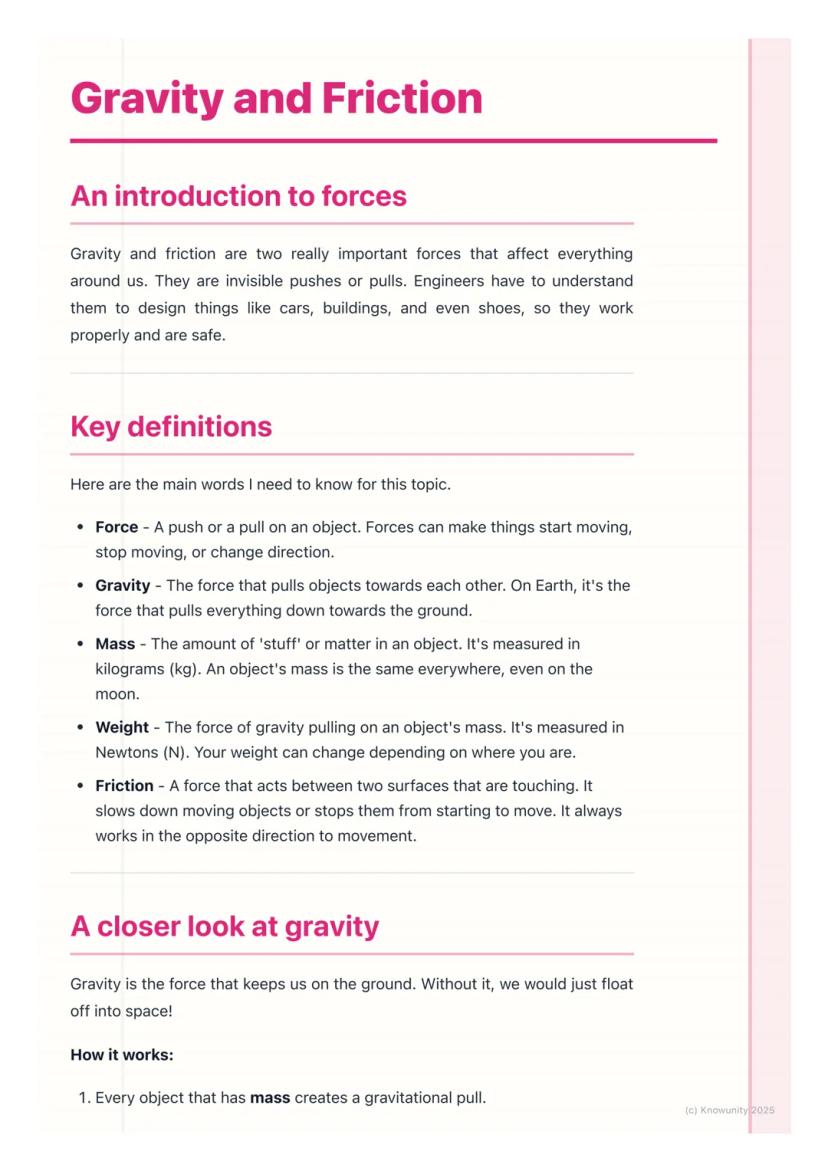
Introduction to Forces
You can't see them, but forces are constantly pushing and pulling everything around you! These invisible forces make things start moving, stop moving, or change direction completely.
Gravity is the force that keeps your feet on the ground and makes things fall down towards Earth. Friction happens when surfaces rub together - it's what stops you from sliding around like you're on ice all the time.
Engineers need to understand these forces brilliantly to design safe cars, sturdy buildings, and even the trainers on your feet. Once you get how these work, you'll start spotting them everywhere!
Quick Tip: Think of forces as invisible hands that are always pushing or pulling objects - even when nothing seems to be happening!
2
of 5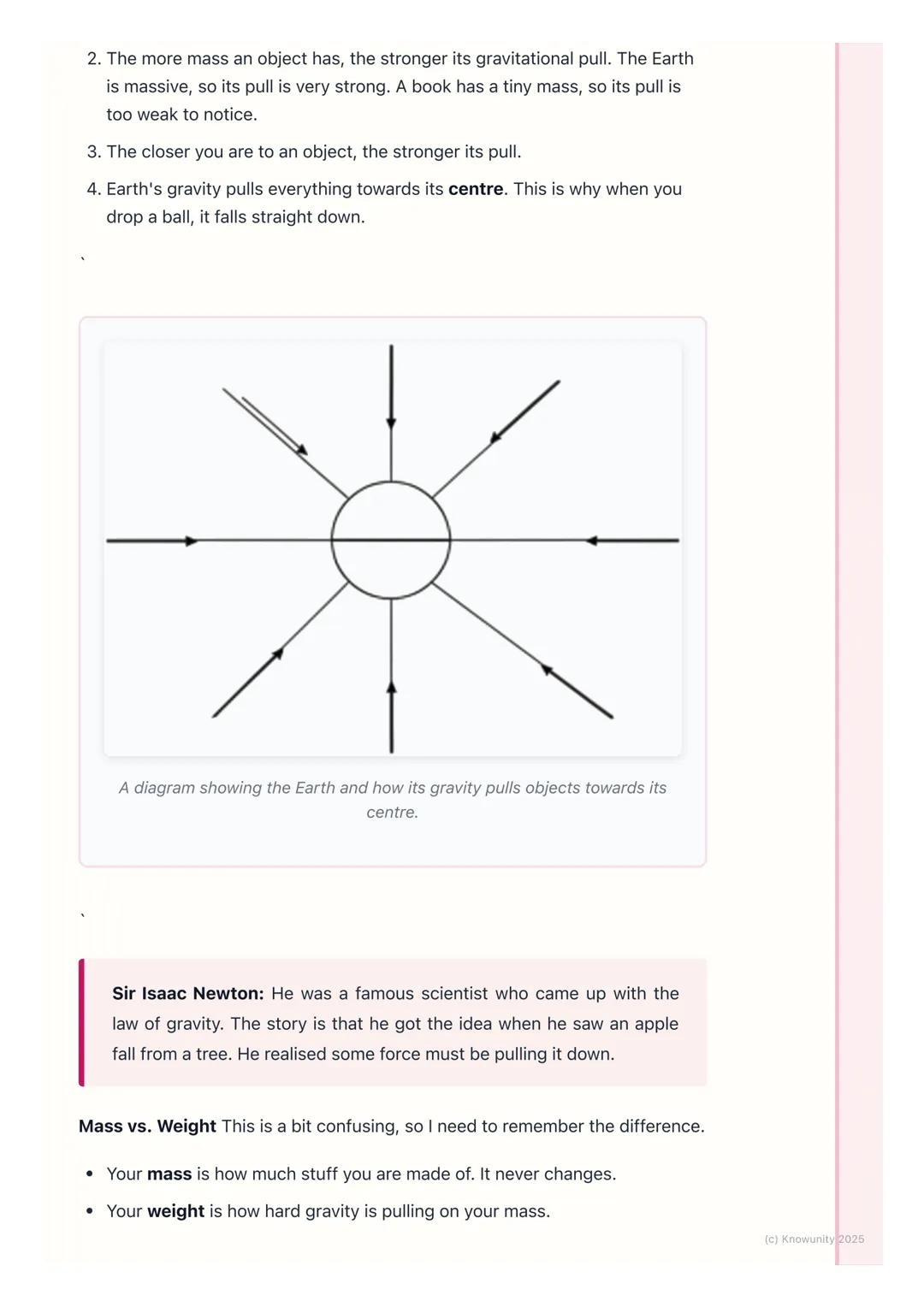
How Gravity Actually Works
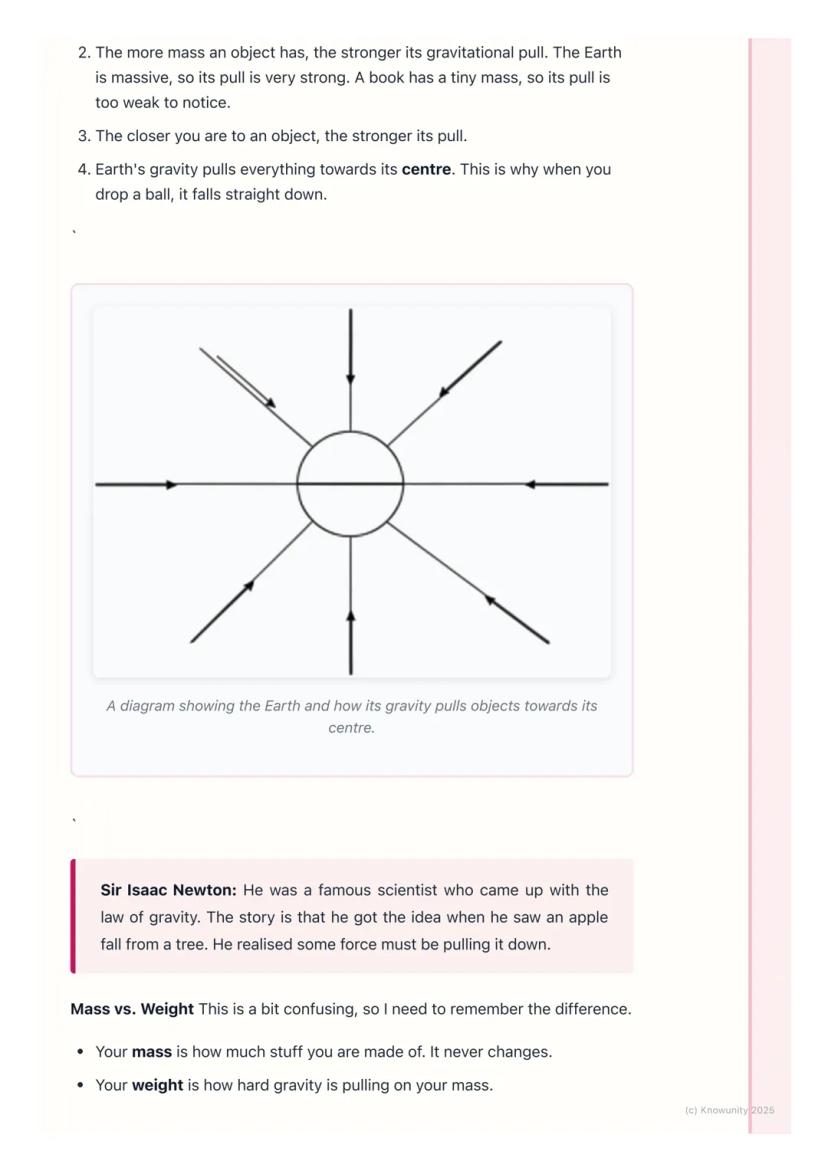
Here's the mad thing about gravity - every single object that has mass (the amount of stuff it's made of) pulls on every other object! Earth is absolutely massive, so its gravitational pull is incredibly strong.
The closer you are to something, the stronger the pull gets. That's why when you drop your phone, it falls straight down towards Earth's centre rather than floating sideways.
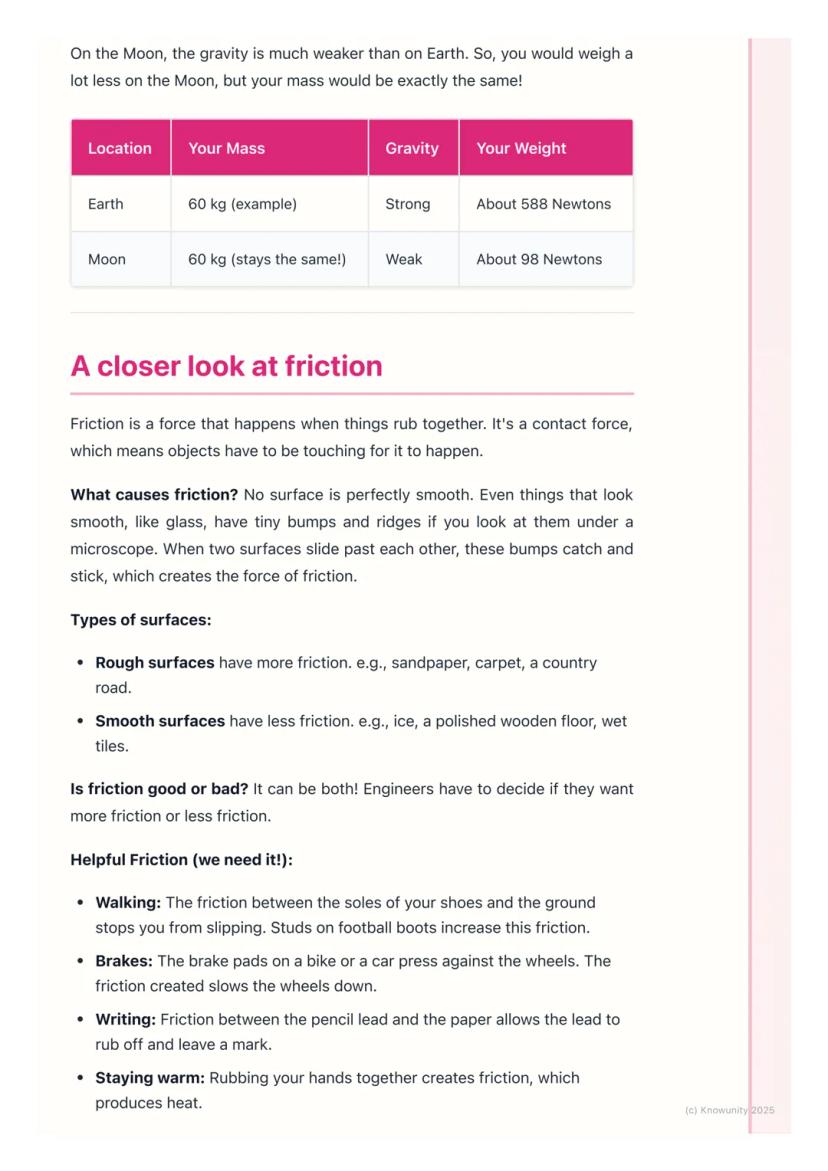
Mass versus weight trips up loads of students, but it's actually dead simple. Your mass (measured in kg) never changes - you're made of the same amount of stuff whether you're in Dublin or on the Moon. Your weight (measured in Newtons) is just how hard gravity pulls on that mass.
On the Moon, you'd weigh about six times less than on Earth, but you'd still be exactly the same person with the same mass!
Remember: Sir Isaac Newton figured out gravity when he saw an apple fall - sometimes the best discoveries come from noticing everyday things!
3
of 5
Understanding Friction
Friction is the force you feel when surfaces rub together, and it always works against movement. Even surfaces that look perfectly smooth have tiny bumps and ridges that catch and stick when they slide past each other.
Rough surfaces like sandpaper or a football pitch create loads of friction. Smooth surfaces like ice or wet tiles have much less friction - that's why they're so slippery!
Sometimes friction is brilliant and sometimes it's a right pain. You absolutely need it for walking (without it, you'd slip constantly), using brakes on your bike, or even writing with a pencil. But friction also wears out your shoes and makes it harder to push heavy things around.
Engineers get really clever about this - they add oil to engine parts to reduce unwanted friction, but they make car tyres rough to increase helpful friction with the road.
Key Point: Friction always pushes in the opposite direction to movement - if something slides right, friction pushes it left!
4
of 5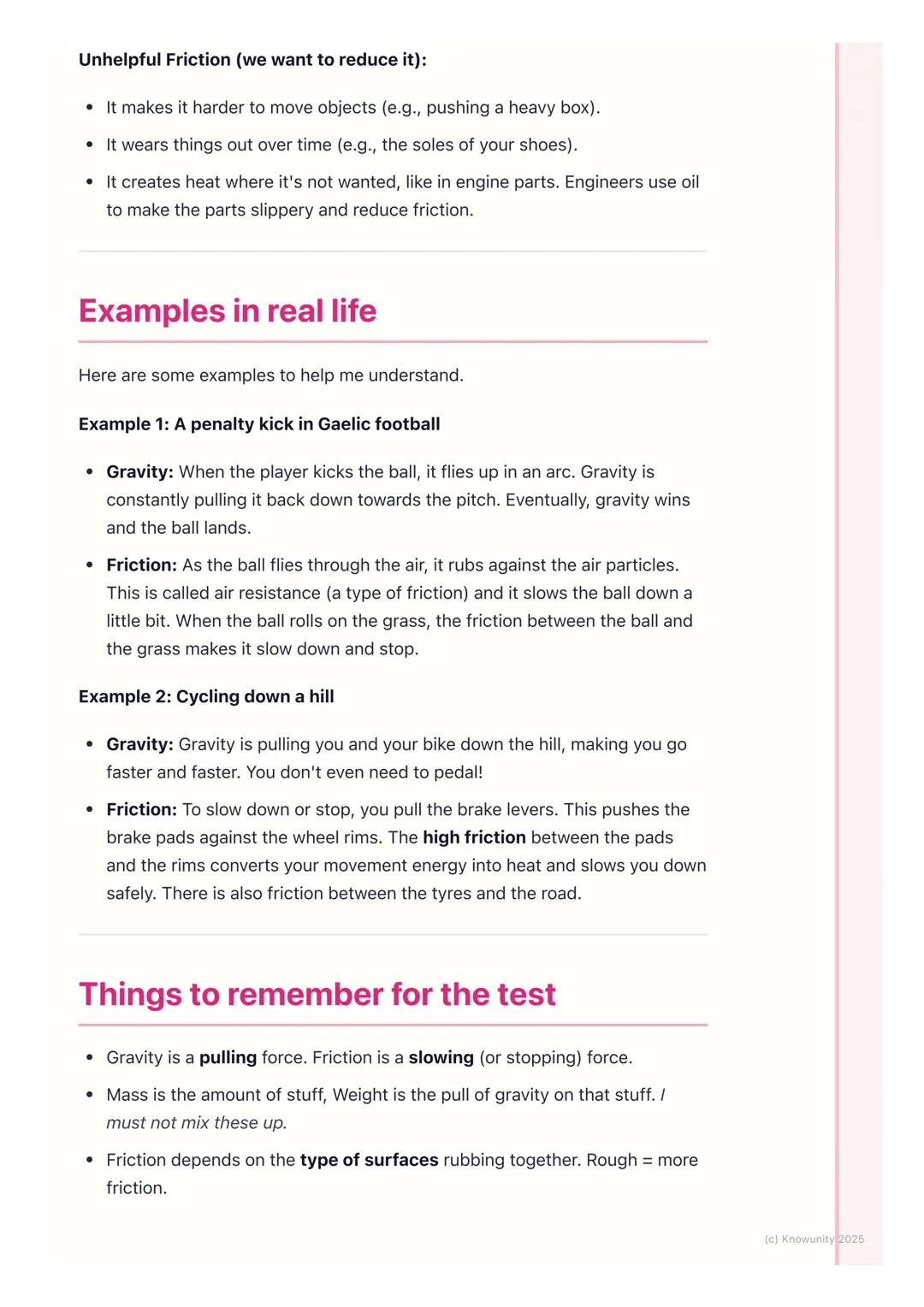
Real-Life Examples
Picture a penalty kick in Gaelic football. When the ball leaves the player's boot, gravity immediately starts pulling it back down towards the pitch. Meanwhile, air resistance (a type of friction) slows the ball down as it flies through the air.
When you're cycling down a hill, gravity pulls you faster and faster - you don't even need to pedal! To slow down safely, you squeeze the brake levers, which creates loads of friction between the brake pads and your wheel rims.
These forces work together constantly. Gravity might be pulling a book off your desk, but friction between the book and the desk surface keeps it in place. It's like an invisible tug-of-war happening all around you!
Every sport, every form of transport, and every simple task like walking involves these two forces working either together or against each other.
Think About It: Next time you're walking on different surfaces, notice how your shoes grip differently - that's friction changing with the surface type!
5
of 5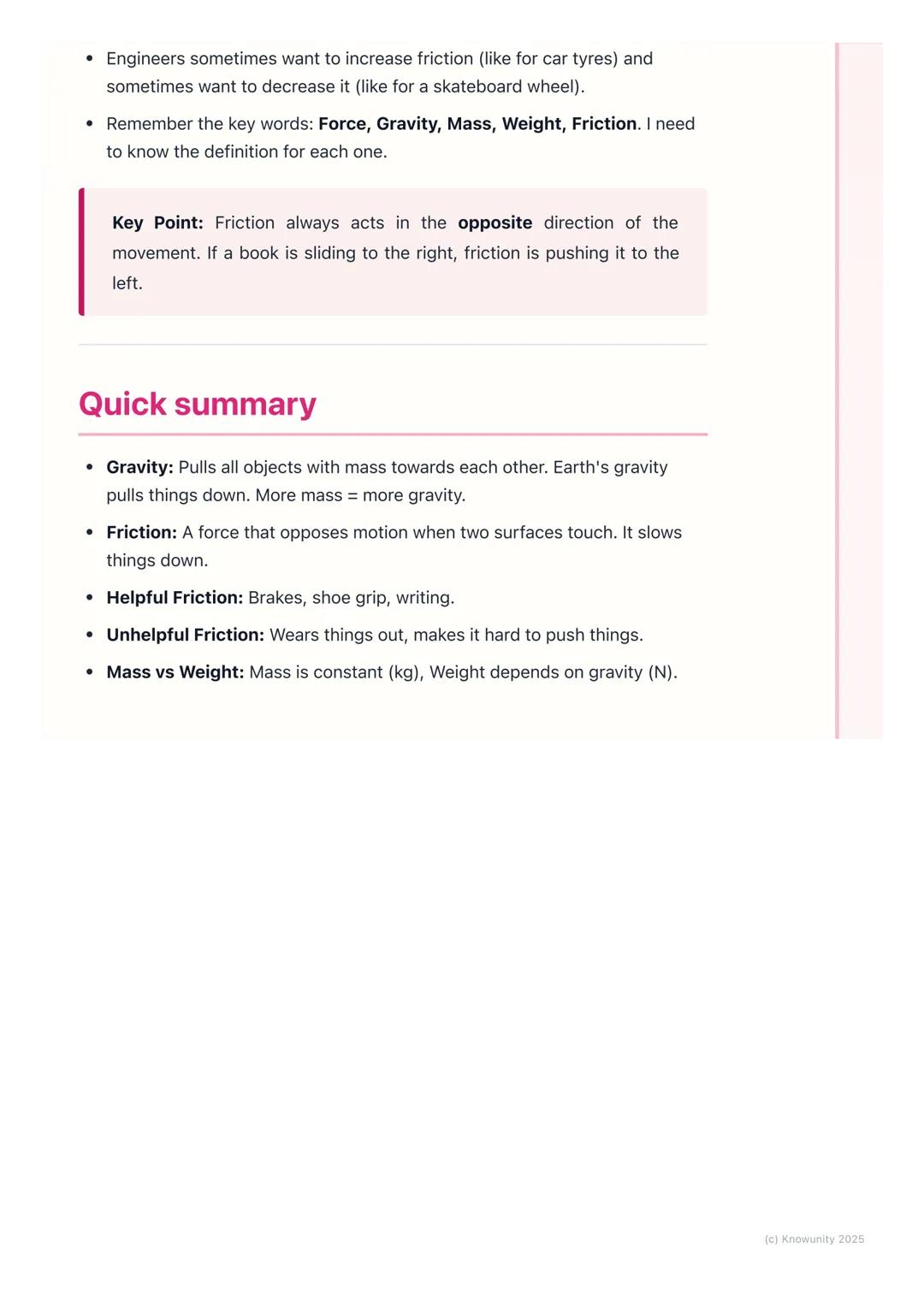
Key Points for Tests
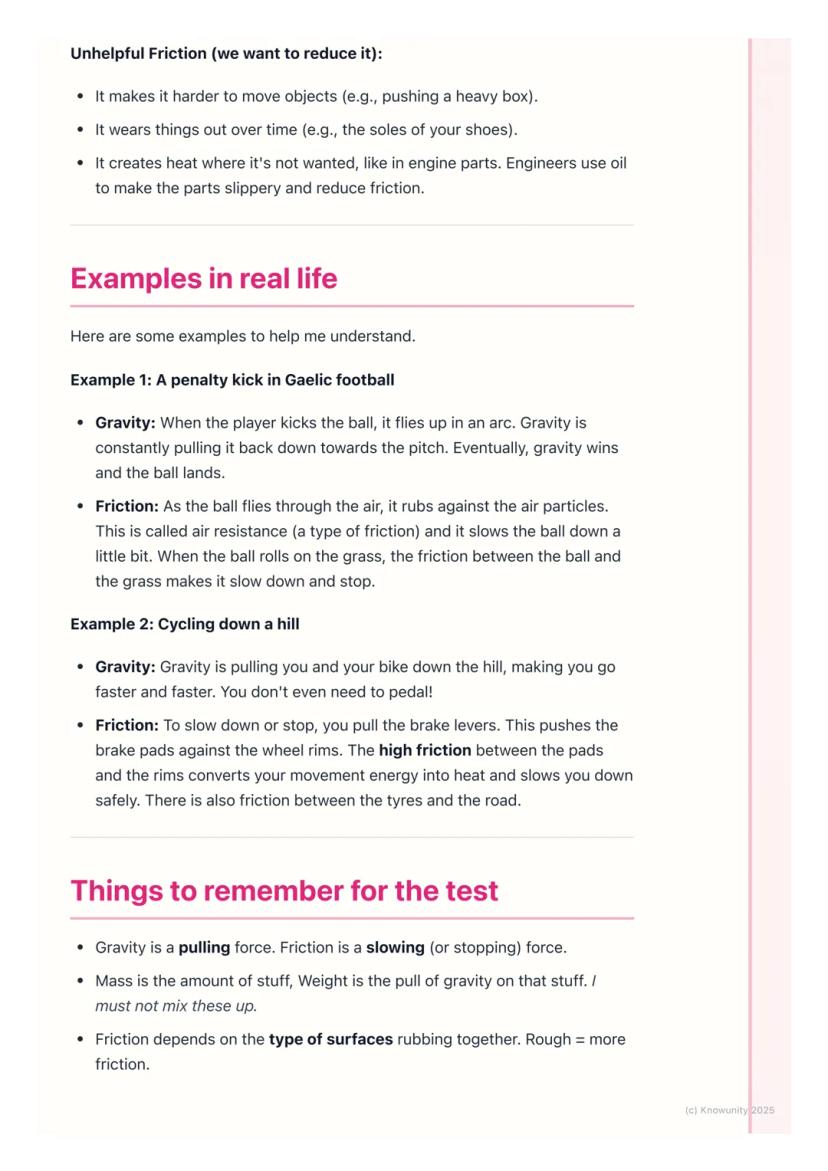
Remember that gravity always pulls objects together (on Earth, that means downwards), while friction always opposes movement between touching surfaces. Don't mix up mass and weight - mass stays constant, but weight changes depending on gravity's strength.
The type of surface makes a huge difference to friction. Engineers sometimes want more friction (like football boot studs) and sometimes want less (like skateboard wheels). Both forces are essential for understanding how things move in the real world.
For your exams, make sure you can define these terms clearly: Force (push or pull), Gravity (pulls objects towards each other), Mass (amount of matter in kg), Weight (gravity's pull measured in Newtons), and Friction (opposes motion between surfaces).
These concepts aren't just for tests though - they explain why your world works the way it does, from why you can walk without slipping to why things eventually stop moving when you let them go.
Exam Success: Practice explaining these forces using everyday examples - it makes them much easier to remember and understand!
Si on te demande...
Qu'est-ce que le compagnon IA de Knowunity ?
Notre compagnon IA est spécialement conçu pour répondre aux besoins des étudiants. Sur la base des millions d'éléments de contenu que nous avons sur la plateforme, nous pouvons fournir des réponses vraiment significatives et pertinentes aux étudiants. Mais il ne s'agit pas seulement de réponses, le compagnon a encore plus pour but de guider les élèves dans leurs défis d'apprentissage quotidiens, avec des plans d'étude personnalisés, des quiz ou des éléments de contenu dans le chat et une personnalisation à 100% basée sur les compétences et les développements de l'étudiant.
Où puis-je télécharger l'appli Knowunity ?
Tu peux télécharger l'application dans Google Play Store et dans l'App Store d'Apple.
L'application est-elle vraiment gratuite ?
Oui, tu as un accès entièrement gratuit à tous les contenus de l'appli, tu peux chatter ou suivre les créateurs à tout moment. De plus, nous proposons Knowunity Premium, qui te permet de réviser sans limites!
Contenus les plus populaires en Engineering
1Contenus les plus populaires
9Rien ne te convient ? Explore d'autres matières.
Les étudiants nous adorent — il ne manque plus que toi.
4.6/5App Store
4.7/5Google Play
L'application est très facile d'utilisation et bien conçue. Jusqu'à présent, j'ai trouvé tout ce que je cherchais et j'ai pu apprendre beaucoup de choses grâce aux présentations ! Je vais certainement utiliser l'application pour un travail en classe ! Et comme source d'inspiration personnelle, elle est bien sûr aussi très utile.
Stefan Sutilisateur iOS
Cette application est vraiment super. Il y a tellement de fiches de révision et d'aide, [...]. Par exemple, la matière qui me pose problème est le français et l'appli a un choix d'aide très large. Grâce à cette application, je me suis améliorée en français. Je la recommanderais à tout le monde.
Samantha Klichutilisatrice Android
Waouh, je suis vraiment abasourdi. J'ai essayé l'application parce que je l'avais déjà vue plusieurs fois dans la publicité et j'ai été absolument choquée. Cette appli est L'AIDE dont on rêve pour l'école et surtout, elle propose tellement de choses, comme des rédactions et des fiches qui m'ont personnellement TRÈS bien aidé.
Annautilisatrice iOS
Engineering16 vues·Mis à jour Jun 5, 2026·5 pagesUnderstanding Gravity and Friction: Key Concepts
Ever wonder why you don't float off into space when you jump, or why your shoes grip the ground when you walk? Two invisible forces called gravity and friction are working around you all the time, affecting everything from kicking...
1
of 5
Inscris-toi pour voir le contenu. C'est gratuit!
- Accès à tous les documents
- Améliore tes notes
- Rejoins des millions d'étudiants
Introduction to Forces
You can't see them, but forces are constantly pushing and pulling everything around you! These invisible forces make things start moving, stop moving, or change direction completely.
Gravity is the force that keeps your feet on the ground and makes things fall down towards Earth. Friction happens when surfaces rub together - it's what stops you from sliding around like you're on ice all the time.
Engineers need to understand these forces brilliantly to design safe cars, sturdy buildings, and even the trainers on your feet. Once you get how these work, you'll start spotting them everywhere!
Quick Tip: Think of forces as invisible hands that are always pushing or pulling objects - even when nothing seems to be happening!
2
of 5Inscris-toi pour voir le contenu. C'est gratuit!
- Accès à tous les documents
- Améliore tes notes
- Rejoins des millions d'étudiants
How Gravity Actually Works
Here's the mad thing about gravity - every single object that has mass (the amount of stuff it's made of) pulls on every other object! Earth is absolutely massive, so its gravitational pull is incredibly strong.
The closer you are to something, the stronger the pull gets. That's why when you drop your phone, it falls straight down towards Earth's centre rather than floating sideways.
Mass versus weight trips up loads of students, but it's actually dead simple. Your mass (measured in kg) never changes - you're made of the same amount of stuff whether you're in Dublin or on the Moon. Your weight (measured in Newtons) is just how hard gravity pulls on that mass.
On the Moon, you'd weigh about six times less than on Earth, but you'd still be exactly the same person with the same mass!
Remember: Sir Isaac Newton figured out gravity when he saw an apple fall - sometimes the best discoveries come from noticing everyday things!
3
of 5Inscris-toi pour voir le contenu. C'est gratuit!
- Accès à tous les documents
- Améliore tes notes
- Rejoins des millions d'étudiants
Understanding Friction
Friction is the force you feel when surfaces rub together, and it always works against movement. Even surfaces that look perfectly smooth have tiny bumps and ridges that catch and stick when they slide past each other.
Rough surfaces like sandpaper or a football pitch create loads of friction. Smooth surfaces like ice or wet tiles have much less friction - that's why they're so slippery!
Sometimes friction is brilliant and sometimes it's a right pain. You absolutely need it for walking (without it, you'd slip constantly), using brakes on your bike, or even writing with a pencil. But friction also wears out your shoes and makes it harder to push heavy things around.
Engineers get really clever about this - they add oil to engine parts to reduce unwanted friction, but they make car tyres rough to increase helpful friction with the road.
Key Point: Friction always pushes in the opposite direction to movement - if something slides right, friction pushes it left!
4
of 5Inscris-toi pour voir le contenu. C'est gratuit!
- Accès à tous les documents
- Améliore tes notes
- Rejoins des millions d'étudiants
Real-Life Examples
Picture a penalty kick in Gaelic football. When the ball leaves the player's boot, gravity immediately starts pulling it back down towards the pitch. Meanwhile, air resistance (a type of friction) slows the ball down as it flies through the air.
When you're cycling down a hill, gravity pulls you faster and faster - you don't even need to pedal! To slow down safely, you squeeze the brake levers, which creates loads of friction between the brake pads and your wheel rims.
These forces work together constantly. Gravity might be pulling a book off your desk, but friction between the book and the desk surface keeps it in place. It's like an invisible tug-of-war happening all around you!
Every sport, every form of transport, and every simple task like walking involves these two forces working either together or against each other.
Think About It: Next time you're walking on different surfaces, notice how your shoes grip differently - that's friction changing with the surface type!
5
of 5Inscris-toi pour voir le contenu. C'est gratuit!
- Accès à tous les documents
- Améliore tes notes
- Rejoins des millions d'étudiants
Key Points for Tests
Remember that gravity always pulls objects together (on Earth, that means downwards), while friction always opposes movement between touching surfaces. Don't mix up mass and weight - mass stays constant, but weight changes depending on gravity's strength.
The type of surface makes a huge difference to friction. Engineers sometimes want more friction (like football boot studs) and sometimes want less (like skateboard wheels). Both forces are essential for understanding how things move in the real world.
For your exams, make sure you can define these terms clearly: Force (push or pull), Gravity (pulls objects towards each other), Mass (amount of matter in kg), Weight (gravity's pull measured in Newtons), and Friction (opposes motion between surfaces).
These concepts aren't just for tests though - they explain why your world works the way it does, from why you can walk without slipping to why things eventually stop moving when you let them go.
Exam Success: Practice explaining these forces using everyday examples - it makes them much easier to remember and understand!
Si on te demande...
Qu'est-ce que le compagnon IA de Knowunity ?
Notre compagnon IA est spécialement conçu pour répondre aux besoins des étudiants. Sur la base des millions d'éléments de contenu que nous avons sur la plateforme, nous pouvons fournir des réponses vraiment significatives et pertinentes aux étudiants. Mais il ne s'agit pas seulement de réponses, le compagnon a encore plus pour but de guider les élèves dans leurs défis d'apprentissage quotidiens, avec des plans d'étude personnalisés, des quiz ou des éléments de contenu dans le chat et une personnalisation à 100% basée sur les compétences et les développements de l'étudiant.
Où puis-je télécharger l'appli Knowunity ?
Tu peux télécharger l'application dans Google Play Store et dans l'App Store d'Apple.
L'application est-elle vraiment gratuite ?
Oui, tu as un accès entièrement gratuit à tous les contenus de l'appli, tu peux chatter ou suivre les créateurs à tout moment. De plus, nous proposons Knowunity Premium, qui te permet de réviser sans limites!
Contenus les plus populaires en Engineering
1Contenus les plus populaires
9Rien ne te convient ? Explore d'autres matières.
Les étudiants nous adorent — il ne manque plus que toi.
4.6/5App Store
4.7/5Google Play
L'application est très facile d'utilisation et bien conçue. Jusqu'à présent, j'ai trouvé tout ce que je cherchais et j'ai pu apprendre beaucoup de choses grâce aux présentations ! Je vais certainement utiliser l'application pour un travail en classe ! Et comme source d'inspiration personnelle, elle est bien sûr aussi très utile.
Stefan Sutilisateur iOS
Cette application est vraiment super. Il y a tellement de fiches de révision et d'aide, [...]. Par exemple, la matière qui me pose problème est le français et l'appli a un choix d'aide très large. Grâce à cette application, je me suis améliorée en français. Je la recommanderais à tout le monde.
Samantha Klichutilisatrice Android
Waouh, je suis vraiment abasourdi. J'ai essayé l'application parce que je l'avais déjà vue plusieurs fois dans la publicité et j'ai été absolument choquée. Cette appli est L'AIDE dont on rêve pour l'école et surtout, elle propose tellement de choses, comme des rédactions et des fiches qui m'ont personnellement TRÈS bien aidé.
Annautilisatrice iOS