
Ever wonder why bridges are made from steel instead of...
 Engineering2 vues·Mis à jour Jun 14, 2026·6 pages
Understanding Material Properties
1 / 6
1
of 6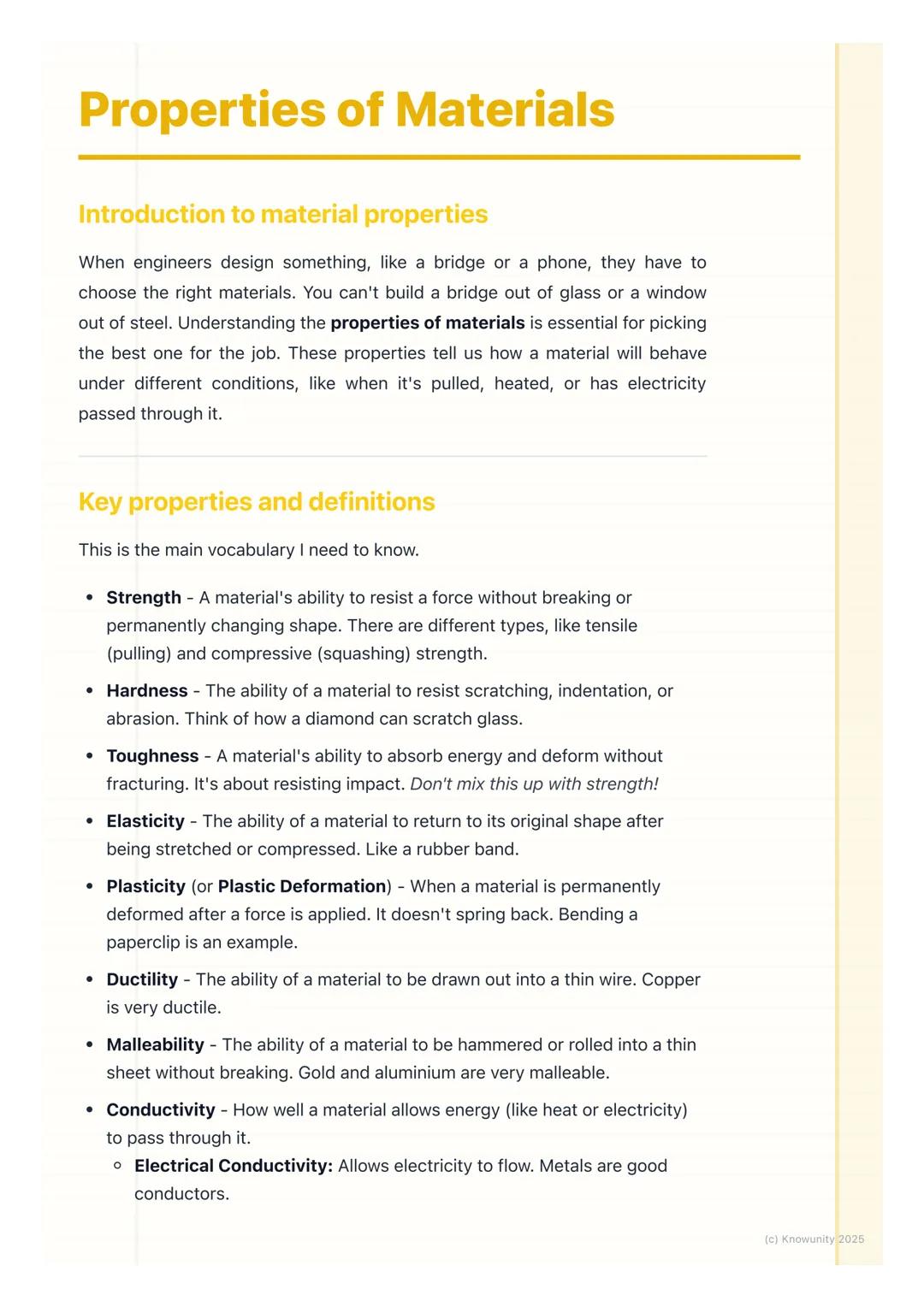
Introduction to Material Properties
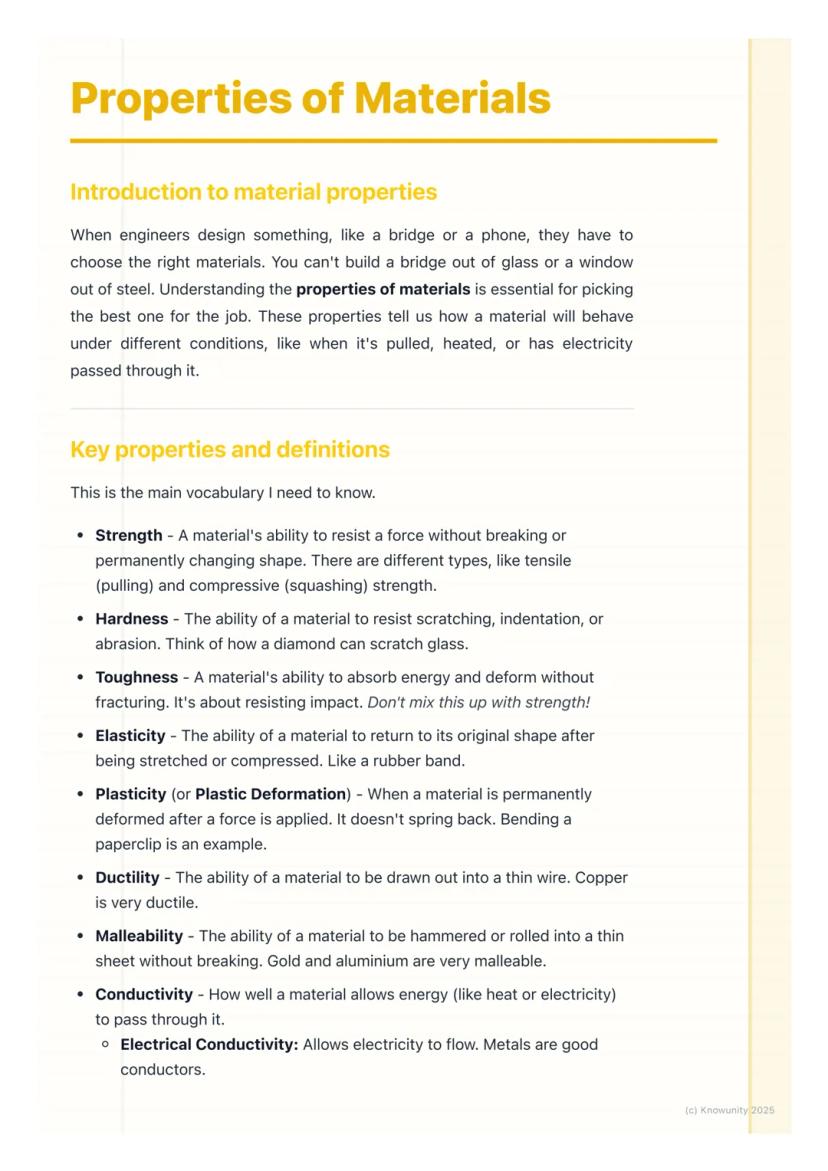
Choosing the right material for any project is like picking the right tool for a job - get it wrong and everything falls apart! Material properties are the characteristics that tell us how a substance will behave under different conditions.
Understanding these properties is absolutely crucial for engineers designing everything from bridges to smartphones. They need to know whether a material will bend without breaking, conduct electricity, or withstand extreme temperatures.
The key is matching the material's natural abilities to what the job demands. You wouldn't use rubber for a building foundation or concrete for electrical wires - each material has its own superpowers and weaknesses.
Remember: Every material choice in engineering comes down to finding the perfect match between what's needed and what the material can actually do.
2
of 6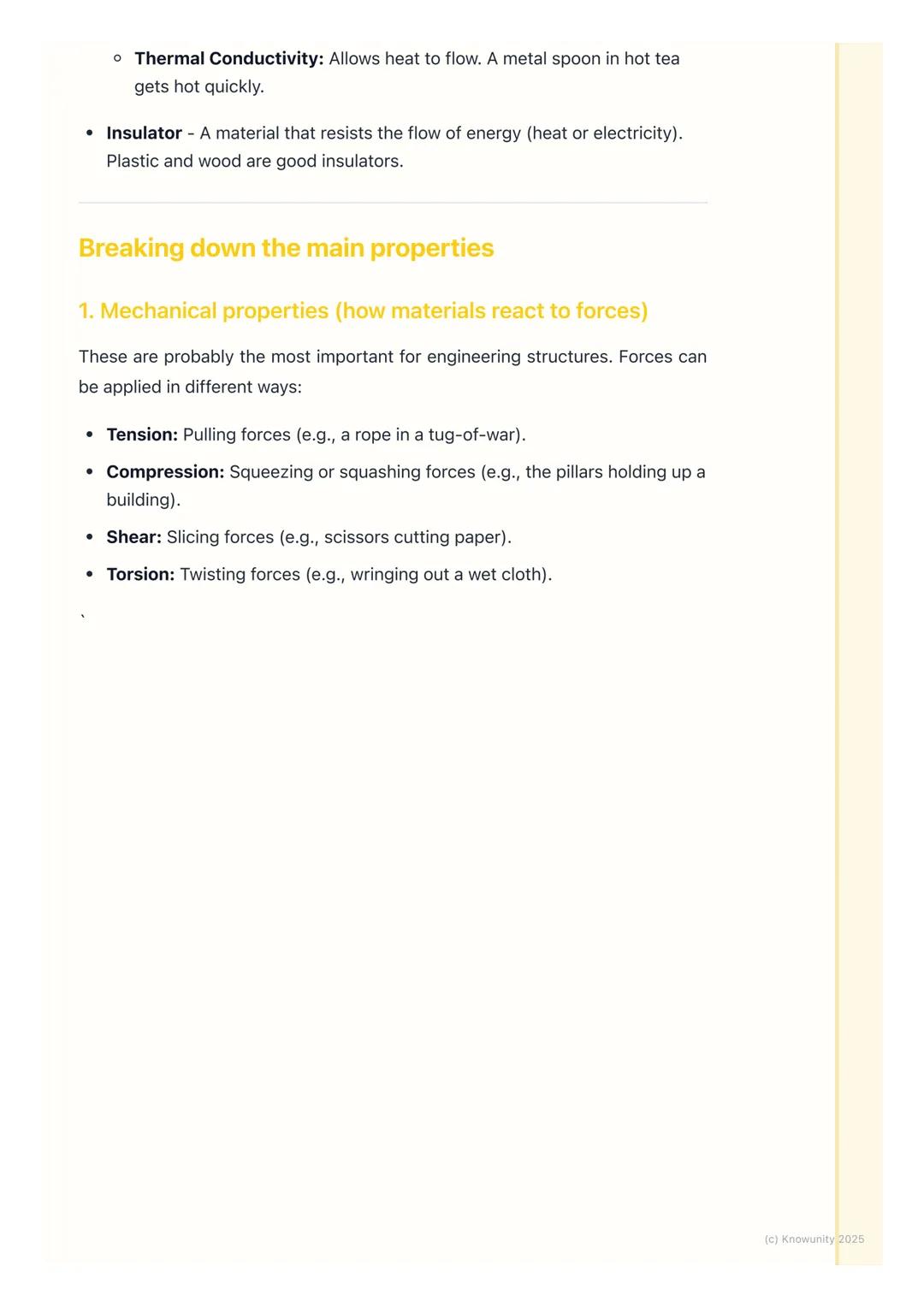
Key Mechanical Properties
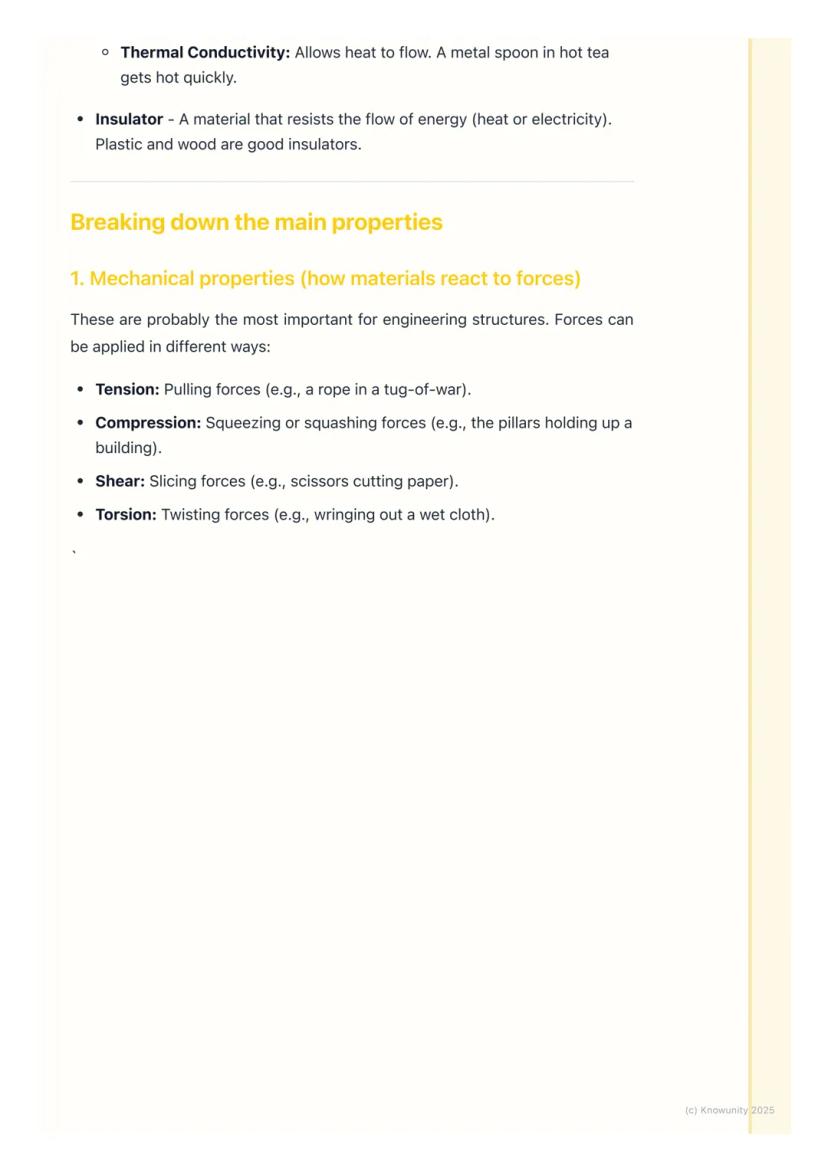
Mechanical properties are all about how materials handle forces - and there are some crucial differences you need to nail down. Strength is a material's ability to resist breaking under steady forces, whether that's tension (pulling), compression (squashing), or shear (slicing).
Don't confuse strength with toughness - that's a material's ability to absorb sudden impacts without fracturing. Think of it this way: glass is strong but not tough (it shatters when dropped), while a car bumper is tough because it absorbs crash energy.
Hardness is completely different again - it's about resisting scratches and surface damage. A diamond is incredibly hard, which is why it can cut through almost anything else.
Pro tip: Ceramic tiles are strong in compression but brittle under impact - perfect for floors but terrible for hammers!
3
of 6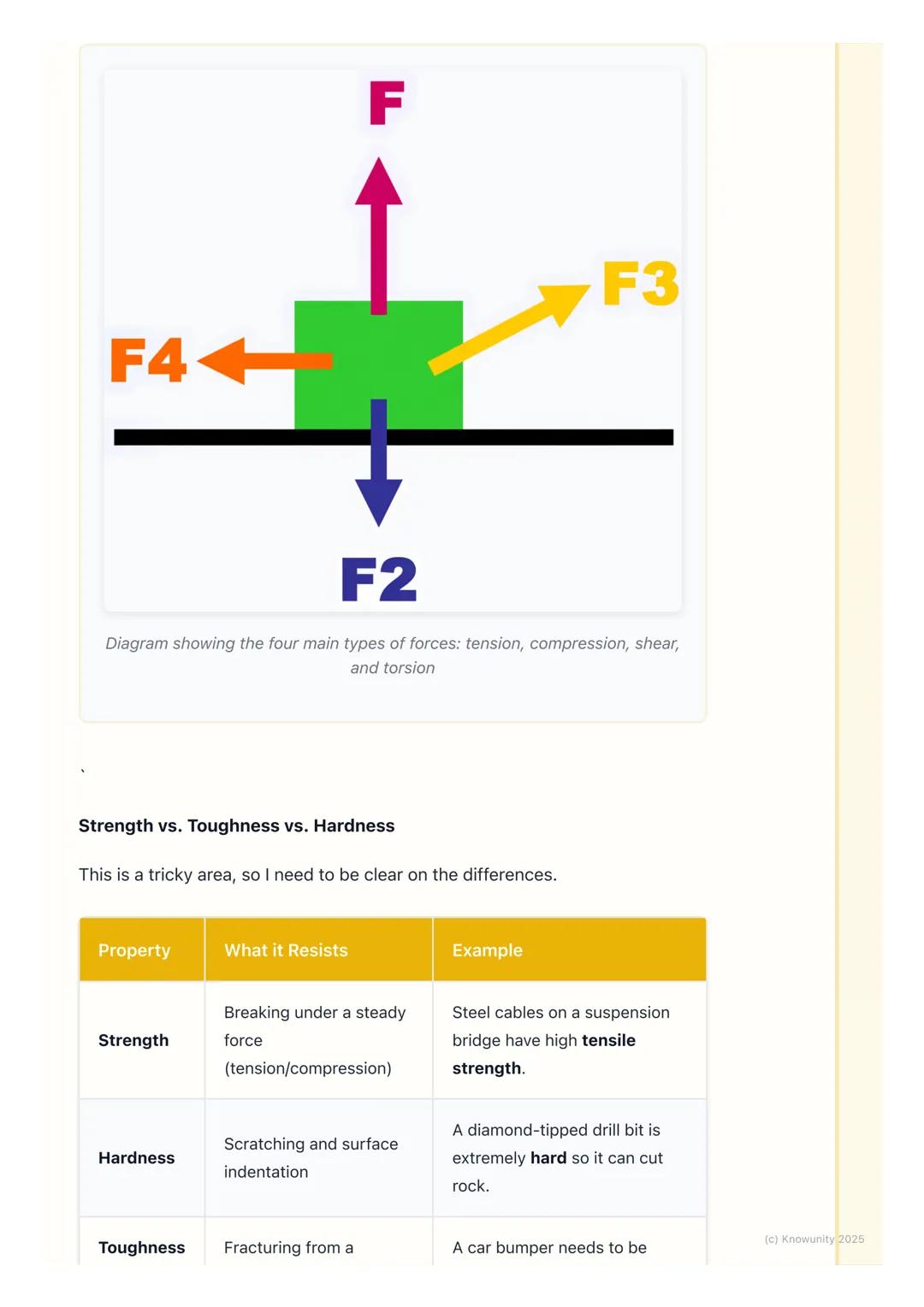
Elasticity vs Plasticity
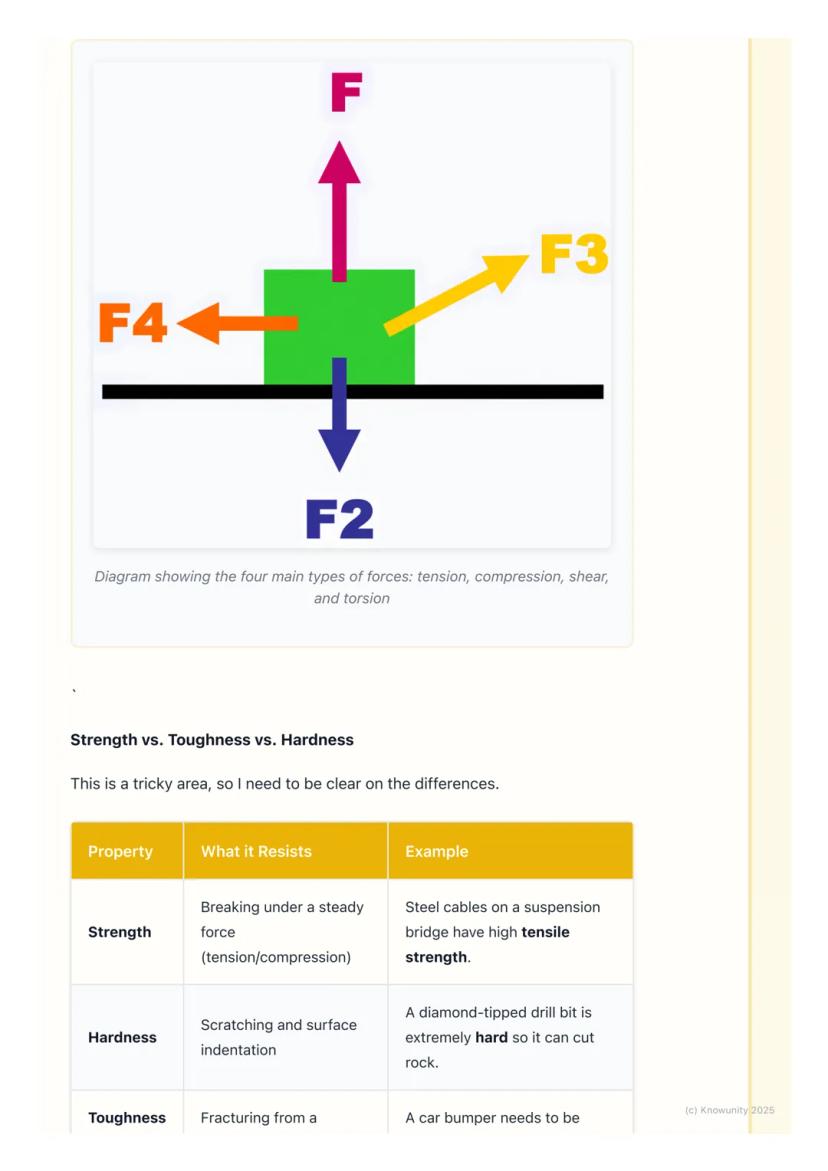
Here's where things get interesting - what happens when you remove the force? Elastic deformation means the material springs back to its original shape, like a rubber band or spring. The elastic limit is the maximum force you can apply before this stops working.
Plastic deformation is permanent - once you've bent that paperclip or crushed that can, it's staying that way. This isn't necessarily bad; sometimes you want materials to deform permanently.
Two special types of plasticity are ductility and malleability . Most materials that are good at one are good at both.
Quick check: If you can stretch it into a wire, it's ductile. If you can hammer it flat, it's malleable.
4
of 6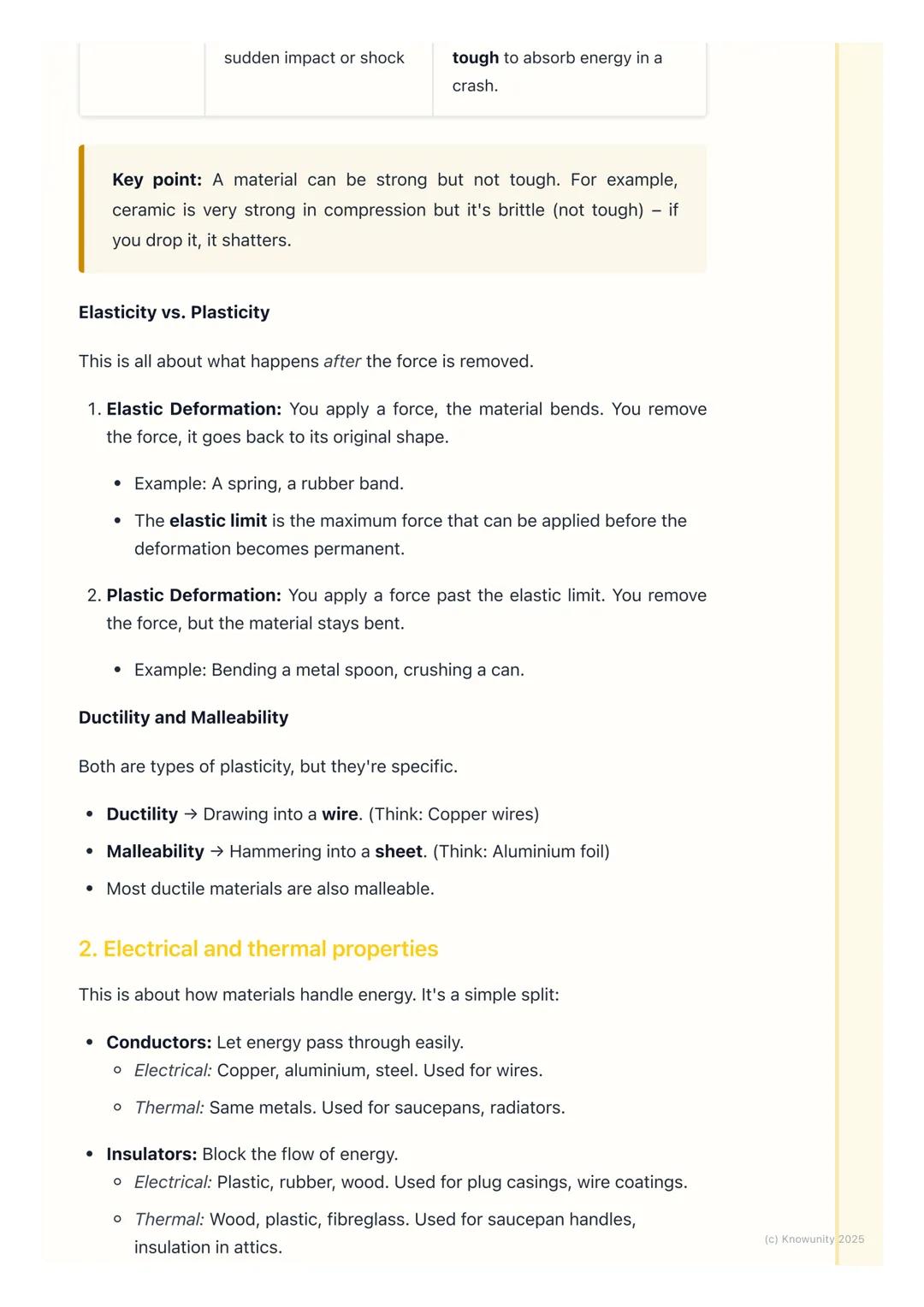
Electrical and Thermal Properties
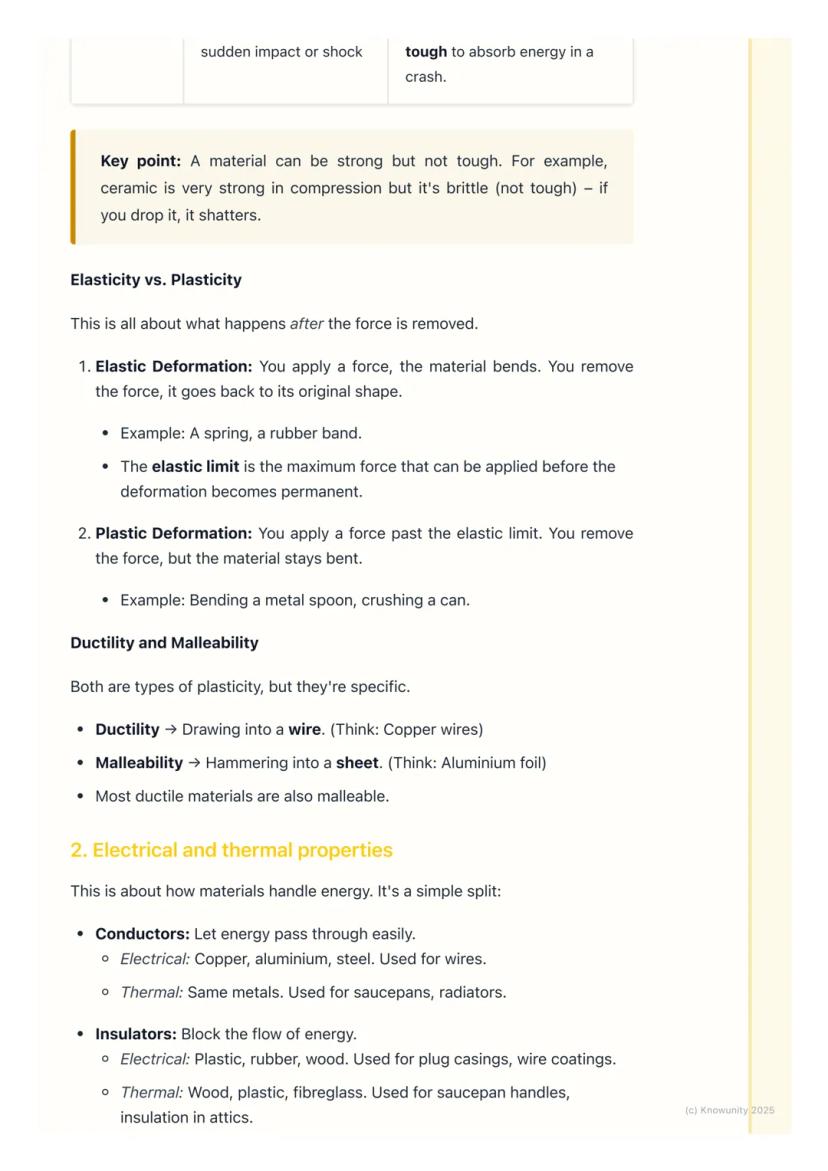
Materials either let energy flow through them or block it - there's no middle ground here! Conductors like copper, aluminium and steel let both electricity and heat pass through easily, which is why they're used for wires and saucepans.
Insulators like plastic, rubber and wood block energy flow. That's why electrical plugs have plastic casings and saucepans have wooden handles - you don't want electricity or heat reaching you!
The same materials that conduct electricity usually conduct heat too, and the same materials that insulate against electricity also insulate against heat. This makes choosing materials much simpler.
Real-world connection: Your phone charger uses copper wires (conductor) wrapped in plastic (insulator) - perfect combo!
5
of 6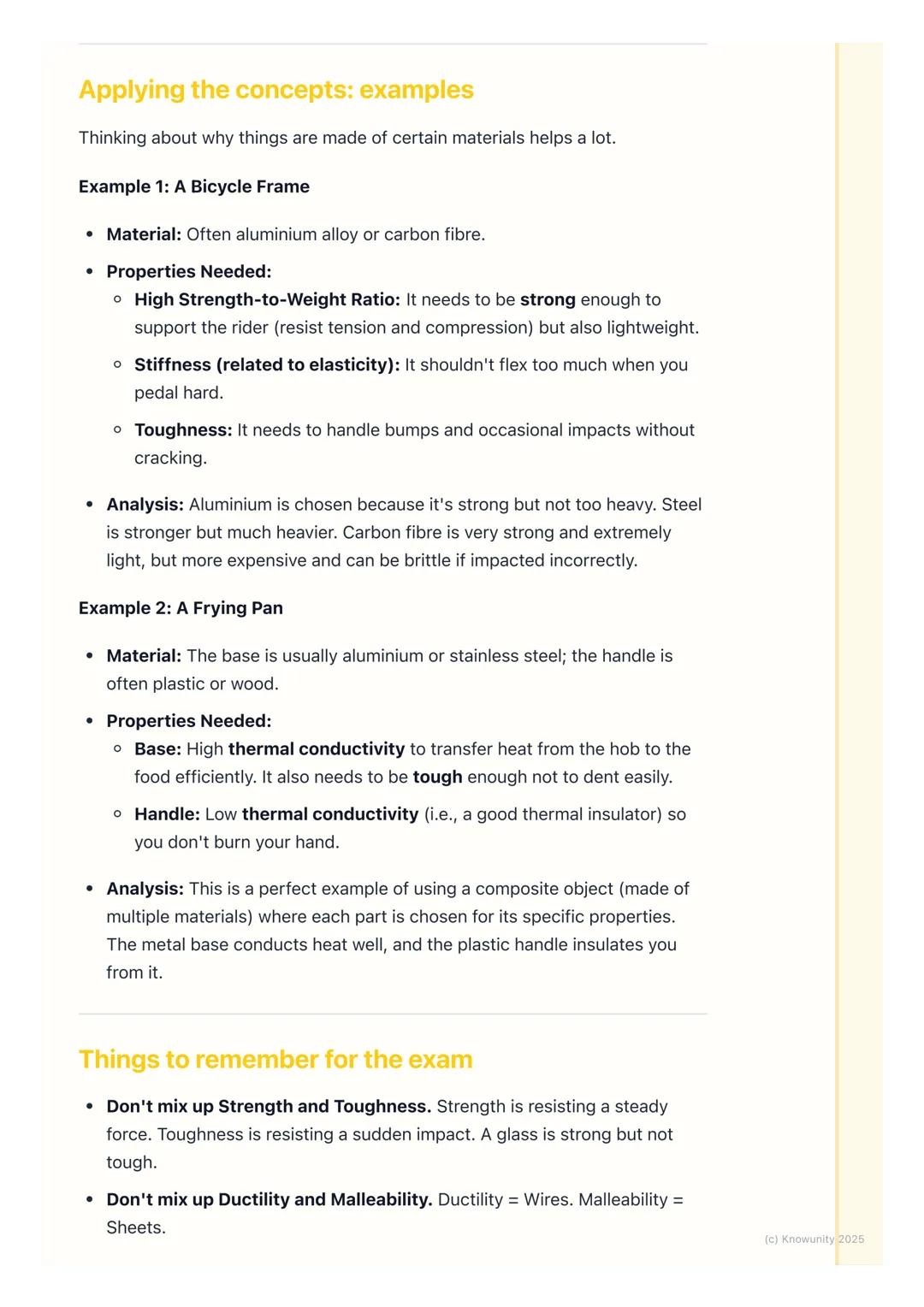
Real-World Applications
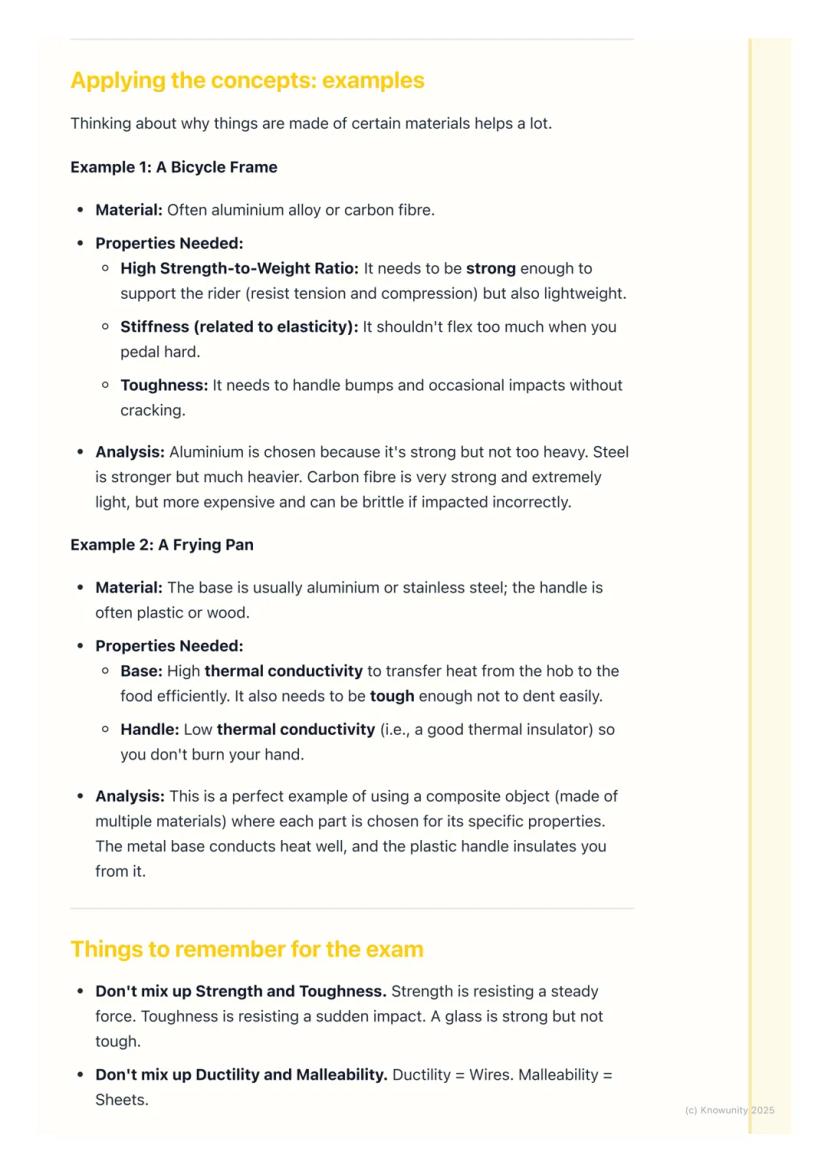
Let's see how this works in practice! A bicycle frame needs high strength-to-weight ratio (strong but light), stiffness (won't flex when pedalling), and toughness (handles bumps). That's why they use aluminium alloy or carbon fibre instead of steel or plastic.
A frying pan shows brilliant material pairing - the base is aluminium or steel for high thermal conductivity (heats food efficiently), while the handle is plastic or wood for thermal insulation (protects your hand). Each part does its specific job perfectly.
These examples show why engineers often use composite objects made from multiple materials. Instead of finding one perfect material, they combine different materials where each one's properties shine.
Think like an engineer: Always ask "What does this part need to do?" then match those needs to material properties.
6
of 6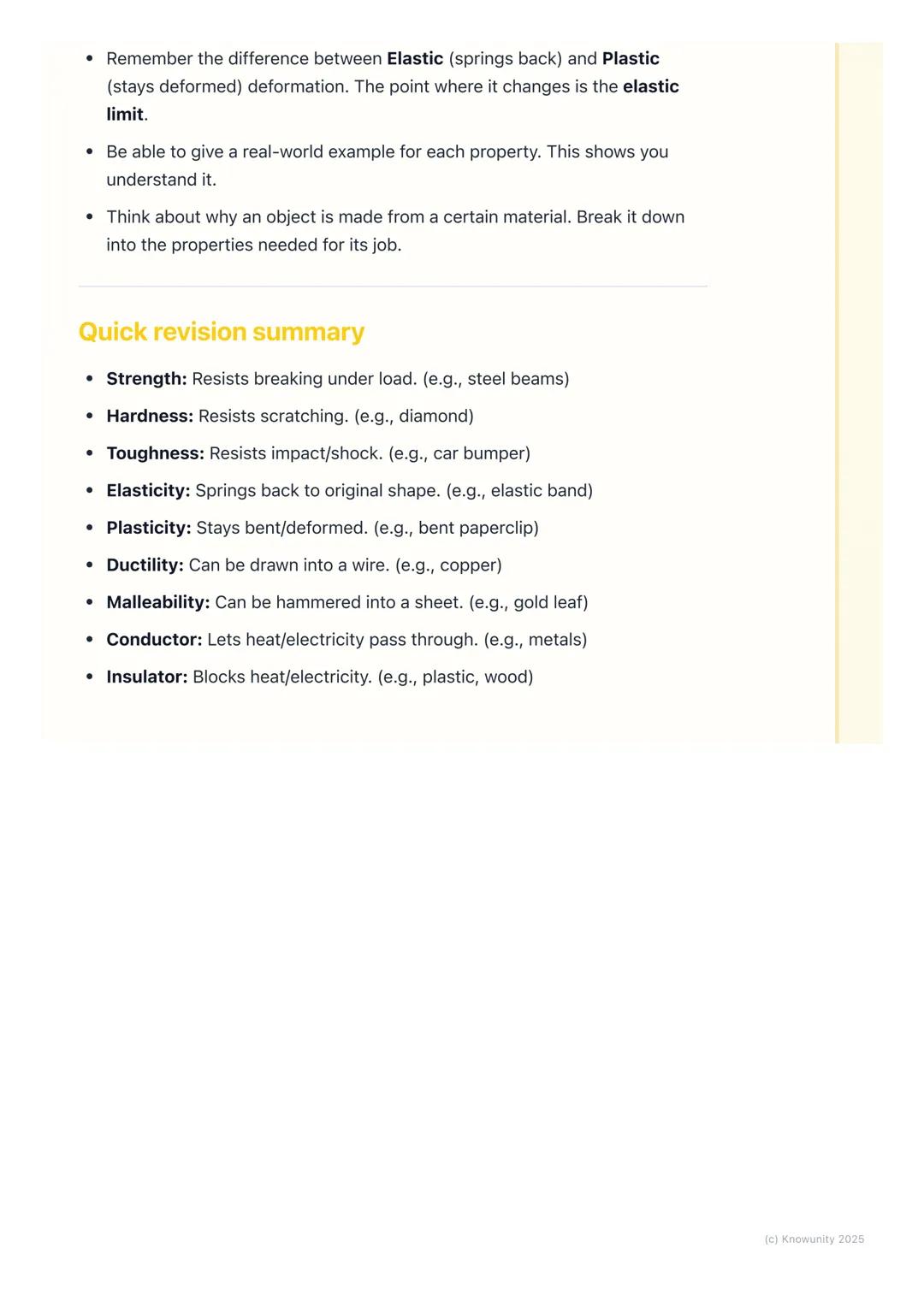
Exam Success Tips
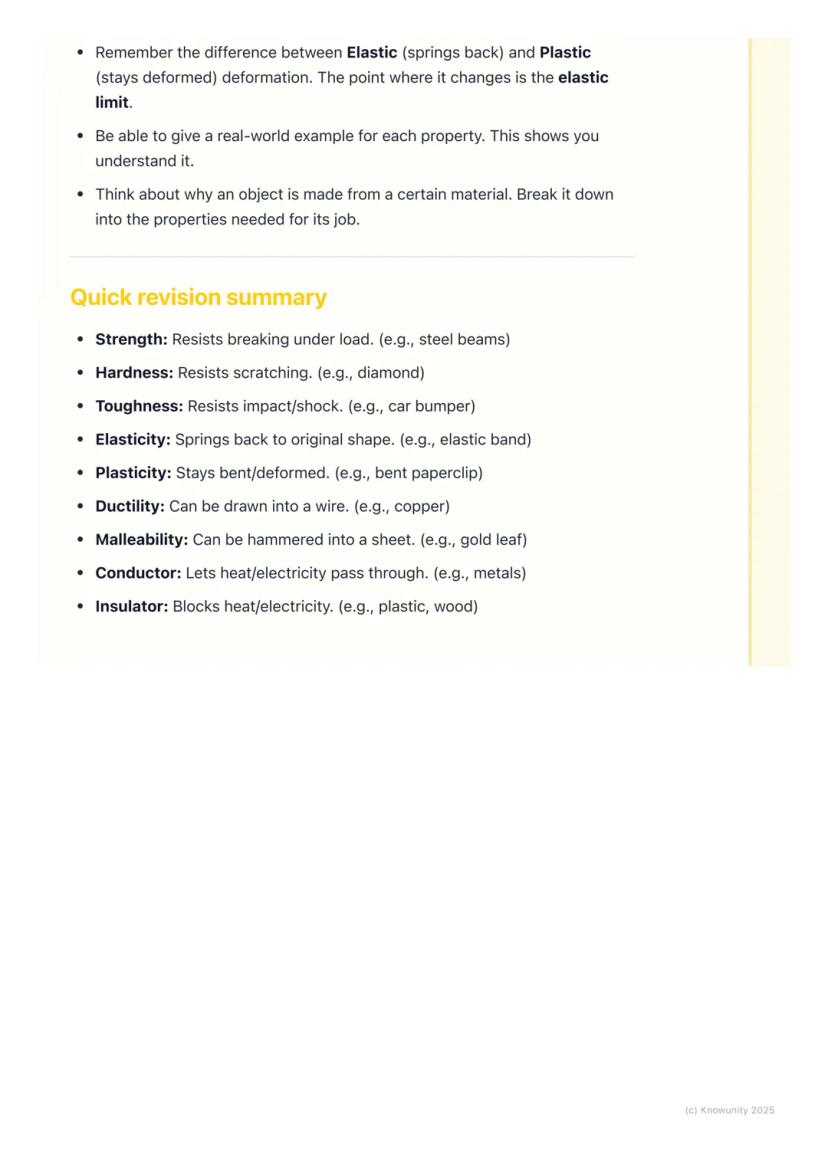
Here are the key points that trip up students: Don't mix up strength (resists steady forces) with toughness (resists sudden impacts). Remember that ductility means wires and malleability means sheets.
The elastic limit is your friend - it's the point where materials stop springing back and start staying bent. Understanding this helps explain why springs work and why bent metal doesn't fix itself.
For any exam question about material choice, break it down systematically: what forces will act on it? Does it need to conduct or insulate? How important is weight? Then match these needs to the right properties.
Exam strategy: Always give real-world examples - they prove you understand the concept, not just the definition.
Si on te demande...
Qu'est-ce que le compagnon IA de Knowunity ?
Notre compagnon IA est spécialement conçu pour répondre aux besoins des étudiants. Sur la base des millions d'éléments de contenu que nous avons sur la plateforme, nous pouvons fournir des réponses vraiment significatives et pertinentes aux étudiants. Mais il ne s'agit pas seulement de réponses, le compagnon a encore plus pour but de guider les élèves dans leurs défis d'apprentissage quotidiens, avec des plans d'étude personnalisés, des quiz ou des éléments de contenu dans le chat et une personnalisation à 100% basée sur les compétences et les développements de l'étudiant.
Où puis-je télécharger l'appli Knowunity ?
Tu peux télécharger l'application dans Google Play Store et dans l'App Store d'Apple.
L'application est-elle vraiment gratuite ?
Oui, tu as un accès entièrement gratuit à tous les contenus de l'appli, tu peux chatter ou suivre les créateurs à tout moment. De plus, nous proposons Knowunity Premium, qui te permet de réviser sans limites!
Contenus les plus populaires en Engineering
1Contenus les plus populaires
9 Irish
IrishIrish oral questions and answers
Questions and answers for the leaving cert oral
5th Year4264
 English
Key Quotes : Sive
Key Quotes and explanations: Sive
6th Year2842
IrishIrish oral questions
Outline of oral questions
5th Year2055
IrishIníon- le hÁine Durkin
Aine Durkin’s poem, Iníon: Themes & summary
5th Year890
IrishIrish poetry 2027
Iníon + Dínit an Bhróin
5th Year1153
IrishLC HL notes- Iníon (poem)
Includes poem in English and Irish, theme, key words & phrases
5th Year2304
EnglishCultural Context : Shawshank Redemption : Sive : Small Things Like These
Comparative Study : Cultural Context : Shawshank Redemption, Sive and Small Things Like These
6th Year1430
IrishMo Ghrá-sa (Idir Lúibíní)
Notes on mo ghrá-sa
5th Year380
IrishAn Gaeilge Aiste
Irish Language essay
6th Year1320
Rien ne te convient ? Explore d'autres matières.
Les étudiants nous adorent — il ne manque plus que toi.
4.6/5App Store
4.7/5Google Play
L'application est très facile d'utilisation et bien conçue. Jusqu'à présent, j'ai trouvé tout ce que je cherchais et j'ai pu apprendre beaucoup de choses grâce aux présentations ! Je vais certainement utiliser l'application pour un travail en classe ! Et comme source d'inspiration personnelle, elle est bien sûr aussi très utile.
Stefan Sutilisateur iOS
Cette application est vraiment super. Il y a tellement de fiches de révision et d'aide, [...]. Par exemple, la matière qui me pose problème est le français et l'appli a un choix d'aide très large. Grâce à cette application, je me suis améliorée en français. Je la recommanderais à tout le monde.
Samantha Klichutilisatrice Android
Waouh, je suis vraiment abasourdi. J'ai essayé l'application parce que je l'avais déjà vue plusieurs fois dans la publicité et j'ai été absolument choquée. Cette appli est L'AIDE dont on rêve pour l'école et surtout, elle propose tellement de choses, comme des rédactions et des fiches qui m'ont personnellement TRÈS bien aidé.
Annautilisatrice iOS
Engineering2 vues·Mis à jour Jun 14, 2026·6 pagesUnderstanding Material Properties
Ever wonder why bridges are made from steel instead of glass, or why phone cases aren't made from metal? Engineers have to choose the perfect materials for every job, and it all comes down to understanding material properties. These properties...
1
of 6
Inscris-toi pour voir le contenu. C'est gratuit!
- Accès à tous les documents
- Améliore tes notes
- Rejoins des millions d'étudiants
Introduction to Material Properties
Choosing the right material for any project is like picking the right tool for a job - get it wrong and everything falls apart! Material properties are the characteristics that tell us how a substance will behave under different conditions.
Understanding these properties is absolutely crucial for engineers designing everything from bridges to smartphones. They need to know whether a material will bend without breaking, conduct electricity, or withstand extreme temperatures.
The key is matching the material's natural abilities to what the job demands. You wouldn't use rubber for a building foundation or concrete for electrical wires - each material has its own superpowers and weaknesses.
Remember: Every material choice in engineering comes down to finding the perfect match between what's needed and what the material can actually do.
2
of 6Inscris-toi pour voir le contenu. C'est gratuit!
- Accès à tous les documents
- Améliore tes notes
- Rejoins des millions d'étudiants
Key Mechanical Properties
Mechanical properties are all about how materials handle forces - and there are some crucial differences you need to nail down. Strength is a material's ability to resist breaking under steady forces, whether that's tension (pulling), compression (squashing), or shear (slicing).
Don't confuse strength with toughness - that's a material's ability to absorb sudden impacts without fracturing. Think of it this way: glass is strong but not tough (it shatters when dropped), while a car bumper is tough because it absorbs crash energy.
Hardness is completely different again - it's about resisting scratches and surface damage. A diamond is incredibly hard, which is why it can cut through almost anything else.
Pro tip: Ceramic tiles are strong in compression but brittle under impact - perfect for floors but terrible for hammers!
3
of 6Inscris-toi pour voir le contenu. C'est gratuit!
- Accès à tous les documents
- Améliore tes notes
- Rejoins des millions d'étudiants
Elasticity vs Plasticity
Here's where things get interesting - what happens when you remove the force? Elastic deformation means the material springs back to its original shape, like a rubber band or spring. The elastic limit is the maximum force you can apply before this stops working.
Plastic deformation is permanent - once you've bent that paperclip or crushed that can, it's staying that way. This isn't necessarily bad; sometimes you want materials to deform permanently.
Two special types of plasticity are ductility and malleability . Most materials that are good at one are good at both.
Quick check: If you can stretch it into a wire, it's ductile. If you can hammer it flat, it's malleable.
4
of 6Inscris-toi pour voir le contenu. C'est gratuit!
- Accès à tous les documents
- Améliore tes notes
- Rejoins des millions d'étudiants
Electrical and Thermal Properties
Materials either let energy flow through them or block it - there's no middle ground here! Conductors like copper, aluminium and steel let both electricity and heat pass through easily, which is why they're used for wires and saucepans.
Insulators like plastic, rubber and wood block energy flow. That's why electrical plugs have plastic casings and saucepans have wooden handles - you don't want electricity or heat reaching you!
The same materials that conduct electricity usually conduct heat too, and the same materials that insulate against electricity also insulate against heat. This makes choosing materials much simpler.
Real-world connection: Your phone charger uses copper wires (conductor) wrapped in plastic (insulator) - perfect combo!
5
of 6Inscris-toi pour voir le contenu. C'est gratuit!
- Accès à tous les documents
- Améliore tes notes
- Rejoins des millions d'étudiants
Real-World Applications
Let's see how this works in practice! A bicycle frame needs high strength-to-weight ratio (strong but light), stiffness (won't flex when pedalling), and toughness (handles bumps). That's why they use aluminium alloy or carbon fibre instead of steel or plastic.
A frying pan shows brilliant material pairing - the base is aluminium or steel for high thermal conductivity (heats food efficiently), while the handle is plastic or wood for thermal insulation (protects your hand). Each part does its specific job perfectly.
These examples show why engineers often use composite objects made from multiple materials. Instead of finding one perfect material, they combine different materials where each one's properties shine.
Think like an engineer: Always ask "What does this part need to do?" then match those needs to material properties.
6
of 6Inscris-toi pour voir le contenu. C'est gratuit!
- Accès à tous les documents
- Améliore tes notes
- Rejoins des millions d'étudiants
Exam Success Tips
Here are the key points that trip up students: Don't mix up strength (resists steady forces) with toughness (resists sudden impacts). Remember that ductility means wires and malleability means sheets.
The elastic limit is your friend - it's the point where materials stop springing back and start staying bent. Understanding this helps explain why springs work and why bent metal doesn't fix itself.
For any exam question about material choice, break it down systematically: what forces will act on it? Does it need to conduct or insulate? How important is weight? Then match these needs to the right properties.
Exam strategy: Always give real-world examples - they prove you understand the concept, not just the definition.
Si on te demande...
Qu'est-ce que le compagnon IA de Knowunity ?
Notre compagnon IA est spécialement conçu pour répondre aux besoins des étudiants. Sur la base des millions d'éléments de contenu que nous avons sur la plateforme, nous pouvons fournir des réponses vraiment significatives et pertinentes aux étudiants. Mais il ne s'agit pas seulement de réponses, le compagnon a encore plus pour but de guider les élèves dans leurs défis d'apprentissage quotidiens, avec des plans d'étude personnalisés, des quiz ou des éléments de contenu dans le chat et une personnalisation à 100% basée sur les compétences et les développements de l'étudiant.
Où puis-je télécharger l'appli Knowunity ?
Tu peux télécharger l'application dans Google Play Store et dans l'App Store d'Apple.
L'application est-elle vraiment gratuite ?
Oui, tu as un accès entièrement gratuit à tous les contenus de l'appli, tu peux chatter ou suivre les créateurs à tout moment. De plus, nous proposons Knowunity Premium, qui te permet de réviser sans limites!
Contenus les plus populaires en Engineering
1Contenus les plus populaires
9IrishIrish oral questions and answers
Questions and answers for the leaving cert oral
5th Year4264
EnglishKey Quotes : Sive
Key Quotes and explanations: Sive
6th Year2842
IrishIrish oral questions
Outline of oral questions
5th Year2055
IrishIníon- le hÁine Durkin
Aine Durkin’s poem, Iníon: Themes & summary
5th Year890
IrishIrish poetry 2027
Iníon + Dínit an Bhróin
5th Year1153
IrishLC HL notes- Iníon (poem)
Includes poem in English and Irish, theme, key words & phrases
5th Year2304
EnglishCultural Context : Shawshank Redemption : Sive : Small Things Like These
Comparative Study : Cultural Context : Shawshank Redemption, Sive and Small Things Like These
6th Year1430
IrishMo Ghrá-sa (Idir Lúibíní)
Notes on mo ghrá-sa
5th Year380
IrishAn Gaeilge Aiste
Irish Language essay
6th Year1320
Rien ne te convient ? Explore d'autres matières.
Les étudiants nous adorent — il ne manque plus que toi.
4.6/5App Store
4.7/5Google Play
L'application est très facile d'utilisation et bien conçue. Jusqu'à présent, j'ai trouvé tout ce que je cherchais et j'ai pu apprendre beaucoup de choses grâce aux présentations ! Je vais certainement utiliser l'application pour un travail en classe ! Et comme source d'inspiration personnelle, elle est bien sûr aussi très utile.
Stefan Sutilisateur iOS
Cette application est vraiment super. Il y a tellement de fiches de révision et d'aide, [...]. Par exemple, la matière qui me pose problème est le français et l'appli a un choix d'aide très large. Grâce à cette application, je me suis améliorée en français. Je la recommanderais à tout le monde.
Samantha Klichutilisatrice Android
Waouh, je suis vraiment abasourdi. J'ai essayé l'application parce que je l'avais déjà vue plusieurs fois dans la publicité et j'ai été absolument choquée. Cette appli est L'AIDE dont on rêve pour l'école et surtout, elle propose tellement de choses, comme des rédactions et des fiches qui m'ont personnellement TRÈS bien aidé.
Annautilisatrice iOS