
Poetic devices are the secret weapons poets use to make...
 English8 vues·Mis à jour Jun 5, 2026·6 pages
Understanding Poetic Devices in Poetry
1 / 6
1
of 6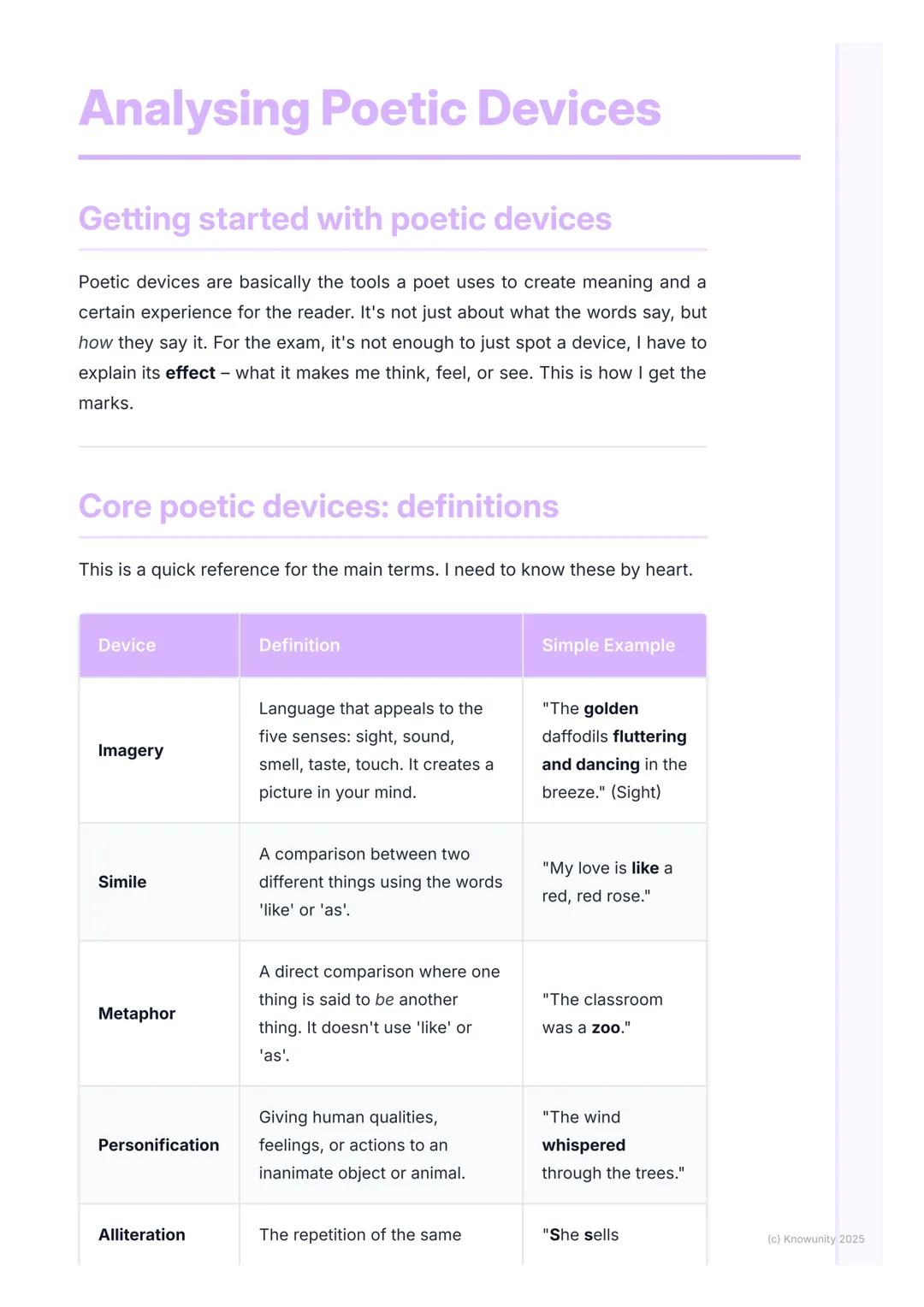
Getting Started with Poetic Devices
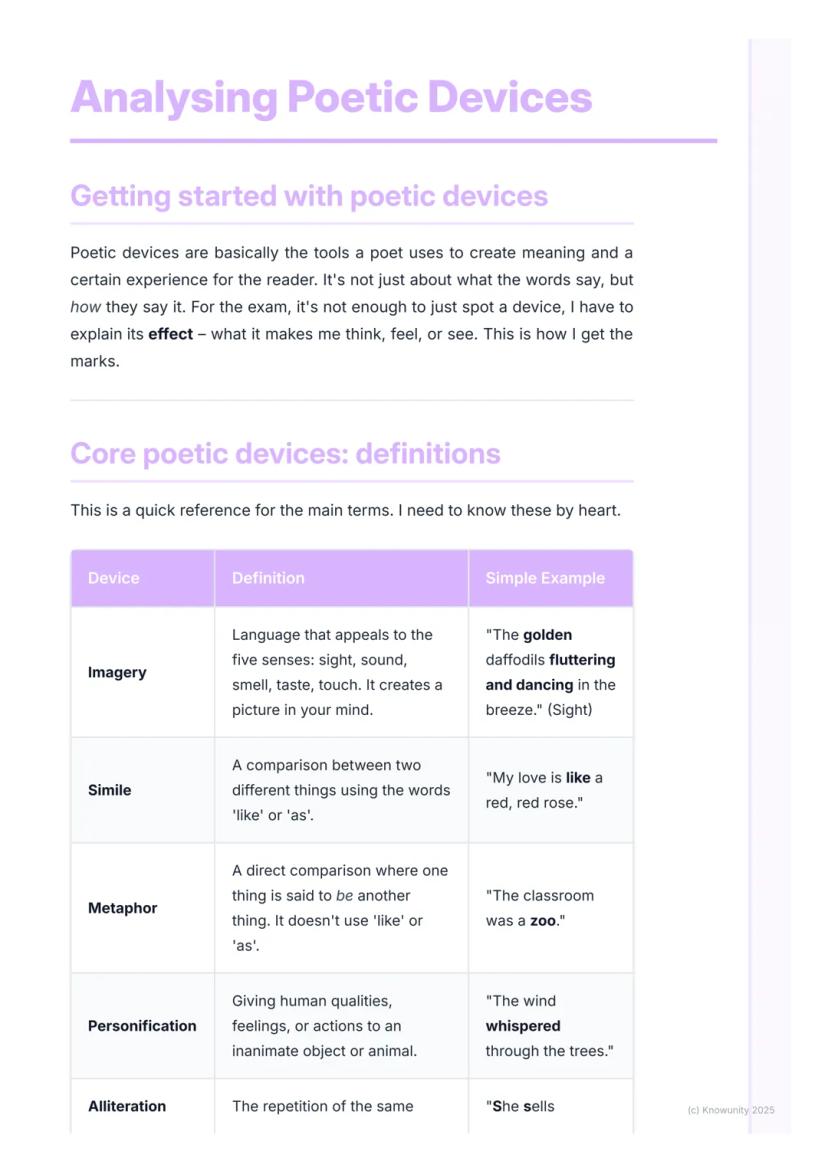
Think of poetic devices as a poet's toolkit for creating meaning and atmosphere. They're not just fancy words - they're deliberate choices that shape how you experience a poem. The key to exam success isn't just identifying these devices, but explaining their effect on you as the reader.
When analysing poetry, always ask yourself: what does this make me think, feel, or see? This approach will earn you the marks because you're showing understanding, not just recognition.
Quick Tip: Learn these core definitions by heart - they're your foundation for all poetry analysis.
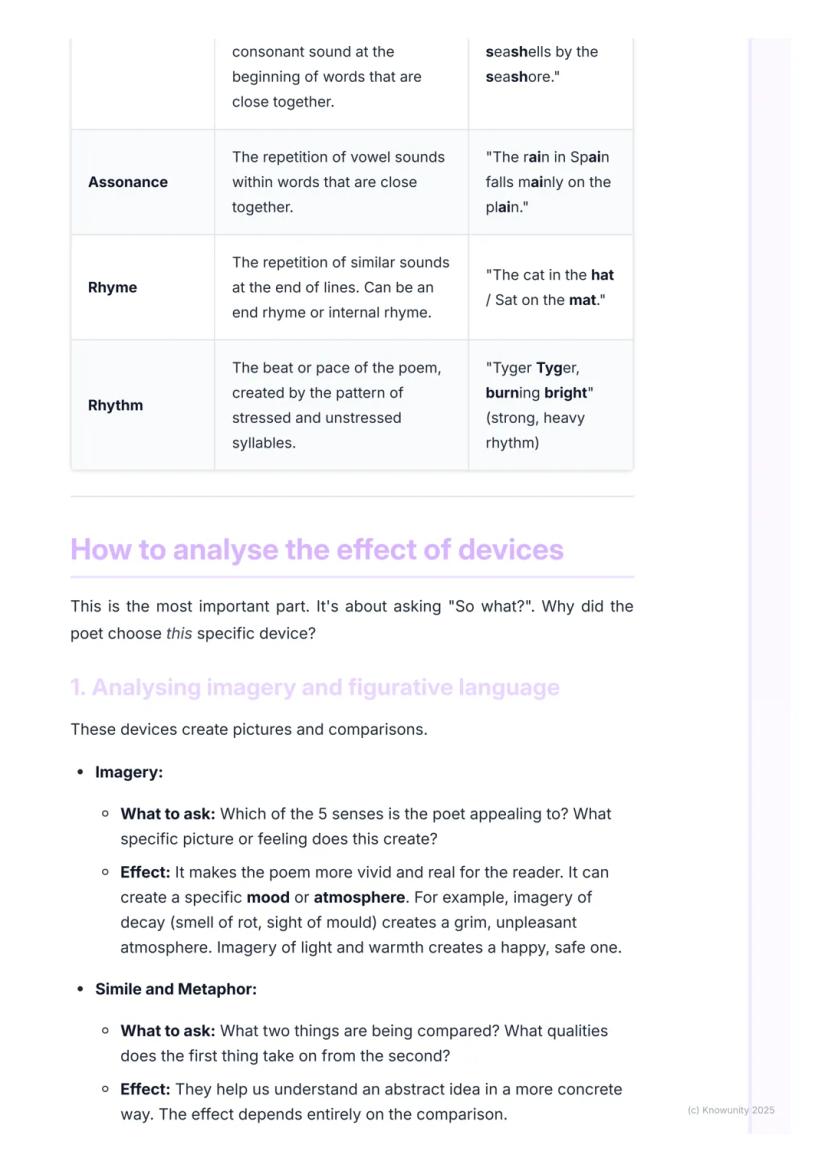
Alliteration repeats consonant sounds at the start of nearby words (like "seashells by the seashore"). Assonance repeats vowel sounds within words close together. Rhyme creates similar sounds at line endings, whilst rhythm establishes the beat through stressed and unstressed syllables.
2
of 6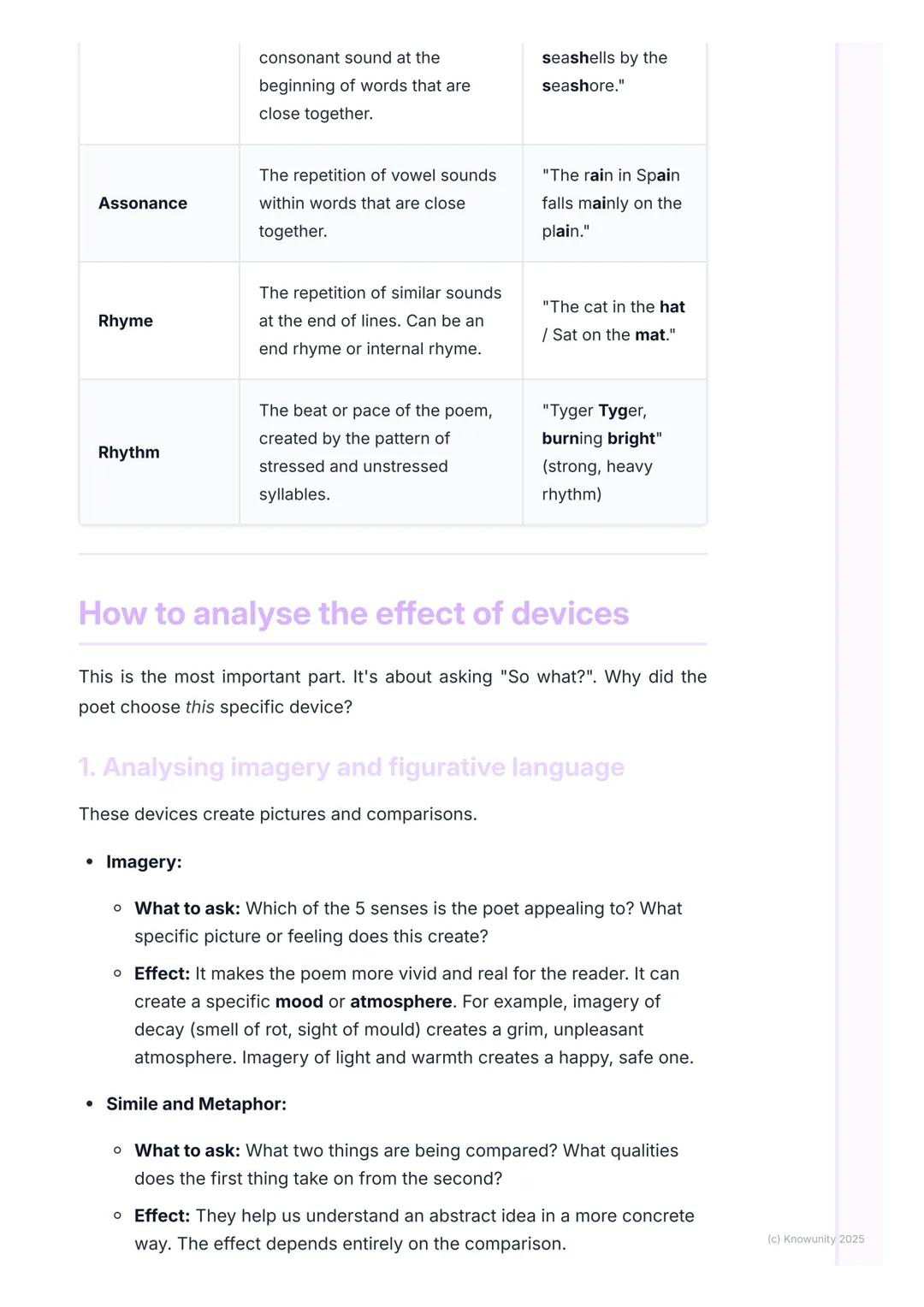
Analysing Imagery and Figurative Language
These devices paint pictures in your mind and make abstract ideas concrete. Imagery appeals to your five senses, creating vivid scenes that establish mood and atmosphere. Dark, decaying imagery creates grimness, whilst light and warmth suggest safety and happiness.
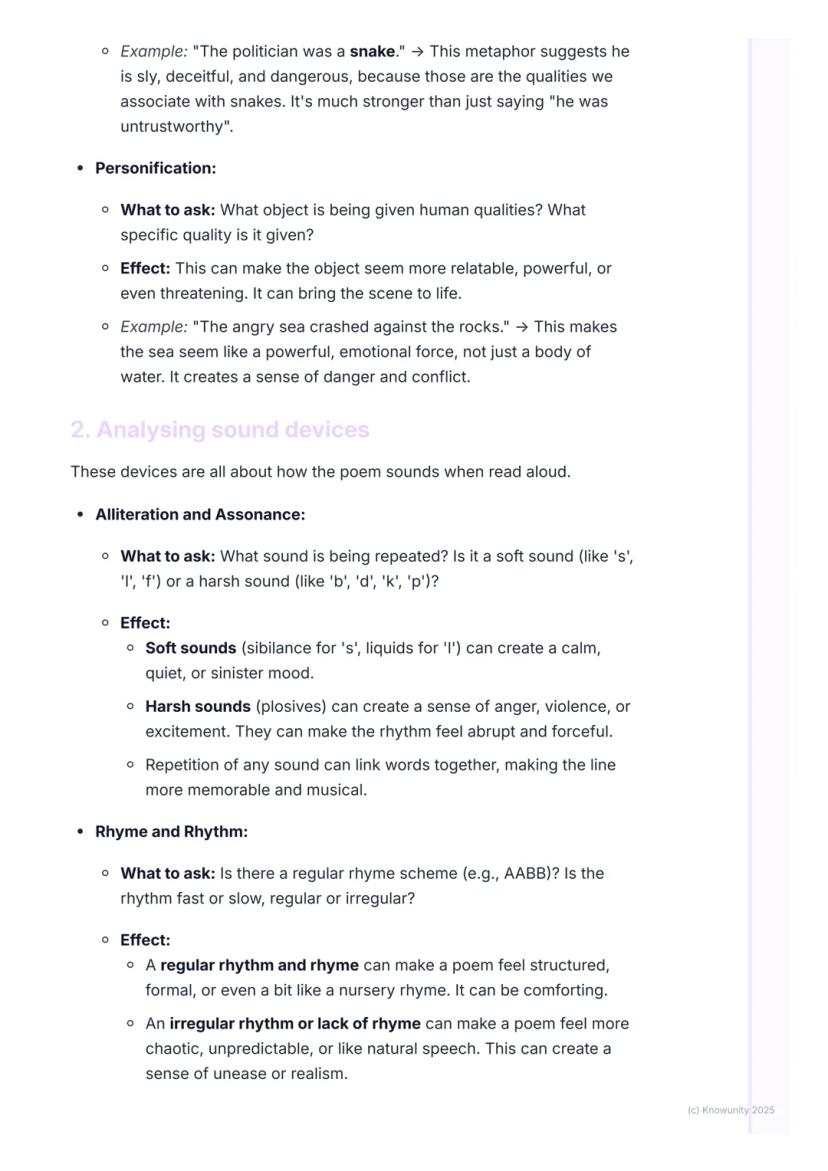
Similes and metaphors work through comparison. A simile uses 'like' or 'as' to compare, whilst a metaphor makes a direct comparison. The magic happens when qualities transfer between the compared things - calling a politician "a snake" suggests they're sly, deceitful, and dangerous.
Personification gives human qualities to objects, making them relatable or threatening. "The angry sea crashed against the rocks" transforms water into an emotional, dangerous force rather than just H2O.
Remember: Always ask what specific qualities are being transferred through these comparisons - that's where the meaning lies.
3
of 6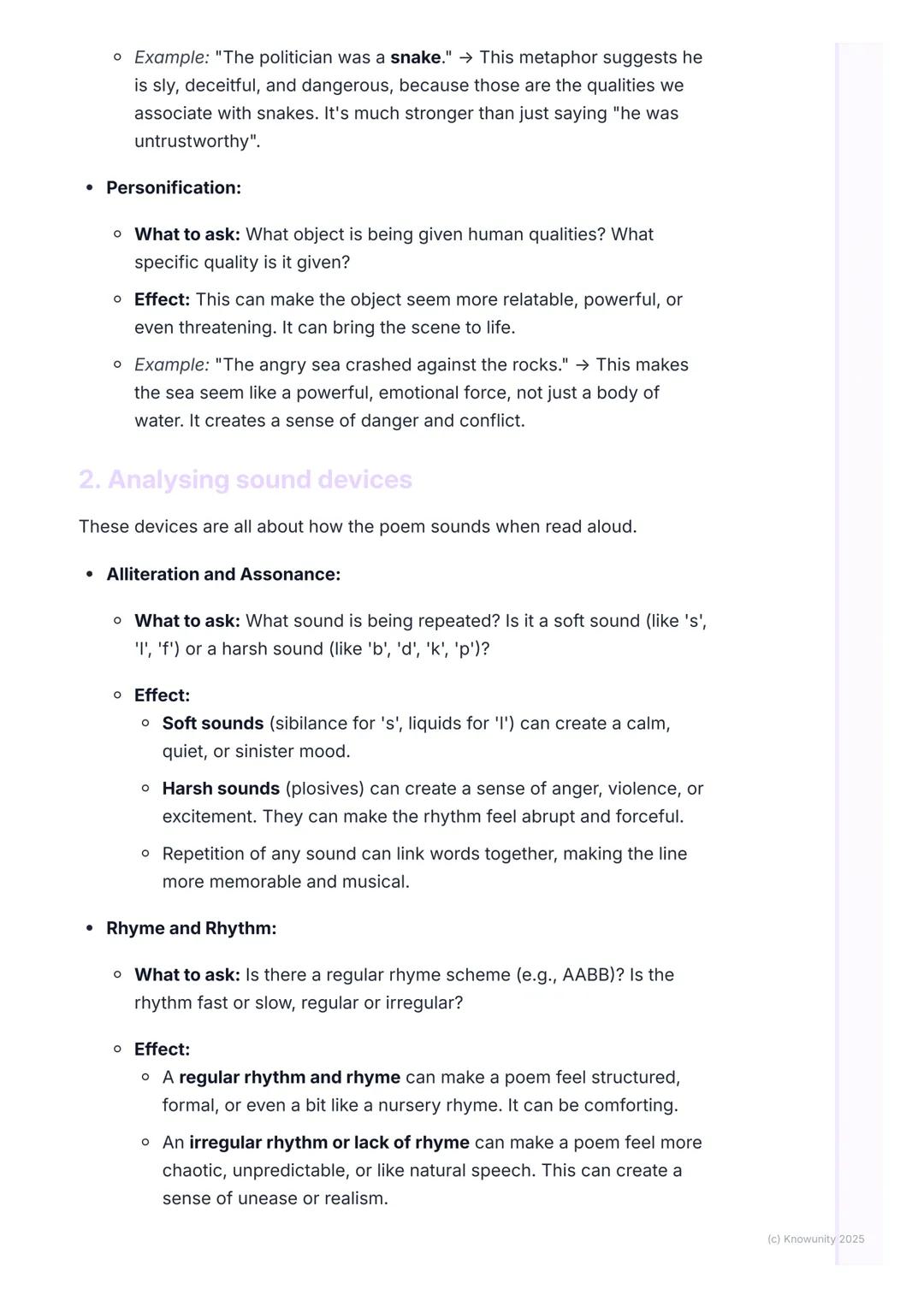
Analysing Sound Devices
Sound devices control how poems feel when read aloud, affecting pace and mood dramatically. Alliteration and assonance work through the type of sounds repeated - soft sounds like 's' and 'l' create calm or sinister moods, whilst harsh sounds like 'b' and 'k' suggest violence or excitement.
The repetition of sounds links words together, making lines more memorable and musical. This isn't accidental - poets choose sounds that match their message.
Rhyme and rhythm create the poem's musical structure. Regular patterns feel formal and comforting, like nursery rhymes. Irregular patterns feel chaotic or realistic, like natural speech. Fast rhythms build excitement or panic, whilst slow rhythms create seriousness or sadness.
Pro Tip: Read poems aloud to really hear how these sound devices work - your ear will pick up effects your eyes might miss.
4
of 6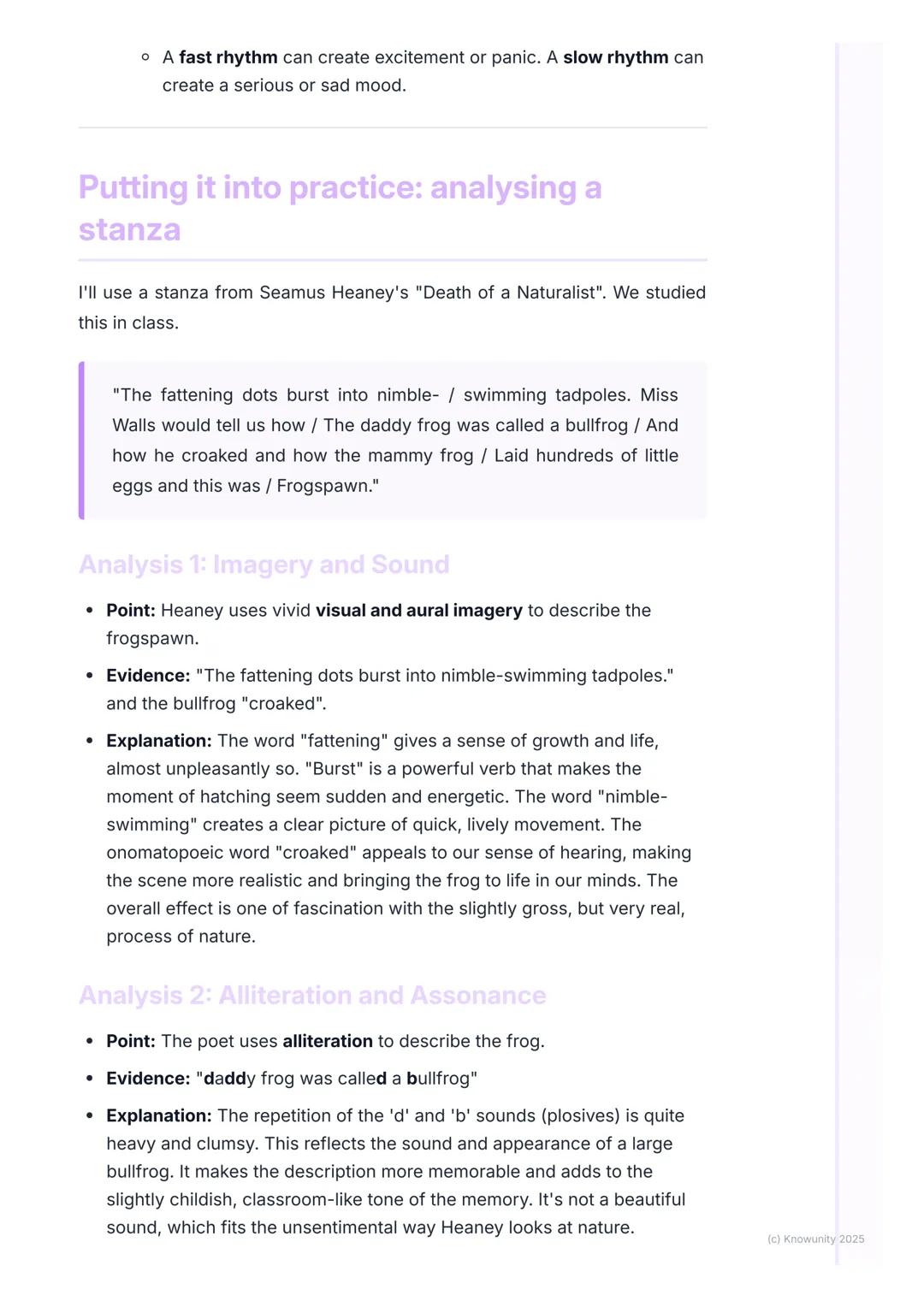
Putting It Into Practice
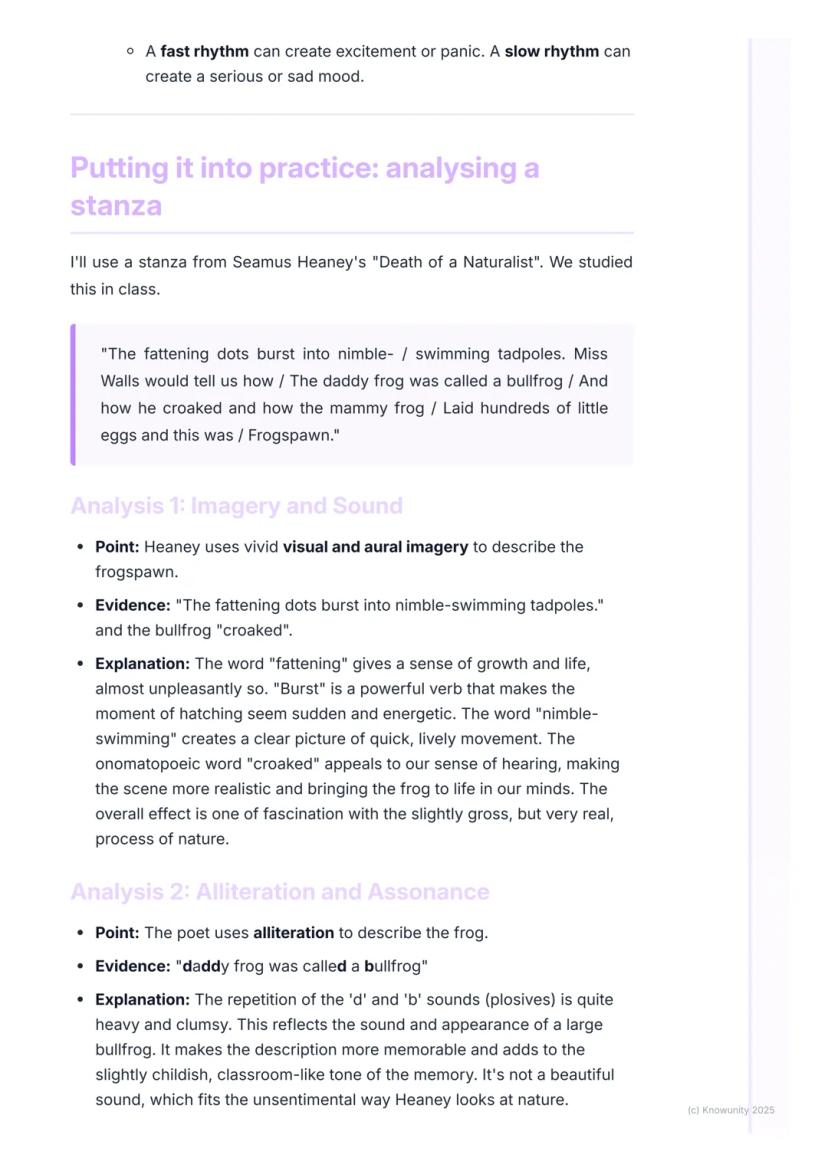
Let's analyse Seamus Heaney's line: "The fattening dots burst into nimble-swimming tadpoles." The vivid visual imagery uses "fattening" to suggest uncomfortable growth, whilst "burst" makes hatching seem explosive and energetic.
The alliteration in "daddy frog" and "bullfrog" uses heavy 'd' and 'b' sounds that mirror a bullfrog's clumsy appearance and croaking sound. This creates a childish, classroom-like tone that fits the poem's memory theme.
Notice how each device serves the poem's overall meaning - Heaney isn't just showing off his vocabulary, he's creating a specific atmosphere and emotional response.
Essential Skill: Always connect your analysis back to the poem's main themes and overall effect - isolated observations won't impress examiners.
5
of 6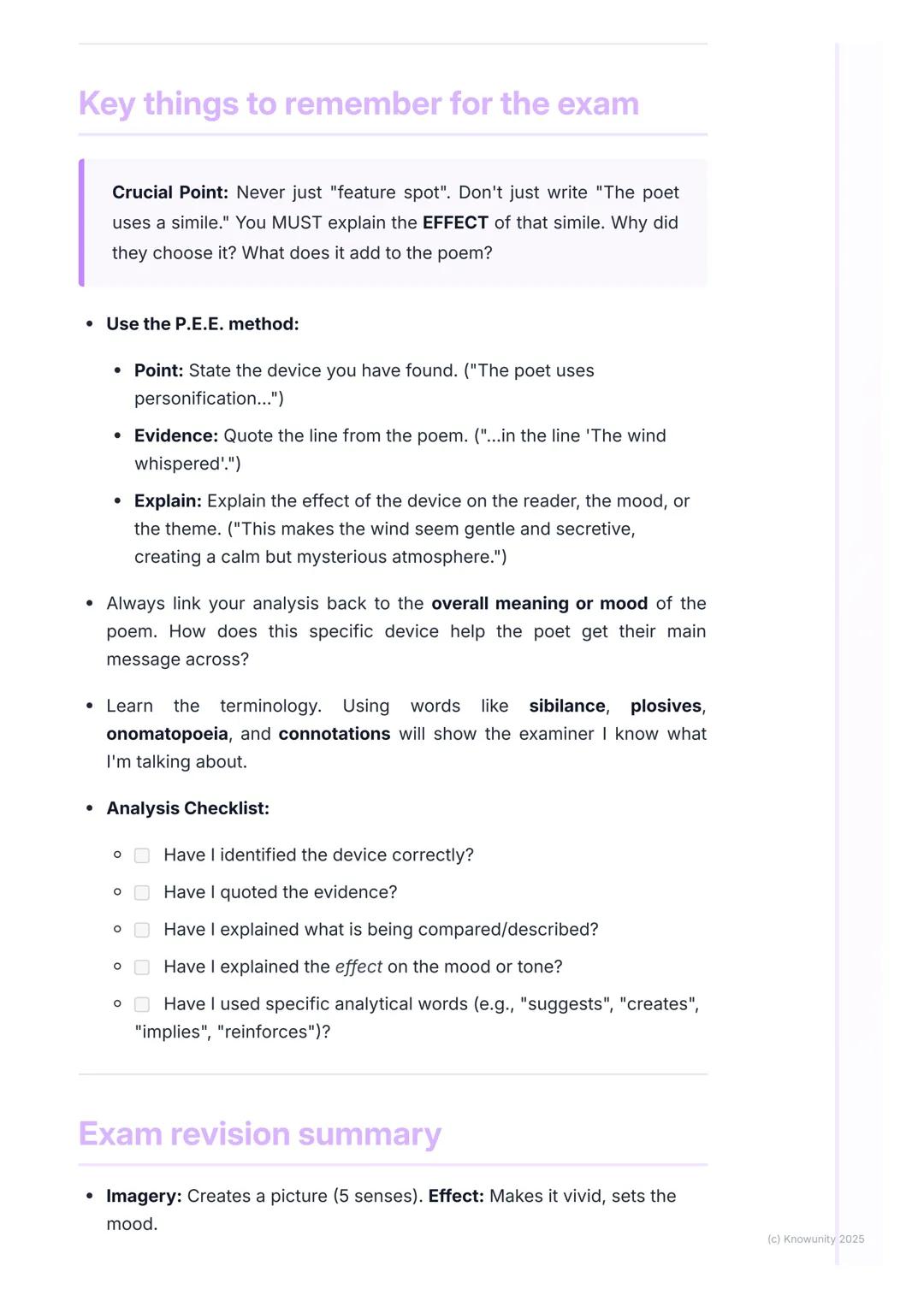
Key Exam Strategies
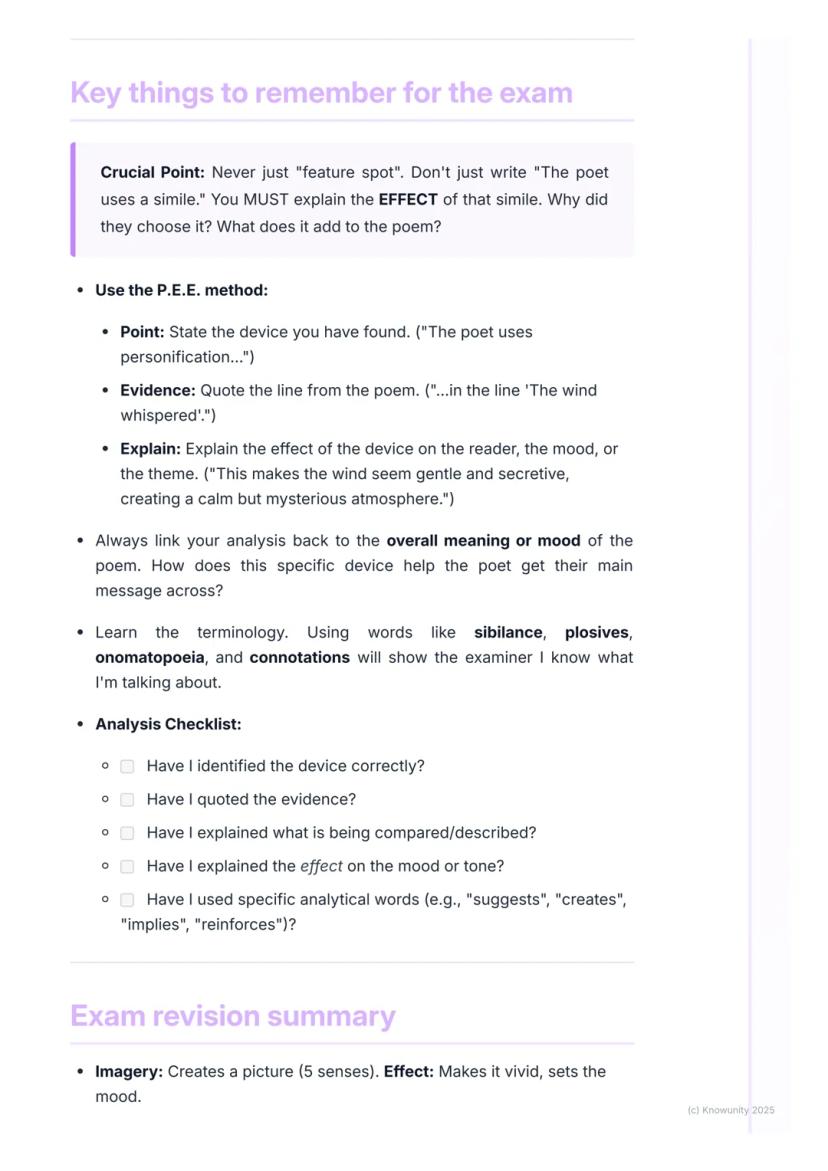
Never just "feature spot" - identifying a simile without explaining its effect scores you nothing. Always use the P.E.E. method: make your Point, provide Evidence through quotation, then Explain the effect on mood, tone, or meaning.
Your explanations should focus on what the device adds to the reader's experience. How does it help the poet communicate their message? What atmosphere does it create? These connections between technique and meaning are what examiners want to see.
Learn the terminology - words like 'sibilance', 'plosives', and 'connotations' show sophisticated understanding. Use analytical phrases like "suggests", "creates", "implies", and "reinforces" to sound professional.
Exam Success: Always link individual devices back to the poem's overall meaning - show how each technique contributes to the bigger picture.
6
of 6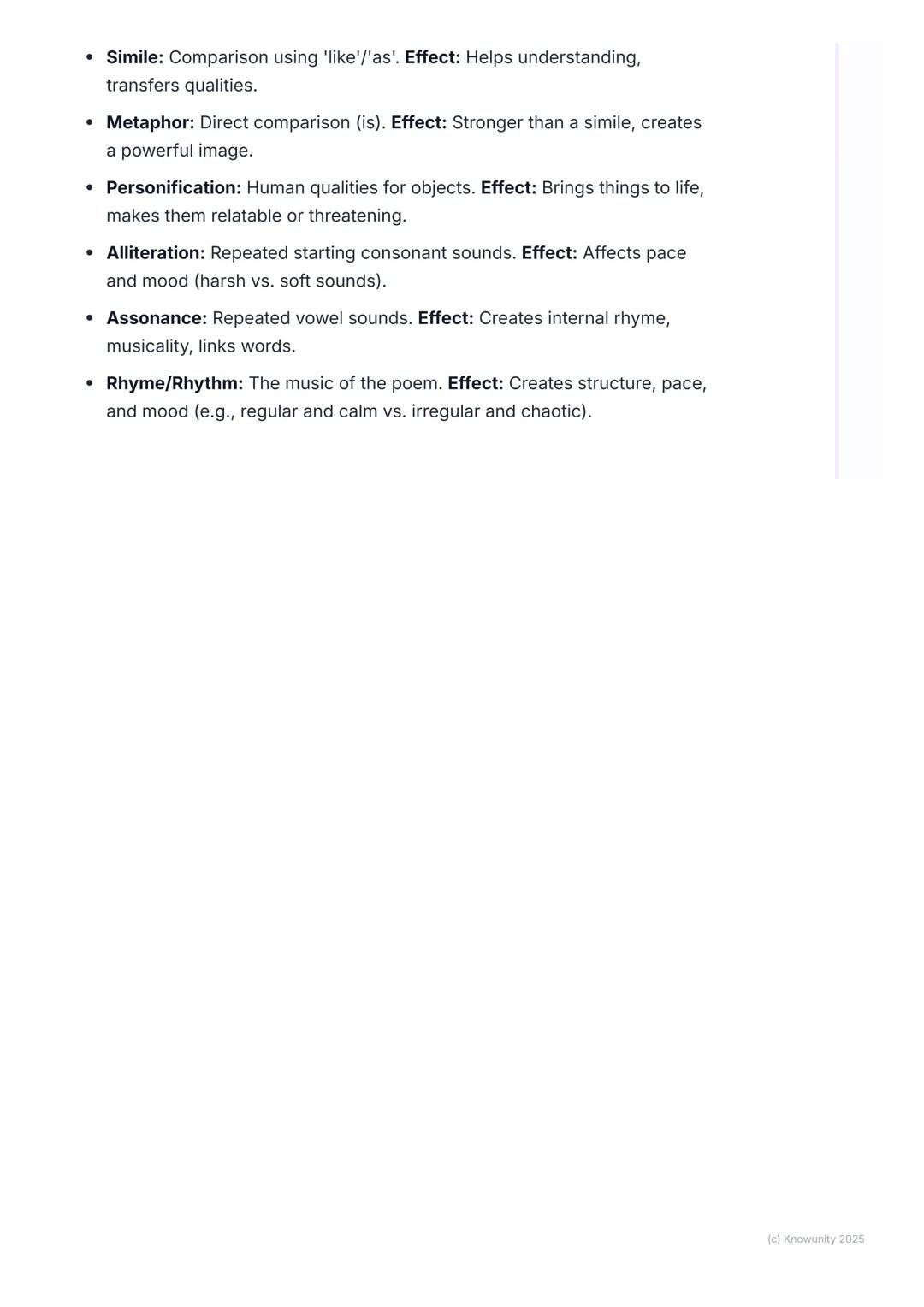
Quick Revision Reference
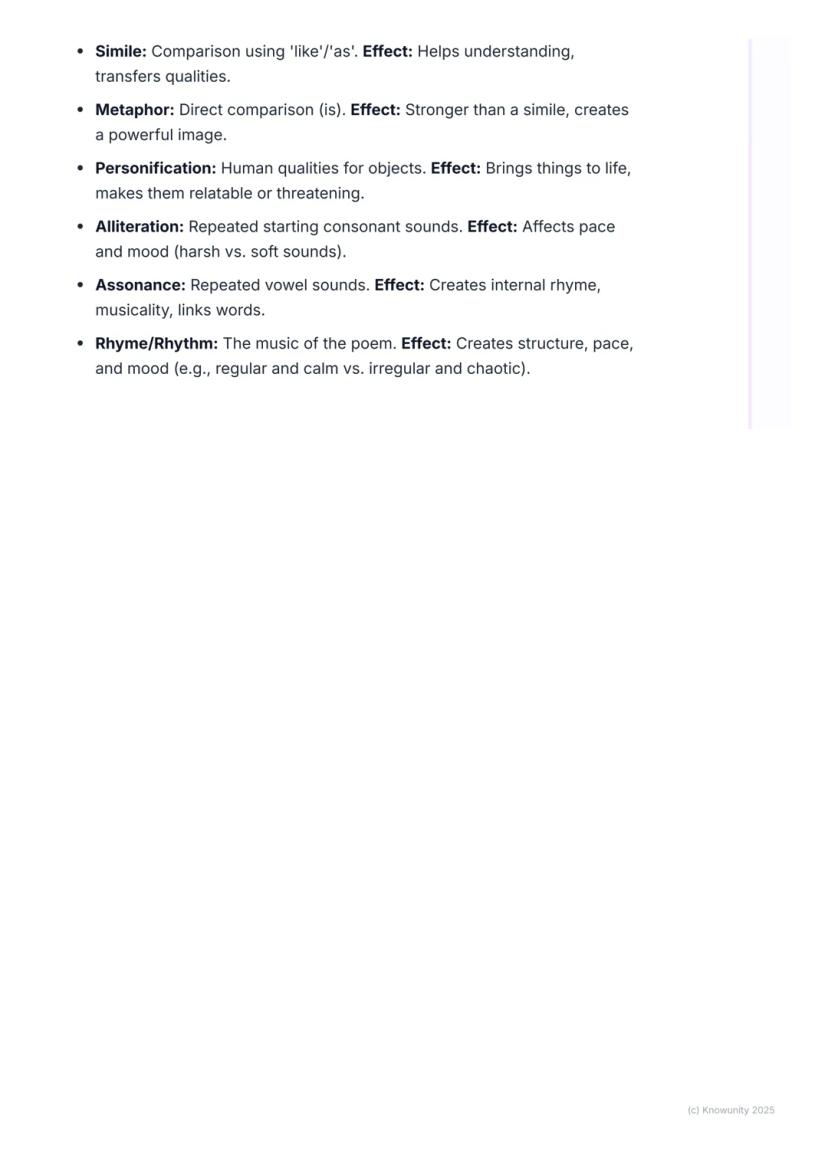
Here's your essential toolkit: Imagery creates vivid pictures using the five senses and sets mood. Similes compare using 'like' or 'as' to aid understanding, whilst metaphors make direct comparisons for stronger impact.
Personification brings objects to life, making them relatable or threatening. Alliteration uses repeated consonant sounds to affect pace and mood - harsh sounds create aggression, soft sounds suggest calm.
Assonance repeats vowel sounds for musicality and internal connections. Rhyme and rhythm provide structure and control pace - regular patterns feel ordered and calm, irregular ones suggest chaos or natural speech.
Final Reminder: Understanding these devices is just the beginning - explaining their effects and linking them to meaning is where the real marks lie.
Si on te demande...
Qu'est-ce que le compagnon IA de Knowunity ?
Notre compagnon IA est spécialement conçu pour répondre aux besoins des étudiants. Sur la base des millions d'éléments de contenu que nous avons sur la plateforme, nous pouvons fournir des réponses vraiment significatives et pertinentes aux étudiants. Mais il ne s'agit pas seulement de réponses, le compagnon a encore plus pour but de guider les élèves dans leurs défis d'apprentissage quotidiens, avec des plans d'étude personnalisés, des quiz ou des éléments de contenu dans le chat et une personnalisation à 100% basée sur les compétences et les développements de l'étudiant.
Où puis-je télécharger l'appli Knowunity ?
Tu peux télécharger l'application dans Google Play Store et dans l'App Store d'Apple.
L'application est-elle vraiment gratuite ?
Oui, tu as un accès entièrement gratuit à tous les contenus de l'appli, tu peux chatter ou suivre les créateurs à tout moment. De plus, nous proposons Knowunity Premium, qui te permet de réviser sans limites!
Contenus les plus populaires en English
9EnglishKey Quotes : Sive
Key Quotes and explanations: Sive
6th Year2842
EnglishCultural Context : Shawshank Redemption : Sive : Small Things Like These
Comparative Study : Cultural Context : Shawshank Redemption, Sive and Small Things Like These
6th Year1430
EnglishElizabeth Bishop notes
Elizabeth Bishop notes
6th Year1271
EnglishPoetry
Paula Meehan - the statue of the virgin at granard speaks, the exact moment i became a poet, prayer for the children of longing, the pattern notes. Seamus Heaney, the forge notes.
6th Year300
EnglishKey Moments of Macbeth
This is a one page summary for key moments of Macbeth including quotes and act numbers
6th Year320
EnglishMud term break
Jc poem english
1st Year141
EnglishBanquo Study Notes
Macbeth
6th Year280
EnglishNotes on Macbeth, poetry and comparative
Notes on Macbeth, dive and comparative
5th Year291
EnglishThe fish-Elizabeth bishop
Overview of Elizabeth bishops poem the fish written in 1940 ,include a summary,tone and mood,key quotes,imagery examples and theme examples
6th Year370
Contenus les plus populaires
9 Irish
IrishIrish oral questions and answers
Questions and answers for the leaving cert oral
5th Year4264
EnglishKey Quotes : Sive
Key Quotes and explanations: Sive
6th Year2842
IrishIrish oral questions
Outline of oral questions
5th Year2055
IrishIníon- le hÁine Durkin
Aine Durkin’s poem, Iníon: Themes & summary
5th Year850
IrishIrish poetry 2027
Iníon + Dínit an Bhróin
5th Year1133
IrishLC HL notes- Iníon (poem)
Includes poem in English and Irish, theme, key words & phrases
5th Year2284
EnglishCultural Context : Shawshank Redemption : Sive : Small Things Like These
Comparative Study : Cultural Context : Shawshank Redemption, Sive and Small Things Like These
6th Year1430
IrishMo Ghrá-sa (Idir Lúibíní)
Notes on mo ghrá-sa
5th Year380
IrishAn Gaeilge Aiste
Irish Language essay
6th Year1320
Rien ne te convient ? Explore d'autres matières.
Les étudiants nous adorent — il ne manque plus que toi.
4.6/5App Store
4.7/5Google Play
L'application est très facile d'utilisation et bien conçue. Jusqu'à présent, j'ai trouvé tout ce que je cherchais et j'ai pu apprendre beaucoup de choses grâce aux présentations ! Je vais certainement utiliser l'application pour un travail en classe ! Et comme source d'inspiration personnelle, elle est bien sûr aussi très utile.
Stefan Sutilisateur iOS
Cette application est vraiment super. Il y a tellement de fiches de révision et d'aide, [...]. Par exemple, la matière qui me pose problème est le français et l'appli a un choix d'aide très large. Grâce à cette application, je me suis améliorée en français. Je la recommanderais à tout le monde.
Samantha Klichutilisatrice Android
Waouh, je suis vraiment abasourdi. J'ai essayé l'application parce que je l'avais déjà vue plusieurs fois dans la publicité et j'ai été absolument choquée. Cette appli est L'AIDE dont on rêve pour l'école et surtout, elle propose tellement de choses, comme des rédactions et des fiches qui m'ont personnellement TRÈS bien aidé.
Annautilisatrice iOS
English8 vues·Mis à jour Jun 5, 2026·6 pagesUnderstanding Poetic Devices in Poetry
Poetic devices are the secret weapons poets use to make their words come alive and hit you right in the feels. It's not just about spotting these techniques - you need to explain why they work and what they do...
1
of 6
Inscris-toi pour voir le contenu. C'est gratuit!
- Accès à tous les documents
- Améliore tes notes
- Rejoins des millions d'étudiants
Getting Started with Poetic Devices
Think of poetic devices as a poet's toolkit for creating meaning and atmosphere. They're not just fancy words - they're deliberate choices that shape how you experience a poem. The key to exam success isn't just identifying these devices, but explaining their effect on you as the reader.
When analysing poetry, always ask yourself: what does this make me think, feel, or see? This approach will earn you the marks because you're showing understanding, not just recognition.
Quick Tip: Learn these core definitions by heart - they're your foundation for all poetry analysis.
Alliteration repeats consonant sounds at the start of nearby words (like "seashells by the seashore"). Assonance repeats vowel sounds within words close together. Rhyme creates similar sounds at line endings, whilst rhythm establishes the beat through stressed and unstressed syllables.
2
of 6Inscris-toi pour voir le contenu. C'est gratuit!
- Accès à tous les documents
- Améliore tes notes
- Rejoins des millions d'étudiants
Analysing Imagery and Figurative Language
These devices paint pictures in your mind and make abstract ideas concrete. Imagery appeals to your five senses, creating vivid scenes that establish mood and atmosphere. Dark, decaying imagery creates grimness, whilst light and warmth suggest safety and happiness.
Similes and metaphors work through comparison. A simile uses 'like' or 'as' to compare, whilst a metaphor makes a direct comparison. The magic happens when qualities transfer between the compared things - calling a politician "a snake" suggests they're sly, deceitful, and dangerous.
Personification gives human qualities to objects, making them relatable or threatening. "The angry sea crashed against the rocks" transforms water into an emotional, dangerous force rather than just H2O.
Remember: Always ask what specific qualities are being transferred through these comparisons - that's where the meaning lies.
3
of 6Inscris-toi pour voir le contenu. C'est gratuit!
- Accès à tous les documents
- Améliore tes notes
- Rejoins des millions d'étudiants
Analysing Sound Devices
Sound devices control how poems feel when read aloud, affecting pace and mood dramatically. Alliteration and assonance work through the type of sounds repeated - soft sounds like 's' and 'l' create calm or sinister moods, whilst harsh sounds like 'b' and 'k' suggest violence or excitement.
The repetition of sounds links words together, making lines more memorable and musical. This isn't accidental - poets choose sounds that match their message.
Rhyme and rhythm create the poem's musical structure. Regular patterns feel formal and comforting, like nursery rhymes. Irregular patterns feel chaotic or realistic, like natural speech. Fast rhythms build excitement or panic, whilst slow rhythms create seriousness or sadness.
Pro Tip: Read poems aloud to really hear how these sound devices work - your ear will pick up effects your eyes might miss.
4
of 6Inscris-toi pour voir le contenu. C'est gratuit!
- Accès à tous les documents
- Améliore tes notes
- Rejoins des millions d'étudiants
Putting It Into Practice
Let's analyse Seamus Heaney's line: "The fattening dots burst into nimble-swimming tadpoles." The vivid visual imagery uses "fattening" to suggest uncomfortable growth, whilst "burst" makes hatching seem explosive and energetic.
The alliteration in "daddy frog" and "bullfrog" uses heavy 'd' and 'b' sounds that mirror a bullfrog's clumsy appearance and croaking sound. This creates a childish, classroom-like tone that fits the poem's memory theme.
Notice how each device serves the poem's overall meaning - Heaney isn't just showing off his vocabulary, he's creating a specific atmosphere and emotional response.
Essential Skill: Always connect your analysis back to the poem's main themes and overall effect - isolated observations won't impress examiners.
5
of 6Inscris-toi pour voir le contenu. C'est gratuit!
- Accès à tous les documents
- Améliore tes notes
- Rejoins des millions d'étudiants
Key Exam Strategies
Never just "feature spot" - identifying a simile without explaining its effect scores you nothing. Always use the P.E.E. method: make your Point, provide Evidence through quotation, then Explain the effect on mood, tone, or meaning.
Your explanations should focus on what the device adds to the reader's experience. How does it help the poet communicate their message? What atmosphere does it create? These connections between technique and meaning are what examiners want to see.
Learn the terminology - words like 'sibilance', 'plosives', and 'connotations' show sophisticated understanding. Use analytical phrases like "suggests", "creates", "implies", and "reinforces" to sound professional.
Exam Success: Always link individual devices back to the poem's overall meaning - show how each technique contributes to the bigger picture.
6
of 6Inscris-toi pour voir le contenu. C'est gratuit!
- Accès à tous les documents
- Améliore tes notes
- Rejoins des millions d'étudiants
Quick Revision Reference
Here's your essential toolkit: Imagery creates vivid pictures using the five senses and sets mood. Similes compare using 'like' or 'as' to aid understanding, whilst metaphors make direct comparisons for stronger impact.
Personification brings objects to life, making them relatable or threatening. Alliteration uses repeated consonant sounds to affect pace and mood - harsh sounds create aggression, soft sounds suggest calm.
Assonance repeats vowel sounds for musicality and internal connections. Rhyme and rhythm provide structure and control pace - regular patterns feel ordered and calm, irregular ones suggest chaos or natural speech.
Final Reminder: Understanding these devices is just the beginning - explaining their effects and linking them to meaning is where the real marks lie.
Si on te demande...
Qu'est-ce que le compagnon IA de Knowunity ?
Notre compagnon IA est spécialement conçu pour répondre aux besoins des étudiants. Sur la base des millions d'éléments de contenu que nous avons sur la plateforme, nous pouvons fournir des réponses vraiment significatives et pertinentes aux étudiants. Mais il ne s'agit pas seulement de réponses, le compagnon a encore plus pour but de guider les élèves dans leurs défis d'apprentissage quotidiens, avec des plans d'étude personnalisés, des quiz ou des éléments de contenu dans le chat et une personnalisation à 100% basée sur les compétences et les développements de l'étudiant.
Où puis-je télécharger l'appli Knowunity ?
Tu peux télécharger l'application dans Google Play Store et dans l'App Store d'Apple.
L'application est-elle vraiment gratuite ?
Oui, tu as un accès entièrement gratuit à tous les contenus de l'appli, tu peux chatter ou suivre les créateurs à tout moment. De plus, nous proposons Knowunity Premium, qui te permet de réviser sans limites!
Contenus les plus populaires en English
9EnglishKey Quotes : Sive
Key Quotes and explanations: Sive
6th Year2842
EnglishCultural Context : Shawshank Redemption : Sive : Small Things Like These
Comparative Study : Cultural Context : Shawshank Redemption, Sive and Small Things Like These
6th Year1430
EnglishElizabeth Bishop notes
Elizabeth Bishop notes
6th Year1271
EnglishPoetry
Paula Meehan - the statue of the virgin at granard speaks, the exact moment i became a poet, prayer for the children of longing, the pattern notes. Seamus Heaney, the forge notes.
6th Year300
EnglishKey Moments of Macbeth
This is a one page summary for key moments of Macbeth including quotes and act numbers
6th Year320
EnglishMud term break
Jc poem english
1st Year141
EnglishBanquo Study Notes
Macbeth
6th Year280
EnglishNotes on Macbeth, poetry and comparative
Notes on Macbeth, dive and comparative
5th Year291
EnglishThe fish-Elizabeth bishop
Overview of Elizabeth bishops poem the fish written in 1940 ,include a summary,tone and mood,key quotes,imagery examples and theme examples
6th Year370
Contenus les plus populaires
9IrishIrish oral questions and answers
Questions and answers for the leaving cert oral
5th Year4264
EnglishKey Quotes : Sive
Key Quotes and explanations: Sive
6th Year2842
IrishIrish oral questions
Outline of oral questions
5th Year2055
IrishIníon- le hÁine Durkin
Aine Durkin’s poem, Iníon: Themes & summary
5th Year850
IrishIrish poetry 2027
Iníon + Dínit an Bhróin
5th Year1133
IrishLC HL notes- Iníon (poem)
Includes poem in English and Irish, theme, key words & phrases
5th Year2284
EnglishCultural Context : Shawshank Redemption : Sive : Small Things Like These
Comparative Study : Cultural Context : Shawshank Redemption, Sive and Small Things Like These
6th Year1430
IrishMo Ghrá-sa (Idir Lúibíní)
Notes on mo ghrá-sa
5th Year380
IrishAn Gaeilge Aiste
Irish Language essay
6th Year1320
Rien ne te convient ? Explore d'autres matières.
Les étudiants nous adorent — il ne manque plus que toi.
4.6/5App Store
4.7/5Google Play
L'application est très facile d'utilisation et bien conçue. Jusqu'à présent, j'ai trouvé tout ce que je cherchais et j'ai pu apprendre beaucoup de choses grâce aux présentations ! Je vais certainement utiliser l'application pour un travail en classe ! Et comme source d'inspiration personnelle, elle est bien sûr aussi très utile.
Stefan Sutilisateur iOS
Cette application est vraiment super. Il y a tellement de fiches de révision et d'aide, [...]. Par exemple, la matière qui me pose problème est le français et l'appli a un choix d'aide très large. Grâce à cette application, je me suis améliorée en français. Je la recommanderais à tout le monde.
Samantha Klichutilisatrice Android
Waouh, je suis vraiment abasourdi. J'ai essayé l'application parce que je l'avais déjà vue plusieurs fois dans la publicité et j'ai été absolument choquée. Cette appli est L'AIDE dont on rêve pour l'école et surtout, elle propose tellement de choses, comme des rédactions et des fiches qui m'ont personnellement TRÈS bien aidé.
Annautilisatrice iOS