
Analysing unseen poetry doesn't have to be scary - it's...
 English5 vues·Mis à jour Jun 18, 2026·7 pages
Mastering the Analysis of Unseen Poetry
1 / 7
1
of 7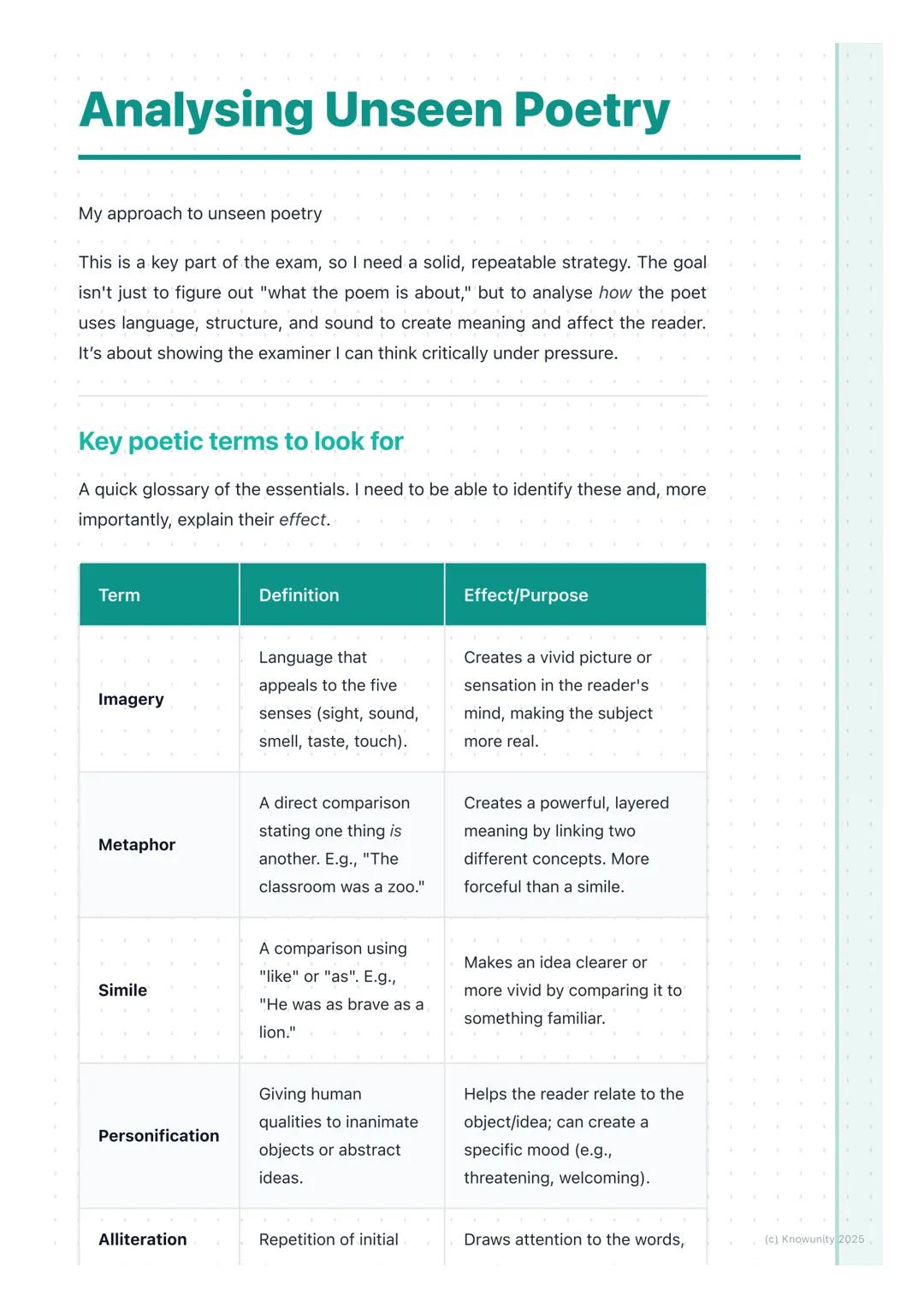
My Approach to Unseen Poetry
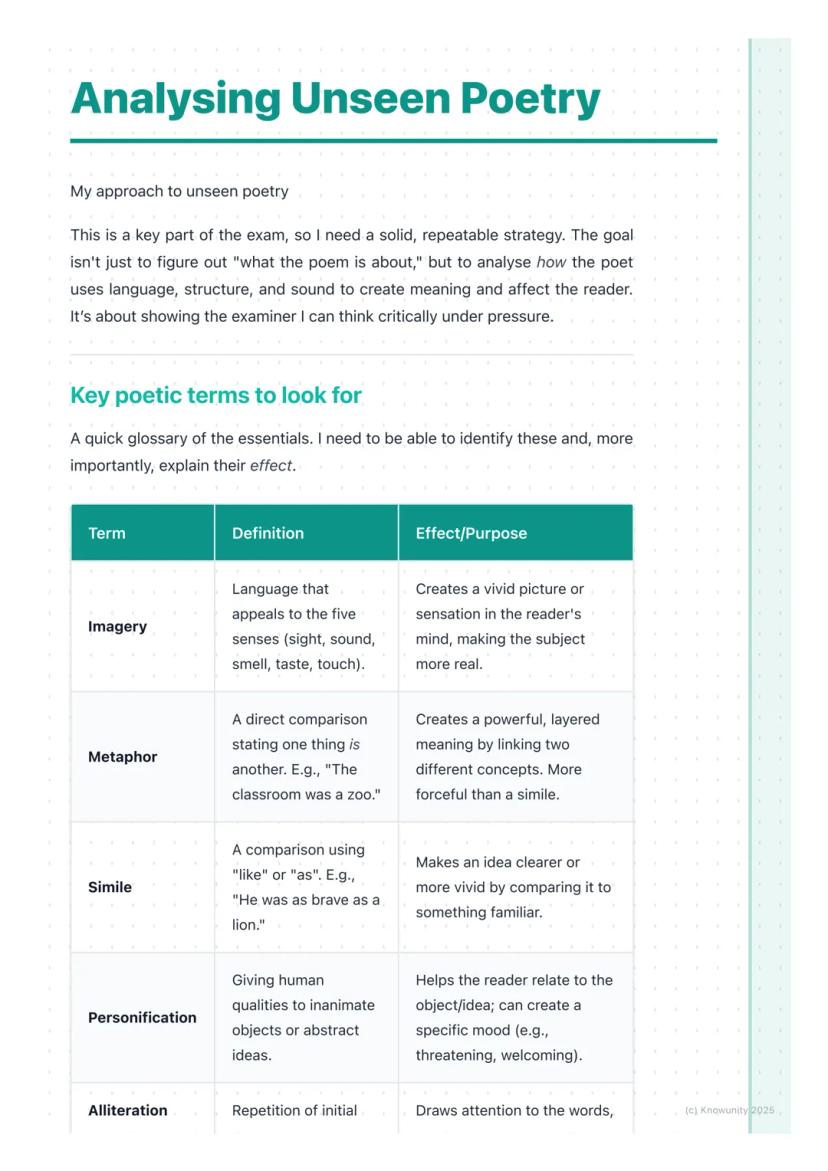
Right, let's be honest - unseen poetry analysis can feel overwhelming when you're sitting in that exam hall. But here's the thing: you're not just trying to figure out what the poem means. You're showing the examiner that you can think critically about how poets use language, structure, and sound to create meaning.
The key is having a repeatable strategy that works every time. Think of it like having a toolkit - once you know which tools to use and when, you'll feel much more confident tackling any poem they throw at you.
Essential poetic techniques you need to master include imagery (language that hits your five senses), metaphors and similes (comparisons that create deeper meaning), and personification (giving human qualities to objects). These aren't just fancy terms to memorise - they're the building blocks of how poems actually work.
Quick Tip: Don't panic if you don't "get" the poem immediately. Even experienced readers need multiple reads to fully understand a poem's layers.
2
of 7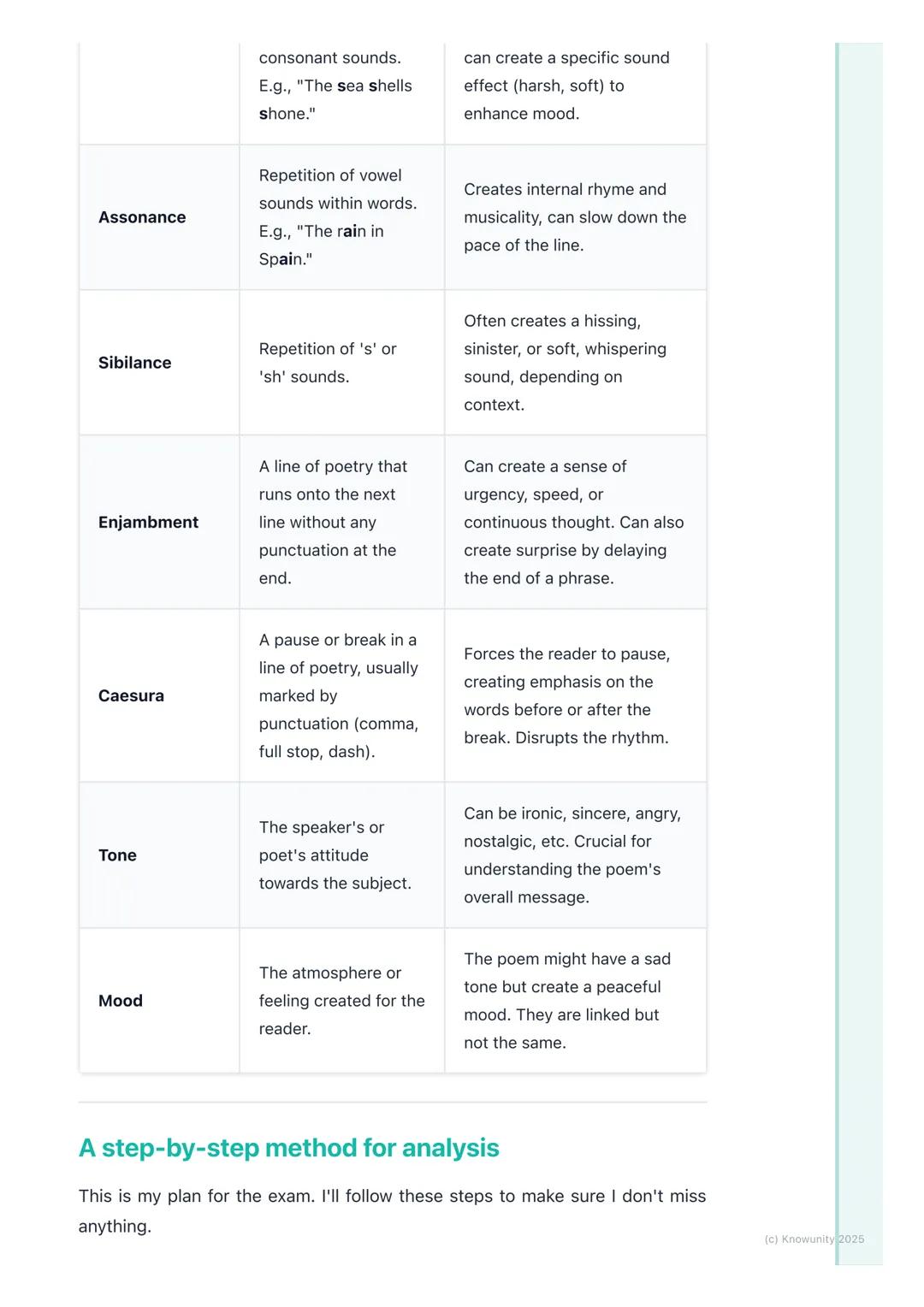
Sound Devices and Structural Elements
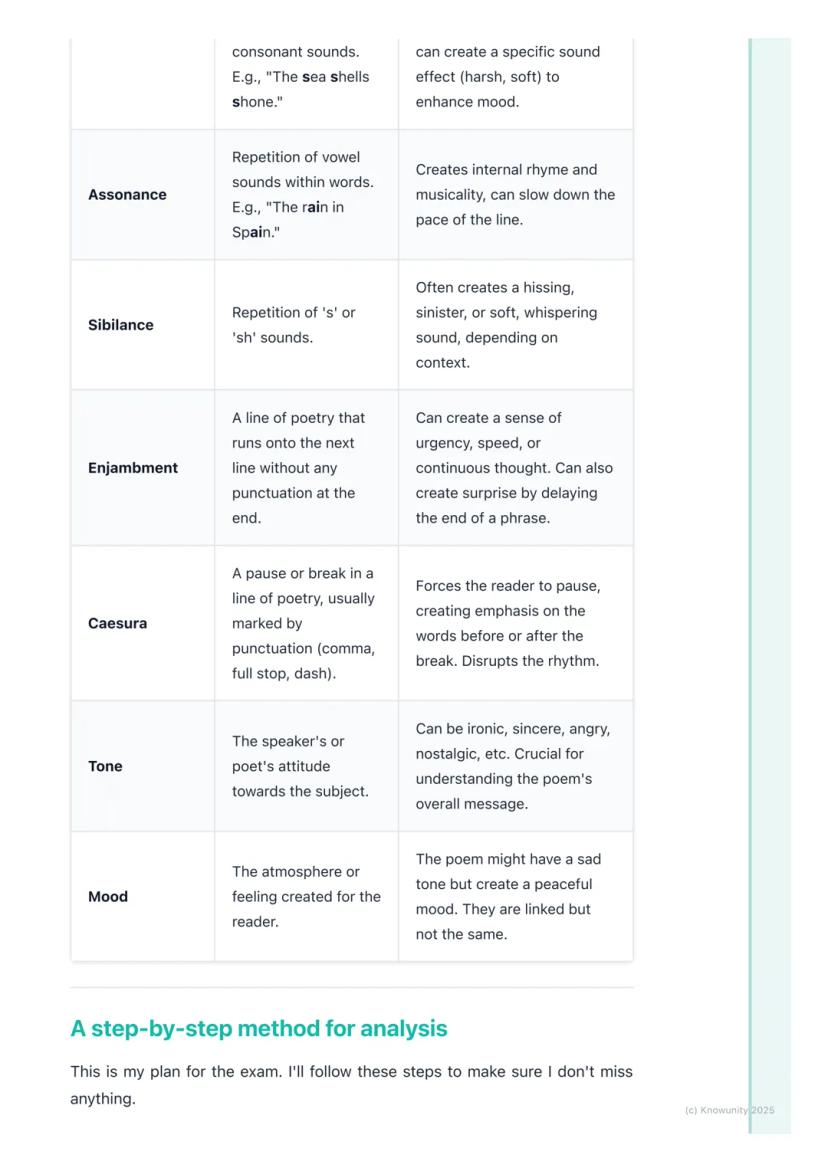
Sound techniques are your secret weapon for impressive analysis. Alliteration (repeated starting sounds) grabs attention and can create specific moods - harsh or soft depending on the sounds used. Assonance (repeated vowel sounds) creates internal rhythm, whilst sibilance (those 's' and 'sh' sounds) often creates sinister or whispering effects.
Don't overlook structural elements like enjambment and caesura. Enjambment is when lines run on without punctuation - this creates urgency or continuous thought. Caesura is the opposite - those pauses created by punctuation that force you to stop and emphasise certain words.
Understanding tone versus mood is crucial for top marks. Tone is the speaker's attitude (angry, nostalgic, ironic), whilst mood is the atmosphere created for you as the reader. A poem about death might have a sad tone but create a peaceful mood - they're linked but different.
Remember: Every technique you identify must be connected to its effect. Never just spot features - always explain why the poet used them.
3
of 7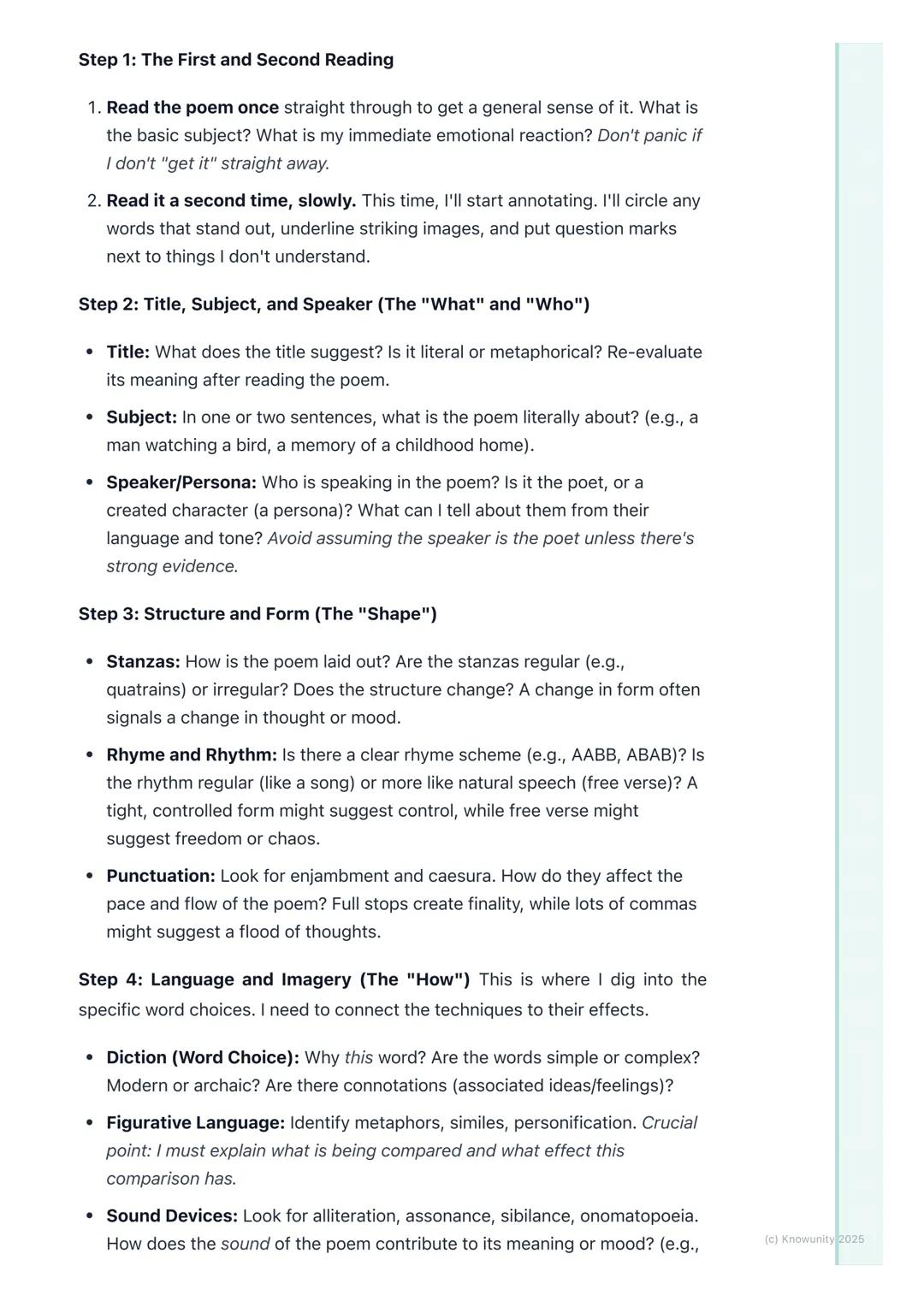
Step-by-Step Analysis Method
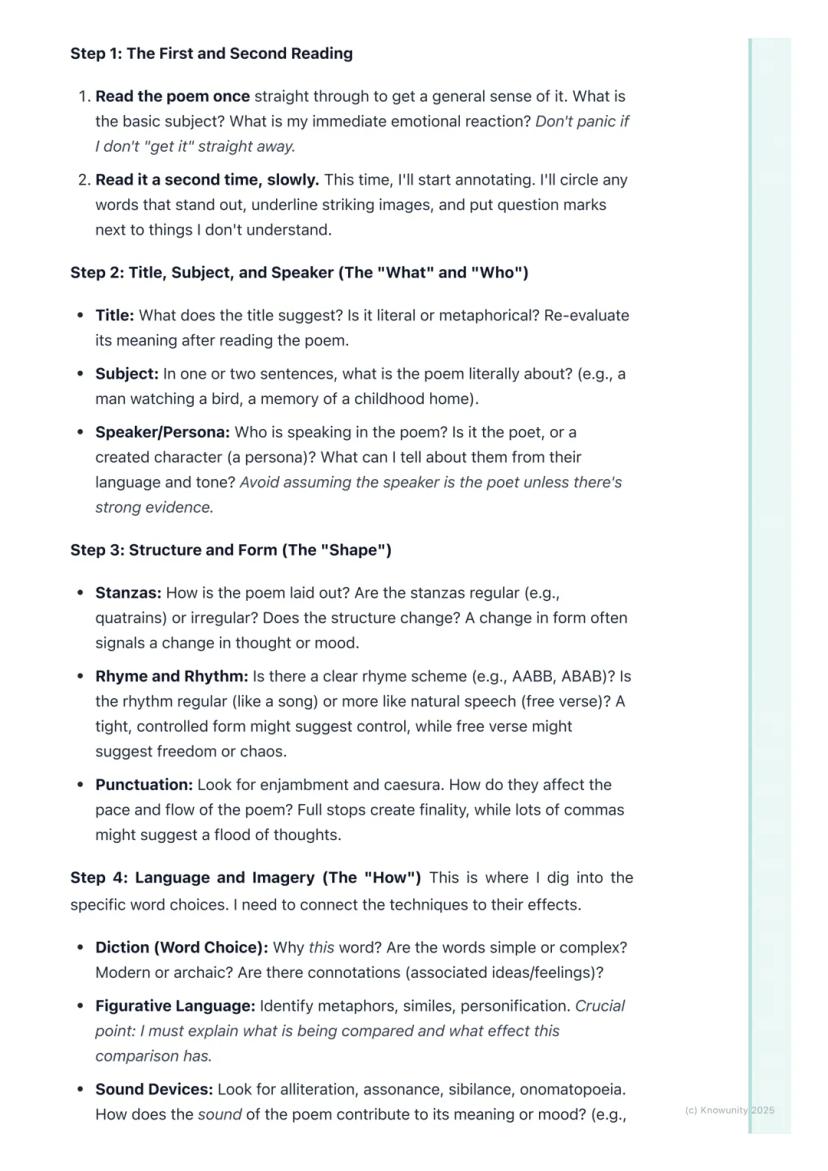
Here's your foolproof exam strategy: Start with two readings. First time through, just get the general sense - don't stress if it's confusing. Second reading is when you start annotating - circle striking words, underline images, put question marks next to confusing bits.
Next, tackle the basics: What does the title suggest? Who's the speaker (don't assume it's the poet unless you're sure)? What's the poem literally about in one sentence? These fundamentals give you solid ground to build your analysis on.
Structure analysis comes next. Look at stanza patterns, rhyme schemes, and rhythm. Regular forms often suggest control, whilst free verse might indicate freedom or chaos. Pay attention to punctuation - full stops create finality, lots of commas suggest rushing thoughts.
Then dive into language analysis. Why did the poet choose these specific words? What are the connotations? Identify metaphors, similes, personification, but crucially - explain what's being compared and why that comparison matters.
Pro Tip: Changes in structure often signal changes in thought or mood. Always note when the poem shifts gear.
4
of 7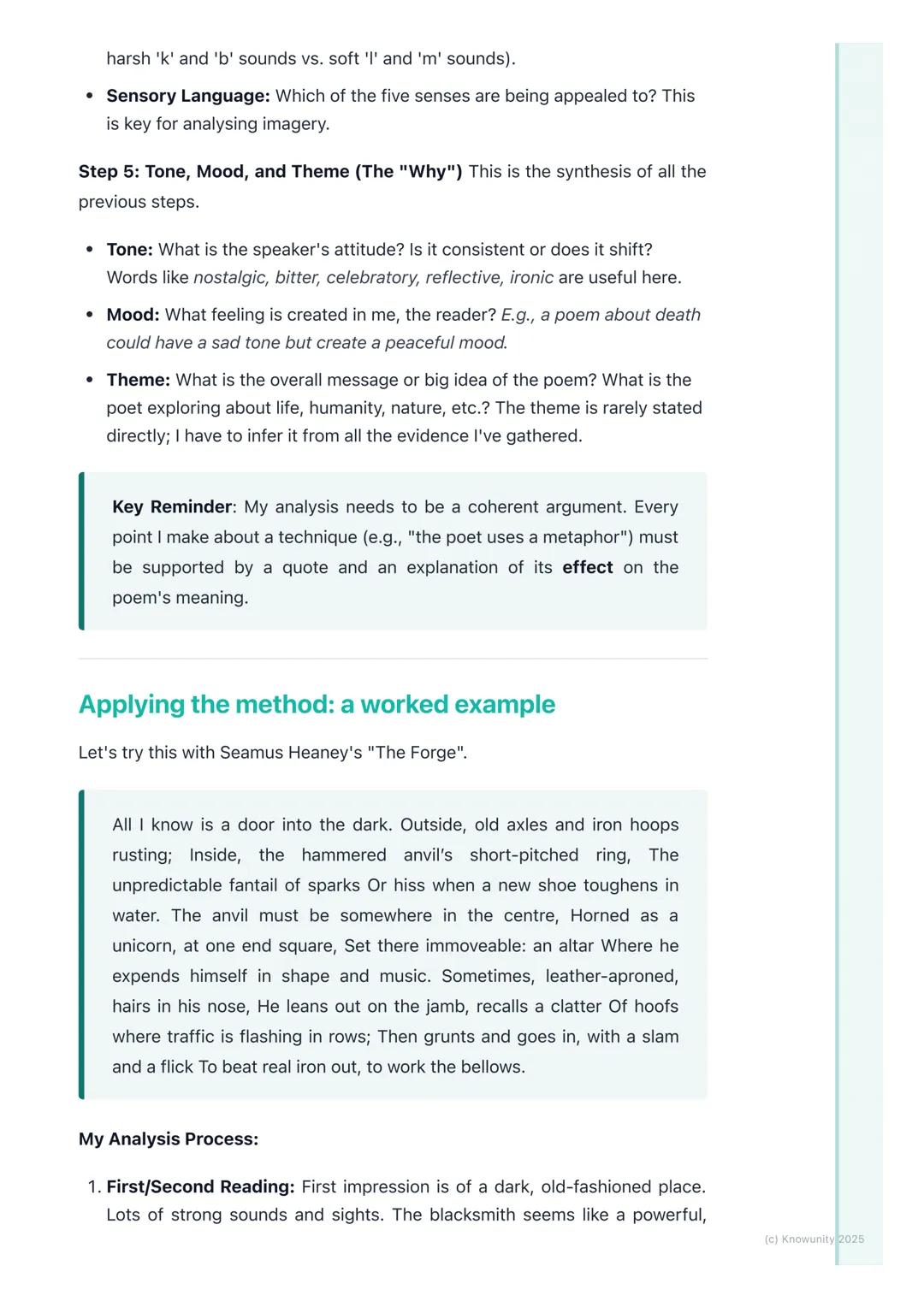
Language, Imagery and Theme
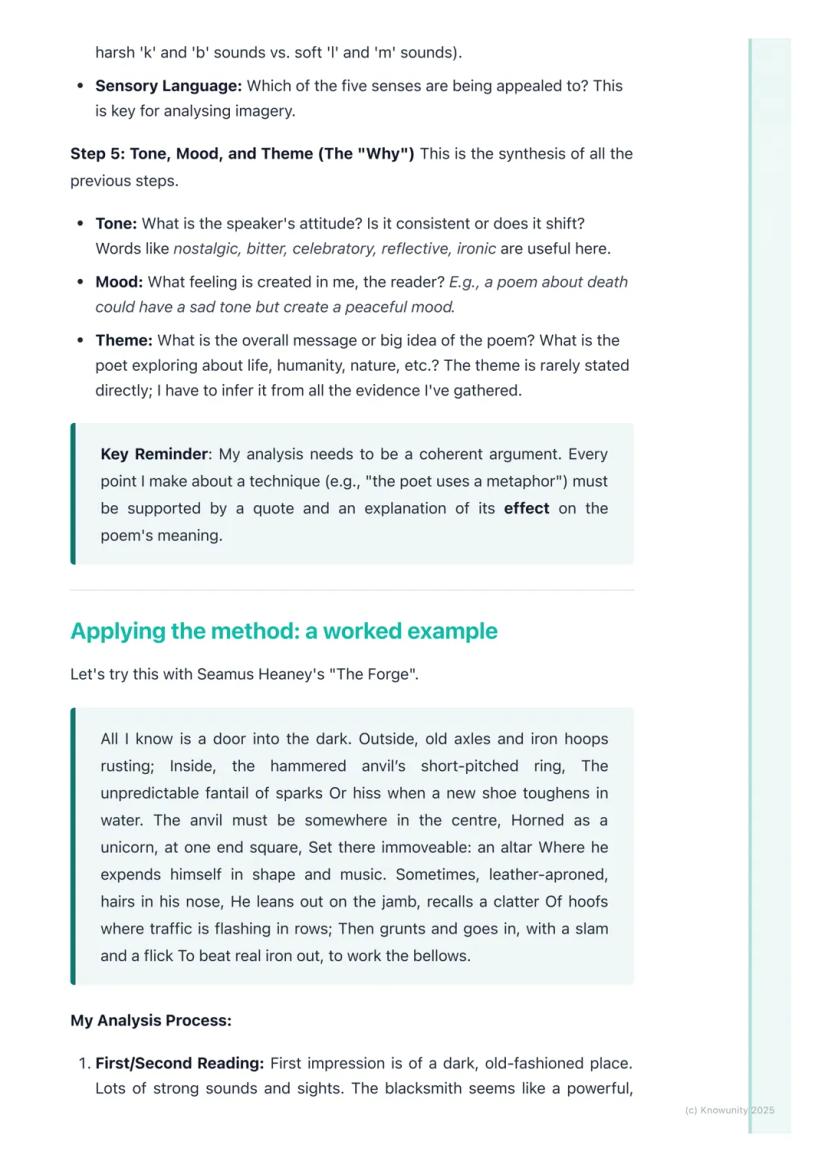
Sensory language is where poems really come alive. Which of the five senses is the poet appealing to? This creates vivid imagery that makes abstract ideas concrete and relatable. Sound devices aren't just decorative - harsh 'k' and 'b' sounds create different effects than soft 'l' and 'm' sounds.
The final step is synthesising everything into tone, mood, and theme. What's the speaker's attitude throughout the poem? Does it shift? What overall feeling does the poem create in you as the reader? Most importantly, what's the big idea the poet is exploring about life, humanity, or nature?
Theme is rarely stated directly - you've got to piece it together from all your evidence. Think of yourself as a detective collecting clues. Every technique you've identified should contribute to your understanding of the poem's deeper meaning.
Remember, your analysis needs to be a coherent argument. Every point about technique must be backed up with a quote and an explanation of its effect. You're building a case for your interpretation.
Key Point: Trust your own interpretation as long as you can back it up with textual evidence. The examiner wants to see your genuine engagement with the poem.
5
of 7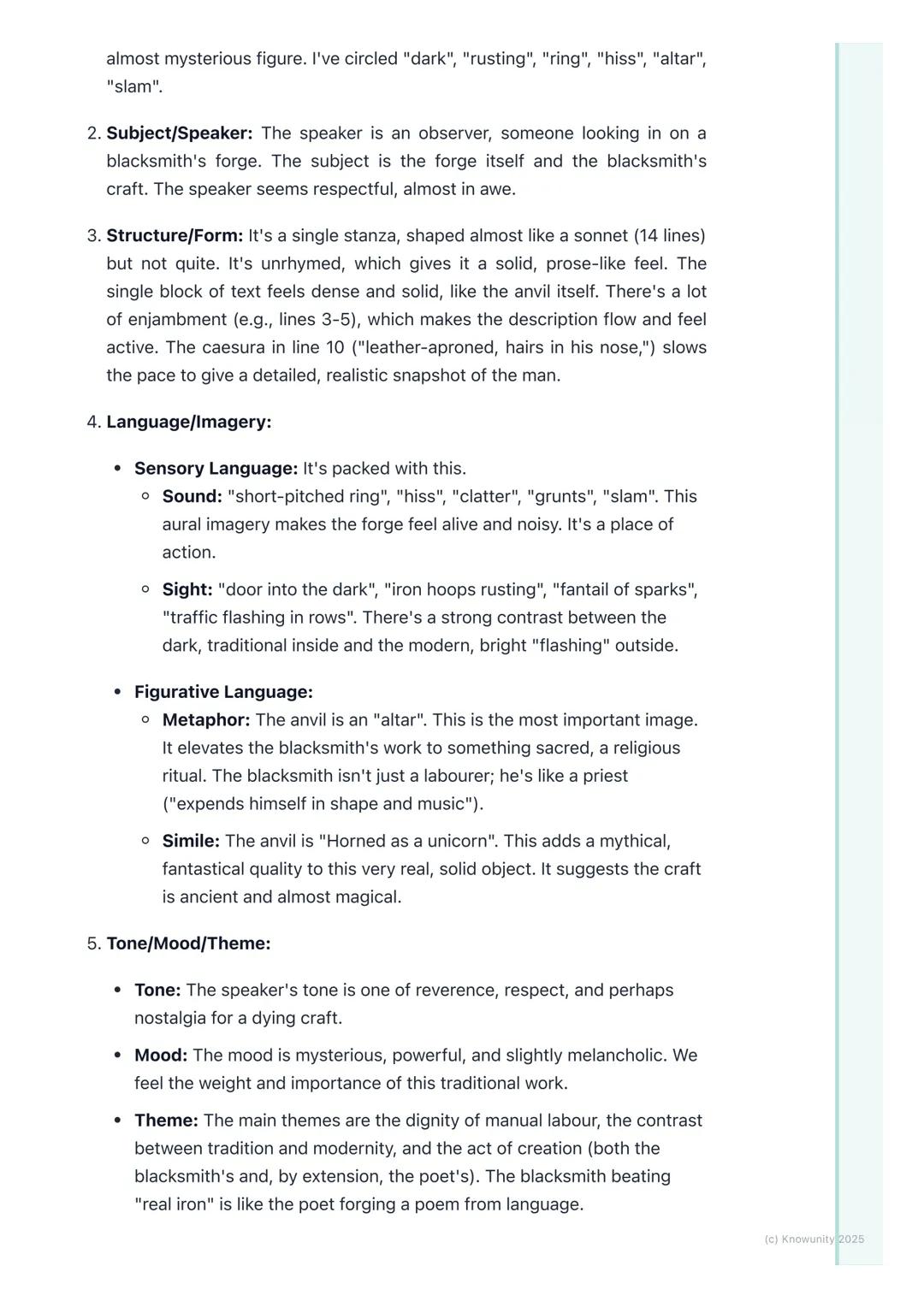
Worked Example: "The Forge"
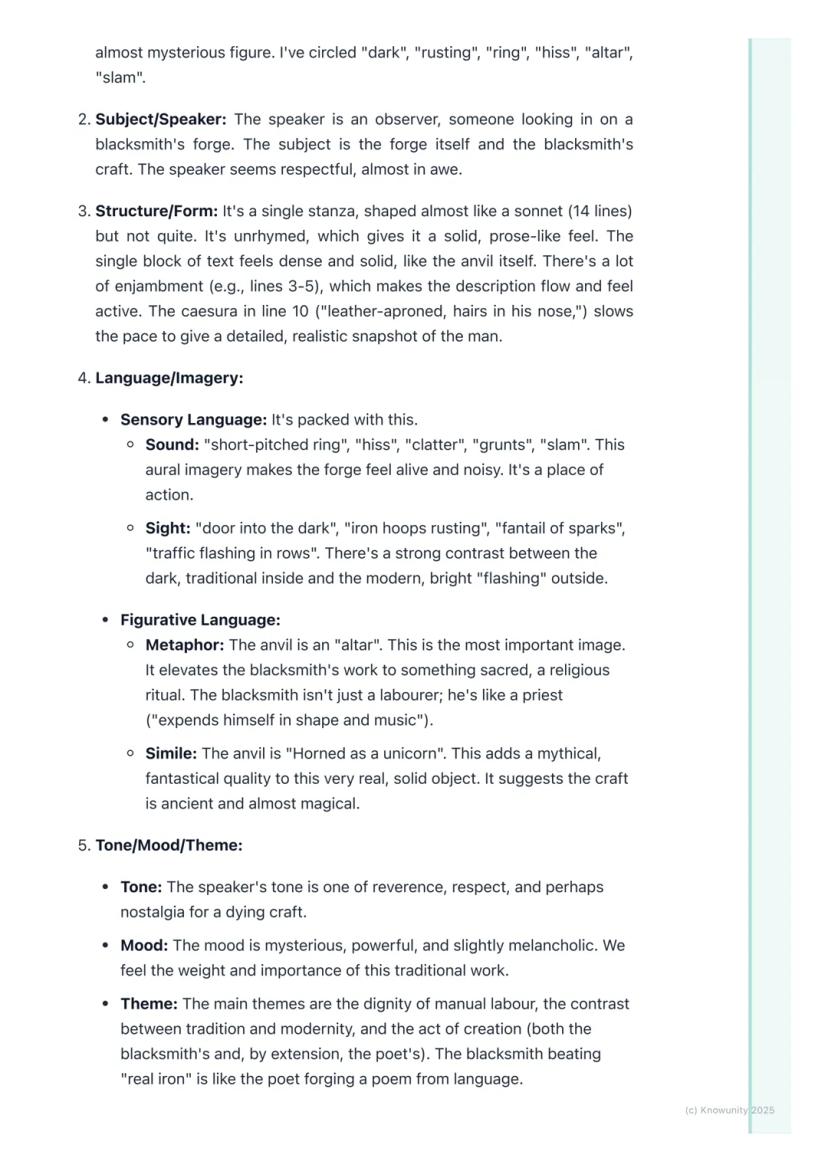
Let's see this method in action with Seamus Heaney's "The Forge". First impressions: it's about a blacksmith's workshop, packed with strong sounds and sights. The blacksmith seems powerful and mysterious.
The structure is almost sonnet-like (14 lines) but unrhymed, giving it a solid, prose-like feel. That single stanza feels dense like the anvil itself. Lots of enjambment makes the description flow actively, whilst the caesura in "leather-aproned, hairs in his nose," slows us down for a detailed snapshot.
Sensory imagery dominates: sounds like "short-pitched ring", "hiss", "clatter" make the forge feel alive. There's a strong contrast between the dark, traditional inside and the modern "flashing" traffic outside. The most crucial metaphor is the anvil as an "altar" - this elevates the blacksmith's work to something sacred.
The simile "Horned as a unicorn" adds mythical quality to this solid object. The tone shows reverence for traditional craft, whilst the mood feels mysterious and slightly melancholic. The main theme explores the dignity of manual labour and the contrast between tradition and modernity.
Analysis Insight: Notice how the blacksmith beating "real iron" parallels the poet forging a poem from language - it's about the creative process itself.
6
of 7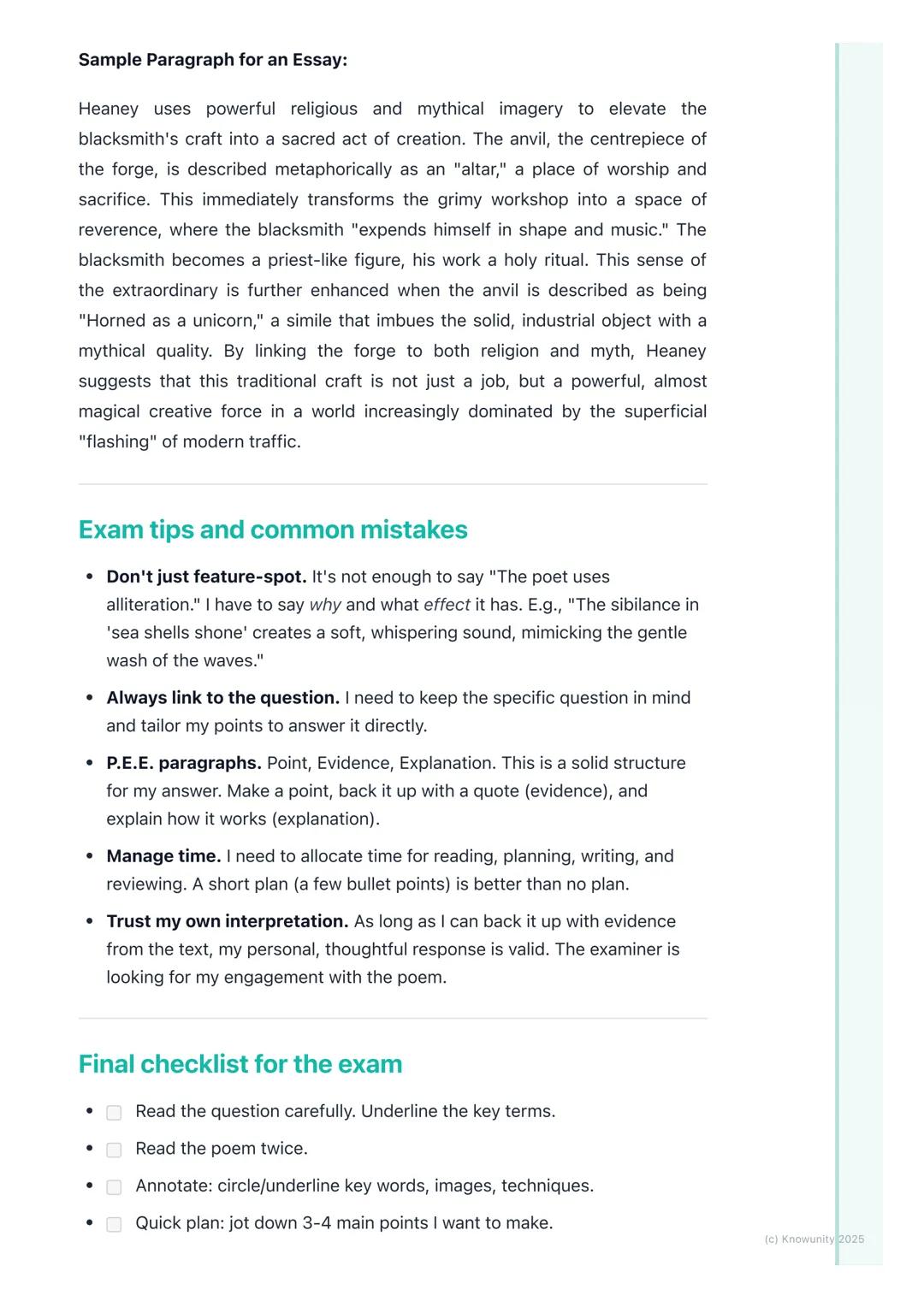
Sample Analysis and Exam Strategy
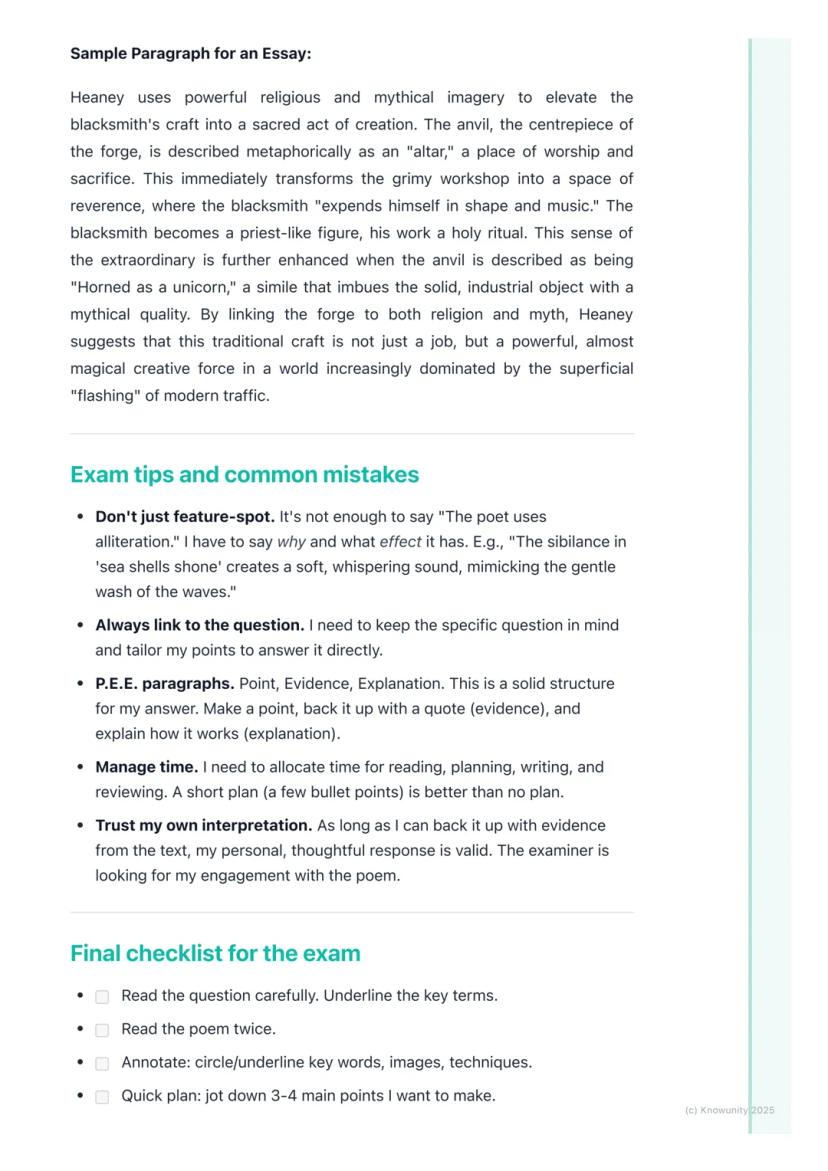
Here's how a top-level paragraph looks: "Heaney uses powerful religious and mythical imagery to elevate the blacksmith's craft into a sacred act of creation. The anvil becomes an 'altar' where the blacksmith 'expends himself in shape and music,' transforming him into a priest-like figure performing holy ritual."
Avoid common mistakes: Don't just feature-spot. Saying "The poet uses alliteration" gets you nowhere. Instead: "The sibilance in 'sea shells shone' creates soft, whispering sounds, mimicking gentle waves." Always connect technique to effect.
Use P.E.E. structure: Point, Evidence, Explanation. Make your point, back it up with a quote, then explain how it works. This keeps your analysis focused and convincing.
Time management is crucial. Allocate time for reading, planning, writing, and reviewing. A brief plan with 3-4 main points beats diving in without direction.
Confidence Builder: Your thoughtful, personal response is exactly what examiners want to see. Trust your interpretation as long as you support it with evidence.
7
of 7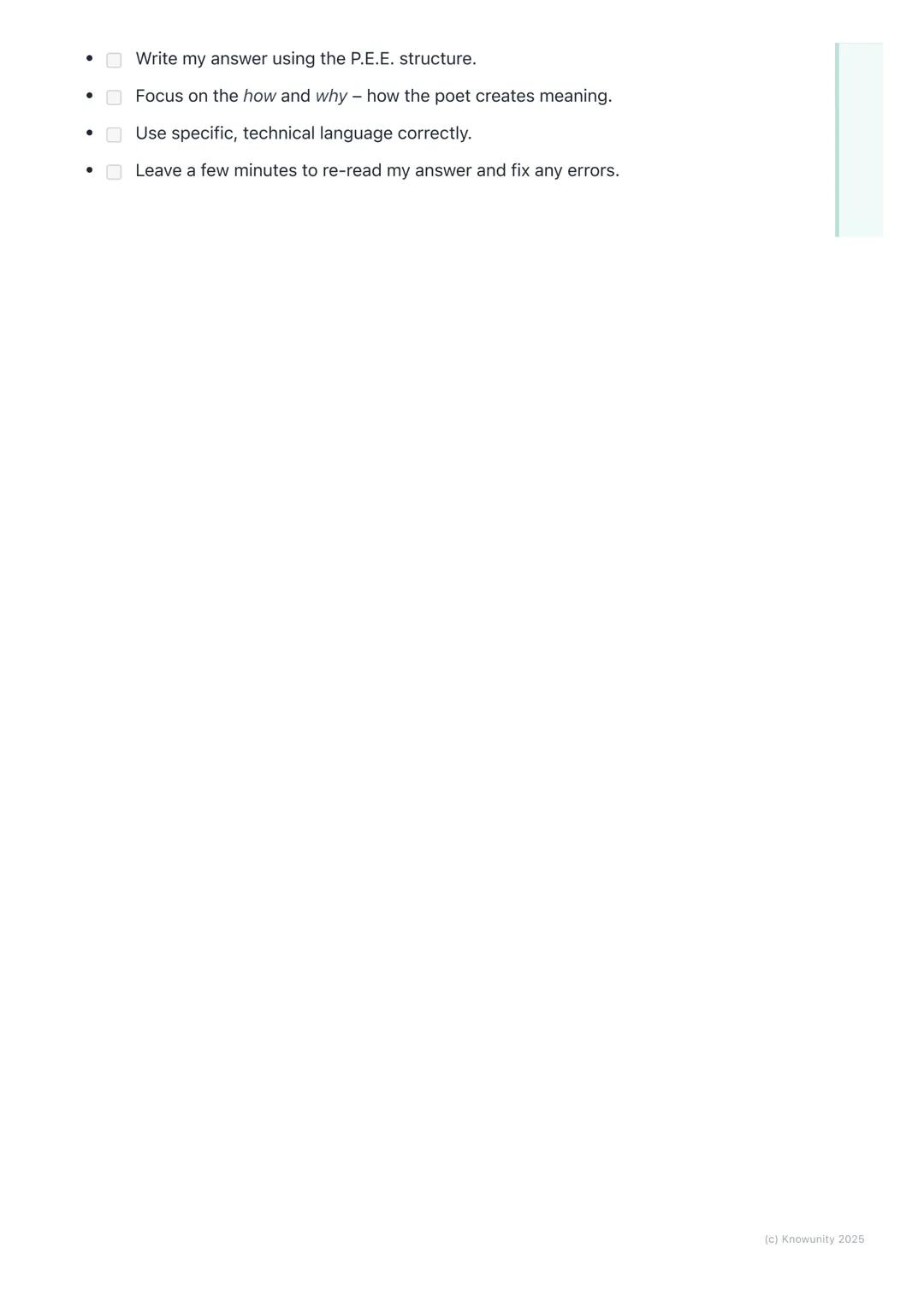
Final Exam Checklist
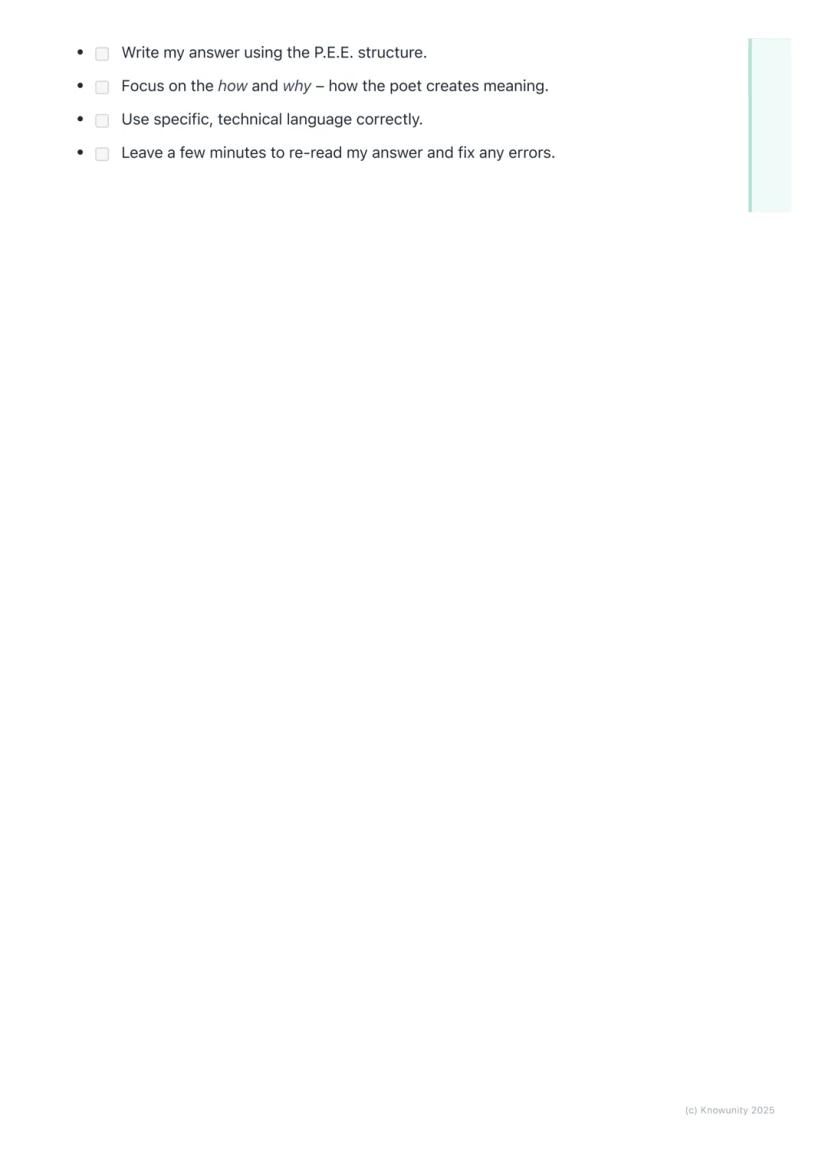
Your exam day strategy should be systematic: Read the question carefully and underline key terms. Read the poem twice, then annotate by circling key words, images, and techniques. Jot down a quick plan with your 3-4 main points before you start writing.
Focus on the how and why rather than just what. How does the poet create meaning? Why did they make these specific choices? Use technical language correctly but don't throw in terms just to impress - they need to serve your argument.
Always link back to the specific question being asked. Tailor your points to answer it directly rather than writing everything you know about the poem. Leave a few minutes at the end to re-read and fix any errors.
Remember, unseen poetry analysis is a skill you can master with practice. The more you use this systematic approach, the more natural it becomes. You've got all the tools you need - now it's about applying them confidently under exam conditions.
Final Reminder: Every poem has layers of meaning waiting to be discovered. Your job is to peel back those layers systematically and show the examiner what you've found.
Si on te demande...
Qu'est-ce que le compagnon IA de Knowunity ?
Notre compagnon IA est spécialement conçu pour répondre aux besoins des étudiants. Sur la base des millions d'éléments de contenu que nous avons sur la plateforme, nous pouvons fournir des réponses vraiment significatives et pertinentes aux étudiants. Mais il ne s'agit pas seulement de réponses, le compagnon a encore plus pour but de guider les élèves dans leurs défis d'apprentissage quotidiens, avec des plans d'étude personnalisés, des quiz ou des éléments de contenu dans le chat et une personnalisation à 100% basée sur les compétences et les développements de l'étudiant.
Où puis-je télécharger l'appli Knowunity ?
Tu peux télécharger l'application dans Google Play Store et dans l'App Store d'Apple.
L'application est-elle vraiment gratuite ?
Oui, tu as un accès entièrement gratuit à tous les contenus de l'appli, tu peux chatter ou suivre les créateurs à tout moment. De plus, nous proposons Knowunity Premium, qui te permet de réviser sans limites!
Contenus les plus populaires en English
9EnglishKey Quotes : Sive
Key Quotes and explanations: Sive
6th Year2842
EnglishCultural Context : Shawshank Redemption : Sive : Small Things Like These
Comparative Study : Cultural Context : Shawshank Redemption, Sive and Small Things Like These
6th Year1430
EnglishElizabeth Bishop notes
Elizabeth Bishop notes
6th Year1271
EnglishPoetry
Paula Meehan - the statue of the virgin at granard speaks, the exact moment i became a poet, prayer for the children of longing, the pattern notes. Seamus Heaney, the forge notes.
6th Year300
EnglishKey Moments of Macbeth
This is a one page summary for key moments of Macbeth including quotes and act numbers
6th Year320
EnglishMud term break
Jc poem english
1st Year141
EnglishBanquo Study Notes
Macbeth
6th Year280
EnglishNotes on Macbeth, poetry and comparative
Notes on Macbeth, dive and comparative
5th Year291
EnglishThe fish-Elizabeth bishop
Overview of Elizabeth bishops poem the fish written in 1940 ,include a summary,tone and mood,key quotes,imagery examples and theme examples
6th Year370
Contenus les plus populaires
9 Irish
IrishIrish oral questions and answers
Questions and answers for the leaving cert oral
5th Year4264
EnglishKey Quotes : Sive
Key Quotes and explanations: Sive
6th Year2842
IrishIrish oral questions
Outline of oral questions
5th Year2055
IrishIníon- le hÁine Durkin
Aine Durkin’s poem, Iníon: Themes & summary
5th Year890
IrishIrish poetry 2027
Iníon + Dínit an Bhróin
5th Year1153
IrishLC HL notes- Iníon (poem)
Includes poem in English and Irish, theme, key words & phrases
5th Year2304
EnglishCultural Context : Shawshank Redemption : Sive : Small Things Like These
Comparative Study : Cultural Context : Shawshank Redemption, Sive and Small Things Like These
6th Year1430
IrishMo Ghrá-sa (Idir Lúibíní)
Notes on mo ghrá-sa
5th Year380
IrishAn Gaeilge Aiste
Irish Language essay
6th Year1320
Rien ne te convient ? Explore d'autres matières.
Les étudiants nous adorent — il ne manque plus que toi.
4.6/5App Store
4.7/5Google Play
L'application est très facile d'utilisation et bien conçue. Jusqu'à présent, j'ai trouvé tout ce que je cherchais et j'ai pu apprendre beaucoup de choses grâce aux présentations ! Je vais certainement utiliser l'application pour un travail en classe ! Et comme source d'inspiration personnelle, elle est bien sûr aussi très utile.
Stefan Sutilisateur iOS
Cette application est vraiment super. Il y a tellement de fiches de révision et d'aide, [...]. Par exemple, la matière qui me pose problème est le français et l'appli a un choix d'aide très large. Grâce à cette application, je me suis améliorée en français. Je la recommanderais à tout le monde.
Samantha Klichutilisatrice Android
Waouh, je suis vraiment abasourdi. J'ai essayé l'application parce que je l'avais déjà vue plusieurs fois dans la publicité et j'ai été absolument choquée. Cette appli est L'AIDE dont on rêve pour l'école et surtout, elle propose tellement de choses, comme des rédactions et des fiches qui m'ont personnellement TRÈS bien aidé.
Annautilisatrice iOS
English5 vues·Mis à jour Jun 18, 2026·7 pagesMastering the Analysis of Unseen Poetry
Analysing unseen poetry doesn't have to be scary - it's all about having a solid strategy that you can rely on in the exam. This guide gives you a step-by-step method to tackle any poem, plus the essential techniques you...
1
of 7
Inscris-toi pour voir le contenu. C'est gratuit!
- Accès à tous les documents
- Améliore tes notes
- Rejoins des millions d'étudiants
My Approach to Unseen Poetry
Right, let's be honest - unseen poetry analysis can feel overwhelming when you're sitting in that exam hall. But here's the thing: you're not just trying to figure out what the poem means. You're showing the examiner that you can think critically about how poets use language, structure, and sound to create meaning.
The key is having a repeatable strategy that works every time. Think of it like having a toolkit - once you know which tools to use and when, you'll feel much more confident tackling any poem they throw at you.
Essential poetic techniques you need to master include imagery (language that hits your five senses), metaphors and similes (comparisons that create deeper meaning), and personification (giving human qualities to objects). These aren't just fancy terms to memorise - they're the building blocks of how poems actually work.
Quick Tip: Don't panic if you don't "get" the poem immediately. Even experienced readers need multiple reads to fully understand a poem's layers.
2
of 7Inscris-toi pour voir le contenu. C'est gratuit!
- Accès à tous les documents
- Améliore tes notes
- Rejoins des millions d'étudiants
Sound Devices and Structural Elements
Sound techniques are your secret weapon for impressive analysis. Alliteration (repeated starting sounds) grabs attention and can create specific moods - harsh or soft depending on the sounds used. Assonance (repeated vowel sounds) creates internal rhythm, whilst sibilance (those 's' and 'sh' sounds) often creates sinister or whispering effects.
Don't overlook structural elements like enjambment and caesura. Enjambment is when lines run on without punctuation - this creates urgency or continuous thought. Caesura is the opposite - those pauses created by punctuation that force you to stop and emphasise certain words.
Understanding tone versus mood is crucial for top marks. Tone is the speaker's attitude (angry, nostalgic, ironic), whilst mood is the atmosphere created for you as the reader. A poem about death might have a sad tone but create a peaceful mood - they're linked but different.
Remember: Every technique you identify must be connected to its effect. Never just spot features - always explain why the poet used them.
3
of 7Inscris-toi pour voir le contenu. C'est gratuit!
- Accès à tous les documents
- Améliore tes notes
- Rejoins des millions d'étudiants
Step-by-Step Analysis Method
Here's your foolproof exam strategy: Start with two readings. First time through, just get the general sense - don't stress if it's confusing. Second reading is when you start annotating - circle striking words, underline images, put question marks next to confusing bits.
Next, tackle the basics: What does the title suggest? Who's the speaker (don't assume it's the poet unless you're sure)? What's the poem literally about in one sentence? These fundamentals give you solid ground to build your analysis on.
Structure analysis comes next. Look at stanza patterns, rhyme schemes, and rhythm. Regular forms often suggest control, whilst free verse might indicate freedom or chaos. Pay attention to punctuation - full stops create finality, lots of commas suggest rushing thoughts.
Then dive into language analysis. Why did the poet choose these specific words? What are the connotations? Identify metaphors, similes, personification, but crucially - explain what's being compared and why that comparison matters.
Pro Tip: Changes in structure often signal changes in thought or mood. Always note when the poem shifts gear.
4
of 7Inscris-toi pour voir le contenu. C'est gratuit!
- Accès à tous les documents
- Améliore tes notes
- Rejoins des millions d'étudiants
Language, Imagery and Theme
Sensory language is where poems really come alive. Which of the five senses is the poet appealing to? This creates vivid imagery that makes abstract ideas concrete and relatable. Sound devices aren't just decorative - harsh 'k' and 'b' sounds create different effects than soft 'l' and 'm' sounds.
The final step is synthesising everything into tone, mood, and theme. What's the speaker's attitude throughout the poem? Does it shift? What overall feeling does the poem create in you as the reader? Most importantly, what's the big idea the poet is exploring about life, humanity, or nature?
Theme is rarely stated directly - you've got to piece it together from all your evidence. Think of yourself as a detective collecting clues. Every technique you've identified should contribute to your understanding of the poem's deeper meaning.
Remember, your analysis needs to be a coherent argument. Every point about technique must be backed up with a quote and an explanation of its effect. You're building a case for your interpretation.
Key Point: Trust your own interpretation as long as you can back it up with textual evidence. The examiner wants to see your genuine engagement with the poem.
5
of 7Inscris-toi pour voir le contenu. C'est gratuit!
- Accès à tous les documents
- Améliore tes notes
- Rejoins des millions d'étudiants
Worked Example: "The Forge"
Let's see this method in action with Seamus Heaney's "The Forge". First impressions: it's about a blacksmith's workshop, packed with strong sounds and sights. The blacksmith seems powerful and mysterious.
The structure is almost sonnet-like (14 lines) but unrhymed, giving it a solid, prose-like feel. That single stanza feels dense like the anvil itself. Lots of enjambment makes the description flow actively, whilst the caesura in "leather-aproned, hairs in his nose," slows us down for a detailed snapshot.
Sensory imagery dominates: sounds like "short-pitched ring", "hiss", "clatter" make the forge feel alive. There's a strong contrast between the dark, traditional inside and the modern "flashing" traffic outside. The most crucial metaphor is the anvil as an "altar" - this elevates the blacksmith's work to something sacred.
The simile "Horned as a unicorn" adds mythical quality to this solid object. The tone shows reverence for traditional craft, whilst the mood feels mysterious and slightly melancholic. The main theme explores the dignity of manual labour and the contrast between tradition and modernity.
Analysis Insight: Notice how the blacksmith beating "real iron" parallels the poet forging a poem from language - it's about the creative process itself.
6
of 7Inscris-toi pour voir le contenu. C'est gratuit!
- Accès à tous les documents
- Améliore tes notes
- Rejoins des millions d'étudiants
Sample Analysis and Exam Strategy
Here's how a top-level paragraph looks: "Heaney uses powerful religious and mythical imagery to elevate the blacksmith's craft into a sacred act of creation. The anvil becomes an 'altar' where the blacksmith 'expends himself in shape and music,' transforming him into a priest-like figure performing holy ritual."
Avoid common mistakes: Don't just feature-spot. Saying "The poet uses alliteration" gets you nowhere. Instead: "The sibilance in 'sea shells shone' creates soft, whispering sounds, mimicking gentle waves." Always connect technique to effect.
Use P.E.E. structure: Point, Evidence, Explanation. Make your point, back it up with a quote, then explain how it works. This keeps your analysis focused and convincing.
Time management is crucial. Allocate time for reading, planning, writing, and reviewing. A brief plan with 3-4 main points beats diving in without direction.
Confidence Builder: Your thoughtful, personal response is exactly what examiners want to see. Trust your interpretation as long as you support it with evidence.
7
of 7Inscris-toi pour voir le contenu. C'est gratuit!
- Accès à tous les documents
- Améliore tes notes
- Rejoins des millions d'étudiants
Final Exam Checklist
Your exam day strategy should be systematic: Read the question carefully and underline key terms. Read the poem twice, then annotate by circling key words, images, and techniques. Jot down a quick plan with your 3-4 main points before you start writing.
Focus on the how and why rather than just what. How does the poet create meaning? Why did they make these specific choices? Use technical language correctly but don't throw in terms just to impress - they need to serve your argument.
Always link back to the specific question being asked. Tailor your points to answer it directly rather than writing everything you know about the poem. Leave a few minutes at the end to re-read and fix any errors.
Remember, unseen poetry analysis is a skill you can master with practice. The more you use this systematic approach, the more natural it becomes. You've got all the tools you need - now it's about applying them confidently under exam conditions.
Final Reminder: Every poem has layers of meaning waiting to be discovered. Your job is to peel back those layers systematically and show the examiner what you've found.
Si on te demande...
Qu'est-ce que le compagnon IA de Knowunity ?
Notre compagnon IA est spécialement conçu pour répondre aux besoins des étudiants. Sur la base des millions d'éléments de contenu que nous avons sur la plateforme, nous pouvons fournir des réponses vraiment significatives et pertinentes aux étudiants. Mais il ne s'agit pas seulement de réponses, le compagnon a encore plus pour but de guider les élèves dans leurs défis d'apprentissage quotidiens, avec des plans d'étude personnalisés, des quiz ou des éléments de contenu dans le chat et une personnalisation à 100% basée sur les compétences et les développements de l'étudiant.
Où puis-je télécharger l'appli Knowunity ?
Tu peux télécharger l'application dans Google Play Store et dans l'App Store d'Apple.
L'application est-elle vraiment gratuite ?
Oui, tu as un accès entièrement gratuit à tous les contenus de l'appli, tu peux chatter ou suivre les créateurs à tout moment. De plus, nous proposons Knowunity Premium, qui te permet de réviser sans limites!
Contenus les plus populaires en English
9EnglishKey Quotes : Sive
Key Quotes and explanations: Sive
6th Year2842
EnglishCultural Context : Shawshank Redemption : Sive : Small Things Like These
Comparative Study : Cultural Context : Shawshank Redemption, Sive and Small Things Like These
6th Year1430
EnglishElizabeth Bishop notes
Elizabeth Bishop notes
6th Year1271
EnglishPoetry
Paula Meehan - the statue of the virgin at granard speaks, the exact moment i became a poet, prayer for the children of longing, the pattern notes. Seamus Heaney, the forge notes.
6th Year300
EnglishKey Moments of Macbeth
This is a one page summary for key moments of Macbeth including quotes and act numbers
6th Year320
EnglishMud term break
Jc poem english
1st Year141
EnglishBanquo Study Notes
Macbeth
6th Year280
EnglishNotes on Macbeth, poetry and comparative
Notes on Macbeth, dive and comparative
5th Year291
EnglishThe fish-Elizabeth bishop
Overview of Elizabeth bishops poem the fish written in 1940 ,include a summary,tone and mood,key quotes,imagery examples and theme examples
6th Year370
Contenus les plus populaires
9IrishIrish oral questions and answers
Questions and answers for the leaving cert oral
5th Year4264
EnglishKey Quotes : Sive
Key Quotes and explanations: Sive
6th Year2842
IrishIrish oral questions
Outline of oral questions
5th Year2055
IrishIníon- le hÁine Durkin
Aine Durkin’s poem, Iníon: Themes & summary
5th Year890
IrishIrish poetry 2027
Iníon + Dínit an Bhróin
5th Year1153
IrishLC HL notes- Iníon (poem)
Includes poem in English and Irish, theme, key words & phrases
5th Year2304
EnglishCultural Context : Shawshank Redemption : Sive : Small Things Like These
Comparative Study : Cultural Context : Shawshank Redemption, Sive and Small Things Like These
6th Year1430
IrishMo Ghrá-sa (Idir Lúibíní)
Notes on mo ghrá-sa
5th Year380
IrishAn Gaeilge Aiste
Irish Language essay
6th Year1320
Rien ne te convient ? Explore d'autres matières.
Les étudiants nous adorent — il ne manque plus que toi.
4.6/5App Store
4.7/5Google Play
L'application est très facile d'utilisation et bien conçue. Jusqu'à présent, j'ai trouvé tout ce que je cherchais et j'ai pu apprendre beaucoup de choses grâce aux présentations ! Je vais certainement utiliser l'application pour un travail en classe ! Et comme source d'inspiration personnelle, elle est bien sûr aussi très utile.
Stefan Sutilisateur iOS
Cette application est vraiment super. Il y a tellement de fiches de révision et d'aide, [...]. Par exemple, la matière qui me pose problème est le français et l'appli a un choix d'aide très large. Grâce à cette application, je me suis améliorée en français. Je la recommanderais à tout le monde.
Samantha Klichutilisatrice Android
Waouh, je suis vraiment abasourdi. J'ai essayé l'application parce que je l'avais déjà vue plusieurs fois dans la publicité et j'ai été absolument choquée. Cette appli est L'AIDE dont on rêve pour l'école et surtout, elle propose tellement de choses, comme des rédactions et des fiches qui m'ont personnellement TRÈS bien aidé.
Annautilisatrice iOS