
Learning the months of the year in French is essential...
 French3 vues·Mis à jour Jun 14, 2026·4 pages
Les Mois de l'Année en Français
1 / 4
1
of 4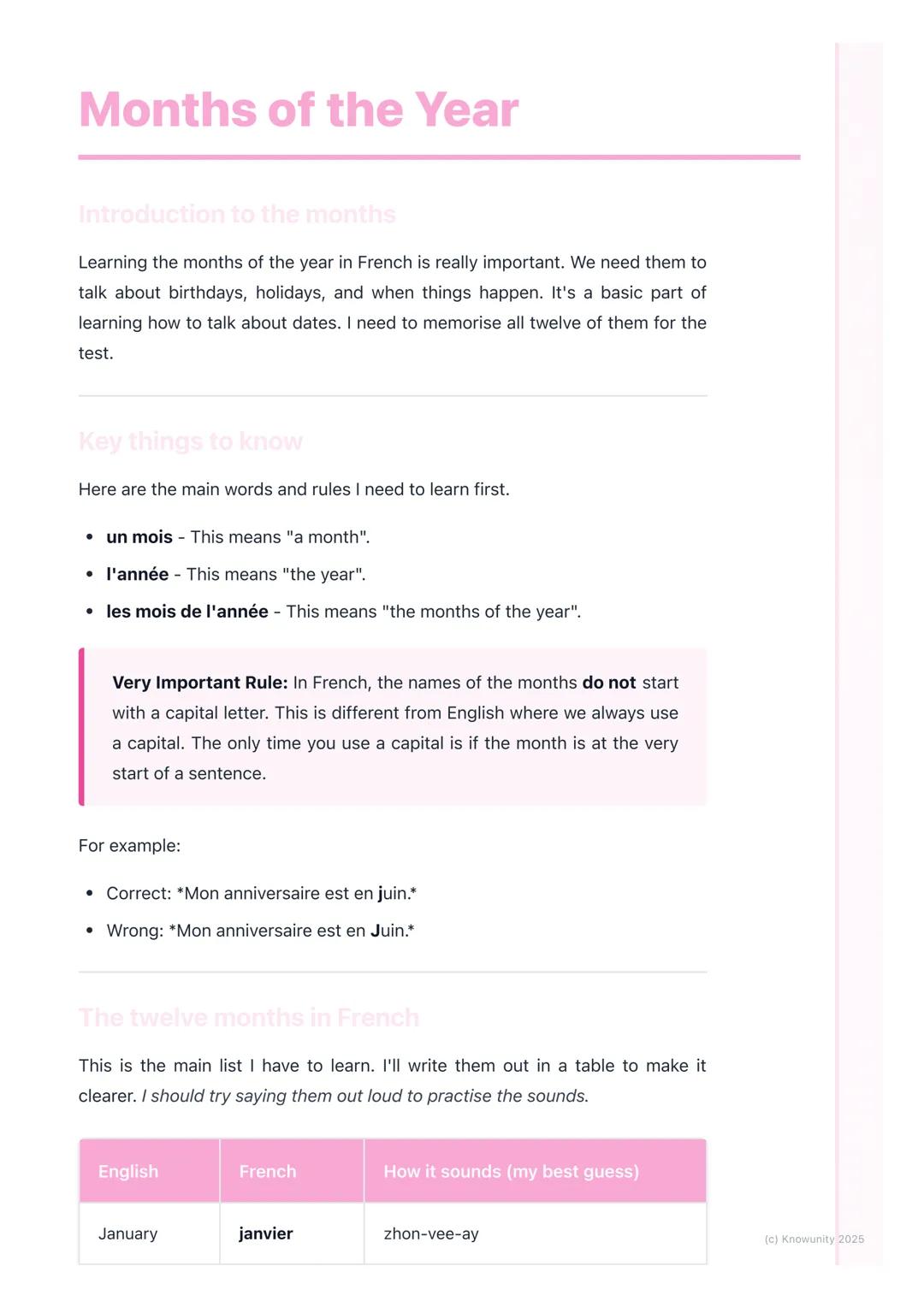
Getting Started with French Months
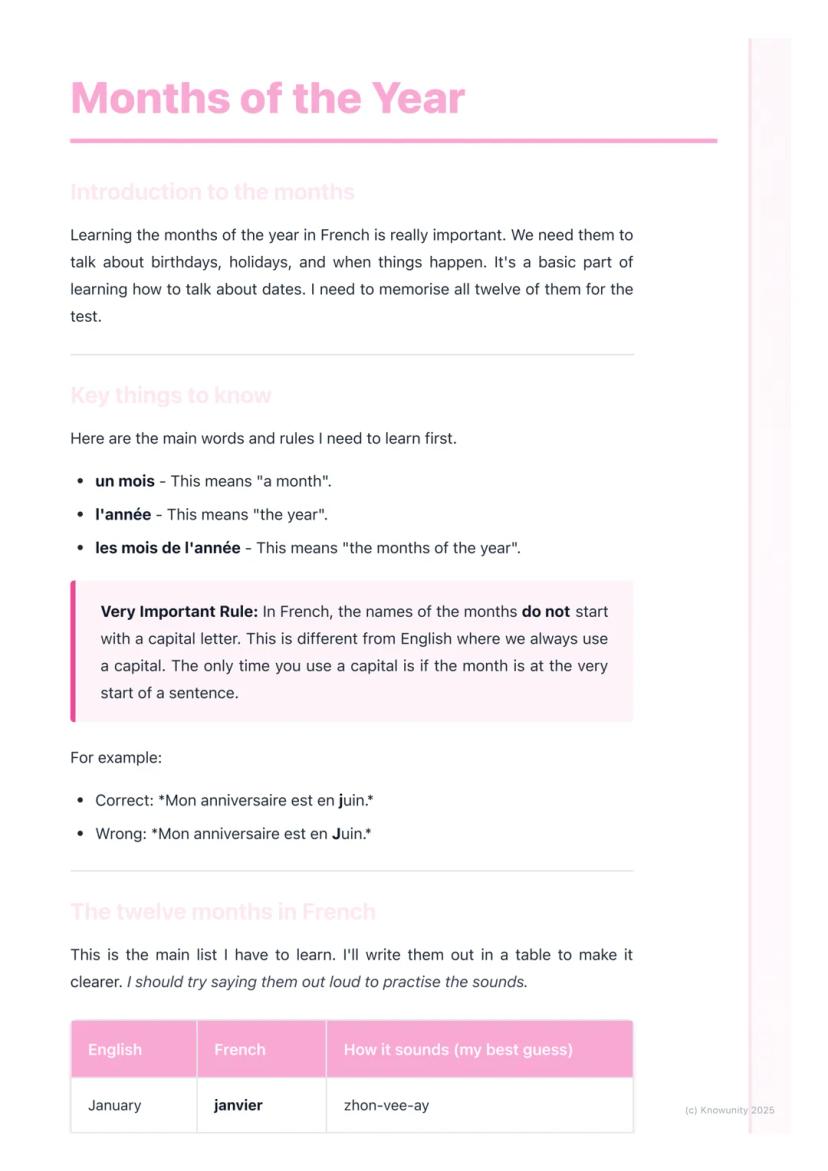
You'll use French months constantly - from talking about your birthday to planning holidays. The good news is that many of them look quite similar to English, so you're already halfway there!
There are three key terms to master first: un mois (a month), l'année (the year), and les mois de l'année (the months of the year). These will pop up everywhere when discussing dates.
Here's the game-changer that trips up loads of students: French months never start with capital letters unless they're at the beginning of a sentence. So it's "Mon anniversaire est en juin" (My birthday is in June), not "Mon anniversaire est en Juin."
Quick Tip: Practice saying the months out loud - hearing yourself say them helps with spelling and pronunciation!
2
of 4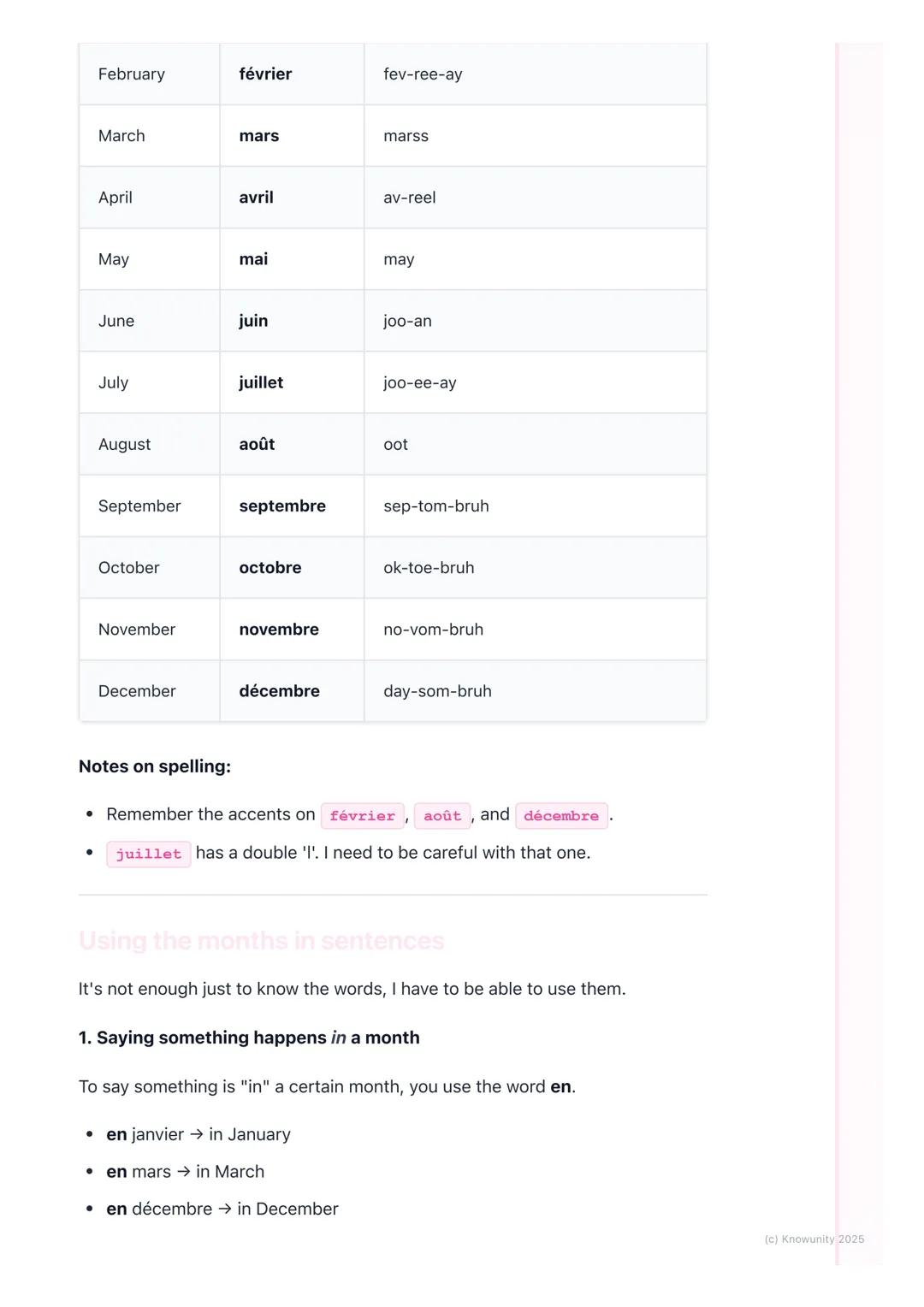
The Twelve Months You Need to Know
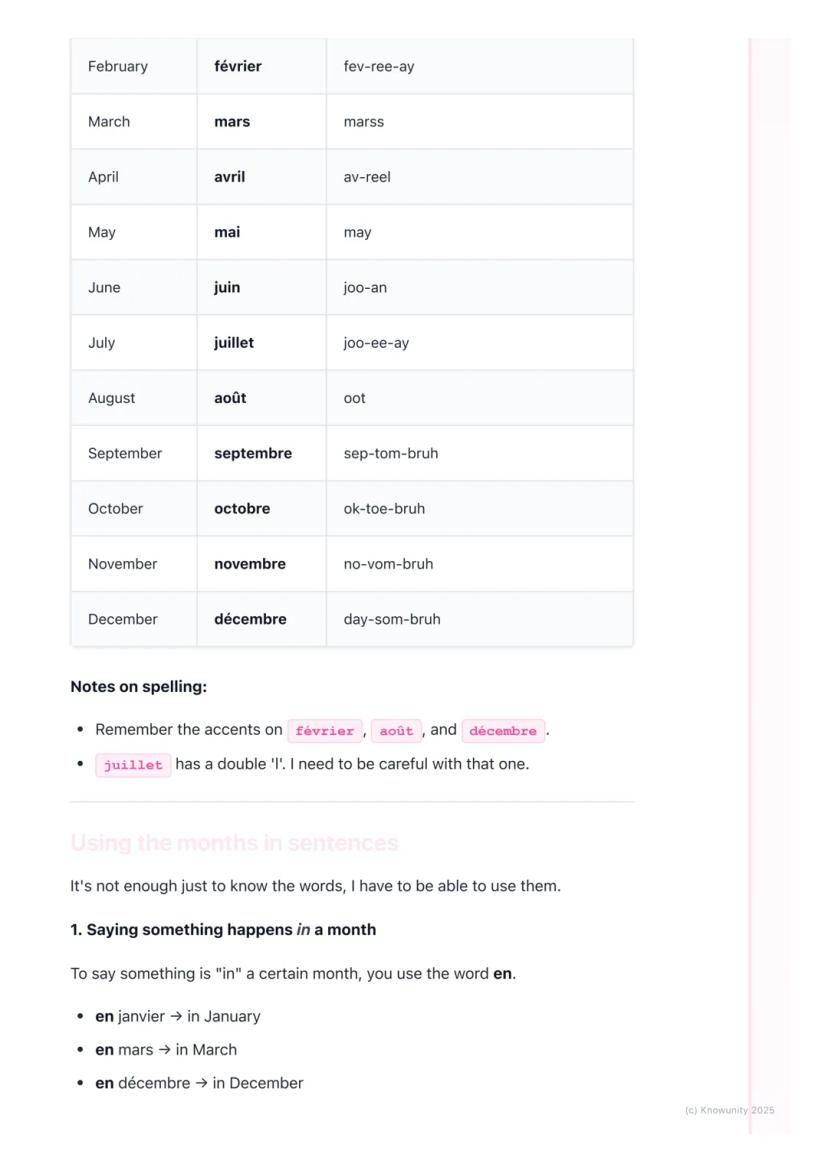
Here are all twelve months with their pronunciation guides. Don't worry about getting the pronunciation perfect straight away - just have a go and you'll improve with practice.
janvier , février , mars (marss), avril , mai (may), juin - these first six are quite different from English.
The summer and autumn months are more familiar: juillet , août (oot), septembre , octobre , novembre , décembre .
Watch out for the tricky spellings: février, août, and décembre all have accents, whilst juillet has a sneaky double 'l' that's easy to forget.
Memory Hack: The last four months (septembre, octobre, novembre, décembre) are dead similar to English - use these as your confidence boosters!
3
of 4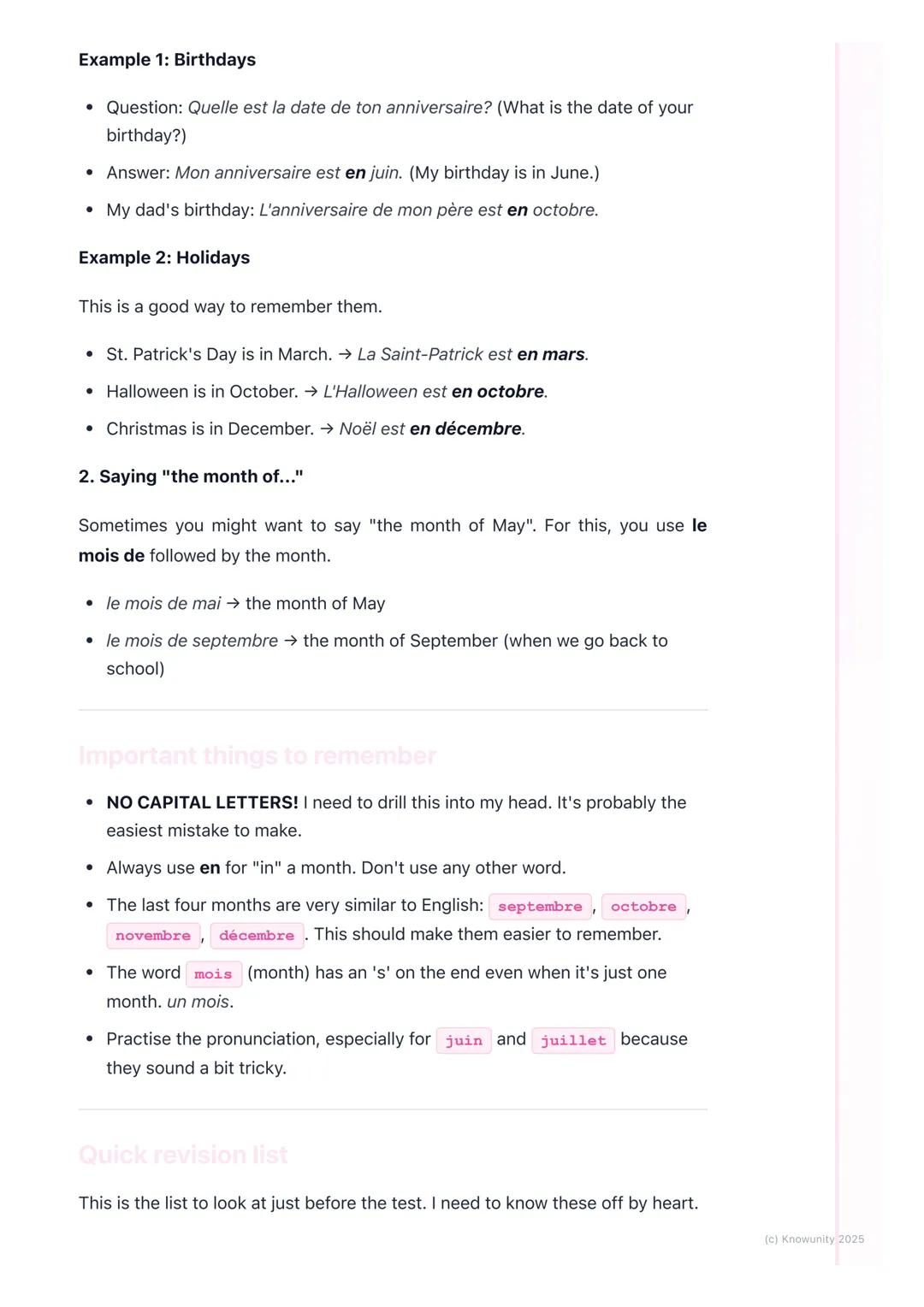
Using Months in Real Conversations
Now for the practical bit - actually using these months in sentences. This is where French gets really useful for everyday chat.
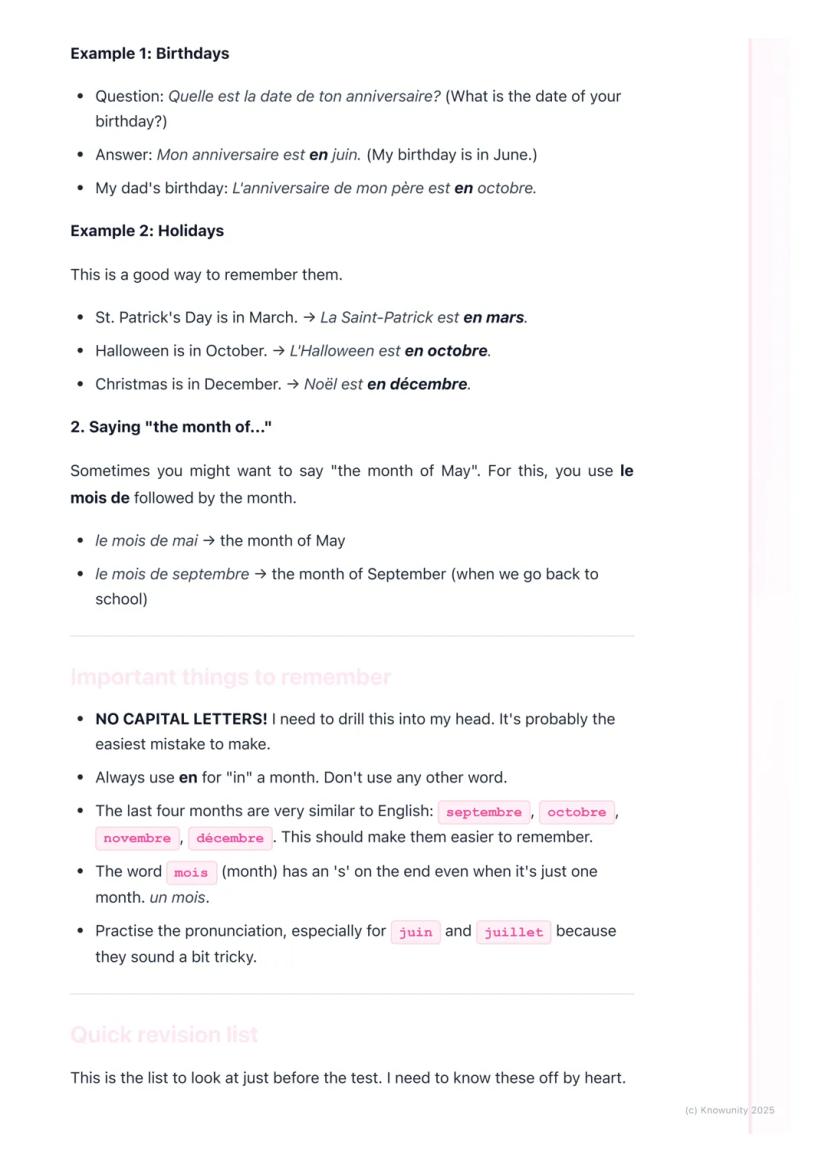
To say something happens "in" a month, you always use en. So "en janvier" means "in January", "en mars" means "in March", and so on. This works for absolutely everything - birthdays, holidays, school terms.
For birthdays, you'll often hear "Mon anniversaire est en juin" (My birthday is in June). For holidays, try "Noël est en décembre" (Christmas is in December) or "La Saint-Patrick est en mars" (St. Patrick's Day is in March).
Sometimes you might need to say "the month of..." - that's when you use le mois de followed by the month name, like "le mois de septembre" (the month of September).
Test Prep: Remember - always use 'en' for 'in' with months, never any other word. This is a common exam question!
4
of 4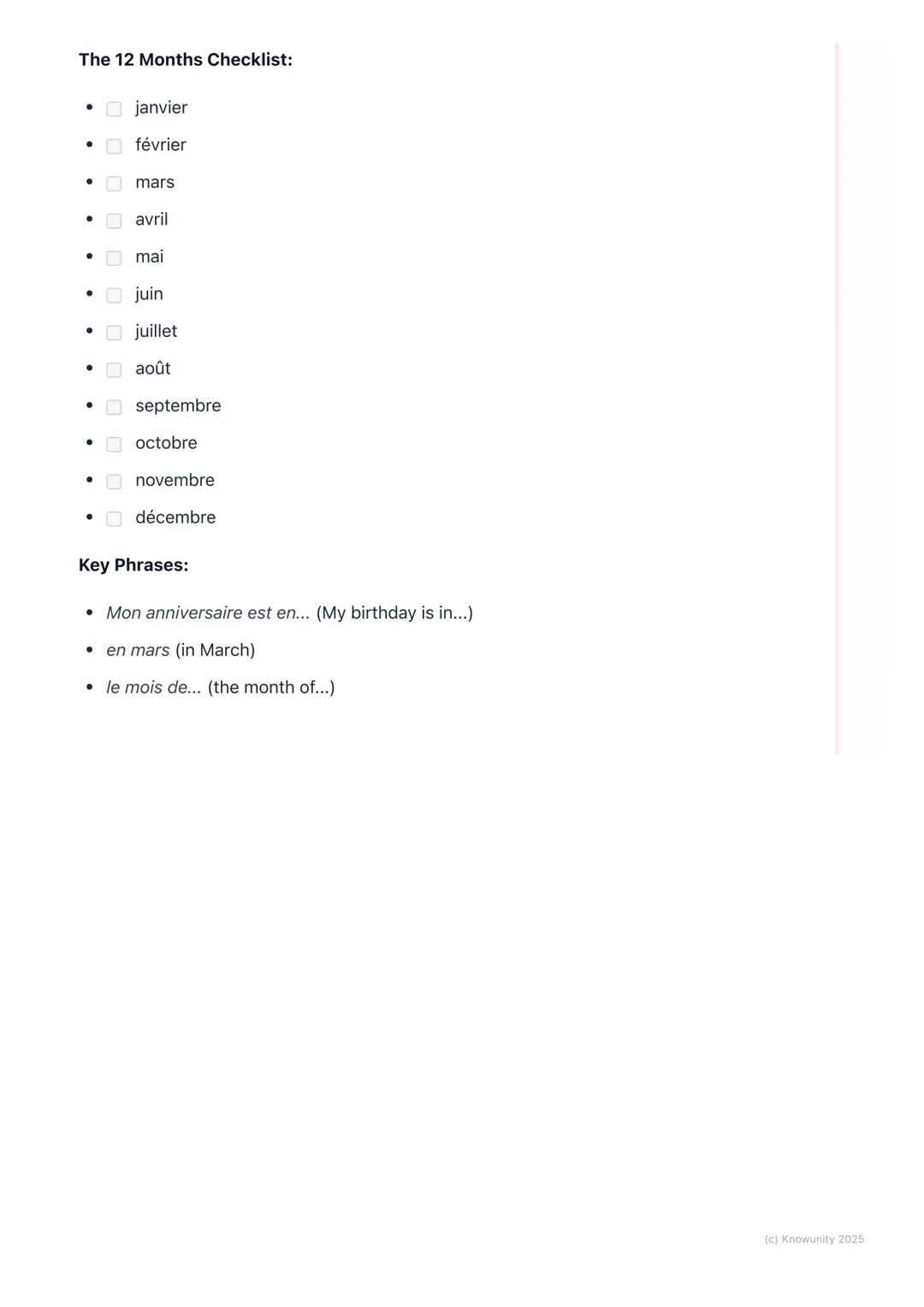
Your Final Revision Checklist
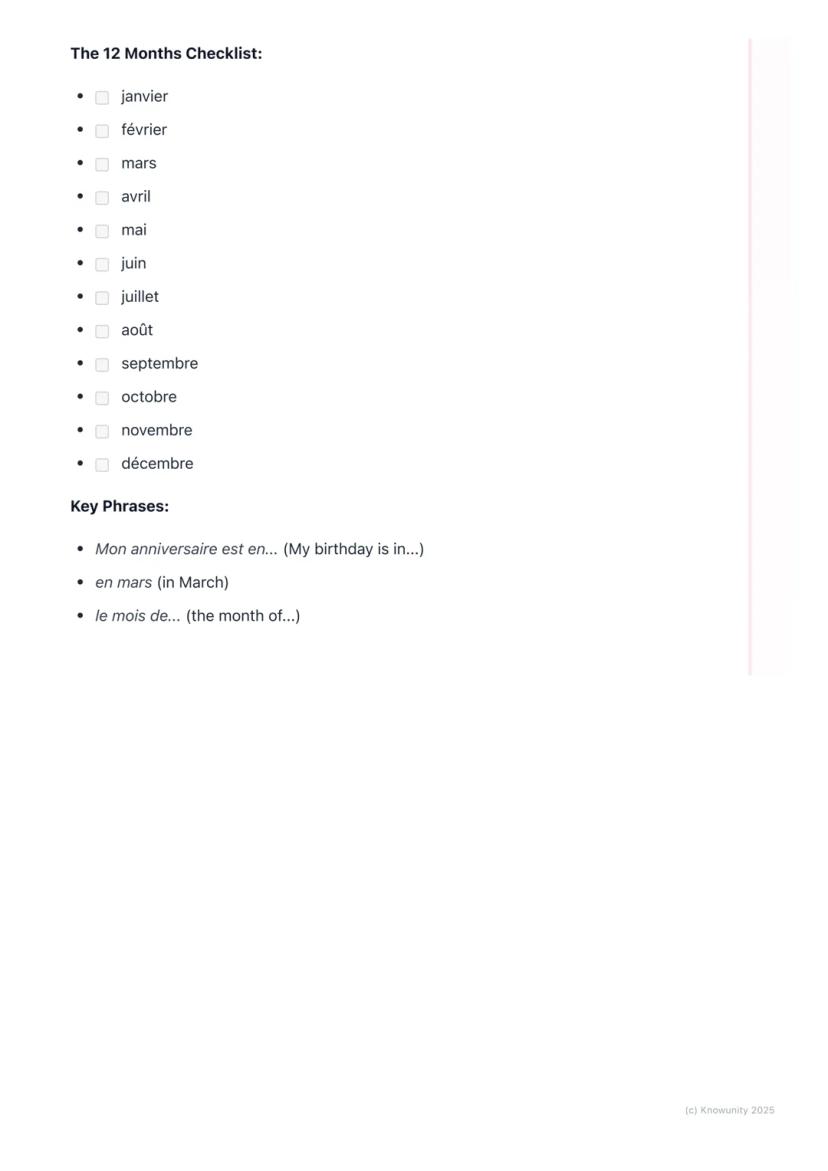
Right, here's your quick-fire revision list for before any test or when you need a speedy reminder.
The twelve months in order: janvier, février, mars, avril, mai, juin, juillet, août, septembre, octobre, novembre, décembre. Run through these a few times until they flow naturally.
Your essential phrases are "Mon anniversaire est en..." (My birthday is in...), "en mars" (in March), and "le mois de..." (the month of...). These three patterns will cover most situations you'll encounter.
Remember the golden rules: no capitals unless it's the start of a sentence, always use 'en' for 'in', and don't panic about pronunciation - you'll get better with practice.
Confidence Booster: You've already got this! Many French months are similar to English, and with a bit of practice, you'll be using them naturally in conversations.
Si on te demande...
Qu'est-ce que le compagnon IA de Knowunity ?
Notre compagnon IA est spécialement conçu pour répondre aux besoins des étudiants. Sur la base des millions d'éléments de contenu que nous avons sur la plateforme, nous pouvons fournir des réponses vraiment significatives et pertinentes aux étudiants. Mais il ne s'agit pas seulement de réponses, le compagnon a encore plus pour but de guider les élèves dans leurs défis d'apprentissage quotidiens, avec des plans d'étude personnalisés, des quiz ou des éléments de contenu dans le chat et une personnalisation à 100% basée sur les compétences et les développements de l'étudiant.
Où puis-je télécharger l'appli Knowunity ?
Tu peux télécharger l'application dans Google Play Store et dans l'App Store d'Apple.
L'application est-elle vraiment gratuite ?
Oui, tu as un accès entièrement gratuit à tous les contenus de l'appli, tu peux chatter ou suivre les créateurs à tout moment. De plus, nous proposons Knowunity Premium, qui te permet de réviser sans limites!
Contenus les plus populaires en French
2Contenus les plus populaires
9 Irish
IrishIrish oral questions and answers
Questions and answers for the leaving cert oral
5th Year4264
 English
Key Quotes : Sive
Key Quotes and explanations: Sive
6th Year2842
IrishIrish oral questions
Outline of oral questions
5th Year2055
IrishIníon- le hÁine Durkin
Aine Durkin’s poem, Iníon: Themes & summary
5th Year890
IrishIrish poetry 2027
Iníon + Dínit an Bhróin
5th Year1153
IrishLC HL notes- Iníon (poem)
Includes poem in English and Irish, theme, key words & phrases
5th Year2304
EnglishCultural Context : Shawshank Redemption : Sive : Small Things Like These
Comparative Study : Cultural Context : Shawshank Redemption, Sive and Small Things Like These
6th Year1430
IrishMo Ghrá-sa (Idir Lúibíní)
Notes on mo ghrá-sa
5th Year380
IrishAn Gaeilge Aiste
Irish Language essay
6th Year1320
Rien ne te convient ? Explore d'autres matières.
Les étudiants nous adorent — il ne manque plus que toi.
4.6/5App Store
4.7/5Google Play
L'application est très facile d'utilisation et bien conçue. Jusqu'à présent, j'ai trouvé tout ce que je cherchais et j'ai pu apprendre beaucoup de choses grâce aux présentations ! Je vais certainement utiliser l'application pour un travail en classe ! Et comme source d'inspiration personnelle, elle est bien sûr aussi très utile.
Stefan Sutilisateur iOS
Cette application est vraiment super. Il y a tellement de fiches de révision et d'aide, [...]. Par exemple, la matière qui me pose problème est le français et l'appli a un choix d'aide très large. Grâce à cette application, je me suis améliorée en français. Je la recommanderais à tout le monde.
Samantha Klichutilisatrice Android
Waouh, je suis vraiment abasourdi. J'ai essayé l'application parce que je l'avais déjà vue plusieurs fois dans la publicité et j'ai été absolument choquée. Cette appli est L'AIDE dont on rêve pour l'école et surtout, elle propose tellement de choses, comme des rédactions et des fiches qui m'ont personnellement TRÈS bien aidé.
Annautilisatrice iOS
French3 vues·Mis à jour Jun 14, 2026·4 pagesLes Mois de l'Année en Français
Learning the months of the year in French is essential for talking about birthdays, holidays, and when events happen. It's one of the most practical things you'll use when speaking French, and once you get the hang of it, you'll...
1
of 4
Inscris-toi pour voir le contenu. C'est gratuit!
- Accès à tous les documents
- Améliore tes notes
- Rejoins des millions d'étudiants
Getting Started with French Months
You'll use French months constantly - from talking about your birthday to planning holidays. The good news is that many of them look quite similar to English, so you're already halfway there!
There are three key terms to master first: un mois (a month), l'année (the year), and les mois de l'année (the months of the year). These will pop up everywhere when discussing dates.
Here's the game-changer that trips up loads of students: French months never start with capital letters unless they're at the beginning of a sentence. So it's "Mon anniversaire est en juin" (My birthday is in June), not "Mon anniversaire est en Juin."
Quick Tip: Practice saying the months out loud - hearing yourself say them helps with spelling and pronunciation!
2
of 4Inscris-toi pour voir le contenu. C'est gratuit!
- Accès à tous les documents
- Améliore tes notes
- Rejoins des millions d'étudiants
The Twelve Months You Need to Know
Here are all twelve months with their pronunciation guides. Don't worry about getting the pronunciation perfect straight away - just have a go and you'll improve with practice.
janvier , février , mars (marss), avril , mai (may), juin - these first six are quite different from English.
The summer and autumn months are more familiar: juillet , août (oot), septembre , octobre , novembre , décembre .
Watch out for the tricky spellings: février, août, and décembre all have accents, whilst juillet has a sneaky double 'l' that's easy to forget.
Memory Hack: The last four months (septembre, octobre, novembre, décembre) are dead similar to English - use these as your confidence boosters!
3
of 4Inscris-toi pour voir le contenu. C'est gratuit!
- Accès à tous les documents
- Améliore tes notes
- Rejoins des millions d'étudiants
Using Months in Real Conversations
Now for the practical bit - actually using these months in sentences. This is where French gets really useful for everyday chat.
To say something happens "in" a month, you always use en. So "en janvier" means "in January", "en mars" means "in March", and so on. This works for absolutely everything - birthdays, holidays, school terms.
For birthdays, you'll often hear "Mon anniversaire est en juin" (My birthday is in June). For holidays, try "Noël est en décembre" (Christmas is in December) or "La Saint-Patrick est en mars" (St. Patrick's Day is in March).
Sometimes you might need to say "the month of..." - that's when you use le mois de followed by the month name, like "le mois de septembre" (the month of September).
Test Prep: Remember - always use 'en' for 'in' with months, never any other word. This is a common exam question!
4
of 4Inscris-toi pour voir le contenu. C'est gratuit!
- Accès à tous les documents
- Améliore tes notes
- Rejoins des millions d'étudiants
Your Final Revision Checklist
Right, here's your quick-fire revision list for before any test or when you need a speedy reminder.
The twelve months in order: janvier, février, mars, avril, mai, juin, juillet, août, septembre, octobre, novembre, décembre. Run through these a few times until they flow naturally.
Your essential phrases are "Mon anniversaire est en..." (My birthday is in...), "en mars" (in March), and "le mois de..." (the month of...). These three patterns will cover most situations you'll encounter.
Remember the golden rules: no capitals unless it's the start of a sentence, always use 'en' for 'in', and don't panic about pronunciation - you'll get better with practice.
Confidence Booster: You've already got this! Many French months are similar to English, and with a bit of practice, you'll be using them naturally in conversations.
Si on te demande...
Qu'est-ce que le compagnon IA de Knowunity ?
Notre compagnon IA est spécialement conçu pour répondre aux besoins des étudiants. Sur la base des millions d'éléments de contenu que nous avons sur la plateforme, nous pouvons fournir des réponses vraiment significatives et pertinentes aux étudiants. Mais il ne s'agit pas seulement de réponses, le compagnon a encore plus pour but de guider les élèves dans leurs défis d'apprentissage quotidiens, avec des plans d'étude personnalisés, des quiz ou des éléments de contenu dans le chat et une personnalisation à 100% basée sur les compétences et les développements de l'étudiant.
Où puis-je télécharger l'appli Knowunity ?
Tu peux télécharger l'application dans Google Play Store et dans l'App Store d'Apple.
L'application est-elle vraiment gratuite ?
Oui, tu as un accès entièrement gratuit à tous les contenus de l'appli, tu peux chatter ou suivre les créateurs à tout moment. De plus, nous proposons Knowunity Premium, qui te permet de réviser sans limites!
Contenus les plus populaires en French
2Contenus les plus populaires
9IrishIrish oral questions and answers
Questions and answers for the leaving cert oral
5th Year4264
EnglishKey Quotes : Sive
Key Quotes and explanations: Sive
6th Year2842
IrishIrish oral questions
Outline of oral questions
5th Year2055
IrishIníon- le hÁine Durkin
Aine Durkin’s poem, Iníon: Themes & summary
5th Year890
IrishIrish poetry 2027
Iníon + Dínit an Bhróin
5th Year1153
IrishLC HL notes- Iníon (poem)
Includes poem in English and Irish, theme, key words & phrases
5th Year2304
EnglishCultural Context : Shawshank Redemption : Sive : Small Things Like These
Comparative Study : Cultural Context : Shawshank Redemption, Sive and Small Things Like These
6th Year1430
IrishMo Ghrá-sa (Idir Lúibíní)
Notes on mo ghrá-sa
5th Year380
IrishAn Gaeilge Aiste
Irish Language essay
6th Year1320
Rien ne te convient ? Explore d'autres matières.
Les étudiants nous adorent — il ne manque plus que toi.
4.6/5App Store
4.7/5Google Play
L'application est très facile d'utilisation et bien conçue. Jusqu'à présent, j'ai trouvé tout ce que je cherchais et j'ai pu apprendre beaucoup de choses grâce aux présentations ! Je vais certainement utiliser l'application pour un travail en classe ! Et comme source d'inspiration personnelle, elle est bien sûr aussi très utile.
Stefan Sutilisateur iOS
Cette application est vraiment super. Il y a tellement de fiches de révision et d'aide, [...]. Par exemple, la matière qui me pose problème est le français et l'appli a un choix d'aide très large. Grâce à cette application, je me suis améliorée en français. Je la recommanderais à tout le monde.
Samantha Klichutilisatrice Android
Waouh, je suis vraiment abasourdi. J'ai essayé l'application parce que je l'avais déjà vue plusieurs fois dans la publicité et j'ai été absolument choquée. Cette appli est L'AIDE dont on rêve pour l'école et surtout, elle propose tellement de choses, comme des rédactions et des fiches qui m'ont personnellement TRÈS bien aidé.
Annautilisatrice iOS