
Ever wonder why earthquakes happen or how mountains form? It...
 Geography17 vues·Mis à jour Jun 12, 2026·6 pages
Understanding Plate Tectonics and Earth's Dynamic Surface

1 / 6
1
of 6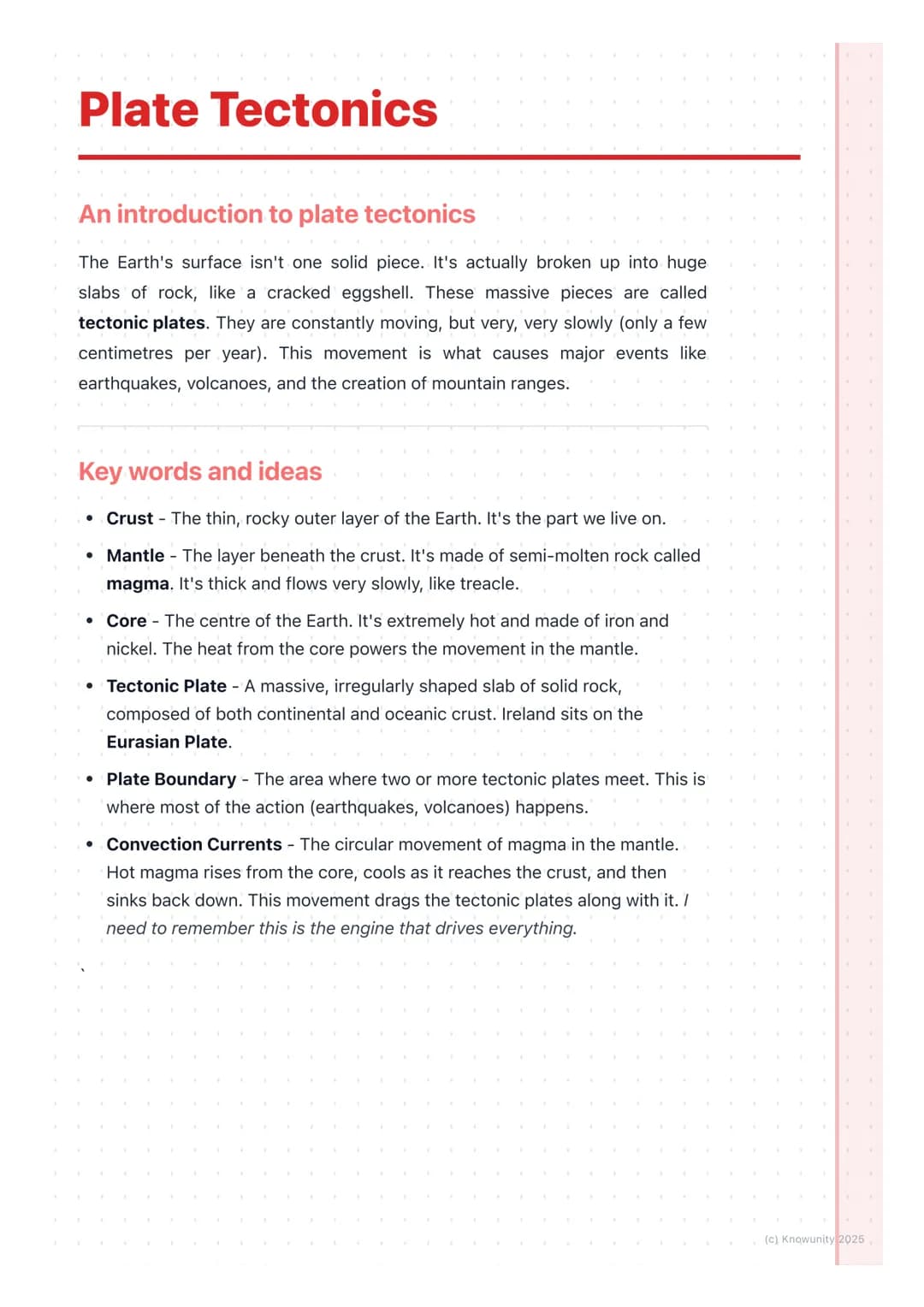
Understanding Earth's Structure and Plate Movement
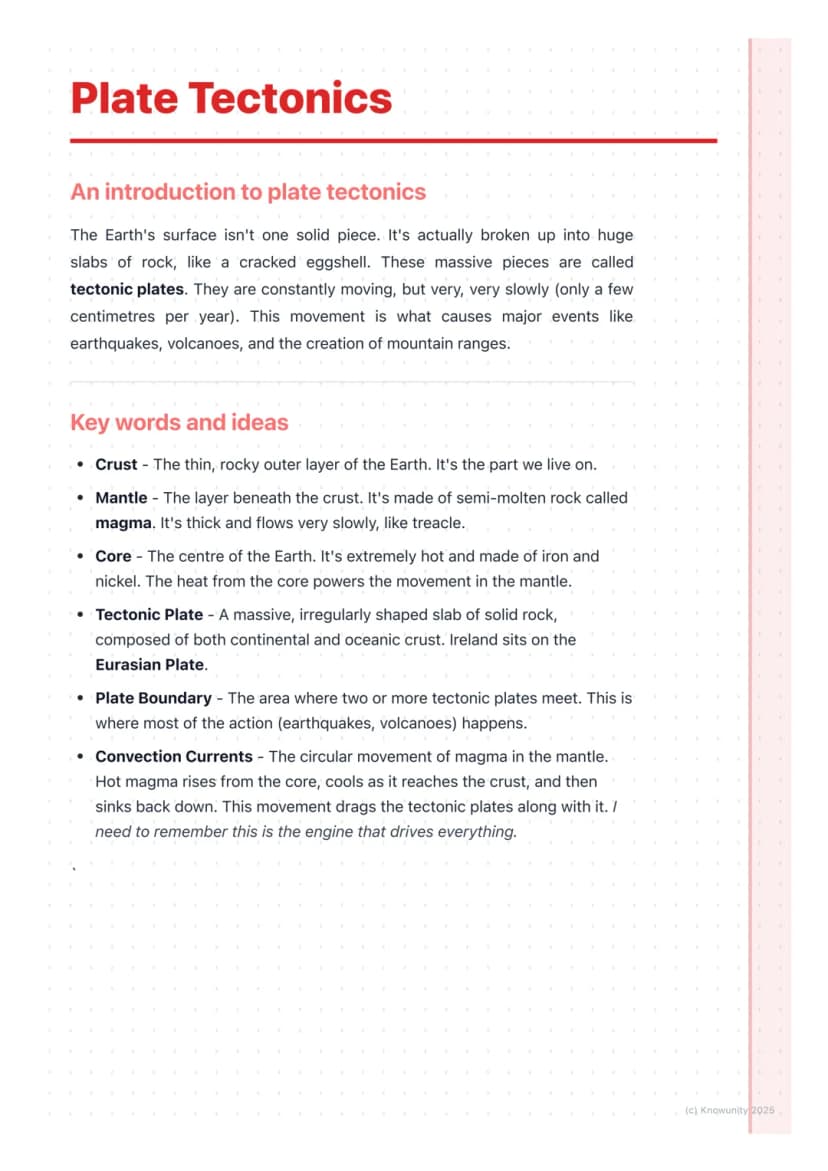
Think of Earth like a massive layered cake with a cracked outer shell. The crust is that thin, rocky outer layer where we live, whilst beneath it lies the mantle – a thick layer of semi-molten rock called magma that flows like treacle.
At Earth's centre is the incredibly hot core made of iron and nickel. This heat powers everything that happens above it! Tectonic plates are those massive, irregularly shaped slabs of solid rock that make up the crust – Ireland sits comfortably on the Eurasian Plate.
The real magic happens because of convection currents in the mantle. Picture a pot of water boiling – hot magma rises from the core, cools near the crust, then sinks back down, creating circular currents that drag the plates along with them. Plate boundaries are where two or more plates meet, and that's where all the exciting (and sometimes dangerous) action occurs!
Key Point: Convection currents are the engine that drives everything – always mention this in exam answers!
2
of 6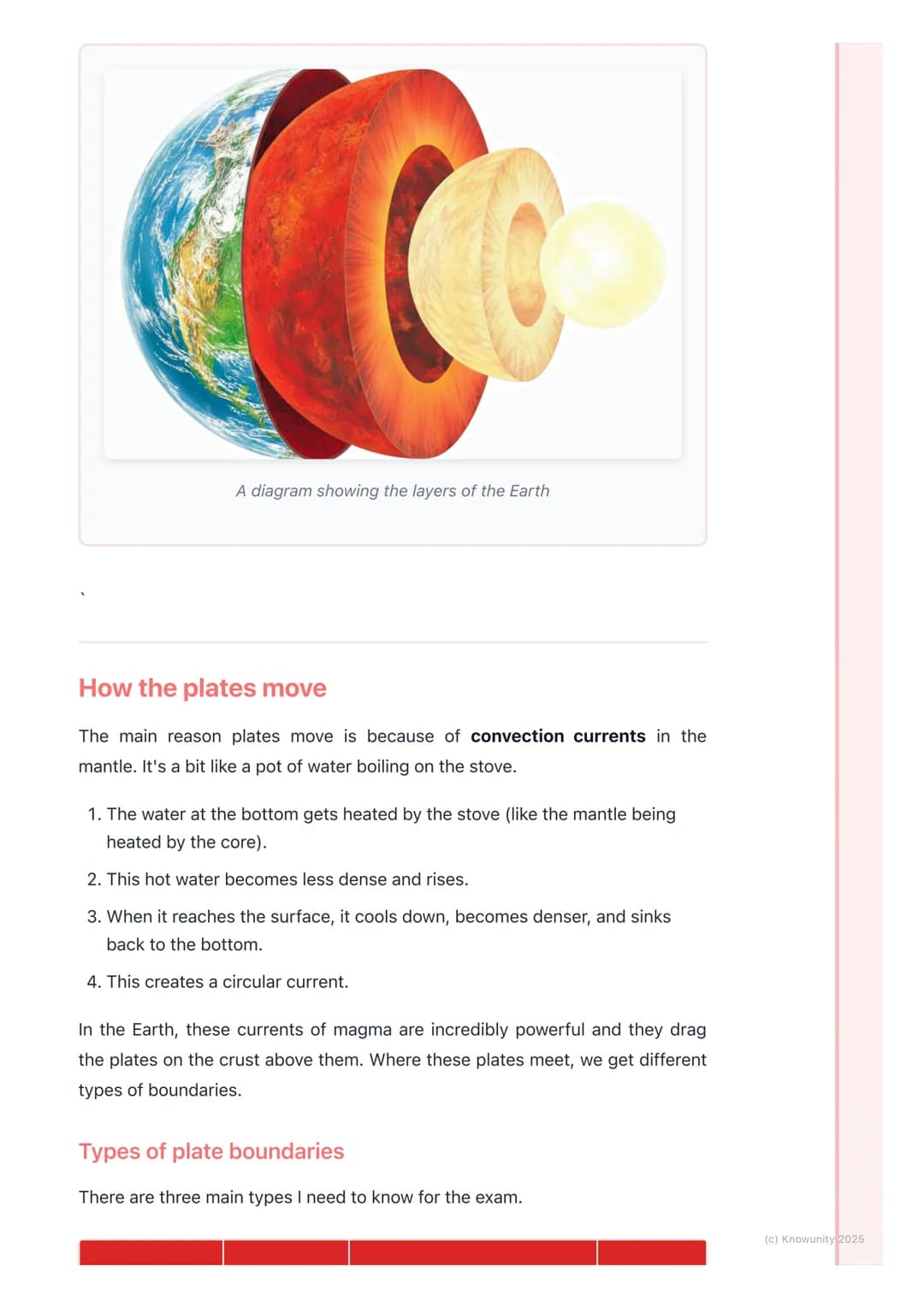
The Three Types of Plate Boundaries
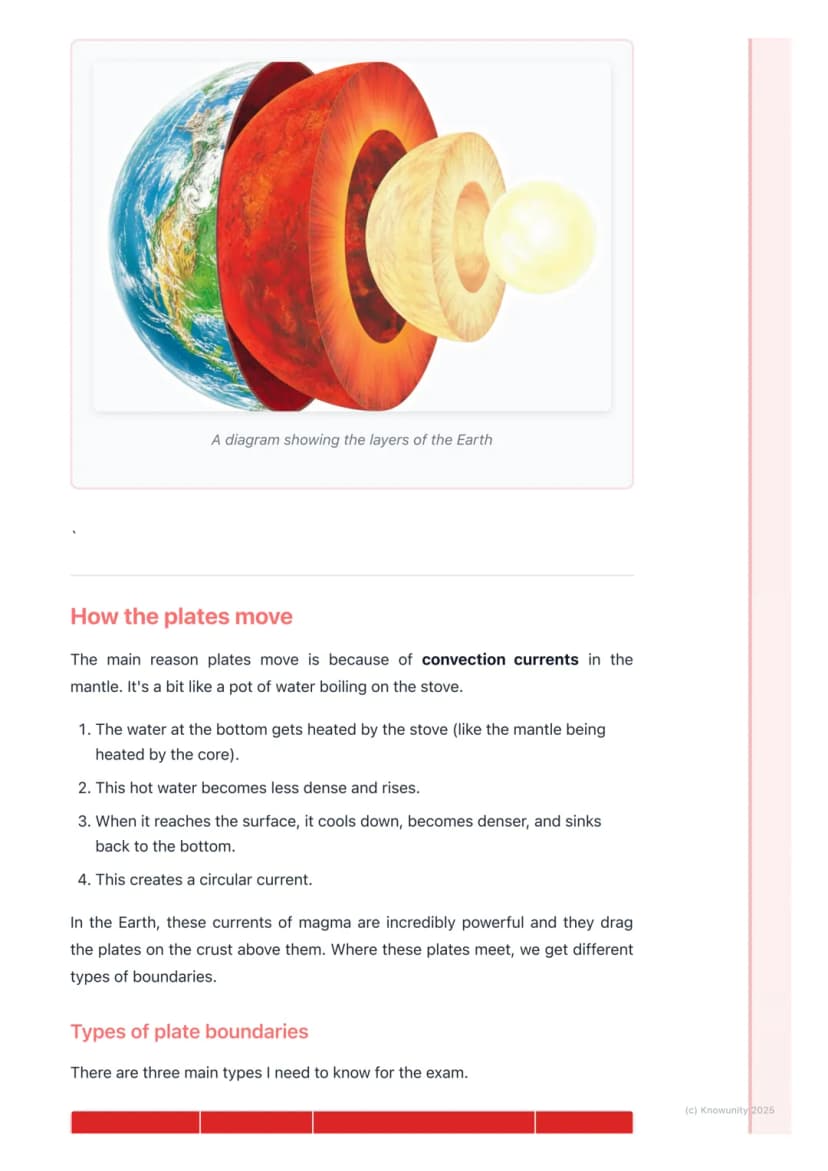
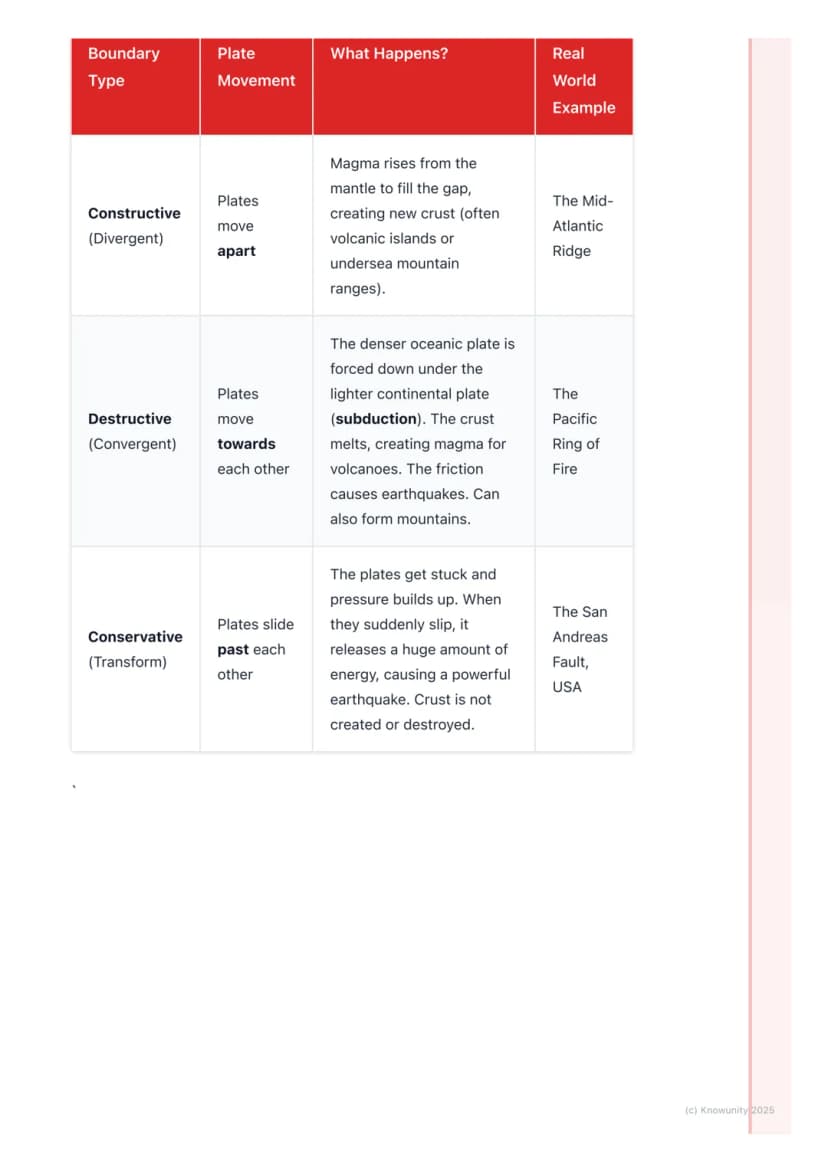
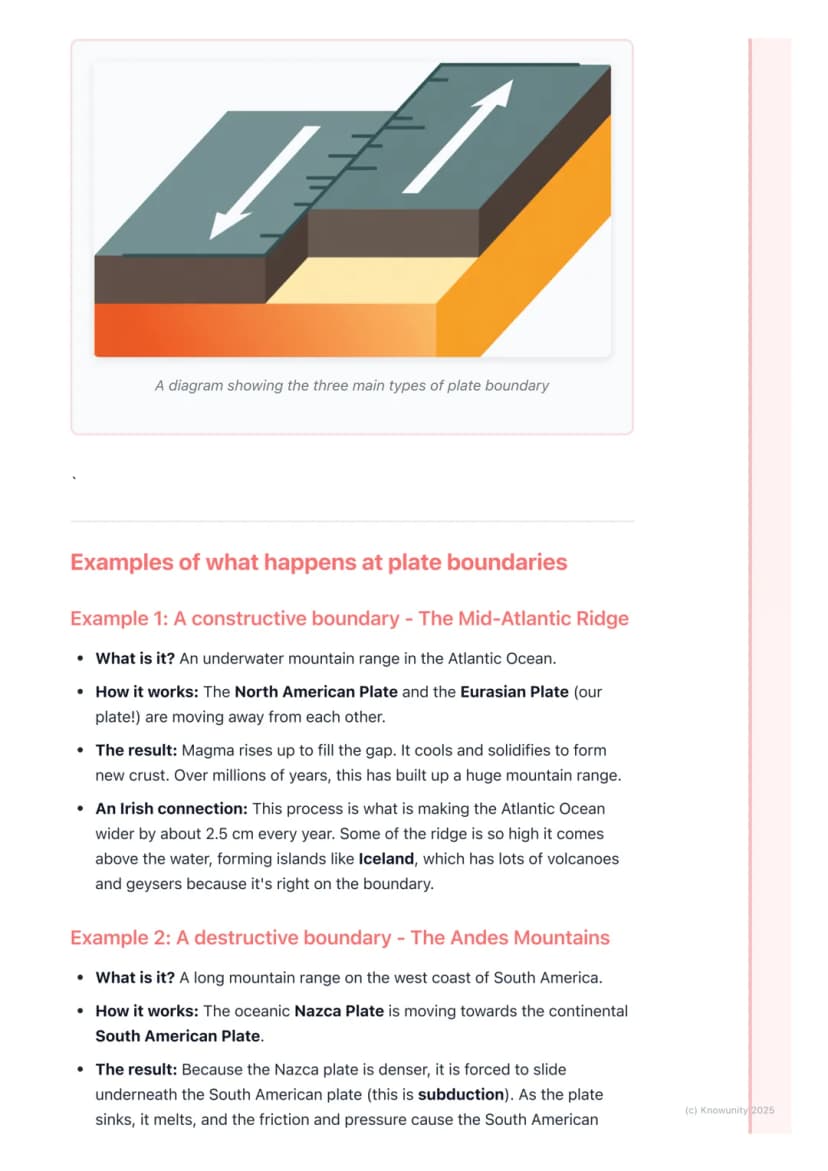
At constructive boundaries, plates move apart from each other. Magma rises to fill the gap, creating new crust and often forming volcanic islands or underwater mountain ranges. The Mid-Atlantic Ridge is a perfect example – it's making the Atlantic Ocean wider by 2.5 cm every year!
Destructive boundaries are where plates crash into each other. The denser oceanic plate gets forced down under the lighter continental plate in a process called subduction. This creates volcanoes, earthquakes, and mountain ranges like the Andes Mountains.
At conservative boundaries, plates slide past each other horizontally. They get stuck, pressure builds up, then suddenly slip, releasing massive energy as powerful earthquakes. The San Andreas Fault in California is the most famous example of this type.
Remember: Oceanic crust is always denser than continental crust, so it always sinks when they collide!
3
of 6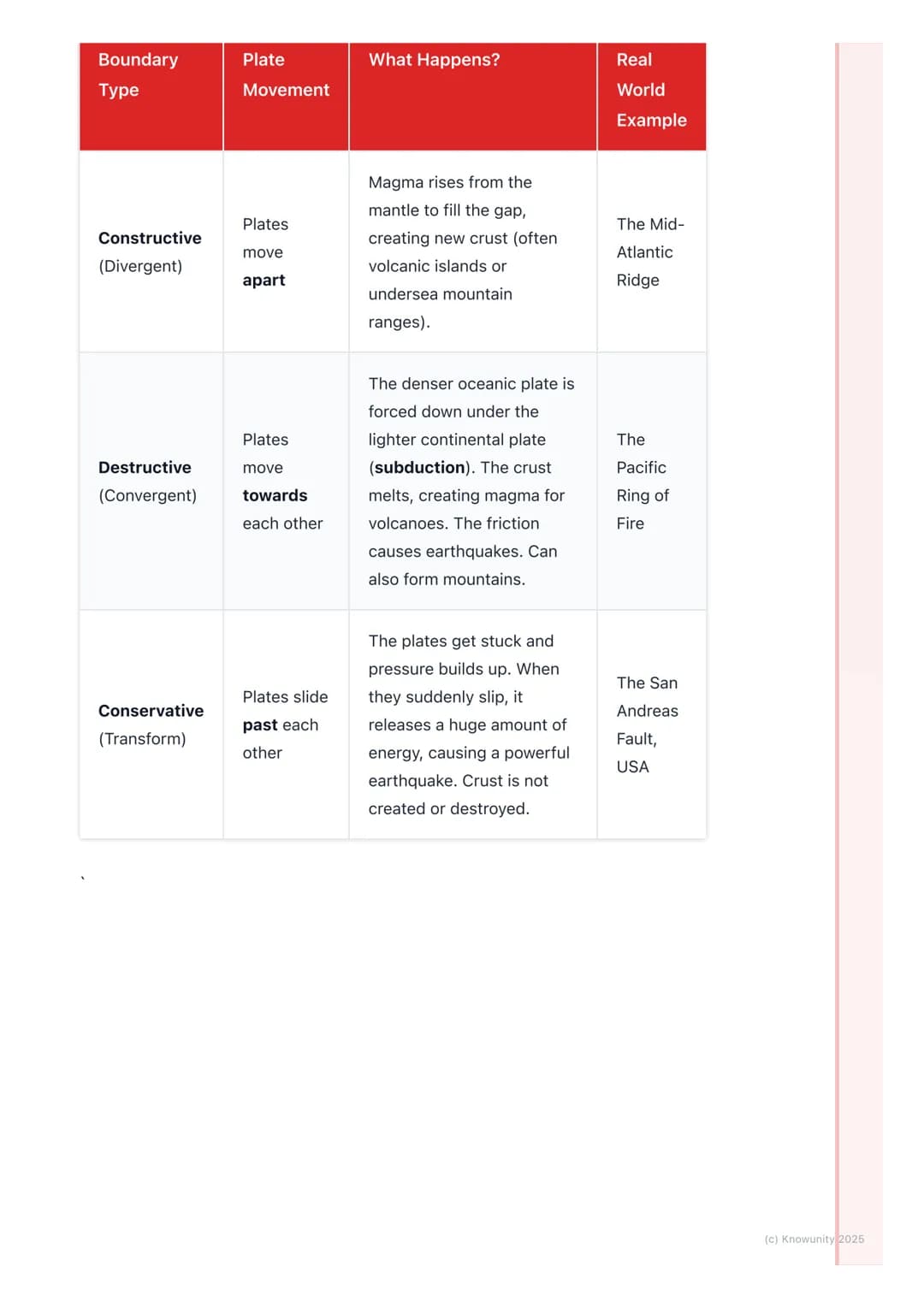
Real-World Examples You Need to Know
The Mid-Atlantic Ridge shows constructive boundaries in action. The North American Plate and our Eurasian Plate are moving apart underwater, and magma rises to fill the space. Over millions of years, this has built a massive underwater mountain range – some parts are so high they form islands like Iceland with its famous volcanoes and geysers!
The Andes Mountains demonstrate destructive boundaries perfectly. The oceanic Nazca Plate is sliding underneath the continental South American Plate through subduction. As the Nazca Plate melts, the friction and pressure cause the South American plate to buckle upwards, creating this enormous mountain range dotted with active volcanoes.
The Pacific Ring of Fire is a string of destructive plate boundaries around the Pacific Ocean where most of the world's earthquakes and volcanic eruptions happen. It's like a giant horseshoe of geological activity!
Fun Fact: Ireland is lucky to be far from any plate boundaries, which is why we don't have volcanoes or major earthquakes!
4
of 6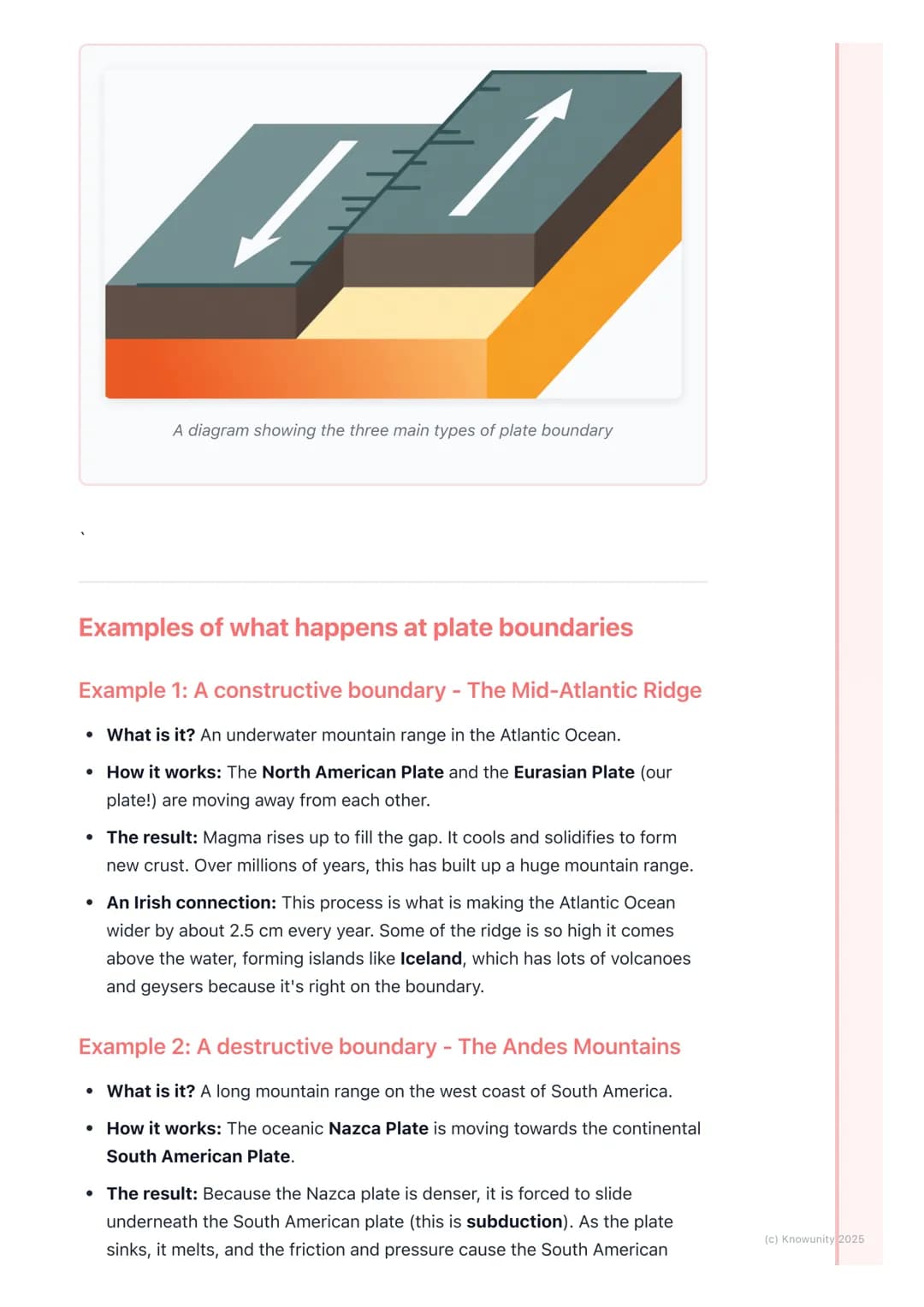
Key Concepts for Success
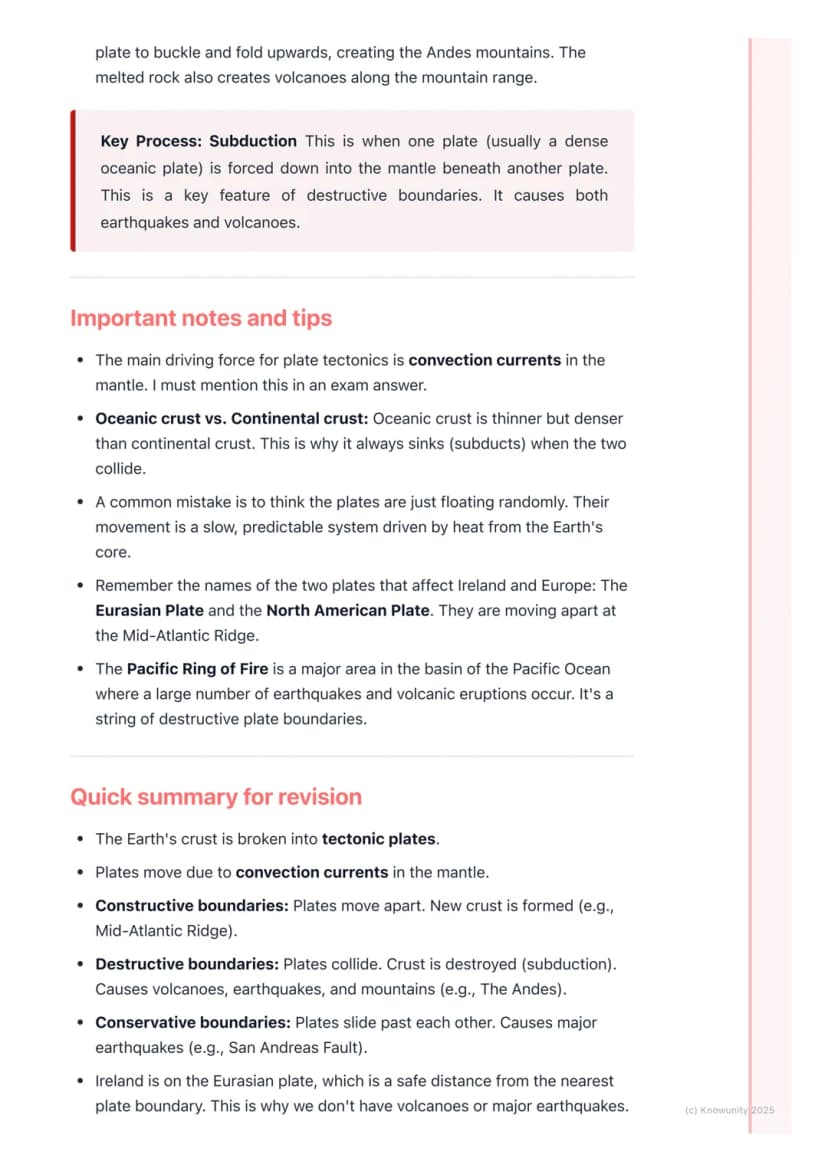
Remember that subduction is the crucial process at destructive boundaries where one plate is forced down into the mantle beneath another. This single process creates earthquakes, volcanoes, and mountain ranges all at once! The key difference between oceanic and continental crust is that oceanic crust is thinner but denser.
Don't make the common mistake of thinking plates float around randomly – their movement is a slow, predictable system entirely driven by heat from Earth's core. The plates affecting Ireland and Europe are the Eurasian Plate and the North American Plate, which are slowly moving apart.
For your exams, always explain that convection currents in the mantle are the main driving force behind plate tectonics. Think of the three boundary types as: constructive (building new crust), destructive (destroying old crust), and conservative (just sliding past without creating or destroying).
Exam Tip: Learn the real-world examples by heart – Mid-Atlantic Ridge, Andes Mountains, and San Andreas Fault are exam favourites!
5
of 6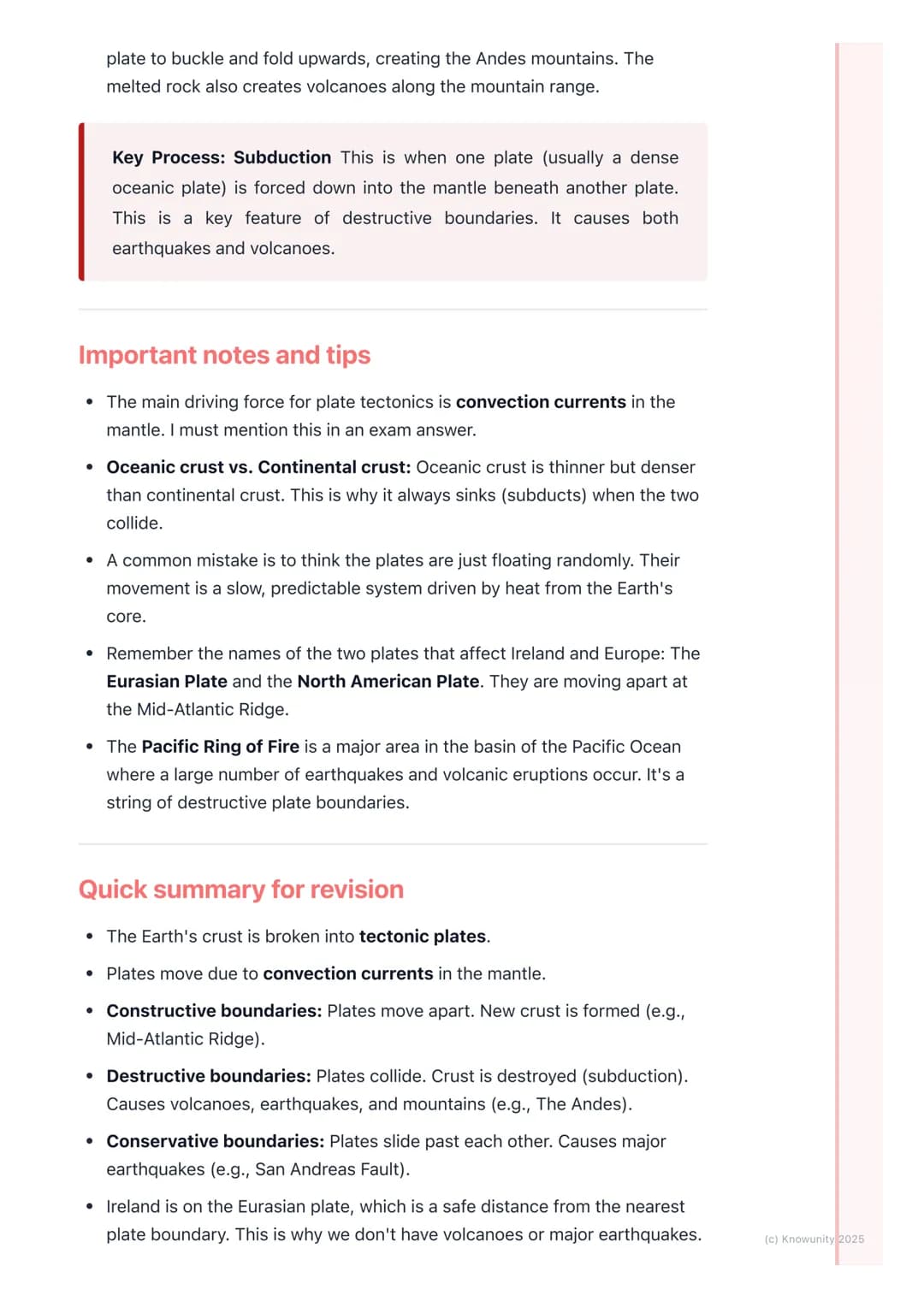
6
of 6
Si on te demande...
Qu'est-ce que le compagnon IA de Knowunity ?
Notre compagnon IA est spécialement conçu pour répondre aux besoins des étudiants. Sur la base des millions d'éléments de contenu que nous avons sur la plateforme, nous pouvons fournir des réponses vraiment significatives et pertinentes aux étudiants. Mais il ne s'agit pas seulement de réponses, le compagnon a encore plus pour but de guider les élèves dans leurs défis d'apprentissage quotidiens, avec des plans d'étude personnalisés, des quiz ou des éléments de contenu dans le chat et une personnalisation à 100% basée sur les compétences et les développements de l'étudiant.
Où puis-je télécharger l'appli Knowunity ?
Tu peux télécharger l'application dans Google Play Store et dans l'App Store d'Apple.
L'application est-elle vraiment gratuite ?
Oui, tu as un accès entièrement gratuit à tous les contenus de l'appli, tu peux chatter ou suivre les créateurs à tout moment. De plus, nous proposons Knowunity Premium, qui te permet de réviser sans limites!
Contenus les plus populaires en Geography
9GeographyGeography notes on rocks
Includes types of rocks,uses of rocks, case studies
1st Year341
GeographyEarthquakes revision notes
Notes on earthquakes with diagrams
1st Year110
GeographyPopulation Change and Migration
This covers factors that cause populations to grow or shrink, including birth rates, death rates, and the reasons people migrate.
2nd Year90
GeographyRock notes geography
Geography
5th Year250
GeographyThe sea
Jc Geography
1st Year230
GeographyGeography notes On the sea
Includes costal erosion, sea cliffs, longshore drift etc.
1st Year160
GeographyInside the Earth
Students will learn about the basic layers of the Earth: the crust, mantle, and core, understanding that our planet is made up of different parts.
1st Year51
GeographyGeography notes on glaciation
Includes diagrams, erosion, deposition, transportation
1st Year210
GeographyGeography notes on weather
Includes instruments, diagrams, how to read weather
1st Year120
Contenus les plus populaires
9 Irish
IrishIrish oral questions and answers
Questions and answers for the leaving cert oral
5th Year4264
 English
Key Quotes : Sive
Key Quotes and explanations: Sive
6th Year2842
IrishIrish oral questions
Outline of oral questions
5th Year2055
IrishIníon- le hÁine Durkin
Aine Durkin’s poem, Iníon: Themes & summary
5th Year850
IrishIrish poetry 2027
Iníon + Dínit an Bhróin
5th Year1133
IrishLC HL notes- Iníon (poem)
Includes poem in English and Irish, theme, key words & phrases
5th Year2284
EnglishCultural Context : Shawshank Redemption : Sive : Small Things Like These
Comparative Study : Cultural Context : Shawshank Redemption, Sive and Small Things Like These
6th Year1430
IrishMo Ghrá-sa (Idir Lúibíní)
Notes on mo ghrá-sa
5th Year380
IrishAn Gaeilge Aiste
Irish Language essay
6th Year1320
Rien ne te convient ? Explore d'autres matières.
Les étudiants nous adorent — il ne manque plus que toi.
4.6/5App Store
4.7/5Google Play
L'application est très facile d'utilisation et bien conçue. Jusqu'à présent, j'ai trouvé tout ce que je cherchais et j'ai pu apprendre beaucoup de choses grâce aux présentations ! Je vais certainement utiliser l'application pour un travail en classe ! Et comme source d'inspiration personnelle, elle est bien sûr aussi très utile.
Stefan Sutilisateur iOS
Cette application est vraiment super. Il y a tellement de fiches de révision et d'aide, [...]. Par exemple, la matière qui me pose problème est le français et l'appli a un choix d'aide très large. Grâce à cette application, je me suis améliorée en français. Je la recommanderais à tout le monde.
Samantha Klichutilisatrice Android
Waouh, je suis vraiment abasourdi. J'ai essayé l'application parce que je l'avais déjà vue plusieurs fois dans la publicité et j'ai été absolument choquée. Cette appli est L'AIDE dont on rêve pour l'école et surtout, elle propose tellement de choses, comme des rédactions et des fiches qui m'ont personnellement TRÈS bien aidé.
Annautilisatrice iOS
Geography17 vues·Mis à jour Jun 12, 2026·6 pagesUnderstanding Plate Tectonics and Earth's Dynamic Surface
Ever wonder why earthquakes happen or how mountains form? It all comes down to the fact that Earth's surface isn't one solid piece – it's actually broken up into massive slabs of rock called tectonic plates that are constantly moving...
1
of 6
Inscris-toi pour voir le contenu. C'est gratuit!
- Accès à tous les documents
- Améliore tes notes
- Rejoins des millions d'étudiants
Understanding Earth's Structure and Plate Movement
Think of Earth like a massive layered cake with a cracked outer shell. The crust is that thin, rocky outer layer where we live, whilst beneath it lies the mantle – a thick layer of semi-molten rock called magma that flows like treacle.
At Earth's centre is the incredibly hot core made of iron and nickel. This heat powers everything that happens above it! Tectonic plates are those massive, irregularly shaped slabs of solid rock that make up the crust – Ireland sits comfortably on the Eurasian Plate.
The real magic happens because of convection currents in the mantle. Picture a pot of water boiling – hot magma rises from the core, cools near the crust, then sinks back down, creating circular currents that drag the plates along with them. Plate boundaries are where two or more plates meet, and that's where all the exciting (and sometimes dangerous) action occurs!
Key Point: Convection currents are the engine that drives everything – always mention this in exam answers!
2
of 6Inscris-toi pour voir le contenu. C'est gratuit!
- Accès à tous les documents
- Améliore tes notes
- Rejoins des millions d'étudiants
The Three Types of Plate Boundaries
At constructive boundaries, plates move apart from each other. Magma rises to fill the gap, creating new crust and often forming volcanic islands or underwater mountain ranges. The Mid-Atlantic Ridge is a perfect example – it's making the Atlantic Ocean wider by 2.5 cm every year!
Destructive boundaries are where plates crash into each other. The denser oceanic plate gets forced down under the lighter continental plate in a process called subduction. This creates volcanoes, earthquakes, and mountain ranges like the Andes Mountains.
At conservative boundaries, plates slide past each other horizontally. They get stuck, pressure builds up, then suddenly slip, releasing massive energy as powerful earthquakes. The San Andreas Fault in California is the most famous example of this type.
Remember: Oceanic crust is always denser than continental crust, so it always sinks when they collide!
3
of 6Inscris-toi pour voir le contenu. C'est gratuit!
- Accès à tous les documents
- Améliore tes notes
- Rejoins des millions d'étudiants
Real-World Examples You Need to Know
The Mid-Atlantic Ridge shows constructive boundaries in action. The North American Plate and our Eurasian Plate are moving apart underwater, and magma rises to fill the space. Over millions of years, this has built a massive underwater mountain range – some parts are so high they form islands like Iceland with its famous volcanoes and geysers!
The Andes Mountains demonstrate destructive boundaries perfectly. The oceanic Nazca Plate is sliding underneath the continental South American Plate through subduction. As the Nazca Plate melts, the friction and pressure cause the South American plate to buckle upwards, creating this enormous mountain range dotted with active volcanoes.
The Pacific Ring of Fire is a string of destructive plate boundaries around the Pacific Ocean where most of the world's earthquakes and volcanic eruptions happen. It's like a giant horseshoe of geological activity!
Fun Fact: Ireland is lucky to be far from any plate boundaries, which is why we don't have volcanoes or major earthquakes!
4
of 6Inscris-toi pour voir le contenu. C'est gratuit!
- Accès à tous les documents
- Améliore tes notes
- Rejoins des millions d'étudiants
Key Concepts for Success
Remember that subduction is the crucial process at destructive boundaries where one plate is forced down into the mantle beneath another. This single process creates earthquakes, volcanoes, and mountain ranges all at once! The key difference between oceanic and continental crust is that oceanic crust is thinner but denser.
Don't make the common mistake of thinking plates float around randomly – their movement is a slow, predictable system entirely driven by heat from Earth's core. The plates affecting Ireland and Europe are the Eurasian Plate and the North American Plate, which are slowly moving apart.
For your exams, always explain that convection currents in the mantle are the main driving force behind plate tectonics. Think of the three boundary types as: constructive (building new crust), destructive (destroying old crust), and conservative (just sliding past without creating or destroying).
Exam Tip: Learn the real-world examples by heart – Mid-Atlantic Ridge, Andes Mountains, and San Andreas Fault are exam favourites!
5
of 6Inscris-toi pour voir le contenu. C'est gratuit!
- Accès à tous les documents
- Améliore tes notes
- Rejoins des millions d'étudiants
6
of 6Inscris-toi pour voir le contenu. C'est gratuit!
- Accès à tous les documents
- Améliore tes notes
- Rejoins des millions d'étudiants
Si on te demande...
Qu'est-ce que le compagnon IA de Knowunity ?
Notre compagnon IA est spécialement conçu pour répondre aux besoins des étudiants. Sur la base des millions d'éléments de contenu que nous avons sur la plateforme, nous pouvons fournir des réponses vraiment significatives et pertinentes aux étudiants. Mais il ne s'agit pas seulement de réponses, le compagnon a encore plus pour but de guider les élèves dans leurs défis d'apprentissage quotidiens, avec des plans d'étude personnalisés, des quiz ou des éléments de contenu dans le chat et une personnalisation à 100% basée sur les compétences et les développements de l'étudiant.
Où puis-je télécharger l'appli Knowunity ?
Tu peux télécharger l'application dans Google Play Store et dans l'App Store d'Apple.
L'application est-elle vraiment gratuite ?
Oui, tu as un accès entièrement gratuit à tous les contenus de l'appli, tu peux chatter ou suivre les créateurs à tout moment. De plus, nous proposons Knowunity Premium, qui te permet de réviser sans limites!
Contenus les plus populaires en Geography
9GeographyGeography notes on rocks
Includes types of rocks,uses of rocks, case studies
1st Year341
GeographyEarthquakes revision notes
Notes on earthquakes with diagrams
1st Year110
GeographyPopulation Change and Migration
This covers factors that cause populations to grow or shrink, including birth rates, death rates, and the reasons people migrate.
2nd Year90
GeographyRock notes geography
Geography
5th Year250
GeographyThe sea
Jc Geography
1st Year230
GeographyGeography notes On the sea
Includes costal erosion, sea cliffs, longshore drift etc.
1st Year160
GeographyInside the Earth
Students will learn about the basic layers of the Earth: the crust, mantle, and core, understanding that our planet is made up of different parts.
1st Year51
GeographyGeography notes on glaciation
Includes diagrams, erosion, deposition, transportation
1st Year210
GeographyGeography notes on weather
Includes instruments, diagrams, how to read weather
1st Year120
Contenus les plus populaires
9IrishIrish oral questions and answers
Questions and answers for the leaving cert oral
5th Year4264
EnglishKey Quotes : Sive
Key Quotes and explanations: Sive
6th Year2842
IrishIrish oral questions
Outline of oral questions
5th Year2055
IrishIníon- le hÁine Durkin
Aine Durkin’s poem, Iníon: Themes & summary
5th Year850
IrishIrish poetry 2027
Iníon + Dínit an Bhróin
5th Year1133
IrishLC HL notes- Iníon (poem)
Includes poem in English and Irish, theme, key words & phrases
5th Year2284
EnglishCultural Context : Shawshank Redemption : Sive : Small Things Like These
Comparative Study : Cultural Context : Shawshank Redemption, Sive and Small Things Like These
6th Year1430
IrishMo Ghrá-sa (Idir Lúibíní)
Notes on mo ghrá-sa
5th Year380
IrishAn Gaeilge Aiste
Irish Language essay
6th Year1320
Rien ne te convient ? Explore d'autres matières.
Les étudiants nous adorent — il ne manque plus que toi.
4.6/5App Store
4.7/5Google Play
L'application est très facile d'utilisation et bien conçue. Jusqu'à présent, j'ai trouvé tout ce que je cherchais et j'ai pu apprendre beaucoup de choses grâce aux présentations ! Je vais certainement utiliser l'application pour un travail en classe ! Et comme source d'inspiration personnelle, elle est bien sûr aussi très utile.
Stefan Sutilisateur iOS
Cette application est vraiment super. Il y a tellement de fiches de révision et d'aide, [...]. Par exemple, la matière qui me pose problème est le français et l'appli a un choix d'aide très large. Grâce à cette application, je me suis améliorée en français. Je la recommanderais à tout le monde.
Samantha Klichutilisatrice Android
Waouh, je suis vraiment abasourdi. J'ai essayé l'application parce que je l'avais déjà vue plusieurs fois dans la publicité et j'ai été absolument choquée. Cette appli est L'AIDE dont on rêve pour l'école et surtout, elle propose tellement de choses, comme des rédactions et des fiches qui m'ont personnellement TRÈS bien aidé.
Annautilisatrice iOS