
Ever wondered what's beneath your feet when you walk across...
 Geography3 vues·Mis à jour Jun 5, 2026·6 pages
Understanding Soil Formation and Its Importance

1 / 6
1
of 6
What Actually Is Soil?
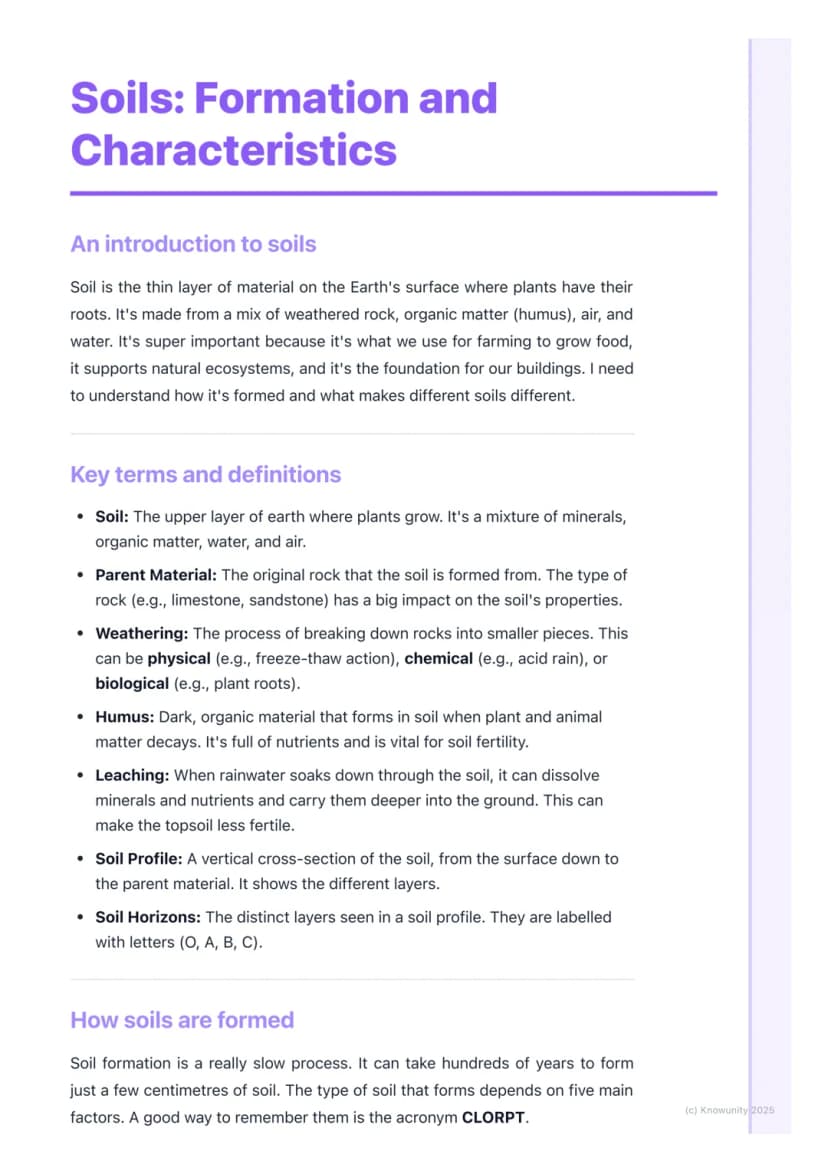
Think of soil as nature's ultimate recycling project. It's a living mixture of weathered rock, organic matter (called humus), air, and water that creates the foundation for almost everything we do - from growing food to building homes.
The magic happens through weathering - rocks slowly breaking down through physical forces like freeze-thaw cycles, chemical reactions from acid rain, and biological activity from plant roots. This process is incredibly slow; it can take hundreds of years to create just a few centimetres of soil.
Several key components make soil work. Parent material is the original rock that determines many soil characteristics. Humus forms when dead plants and animals decompose, creating a dark, nutrient-rich material that's essential for plant growth.
Key Insight: Soil formation is so slow that it's considered a non-renewable resource - once it's gone through erosion, it's essentially gone forever.
2
of 6
How Soils Form: The CLORPT Factors
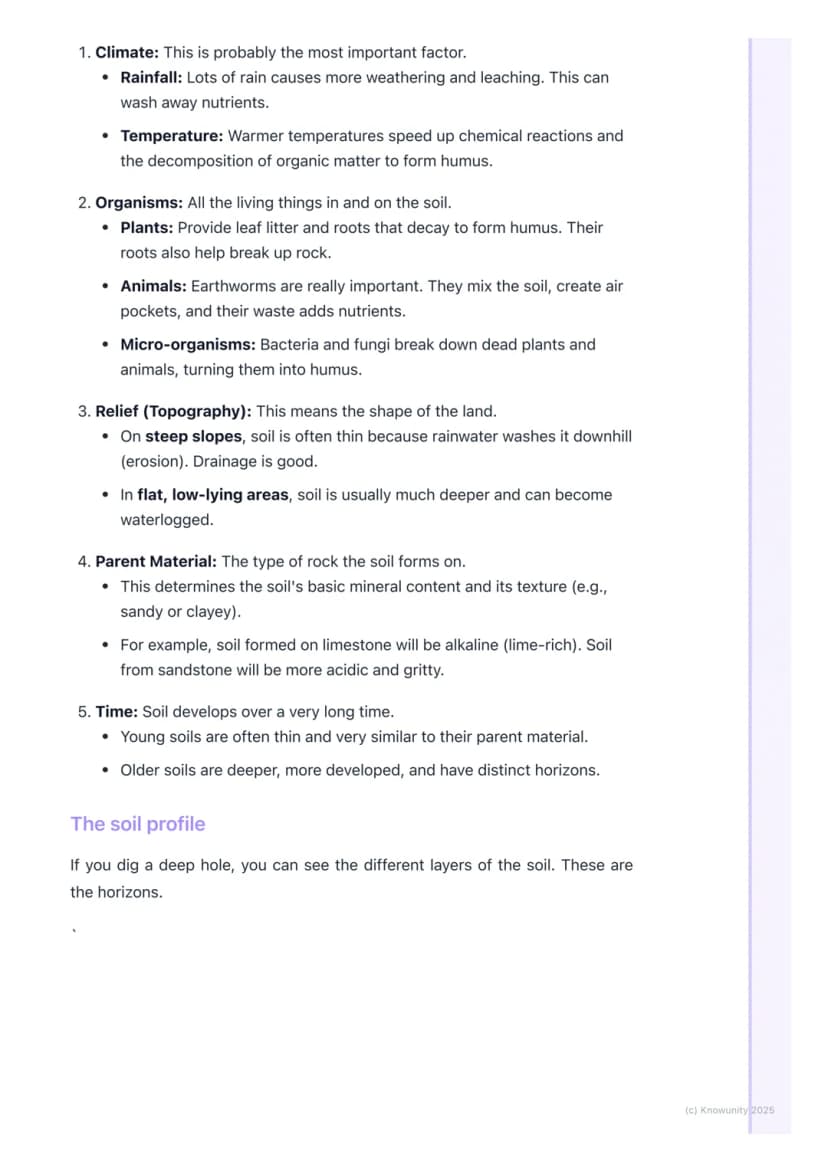
Soil formation depends on five crucial factors, easily remembered by the acronym CLORPT: Climate, Living organisms, Relief, Parent material, and Time.
Climate is usually the most important factor. Heavy rainfall causes more leaching - where water dissolves nutrients and carries them deeper underground, potentially making topsoil less fertile. Warmer temperatures speed up chemical reactions and help organic matter decompose faster into humus.
Living organisms are soil's workforce. Plants provide leaf litter and roots that become humus, whilst earthworms are absolute heroes - they mix soil layers, create air pockets, and add nutrients through their waste. Bacteria and fungi break down dead material into usable nutrients.
Relief (the shape of the land) dramatically affects soil development. Steep slopes often have thin soils because rainfall washes material downhill, whilst flat areas typically develop deeper, sometimes waterlogged soils. The original parent material determines the soil's basic mineral content and texture - limestone creates alkaline soils whilst sandstone produces more acidic, gritty ones.
Remember This: Climate is king! More rain equals more leaching, which is why Ireland's wet, mountainous areas often have less fertile soils.
3
of 6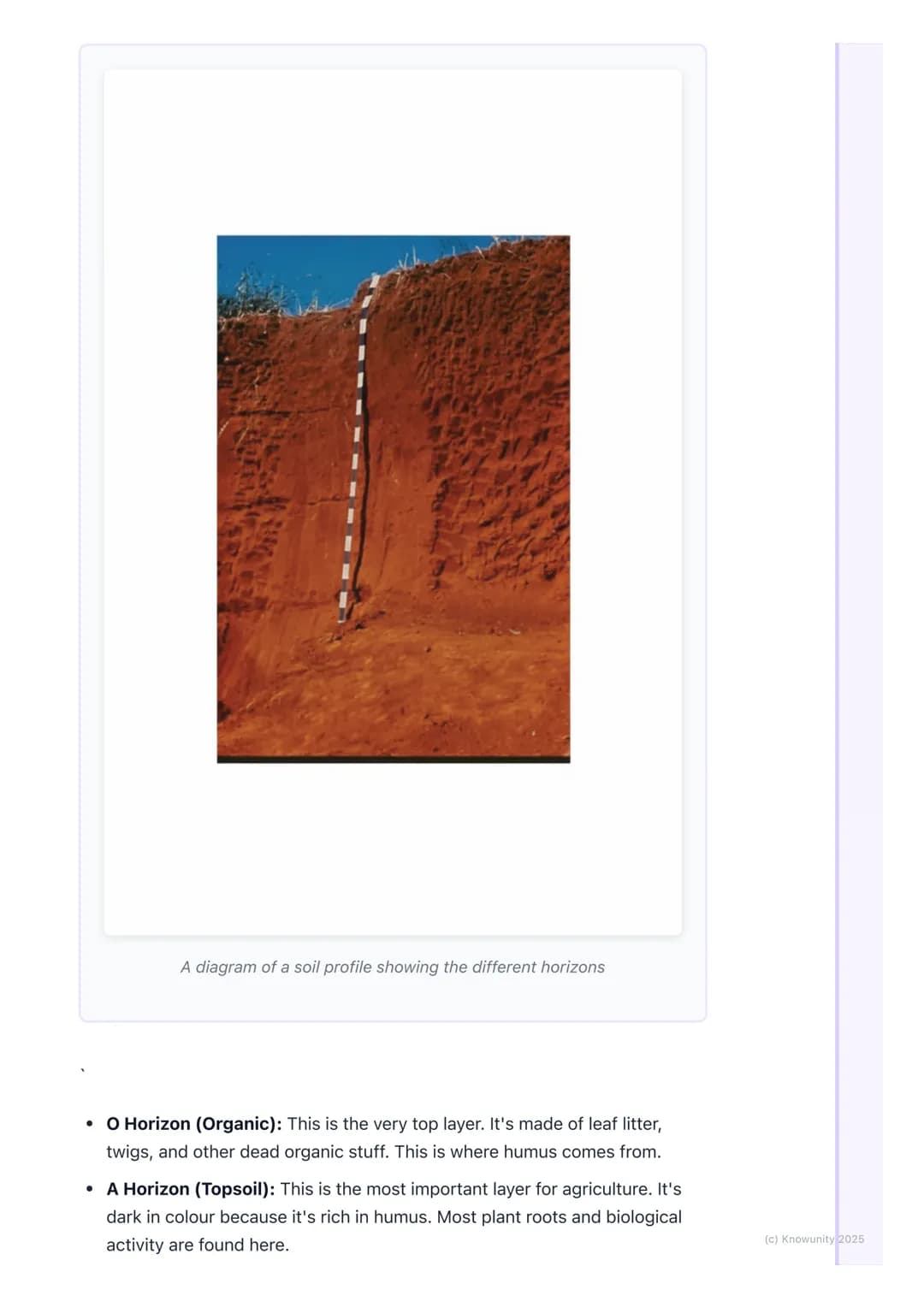
The Soil Profile: Layers Tell Stories
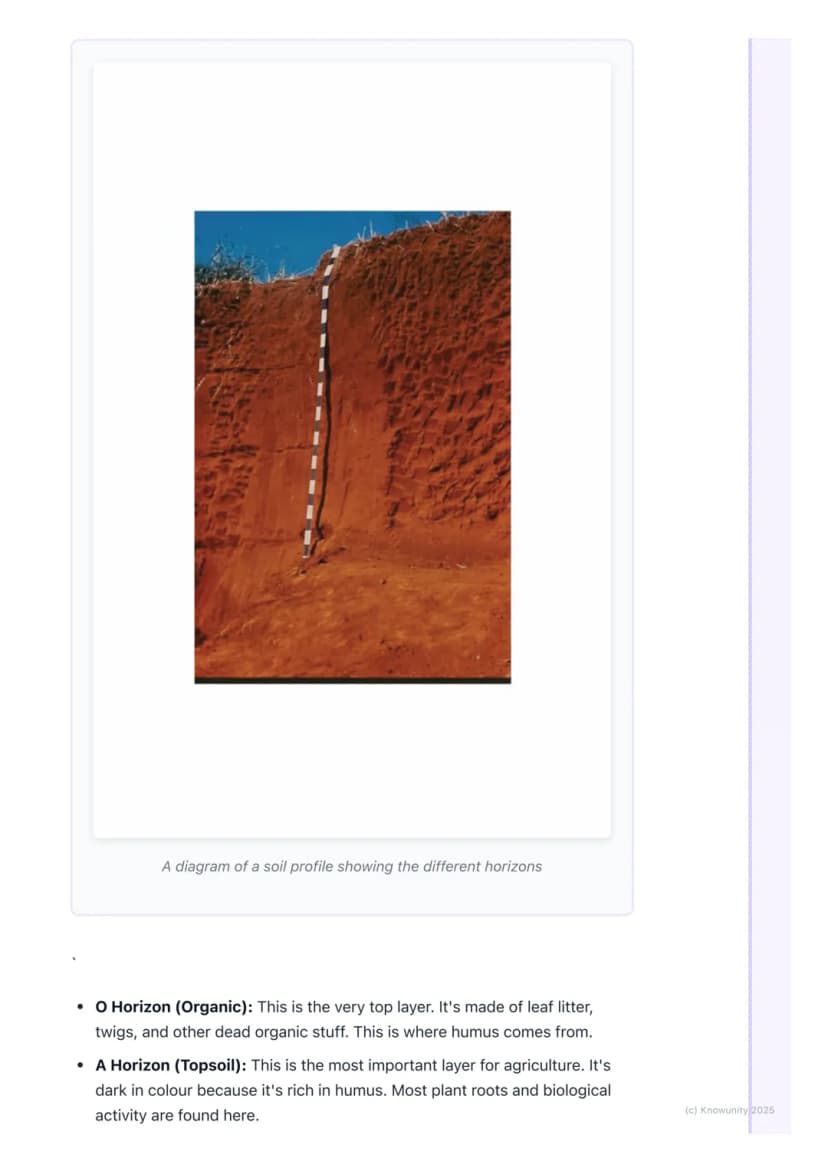
When you dig deep into soil, you'll discover distinct layers called horizons that reveal the soil's history and health.
The O Horizon sits at the very top - it's pure organic material like fallen leaves and twigs that haven't fully decomposed yet. Just below, the A Horizon (topsoil) is where the action happens. This dark, humus-rich layer supports most plant roots and biological activity, making it absolutely crucial for agriculture.
The B Horizon (subsoil) appears lighter because it contains less humus. However, it often accumulates minerals that have been leached down from above. Sometimes this creates a hardpan - a solid layer that blocks water movement and root growth.
Deeper still, the C Horizon contains weathered rock fragments representing the early stages of soil formation. At the bottom, the R Horizon is solid bedrock that hasn't weathered yet.
Exam Tip: Understanding soil horizons helps explain why different layers have different colours, textures, and uses - it's like reading the soil's biography!
4
of 6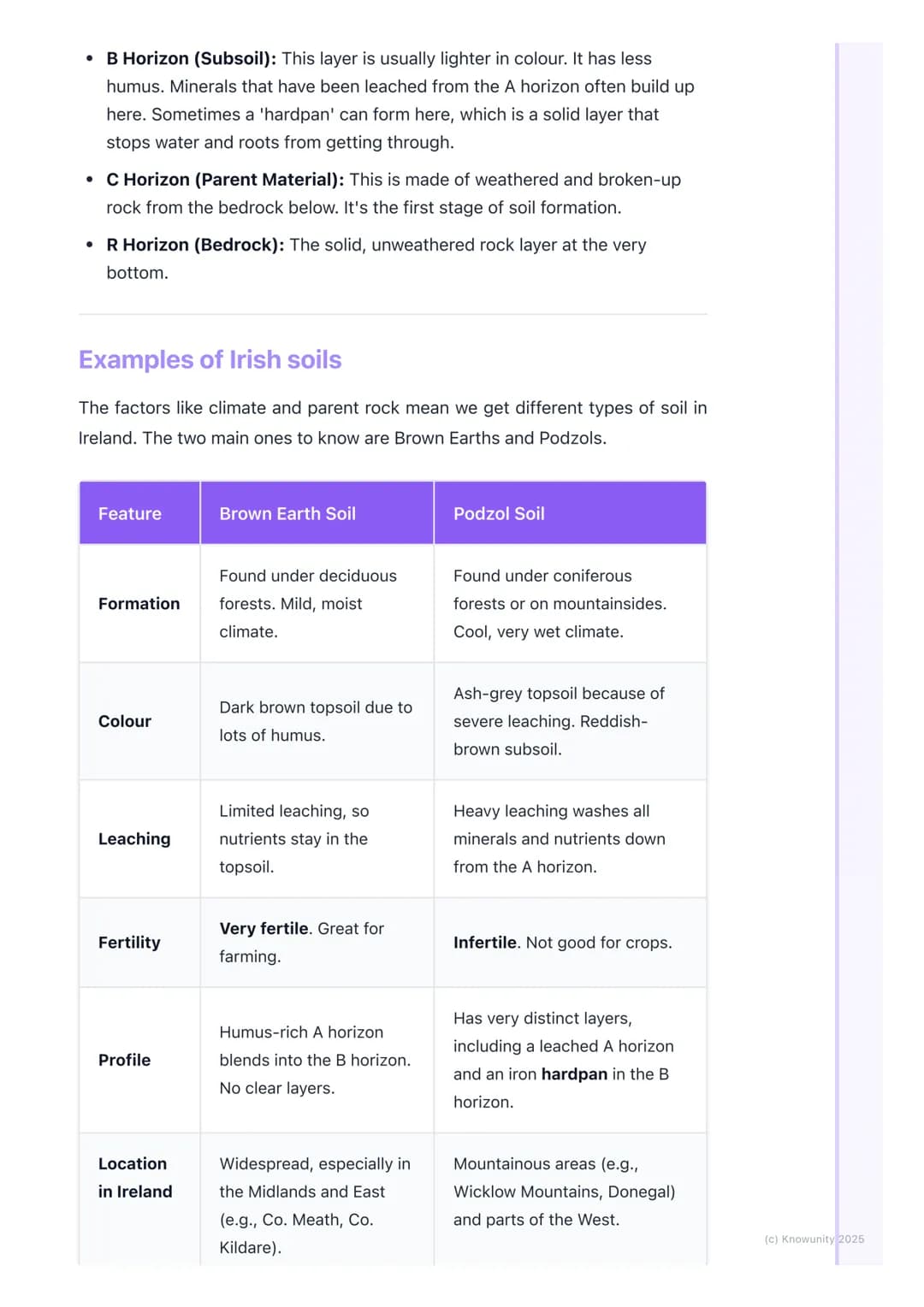
Irish Soil Types: Brown Earths vs Podzols
Ireland's varied climate and geology create distinctly different soil types, with Brown Earths and Podzols being the most important to understand.
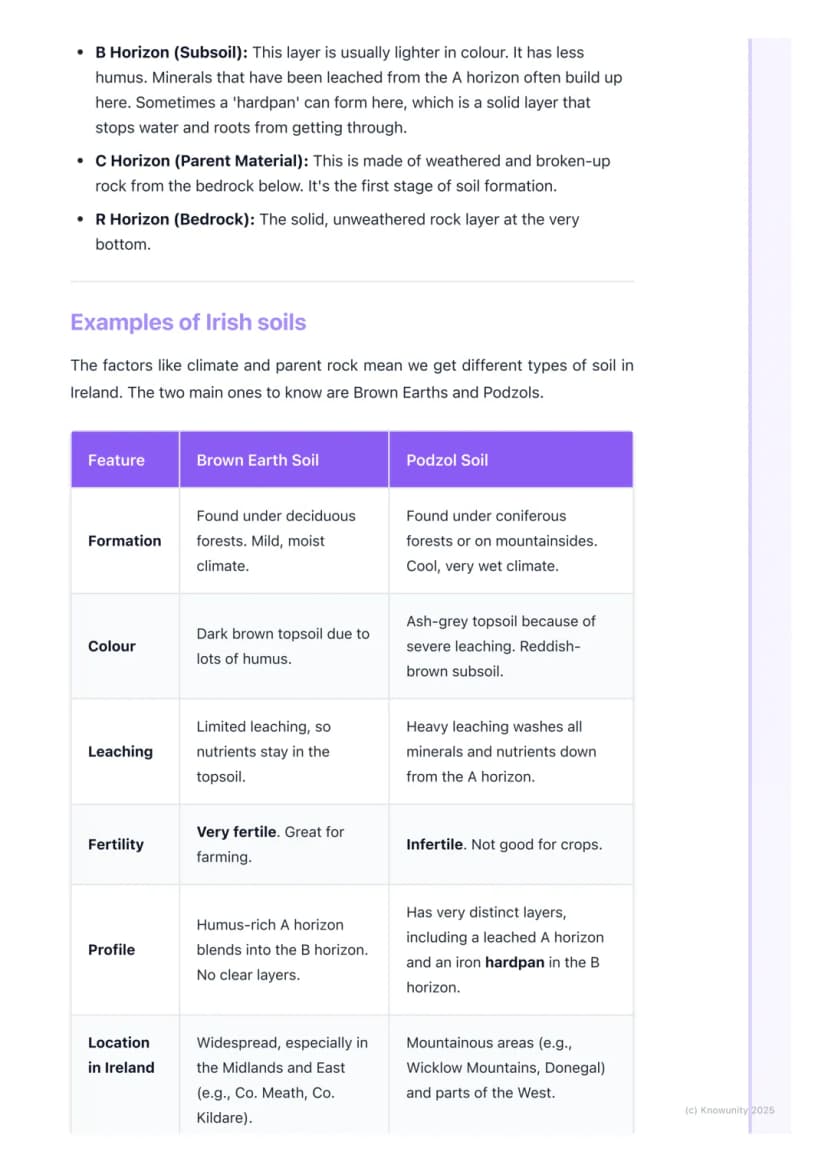
Brown Earths are Ireland's agricultural superstars. Found mainly in the midlands and eastern counties like Meath and Kildare, these soils developed under deciduous forests in relatively mild, moist conditions. Their dark brown colour comes from abundant humus, and limited leaching means nutrients stay in the topsoil where plants need them.
Podzols tell a completely different story. Found in mountainous areas like Wicklow and Donegal, these soils form under coniferous forests in cool, very wet conditions. Heavy rainfall causes severe leaching, creating distinctive ash-grey topsoil and reddish-brown subsoil with an iron hardpan that blocks drainage.
The contrast is stark: Brown Earths are perfect for crops and pasture, whilst Podzols are mainly suitable for forestry. This explains why Ireland's best farmland is in the east and midlands, whilst upland areas remain forested or used for grazing.
Geographic Connection: Soil types directly explain Ireland's land use patterns - you can predict what grows where just by understanding the soil beneath!
5
of 6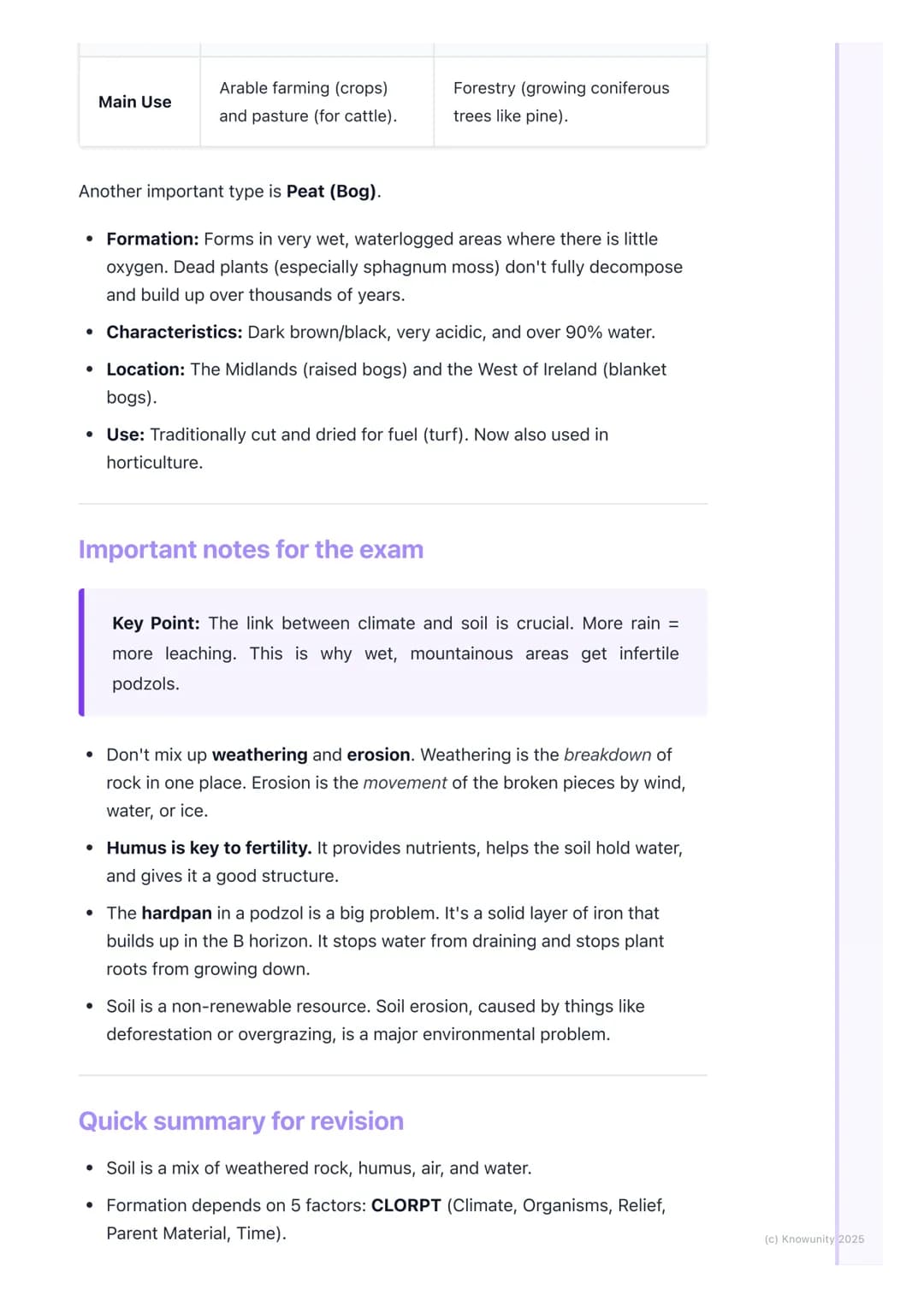
Peat: Ireland's Unique Soil Story
Peat represents a special case in Irish soils, forming in waterlogged conditions where dead plants (especially sphagnum moss) can't fully decompose due to lack of oxygen.
Over thousands of years, this organic matter builds up into dark brown or black deposits that are over 90% water and highly acidic. Ireland's peat forms in two main environments: raised bogs in the midlands and blanket bogs covering western uplands.
Traditionally, peat was cut and dried as turf for fuel, and it's still used in horticulture today. However, peat bogs are now recognised as important ecosystems and carbon stores, making their conservation increasingly important.
The formation process is fascinating - what starts as living sphagnum moss in waterlogged conditions slowly transforms into layers of peat that can be several metres thick. This creates unique landscapes that are distinctly Irish.
Environmental Note: Peat bogs are crucial for climate regulation as they store massive amounts of carbon - protecting them helps fight climate change!
6
of 6
Key Concepts for Success
Understanding soil formation helps explain so much about Ireland's geography, agriculture, and environmental challenges.
Remember that weathering breaks down rocks in place, whilst erosion moves the broken material elsewhere - don't mix these up! Humus is absolutely vital for soil fertility because it provides nutrients, helps retain water, and creates good soil structure.
The hardpan in podzols creates serious problems by blocking drainage and root growth, explaining why these soils aren't suitable for agriculture. Meanwhile, leaching is the key process that makes some soils fertile (when limited) or infertile (when excessive).
Soil connects to bigger environmental issues too. Because soil formation is so slow, soil erosion from deforestation or overgrazing represents a major environmental threat that affects food security and ecosystem health.
Exam Success: Focus on the connections - link soil types to climate, parent material to soil characteristics, and soil quality to land use patterns across Ireland.
Si on te demande...
Qu'est-ce que le compagnon IA de Knowunity ?
Notre compagnon IA est spécialement conçu pour répondre aux besoins des étudiants. Sur la base des millions d'éléments de contenu que nous avons sur la plateforme, nous pouvons fournir des réponses vraiment significatives et pertinentes aux étudiants. Mais il ne s'agit pas seulement de réponses, le compagnon a encore plus pour but de guider les élèves dans leurs défis d'apprentissage quotidiens, avec des plans d'étude personnalisés, des quiz ou des éléments de contenu dans le chat et une personnalisation à 100% basée sur les compétences et les développements de l'étudiant.
Où puis-je télécharger l'appli Knowunity ?
Tu peux télécharger l'application dans Google Play Store et dans l'App Store d'Apple.
L'application est-elle vraiment gratuite ?
Oui, tu as un accès entièrement gratuit à tous les contenus de l'appli, tu peux chatter ou suivre les créateurs à tout moment. De plus, nous proposons Knowunity Premium, qui te permet de réviser sans limites!
Contenus les plus populaires en Geography
9GeographyGeography notes on rocks
Includes types of rocks,uses of rocks, case studies
1st Year341
GeographyEarthquakes revision notes
Notes on earthquakes with diagrams
1st Year110
GeographyPopulation Change and Migration
This covers factors that cause populations to grow or shrink, including birth rates, death rates, and the reasons people migrate.
2nd Year90
GeographyRock notes geography
Geography
5th Year250
GeographyThe sea
Jc Geography
1st Year230
GeographyGeography notes On the sea
Includes costal erosion, sea cliffs, longshore drift etc.
1st Year160
GeographyInside the Earth
Students will learn about the basic layers of the Earth: the crust, mantle, and core, understanding that our planet is made up of different parts.
1st Year51
GeographyGeography notes on glaciation
Includes diagrams, erosion, deposition, transportation
1st Year210
GeographyGeography notes on weather
Includes instruments, diagrams, how to read weather
1st Year120
Contenus les plus populaires
9 Irish
IrishIrish oral questions and answers
Questions and answers for the leaving cert oral
5th Year4264
 English
Key Quotes : Sive
Key Quotes and explanations: Sive
6th Year2842
IrishIrish oral questions
Outline of oral questions
5th Year2055
IrishIníon- le hÁine Durkin
Aine Durkin’s poem, Iníon: Themes & summary
5th Year850
IrishIrish poetry 2027
Iníon + Dínit an Bhróin
5th Year1133
IrishLC HL notes- Iníon (poem)
Includes poem in English and Irish, theme, key words & phrases
5th Year2284
EnglishCultural Context : Shawshank Redemption : Sive : Small Things Like These
Comparative Study : Cultural Context : Shawshank Redemption, Sive and Small Things Like These
6th Year1430
IrishMo Ghrá-sa (Idir Lúibíní)
Notes on mo ghrá-sa
5th Year380
IrishAn Gaeilge Aiste
Irish Language essay
6th Year1320
Rien ne te convient ? Explore d'autres matières.
Les étudiants nous adorent — il ne manque plus que toi.
4.6/5App Store
4.7/5Google Play
L'application est très facile d'utilisation et bien conçue. Jusqu'à présent, j'ai trouvé tout ce que je cherchais et j'ai pu apprendre beaucoup de choses grâce aux présentations ! Je vais certainement utiliser l'application pour un travail en classe ! Et comme source d'inspiration personnelle, elle est bien sûr aussi très utile.
Stefan Sutilisateur iOS
Cette application est vraiment super. Il y a tellement de fiches de révision et d'aide, [...]. Par exemple, la matière qui me pose problème est le français et l'appli a un choix d'aide très large. Grâce à cette application, je me suis améliorée en français. Je la recommanderais à tout le monde.
Samantha Klichutilisatrice Android
Waouh, je suis vraiment abasourdi. J'ai essayé l'application parce que je l'avais déjà vue plusieurs fois dans la publicité et j'ai été absolument choquée. Cette appli est L'AIDE dont on rêve pour l'école et surtout, elle propose tellement de choses, comme des rédactions et des fiches qui m'ont personnellement TRÈS bien aidé.
Annautilisatrice iOS
Geography3 vues·Mis à jour Jun 5, 2026·6 pagesUnderstanding Soil Formation and Its Importance
Ever wondered what's beneath your feet when you walk across a field or dig in your garden? Soil might look like simple dirt, but it's actually an incredibly complex system that took thousands of years to form. Understanding how different...
1
of 6
Inscris-toi pour voir le contenu. C'est gratuit!
- Accès à tous les documents
- Améliore tes notes
- Rejoins des millions d'étudiants
What Actually Is Soil?
Think of soil as nature's ultimate recycling project. It's a living mixture of weathered rock, organic matter (called humus), air, and water that creates the foundation for almost everything we do - from growing food to building homes.
The magic happens through weathering - rocks slowly breaking down through physical forces like freeze-thaw cycles, chemical reactions from acid rain, and biological activity from plant roots. This process is incredibly slow; it can take hundreds of years to create just a few centimetres of soil.
Several key components make soil work. Parent material is the original rock that determines many soil characteristics. Humus forms when dead plants and animals decompose, creating a dark, nutrient-rich material that's essential for plant growth.
Key Insight: Soil formation is so slow that it's considered a non-renewable resource - once it's gone through erosion, it's essentially gone forever.
2
of 6Inscris-toi pour voir le contenu. C'est gratuit!
- Accès à tous les documents
- Améliore tes notes
- Rejoins des millions d'étudiants
How Soils Form: The CLORPT Factors
Soil formation depends on five crucial factors, easily remembered by the acronym CLORPT: Climate, Living organisms, Relief, Parent material, and Time.
Climate is usually the most important factor. Heavy rainfall causes more leaching - where water dissolves nutrients and carries them deeper underground, potentially making topsoil less fertile. Warmer temperatures speed up chemical reactions and help organic matter decompose faster into humus.
Living organisms are soil's workforce. Plants provide leaf litter and roots that become humus, whilst earthworms are absolute heroes - they mix soil layers, create air pockets, and add nutrients through their waste. Bacteria and fungi break down dead material into usable nutrients.
Relief (the shape of the land) dramatically affects soil development. Steep slopes often have thin soils because rainfall washes material downhill, whilst flat areas typically develop deeper, sometimes waterlogged soils. The original parent material determines the soil's basic mineral content and texture - limestone creates alkaline soils whilst sandstone produces more acidic, gritty ones.
Remember This: Climate is king! More rain equals more leaching, which is why Ireland's wet, mountainous areas often have less fertile soils.
3
of 6Inscris-toi pour voir le contenu. C'est gratuit!
- Accès à tous les documents
- Améliore tes notes
- Rejoins des millions d'étudiants
The Soil Profile: Layers Tell Stories
When you dig deep into soil, you'll discover distinct layers called horizons that reveal the soil's history and health.
The O Horizon sits at the very top - it's pure organic material like fallen leaves and twigs that haven't fully decomposed yet. Just below, the A Horizon (topsoil) is where the action happens. This dark, humus-rich layer supports most plant roots and biological activity, making it absolutely crucial for agriculture.
The B Horizon (subsoil) appears lighter because it contains less humus. However, it often accumulates minerals that have been leached down from above. Sometimes this creates a hardpan - a solid layer that blocks water movement and root growth.
Deeper still, the C Horizon contains weathered rock fragments representing the early stages of soil formation. At the bottom, the R Horizon is solid bedrock that hasn't weathered yet.
Exam Tip: Understanding soil horizons helps explain why different layers have different colours, textures, and uses - it's like reading the soil's biography!
4
of 6Inscris-toi pour voir le contenu. C'est gratuit!
- Accès à tous les documents
- Améliore tes notes
- Rejoins des millions d'étudiants
Irish Soil Types: Brown Earths vs Podzols
Ireland's varied climate and geology create distinctly different soil types, with Brown Earths and Podzols being the most important to understand.
Brown Earths are Ireland's agricultural superstars. Found mainly in the midlands and eastern counties like Meath and Kildare, these soils developed under deciduous forests in relatively mild, moist conditions. Their dark brown colour comes from abundant humus, and limited leaching means nutrients stay in the topsoil where plants need them.
Podzols tell a completely different story. Found in mountainous areas like Wicklow and Donegal, these soils form under coniferous forests in cool, very wet conditions. Heavy rainfall causes severe leaching, creating distinctive ash-grey topsoil and reddish-brown subsoil with an iron hardpan that blocks drainage.
The contrast is stark: Brown Earths are perfect for crops and pasture, whilst Podzols are mainly suitable for forestry. This explains why Ireland's best farmland is in the east and midlands, whilst upland areas remain forested or used for grazing.
Geographic Connection: Soil types directly explain Ireland's land use patterns - you can predict what grows where just by understanding the soil beneath!
5
of 6Inscris-toi pour voir le contenu. C'est gratuit!
- Accès à tous les documents
- Améliore tes notes
- Rejoins des millions d'étudiants
Peat: Ireland's Unique Soil Story
Peat represents a special case in Irish soils, forming in waterlogged conditions where dead plants (especially sphagnum moss) can't fully decompose due to lack of oxygen.
Over thousands of years, this organic matter builds up into dark brown or black deposits that are over 90% water and highly acidic. Ireland's peat forms in two main environments: raised bogs in the midlands and blanket bogs covering western uplands.
Traditionally, peat was cut and dried as turf for fuel, and it's still used in horticulture today. However, peat bogs are now recognised as important ecosystems and carbon stores, making their conservation increasingly important.
The formation process is fascinating - what starts as living sphagnum moss in waterlogged conditions slowly transforms into layers of peat that can be several metres thick. This creates unique landscapes that are distinctly Irish.
Environmental Note: Peat bogs are crucial for climate regulation as they store massive amounts of carbon - protecting them helps fight climate change!
6
of 6Inscris-toi pour voir le contenu. C'est gratuit!
- Accès à tous les documents
- Améliore tes notes
- Rejoins des millions d'étudiants
Key Concepts for Success
Understanding soil formation helps explain so much about Ireland's geography, agriculture, and environmental challenges.
Remember that weathering breaks down rocks in place, whilst erosion moves the broken material elsewhere - don't mix these up! Humus is absolutely vital for soil fertility because it provides nutrients, helps retain water, and creates good soil structure.
The hardpan in podzols creates serious problems by blocking drainage and root growth, explaining why these soils aren't suitable for agriculture. Meanwhile, leaching is the key process that makes some soils fertile (when limited) or infertile (when excessive).
Soil connects to bigger environmental issues too. Because soil formation is so slow, soil erosion from deforestation or overgrazing represents a major environmental threat that affects food security and ecosystem health.
Exam Success: Focus on the connections - link soil types to climate, parent material to soil characteristics, and soil quality to land use patterns across Ireland.
Si on te demande...
Qu'est-ce que le compagnon IA de Knowunity ?
Notre compagnon IA est spécialement conçu pour répondre aux besoins des étudiants. Sur la base des millions d'éléments de contenu que nous avons sur la plateforme, nous pouvons fournir des réponses vraiment significatives et pertinentes aux étudiants. Mais il ne s'agit pas seulement de réponses, le compagnon a encore plus pour but de guider les élèves dans leurs défis d'apprentissage quotidiens, avec des plans d'étude personnalisés, des quiz ou des éléments de contenu dans le chat et une personnalisation à 100% basée sur les compétences et les développements de l'étudiant.
Où puis-je télécharger l'appli Knowunity ?
Tu peux télécharger l'application dans Google Play Store et dans l'App Store d'Apple.
L'application est-elle vraiment gratuite ?
Oui, tu as un accès entièrement gratuit à tous les contenus de l'appli, tu peux chatter ou suivre les créateurs à tout moment. De plus, nous proposons Knowunity Premium, qui te permet de réviser sans limites!
Contenus les plus populaires en Geography
9GeographyGeography notes on rocks
Includes types of rocks,uses of rocks, case studies
1st Year341
GeographyEarthquakes revision notes
Notes on earthquakes with diagrams
1st Year110
GeographyPopulation Change and Migration
This covers factors that cause populations to grow or shrink, including birth rates, death rates, and the reasons people migrate.
2nd Year90
GeographyRock notes geography
Geography
5th Year250
GeographyThe sea
Jc Geography
1st Year230
GeographyGeography notes On the sea
Includes costal erosion, sea cliffs, longshore drift etc.
1st Year160
GeographyInside the Earth
Students will learn about the basic layers of the Earth: the crust, mantle, and core, understanding that our planet is made up of different parts.
1st Year51
GeographyGeography notes on glaciation
Includes diagrams, erosion, deposition, transportation
1st Year210
GeographyGeography notes on weather
Includes instruments, diagrams, how to read weather
1st Year120
Contenus les plus populaires
9IrishIrish oral questions and answers
Questions and answers for the leaving cert oral
5th Year4264
EnglishKey Quotes : Sive
Key Quotes and explanations: Sive
6th Year2842
IrishIrish oral questions
Outline of oral questions
5th Year2055
IrishIníon- le hÁine Durkin
Aine Durkin’s poem, Iníon: Themes & summary
5th Year850
IrishIrish poetry 2027
Iníon + Dínit an Bhróin
5th Year1133
IrishLC HL notes- Iníon (poem)
Includes poem in English and Irish, theme, key words & phrases
5th Year2284
EnglishCultural Context : Shawshank Redemption : Sive : Small Things Like These
Comparative Study : Cultural Context : Shawshank Redemption, Sive and Small Things Like These
6th Year1430
IrishMo Ghrá-sa (Idir Lúibíní)
Notes on mo ghrá-sa
5th Year380
IrishAn Gaeilge Aiste
Irish Language essay
6th Year1320
Rien ne te convient ? Explore d'autres matières.
Les étudiants nous adorent — il ne manque plus que toi.
4.6/5App Store
4.7/5Google Play
L'application est très facile d'utilisation et bien conçue. Jusqu'à présent, j'ai trouvé tout ce que je cherchais et j'ai pu apprendre beaucoup de choses grâce aux présentations ! Je vais certainement utiliser l'application pour un travail en classe ! Et comme source d'inspiration personnelle, elle est bien sûr aussi très utile.
Stefan Sutilisateur iOS
Cette application est vraiment super. Il y a tellement de fiches de révision et d'aide, [...]. Par exemple, la matière qui me pose problème est le français et l'appli a un choix d'aide très large. Grâce à cette application, je me suis améliorée en français. Je la recommanderais à tout le monde.
Samantha Klichutilisatrice Android
Waouh, je suis vraiment abasourdi. J'ai essayé l'application parce que je l'avais déjà vue plusieurs fois dans la publicité et j'ai été absolument choquée. Cette appli est L'AIDE dont on rêve pour l'école et surtout, elle propose tellement de choses, comme des rédactions et des fiches qui m'ont personnellement TRÈS bien aidé.
Annautilisatrice iOS