
Ever wonder where rain comes from or why puddles disappear... Affiche plus
 Geography2 vues·Mis à jour Jun 2, 2026·5 pages
Understanding the Water Cycle: Key Processes Explained

1 / 5
1
of 5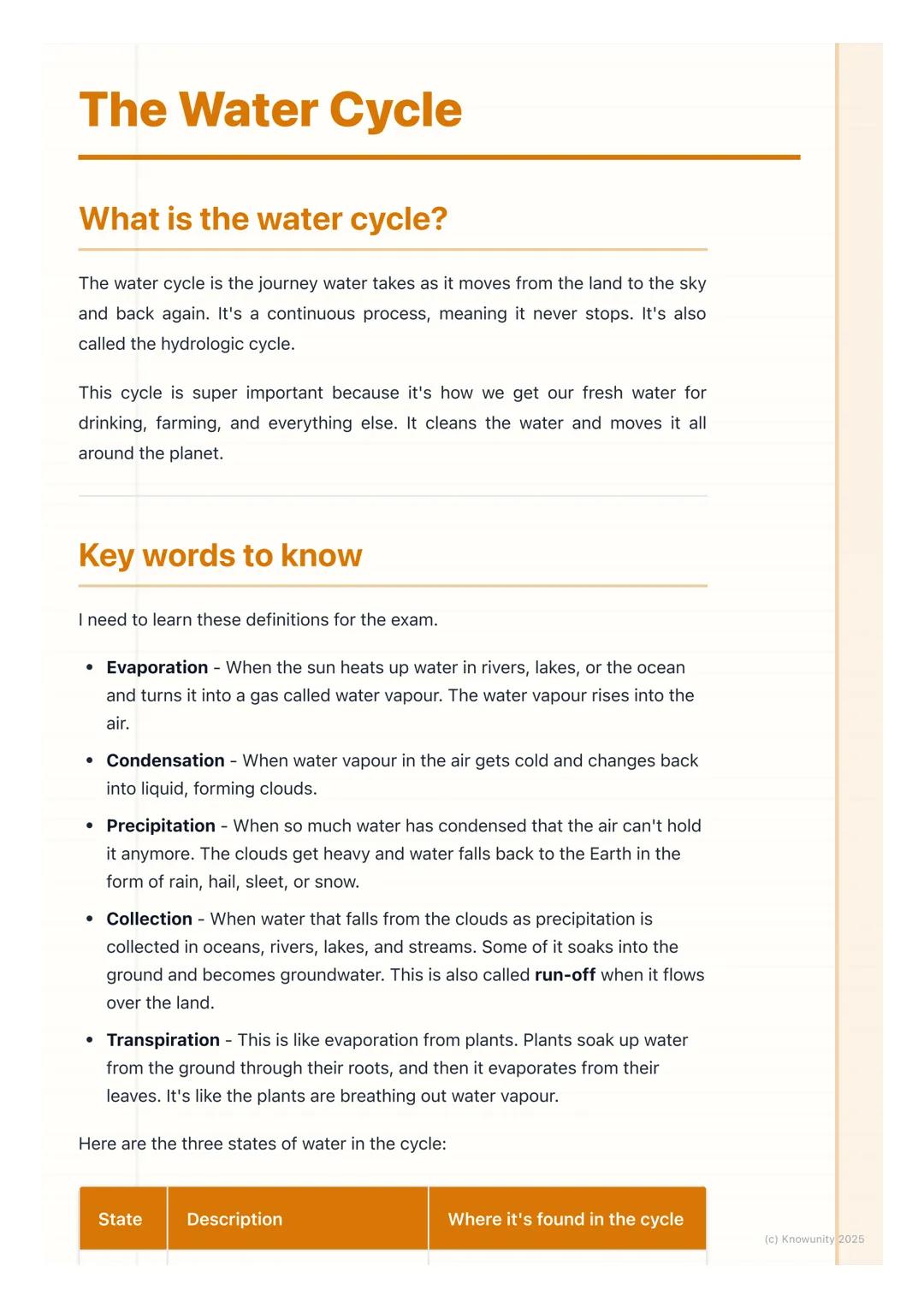
What is the Water Cycle?
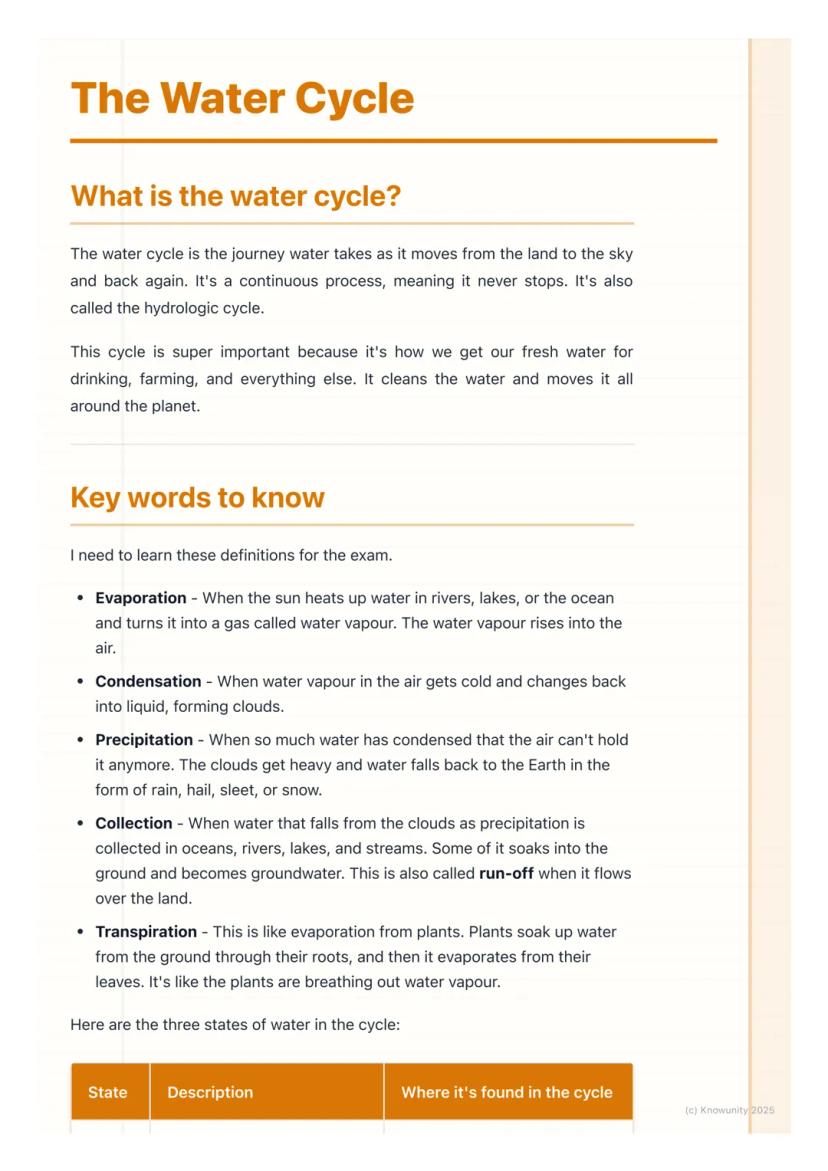
The water cycle is like a never-ending journey that water takes from land to sky and back again. Think of it as nature's recycling system - the same water has been cycling around Earth for millions of years!
This process is absolutely crucial because it's how we get clean, fresh water for drinking and farming. Without the water cycle, all our water would just sit in the oceans as salty seawater.
The cycle works because water can exist in three different states: liquid (like in rivers), gas (invisible water vapour), and solid (ice and snow). As water changes between these states, it moves around our planet.
Quick Tip: The water cycle is also called the hydrologic cycle - both terms mean exactly the same thing!
2
of 5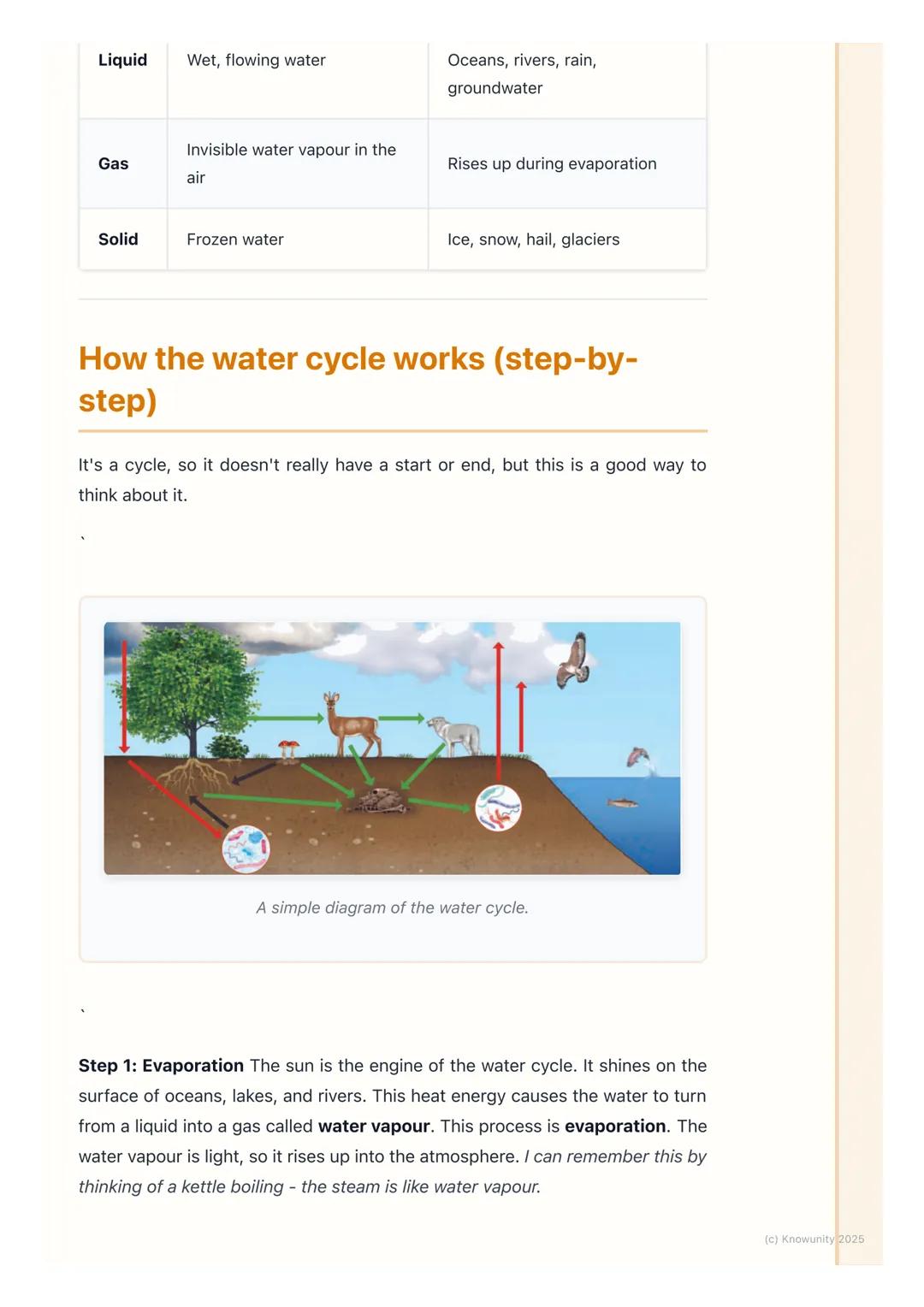
Essential Terms You Need to Know
Understanding these five key processes will help you ace any test on the water cycle. Each term describes what happens to water at different stages of its journey.
Evaporation happens when the sun heats up water in rivers, lakes, or oceans, turning it into invisible water vapour that rises into the air. Condensation is the opposite - when this water vapour gets cold and turns back into tiny droplets that form clouds.
Precipitation occurs when clouds become too heavy with water and release it as rain, snow, hail, or sleet. Collection is when this fallen water gathers in oceans, rivers, and lakes, or soaks into the ground as groundwater.
Don't forget transpiration - this is like evaporation from plants! Trees and other plants release water vapour through their leaves, adding moisture to the air just like evaporation from water surfaces.
Memory Trick: Think of transpiration as plants "breathing out" water vapour!
3
of 5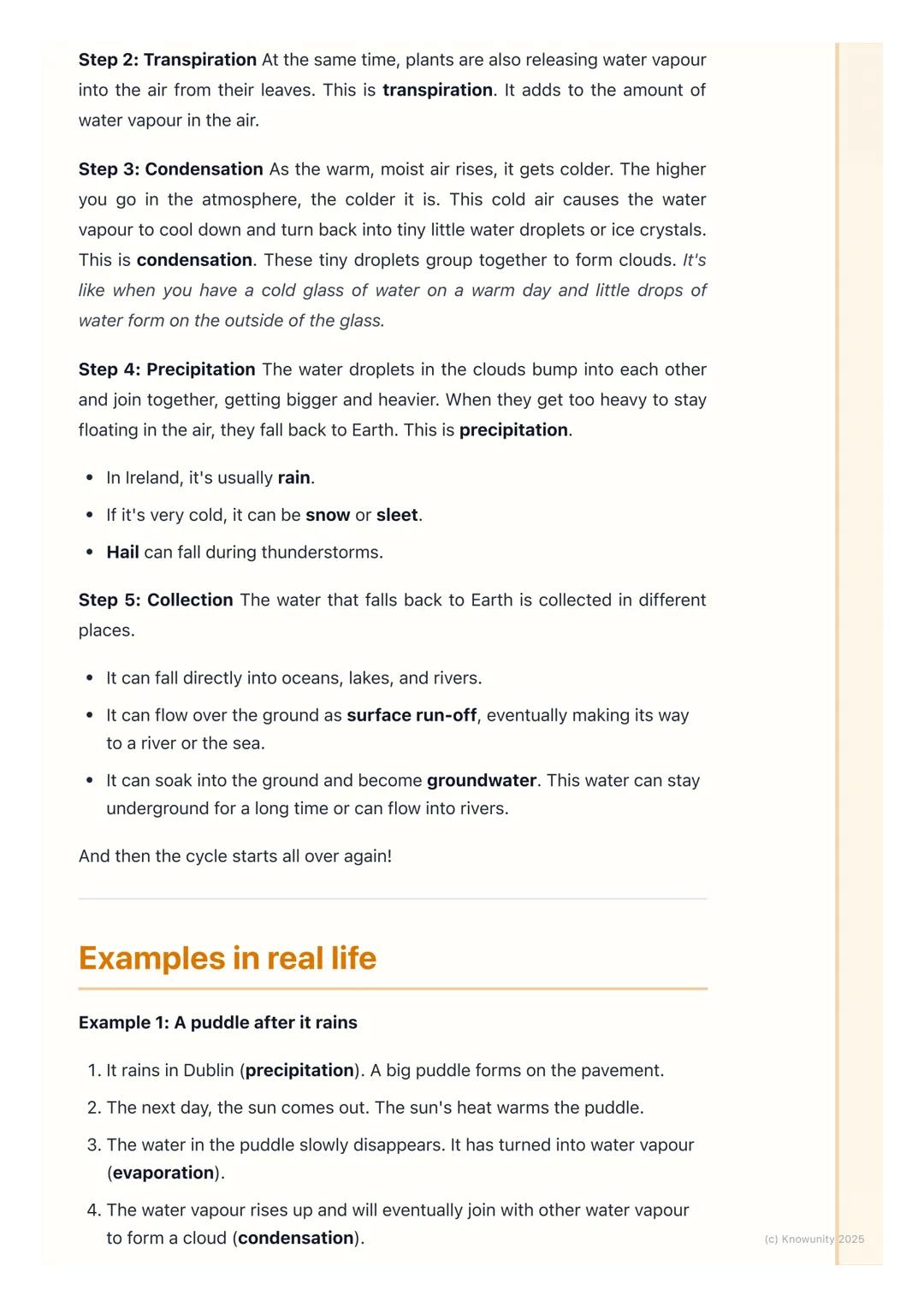
How the Water Cycle Actually Works
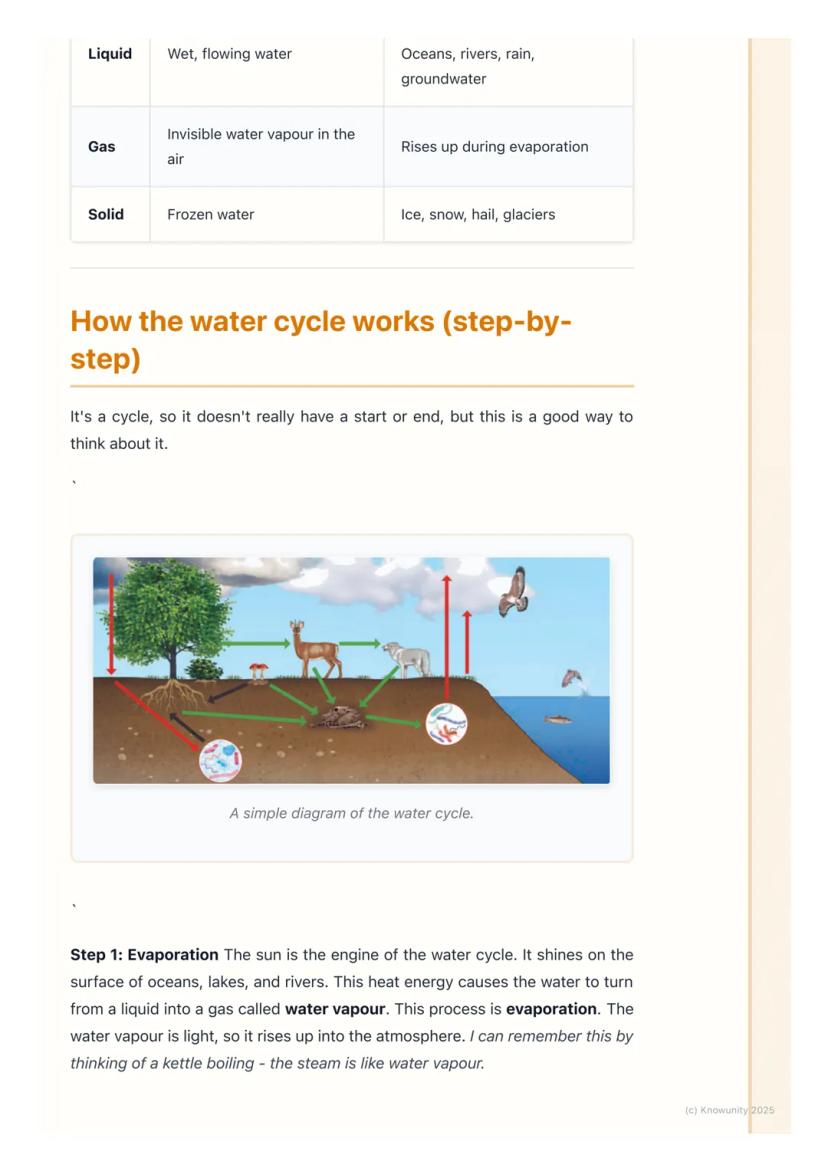
The sun is the engine that powers the entire water cycle. When it shines on oceans, lakes, and rivers, the heat energy turns liquid water into water vapour through evaporation. This invisible vapour rises up into the atmosphere like steam from a kettle.
At the same time, plants add even more water vapour through transpiration. As this warm, moist air rises higher, it cools down because the atmosphere gets colder with altitude.
When the water vapour cools enough, condensation happens - the vapour turns back into tiny droplets that clump together to form clouds. Eventually, these droplets become too heavy to float and fall as precipitation (rain, snow, or hail in Ireland).
The fallen water then gets collected in different places. Some flows directly into rivers and seas, some becomes surface run-off, and some soaks into the ground as groundwater. Then the whole amazing process starts over again!
Real-Life Connection: Notice how puddles disappear after sunny days? That's evaporation in action!
4
of 5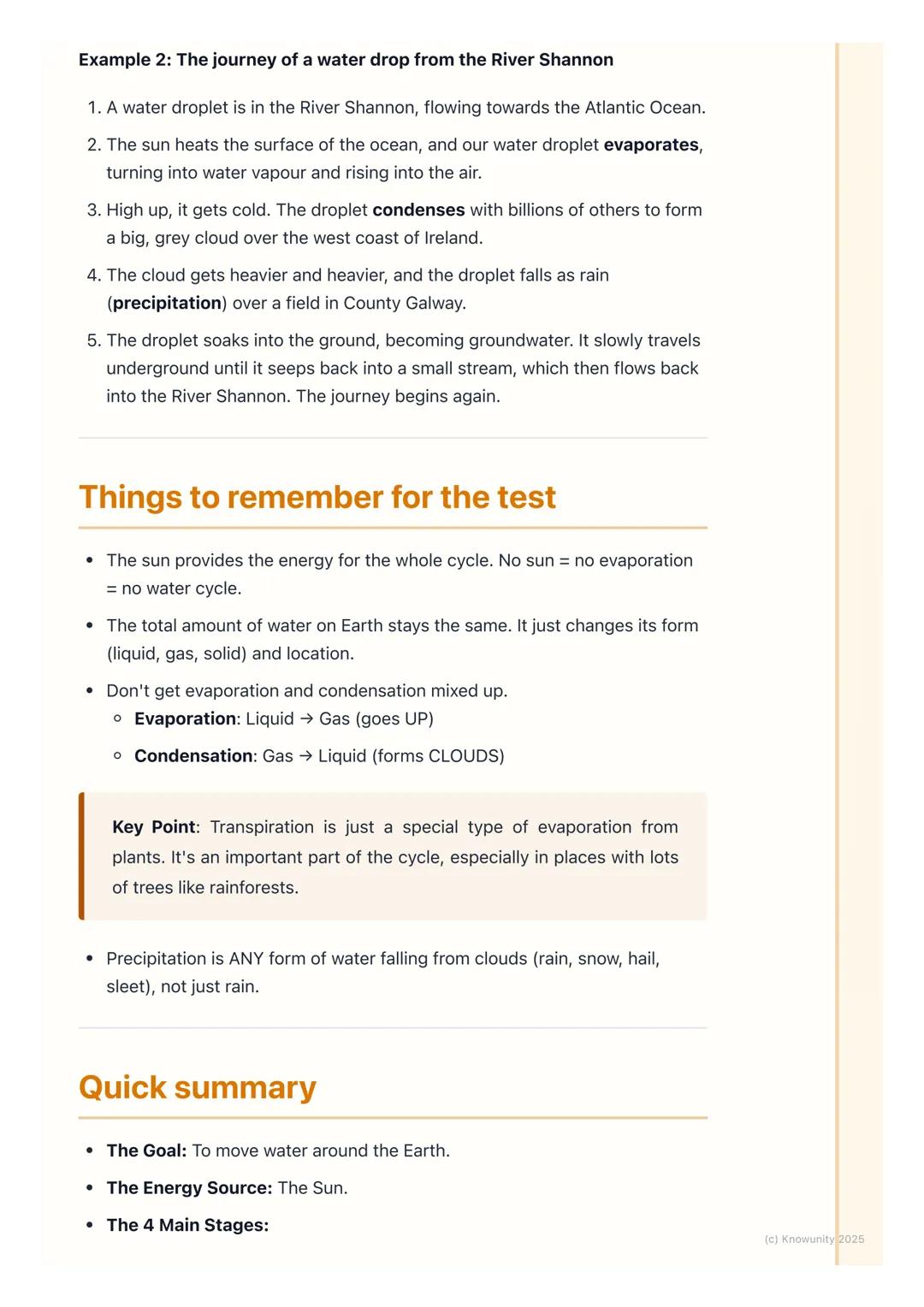
Real Examples from Ireland
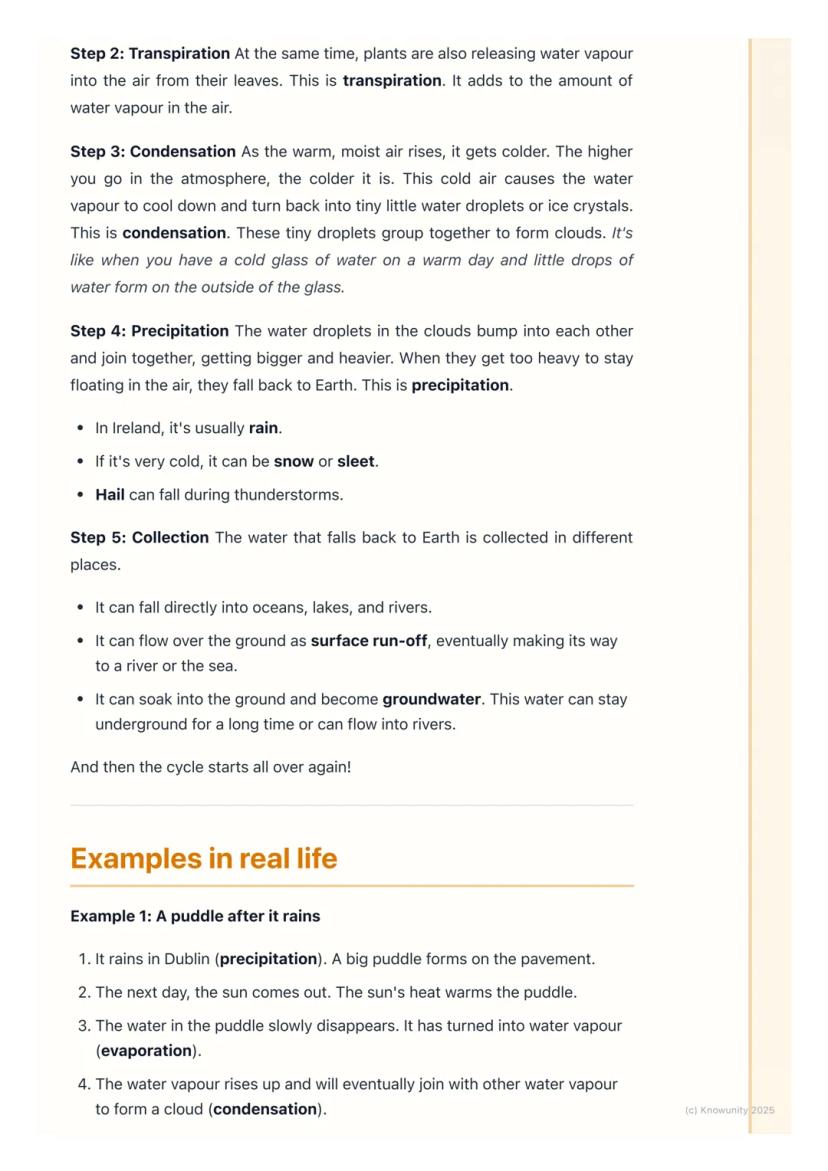
Imagine a water droplet's journey starting in the River Shannon. The sun heats the ocean surface where the river meets the Atlantic, causing our droplet to evaporate and rise as water vapour into the Irish sky.
High up in the atmosphere, it gets cold and our droplet condenses with billions of others to form a grey cloud over the west coast. When the cloud becomes heavy enough, the droplet falls as rain over a field in County Galway.
Our droplet then soaks into the ground, becoming groundwater that slowly travels underground. Eventually, it seeps into a small stream that flows back into the River Shannon, ready to begin its journey all over again.
Even something as simple as a Dublin puddle shows the cycle perfectly. After rain (precipitation), the sun comes out and gradually makes the puddle disappear (evaporation). That water vapour will eventually help form new clouds somewhere else!
Test Success: Remember that the total amount of water on Earth never changes - it just moves around and changes form!
5
of 5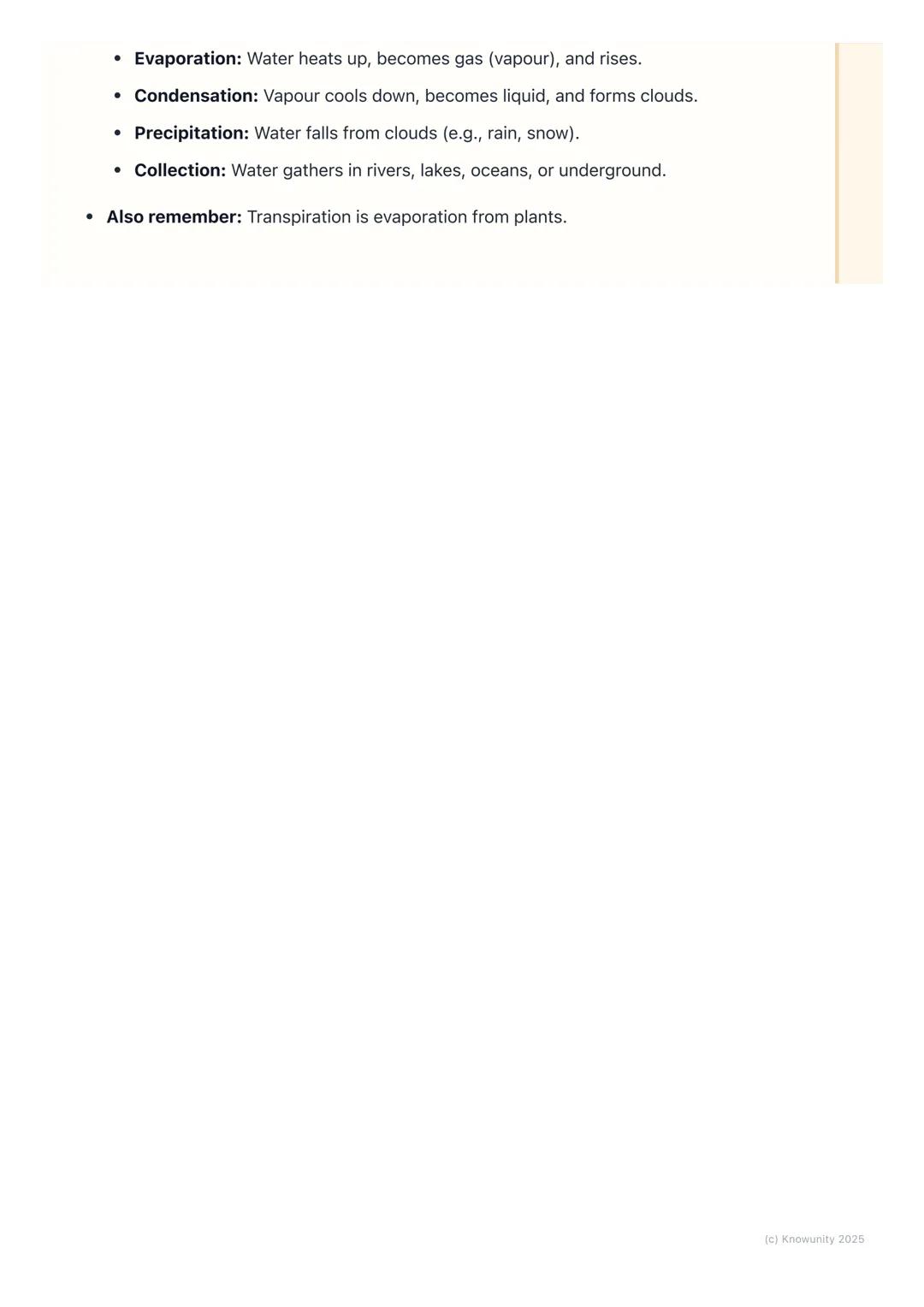
Key Points for Your Exam
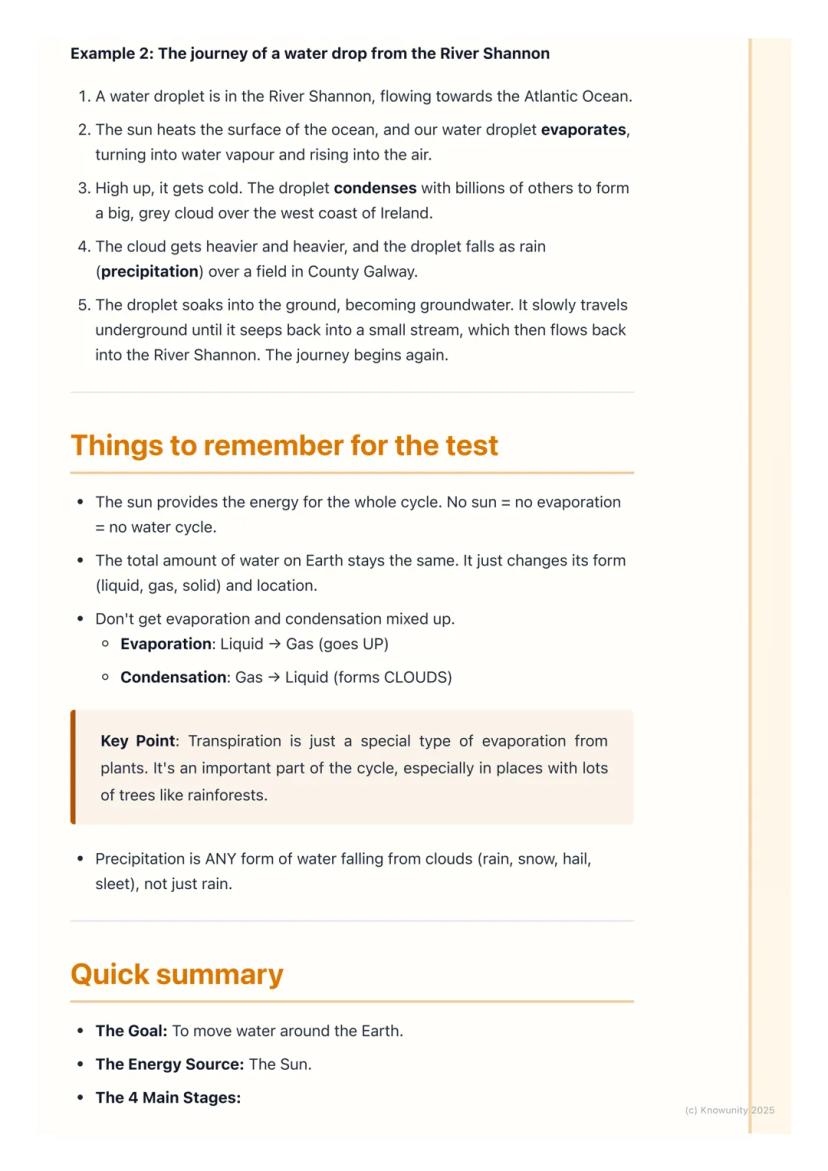
The most important thing to remember is that the sun provides all the energy for the water cycle. No sun means no evaporation, which means no water cycle at all!
Don't mix up evaporation (liquid turning to gas and going UP) with condensation (gas turning back to liquid and forming CLOUDS). These are opposite processes that students often confuse.
Precipitation includes any water falling from clouds - not just rain, but also snow, hail, and sleet. In Ireland, we see all of these forms throughout the year.
The four main stages work together perfectly: evaporation, condensation, precipitation, and collection. Add in transpiration from plants, and you've got the complete picture of how water moves around our planet in this endless, essential cycle.
Success Strategy: Practice drawing the water cycle diagram and labelling each process - this often appears on tests!
Si on te demande...
Qu'est-ce que le compagnon IA de Knowunity ?
Notre compagnon IA est spécialement conçu pour répondre aux besoins des étudiants. Sur la base des millions d'éléments de contenu que nous avons sur la plateforme, nous pouvons fournir des réponses vraiment significatives et pertinentes aux étudiants. Mais il ne s'agit pas seulement de réponses, le compagnon a encore plus pour but de guider les élèves dans leurs défis d'apprentissage quotidiens, avec des plans d'étude personnalisés, des quiz ou des éléments de contenu dans le chat et une personnalisation à 100% basée sur les compétences et les développements de l'étudiant.
Où puis-je télécharger l'appli Knowunity ?
Tu peux télécharger l'application dans Google Play Store et dans l'App Store d'Apple.
L'application est-elle vraiment gratuite ?
Oui, tu as un accès entièrement gratuit à tous les contenus de l'appli, tu peux chatter ou suivre les créateurs à tout moment. De plus, nous proposons Knowunity Premium, qui te permet de réviser sans limites!
Contenus les plus populaires en Geography
9Contenus les plus populaires
9Rien ne te convient ? Explore d'autres matières.
Les étudiants nous adorent — il ne manque plus que toi.
4.6/5App Store
4.7/5Google Play
L'application est très facile d'utilisation et bien conçue. Jusqu'à présent, j'ai trouvé tout ce que je cherchais et j'ai pu apprendre beaucoup de choses grâce aux présentations ! Je vais certainement utiliser l'application pour un travail en classe ! Et comme source d'inspiration personnelle, elle est bien sûr aussi très utile.
Stefan Sutilisateur iOS
Cette application est vraiment super. Il y a tellement de fiches de révision et d'aide, [...]. Par exemple, la matière qui me pose problème est le français et l'appli a un choix d'aide très large. Grâce à cette application, je me suis améliorée en français. Je la recommanderais à tout le monde.
Samantha Klichutilisatrice Android
Waouh, je suis vraiment abasourdi. J'ai essayé l'application parce que je l'avais déjà vue plusieurs fois dans la publicité et j'ai été absolument choquée. Cette appli est L'AIDE dont on rêve pour l'école et surtout, elle propose tellement de choses, comme des rédactions et des fiches qui m'ont personnellement TRÈS bien aidé.
Annautilisatrice iOS
Geography2 vues·Mis à jour Jun 2, 2026·5 pagesUnderstanding the Water Cycle: Key Processes Explained
Ever wonder where rain comes from or why puddles disappear on sunny days? The water cycle is nature's brilliant recycling system that moves water around our planet constantly. Understanding this process helps explain everything from why we have fresh water... Affiche plus
1
of 5Inscris-toi pour voir le contenu. C'est gratuit!
- Accès à tous les documents
- Améliore tes notes
- Rejoins des millions d'étudiants
What is the Water Cycle?
The water cycle is like a never-ending journey that water takes from land to sky and back again. Think of it as nature's recycling system - the same water has been cycling around Earth for millions of years!
This process is absolutely crucial because it's how we get clean, fresh water for drinking and farming. Without the water cycle, all our water would just sit in the oceans as salty seawater.
The cycle works because water can exist in three different states: liquid (like in rivers), gas (invisible water vapour), and solid (ice and snow). As water changes between these states, it moves around our planet.
Quick Tip: The water cycle is also called the hydrologic cycle - both terms mean exactly the same thing!
2
of 5Inscris-toi pour voir le contenu. C'est gratuit!
- Accès à tous les documents
- Améliore tes notes
- Rejoins des millions d'étudiants
Essential Terms You Need to Know
Understanding these five key processes will help you ace any test on the water cycle. Each term describes what happens to water at different stages of its journey.
Evaporation happens when the sun heats up water in rivers, lakes, or oceans, turning it into invisible water vapour that rises into the air. Condensation is the opposite - when this water vapour gets cold and turns back into tiny droplets that form clouds.
Precipitation occurs when clouds become too heavy with water and release it as rain, snow, hail, or sleet. Collection is when this fallen water gathers in oceans, rivers, and lakes, or soaks into the ground as groundwater.
Don't forget transpiration - this is like evaporation from plants! Trees and other plants release water vapour through their leaves, adding moisture to the air just like evaporation from water surfaces.
Memory Trick: Think of transpiration as plants "breathing out" water vapour!
3
of 5Inscris-toi pour voir le contenu. C'est gratuit!
- Accès à tous les documents
- Améliore tes notes
- Rejoins des millions d'étudiants
How the Water Cycle Actually Works
The sun is the engine that powers the entire water cycle. When it shines on oceans, lakes, and rivers, the heat energy turns liquid water into water vapour through evaporation. This invisible vapour rises up into the atmosphere like steam from a kettle.
At the same time, plants add even more water vapour through transpiration. As this warm, moist air rises higher, it cools down because the atmosphere gets colder with altitude.
When the water vapour cools enough, condensation happens - the vapour turns back into tiny droplets that clump together to form clouds. Eventually, these droplets become too heavy to float and fall as precipitation (rain, snow, or hail in Ireland).
The fallen water then gets collected in different places. Some flows directly into rivers and seas, some becomes surface run-off, and some soaks into the ground as groundwater. Then the whole amazing process starts over again!
Real-Life Connection: Notice how puddles disappear after sunny days? That's evaporation in action!
4
of 5Inscris-toi pour voir le contenu. C'est gratuit!
- Accès à tous les documents
- Améliore tes notes
- Rejoins des millions d'étudiants
Real Examples from Ireland
Imagine a water droplet's journey starting in the River Shannon. The sun heats the ocean surface where the river meets the Atlantic, causing our droplet to evaporate and rise as water vapour into the Irish sky.
High up in the atmosphere, it gets cold and our droplet condenses with billions of others to form a grey cloud over the west coast. When the cloud becomes heavy enough, the droplet falls as rain over a field in County Galway.
Our droplet then soaks into the ground, becoming groundwater that slowly travels underground. Eventually, it seeps into a small stream that flows back into the River Shannon, ready to begin its journey all over again.
Even something as simple as a Dublin puddle shows the cycle perfectly. After rain (precipitation), the sun comes out and gradually makes the puddle disappear (evaporation). That water vapour will eventually help form new clouds somewhere else!
Test Success: Remember that the total amount of water on Earth never changes - it just moves around and changes form!
5
of 5Inscris-toi pour voir le contenu. C'est gratuit!
- Accès à tous les documents
- Améliore tes notes
- Rejoins des millions d'étudiants
Key Points for Your Exam
The most important thing to remember is that the sun provides all the energy for the water cycle. No sun means no evaporation, which means no water cycle at all!
Don't mix up evaporation (liquid turning to gas and going UP) with condensation (gas turning back to liquid and forming CLOUDS). These are opposite processes that students often confuse.
Precipitation includes any water falling from clouds - not just rain, but also snow, hail, and sleet. In Ireland, we see all of these forms throughout the year.
The four main stages work together perfectly: evaporation, condensation, precipitation, and collection. Add in transpiration from plants, and you've got the complete picture of how water moves around our planet in this endless, essential cycle.
Success Strategy: Practice drawing the water cycle diagram and labelling each process - this often appears on tests!
Si on te demande...
Qu'est-ce que le compagnon IA de Knowunity ?
Notre compagnon IA est spécialement conçu pour répondre aux besoins des étudiants. Sur la base des millions d'éléments de contenu que nous avons sur la plateforme, nous pouvons fournir des réponses vraiment significatives et pertinentes aux étudiants. Mais il ne s'agit pas seulement de réponses, le compagnon a encore plus pour but de guider les élèves dans leurs défis d'apprentissage quotidiens, avec des plans d'étude personnalisés, des quiz ou des éléments de contenu dans le chat et une personnalisation à 100% basée sur les compétences et les développements de l'étudiant.
Où puis-je télécharger l'appli Knowunity ?
Tu peux télécharger l'application dans Google Play Store et dans l'App Store d'Apple.
L'application est-elle vraiment gratuite ?
Oui, tu as un accès entièrement gratuit à tous les contenus de l'appli, tu peux chatter ou suivre les créateurs à tout moment. De plus, nous proposons Knowunity Premium, qui te permet de réviser sans limites!
Contenus les plus populaires en Geography
9Contenus les plus populaires
9Rien ne te convient ? Explore d'autres matières.
Les étudiants nous adorent — il ne manque plus que toi.
4.6/5App Store
4.7/5Google Play
L'application est très facile d'utilisation et bien conçue. Jusqu'à présent, j'ai trouvé tout ce que je cherchais et j'ai pu apprendre beaucoup de choses grâce aux présentations ! Je vais certainement utiliser l'application pour un travail en classe ! Et comme source d'inspiration personnelle, elle est bien sûr aussi très utile.
Stefan Sutilisateur iOS
Cette application est vraiment super. Il y a tellement de fiches de révision et d'aide, [...]. Par exemple, la matière qui me pose problème est le français et l'appli a un choix d'aide très large. Grâce à cette application, je me suis améliorée en français. Je la recommanderais à tout le monde.
Samantha Klichutilisatrice Android
Waouh, je suis vraiment abasourdi. J'ai essayé l'application parce que je l'avais déjà vue plusieurs fois dans la publicité et j'ai été absolument choquée. Cette appli est L'AIDE dont on rêve pour l'école et surtout, elle propose tellement de choses, comme des rédactions et des fiches qui m'ont personnellement TRÈS bien aidé.
Annautilisatrice iOS