
Ancient Egypt, one of the world's most fascinating civilisations, thrived...
 History4 vues·Mis à jour Jun 14, 2026·5 pages
Discovering Ancient Egypt: Pharaohs, Pyramids, and Nile Secrets
1 / 5
1
of 5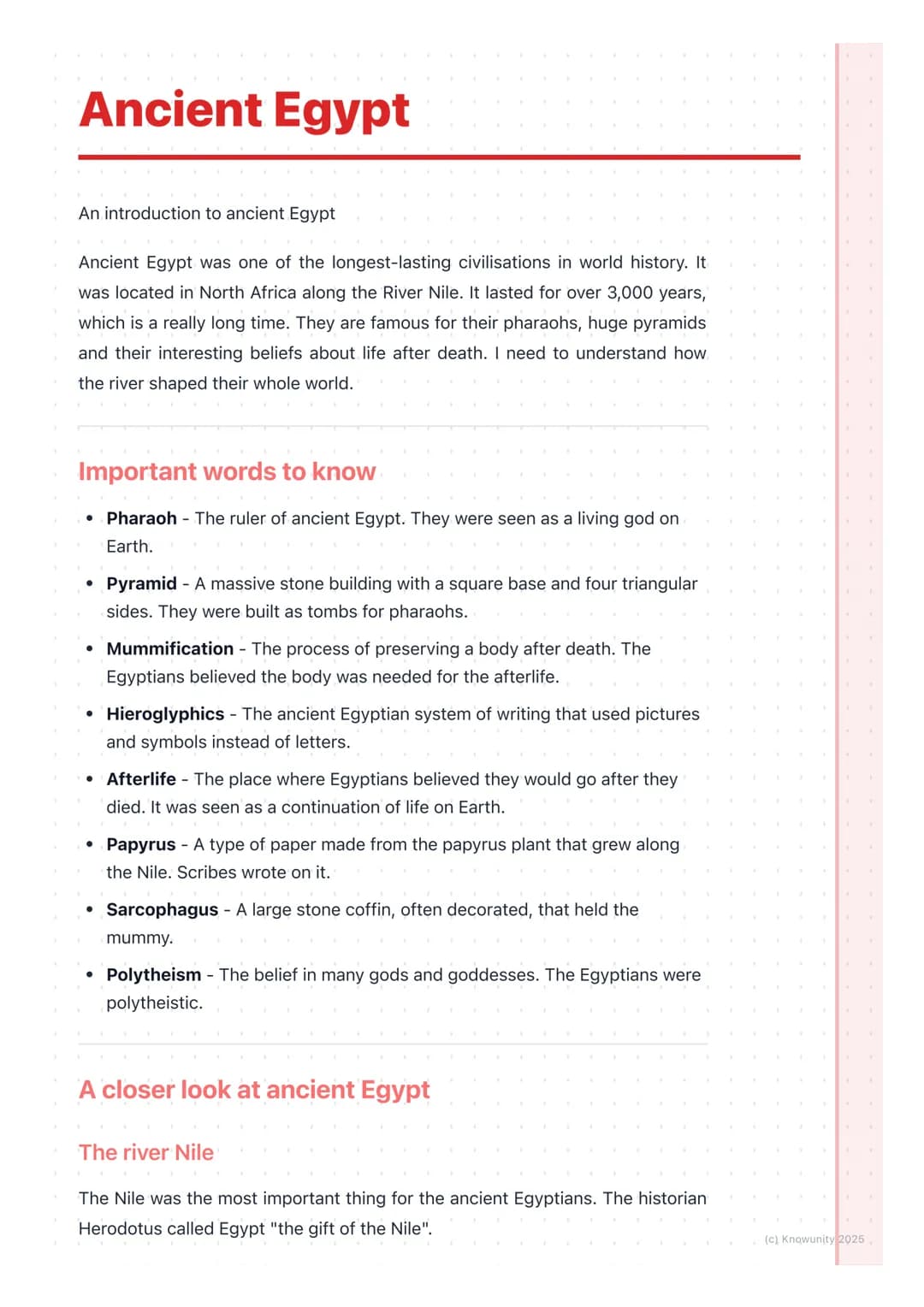
Introduction to Ancient Egypt
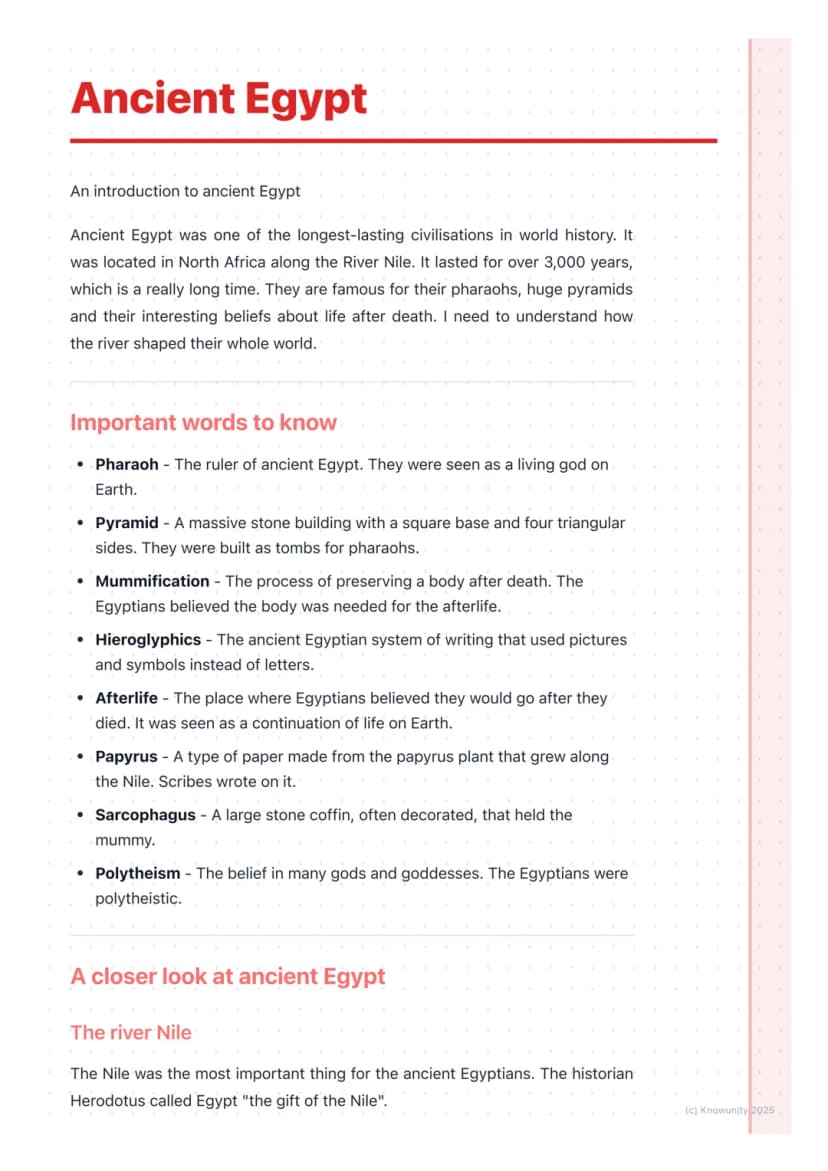
Ever wondered how a civilisation survived for thousands of years in the desert? Ancient Egypt's entire world revolved around the River Nile. This mighty waterway provided everything they needed to build one of history's most impressive civilisations.
Egypt wasn't just about pyramids and mummies - it was a complex society with its own writing system, religious beliefs, and social structure. The Egyptians were masters at adapting to their environment and creating amazing things with the resources they had.
Hieroglyphics were their special writing system using pictures and symbols instead of letters. These detailed symbols tell us so much about their daily lives and beliefs. Other important terms you'll need to know include pharaoh , pyramid (massive tombs), and mummification (the way they preserved bodies).
Did you know? The historian Herodotus called Egypt "the gift of the Nile" because absolutely everything in Egyptian life depended on this amazing river!
2
of 5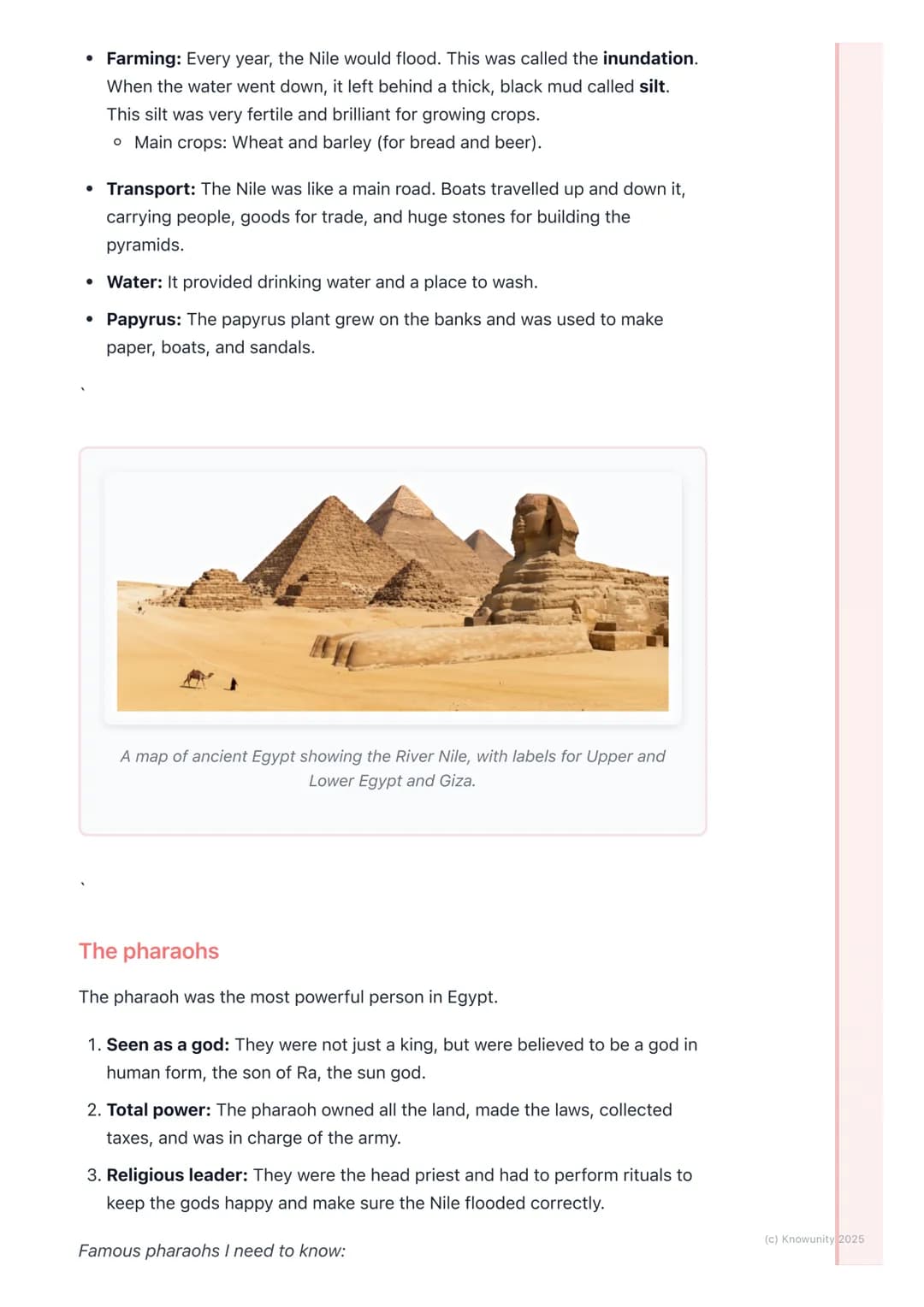
The Mighty Nile: Egypt's Lifeline
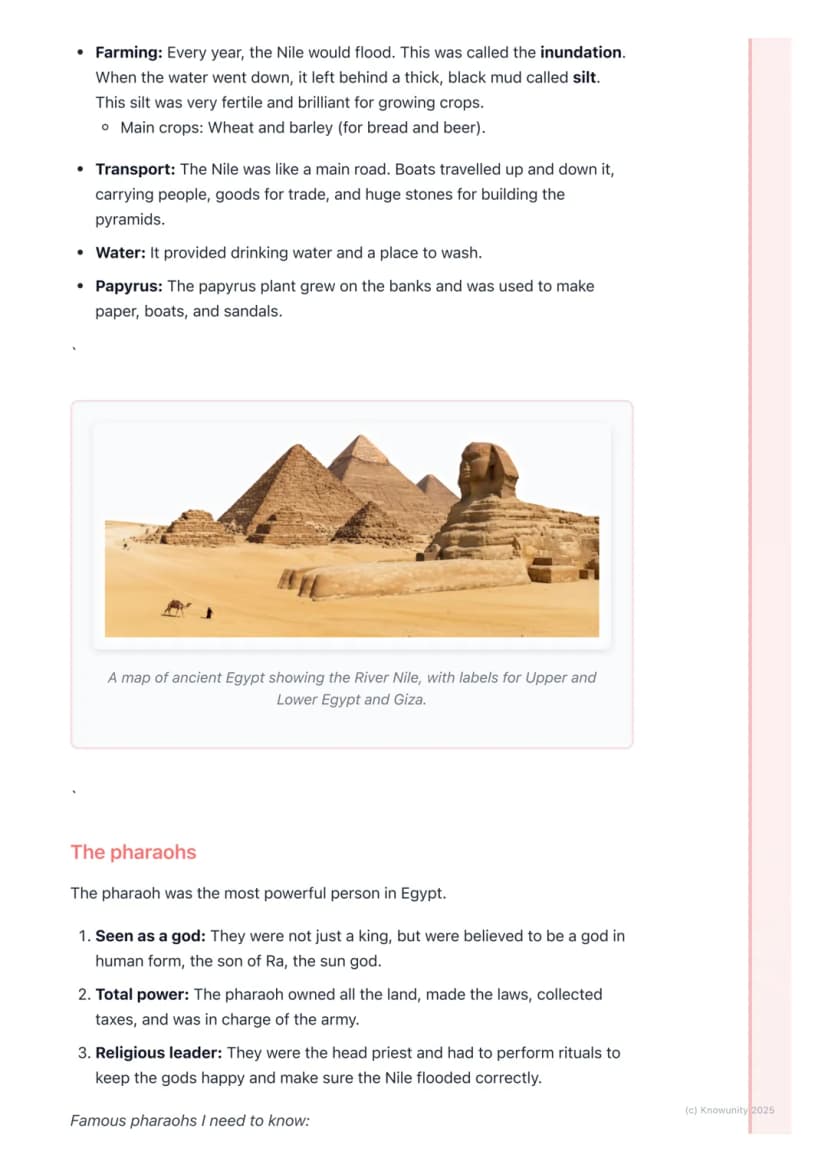
The Nile wasn't just a river - it was the heartbeat of ancient Egypt! Each year, the river would flood (called the inundation), leaving behind rich black soil perfect for growing crops. Without this natural miracle, Egyptian civilisation couldn't have existed.
The river served multiple crucial purposes in daily life:
- Farming: The fertile silt left after flooding allowed Egyptians to grow wheat and barley, which they made into bread and beer.
- Transport: Think of the Nile as Egypt's motorway! Boats travelled up and down carrying people, trade goods, and even massive stones for building projects.
- Resources: Beyond water for drinking and washing, the papyrus plant growing along the banks was used to make paper, boats, and even sandals.
The geography of Egypt was divided into two main regions: Upper Egypt (the southern part) and Lower Egypt (the northern delta region). This might seem confusing, but it's based on how the Nile flows from south to north!
Remember this! When you see "Upper Egypt" on a map, it's actually in the south, while "Lower Egypt" is in the north where the Nile spreads out into its delta.
3
of 5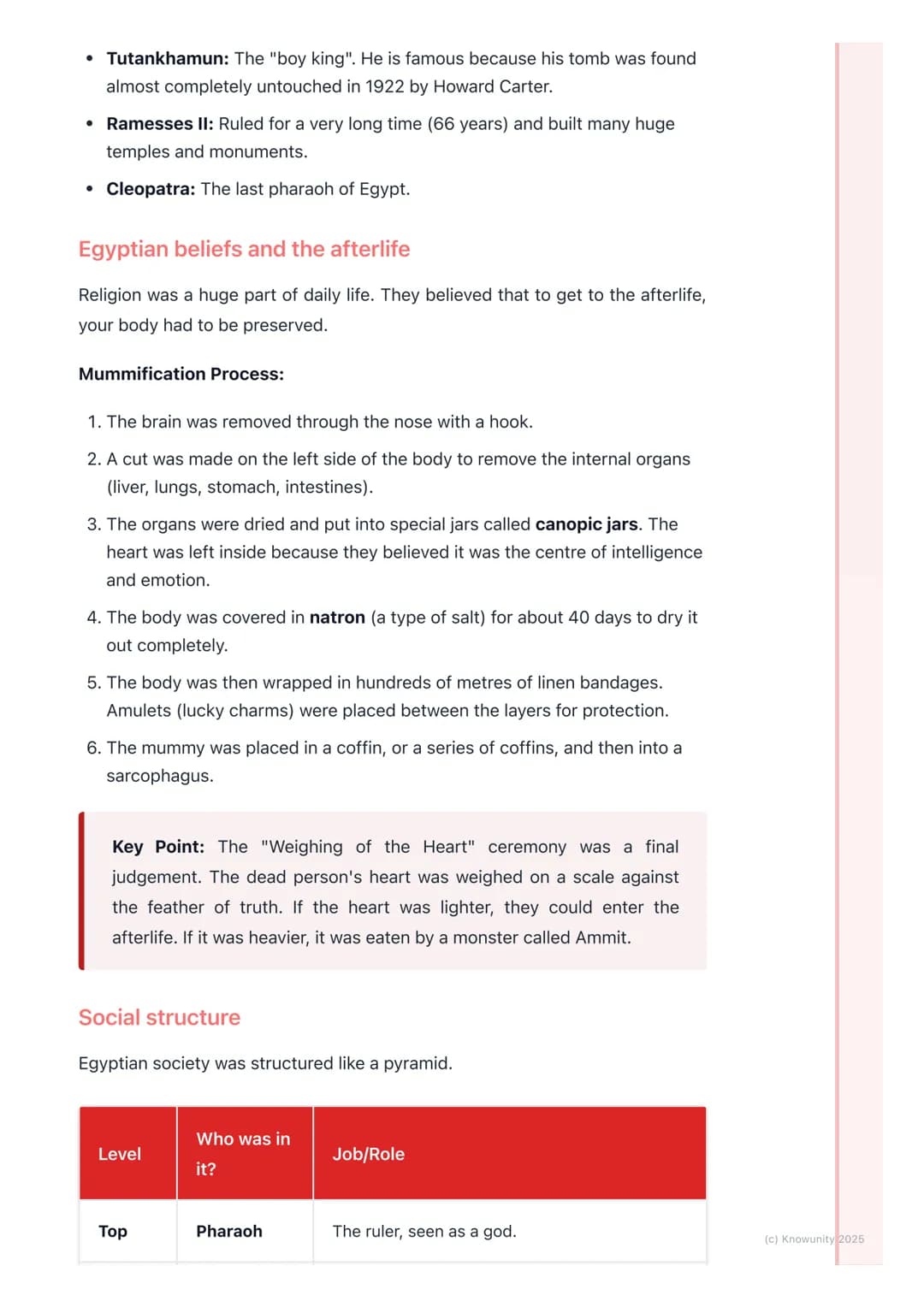
The Pharaohs and Egyptian Beliefs
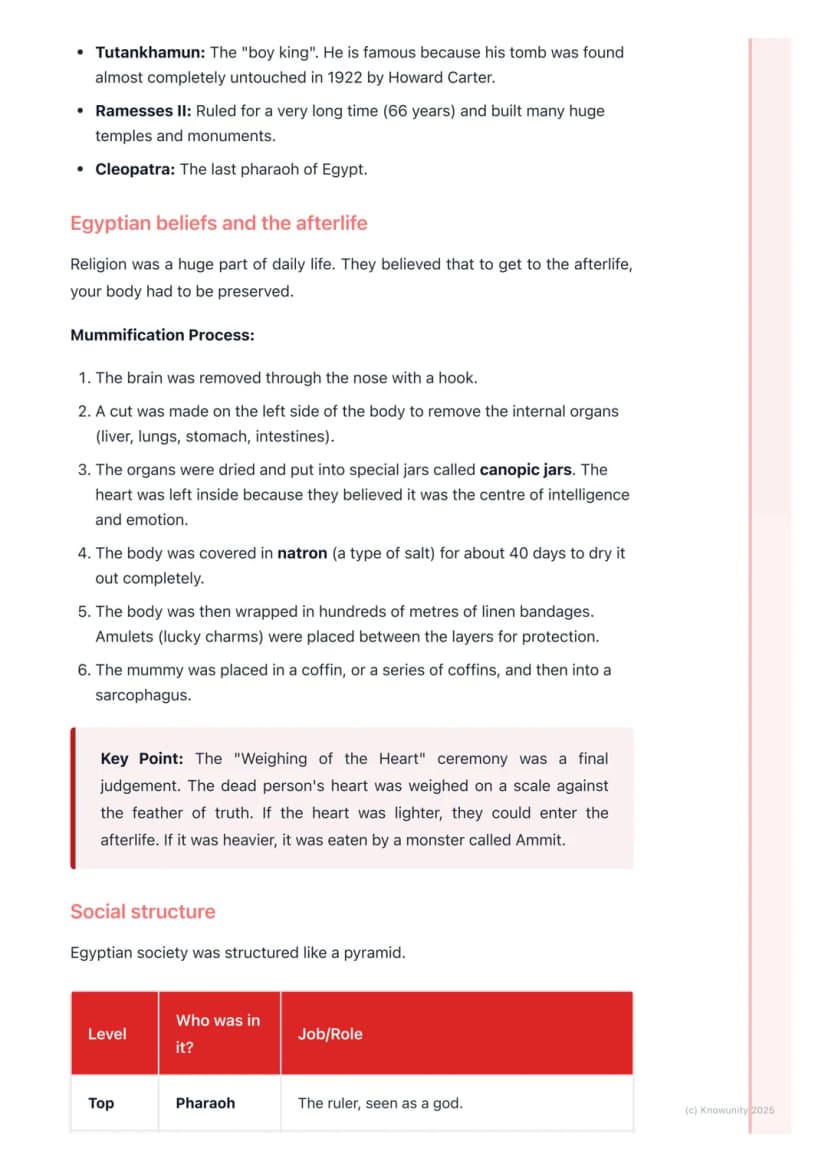
Imagine being treated as both king and god! That's exactly what happened to Egyptian pharaohs. These weren't ordinary rulers - they were believed to be living gods walking on earth, typically considered sons of Ra (the sun god).
Pharaohs had total power over everything in Egypt. They owned all the land, made all the laws, collected taxes, and led the army. As the chief religious leaders, they also performed important rituals to keep the gods happy and ensure the Nile flooded properly each year.
Some pharaohs you should definitely know about include Tutankhamun (the famous boy king whose tomb was discovered almost intact), Ramesses II (who ruled for an incredible 66 years), and Cleopatra (Egypt's last pharaoh).
Religion shaped everything in Egyptian life, especially their elaborate beliefs about death and the afterlife. Egyptians believed your body needed to be preserved to reach the afterlife, which is why mummification was so important. This complex process involved removing organs, drying the body with natron salt, and wrapping it in linen bandages with protective amulets.
Fascinating fact! In the "Weighing of the Heart" ceremony, your heart was weighed against the feather of truth. If your heart was lighter (meaning you lived a good life), you could enter the afterlife. If not, a monster called Ammit would eat your heart!
4
of 5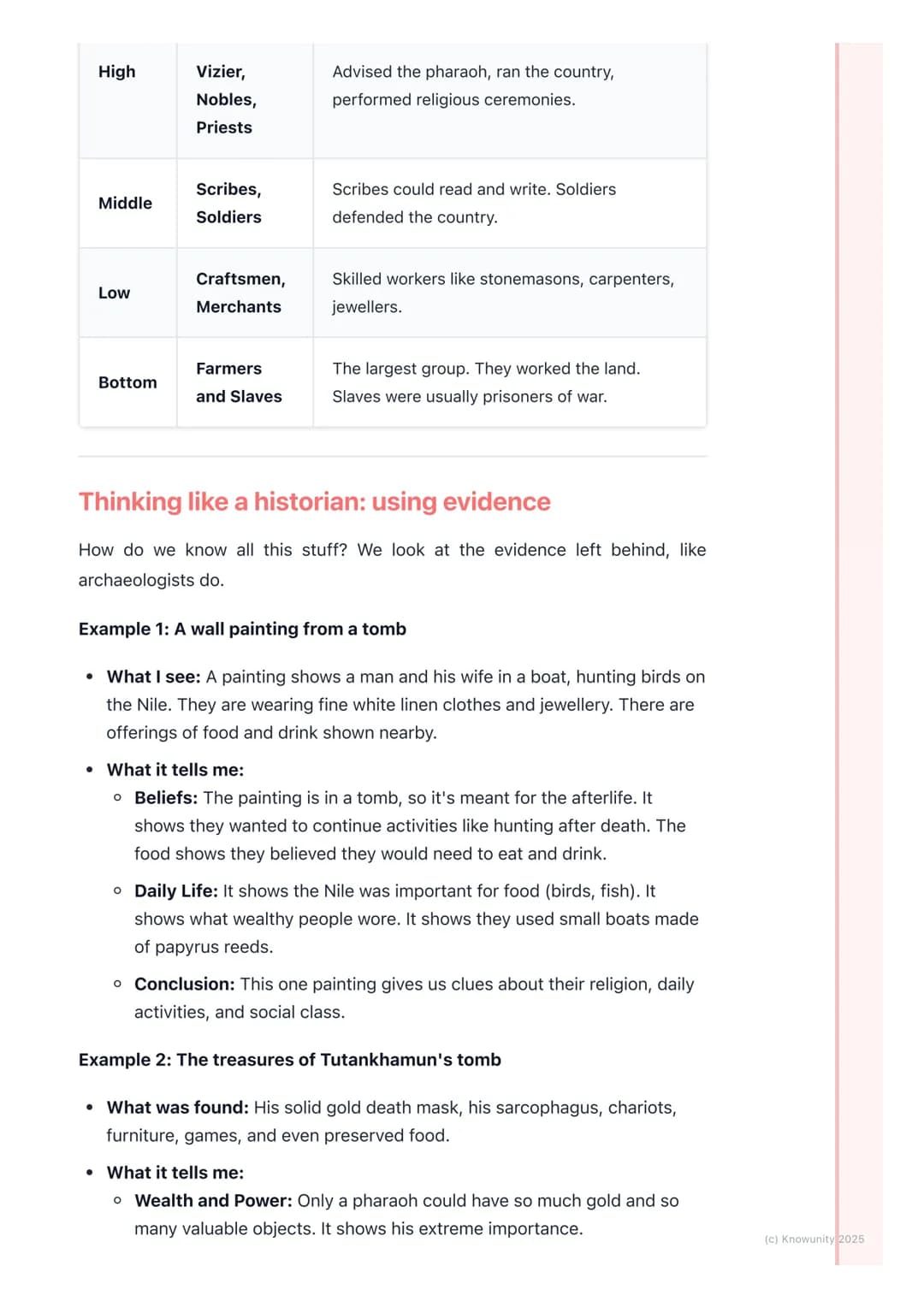
Egyptian Society and Evidence
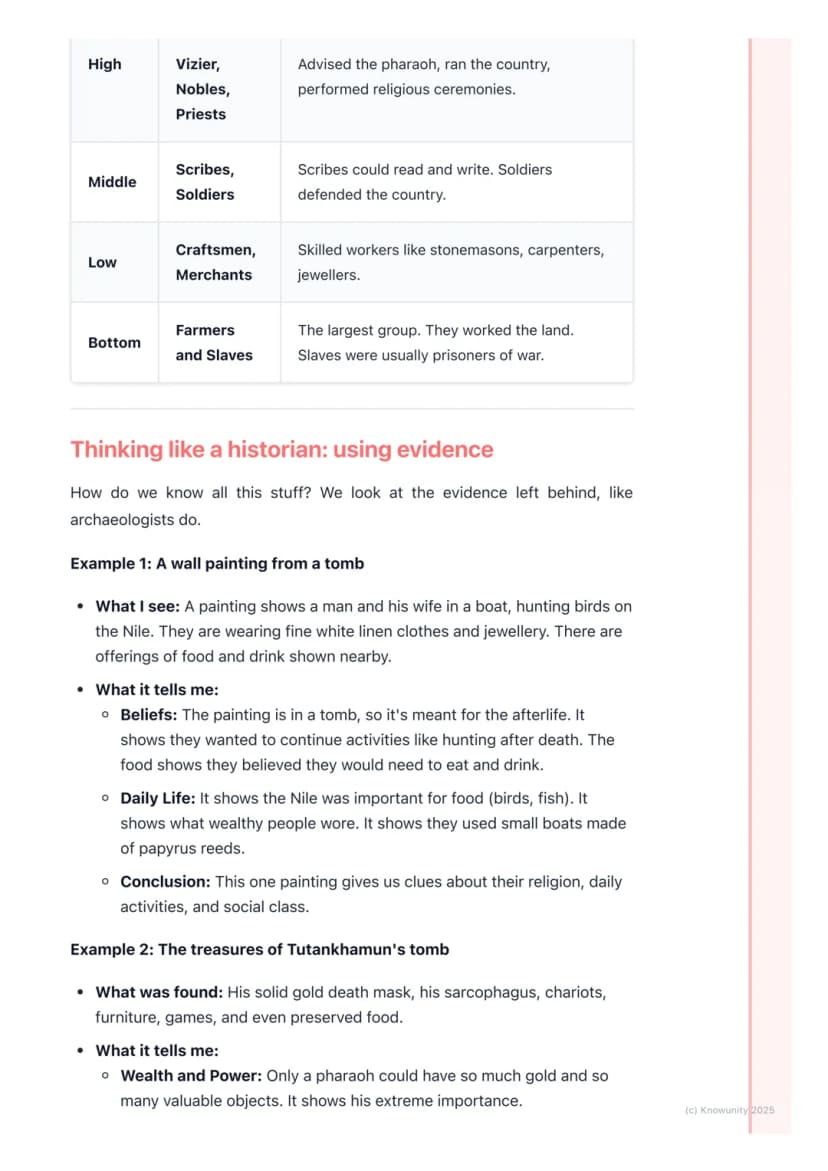
Egyptian society was structured like a pyramid, with very clear levels. At the top sat the pharaoh, followed by the vizier, nobles, and priests who helped run the country. In the middle were scribes (who could read and write) and soldiers who protected Egypt.
The lower levels included craftsmen and merchants who created and traded goods. At the bottom - but absolutely essential - were the farmers who made up the largest group and worked the land. Slaves (usually prisoners of war) were at the very bottom of society.
How do historians know all this? By studying the evidence left behind! Wall paintings from tombs show us what ancient Egyptians did in daily life and what they believed about the afterlife. For example, a painting showing a wealthy couple hunting birds from a boat tells us about their clothing, activities, and even what they hoped to do after death.
Archaeological discoveries like Tutankhamun's tomb provide even more clues. His golden death mask, furniture, games, and even preserved food show us the incredible wealth of pharaohs and the amazing skills of Egyptian craftsmen.
Think like a historian! When you look at Egyptian artifacts, ask yourself: What does this tell me about their beliefs? What does it reveal about daily life? What skills did they need to create it?
5
of 5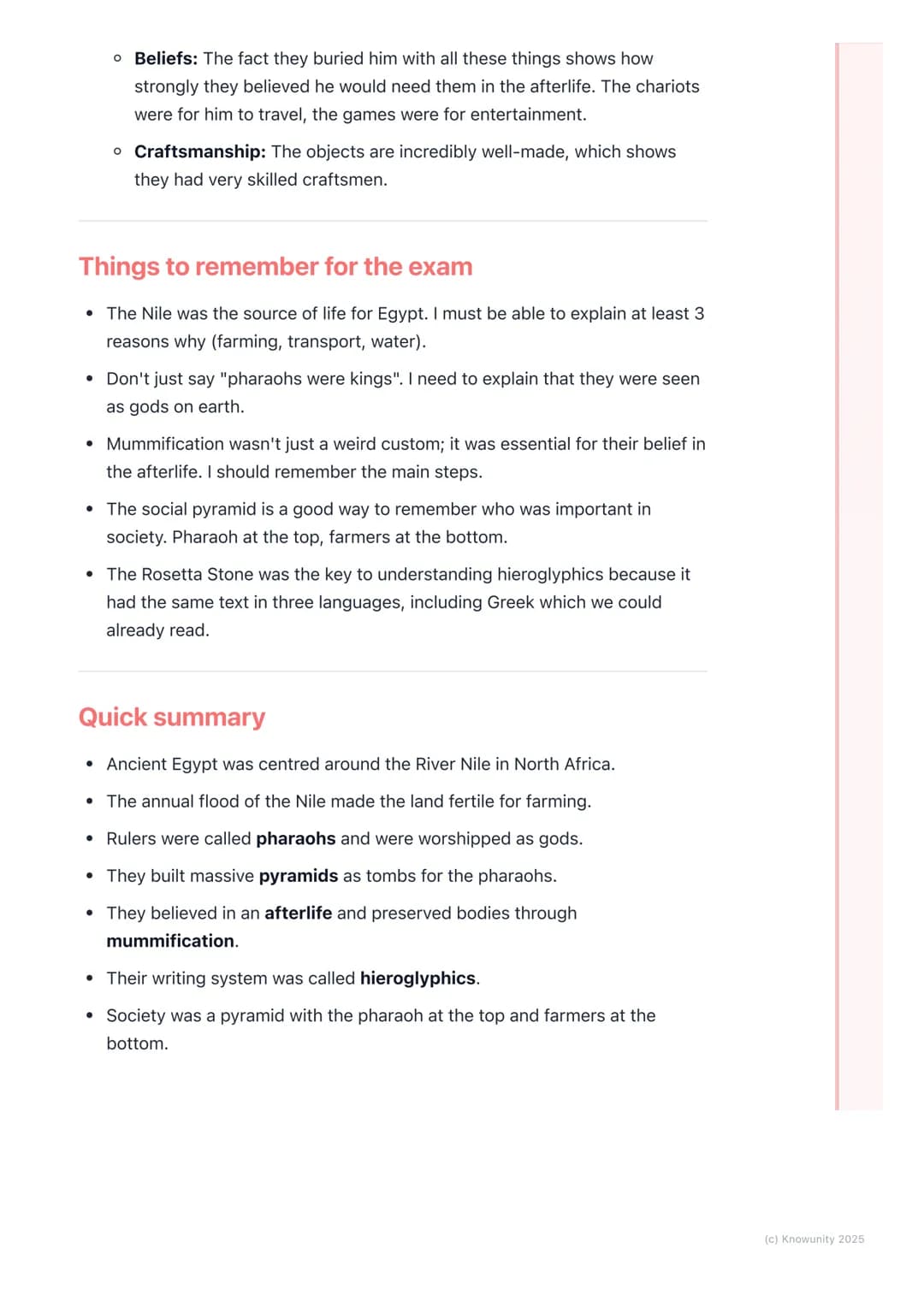
Key Points to Remember
The River Nile truly was the source of all life in Egypt. Its annual floods created fertile farmland, provided transport for people and building materials, and supplied water for drinking and washing. Without the Nile, there would be no ancient Egypt!
Remember that pharaohs weren't just powerful kings - they were considered actual gods in human form. This divine status gave them complete control over Egyptian society and explains why they were buried with such incredible treasures.
Mummification might seem strange to us today, but it made perfect sense to Egyptians who believed the body needed to be preserved for the afterlife. The complex process shows how important religious beliefs were in their society.
The social structure of ancient Egypt helps us understand who had power and privilege. From the god-like pharaoh at the top to the hardworking farmers at the bottom, everyone had their place in this ordered society.
Exam tip! When writing about ancient Egypt, always connect their practices (like building pyramids or mummification) to their beliefs. This shows deeper understanding than just describing what they did!
Si on te demande...
Qu'est-ce que le compagnon IA de Knowunity ?
Notre compagnon IA est spécialement conçu pour répondre aux besoins des étudiants. Sur la base des millions d'éléments de contenu que nous avons sur la plateforme, nous pouvons fournir des réponses vraiment significatives et pertinentes aux étudiants. Mais il ne s'agit pas seulement de réponses, le compagnon a encore plus pour but de guider les élèves dans leurs défis d'apprentissage quotidiens, avec des plans d'étude personnalisés, des quiz ou des éléments de contenu dans le chat et une personnalisation à 100% basée sur les compétences et les développements de l'étudiant.
Où puis-je télécharger l'appli Knowunity ?
Tu peux télécharger l'application dans Google Play Store et dans l'App Store d'Apple.
L'application est-elle vraiment gratuite ?
Oui, tu as un accès entièrement gratuit à tous les contenus de l'appli, tu peux chatter ou suivre les créateurs à tout moment. De plus, nous proposons Knowunity Premium, qui te permet de réviser sans limites!
Contenus les plus populaires en History
9HistoryThe Great Famine (An Gorta Mór)
Students will learn about the causes, devastating impact, and long-term consequences of the potato famine on Irish population and society.
2nd Year282
HistoryThe renaissance
junior cert renaissance summary
1st Year361
HistoryCauses and Consequences of World War II
This subtopic covers the origins of the Second World War, its global scale, and its devastating human and political consequences, including the atomic bomb.
3rd Year152
HistoryThe 1798 Rebellion in Ireland
Learning about the causes, events, and aftermath of the United Irishmen's rebellion against British rule, inspired by revolutionary ideals.
3rd Year211
HistoryAmerican revolution
junior cert american revolution summary
1st Year442
HistoryThe Great Famine (An Gorta Mór)
This critical subtopic examines the causes, devastating impact, and long-term consequences of the potato famine on Irish society, population, and emigration.
3rd Year140
HistoryThe Renaissance
Students will learn about a time of 'rebirth' in Europe, where new ideas in art, science, and literature flourished.
1st Year140
History1916 Rising Revison Sheet
revision sheet
3rd Year211
HistoryThe Reformation in Europe
Students will learn about the causes and key figures of the Protestant Reformation and its impact on European society and politics.
3rd Year110
Contenus les plus populaires
9 Irish
IrishIrish oral questions and answers
Questions and answers for the leaving cert oral
5th Year4264
 English
Key Quotes : Sive
Key Quotes and explanations: Sive
6th Year2842
IrishIrish oral questions
Outline of oral questions
5th Year2055
IrishIníon- le hÁine Durkin
Aine Durkin’s poem, Iníon: Themes & summary
5th Year850
IrishIrish poetry 2027
Iníon + Dínit an Bhróin
5th Year1133
IrishLC HL notes- Iníon (poem)
Includes poem in English and Irish, theme, key words & phrases
5th Year2284
EnglishCultural Context : Shawshank Redemption : Sive : Small Things Like These
Comparative Study : Cultural Context : Shawshank Redemption, Sive and Small Things Like These
6th Year1430
IrishMo Ghrá-sa (Idir Lúibíní)
Notes on mo ghrá-sa
5th Year380
IrishAn Gaeilge Aiste
Irish Language essay
6th Year1320
Rien ne te convient ? Explore d'autres matières.
Les étudiants nous adorent — il ne manque plus que toi.
4.6/5App Store
4.7/5Google Play
L'application est très facile d'utilisation et bien conçue. Jusqu'à présent, j'ai trouvé tout ce que je cherchais et j'ai pu apprendre beaucoup de choses grâce aux présentations ! Je vais certainement utiliser l'application pour un travail en classe ! Et comme source d'inspiration personnelle, elle est bien sûr aussi très utile.
Stefan Sutilisateur iOS
Cette application est vraiment super. Il y a tellement de fiches de révision et d'aide, [...]. Par exemple, la matière qui me pose problème est le français et l'appli a un choix d'aide très large. Grâce à cette application, je me suis améliorée en français. Je la recommanderais à tout le monde.
Samantha Klichutilisatrice Android
Waouh, je suis vraiment abasourdi. J'ai essayé l'application parce que je l'avais déjà vue plusieurs fois dans la publicité et j'ai été absolument choquée. Cette appli est L'AIDE dont on rêve pour l'école et surtout, elle propose tellement de choses, comme des rédactions et des fiches qui m'ont personnellement TRÈS bien aidé.
Annautilisatrice iOS
History4 vues·Mis à jour Jun 14, 2026·5 pagesDiscovering Ancient Egypt: Pharaohs, Pyramids, and Nile Secrets
Ancient Egypt, one of the world's most fascinating civilisations, thrived along the River Nile in North Africa for over 3,000 years. From powerful pharaohs and massive pyramids to complex beliefs about the afterlife, ancient Egyptian society created a legacy that...
1
of 5
Inscris-toi pour voir le contenu. C'est gratuit!
- Accès à tous les documents
- Améliore tes notes
- Rejoins des millions d'étudiants
Introduction to Ancient Egypt
Ever wondered how a civilisation survived for thousands of years in the desert? Ancient Egypt's entire world revolved around the River Nile. This mighty waterway provided everything they needed to build one of history's most impressive civilisations.
Egypt wasn't just about pyramids and mummies - it was a complex society with its own writing system, religious beliefs, and social structure. The Egyptians were masters at adapting to their environment and creating amazing things with the resources they had.
Hieroglyphics were their special writing system using pictures and symbols instead of letters. These detailed symbols tell us so much about their daily lives and beliefs. Other important terms you'll need to know include pharaoh , pyramid (massive tombs), and mummification (the way they preserved bodies).
Did you know? The historian Herodotus called Egypt "the gift of the Nile" because absolutely everything in Egyptian life depended on this amazing river!
2
of 5Inscris-toi pour voir le contenu. C'est gratuit!
- Accès à tous les documents
- Améliore tes notes
- Rejoins des millions d'étudiants
The Mighty Nile: Egypt's Lifeline
The Nile wasn't just a river - it was the heartbeat of ancient Egypt! Each year, the river would flood (called the inundation), leaving behind rich black soil perfect for growing crops. Without this natural miracle, Egyptian civilisation couldn't have existed.
The river served multiple crucial purposes in daily life:
- Farming: The fertile silt left after flooding allowed Egyptians to grow wheat and barley, which they made into bread and beer.
- Transport: Think of the Nile as Egypt's motorway! Boats travelled up and down carrying people, trade goods, and even massive stones for building projects.
- Resources: Beyond water for drinking and washing, the papyrus plant growing along the banks was used to make paper, boats, and even sandals.
The geography of Egypt was divided into two main regions: Upper Egypt (the southern part) and Lower Egypt (the northern delta region). This might seem confusing, but it's based on how the Nile flows from south to north!
Remember this! When you see "Upper Egypt" on a map, it's actually in the south, while "Lower Egypt" is in the north where the Nile spreads out into its delta.
3
of 5Inscris-toi pour voir le contenu. C'est gratuit!
- Accès à tous les documents
- Améliore tes notes
- Rejoins des millions d'étudiants
The Pharaohs and Egyptian Beliefs
Imagine being treated as both king and god! That's exactly what happened to Egyptian pharaohs. These weren't ordinary rulers - they were believed to be living gods walking on earth, typically considered sons of Ra (the sun god).
Pharaohs had total power over everything in Egypt. They owned all the land, made all the laws, collected taxes, and led the army. As the chief religious leaders, they also performed important rituals to keep the gods happy and ensure the Nile flooded properly each year.
Some pharaohs you should definitely know about include Tutankhamun (the famous boy king whose tomb was discovered almost intact), Ramesses II (who ruled for an incredible 66 years), and Cleopatra (Egypt's last pharaoh).
Religion shaped everything in Egyptian life, especially their elaborate beliefs about death and the afterlife. Egyptians believed your body needed to be preserved to reach the afterlife, which is why mummification was so important. This complex process involved removing organs, drying the body with natron salt, and wrapping it in linen bandages with protective amulets.
Fascinating fact! In the "Weighing of the Heart" ceremony, your heart was weighed against the feather of truth. If your heart was lighter (meaning you lived a good life), you could enter the afterlife. If not, a monster called Ammit would eat your heart!
4
of 5Inscris-toi pour voir le contenu. C'est gratuit!
- Accès à tous les documents
- Améliore tes notes
- Rejoins des millions d'étudiants
Egyptian Society and Evidence
Egyptian society was structured like a pyramid, with very clear levels. At the top sat the pharaoh, followed by the vizier, nobles, and priests who helped run the country. In the middle were scribes (who could read and write) and soldiers who protected Egypt.
The lower levels included craftsmen and merchants who created and traded goods. At the bottom - but absolutely essential - were the farmers who made up the largest group and worked the land. Slaves (usually prisoners of war) were at the very bottom of society.
How do historians know all this? By studying the evidence left behind! Wall paintings from tombs show us what ancient Egyptians did in daily life and what they believed about the afterlife. For example, a painting showing a wealthy couple hunting birds from a boat tells us about their clothing, activities, and even what they hoped to do after death.
Archaeological discoveries like Tutankhamun's tomb provide even more clues. His golden death mask, furniture, games, and even preserved food show us the incredible wealth of pharaohs and the amazing skills of Egyptian craftsmen.
Think like a historian! When you look at Egyptian artifacts, ask yourself: What does this tell me about their beliefs? What does it reveal about daily life? What skills did they need to create it?
5
of 5Inscris-toi pour voir le contenu. C'est gratuit!
- Accès à tous les documents
- Améliore tes notes
- Rejoins des millions d'étudiants
Key Points to Remember
The River Nile truly was the source of all life in Egypt. Its annual floods created fertile farmland, provided transport for people and building materials, and supplied water for drinking and washing. Without the Nile, there would be no ancient Egypt!
Remember that pharaohs weren't just powerful kings - they were considered actual gods in human form. This divine status gave them complete control over Egyptian society and explains why they were buried with such incredible treasures.
Mummification might seem strange to us today, but it made perfect sense to Egyptians who believed the body needed to be preserved for the afterlife. The complex process shows how important religious beliefs were in their society.
The social structure of ancient Egypt helps us understand who had power and privilege. From the god-like pharaoh at the top to the hardworking farmers at the bottom, everyone had their place in this ordered society.
Exam tip! When writing about ancient Egypt, always connect their practices (like building pyramids or mummification) to their beliefs. This shows deeper understanding than just describing what they did!
Si on te demande...
Qu'est-ce que le compagnon IA de Knowunity ?
Notre compagnon IA est spécialement conçu pour répondre aux besoins des étudiants. Sur la base des millions d'éléments de contenu que nous avons sur la plateforme, nous pouvons fournir des réponses vraiment significatives et pertinentes aux étudiants. Mais il ne s'agit pas seulement de réponses, le compagnon a encore plus pour but de guider les élèves dans leurs défis d'apprentissage quotidiens, avec des plans d'étude personnalisés, des quiz ou des éléments de contenu dans le chat et une personnalisation à 100% basée sur les compétences et les développements de l'étudiant.
Où puis-je télécharger l'appli Knowunity ?
Tu peux télécharger l'application dans Google Play Store et dans l'App Store d'Apple.
L'application est-elle vraiment gratuite ?
Oui, tu as un accès entièrement gratuit à tous les contenus de l'appli, tu peux chatter ou suivre les créateurs à tout moment. De plus, nous proposons Knowunity Premium, qui te permet de réviser sans limites!
Contenus les plus populaires en History
9HistoryThe Great Famine (An Gorta Mór)
Students will learn about the causes, devastating impact, and long-term consequences of the potato famine on Irish population and society.
2nd Year282
HistoryThe renaissance
junior cert renaissance summary
1st Year361
HistoryCauses and Consequences of World War II
This subtopic covers the origins of the Second World War, its global scale, and its devastating human and political consequences, including the atomic bomb.
3rd Year152
HistoryThe 1798 Rebellion in Ireland
Learning about the causes, events, and aftermath of the United Irishmen's rebellion against British rule, inspired by revolutionary ideals.
3rd Year211
HistoryAmerican revolution
junior cert american revolution summary
1st Year442
HistoryThe Great Famine (An Gorta Mór)
This critical subtopic examines the causes, devastating impact, and long-term consequences of the potato famine on Irish society, population, and emigration.
3rd Year140
HistoryThe Renaissance
Students will learn about a time of 'rebirth' in Europe, where new ideas in art, science, and literature flourished.
1st Year140
History1916 Rising Revison Sheet
revision sheet
3rd Year211
HistoryThe Reformation in Europe
Students will learn about the causes and key figures of the Protestant Reformation and its impact on European society and politics.
3rd Year110
Contenus les plus populaires
9IrishIrish oral questions and answers
Questions and answers for the leaving cert oral
5th Year4264
EnglishKey Quotes : Sive
Key Quotes and explanations: Sive
6th Year2842
IrishIrish oral questions
Outline of oral questions
5th Year2055
IrishIníon- le hÁine Durkin
Aine Durkin’s poem, Iníon: Themes & summary
5th Year850
IrishIrish poetry 2027
Iníon + Dínit an Bhróin
5th Year1133
IrishLC HL notes- Iníon (poem)
Includes poem in English and Irish, theme, key words & phrases
5th Year2284
EnglishCultural Context : Shawshank Redemption : Sive : Small Things Like These
Comparative Study : Cultural Context : Shawshank Redemption, Sive and Small Things Like These
6th Year1430
IrishMo Ghrá-sa (Idir Lúibíní)
Notes on mo ghrá-sa
5th Year380
IrishAn Gaeilge Aiste
Irish Language essay
6th Year1320
Rien ne te convient ? Explore d'autres matières.
Les étudiants nous adorent — il ne manque plus que toi.
4.6/5App Store
4.7/5Google Play
L'application est très facile d'utilisation et bien conçue. Jusqu'à présent, j'ai trouvé tout ce que je cherchais et j'ai pu apprendre beaucoup de choses grâce aux présentations ! Je vais certainement utiliser l'application pour un travail en classe ! Et comme source d'inspiration personnelle, elle est bien sûr aussi très utile.
Stefan Sutilisateur iOS
Cette application est vraiment super. Il y a tellement de fiches de révision et d'aide, [...]. Par exemple, la matière qui me pose problème est le français et l'appli a un choix d'aide très large. Grâce à cette application, je me suis améliorée en français. Je la recommanderais à tout le monde.
Samantha Klichutilisatrice Android
Waouh, je suis vraiment abasourdi. J'ai essayé l'application parce que je l'avais déjà vue plusieurs fois dans la publicité et j'ai été absolument choquée. Cette appli est L'AIDE dont on rêve pour l'école et surtout, elle propose tellement de choses, comme des rédactions et des fiches qui m'ont personnellement TRÈS bien aidé.
Annautilisatrice iOS