
The Great Famine (An Gorta Mór) devastated Ireland from 1845... Affiche plus
 History3 vues·Mis à jour Jun 5, 2026·5 pages
The Irish Potato Famine: Causes and Impact

1 / 5
1
of 5
Understanding the Famine's Beginning
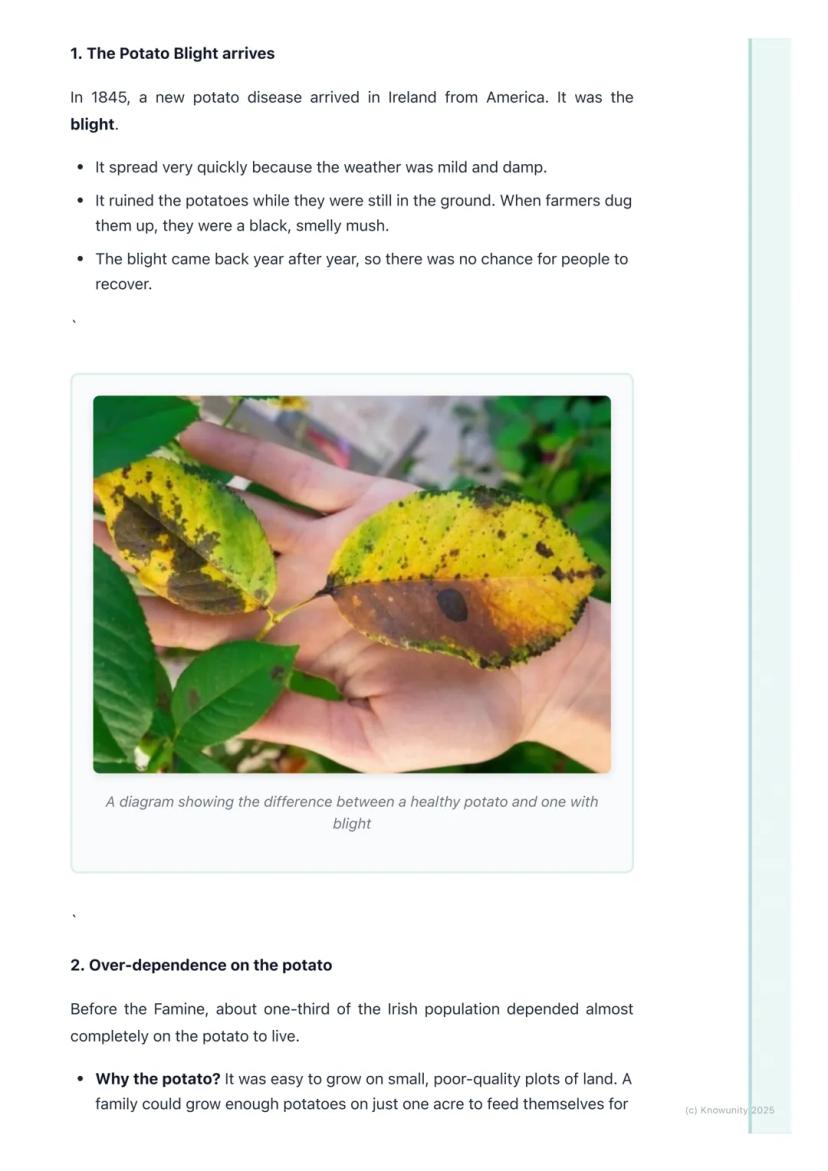
Ever wondered how a plant disease could kill a million people? The Great Famine started when a nasty fungus called potato blight arrived from America in 1845. This disease turned Ireland's main food source into black, smelly mush while it was still in the ground.
The blight spread like wildfire because Ireland's weather was perfect for it - mild and damp. What made this particularly devastating was that it kept coming back year after year, giving families no chance to recover or find alternatives.
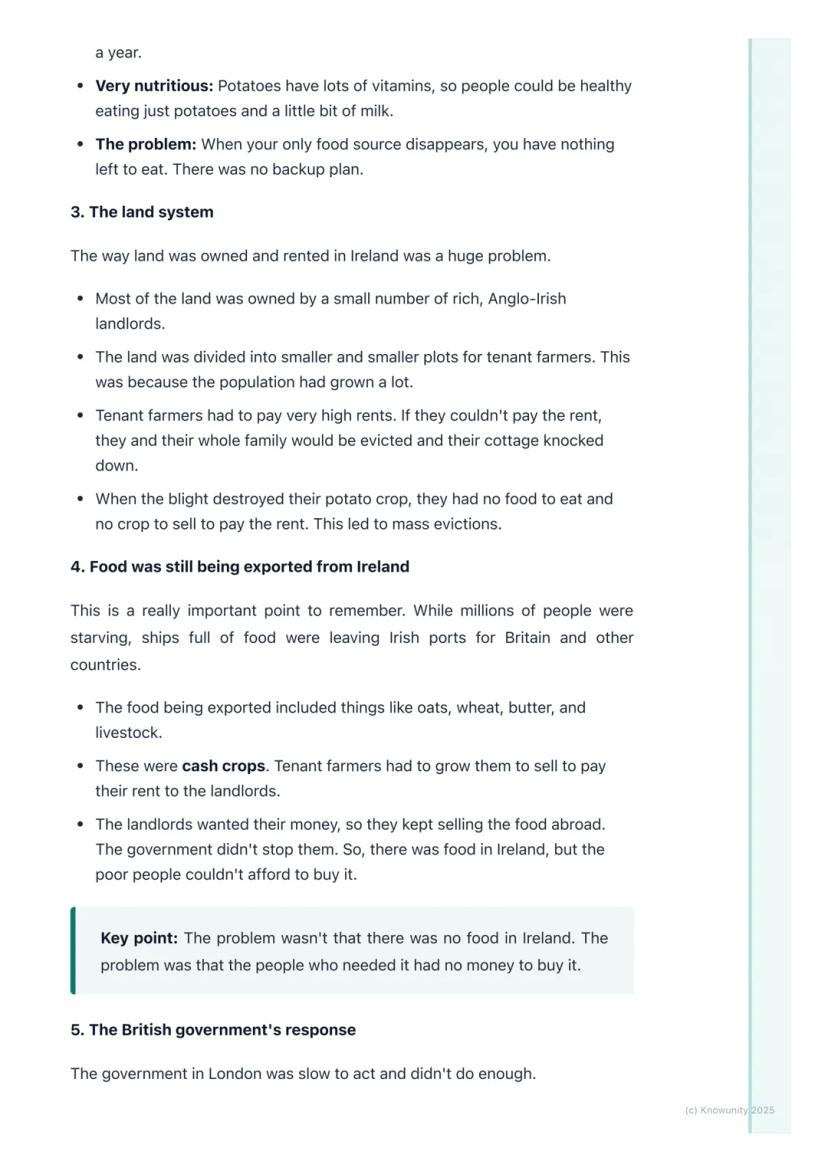
Before the famine, about one-third of Ireland's population lived almost entirely on potatoes. This might sound mental, but potatoes were actually brilliant for poor families - you could grow enough on just one acre to feed everyone for a whole year, and they're packed with vitamins.
Did you know? A family of six could survive healthily on just potatoes and a bit of milk. But when that single food source disappeared, they had absolutely nothing left to eat.
2
of 5
The Unfair Land System
Picture this: you're a farmer, but you don't own your land. That was reality for most Irish people - they were tenant farmers who had to rent tiny plots from wealthy landlords. Most of these landlords lived comfortably in Britain and cared more about their rent money than their tenants' lives.
When the potato crop failed, tenant farmers faced an impossible choice. They had no food to eat and no crop to sell to pay their rent. The punishment for not paying? Eviction - being thrown out of your home with nowhere to go.
The land was divided into smaller and smaller plots because Ireland's population had grown massively. Families were squeezed onto tiny pieces of poor-quality land, making them completely dependent on the high-yield potato crop.
Think about it: If you couldn't pay rent today, imagine being kicked out onto the street with your entire family and having your house knocked down behind you.
3
of 5
Food Leaving While People Starved
Here's the maddest part - whilst millions of Irish people were literally starving to death, ships loaded with food were sailing out of Irish ports every single day. These ships carried oats, wheat, butter, and livestock to Britain and other countries.
This wasn't an accident or oversight. Landlords demanded their rent money, so tenant farmers had to keep growing and selling cash crops (crops grown for money, not food) to pay what they owed. The British government could have stopped these exports but chose not to.
The harsh truth is that there was actually plenty of food in Ireland during the famine. The problem wasn't shortage - it was that starving people had no money to buy the food that was there.
Remember this key fact: The famine wasn't really about lack of food in Ireland - it was about poor people having no access to the food that existed.
4
of 5
Government Failure
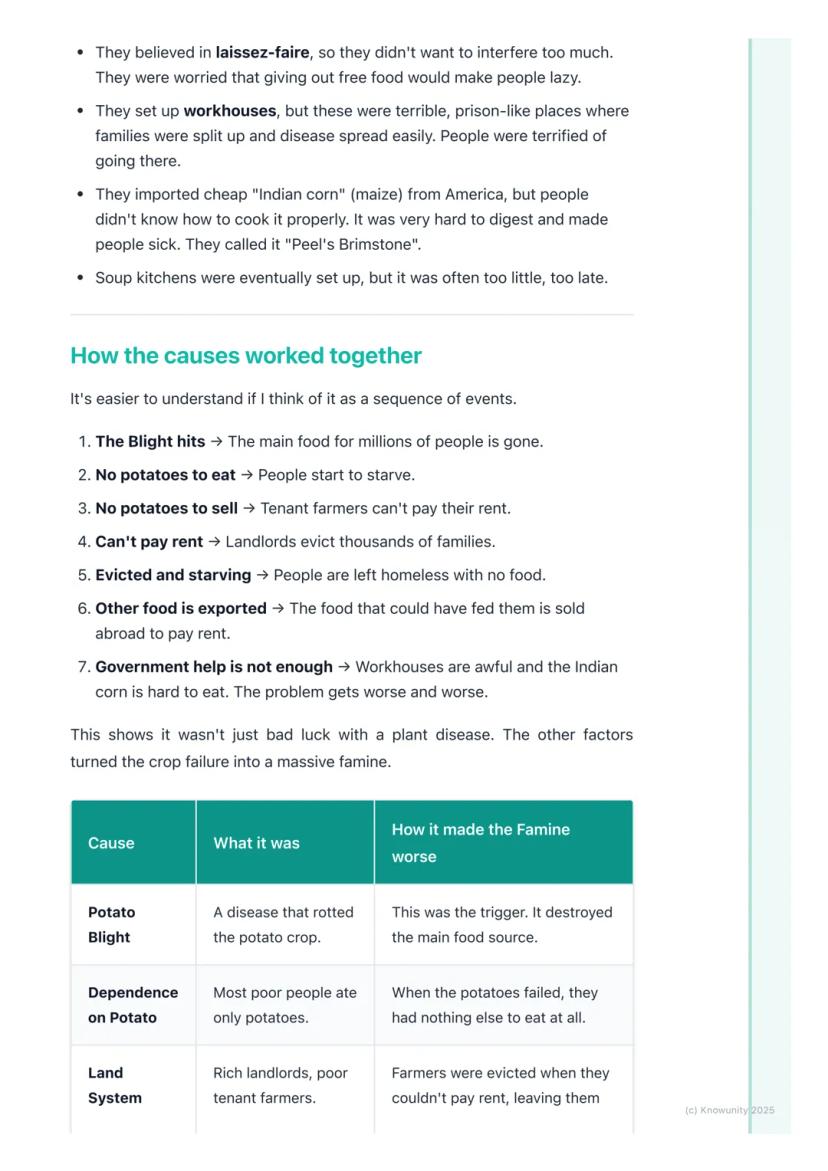
The British government's response was shockingly inadequate, and their attitudes made things much worse. They believed in laissez-faire (a French phrase meaning "let it be") - basically, they thought the government shouldn't interfere too much in people's lives or the economy.
Politicians worried that giving out free food would make Irish people "lazy" and dependent. Instead, they set up workhouses - horrible, prison-like places where families were split up and disease spread rapidly. People were terrified of going there.
The government did import cheap "Indian corn" (maize) from America, but it was a disaster. Irish people didn't know how to cook it properly, it was incredibly hard to digest, and it made people sick. They nicknamed it "Peel's Brimstone" after the Prime Minister.
Eventually, soup kitchens were established, but by then it was often too little, too late. Hundreds of thousands had already died or been forced to emigrate.
Government attitude: They genuinely believed that interfering too much would somehow make the situation worse, even as people died in the streets.
5
of 5
How Everything Connected
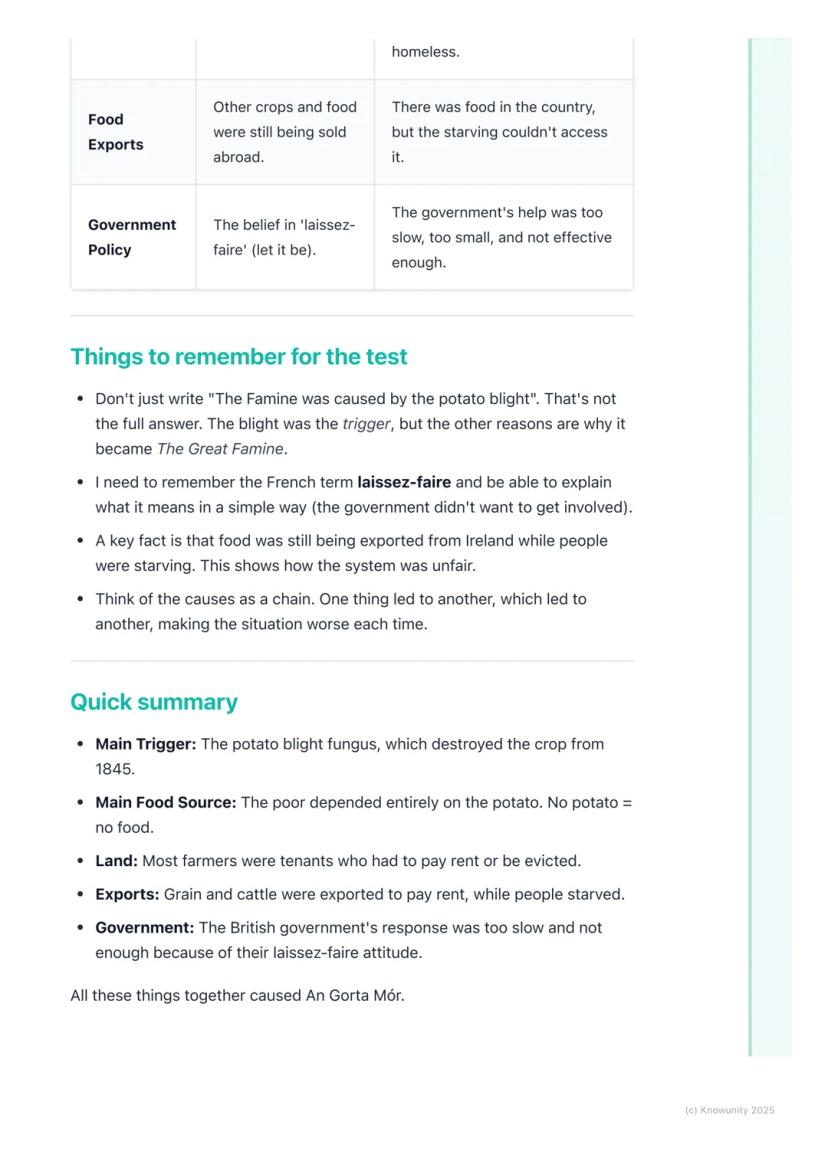
Understanding the famine means seeing how these causes created a chain reaction that turned a crop disease into a massive human catastrophe. It started with blight destroying the potatoes, which left millions without food.
When people couldn't sell potatoes, they couldn't pay rent to their landlords. This led to mass evictions, leaving families homeless and starving. Meanwhile, other food that could have saved lives was being shipped abroad to pay those same rents.
The government's laissez-faire approach meant help was too slow and too small. Their workhouses were so awful that many people preferred to starve rather than enter them. The imported corn was poorly prepared and often made people sicker.
This shows why the Great Famine was about much more than just a plant disease. It was about a social and economic system that failed to protect its most vulnerable people when they needed help most.
Key lesson: Natural disasters become human catastrophes when unfair systems prevent people from accessing help and resources.
Si on te demande...
Qu'est-ce que le compagnon IA de Knowunity ?
Notre compagnon IA est spécialement conçu pour répondre aux besoins des étudiants. Sur la base des millions d'éléments de contenu que nous avons sur la plateforme, nous pouvons fournir des réponses vraiment significatives et pertinentes aux étudiants. Mais il ne s'agit pas seulement de réponses, le compagnon a encore plus pour but de guider les élèves dans leurs défis d'apprentissage quotidiens, avec des plans d'étude personnalisés, des quiz ou des éléments de contenu dans le chat et une personnalisation à 100% basée sur les compétences et les développements de l'étudiant.
Où puis-je télécharger l'appli Knowunity ?
Tu peux télécharger l'application dans Google Play Store et dans l'App Store d'Apple.
L'application est-elle vraiment gratuite ?
Oui, tu as un accès entièrement gratuit à tous les contenus de l'appli, tu peux chatter ou suivre les créateurs à tout moment. De plus, nous proposons Knowunity Premium, qui te permet de réviser sans limites!
Contenus les plus populaires en History
9Contenus les plus populaires
9Rien ne te convient ? Explore d'autres matières.
Les étudiants nous adorent — il ne manque plus que toi.
4.6/5App Store
4.7/5Google Play
L'application est très facile d'utilisation et bien conçue. Jusqu'à présent, j'ai trouvé tout ce que je cherchais et j'ai pu apprendre beaucoup de choses grâce aux présentations ! Je vais certainement utiliser l'application pour un travail en classe ! Et comme source d'inspiration personnelle, elle est bien sûr aussi très utile.
Stefan Sutilisateur iOS
Cette application est vraiment super. Il y a tellement de fiches de révision et d'aide, [...]. Par exemple, la matière qui me pose problème est le français et l'appli a un choix d'aide très large. Grâce à cette application, je me suis améliorée en français. Je la recommanderais à tout le monde.
Samantha Klichutilisatrice Android
Waouh, je suis vraiment abasourdi. J'ai essayé l'application parce que je l'avais déjà vue plusieurs fois dans la publicité et j'ai été absolument choquée. Cette appli est L'AIDE dont on rêve pour l'école et surtout, elle propose tellement de choses, comme des rédactions et des fiches qui m'ont personnellement TRÈS bien aidé.
Annautilisatrice iOS
History3 vues·Mis à jour Jun 5, 2026·5 pagesThe Irish Potato Famine: Causes and Impact
The Great Famine (An Gorta Mór) devastated Ireland from 1845 to 1852, killing over one million people. It wasn't just bad luck with crops - it was a disaster created by multiple problems happening all at once. Understanding these causes... Affiche plus
1
of 5Inscris-toi pour voir le contenu. C'est gratuit!
- Accès à tous les documents
- Améliore tes notes
- Rejoins des millions d'étudiants
Understanding the Famine's Beginning
Ever wondered how a plant disease could kill a million people? The Great Famine started when a nasty fungus called potato blight arrived from America in 1845. This disease turned Ireland's main food source into black, smelly mush while it was still in the ground.
The blight spread like wildfire because Ireland's weather was perfect for it - mild and damp. What made this particularly devastating was that it kept coming back year after year, giving families no chance to recover or find alternatives.
Before the famine, about one-third of Ireland's population lived almost entirely on potatoes. This might sound mental, but potatoes were actually brilliant for poor families - you could grow enough on just one acre to feed everyone for a whole year, and they're packed with vitamins.
Did you know? A family of six could survive healthily on just potatoes and a bit of milk. But when that single food source disappeared, they had absolutely nothing left to eat.
2
of 5Inscris-toi pour voir le contenu. C'est gratuit!
- Accès à tous les documents
- Améliore tes notes
- Rejoins des millions d'étudiants
The Unfair Land System
Picture this: you're a farmer, but you don't own your land. That was reality for most Irish people - they were tenant farmers who had to rent tiny plots from wealthy landlords. Most of these landlords lived comfortably in Britain and cared more about their rent money than their tenants' lives.
When the potato crop failed, tenant farmers faced an impossible choice. They had no food to eat and no crop to sell to pay their rent. The punishment for not paying? Eviction - being thrown out of your home with nowhere to go.
The land was divided into smaller and smaller plots because Ireland's population had grown massively. Families were squeezed onto tiny pieces of poor-quality land, making them completely dependent on the high-yield potato crop.
Think about it: If you couldn't pay rent today, imagine being kicked out onto the street with your entire family and having your house knocked down behind you.
3
of 5Inscris-toi pour voir le contenu. C'est gratuit!
- Accès à tous les documents
- Améliore tes notes
- Rejoins des millions d'étudiants
Food Leaving While People Starved
Here's the maddest part - whilst millions of Irish people were literally starving to death, ships loaded with food were sailing out of Irish ports every single day. These ships carried oats, wheat, butter, and livestock to Britain and other countries.
This wasn't an accident or oversight. Landlords demanded their rent money, so tenant farmers had to keep growing and selling cash crops (crops grown for money, not food) to pay what they owed. The British government could have stopped these exports but chose not to.
The harsh truth is that there was actually plenty of food in Ireland during the famine. The problem wasn't shortage - it was that starving people had no money to buy the food that was there.
Remember this key fact: The famine wasn't really about lack of food in Ireland - it was about poor people having no access to the food that existed.
4
of 5Inscris-toi pour voir le contenu. C'est gratuit!
- Accès à tous les documents
- Améliore tes notes
- Rejoins des millions d'étudiants
Government Failure
The British government's response was shockingly inadequate, and their attitudes made things much worse. They believed in laissez-faire (a French phrase meaning "let it be") - basically, they thought the government shouldn't interfere too much in people's lives or the economy.
Politicians worried that giving out free food would make Irish people "lazy" and dependent. Instead, they set up workhouses - horrible, prison-like places where families were split up and disease spread rapidly. People were terrified of going there.
The government did import cheap "Indian corn" (maize) from America, but it was a disaster. Irish people didn't know how to cook it properly, it was incredibly hard to digest, and it made people sick. They nicknamed it "Peel's Brimstone" after the Prime Minister.
Eventually, soup kitchens were established, but by then it was often too little, too late. Hundreds of thousands had already died or been forced to emigrate.
Government attitude: They genuinely believed that interfering too much would somehow make the situation worse, even as people died in the streets.
5
of 5Inscris-toi pour voir le contenu. C'est gratuit!
- Accès à tous les documents
- Améliore tes notes
- Rejoins des millions d'étudiants
How Everything Connected
Understanding the famine means seeing how these causes created a chain reaction that turned a crop disease into a massive human catastrophe. It started with blight destroying the potatoes, which left millions without food.
When people couldn't sell potatoes, they couldn't pay rent to their landlords. This led to mass evictions, leaving families homeless and starving. Meanwhile, other food that could have saved lives was being shipped abroad to pay those same rents.
The government's laissez-faire approach meant help was too slow and too small. Their workhouses were so awful that many people preferred to starve rather than enter them. The imported corn was poorly prepared and often made people sicker.
This shows why the Great Famine was about much more than just a plant disease. It was about a social and economic system that failed to protect its most vulnerable people when they needed help most.
Key lesson: Natural disasters become human catastrophes when unfair systems prevent people from accessing help and resources.
Si on te demande...
Qu'est-ce que le compagnon IA de Knowunity ?
Notre compagnon IA est spécialement conçu pour répondre aux besoins des étudiants. Sur la base des millions d'éléments de contenu que nous avons sur la plateforme, nous pouvons fournir des réponses vraiment significatives et pertinentes aux étudiants. Mais il ne s'agit pas seulement de réponses, le compagnon a encore plus pour but de guider les élèves dans leurs défis d'apprentissage quotidiens, avec des plans d'étude personnalisés, des quiz ou des éléments de contenu dans le chat et une personnalisation à 100% basée sur les compétences et les développements de l'étudiant.
Où puis-je télécharger l'appli Knowunity ?
Tu peux télécharger l'application dans Google Play Store et dans l'App Store d'Apple.
L'application est-elle vraiment gratuite ?
Oui, tu as un accès entièrement gratuit à tous les contenus de l'appli, tu peux chatter ou suivre les créateurs à tout moment. De plus, nous proposons Knowunity Premium, qui te permet de réviser sans limites!
Contenus les plus populaires en History
9Contenus les plus populaires
9Rien ne te convient ? Explore d'autres matières.
Les étudiants nous adorent — il ne manque plus que toi.
4.6/5App Store
4.7/5Google Play
L'application est très facile d'utilisation et bien conçue. Jusqu'à présent, j'ai trouvé tout ce que je cherchais et j'ai pu apprendre beaucoup de choses grâce aux présentations ! Je vais certainement utiliser l'application pour un travail en classe ! Et comme source d'inspiration personnelle, elle est bien sûr aussi très utile.
Stefan Sutilisateur iOS
Cette application est vraiment super. Il y a tellement de fiches de révision et d'aide, [...]. Par exemple, la matière qui me pose problème est le français et l'appli a un choix d'aide très large. Grâce à cette application, je me suis améliorée en français. Je la recommanderais à tout le monde.
Samantha Klichutilisatrice Android
Waouh, je suis vraiment abasourdi. J'ai essayé l'application parce que je l'avais déjà vue plusieurs fois dans la publicité et j'ai été absolument choquée. Cette appli est L'AIDE dont on rêve pour l'école et surtout, elle propose tellement de choses, comme des rédactions et des fiches qui m'ont personnellement TRÈS bien aidé.
Annautilisatrice iOS