
Ever wondered how Ireland nearly exploded into civil war just...
 History11 vues·Mis à jour May 28, 2026·5 pages
Impact of Home Rule Crisis and WWI on Ireland
1 / 5
1
of 5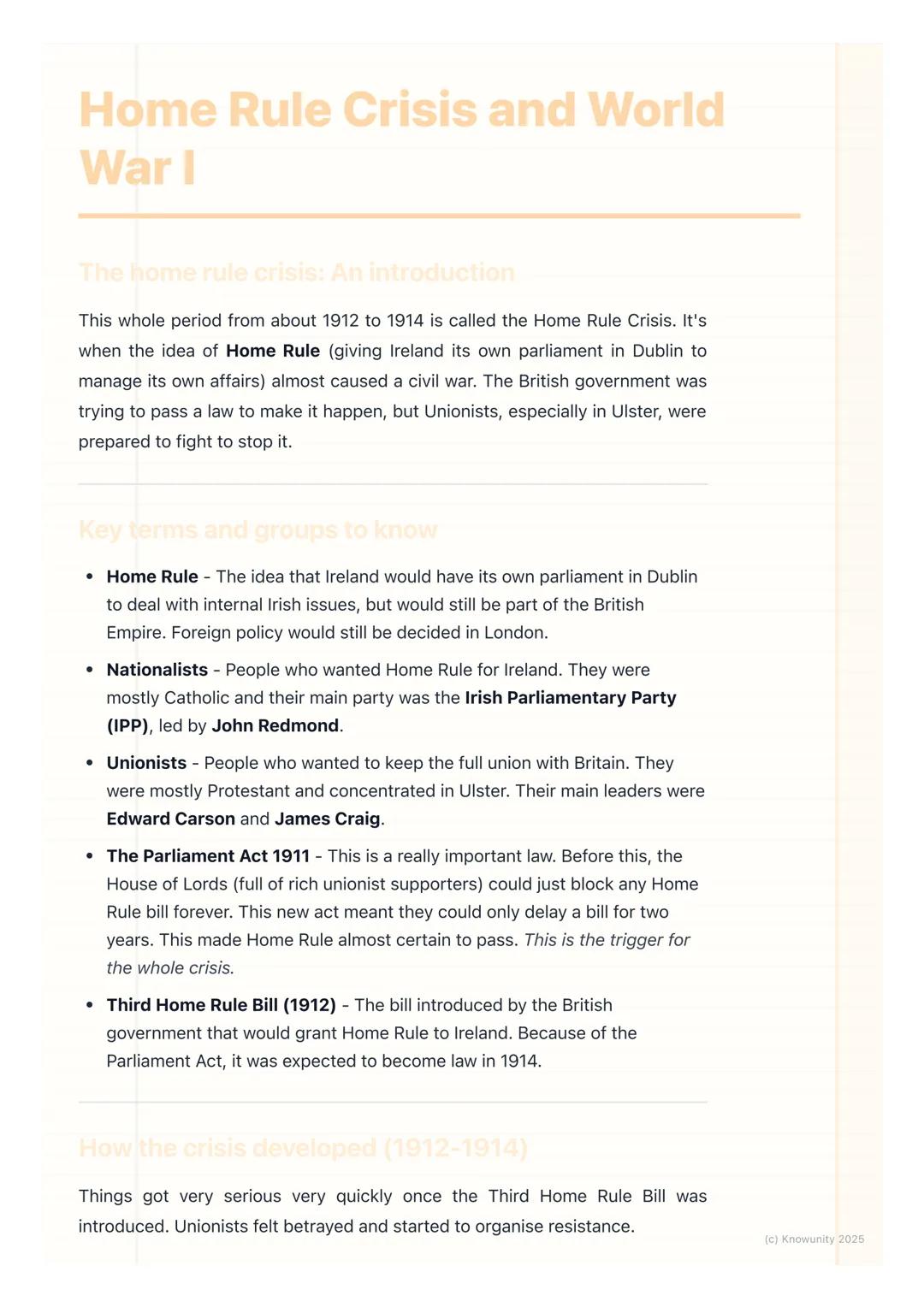
The Home Rule Crisis: An Introduction
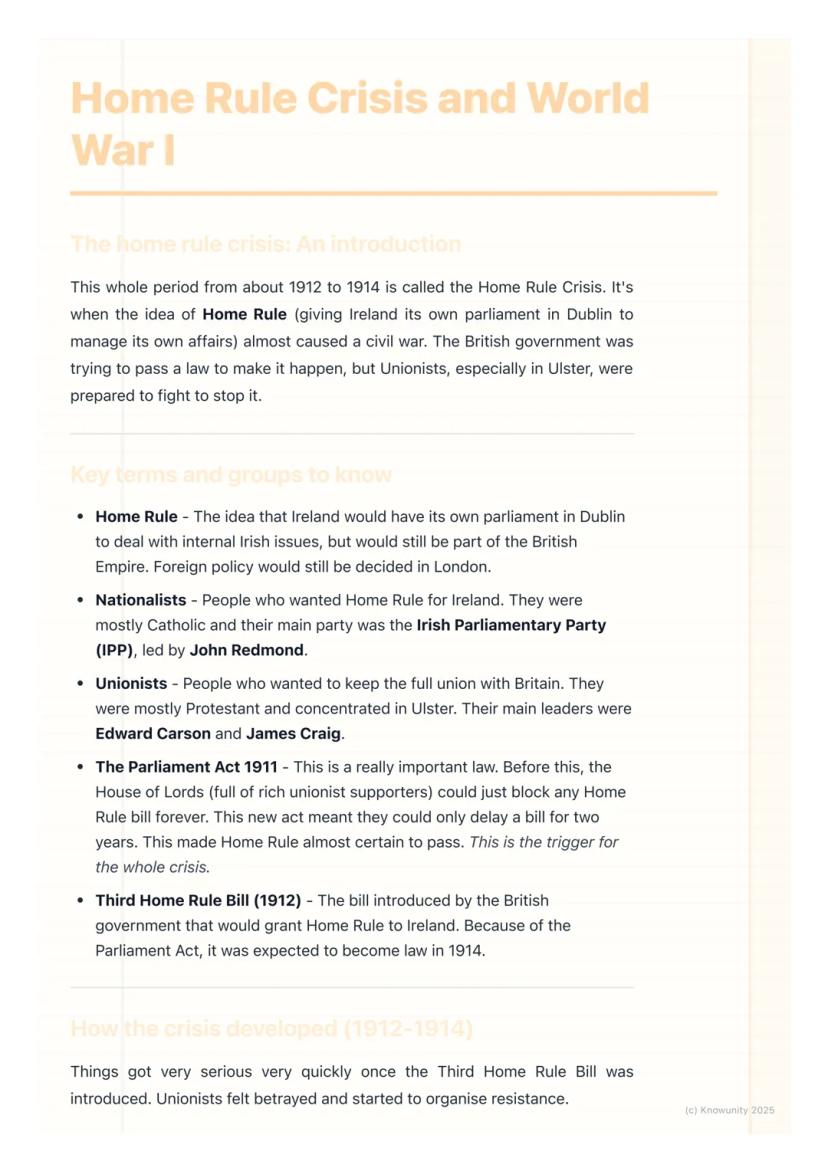
Think of this period as Ireland's "almost civil war" moment. Home Rule meant Ireland would get its own parliament in Dublin to handle local affairs, whilst still staying part of the British Empire. Sounds reasonable, right? Not if you were a Unionist who saw this as the first step towards breaking up the United Kingdom.
The Parliament Act of 1911 changed everything. Before this law, the House of Lords could block Home Rule bills forever. Now they could only delay them for two years. This made Home Rule almost inevitable, which terrified Unionists and triggered the entire crisis.
Two main groups faced off: Nationalists (mostly Catholics who wanted Home Rule, led by John Redmond's Irish Parliamentary Party) and Unionists (mostly Protestants who wanted to keep the full union with Britain, led by Edward Carson and James Craig).
Remember: The Parliament Act 1911 is your starting point for understanding why this crisis happened when it did.
2
of 5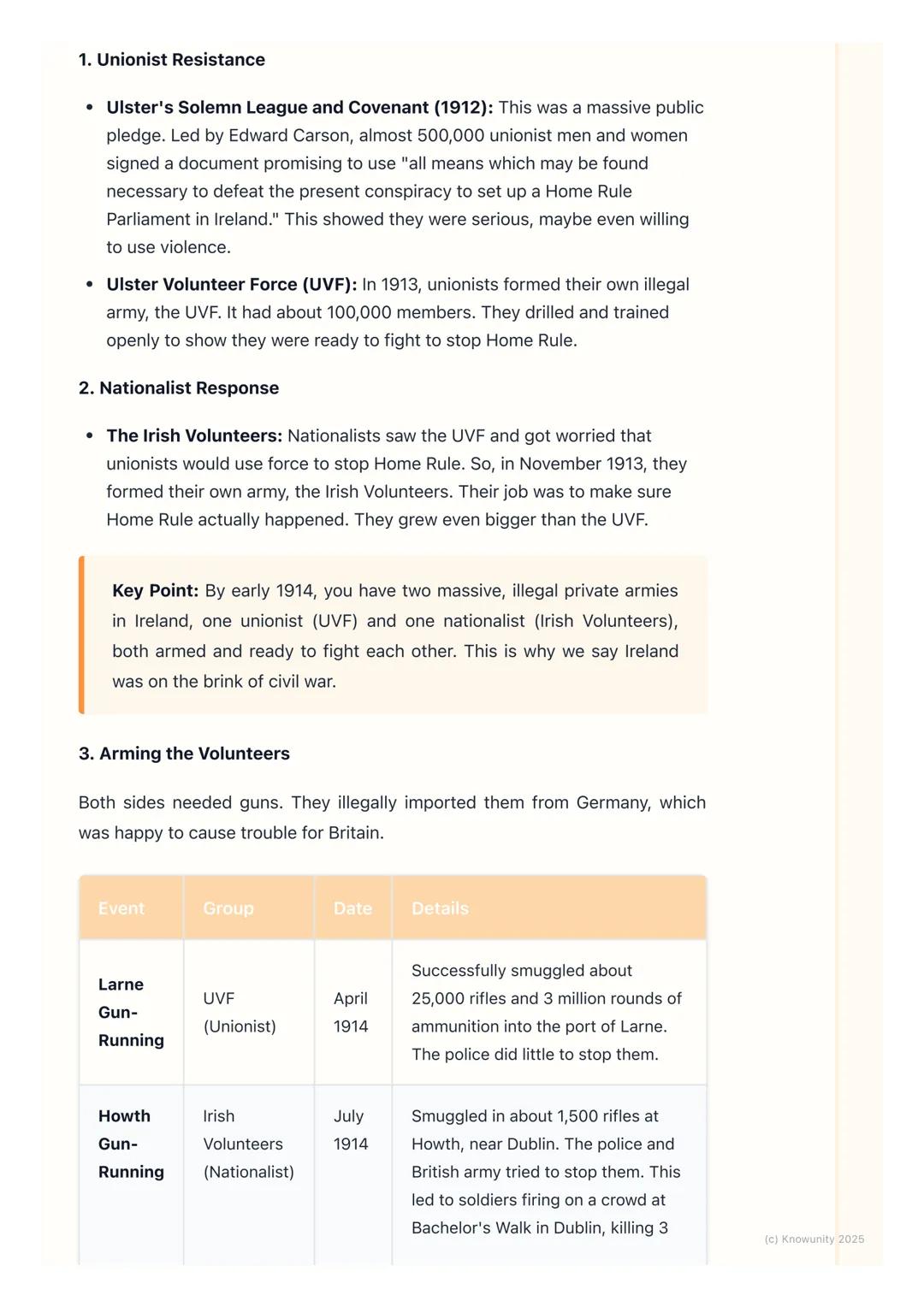
Unionist Resistance and Private Armies
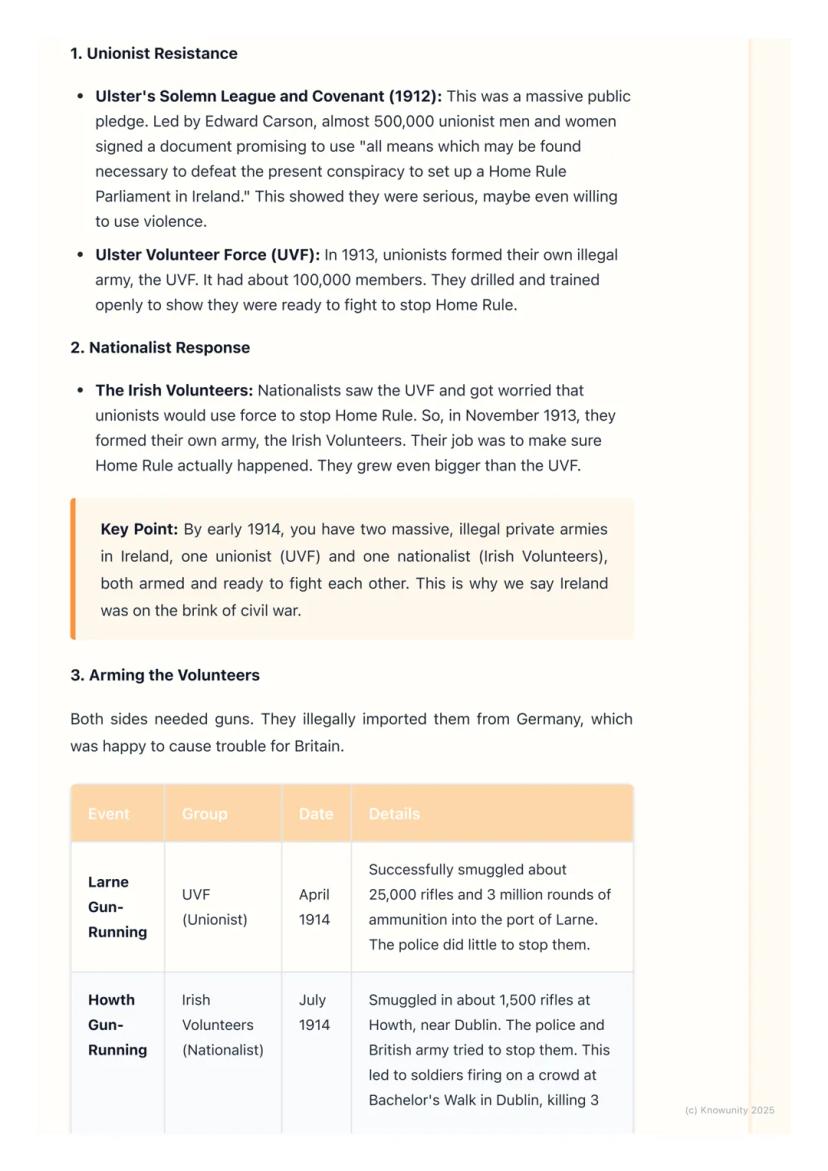
When the Third Home Rule Bill was introduced in 1912, Unionists didn't just complain - they organised massive resistance. The Ulster Solemn League and Covenant saw almost 500,000 people pledge to use "all means necessary" to defeat Home Rule. That's code for "we're willing to fight."
By 1913, they'd formed the Ulster Volunteer Force (UVF) - essentially a private army of 100,000 men who drilled openly and prepared for war. Nationalists couldn't ignore this threat, so they created their own force called the Irish Volunteers in November 1913. This group actually grew larger than the UVF.
Both sides needed weapons, so they illegally imported guns from Germany. The UVF successfully landed weapons at Larne in April 1914 with no police interference. When the Irish Volunteers tried the same at Howth in July 1914, British troops confronted them and later fired on Dublin crowds, killing three civilians.
Key Point: By early 1914, you had two massive illegal armies ready to fight each other - this is why people say Ireland was on the brink of civil war.
3
of 5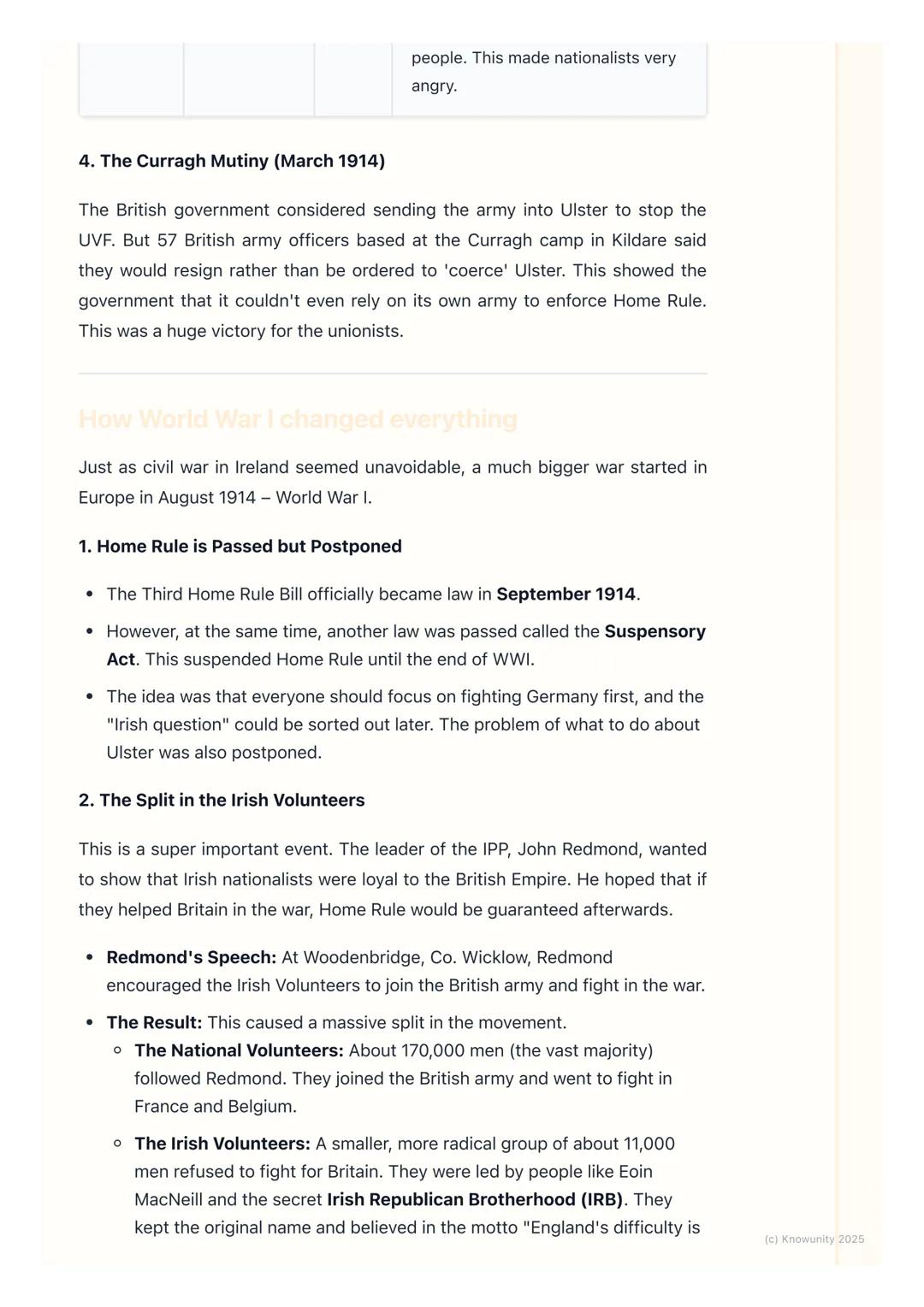
The Curragh Mutiny and World War I Changes Everything
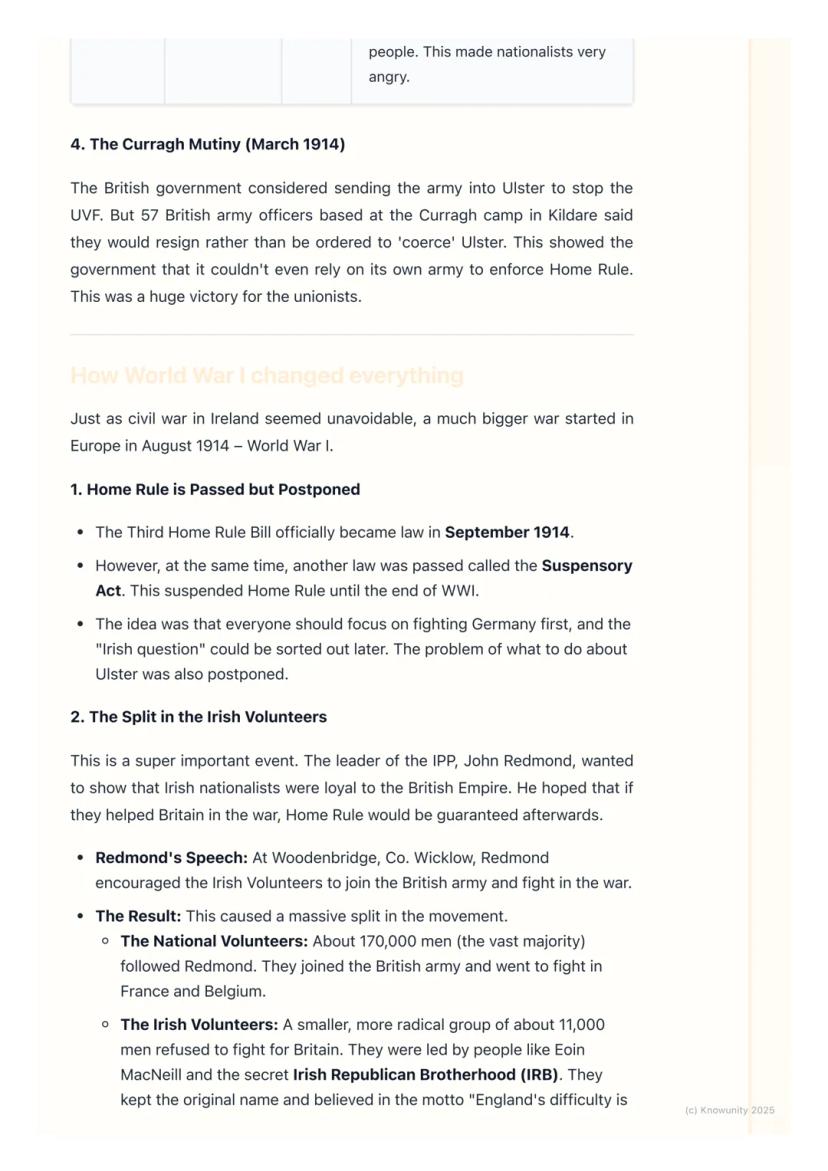
The Curragh Mutiny in March 1914 showed just how serious things had become. When the British government considered sending troops to Ulster to stop the UVF, 57 British army officers said they'd rather resign than fight Unionists. The government couldn't even trust its own army!
Then World War I erupted in August 1914, completely changing the game. The Third Home Rule Bill became law in September 1914, but the Suspensory Act immediately put it on hold until the war ended. Everyone was supposed to focus on fighting Germany first.
John Redmond's speech at Woodenbridge caused a massive split in Irish nationalism. He encouraged Irish Volunteers to join the British army, believing this loyalty would guarantee Home Rule after the war. About 170,000 men followed him, becoming the National Volunteers who went to fight in France and Belgium.
However, around 11,000 more radical members refused and kept the name Irish Volunteers. Led by people like Eoin MacNeill and the secret Irish Republican Brotherhood, they believed "England's difficulty is Ireland's opportunity."
Crucial Detail: This smaller group of Irish Volunteers would become the force that launched the 1916 Easter Rising.
4
of 5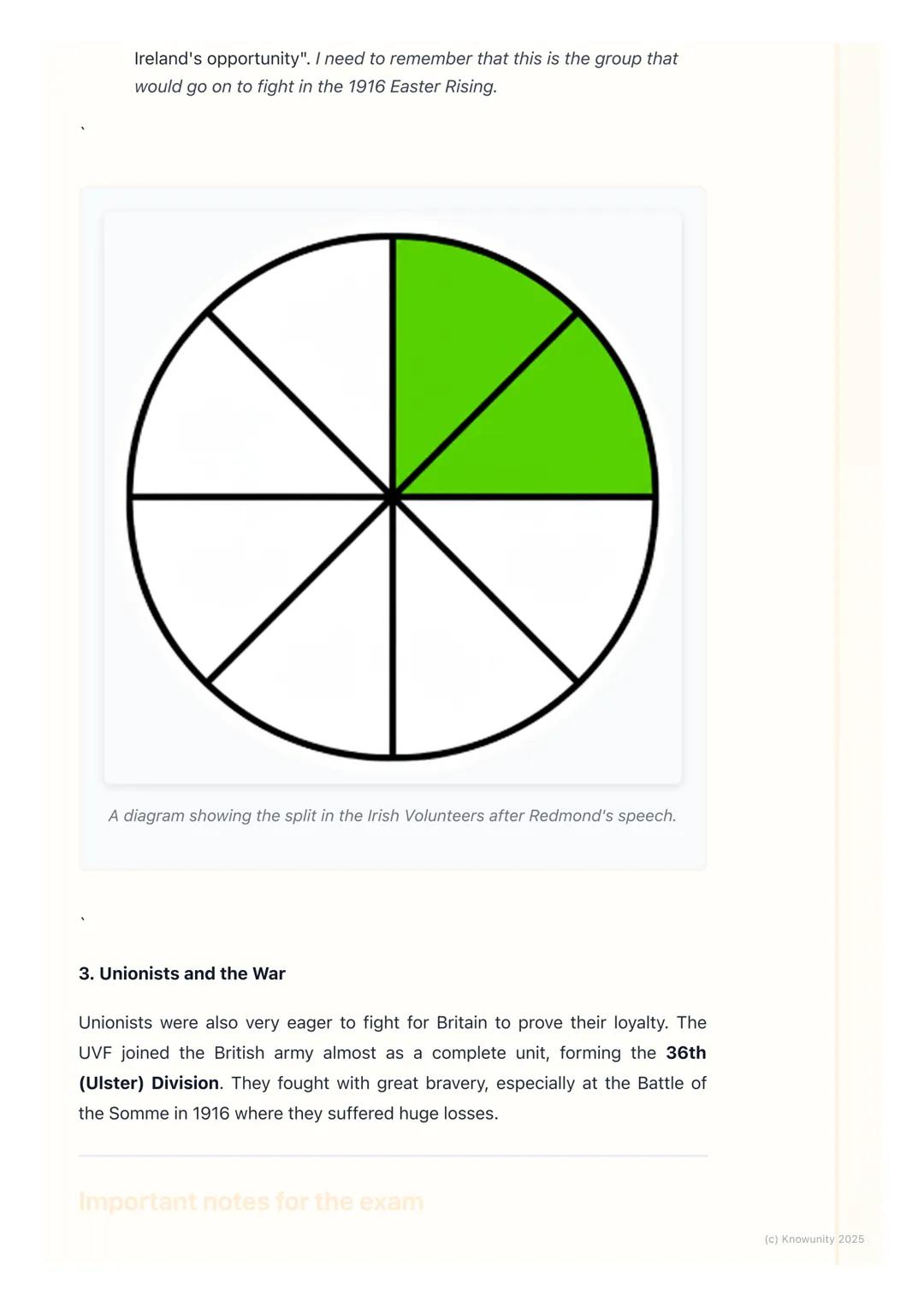
Unionists at War and Long-term Consequences
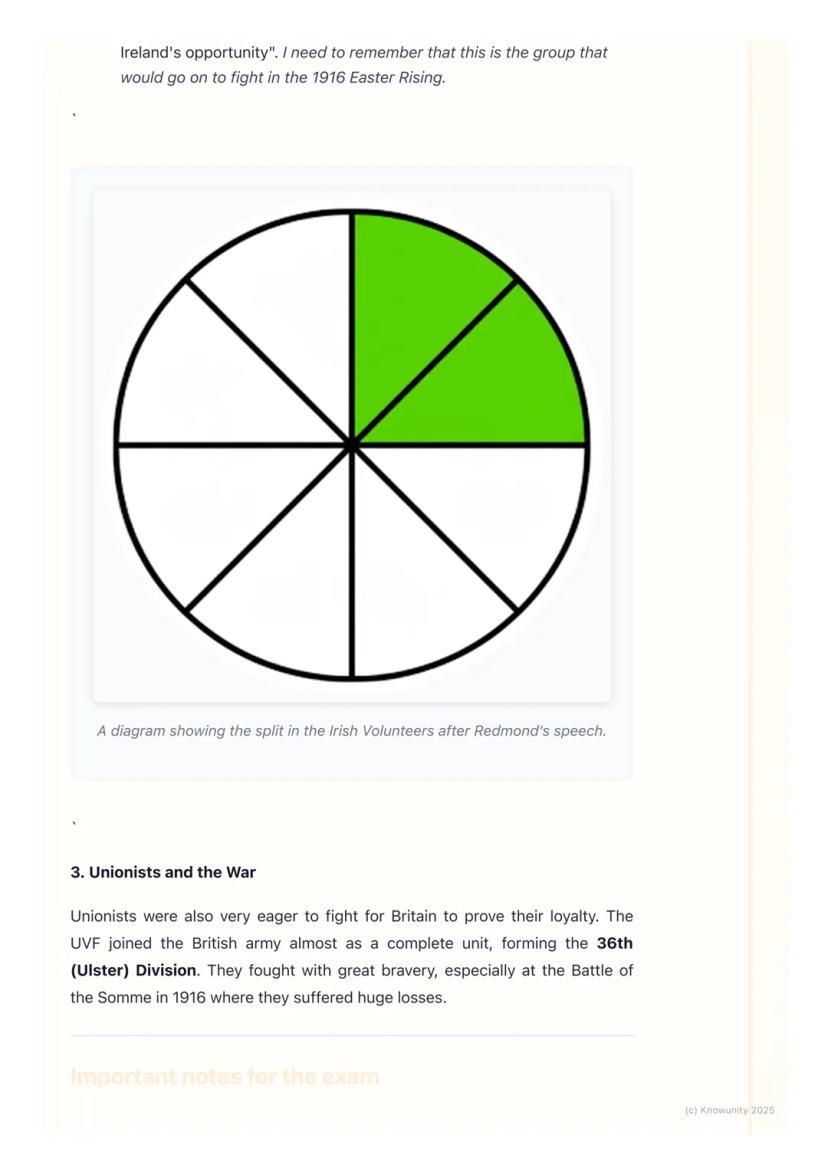
Unionists were equally eager to prove their loyalty to Britain. The UVF essentially became the 36th (Ulster) Division of the British Army. They fought with incredible bravery, especially at the Battle of the Somme in 1916, where they suffered devastating casualties whilst proving their British credentials.
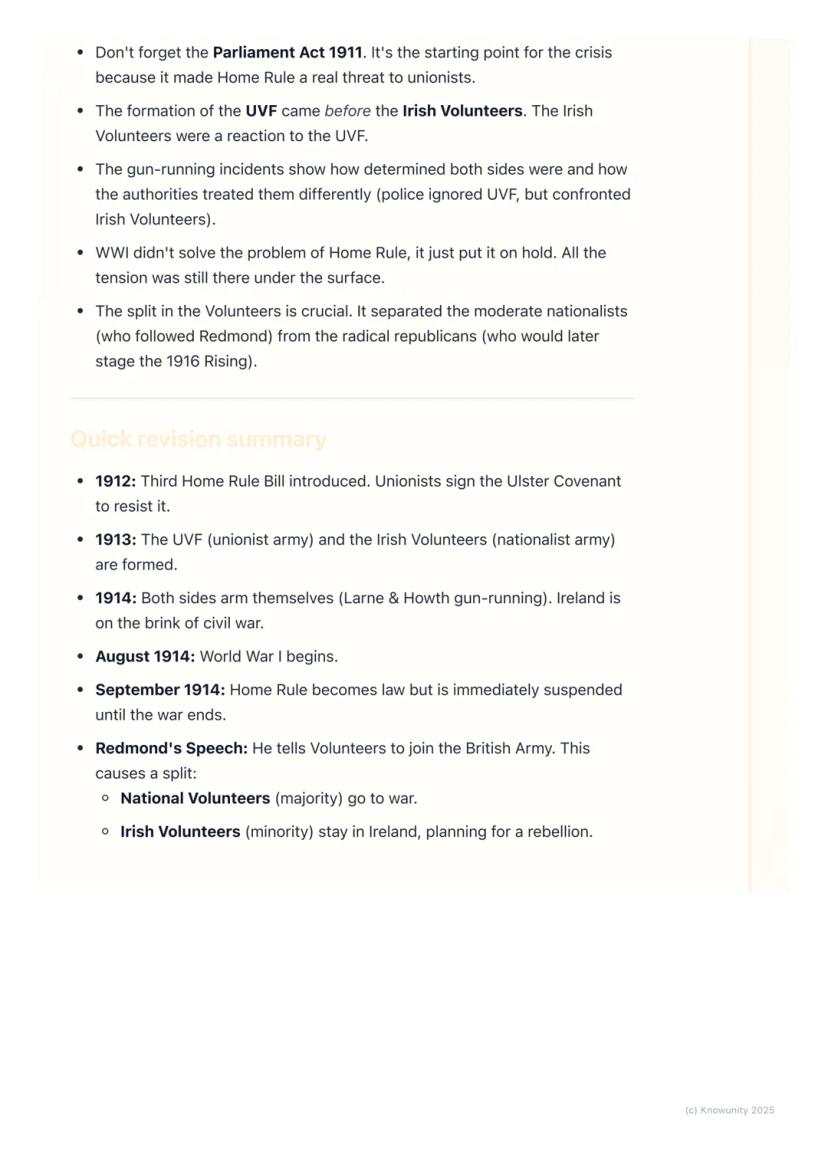
World War I didn't solve Ireland's problems - it just pressed the pause button. All the tensions from the Home Rule Crisis remained bubbling under the surface. The partition question (what to do about Ulster) was still unresolved.
The split between moderate nationalists who supported the war effort and radical republicans who opposed it created the conditions for the 1916 Rising. Whilst most nationalist men were fighting in France, a small but determined group stayed behind, planning rebellion.
Exam Tip: Remember that WWI postponed Home Rule but didn't solve the underlying conflict - it actually made things more complicated by dividing Irish nationalism.
The crisis showed that both communities were willing to use violence to achieve their goals, setting a dangerous precedent for later conflicts in Irish history.
5
of 5
Si on te demande...
Qu'est-ce que le compagnon IA de Knowunity ?
Notre compagnon IA est spécialement conçu pour répondre aux besoins des étudiants. Sur la base des millions d'éléments de contenu que nous avons sur la plateforme, nous pouvons fournir des réponses vraiment significatives et pertinentes aux étudiants. Mais il ne s'agit pas seulement de réponses, le compagnon a encore plus pour but de guider les élèves dans leurs défis d'apprentissage quotidiens, avec des plans d'étude personnalisés, des quiz ou des éléments de contenu dans le chat et une personnalisation à 100% basée sur les compétences et les développements de l'étudiant.
Où puis-je télécharger l'appli Knowunity ?
Tu peux télécharger l'application dans Google Play Store et dans l'App Store d'Apple.
L'application est-elle vraiment gratuite ?
Oui, tu as un accès entièrement gratuit à tous les contenus de l'appli, tu peux chatter ou suivre les créateurs à tout moment. De plus, nous proposons Knowunity Premium, qui te permet de réviser sans limites!
Contenus les plus populaires en History
9Contenus les plus populaires
9Rien ne te convient ? Explore d'autres matières.
Les étudiants nous adorent — il ne manque plus que toi.
4.6/5App Store
4.7/5Google Play
L'application est très facile d'utilisation et bien conçue. Jusqu'à présent, j'ai trouvé tout ce que je cherchais et j'ai pu apprendre beaucoup de choses grâce aux présentations ! Je vais certainement utiliser l'application pour un travail en classe ! Et comme source d'inspiration personnelle, elle est bien sûr aussi très utile.
Stefan Sutilisateur iOS
Cette application est vraiment super. Il y a tellement de fiches de révision et d'aide, [...]. Par exemple, la matière qui me pose problème est le français et l'appli a un choix d'aide très large. Grâce à cette application, je me suis améliorée en français. Je la recommanderais à tout le monde.
Samantha Klichutilisatrice Android
Waouh, je suis vraiment abasourdi. J'ai essayé l'application parce que je l'avais déjà vue plusieurs fois dans la publicité et j'ai été absolument choquée. Cette appli est L'AIDE dont on rêve pour l'école et surtout, elle propose tellement de choses, comme des rédactions et des fiches qui m'ont personnellement TRÈS bien aidé.
Annautilisatrice iOS
History11 vues·Mis à jour May 28, 2026·5 pagesImpact of Home Rule Crisis and WWI on Ireland
Ever wondered how Ireland nearly exploded into civil war just before World War I? The Home Rule Crisis from 1912-1914 was when Britain tried to give Ireland its own parliament, but Unionists in Ulster were prepared to fight to stop...
1
of 5
Inscris-toi pour voir le contenu. C'est gratuit!
- Accès à tous les documents
- Améliore tes notes
- Rejoins des millions d'étudiants
The Home Rule Crisis: An Introduction
Think of this period as Ireland's "almost civil war" moment. Home Rule meant Ireland would get its own parliament in Dublin to handle local affairs, whilst still staying part of the British Empire. Sounds reasonable, right? Not if you were a Unionist who saw this as the first step towards breaking up the United Kingdom.
The Parliament Act of 1911 changed everything. Before this law, the House of Lords could block Home Rule bills forever. Now they could only delay them for two years. This made Home Rule almost inevitable, which terrified Unionists and triggered the entire crisis.
Two main groups faced off: Nationalists (mostly Catholics who wanted Home Rule, led by John Redmond's Irish Parliamentary Party) and Unionists (mostly Protestants who wanted to keep the full union with Britain, led by Edward Carson and James Craig).
Remember: The Parliament Act 1911 is your starting point for understanding why this crisis happened when it did.
2
of 5Inscris-toi pour voir le contenu. C'est gratuit!
- Accès à tous les documents
- Améliore tes notes
- Rejoins des millions d'étudiants
Unionist Resistance and Private Armies
When the Third Home Rule Bill was introduced in 1912, Unionists didn't just complain - they organised massive resistance. The Ulster Solemn League and Covenant saw almost 500,000 people pledge to use "all means necessary" to defeat Home Rule. That's code for "we're willing to fight."
By 1913, they'd formed the Ulster Volunteer Force (UVF) - essentially a private army of 100,000 men who drilled openly and prepared for war. Nationalists couldn't ignore this threat, so they created their own force called the Irish Volunteers in November 1913. This group actually grew larger than the UVF.
Both sides needed weapons, so they illegally imported guns from Germany. The UVF successfully landed weapons at Larne in April 1914 with no police interference. When the Irish Volunteers tried the same at Howth in July 1914, British troops confronted them and later fired on Dublin crowds, killing three civilians.
Key Point: By early 1914, you had two massive illegal armies ready to fight each other - this is why people say Ireland was on the brink of civil war.
3
of 5Inscris-toi pour voir le contenu. C'est gratuit!
- Accès à tous les documents
- Améliore tes notes
- Rejoins des millions d'étudiants
The Curragh Mutiny and World War I Changes Everything
The Curragh Mutiny in March 1914 showed just how serious things had become. When the British government considered sending troops to Ulster to stop the UVF, 57 British army officers said they'd rather resign than fight Unionists. The government couldn't even trust its own army!
Then World War I erupted in August 1914, completely changing the game. The Third Home Rule Bill became law in September 1914, but the Suspensory Act immediately put it on hold until the war ended. Everyone was supposed to focus on fighting Germany first.
John Redmond's speech at Woodenbridge caused a massive split in Irish nationalism. He encouraged Irish Volunteers to join the British army, believing this loyalty would guarantee Home Rule after the war. About 170,000 men followed him, becoming the National Volunteers who went to fight in France and Belgium.
However, around 11,000 more radical members refused and kept the name Irish Volunteers. Led by people like Eoin MacNeill and the secret Irish Republican Brotherhood, they believed "England's difficulty is Ireland's opportunity."
Crucial Detail: This smaller group of Irish Volunteers would become the force that launched the 1916 Easter Rising.
4
of 5Inscris-toi pour voir le contenu. C'est gratuit!
- Accès à tous les documents
- Améliore tes notes
- Rejoins des millions d'étudiants
Unionists at War and Long-term Consequences
Unionists were equally eager to prove their loyalty to Britain. The UVF essentially became the 36th (Ulster) Division of the British Army. They fought with incredible bravery, especially at the Battle of the Somme in 1916, where they suffered devastating casualties whilst proving their British credentials.
World War I didn't solve Ireland's problems - it just pressed the pause button. All the tensions from the Home Rule Crisis remained bubbling under the surface. The partition question (what to do about Ulster) was still unresolved.
The split between moderate nationalists who supported the war effort and radical republicans who opposed it created the conditions for the 1916 Rising. Whilst most nationalist men were fighting in France, a small but determined group stayed behind, planning rebellion.
Exam Tip: Remember that WWI postponed Home Rule but didn't solve the underlying conflict - it actually made things more complicated by dividing Irish nationalism.
The crisis showed that both communities were willing to use violence to achieve their goals, setting a dangerous precedent for later conflicts in Irish history.
5
of 5Inscris-toi pour voir le contenu. C'est gratuit!
- Accès à tous les documents
- Améliore tes notes
- Rejoins des millions d'étudiants
Si on te demande...
Qu'est-ce que le compagnon IA de Knowunity ?
Notre compagnon IA est spécialement conçu pour répondre aux besoins des étudiants. Sur la base des millions d'éléments de contenu que nous avons sur la plateforme, nous pouvons fournir des réponses vraiment significatives et pertinentes aux étudiants. Mais il ne s'agit pas seulement de réponses, le compagnon a encore plus pour but de guider les élèves dans leurs défis d'apprentissage quotidiens, avec des plans d'étude personnalisés, des quiz ou des éléments de contenu dans le chat et une personnalisation à 100% basée sur les compétences et les développements de l'étudiant.
Où puis-je télécharger l'appli Knowunity ?
Tu peux télécharger l'application dans Google Play Store et dans l'App Store d'Apple.
L'application est-elle vraiment gratuite ?
Oui, tu as un accès entièrement gratuit à tous les contenus de l'appli, tu peux chatter ou suivre les créateurs à tout moment. De plus, nous proposons Knowunity Premium, qui te permet de réviser sans limites!
Contenus les plus populaires en History
9Contenus les plus populaires
9Rien ne te convient ? Explore d'autres matières.
Les étudiants nous adorent — il ne manque plus que toi.
4.6/5App Store
4.7/5Google Play
L'application est très facile d'utilisation et bien conçue. Jusqu'à présent, j'ai trouvé tout ce que je cherchais et j'ai pu apprendre beaucoup de choses grâce aux présentations ! Je vais certainement utiliser l'application pour un travail en classe ! Et comme source d'inspiration personnelle, elle est bien sûr aussi très utile.
Stefan Sutilisateur iOS
Cette application est vraiment super. Il y a tellement de fiches de révision et d'aide, [...]. Par exemple, la matière qui me pose problème est le français et l'appli a un choix d'aide très large. Grâce à cette application, je me suis améliorée en français. Je la recommanderais à tout le monde.
Samantha Klichutilisatrice Android
Waouh, je suis vraiment abasourdi. J'ai essayé l'application parce que je l'avais déjà vue plusieurs fois dans la publicité et j'ai été absolument choquée. Cette appli est L'AIDE dont on rêve pour l'école et surtout, elle propose tellement de choses, comme des rédactions et des fiches qui m'ont personnellement TRÈS bien aidé.
Annautilisatrice iOS