
Poetry analysis is a major component of your Leaving Cert...
 Irish2 vues·Mis à jour Jun 8, 2026·6 pages
Eolas ar Fhilíocht: Dioscúrsa Téamaí agus Íomháineachas

1 / 6
1
of 6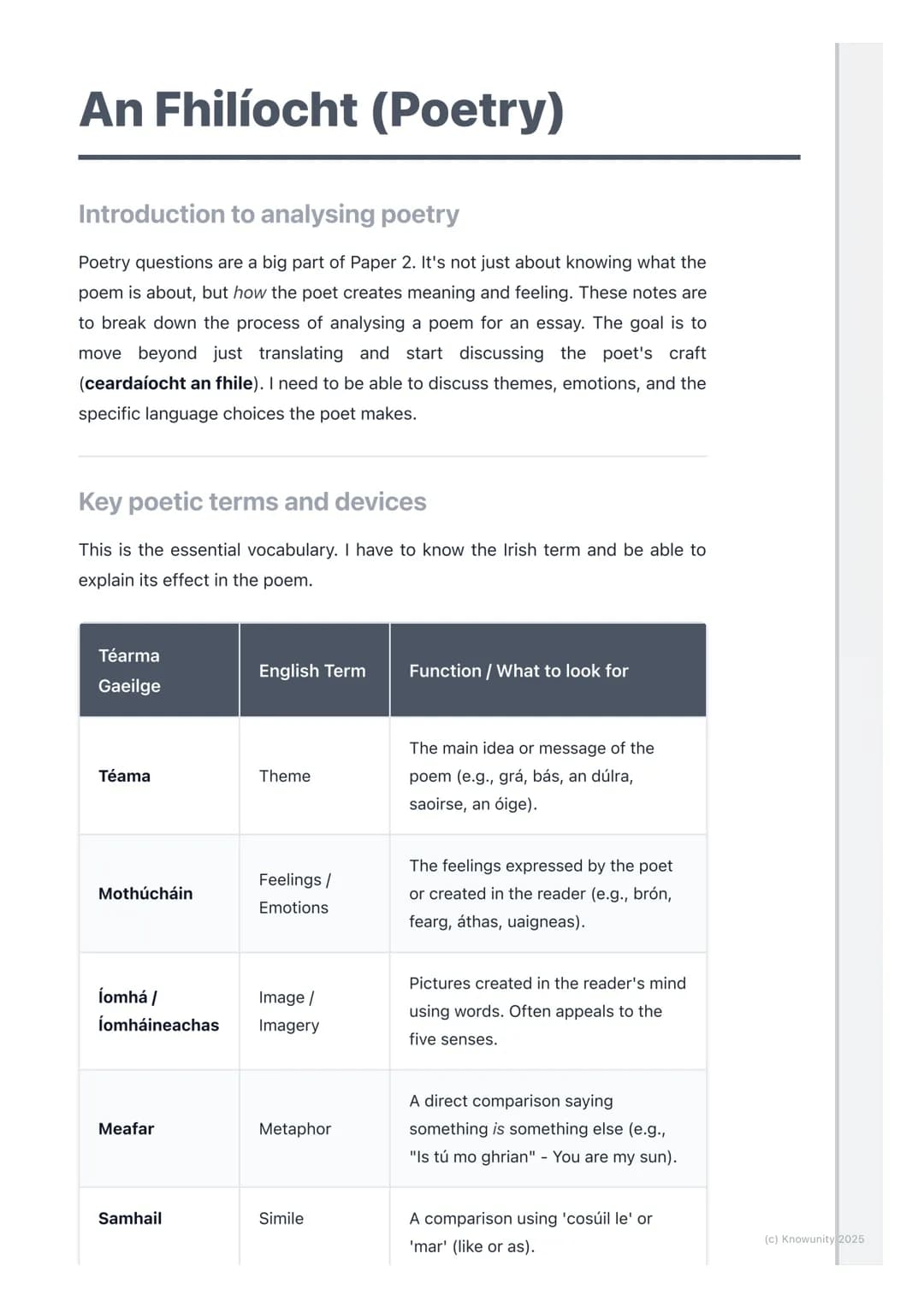
Getting Started with Poetry Analysis
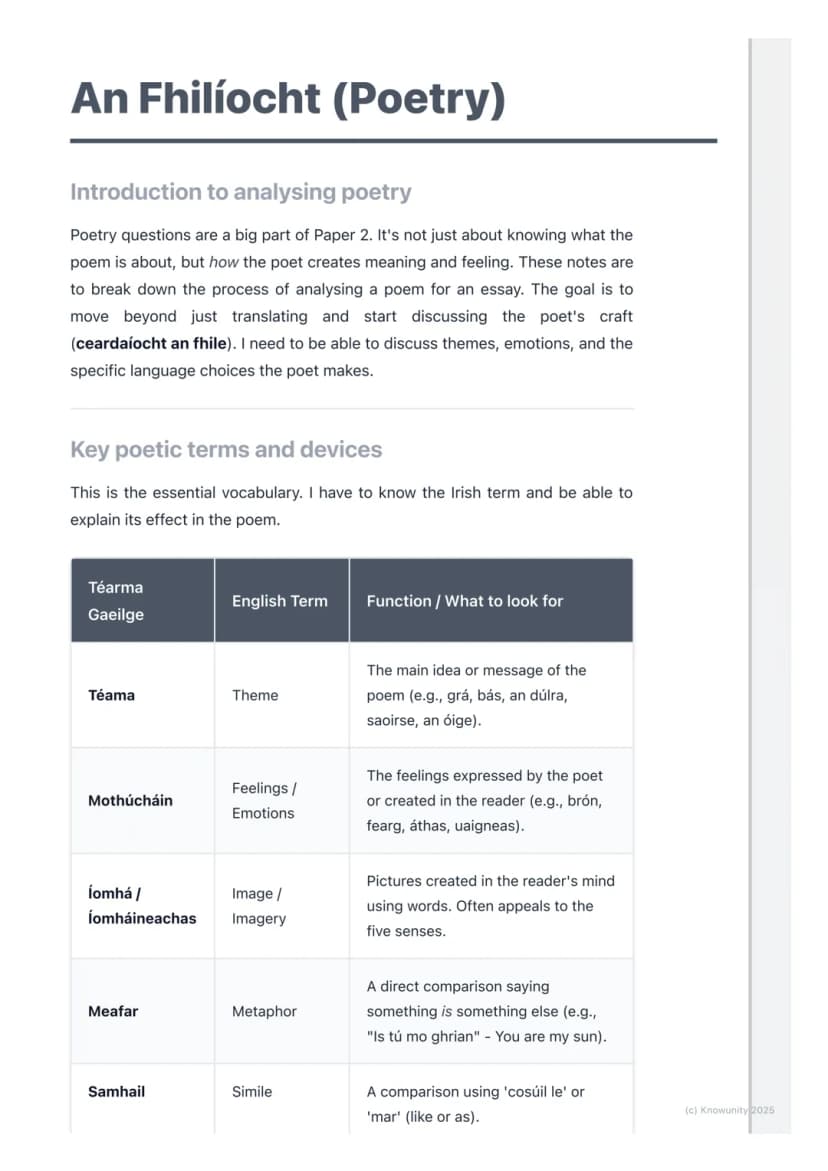
Poetry questions make up a significant chunk of Paper 2, so getting comfortable with analysis is absolutely crucial for your Leaving Cert success. The key shift you need to make is moving beyond simple translation to discussing ceardaíocht an fhile (the poet's craft).
Your job isn't just to say what the poem means, but to explore how the poet creates those meanings and emotions. Think of yourself as a detective uncovering the techniques that make a poem work.
You'll need to master essential téarmaí filíochta (poetic terms) like téama (theme), mothúcháin (emotions), and íomháineachas (imagery). But here's the crucial bit - simply spotting a meafar (metaphor) or samhail (simile) isn't enough.
Remember: Always explain the effect of each poetic device. What does that metaphor make the reader think or feel? How does it strengthen the poem's central theme?
2
of 6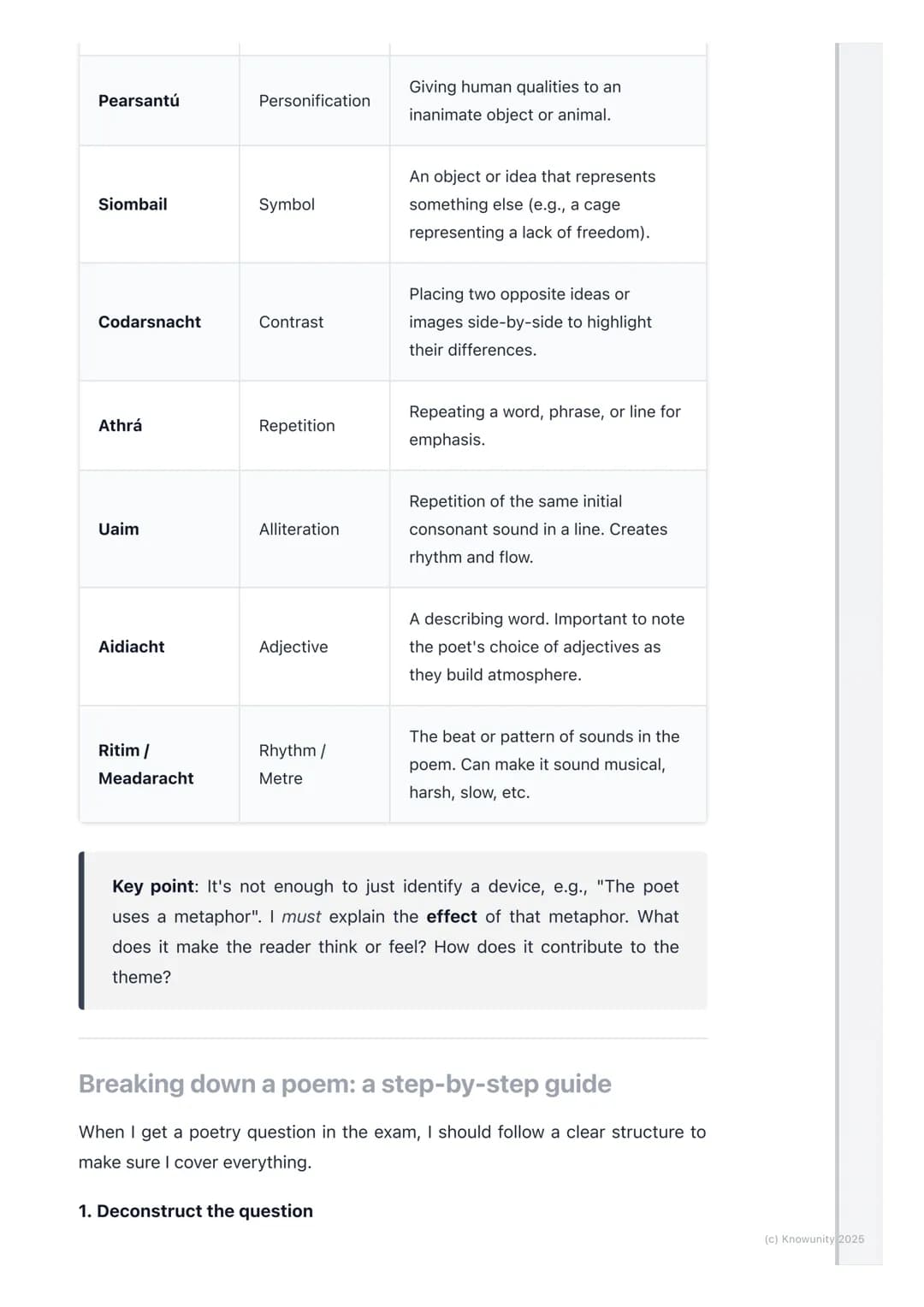
Essential Poetic Devices and Their Effects
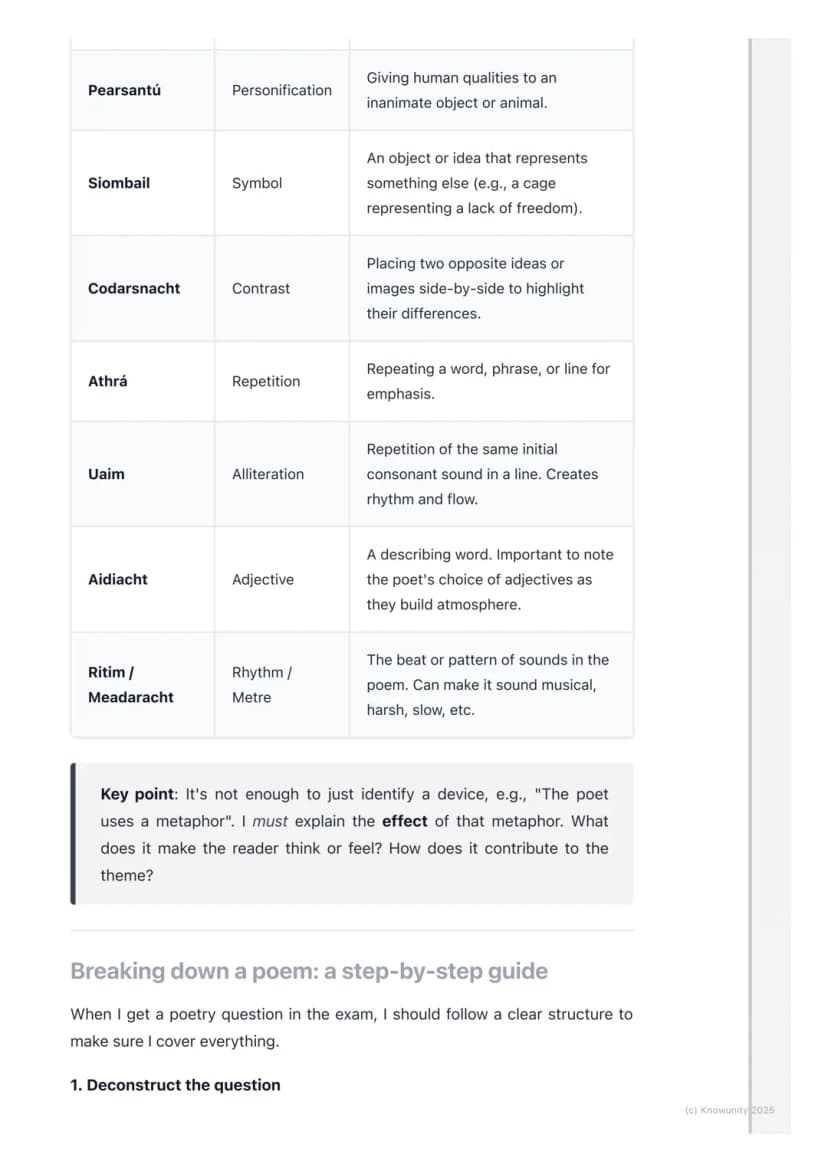
Understanding poetic devices is like having a toolkit for analysis. Pearsantú (personification) gives human qualities to objects, whilst siombail (symbols) represent deeper meanings - like a cage symbolising lost freedom.
Codarsnacht (contrast) places opposite ideas side-by-side to create powerful effects, and athrá (repetition) emphasises key points. Sound devices like uaim (alliteration) create rhythm and atmosphere that can make a poem feel musical or harsh.
Don't forget about aidiachtaí (adjectives) - poets choose describing words very carefully to build specific moods. The ritim (rhythm) and meadaracht (metre) also shape how a poem feels when you read it aloud.
Top Tip: Never just identify a device - always explain its impact. Instead of saying "the poet uses a metaphor," explain what that metaphor achieves in the poem.
3
of 6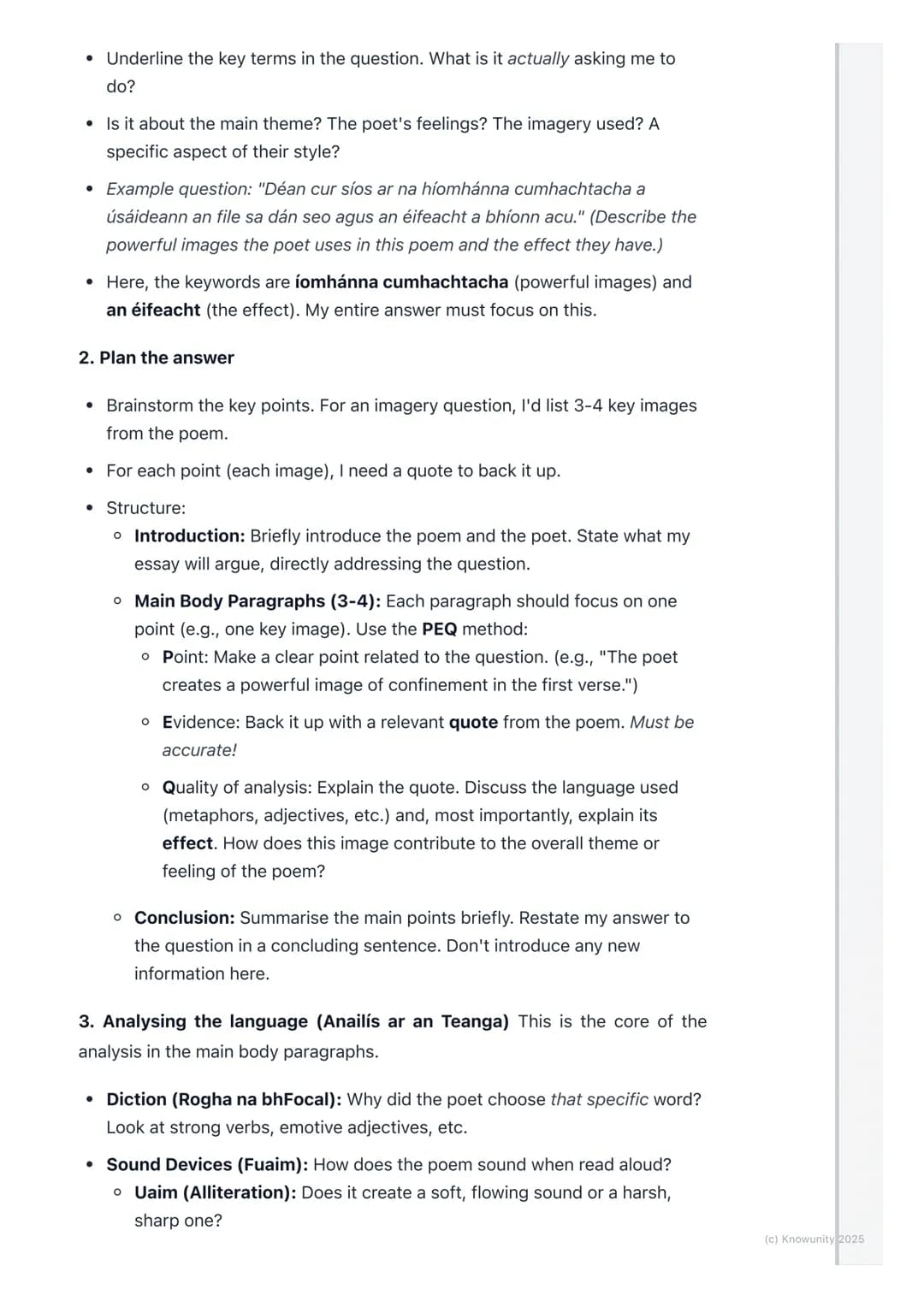
Breaking Down Poetry Questions Step-by-Step
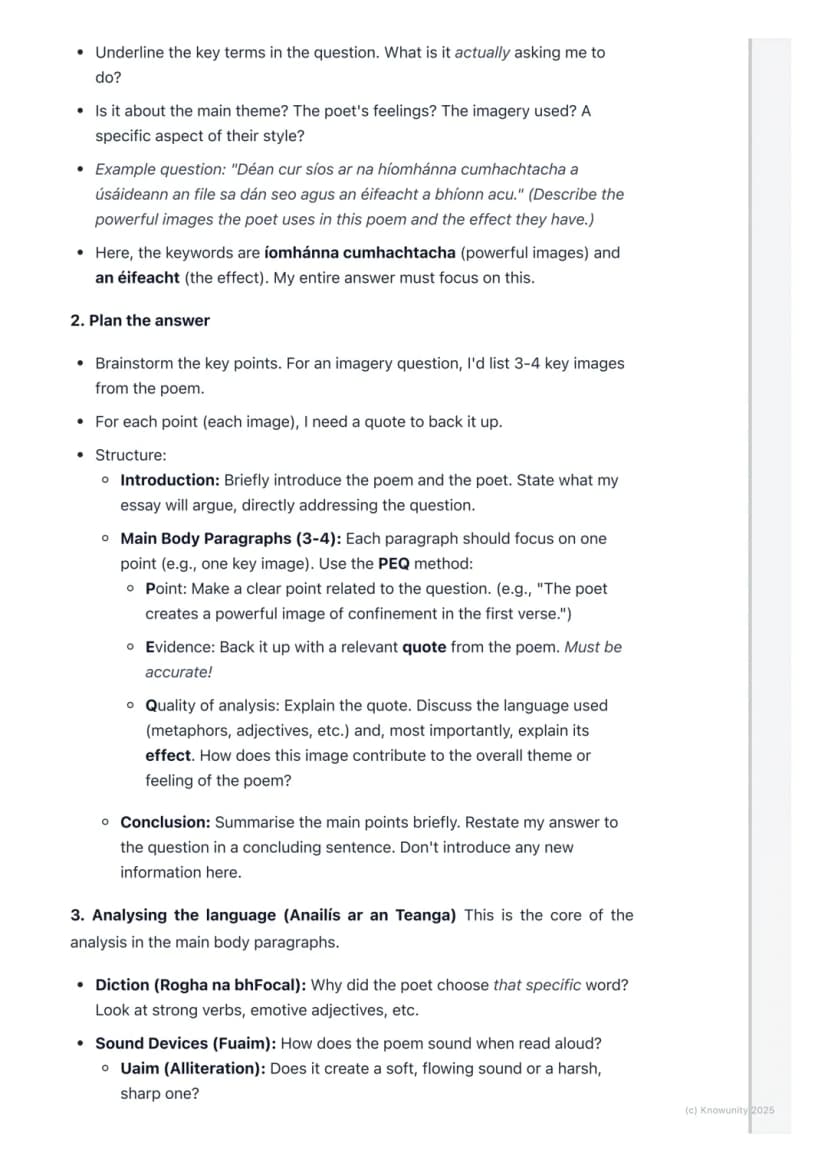
Start by deconstructing the question properly. Underline key terms and identify exactly what you're being asked to discuss - is it about themes, imagery, or the poet's style? This focus will guide your entire answer.
Planning your response is absolutely vital. Brainstorm 3-4 key points that directly answer the question, find supporting quotes for each point, then structure your essay logically with a clear introduction, focused body paragraphs, and concise conclusion.
For your main body paragraphs, use the PEQ method: make a clear Point, provide Evidence (accurate quotes), then offer Quality analysis explaining the language choices and their effects. Each paragraph should focus on one main idea that supports your overall argument.
Your anailís ar an teanga (language analysis) should examine rogha na bhfocal (word choice), sound devices, and how the poem's struchtúr (structure) reinforces its message.
Key Strategy: Always link your analysis back to the question. After explaining a quote, add phrases like "This reinforces the theme of..." to stay on track.
4
of 6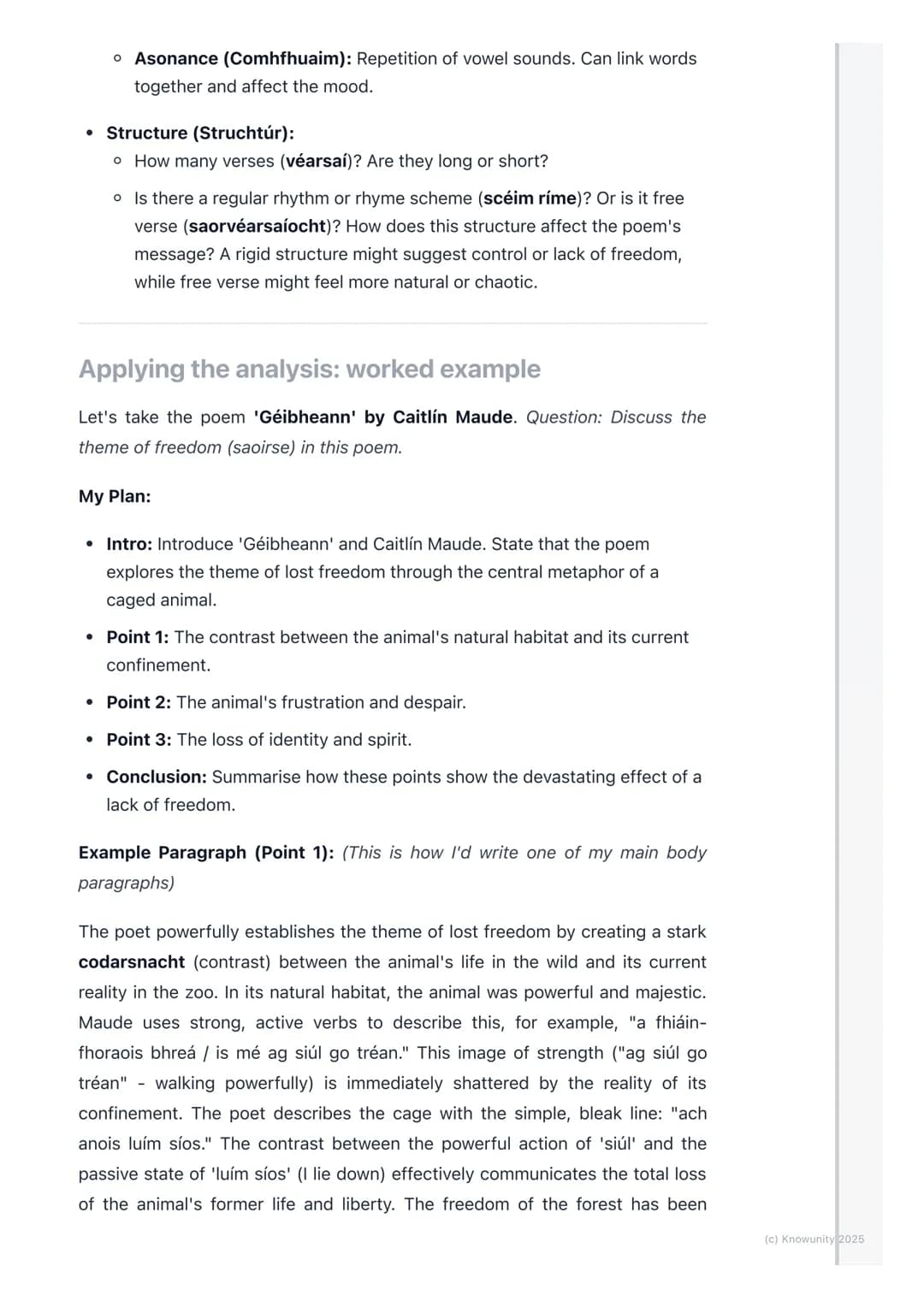
Practical Analysis Example
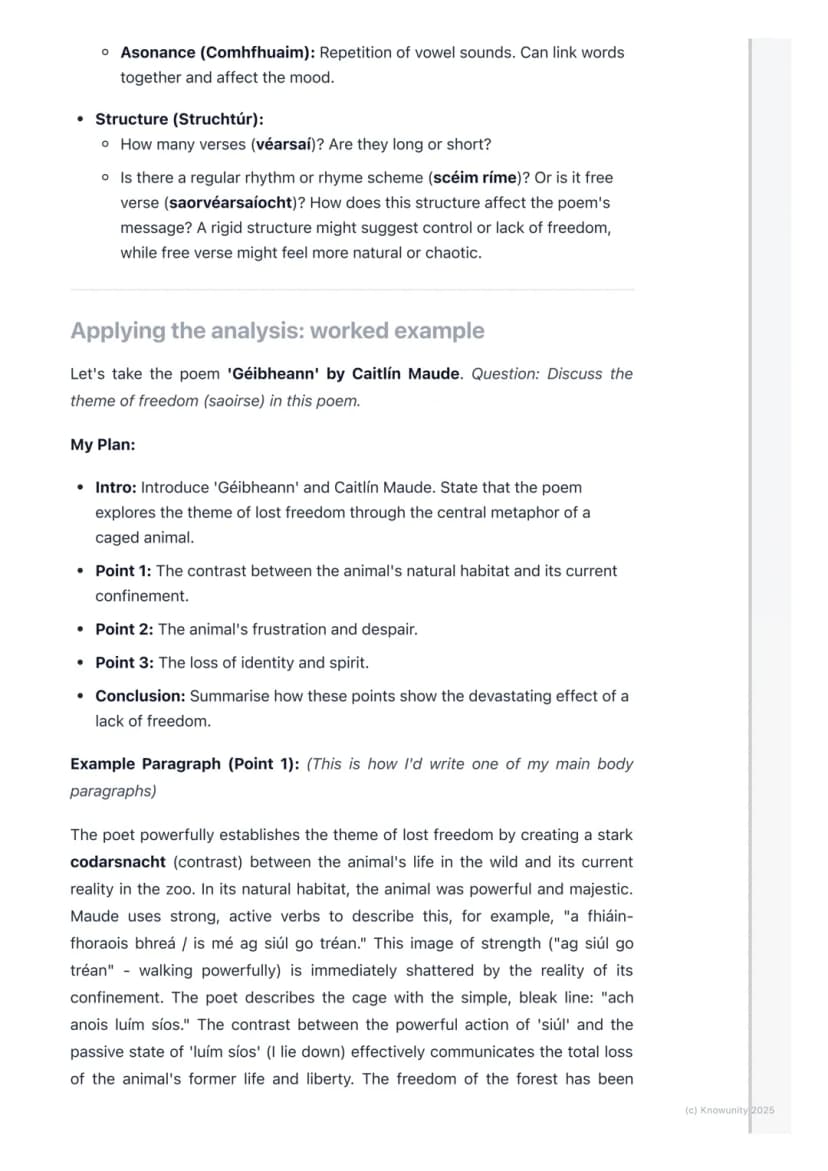
Let's look at 'Géibheann' by Caitlín Maude to see analysis in action. For a question about saoirse (freedom), you'd explore how the poem uses the central metaphor of a caged animal to examine lost liberty.
A strong paragraph might examine the codarsnacht between the animal's natural habitat and current confinement. The powerful verbs describing wild freedom ("ag siúl go tréan") contrast sharply with the passive despair of captivity ("ach anois luím síos").
This contrast between active "siúl" and passive "luím síos" effectively communicates the devastating loss of liberty. The freedom of the forest has been replaced by crushing inaction, perfectly highlighting the poem's central theme.
Notice how this analysis moves beyond simple description to explore how the poet creates meaning through specific language choices and their emotional impact on readers.
Analysis Focus: Quality beats quantity every time. One well-analysed point with a strong quote is worth more than vague paragraphs that just summarise the story.
5
of 6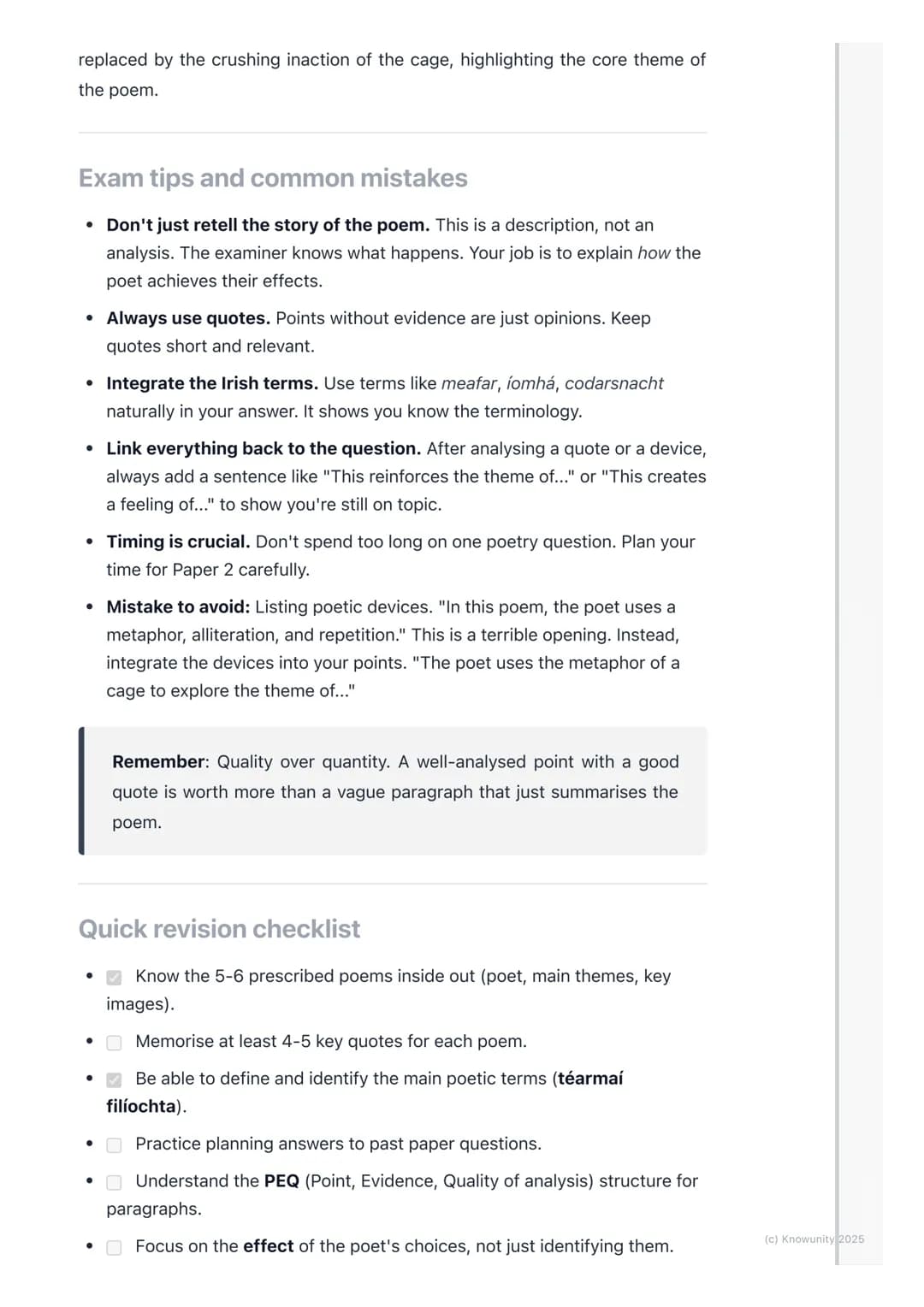
Exam Success and Common Pitfalls
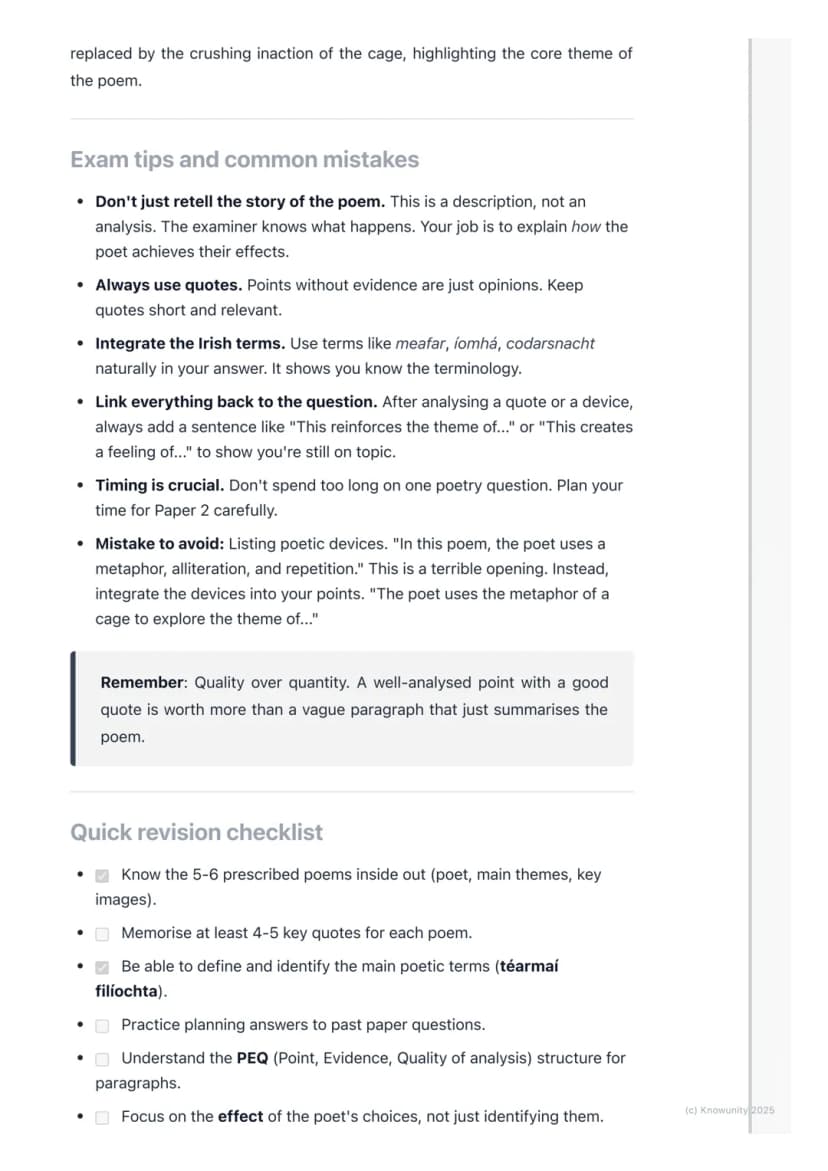
Avoid the classic mistake of simply retelling the poem's story - the examiner already knows what happens! Your job is explaining how the poet achieves their effects through specific techniques and language choices.
Always use quotes to support your points, but keep them short and relevant. Integrate téarmaí Gaeilge naturally throughout your answer to demonstrate your knowledge of poetic terminology.
Timing is absolutely crucial on Paper 2. Don't spend too long on one poetry question - plan your time carefully across all sections. Practice structuring answers quickly using the PEQ method for each paragraph.
Link everything back to your original question. After analysing any quote or device, explicitly connect it to the theme or effect you're discussing to maintain focus throughout your response.
Revision Strategy: Master 4-5 key quotes from each prescribed poem, understand their context, and practice explaining their effects under exam conditions.
6
of 6
Si on te demande...
Qu'est-ce que le compagnon IA de Knowunity ?
Notre compagnon IA est spécialement conçu pour répondre aux besoins des étudiants. Sur la base des millions d'éléments de contenu que nous avons sur la plateforme, nous pouvons fournir des réponses vraiment significatives et pertinentes aux étudiants. Mais il ne s'agit pas seulement de réponses, le compagnon a encore plus pour but de guider les élèves dans leurs défis d'apprentissage quotidiens, avec des plans d'étude personnalisés, des quiz ou des éléments de contenu dans le chat et une personnalisation à 100% basée sur les compétences et les développements de l'étudiant.
Où puis-je télécharger l'appli Knowunity ?
Tu peux télécharger l'application dans Google Play Store et dans l'App Store d'Apple.
L'application est-elle vraiment gratuite ?
Oui, tu as un accès entièrement gratuit à tous les contenus de l'appli, tu peux chatter ou suivre les créateurs à tout moment. De plus, nous proposons Knowunity Premium, qui te permet de réviser sans limites!
Contenus les plus populaires en Irish
9IrishIrish oral questions and answers
Questions and answers for the leaving cert oral
5th Year4264
IrishIrish oral questions
Outline of oral questions
5th Year2055
IrishIrish poetry 2027
Iníon + Dínit an Bhróin
5th Year1133
IrishIníon- le hÁine Durkin
Aine Durkin’s poem, Iníon: Themes & summary
5th Year850
IrishLC HL notes- Iníon (poem)
Includes poem in English and Irish, theme, key words & phrases
5th Year2284
IrishMo Ghrá-sa (Idir Lúibíní)
Notes on mo ghrá-sa
5th Year380
IrishGaeilge Grammar Office
All the basics you need to know on Irish grammar.
6th Year1063
IrishAn Gaeilge Aiste
Irish Language essay
6th Year1320
IrishMé Féin & Mo Chlann (Myself & My Family)
Students will learn vocabulary to describe themselves, their family members, and daily routines. This helps in personal introductions and discussions.
TY291
Contenus les plus populaires
9IrishIrish oral questions and answers
Questions and answers for the leaving cert oral
5th Year4264
 English
Key Quotes : Sive
Key Quotes and explanations: Sive
6th Year2842
IrishIrish oral questions
Outline of oral questions
5th Year2055
IrishIníon- le hÁine Durkin
Aine Durkin’s poem, Iníon: Themes & summary
5th Year850
IrishIrish poetry 2027
Iníon + Dínit an Bhróin
5th Year1133
IrishLC HL notes- Iníon (poem)
Includes poem in English and Irish, theme, key words & phrases
5th Year2284
EnglishCultural Context : Shawshank Redemption : Sive : Small Things Like These
Comparative Study : Cultural Context : Shawshank Redemption, Sive and Small Things Like These
6th Year1430
IrishMo Ghrá-sa (Idir Lúibíní)
Notes on mo ghrá-sa
5th Year380
IrishAn Gaeilge Aiste
Irish Language essay
6th Year1320
Rien ne te convient ? Explore d'autres matières.
Les étudiants nous adorent — il ne manque plus que toi.
4.6/5App Store
4.7/5Google Play
L'application est très facile d'utilisation et bien conçue. Jusqu'à présent, j'ai trouvé tout ce que je cherchais et j'ai pu apprendre beaucoup de choses grâce aux présentations ! Je vais certainement utiliser l'application pour un travail en classe ! Et comme source d'inspiration personnelle, elle est bien sûr aussi très utile.
Stefan Sutilisateur iOS
Cette application est vraiment super. Il y a tellement de fiches de révision et d'aide, [...]. Par exemple, la matière qui me pose problème est le français et l'appli a un choix d'aide très large. Grâce à cette application, je me suis améliorée en français. Je la recommanderais à tout le monde.
Samantha Klichutilisatrice Android
Waouh, je suis vraiment abasourdi. J'ai essayé l'application parce que je l'avais déjà vue plusieurs fois dans la publicité et j'ai été absolument choquée. Cette appli est L'AIDE dont on rêve pour l'école et surtout, elle propose tellement de choses, comme des rédactions et des fiches qui m'ont personnellement TRÈS bien aidé.
Annautilisatrice iOS
Irish2 vues·Mis à jour Jun 8, 2026·6 pagesEolas ar Fhilíocht: Dioscúrsa Téamaí agus Íomháineachas
Poetry analysis is a major component of your Leaving Cert Irish Paper 2, and it's about far more than just understanding what happens in the poem. You'll need to master the art of discussing how poets create meaning through their...
1
of 6
Inscris-toi pour voir le contenu. C'est gratuit!
- Accès à tous les documents
- Améliore tes notes
- Rejoins des millions d'étudiants
Getting Started with Poetry Analysis
Poetry questions make up a significant chunk of Paper 2, so getting comfortable with analysis is absolutely crucial for your Leaving Cert success. The key shift you need to make is moving beyond simple translation to discussing ceardaíocht an fhile (the poet's craft).
Your job isn't just to say what the poem means, but to explore how the poet creates those meanings and emotions. Think of yourself as a detective uncovering the techniques that make a poem work.
You'll need to master essential téarmaí filíochta (poetic terms) like téama (theme), mothúcháin (emotions), and íomháineachas (imagery). But here's the crucial bit - simply spotting a meafar (metaphor) or samhail (simile) isn't enough.
Remember: Always explain the effect of each poetic device. What does that metaphor make the reader think or feel? How does it strengthen the poem's central theme?
2
of 6Inscris-toi pour voir le contenu. C'est gratuit!
- Accès à tous les documents
- Améliore tes notes
- Rejoins des millions d'étudiants
Essential Poetic Devices and Their Effects
Understanding poetic devices is like having a toolkit for analysis. Pearsantú (personification) gives human qualities to objects, whilst siombail (symbols) represent deeper meanings - like a cage symbolising lost freedom.
Codarsnacht (contrast) places opposite ideas side-by-side to create powerful effects, and athrá (repetition) emphasises key points. Sound devices like uaim (alliteration) create rhythm and atmosphere that can make a poem feel musical or harsh.
Don't forget about aidiachtaí (adjectives) - poets choose describing words very carefully to build specific moods. The ritim (rhythm) and meadaracht (metre) also shape how a poem feels when you read it aloud.
Top Tip: Never just identify a device - always explain its impact. Instead of saying "the poet uses a metaphor," explain what that metaphor achieves in the poem.
3
of 6Inscris-toi pour voir le contenu. C'est gratuit!
- Accès à tous les documents
- Améliore tes notes
- Rejoins des millions d'étudiants
Breaking Down Poetry Questions Step-by-Step
Start by deconstructing the question properly. Underline key terms and identify exactly what you're being asked to discuss - is it about themes, imagery, or the poet's style? This focus will guide your entire answer.
Planning your response is absolutely vital. Brainstorm 3-4 key points that directly answer the question, find supporting quotes for each point, then structure your essay logically with a clear introduction, focused body paragraphs, and concise conclusion.
For your main body paragraphs, use the PEQ method: make a clear Point, provide Evidence (accurate quotes), then offer Quality analysis explaining the language choices and their effects. Each paragraph should focus on one main idea that supports your overall argument.
Your anailís ar an teanga (language analysis) should examine rogha na bhfocal (word choice), sound devices, and how the poem's struchtúr (structure) reinforces its message.
Key Strategy: Always link your analysis back to the question. After explaining a quote, add phrases like "This reinforces the theme of..." to stay on track.
4
of 6Inscris-toi pour voir le contenu. C'est gratuit!
- Accès à tous les documents
- Améliore tes notes
- Rejoins des millions d'étudiants
Practical Analysis Example
Let's look at 'Géibheann' by Caitlín Maude to see analysis in action. For a question about saoirse (freedom), you'd explore how the poem uses the central metaphor of a caged animal to examine lost liberty.
A strong paragraph might examine the codarsnacht between the animal's natural habitat and current confinement. The powerful verbs describing wild freedom ("ag siúl go tréan") contrast sharply with the passive despair of captivity ("ach anois luím síos").
This contrast between active "siúl" and passive "luím síos" effectively communicates the devastating loss of liberty. The freedom of the forest has been replaced by crushing inaction, perfectly highlighting the poem's central theme.
Notice how this analysis moves beyond simple description to explore how the poet creates meaning through specific language choices and their emotional impact on readers.
Analysis Focus: Quality beats quantity every time. One well-analysed point with a strong quote is worth more than vague paragraphs that just summarise the story.
5
of 6Inscris-toi pour voir le contenu. C'est gratuit!
- Accès à tous les documents
- Améliore tes notes
- Rejoins des millions d'étudiants
Exam Success and Common Pitfalls
Avoid the classic mistake of simply retelling the poem's story - the examiner already knows what happens! Your job is explaining how the poet achieves their effects through specific techniques and language choices.
Always use quotes to support your points, but keep them short and relevant. Integrate téarmaí Gaeilge naturally throughout your answer to demonstrate your knowledge of poetic terminology.
Timing is absolutely crucial on Paper 2. Don't spend too long on one poetry question - plan your time carefully across all sections. Practice structuring answers quickly using the PEQ method for each paragraph.
Link everything back to your original question. After analysing any quote or device, explicitly connect it to the theme or effect you're discussing to maintain focus throughout your response.
Revision Strategy: Master 4-5 key quotes from each prescribed poem, understand their context, and practice explaining their effects under exam conditions.
6
of 6Inscris-toi pour voir le contenu. C'est gratuit!
- Accès à tous les documents
- Améliore tes notes
- Rejoins des millions d'étudiants
Si on te demande...
Qu'est-ce que le compagnon IA de Knowunity ?
Notre compagnon IA est spécialement conçu pour répondre aux besoins des étudiants. Sur la base des millions d'éléments de contenu que nous avons sur la plateforme, nous pouvons fournir des réponses vraiment significatives et pertinentes aux étudiants. Mais il ne s'agit pas seulement de réponses, le compagnon a encore plus pour but de guider les élèves dans leurs défis d'apprentissage quotidiens, avec des plans d'étude personnalisés, des quiz ou des éléments de contenu dans le chat et une personnalisation à 100% basée sur les compétences et les développements de l'étudiant.
Où puis-je télécharger l'appli Knowunity ?
Tu peux télécharger l'application dans Google Play Store et dans l'App Store d'Apple.
L'application est-elle vraiment gratuite ?
Oui, tu as un accès entièrement gratuit à tous les contenus de l'appli, tu peux chatter ou suivre les créateurs à tout moment. De plus, nous proposons Knowunity Premium, qui te permet de réviser sans limites!
Contenus les plus populaires en Irish
9IrishIrish oral questions and answers
Questions and answers for the leaving cert oral
5th Year4264
IrishIrish oral questions
Outline of oral questions
5th Year2055
IrishIrish poetry 2027
Iníon + Dínit an Bhróin
5th Year1133
IrishIníon- le hÁine Durkin
Aine Durkin’s poem, Iníon: Themes & summary
5th Year850
IrishLC HL notes- Iníon (poem)
Includes poem in English and Irish, theme, key words & phrases
5th Year2284
IrishMo Ghrá-sa (Idir Lúibíní)
Notes on mo ghrá-sa
5th Year380
IrishGaeilge Grammar Office
All the basics you need to know on Irish grammar.
6th Year1063
IrishAn Gaeilge Aiste
Irish Language essay
6th Year1320
IrishMé Féin & Mo Chlann (Myself & My Family)
Students will learn vocabulary to describe themselves, their family members, and daily routines. This helps in personal introductions and discussions.
TY291
Contenus les plus populaires
9IrishIrish oral questions and answers
Questions and answers for the leaving cert oral
5th Year4264
EnglishKey Quotes : Sive
Key Quotes and explanations: Sive
6th Year2842
IrishIrish oral questions
Outline of oral questions
5th Year2055
IrishIníon- le hÁine Durkin
Aine Durkin’s poem, Iníon: Themes & summary
5th Year850
IrishIrish poetry 2027
Iníon + Dínit an Bhróin
5th Year1133
IrishLC HL notes- Iníon (poem)
Includes poem in English and Irish, theme, key words & phrases
5th Year2284
EnglishCultural Context : Shawshank Redemption : Sive : Small Things Like These
Comparative Study : Cultural Context : Shawshank Redemption, Sive and Small Things Like These
6th Year1430
IrishMo Ghrá-sa (Idir Lúibíní)
Notes on mo ghrá-sa
5th Year380
IrishAn Gaeilge Aiste
Irish Language essay
6th Year1320
Rien ne te convient ? Explore d'autres matières.
Les étudiants nous adorent — il ne manque plus que toi.
4.6/5App Store
4.7/5Google Play
L'application est très facile d'utilisation et bien conçue. Jusqu'à présent, j'ai trouvé tout ce que je cherchais et j'ai pu apprendre beaucoup de choses grâce aux présentations ! Je vais certainement utiliser l'application pour un travail en classe ! Et comme source d'inspiration personnelle, elle est bien sûr aussi très utile.
Stefan Sutilisateur iOS
Cette application est vraiment super. Il y a tellement de fiches de révision et d'aide, [...]. Par exemple, la matière qui me pose problème est le français et l'appli a un choix d'aide très large. Grâce à cette application, je me suis améliorée en français. Je la recommanderais à tout le monde.
Samantha Klichutilisatrice Android
Waouh, je suis vraiment abasourdi. J'ai essayé l'application parce que je l'avais déjà vue plusieurs fois dans la publicité et j'ai été absolument choquée. Cette appli est L'AIDE dont on rêve pour l'école et surtout, elle propose tellement de choses, comme des rédactions et des fiches qui m'ont personnellement TRÈS bien aidé.
Annautilisatrice iOS