
The general conversation is the main event of your Irish...
 Irish12 vues·Mis à jour Jun 9, 2026·6 pages
Comhrá Sasúir agus Cleasanna Laethúla
1 / 6
1
of 6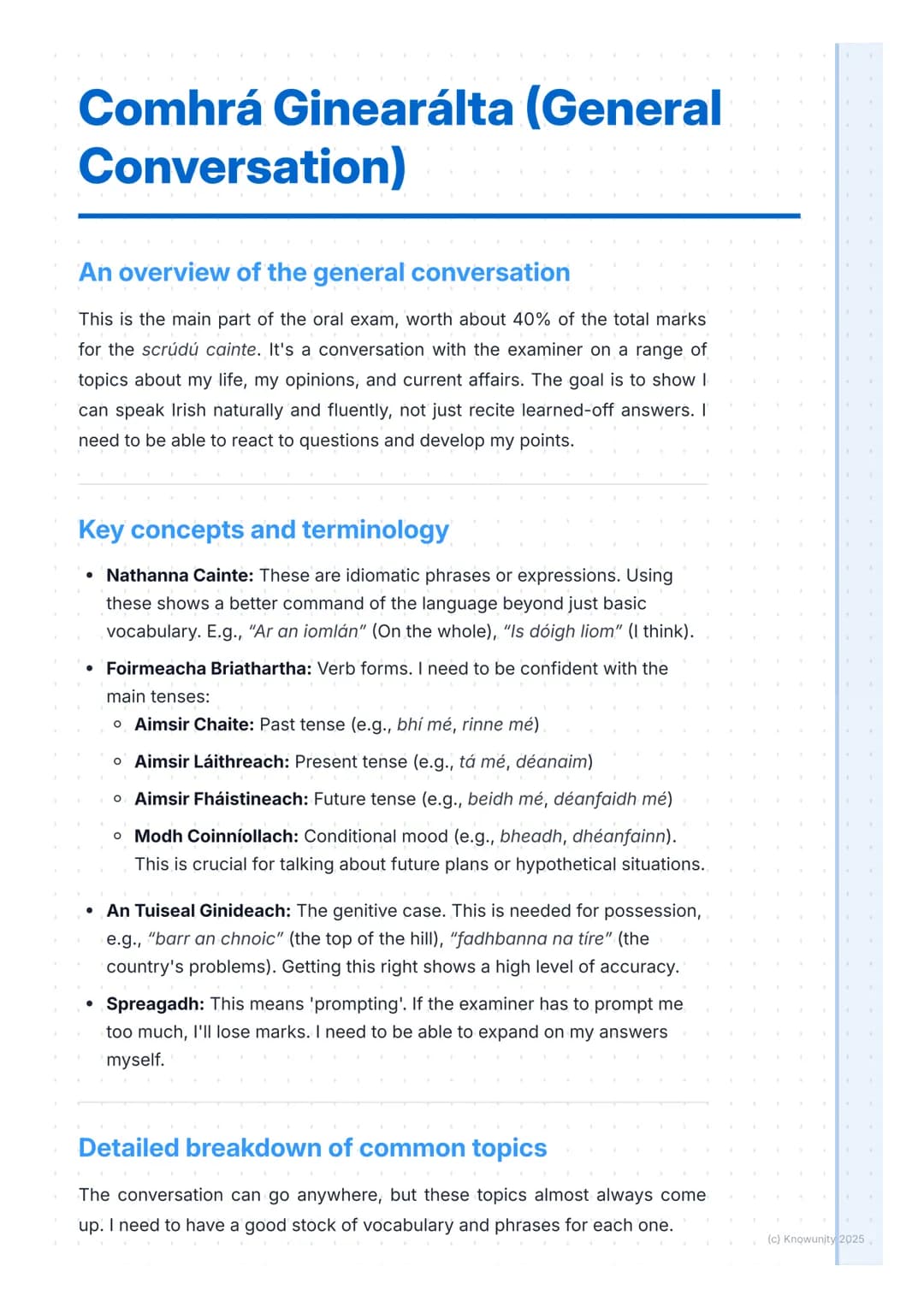
Understanding the General Conversation
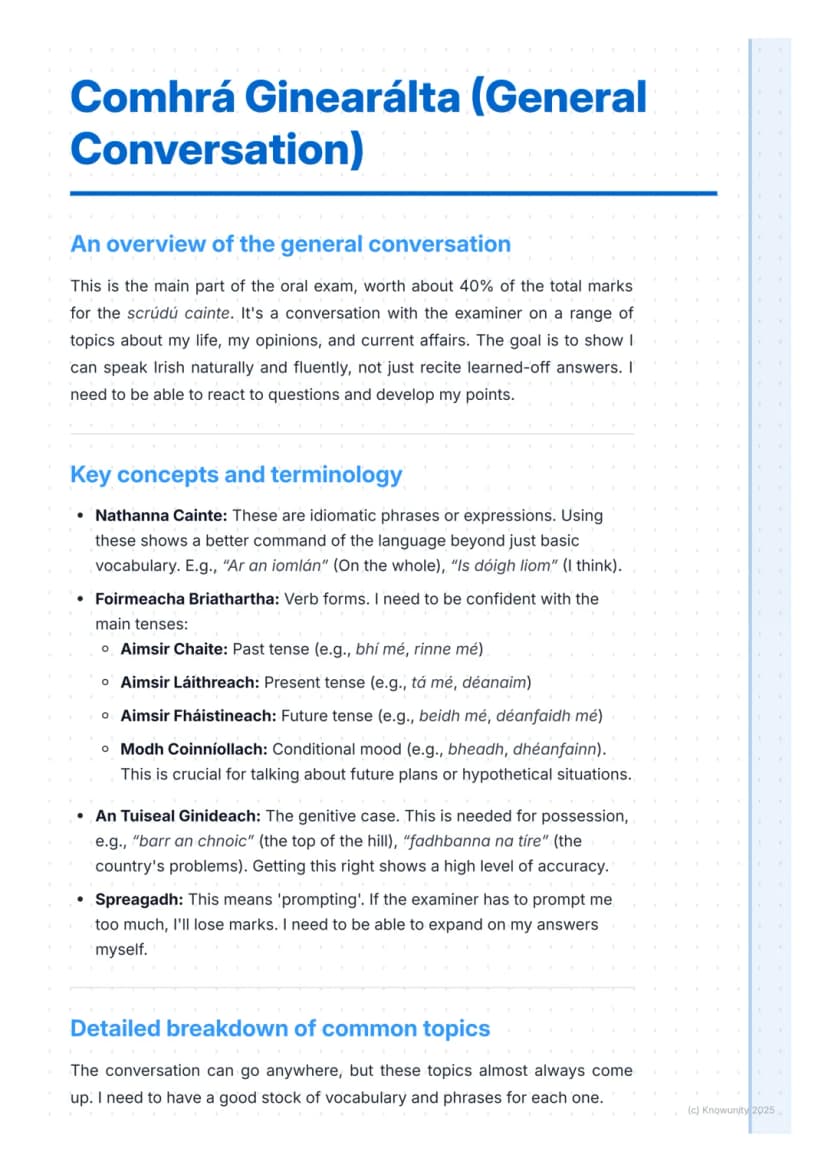
You'll be having a real conversation with the examiner, not just reciting memorised answers. The trick is showing you can think on your feet and develop your points naturally. Spreagadh (prompting) will cost you marks, so you need to expand on answers yourself.
Nathanna cainte (idiomatic phrases) are your secret weapon here. Using expressions like "Ar an iomlán" (on the whole) or "Is dóigh liom" (I think) shows you've got proper command of the language beyond basic vocabulary.
You'll need to be rock-solid with your foirmeacha briathartha (verb forms). Master the past tense (aimsir chaite), present tense (aimsir láithreach), future tense (aimsir fháistineach), and especially the modh coinníollach (conditional mood) for discussing future plans.
Top Tip: Don't panic if you make mistakes - just correct yourself and move on. It actually shows you can self-correct, which examiners love to see!
2
of 6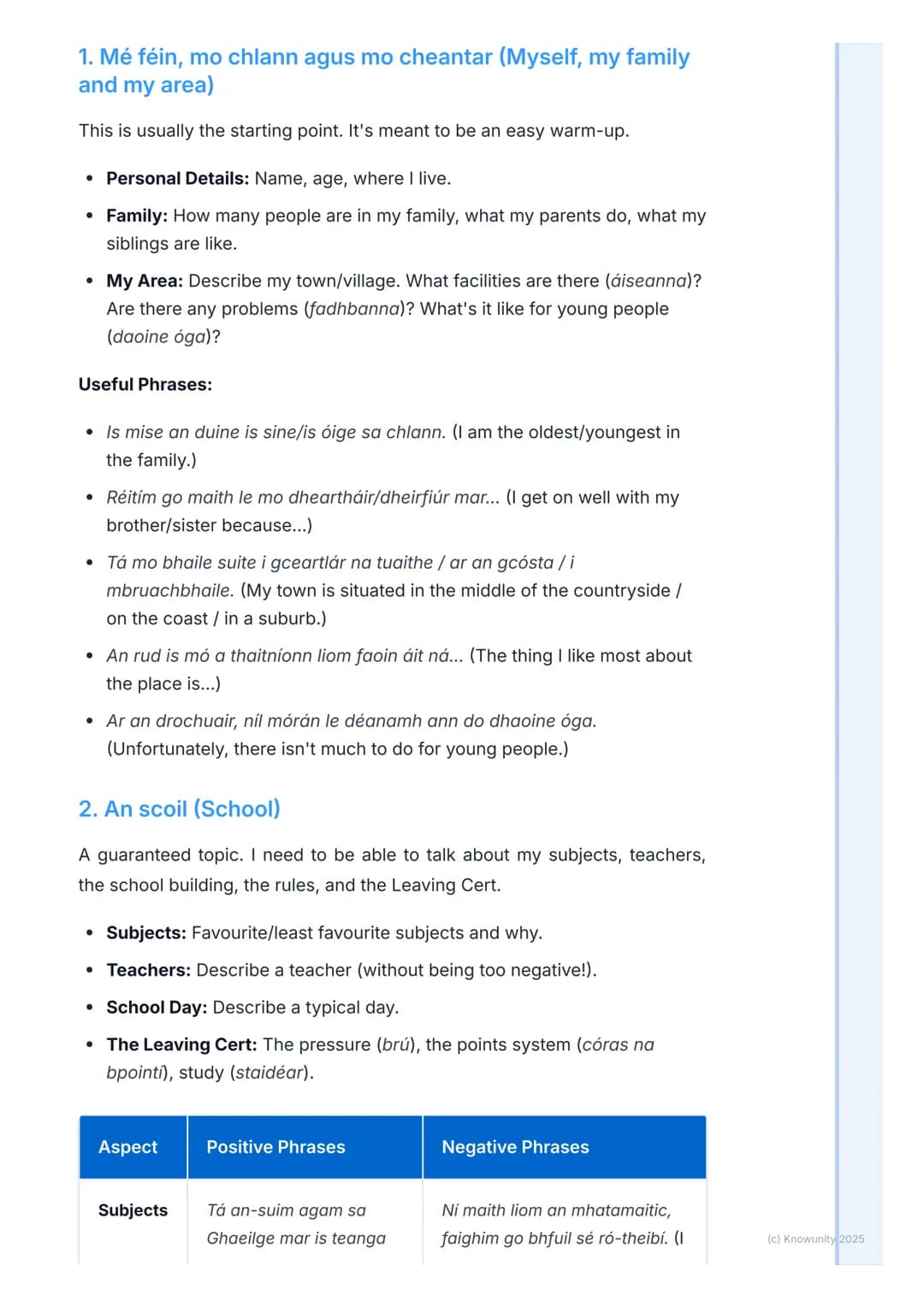
Myself, Family and Local Area
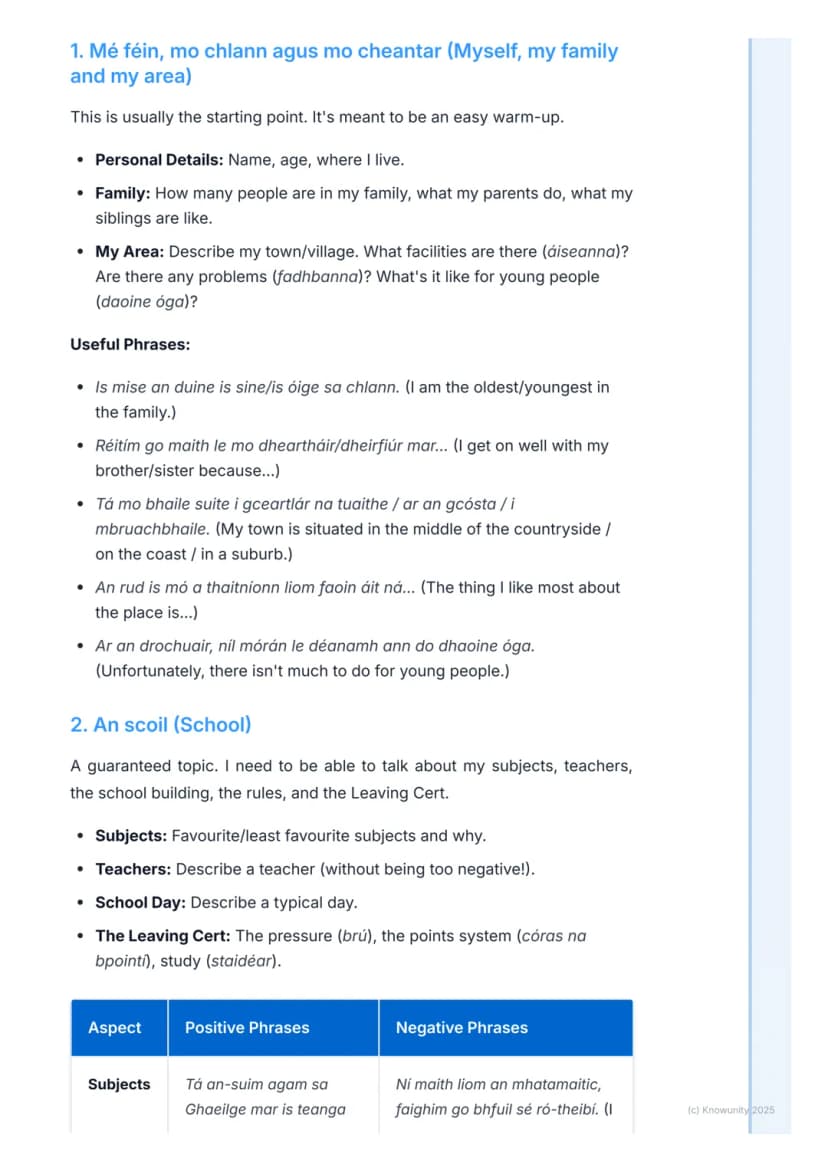
This is usually your warm-up topic, so nail it to build confidence early. You'll chat about personal details, family dynamics, and what your area is like for young people.
For family discussions, try phrases like "Réitím go maith le mo dheartháir mar..." (I get on well with my brother because...) or "Is mise an duine is sine sa chlann" (I am the oldest in the family). These show natural Irish conversation patterns.
When describing your area, get specific about facilities (áiseanna) and problems (fadhbanna). Use "Tá mo bhaile suite i gceartlár na tuaithe" (My town is situated in the middle of the countryside) or "An rud is mó a thaitníonn liom faoin áit ná..." (The thing I like most about the place is...).
Remember: Always give reasons for your opinions. Never just say something is good or bad - explain why with "mar" (because).
3
of 6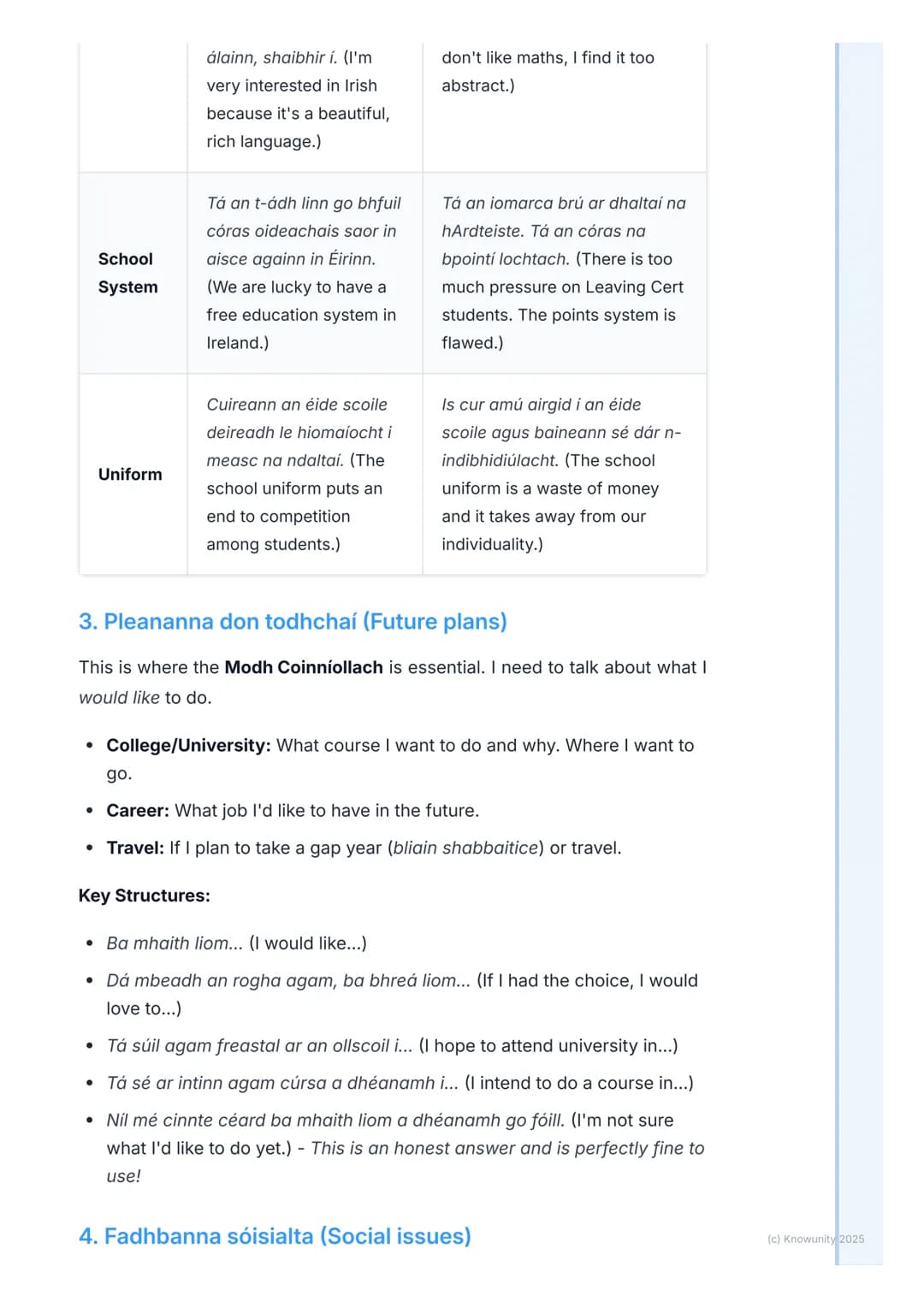
School Life and the Leaving Cert
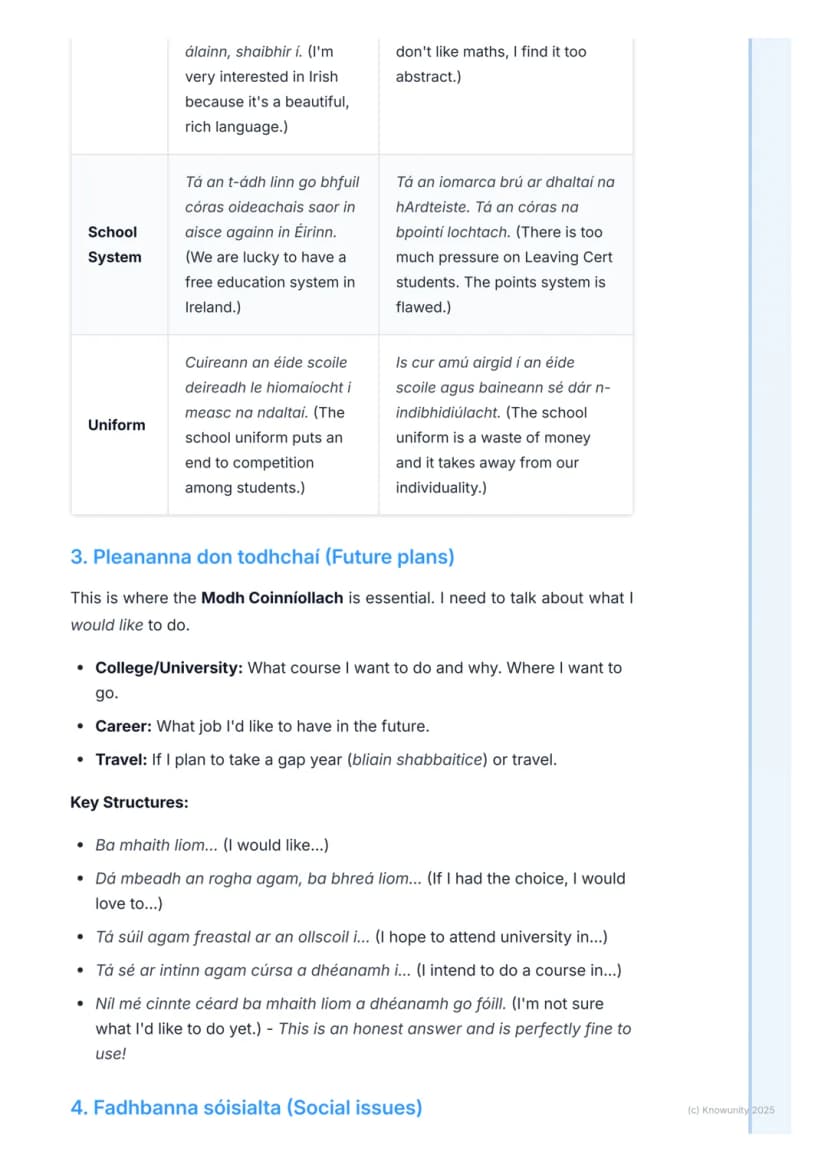
School talk is guaranteed, so prepare opinions on subjects, teachers, and especially córas na bpointi (the points system). You can be honest about finding subjects difficult - just explain why.
For positive subject chat: "Tá an-suim agam sa Ghaeilge mar is teanga álainn, shaibhir í" (I'm very interested in Irish because it's a beautiful, rich language). For negative: "Ní maith liom an mhatamaitic, faighim go bhfuil sé ró-theibí" (I don't like maths, I find it too abstract).
The uniform debate always comes up. Positive angle: "Cuireann an éide scoile deireadh le hiomaíocht i measc na ndaltaí" (School uniform ends competition among students). Negative: "Baineann sé dár n-indibhidiúlacht" (It takes away from our individuality).
Key Point: You can admit uncertainty about future plans - "Níl mé cinnte céard ba mhaith liom a dhéanamh go fóill" is perfectly acceptable!
4
of 6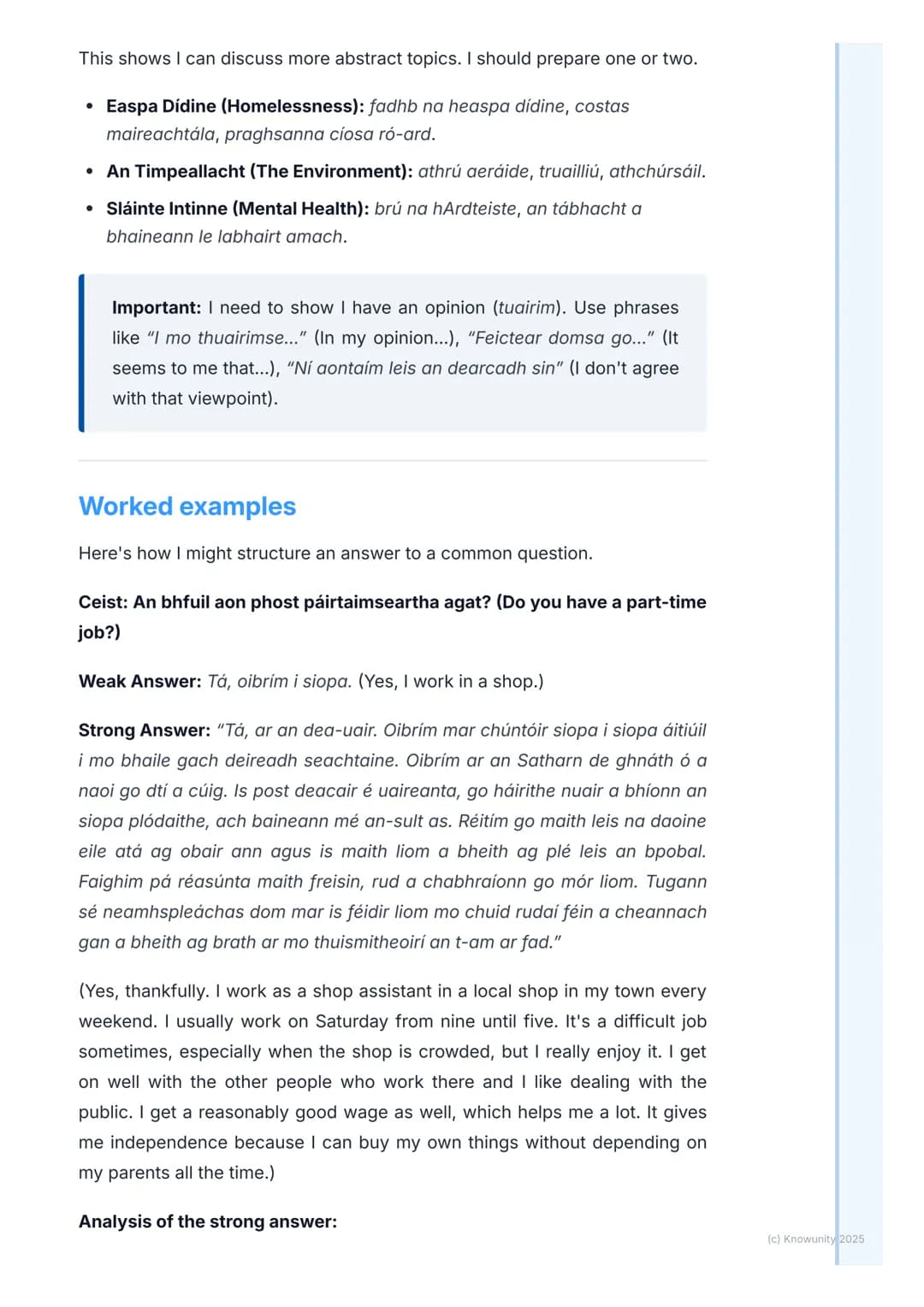
Future Plans and Social Issues
This is where the modh coinníollach becomes essential. Use structures like "Ba mhaith liom..." (I would like...) or "Dá mbeadh an rogha agam..." (If I had the choice...) for college and career chat.
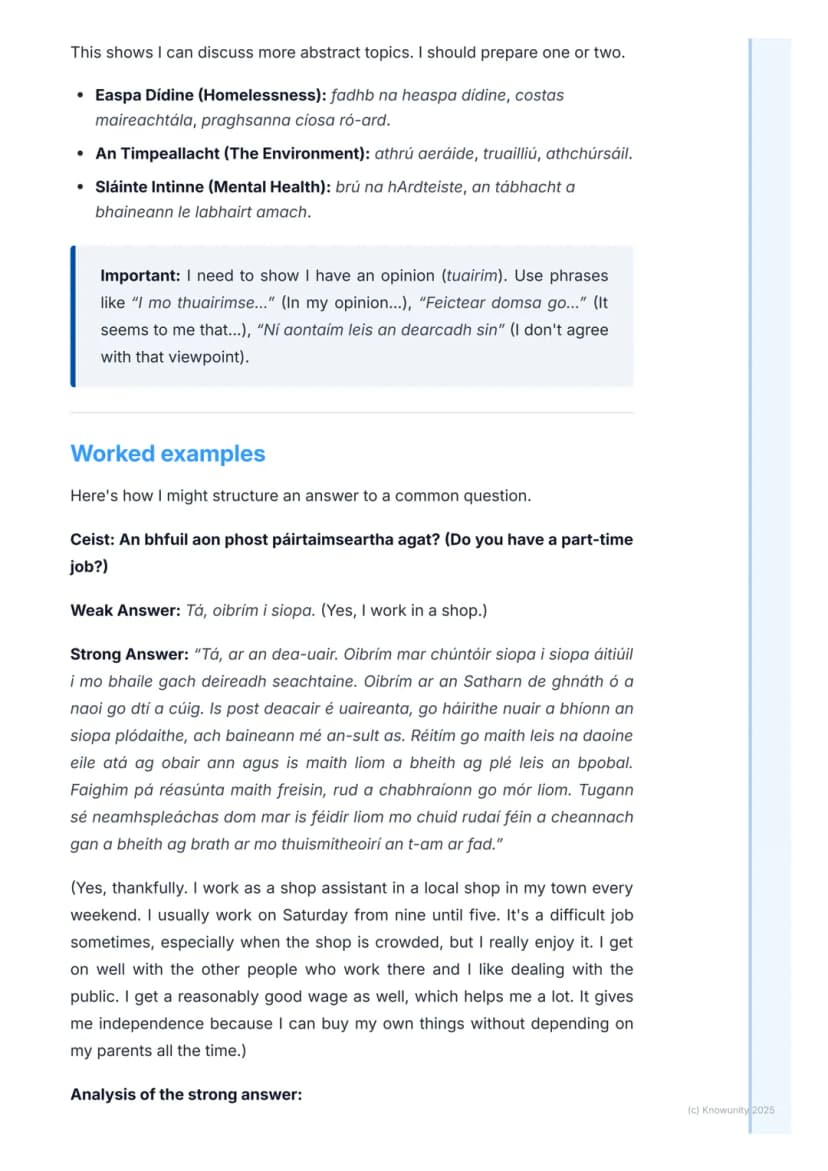
For fadhbanna sóisialta (social issues), pick one or two you actually care about. Easpa dídine (homelessness), athrú aeráide (climate change), or sláinte intinne (mental health) are solid choices. Show you've got opinions with "I mo thuairimse..." (In my opinion...).
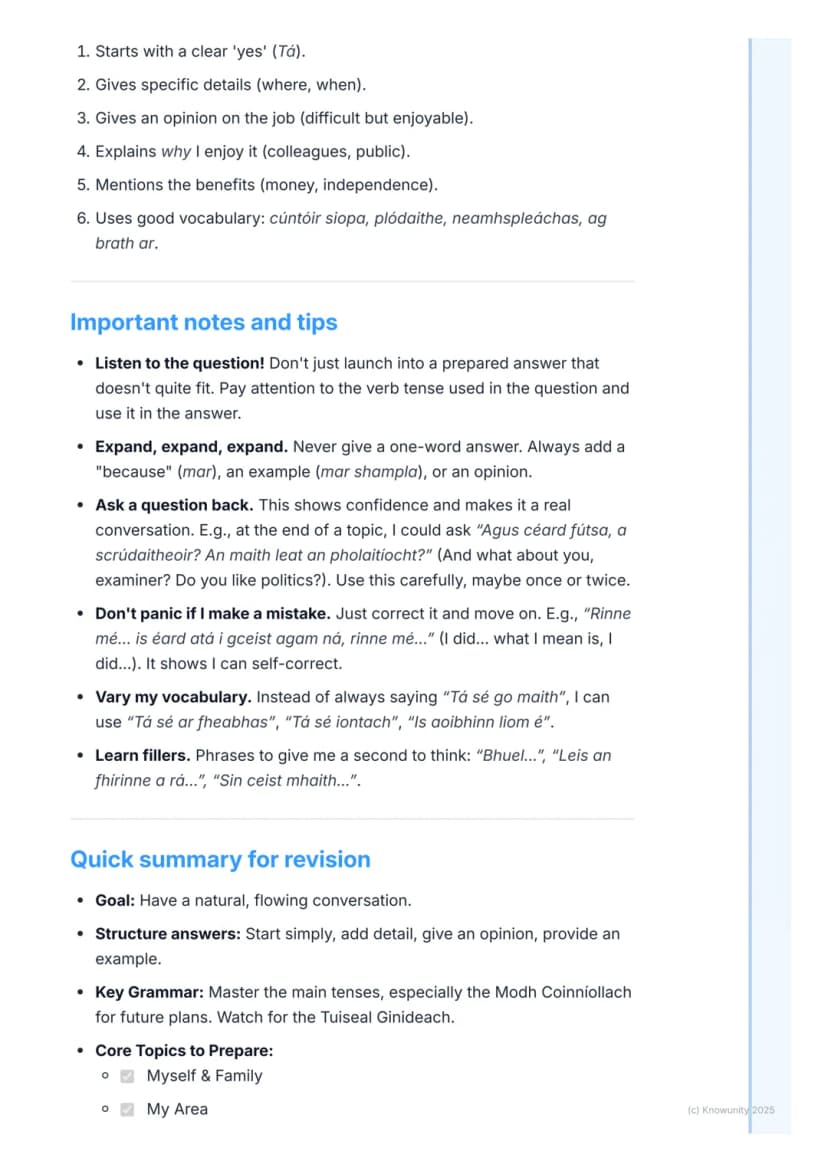
Always expand your answers massively. Instead of "Tá, oibrím i siopa" (Yes, I work in a shop), build it up: explain when, where, what you enjoy, how it gives you neamhspleáchas (independence) from your parents.
Pro Strategy: Ask the examiner a question back occasionally - "Agus céard fútsa?" (And what about you?) shows confidence and creates natural conversation flow.
5
of 6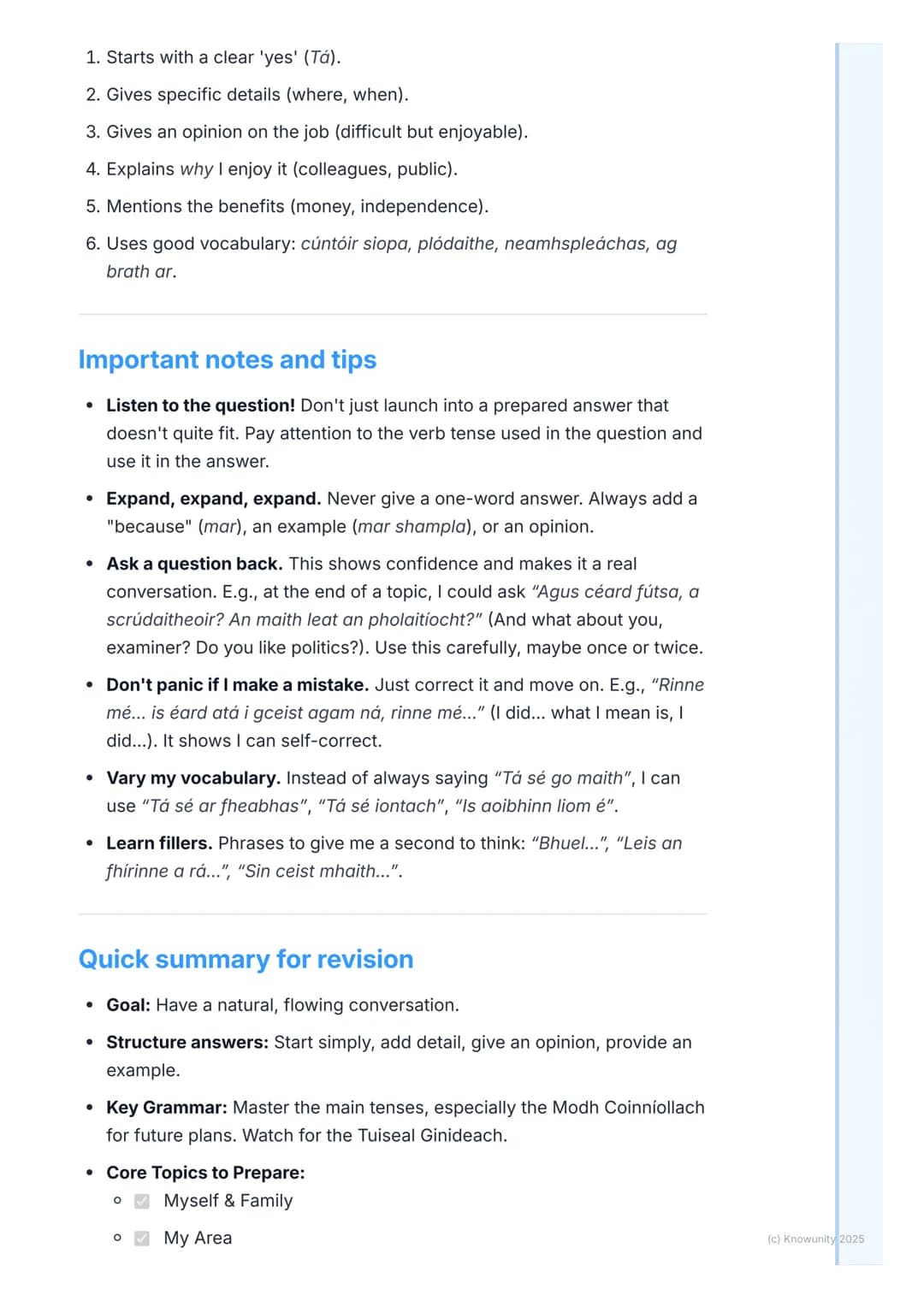
Advanced Techniques and Grammar
Master the tuiseal ginideach (genitive case) for possession - "fadhbanna na tíre" (the country's problems) shows high-level accuracy that examiners notice. Get this right and you'll stand out.
Vary your vocabulary beyond basic responses. Instead of always saying "Tá sé go maith", mix it up with "Tá sé ar fheabhas", "Tá sé iontach", or "Is aoibhinn liom é". This shows natural language range.
Learn strategic fillers to buy thinking time: "Bhuel..." (Well...), "Leis an fhírinne a rá..." (To tell the truth...), or "Sin ceist mhaith..." (That's a good question...). These make you sound more natural.
Crucial: Listen to the actual question asked - don't just launch into prepared answers that don't quite fit. Match the verb tense used in the question.
6
of 6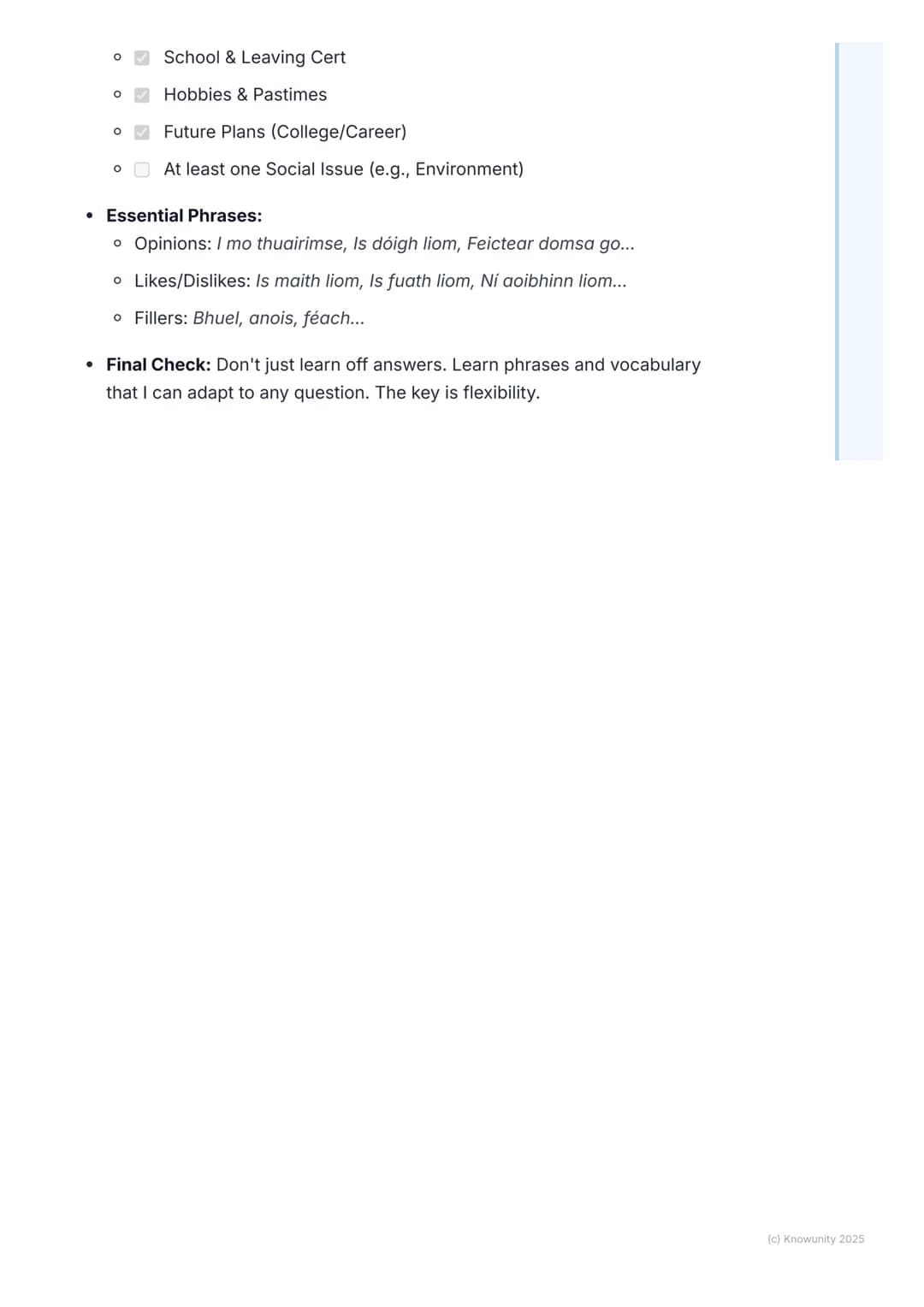
Quick Revision Summary
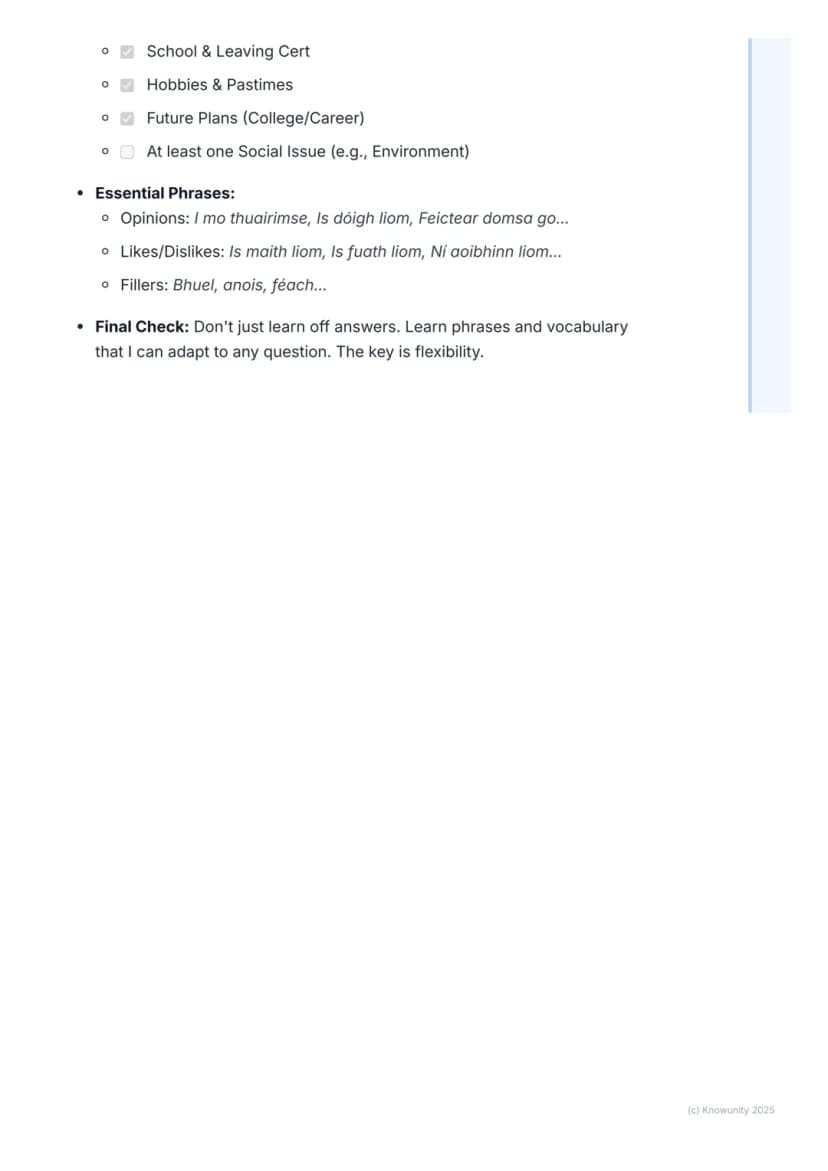
Your core topics to nail: yourself and family, local area, school life, future plans, and at least one social issue you can discuss intelligently. Practice adapting phrases rather than memorising rigid answers.
Essential phrase categories: opinions ("Is dóigh liom", "Feictear domsa go..."), likes/dislikes ("Is maith liom", "Ní aoibhinn liom"), and conversation fillers ("Bhuel", "anois", "féach").
The golden rule is flexibility - learn vocabulary and structures you can adapt to any question the examiner throws at you. Show you can think in Irish, not just recite it.
Final Check: Always expand answers with examples, reasons, and opinions. Never give one-word responses - this is a conversation, not a quiz!
Si on te demande...
Qu'est-ce que le compagnon IA de Knowunity ?
Notre compagnon IA est spécialement conçu pour répondre aux besoins des étudiants. Sur la base des millions d'éléments de contenu que nous avons sur la plateforme, nous pouvons fournir des réponses vraiment significatives et pertinentes aux étudiants. Mais il ne s'agit pas seulement de réponses, le compagnon a encore plus pour but de guider les élèves dans leurs défis d'apprentissage quotidiens, avec des plans d'étude personnalisés, des quiz ou des éléments de contenu dans le chat et une personnalisation à 100% basée sur les compétences et les développements de l'étudiant.
Où puis-je télécharger l'appli Knowunity ?
Tu peux télécharger l'application dans Google Play Store et dans l'App Store d'Apple.
L'application est-elle vraiment gratuite ?
Oui, tu as un accès entièrement gratuit à tous les contenus de l'appli, tu peux chatter ou suivre les créateurs à tout moment. De plus, nous proposons Knowunity Premium, qui te permet de réviser sans limites!
Contenus les plus populaires en Irish
9IrishIrish oral questions and answers
Questions and answers for the leaving cert oral
5th Year4264
IrishIrish oral questions
Outline of oral questions
5th Year2055
IrishIrish poetry 2027
Iníon + Dínit an Bhróin
5th Year1153
IrishIníon- le hÁine Durkin
Aine Durkin’s poem, Iníon: Themes & summary
5th Year890
IrishLC HL notes- Iníon (poem)
Includes poem in English and Irish, theme, key words & phrases
5th Year2304
IrishMo Ghrá-sa (Idir Lúibíní)
Notes on mo ghrá-sa
5th Year380
IrishGaeilge Grammar Office
All the basics you need to know on Irish grammar.
6th Year1063
IrishAn Gaeilge Aiste
Irish Language essay
6th Year1320
IrishMé Féin & Mo Chlann (Myself & My Family)
Students will learn vocabulary to describe themselves, their family members, and daily routines. This helps in personal introductions and discussions.
TY291
Contenus les plus populaires
9IrishIrish oral questions and answers
Questions and answers for the leaving cert oral
5th Year4264
 English
Key Quotes : Sive
Key Quotes and explanations: Sive
6th Year2842
IrishIrish oral questions
Outline of oral questions
5th Year2055
IrishIníon- le hÁine Durkin
Aine Durkin’s poem, Iníon: Themes & summary
5th Year890
IrishIrish poetry 2027
Iníon + Dínit an Bhróin
5th Year1153
IrishLC HL notes- Iníon (poem)
Includes poem in English and Irish, theme, key words & phrases
5th Year2304
EnglishCultural Context : Shawshank Redemption : Sive : Small Things Like These
Comparative Study : Cultural Context : Shawshank Redemption, Sive and Small Things Like These
6th Year1430
IrishMo Ghrá-sa (Idir Lúibíní)
Notes on mo ghrá-sa
5th Year380
IrishAn Gaeilge Aiste
Irish Language essay
6th Year1320
Rien ne te convient ? Explore d'autres matières.
Les étudiants nous adorent — il ne manque plus que toi.
4.6/5App Store
4.7/5Google Play
L'application est très facile d'utilisation et bien conçue. Jusqu'à présent, j'ai trouvé tout ce que je cherchais et j'ai pu apprendre beaucoup de choses grâce aux présentations ! Je vais certainement utiliser l'application pour un travail en classe ! Et comme source d'inspiration personnelle, elle est bien sûr aussi très utile.
Stefan Sutilisateur iOS
Cette application est vraiment super. Il y a tellement de fiches de révision et d'aide, [...]. Par exemple, la matière qui me pose problème est le français et l'appli a un choix d'aide très large. Grâce à cette application, je me suis améliorée en français. Je la recommanderais à tout le monde.
Samantha Klichutilisatrice Android
Waouh, je suis vraiment abasourdi. J'ai essayé l'application parce que je l'avais déjà vue plusieurs fois dans la publicité et j'ai été absolument choquée. Cette appli est L'AIDE dont on rêve pour l'école et surtout, elle propose tellement de choses, comme des rédactions et des fiches qui m'ont personnellement TRÈS bien aidé.
Annautilisatrice iOS
Irish12 vues·Mis à jour Jun 9, 2026·6 pagesComhrá Sasúir agus Cleasanna Laethúla
The general conversation is the main event of your Irish oral exam, worth about 40% of your total marks. It's your chance to show off your natural Irish speaking skills through a proper chat with the examiner about your life,...
1
of 6
Inscris-toi pour voir le contenu. C'est gratuit!
- Accès à tous les documents
- Améliore tes notes
- Rejoins des millions d'étudiants
Understanding the General Conversation
You'll be having a real conversation with the examiner, not just reciting memorised answers. The trick is showing you can think on your feet and develop your points naturally. Spreagadh (prompting) will cost you marks, so you need to expand on answers yourself.
Nathanna cainte (idiomatic phrases) are your secret weapon here. Using expressions like "Ar an iomlán" (on the whole) or "Is dóigh liom" (I think) shows you've got proper command of the language beyond basic vocabulary.
You'll need to be rock-solid with your foirmeacha briathartha (verb forms). Master the past tense (aimsir chaite), present tense (aimsir láithreach), future tense (aimsir fháistineach), and especially the modh coinníollach (conditional mood) for discussing future plans.
Top Tip: Don't panic if you make mistakes - just correct yourself and move on. It actually shows you can self-correct, which examiners love to see!
2
of 6Inscris-toi pour voir le contenu. C'est gratuit!
- Accès à tous les documents
- Améliore tes notes
- Rejoins des millions d'étudiants
Myself, Family and Local Area
This is usually your warm-up topic, so nail it to build confidence early. You'll chat about personal details, family dynamics, and what your area is like for young people.
For family discussions, try phrases like "Réitím go maith le mo dheartháir mar..." (I get on well with my brother because...) or "Is mise an duine is sine sa chlann" (I am the oldest in the family). These show natural Irish conversation patterns.
When describing your area, get specific about facilities (áiseanna) and problems (fadhbanna). Use "Tá mo bhaile suite i gceartlár na tuaithe" (My town is situated in the middle of the countryside) or "An rud is mó a thaitníonn liom faoin áit ná..." (The thing I like most about the place is...).
Remember: Always give reasons for your opinions. Never just say something is good or bad - explain why with "mar" (because).
3
of 6Inscris-toi pour voir le contenu. C'est gratuit!
- Accès à tous les documents
- Améliore tes notes
- Rejoins des millions d'étudiants
School Life and the Leaving Cert
School talk is guaranteed, so prepare opinions on subjects, teachers, and especially córas na bpointi (the points system). You can be honest about finding subjects difficult - just explain why.
For positive subject chat: "Tá an-suim agam sa Ghaeilge mar is teanga álainn, shaibhir í" (I'm very interested in Irish because it's a beautiful, rich language). For negative: "Ní maith liom an mhatamaitic, faighim go bhfuil sé ró-theibí" (I don't like maths, I find it too abstract).
The uniform debate always comes up. Positive angle: "Cuireann an éide scoile deireadh le hiomaíocht i measc na ndaltaí" (School uniform ends competition among students). Negative: "Baineann sé dár n-indibhidiúlacht" (It takes away from our individuality).
Key Point: You can admit uncertainty about future plans - "Níl mé cinnte céard ba mhaith liom a dhéanamh go fóill" is perfectly acceptable!
4
of 6Inscris-toi pour voir le contenu. C'est gratuit!
- Accès à tous les documents
- Améliore tes notes
- Rejoins des millions d'étudiants
Future Plans and Social Issues
This is where the modh coinníollach becomes essential. Use structures like "Ba mhaith liom..." (I would like...) or "Dá mbeadh an rogha agam..." (If I had the choice...) for college and career chat.
For fadhbanna sóisialta (social issues), pick one or two you actually care about. Easpa dídine (homelessness), athrú aeráide (climate change), or sláinte intinne (mental health) are solid choices. Show you've got opinions with "I mo thuairimse..." (In my opinion...).
Always expand your answers massively. Instead of "Tá, oibrím i siopa" (Yes, I work in a shop), build it up: explain when, where, what you enjoy, how it gives you neamhspleáchas (independence) from your parents.
Pro Strategy: Ask the examiner a question back occasionally - "Agus céard fútsa?" (And what about you?) shows confidence and creates natural conversation flow.
5
of 6Inscris-toi pour voir le contenu. C'est gratuit!
- Accès à tous les documents
- Améliore tes notes
- Rejoins des millions d'étudiants
Advanced Techniques and Grammar
Master the tuiseal ginideach (genitive case) for possession - "fadhbanna na tíre" (the country's problems) shows high-level accuracy that examiners notice. Get this right and you'll stand out.
Vary your vocabulary beyond basic responses. Instead of always saying "Tá sé go maith", mix it up with "Tá sé ar fheabhas", "Tá sé iontach", or "Is aoibhinn liom é". This shows natural language range.
Learn strategic fillers to buy thinking time: "Bhuel..." (Well...), "Leis an fhírinne a rá..." (To tell the truth...), or "Sin ceist mhaith..." (That's a good question...). These make you sound more natural.
Crucial: Listen to the actual question asked - don't just launch into prepared answers that don't quite fit. Match the verb tense used in the question.
6
of 6Inscris-toi pour voir le contenu. C'est gratuit!
- Accès à tous les documents
- Améliore tes notes
- Rejoins des millions d'étudiants
Quick Revision Summary
Your core topics to nail: yourself and family, local area, school life, future plans, and at least one social issue you can discuss intelligently. Practice adapting phrases rather than memorising rigid answers.
Essential phrase categories: opinions ("Is dóigh liom", "Feictear domsa go..."), likes/dislikes ("Is maith liom", "Ní aoibhinn liom"), and conversation fillers ("Bhuel", "anois", "féach").
The golden rule is flexibility - learn vocabulary and structures you can adapt to any question the examiner throws at you. Show you can think in Irish, not just recite it.
Final Check: Always expand answers with examples, reasons, and opinions. Never give one-word responses - this is a conversation, not a quiz!
Si on te demande...
Qu'est-ce que le compagnon IA de Knowunity ?
Notre compagnon IA est spécialement conçu pour répondre aux besoins des étudiants. Sur la base des millions d'éléments de contenu que nous avons sur la plateforme, nous pouvons fournir des réponses vraiment significatives et pertinentes aux étudiants. Mais il ne s'agit pas seulement de réponses, le compagnon a encore plus pour but de guider les élèves dans leurs défis d'apprentissage quotidiens, avec des plans d'étude personnalisés, des quiz ou des éléments de contenu dans le chat et une personnalisation à 100% basée sur les compétences et les développements de l'étudiant.
Où puis-je télécharger l'appli Knowunity ?
Tu peux télécharger l'application dans Google Play Store et dans l'App Store d'Apple.
L'application est-elle vraiment gratuite ?
Oui, tu as un accès entièrement gratuit à tous les contenus de l'appli, tu peux chatter ou suivre les créateurs à tout moment. De plus, nous proposons Knowunity Premium, qui te permet de réviser sans limites!
Contenus les plus populaires en Irish
9IrishIrish oral questions and answers
Questions and answers for the leaving cert oral
5th Year4264
IrishIrish oral questions
Outline of oral questions
5th Year2055
IrishIrish poetry 2027
Iníon + Dínit an Bhróin
5th Year1153
IrishIníon- le hÁine Durkin
Aine Durkin’s poem, Iníon: Themes & summary
5th Year890
IrishLC HL notes- Iníon (poem)
Includes poem in English and Irish, theme, key words & phrases
5th Year2304
IrishMo Ghrá-sa (Idir Lúibíní)
Notes on mo ghrá-sa
5th Year380
IrishGaeilge Grammar Office
All the basics you need to know on Irish grammar.
6th Year1063
IrishAn Gaeilge Aiste
Irish Language essay
6th Year1320
IrishMé Féin & Mo Chlann (Myself & My Family)
Students will learn vocabulary to describe themselves, their family members, and daily routines. This helps in personal introductions and discussions.
TY291
Contenus les plus populaires
9IrishIrish oral questions and answers
Questions and answers for the leaving cert oral
5th Year4264
EnglishKey Quotes : Sive
Key Quotes and explanations: Sive
6th Year2842
IrishIrish oral questions
Outline of oral questions
5th Year2055
IrishIníon- le hÁine Durkin
Aine Durkin’s poem, Iníon: Themes & summary
5th Year890
IrishIrish poetry 2027
Iníon + Dínit an Bhróin
5th Year1153
IrishLC HL notes- Iníon (poem)
Includes poem in English and Irish, theme, key words & phrases
5th Year2304
EnglishCultural Context : Shawshank Redemption : Sive : Small Things Like These
Comparative Study : Cultural Context : Shawshank Redemption, Sive and Small Things Like These
6th Year1430
IrishMo Ghrá-sa (Idir Lúibíní)
Notes on mo ghrá-sa
5th Year380
IrishAn Gaeilge Aiste
Irish Language essay
6th Year1320
Rien ne te convient ? Explore d'autres matières.
Les étudiants nous adorent — il ne manque plus que toi.
4.6/5App Store
4.7/5Google Play
L'application est très facile d'utilisation et bien conçue. Jusqu'à présent, j'ai trouvé tout ce que je cherchais et j'ai pu apprendre beaucoup de choses grâce aux présentations ! Je vais certainement utiliser l'application pour un travail en classe ! Et comme source d'inspiration personnelle, elle est bien sûr aussi très utile.
Stefan Sutilisateur iOS
Cette application est vraiment super. Il y a tellement de fiches de révision et d'aide, [...]. Par exemple, la matière qui me pose problème est le français et l'appli a un choix d'aide très large. Grâce à cette application, je me suis améliorée en français. Je la recommanderais à tout le monde.
Samantha Klichutilisatrice Android
Waouh, je suis vraiment abasourdi. J'ai essayé l'application parce que je l'avais déjà vue plusieurs fois dans la publicité et j'ai été absolument choquée. Cette appli est L'AIDE dont on rêve pour l'école et surtout, elle propose tellement de choses, comme des rédactions et des fiches qui m'ont personnellement TRÈS bien aidé.
Annautilisatrice iOS