
Ever wondered why some athletes crumble under pressure whilst others...
 LCPE4 vues·Mis à jour Jun 15, 2026·5 pages
Understanding Arousal and Anxiety: Effects on Performance
1 / 5
1
of 5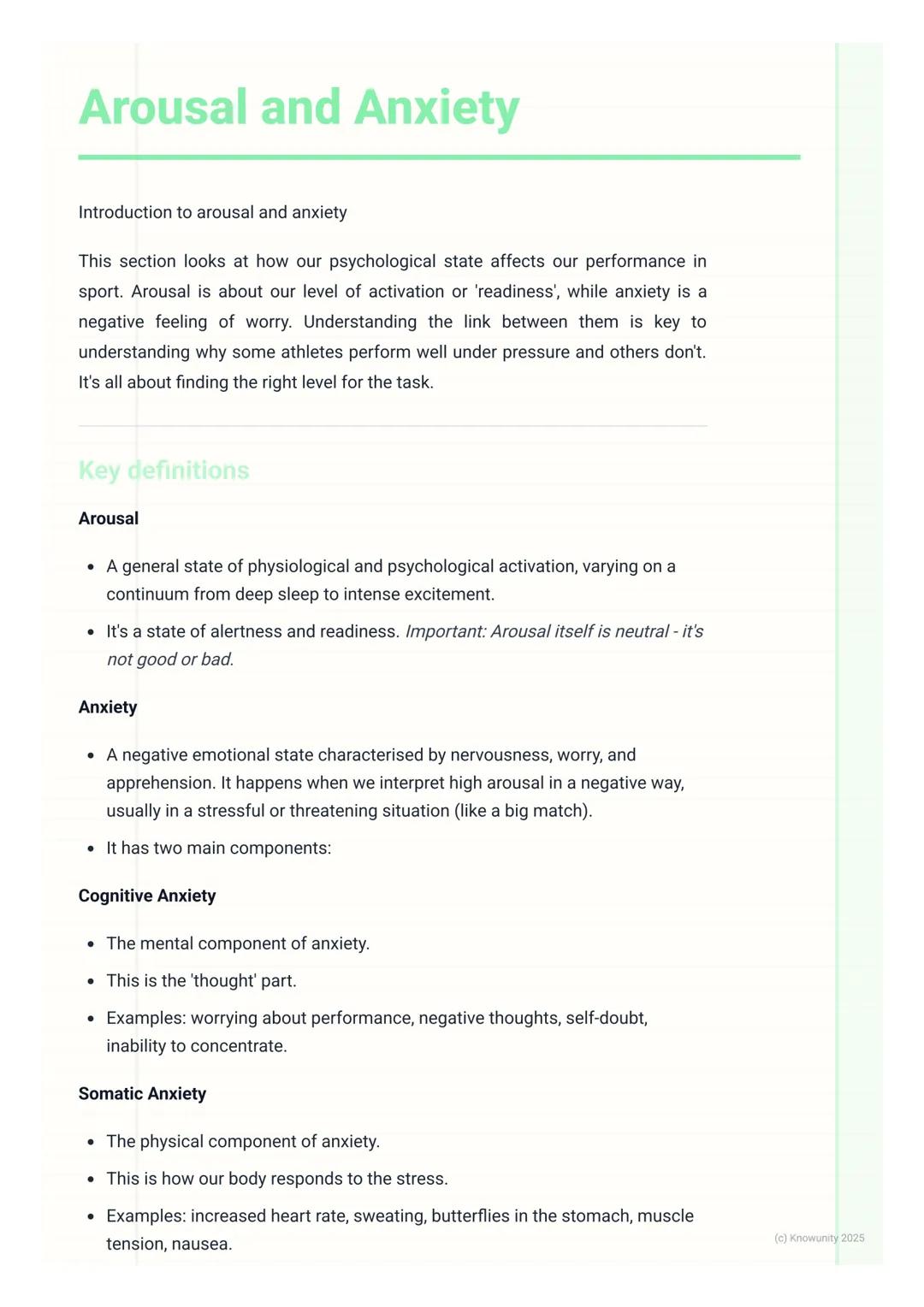
Understanding Arousal and Anxiety
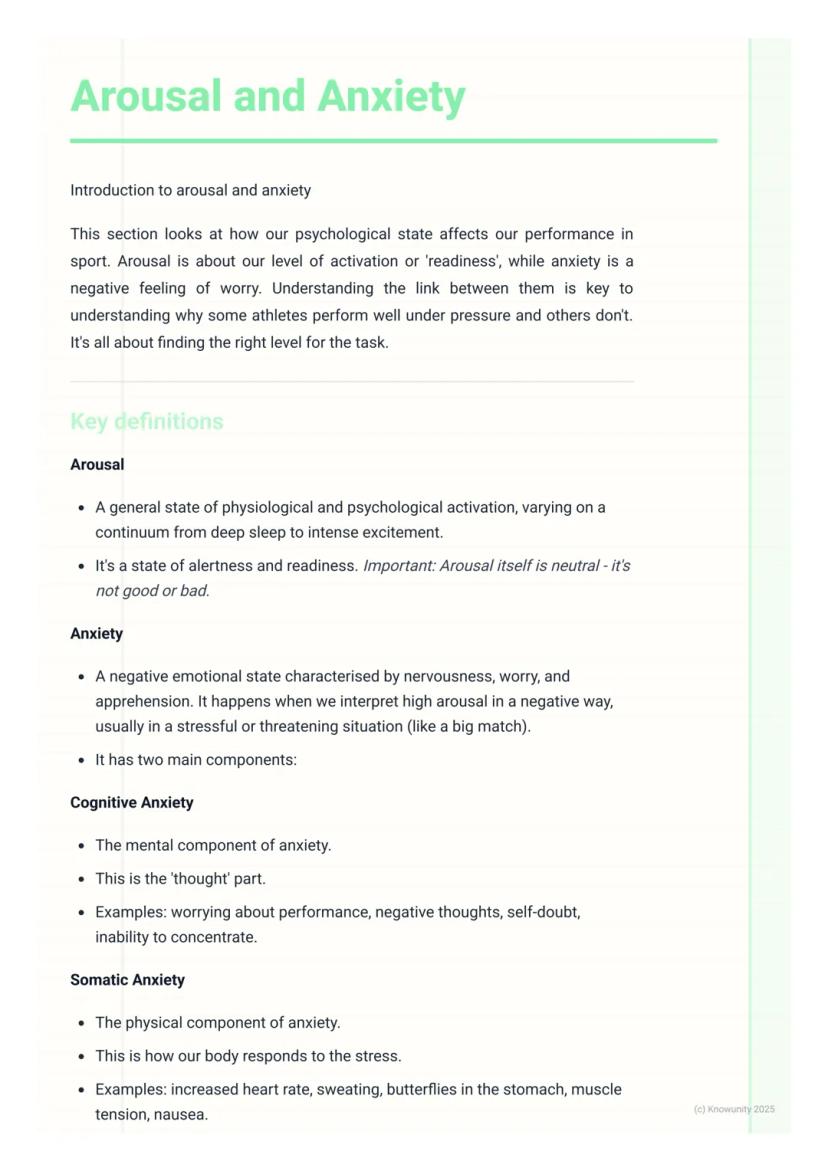
Think of arousal as your body's engine revving up - it's simply your level of alertness and readiness, ranging from being half-asleep to buzzing with excitement. Here's the crucial bit: arousal isn't good or bad, it's completely neutral.
Anxiety, however, is when things go wrong. It's that horrible feeling of worry and nervousness that hits when you interpret high arousal negatively - like when you're about to take a crucial penalty in front of thousands of people.
Anxiety shows up in two ways. Cognitive anxiety messes with your head - think negative thoughts, worrying about failing, or losing concentration. Somatic anxiety attacks your body with symptoms like sweating, butterflies in your stomach, shaking hands, or your heart pounding out of your chest.
Quick Check: Remember that arousal is neutral energy, whilst anxiety is when that energy becomes negative and starts working against you.
2
of 5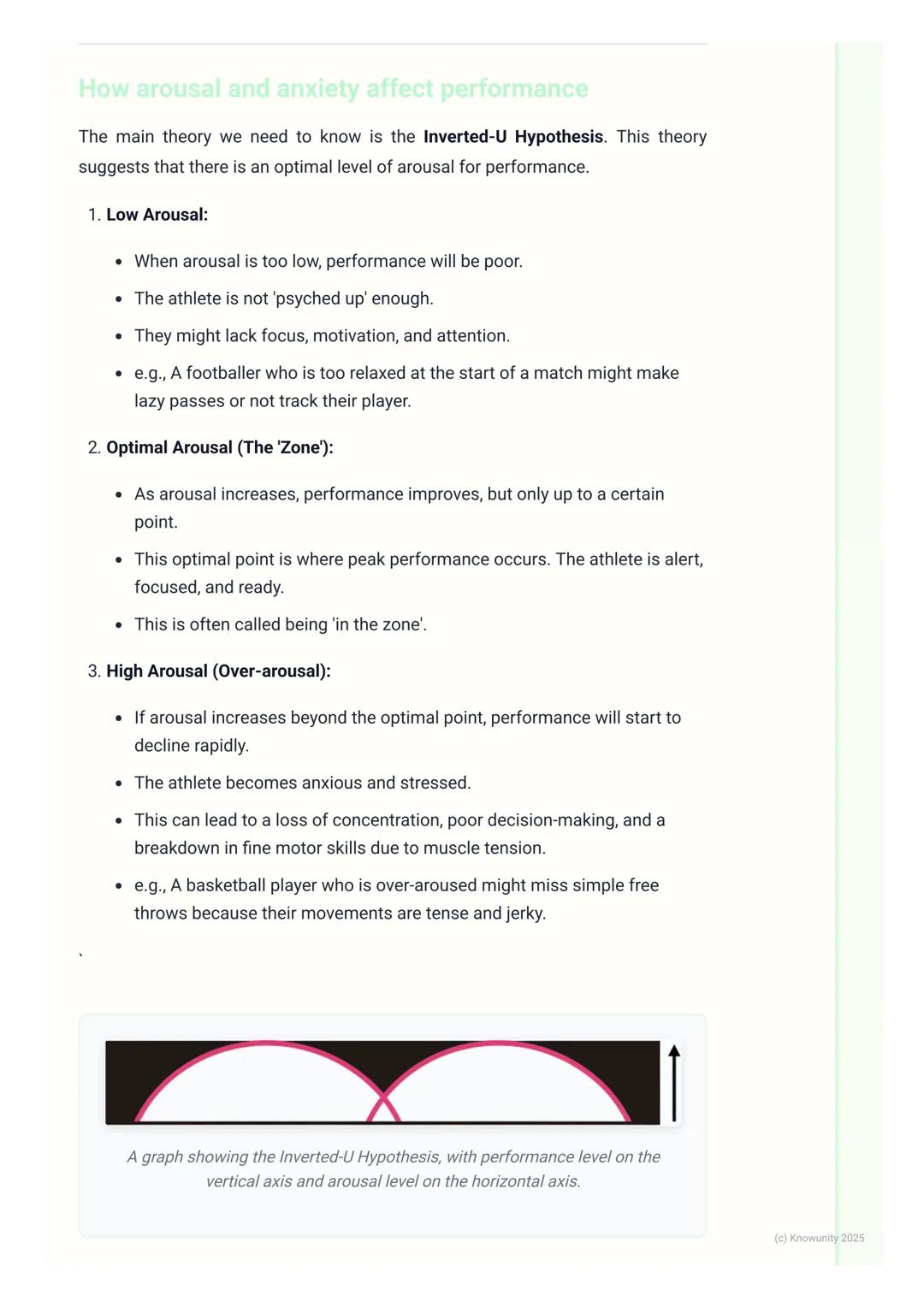
The Inverted-U Hypothesis
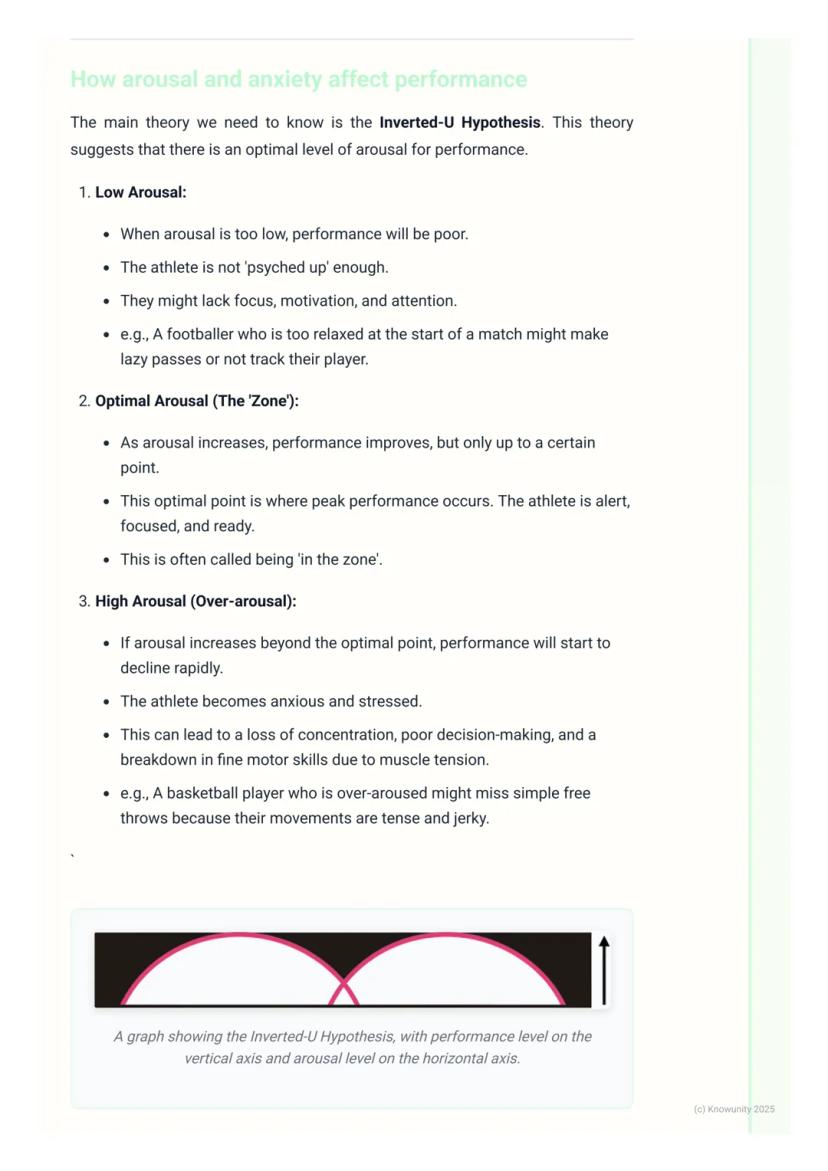
This theory is absolutely essential for understanding sports performance. Picture an upside-down U shape - that's how arousal affects your performance, and it explains why finding the sweet spot matters so much.
When arousal is too low, you'll perform poorly because you're not mentally switched on. You might lack focus or motivation - like a footballer making lazy passes because they're not properly warmed up mentally.
At optimal arousal (the magic zone), you hit peak performance. You're alert, focused, and everything clicks into place. This is what athletes mean when they talk about being "in the zone" - it's genuinely the best feeling in sport.
But push arousal too high and you'll crash spectacularly. Over-arousal triggers anxiety, causing poor decision-making, loss of concentration, and tense muscles that ruin your technique. Think of a basketball player missing simple free throws because they're too wound up.
Performance Tip: Your optimal arousal level isn't fixed - it changes depending on what sport you're playing and how experienced you are.
3
of 5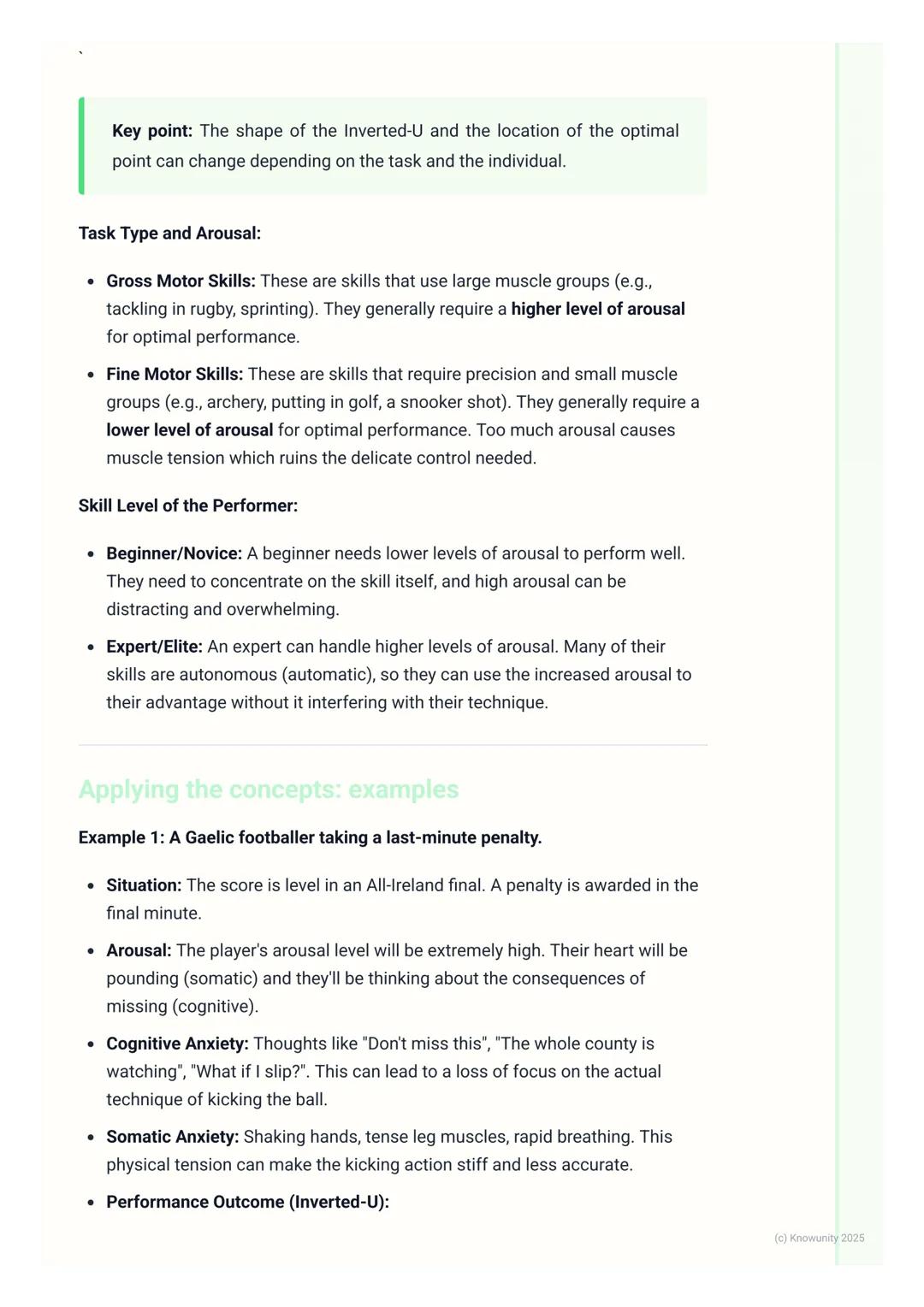
What Affects Your Optimal Arousal Level
Not all sports need the same arousal level, and this is where understanding task types becomes crucial for your performance.
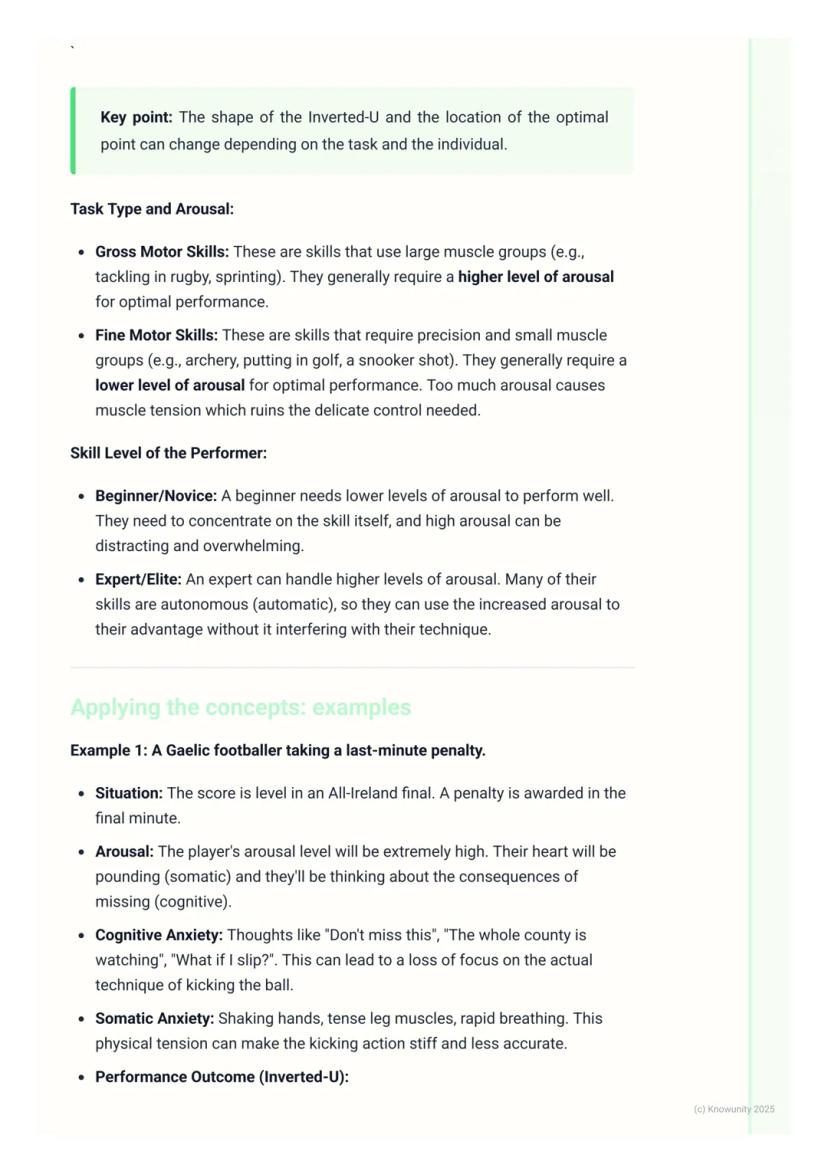
Gross motor skills use big muscle groups - like tackling in rugby or sprinting. These activities can handle much higher arousal levels because the movements are powerful and explosive. Getting properly fired up actually helps your performance here.
Fine motor skills require precision and small muscle control - think archery, putting in golf, or taking a snooker shot. These need much lower arousal levels because too much energy creates muscle tension that destroys the delicate control you need.
Your skill level also matters massively. Beginners need lower arousal to concentrate on learning the basic technique - high arousal just becomes overwhelming and distracting. Expert athletes can handle much higher arousal because their skills are automatic, so they can channel that extra energy positively.
Exam Gold: Always mention both task type and skill level when applying the Inverted-U hypothesis to examples.
4
of 5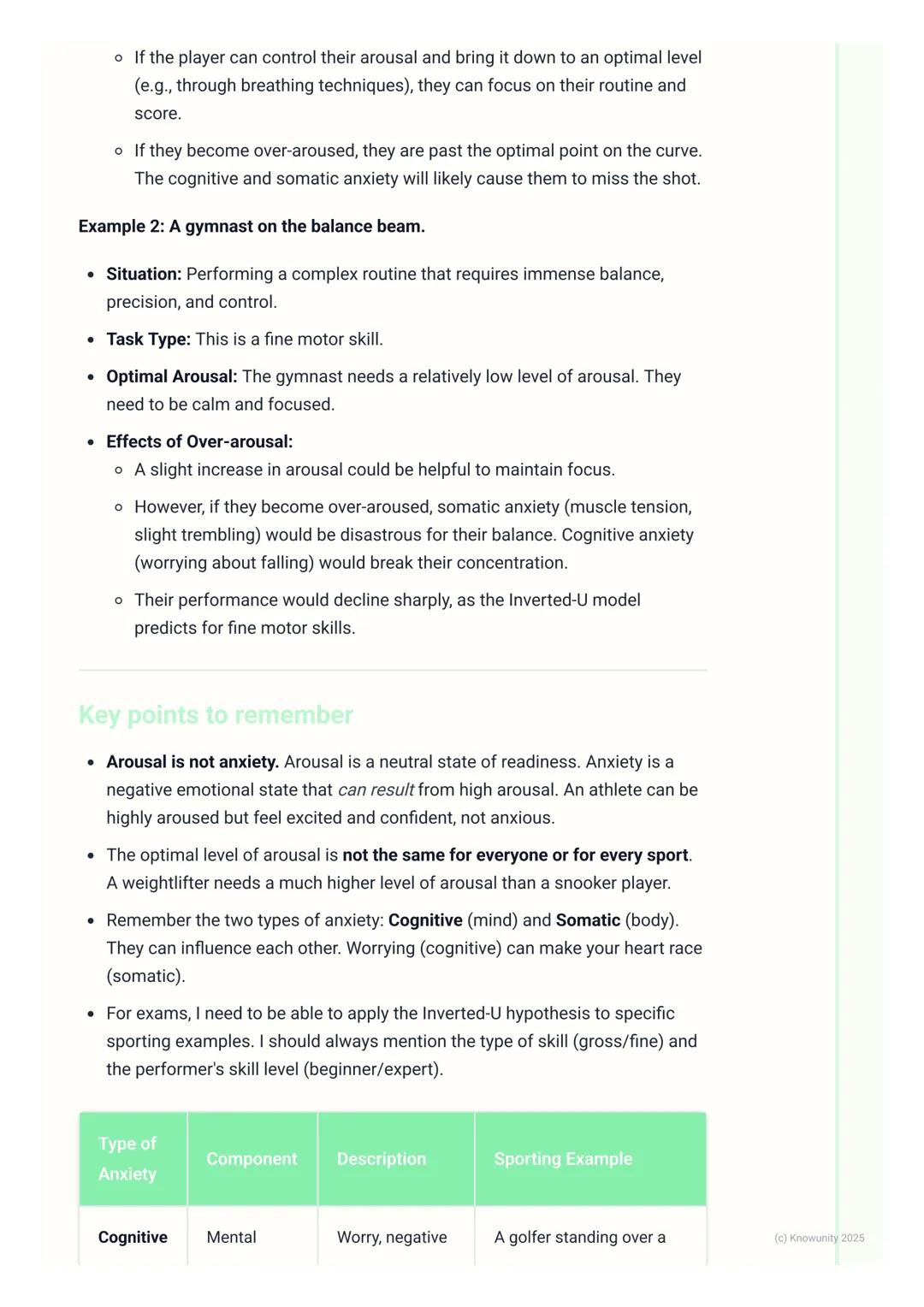
Real-World Examples
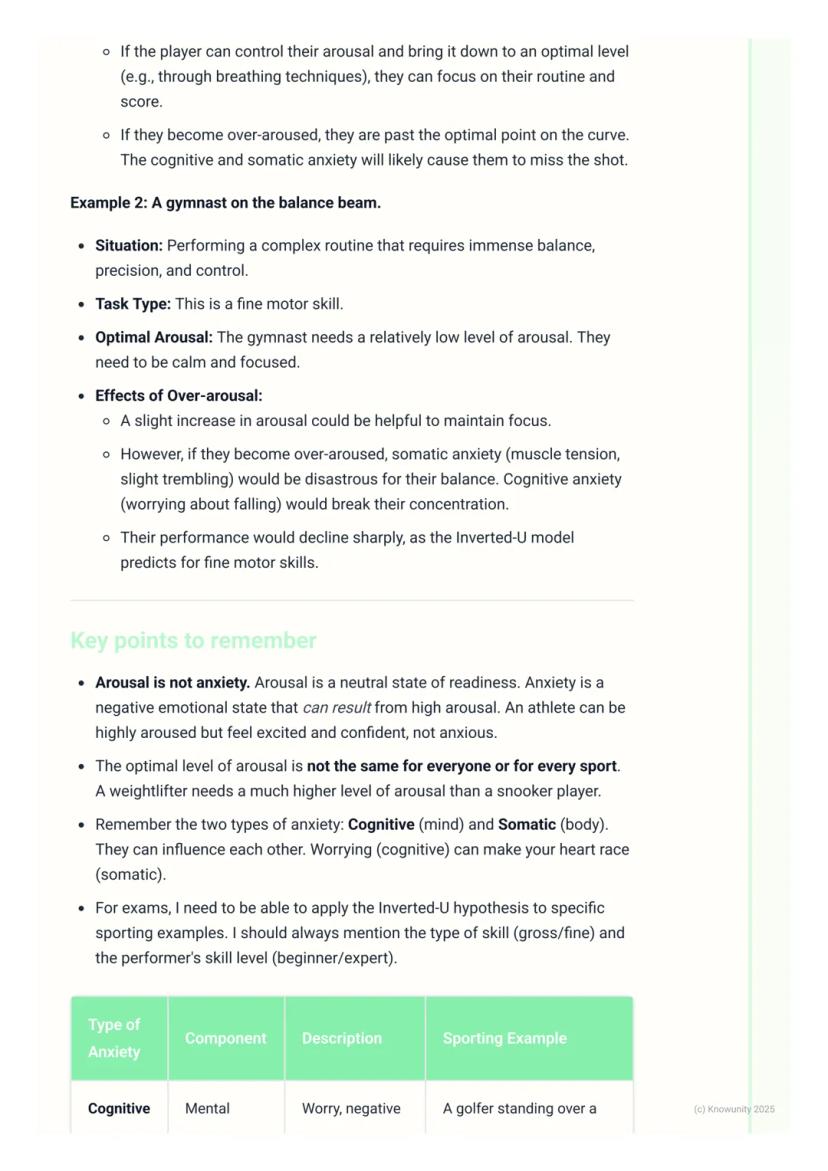
Picture a Gaelic footballer taking a last-minute penalty in an All-Ireland final. Their arousal will be through the roof - heart pounding (somatic anxiety) whilst thinking "don't miss this, everyone's watching" (cognitive anxiety).
If they can control that arousal through breathing techniques and focus on their routine, they'll likely score. But if they become over-aroused, the muscle tension and negative thoughts will probably cause them to miss - they've gone past their optimal point on the curve.
Now consider a gymnast on the balance beam. This fine motor skill needs relatively low arousal for the precision and control required. A slight increase might help focus, but over-arousal would be disastrous - muscle tension would ruin their balance, whilst worrying about falling would shatter their concentration.
The key difference? The footballer can potentially use higher arousal (gross motor skill), whilst the gymnast needs to stay much calmer (fine motor skill). Both need to find their sweet spot, but those spots are in completely different places.
Remember: Arousal and anxiety aren't the same thing - you can be highly aroused but feel excited and confident, not anxious.
5
of 5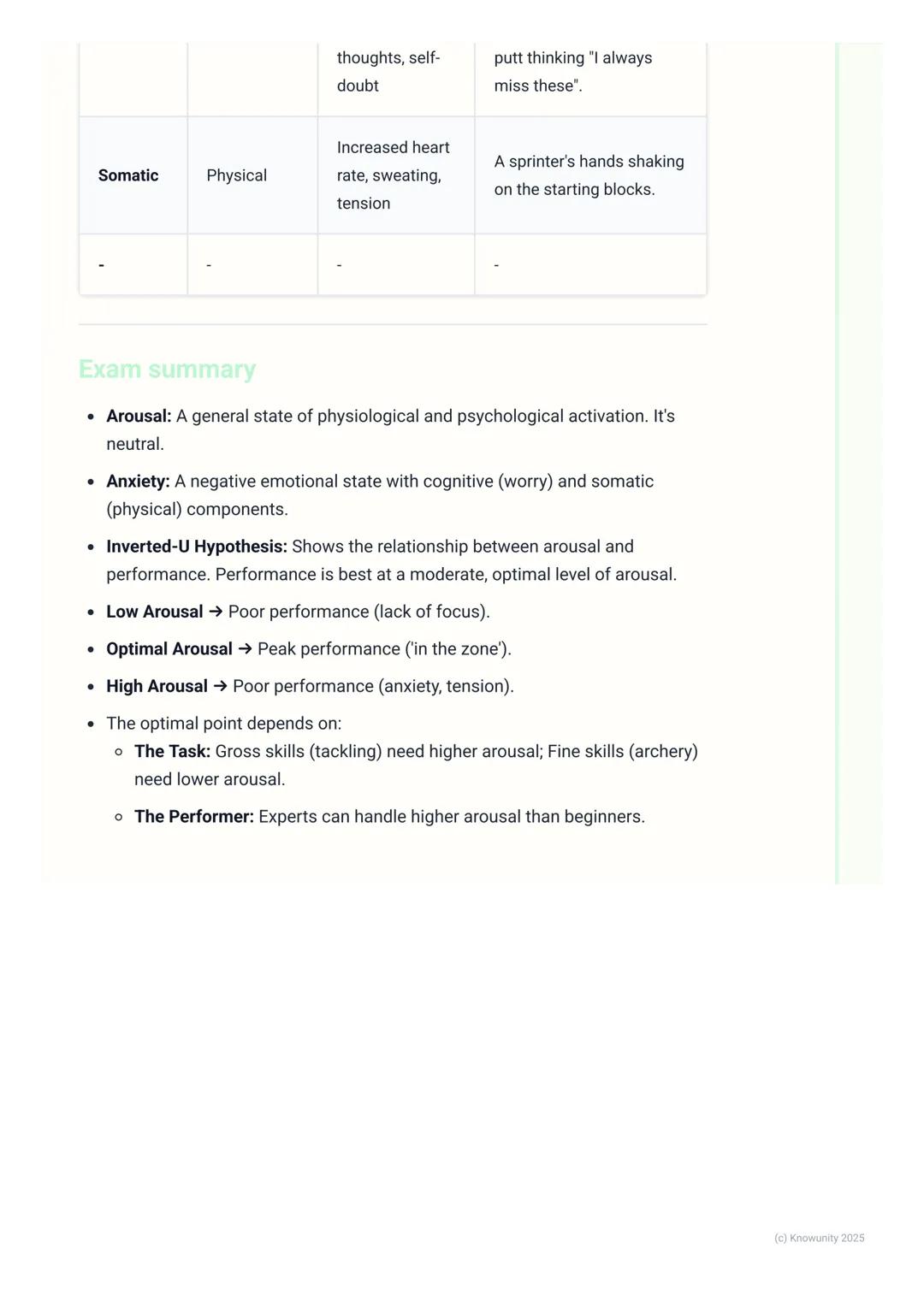
Exam Summary
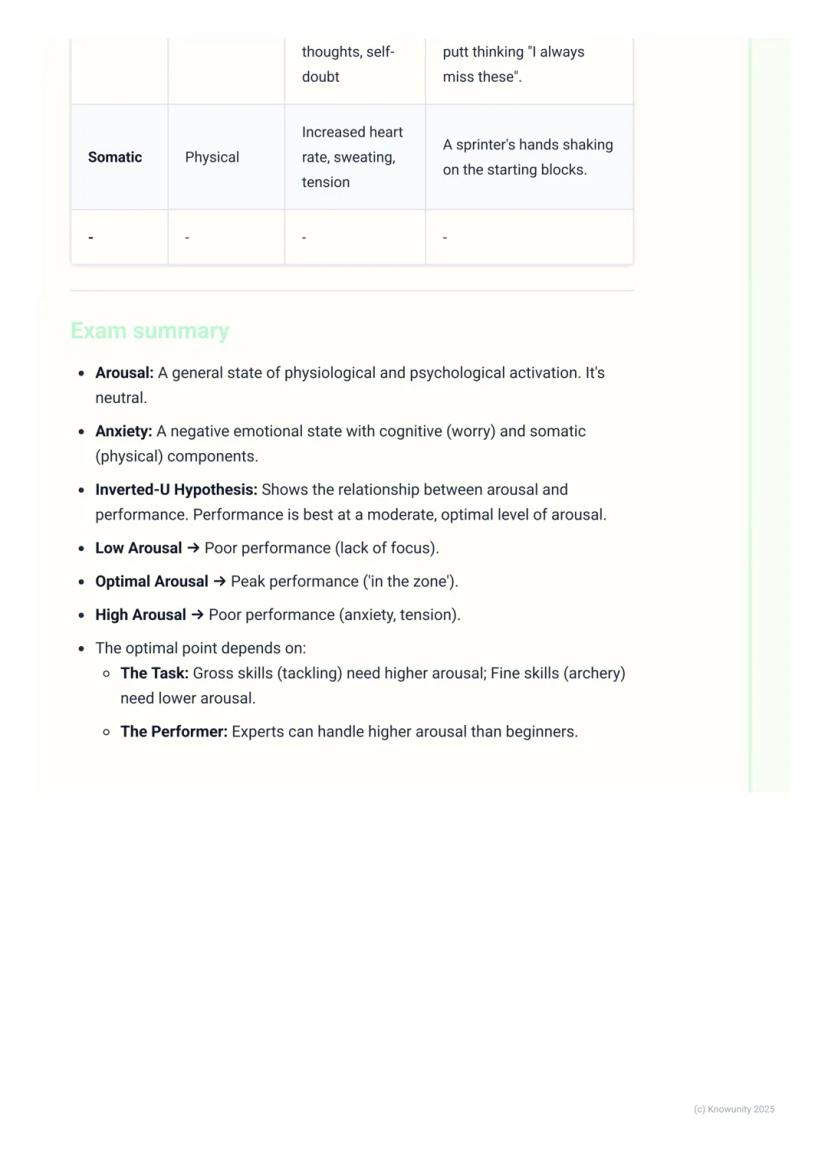
Arousal is your neutral state of activation - think of it as your psychological and physical readiness level. Anxiety is when high arousal turns negative, creating worry (cognitive anxiety) and physical symptoms like sweating or shaking (somatic anxiety).
The Inverted-U Hypothesis shows that performance peaks at moderate arousal levels. Too low means poor focus, optimal means peak performance, and too high creates anxiety that destroys performance.
Your optimal arousal depends on two key factors. Task type matters - gross motor skills (tackling) can handle higher arousal, whilst fine motor skills (archery) need lower levels. Performer level also counts - experts can cope with higher arousal than beginners.
For your exams, always apply these concepts to specific sporting examples. Mention whether it's a gross or fine motor skill, consider the performer's experience level, and explain how different arousal levels would affect their performance using the Inverted-U model.
Exam Success: Practice applying the Inverted-U hypothesis to different sports scenarios - it's a guaranteed way to pick up marks and show you truly understand the concept.
Si on te demande...
Qu'est-ce que le compagnon IA de Knowunity ?
Notre compagnon IA est spécialement conçu pour répondre aux besoins des étudiants. Sur la base des millions d'éléments de contenu que nous avons sur la plateforme, nous pouvons fournir des réponses vraiment significatives et pertinentes aux étudiants. Mais il ne s'agit pas seulement de réponses, le compagnon a encore plus pour but de guider les élèves dans leurs défis d'apprentissage quotidiens, avec des plans d'étude personnalisés, des quiz ou des éléments de contenu dans le chat et une personnalisation à 100% basée sur les compétences et les développements de l'étudiant.
Où puis-je télécharger l'appli Knowunity ?
Tu peux télécharger l'application dans Google Play Store et dans l'App Store d'Apple.
L'application est-elle vraiment gratuite ?
Oui, tu as un accès entièrement gratuit à tous les contenus de l'appli, tu peux chatter ou suivre les créateurs à tout moment. De plus, nous proposons Knowunity Premium, qui te permet de réviser sans limites!
Contenus les plus populaires en LCPE
4LCPEHealthy Eating Guidelines
This section explores national healthy eating guidelines, such as the food pyramid or healthy eating plate, to promote balanced dietary choices.
5th Year50
LCPEBiomechanics of Movement
Applying fundamental biomechanical principles such as force, motion, levers, and stability to analyse and improve human movement efficiency and performance in sport.
6th Year200
LCPEFactors effecting sports psychology ( confidence and self efficacy)
Higher Level LCPE psychological preprration notes
5th Year230
LCPETechnology in Sport
Investigating how technology is used in areas such as performance analysis, equipment design, officiating, and athlete monitoring to enhance training and competition.
6th Year50
Contenus les plus populaires
9 Irish
IrishIrish oral questions and answers
Questions and answers for the leaving cert oral
5th Year4264
 English
Key Quotes : Sive
Key Quotes and explanations: Sive
6th Year2842
IrishIrish oral questions
Outline of oral questions
5th Year2055
IrishIníon- le hÁine Durkin
Aine Durkin’s poem, Iníon: Themes & summary
5th Year890
IrishIrish poetry 2027
Iníon + Dínit an Bhróin
5th Year1153
IrishLC HL notes- Iníon (poem)
Includes poem in English and Irish, theme, key words & phrases
5th Year2304
EnglishCultural Context : Shawshank Redemption : Sive : Small Things Like These
Comparative Study : Cultural Context : Shawshank Redemption, Sive and Small Things Like These
6th Year1430
IrishMo Ghrá-sa (Idir Lúibíní)
Notes on mo ghrá-sa
5th Year380
IrishAn Gaeilge Aiste
Irish Language essay
6th Year1320
Rien ne te convient ? Explore d'autres matières.
Les étudiants nous adorent — il ne manque plus que toi.
4.6/5App Store
4.7/5Google Play
L'application est très facile d'utilisation et bien conçue. Jusqu'à présent, j'ai trouvé tout ce que je cherchais et j'ai pu apprendre beaucoup de choses grâce aux présentations ! Je vais certainement utiliser l'application pour un travail en classe ! Et comme source d'inspiration personnelle, elle est bien sûr aussi très utile.
Stefan Sutilisateur iOS
Cette application est vraiment super. Il y a tellement de fiches de révision et d'aide, [...]. Par exemple, la matière qui me pose problème est le français et l'appli a un choix d'aide très large. Grâce à cette application, je me suis améliorée en français. Je la recommanderais à tout le monde.
Samantha Klichutilisatrice Android
Waouh, je suis vraiment abasourdi. J'ai essayé l'application parce que je l'avais déjà vue plusieurs fois dans la publicité et j'ai été absolument choquée. Cette appli est L'AIDE dont on rêve pour l'école et surtout, elle propose tellement de choses, comme des rédactions et des fiches qui m'ont personnellement TRÈS bien aidé.
Annautilisatrice iOS
LCPE4 vues·Mis à jour Jun 15, 2026·5 pagesUnderstanding Arousal and Anxiety: Effects on Performance
Ever wondered why some athletes crumble under pressure whilst others thrive? It's all about understanding arousal and anxiety- two psychological states that can make or break your sporting performance. Getting the balance right is the difference between being "in...
1
of 5
Inscris-toi pour voir le contenu. C'est gratuit!
- Accès à tous les documents
- Améliore tes notes
- Rejoins des millions d'étudiants
Understanding Arousal and Anxiety
Think of arousal as your body's engine revving up - it's simply your level of alertness and readiness, ranging from being half-asleep to buzzing with excitement. Here's the crucial bit: arousal isn't good or bad, it's completely neutral.
Anxiety, however, is when things go wrong. It's that horrible feeling of worry and nervousness that hits when you interpret high arousal negatively - like when you're about to take a crucial penalty in front of thousands of people.
Anxiety shows up in two ways. Cognitive anxiety messes with your head - think negative thoughts, worrying about failing, or losing concentration. Somatic anxiety attacks your body with symptoms like sweating, butterflies in your stomach, shaking hands, or your heart pounding out of your chest.
Quick Check: Remember that arousal is neutral energy, whilst anxiety is when that energy becomes negative and starts working against you.
2
of 5Inscris-toi pour voir le contenu. C'est gratuit!
- Accès à tous les documents
- Améliore tes notes
- Rejoins des millions d'étudiants
The Inverted-U Hypothesis
This theory is absolutely essential for understanding sports performance. Picture an upside-down U shape - that's how arousal affects your performance, and it explains why finding the sweet spot matters so much.
When arousal is too low, you'll perform poorly because you're not mentally switched on. You might lack focus or motivation - like a footballer making lazy passes because they're not properly warmed up mentally.
At optimal arousal (the magic zone), you hit peak performance. You're alert, focused, and everything clicks into place. This is what athletes mean when they talk about being "in the zone" - it's genuinely the best feeling in sport.
But push arousal too high and you'll crash spectacularly. Over-arousal triggers anxiety, causing poor decision-making, loss of concentration, and tense muscles that ruin your technique. Think of a basketball player missing simple free throws because they're too wound up.
Performance Tip: Your optimal arousal level isn't fixed - it changes depending on what sport you're playing and how experienced you are.
3
of 5Inscris-toi pour voir le contenu. C'est gratuit!
- Accès à tous les documents
- Améliore tes notes
- Rejoins des millions d'étudiants
What Affects Your Optimal Arousal Level
Not all sports need the same arousal level, and this is where understanding task types becomes crucial for your performance.
Gross motor skills use big muscle groups - like tackling in rugby or sprinting. These activities can handle much higher arousal levels because the movements are powerful and explosive. Getting properly fired up actually helps your performance here.
Fine motor skills require precision and small muscle control - think archery, putting in golf, or taking a snooker shot. These need much lower arousal levels because too much energy creates muscle tension that destroys the delicate control you need.
Your skill level also matters massively. Beginners need lower arousal to concentrate on learning the basic technique - high arousal just becomes overwhelming and distracting. Expert athletes can handle much higher arousal because their skills are automatic, so they can channel that extra energy positively.
Exam Gold: Always mention both task type and skill level when applying the Inverted-U hypothesis to examples.
4
of 5Inscris-toi pour voir le contenu. C'est gratuit!
- Accès à tous les documents
- Améliore tes notes
- Rejoins des millions d'étudiants
Real-World Examples
Picture a Gaelic footballer taking a last-minute penalty in an All-Ireland final. Their arousal will be through the roof - heart pounding (somatic anxiety) whilst thinking "don't miss this, everyone's watching" (cognitive anxiety).
If they can control that arousal through breathing techniques and focus on their routine, they'll likely score. But if they become over-aroused, the muscle tension and negative thoughts will probably cause them to miss - they've gone past their optimal point on the curve.
Now consider a gymnast on the balance beam. This fine motor skill needs relatively low arousal for the precision and control required. A slight increase might help focus, but over-arousal would be disastrous - muscle tension would ruin their balance, whilst worrying about falling would shatter their concentration.
The key difference? The footballer can potentially use higher arousal (gross motor skill), whilst the gymnast needs to stay much calmer (fine motor skill). Both need to find their sweet spot, but those spots are in completely different places.
Remember: Arousal and anxiety aren't the same thing - you can be highly aroused but feel excited and confident, not anxious.
5
of 5Inscris-toi pour voir le contenu. C'est gratuit!
- Accès à tous les documents
- Améliore tes notes
- Rejoins des millions d'étudiants
Exam Summary
Arousal is your neutral state of activation - think of it as your psychological and physical readiness level. Anxiety is when high arousal turns negative, creating worry (cognitive anxiety) and physical symptoms like sweating or shaking (somatic anxiety).
The Inverted-U Hypothesis shows that performance peaks at moderate arousal levels. Too low means poor focus, optimal means peak performance, and too high creates anxiety that destroys performance.
Your optimal arousal depends on two key factors. Task type matters - gross motor skills (tackling) can handle higher arousal, whilst fine motor skills (archery) need lower levels. Performer level also counts - experts can cope with higher arousal than beginners.
For your exams, always apply these concepts to specific sporting examples. Mention whether it's a gross or fine motor skill, consider the performer's experience level, and explain how different arousal levels would affect their performance using the Inverted-U model.
Exam Success: Practice applying the Inverted-U hypothesis to different sports scenarios - it's a guaranteed way to pick up marks and show you truly understand the concept.
Si on te demande...
Qu'est-ce que le compagnon IA de Knowunity ?
Notre compagnon IA est spécialement conçu pour répondre aux besoins des étudiants. Sur la base des millions d'éléments de contenu que nous avons sur la plateforme, nous pouvons fournir des réponses vraiment significatives et pertinentes aux étudiants. Mais il ne s'agit pas seulement de réponses, le compagnon a encore plus pour but de guider les élèves dans leurs défis d'apprentissage quotidiens, avec des plans d'étude personnalisés, des quiz ou des éléments de contenu dans le chat et une personnalisation à 100% basée sur les compétences et les développements de l'étudiant.
Où puis-je télécharger l'appli Knowunity ?
Tu peux télécharger l'application dans Google Play Store et dans l'App Store d'Apple.
L'application est-elle vraiment gratuite ?
Oui, tu as un accès entièrement gratuit à tous les contenus de l'appli, tu peux chatter ou suivre les créateurs à tout moment. De plus, nous proposons Knowunity Premium, qui te permet de réviser sans limites!
Contenus les plus populaires en LCPE
4LCPEHealthy Eating Guidelines
This section explores national healthy eating guidelines, such as the food pyramid or healthy eating plate, to promote balanced dietary choices.
5th Year50
LCPEBiomechanics of Movement
Applying fundamental biomechanical principles such as force, motion, levers, and stability to analyse and improve human movement efficiency and performance in sport.
6th Year200
LCPEFactors effecting sports psychology ( confidence and self efficacy)
Higher Level LCPE psychological preprration notes
5th Year230
LCPETechnology in Sport
Investigating how technology is used in areas such as performance analysis, equipment design, officiating, and athlete monitoring to enhance training and competition.
6th Year50
Contenus les plus populaires
9IrishIrish oral questions and answers
Questions and answers for the leaving cert oral
5th Year4264
EnglishKey Quotes : Sive
Key Quotes and explanations: Sive
6th Year2842
IrishIrish oral questions
Outline of oral questions
5th Year2055
IrishIníon- le hÁine Durkin
Aine Durkin’s poem, Iníon: Themes & summary
5th Year890
IrishIrish poetry 2027
Iníon + Dínit an Bhróin
5th Year1153
IrishLC HL notes- Iníon (poem)
Includes poem in English and Irish, theme, key words & phrases
5th Year2304
EnglishCultural Context : Shawshank Redemption : Sive : Small Things Like These
Comparative Study : Cultural Context : Shawshank Redemption, Sive and Small Things Like These
6th Year1430
IrishMo Ghrá-sa (Idir Lúibíní)
Notes on mo ghrá-sa
5th Year380
IrishAn Gaeilge Aiste
Irish Language essay
6th Year1320
Rien ne te convient ? Explore d'autres matières.
Les étudiants nous adorent — il ne manque plus que toi.
4.6/5App Store
4.7/5Google Play
L'application est très facile d'utilisation et bien conçue. Jusqu'à présent, j'ai trouvé tout ce que je cherchais et j'ai pu apprendre beaucoup de choses grâce aux présentations ! Je vais certainement utiliser l'application pour un travail en classe ! Et comme source d'inspiration personnelle, elle est bien sûr aussi très utile.
Stefan Sutilisateur iOS
Cette application est vraiment super. Il y a tellement de fiches de révision et d'aide, [...]. Par exemple, la matière qui me pose problème est le français et l'appli a un choix d'aide très large. Grâce à cette application, je me suis améliorée en français. Je la recommanderais à tout le monde.
Samantha Klichutilisatrice Android
Waouh, je suis vraiment abasourdi. J'ai essayé l'application parce que je l'avais déjà vue plusieurs fois dans la publicité et j'ai été absolument choquée. Cette appli est L'AIDE dont on rêve pour l'école et surtout, elle propose tellement de choses, comme des rédactions et des fiches qui m'ont personnellement TRÈS bien aidé.
Annautilisatrice iOS