
Biomechanics might sound complicated, but it's just the physics behind... Affiche plus
 LCPE17 vues·Mis à jour Jun 1, 2026·8 pages
Understanding Biomechanics: Principles of Movement Efficiency

1 / 8
1
of 8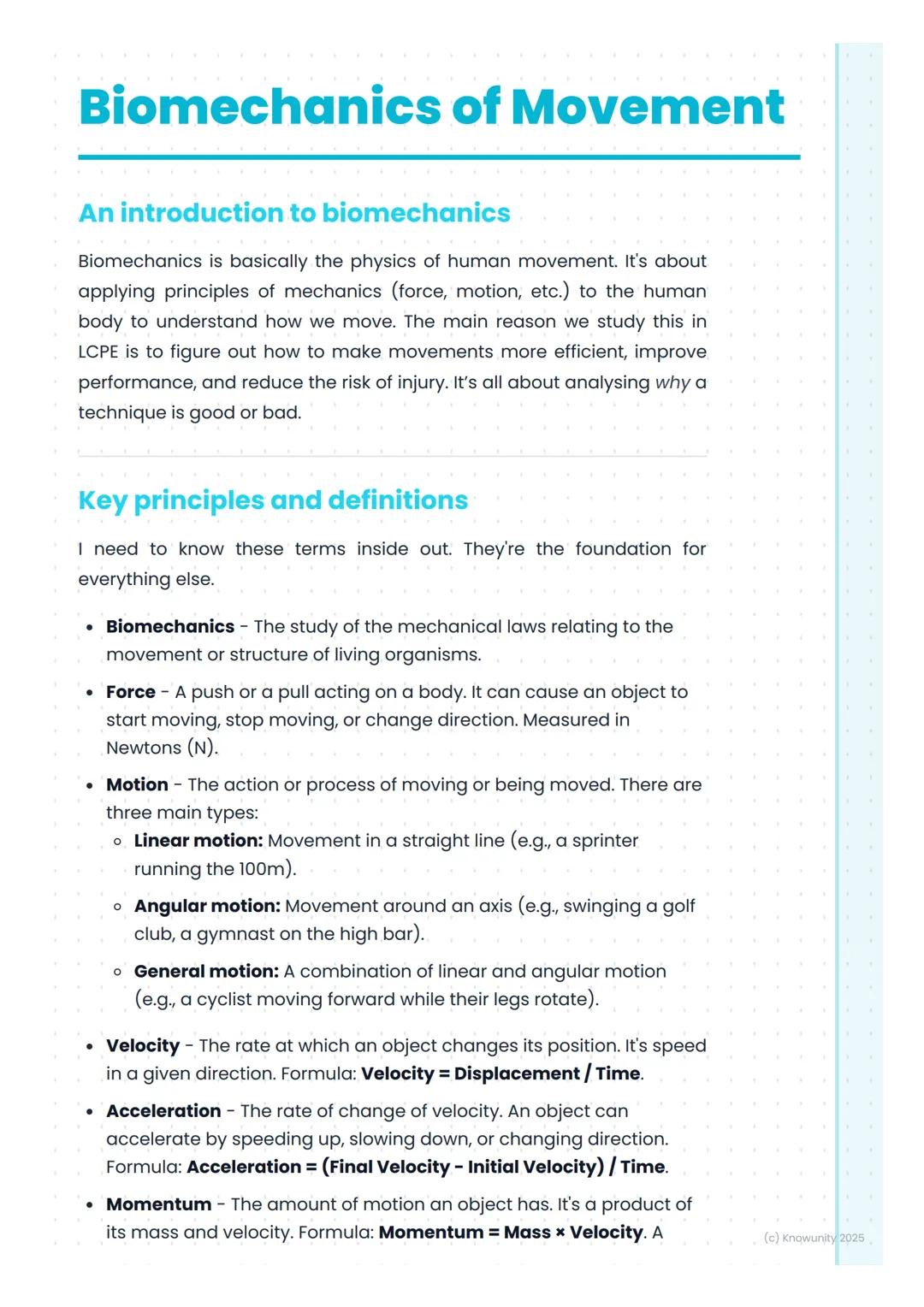
Understanding Biomechanics Basics
Biomechanics is essentially physics applied to human movement. It explains why some techniques work brilliantly whilst others fall flat, and it's your key to understanding how athletes can move more efficiently and safely.
The fundamental concepts you need to master include force (any push or pull measured in Newtons), motion (which comes in three types: linear like sprinting, angular like swinging a hurley, and general motion combining both), and velocity (speed with direction). Acceleration tells us how quickly velocity changes, whilst momentum combines mass and velocity to show how much "oomph" a moving object has.
Your centre of mass is your body's theoretical balance point – usually around your navel when standing still. Stability is your ability to resist being moved or to return to your original position. These concepts work together to explain every sporting movement you'll ever see.
Key Point: Don't just memorise definitions – think about how you see these principles in action during your favourite sports!
2
of 8
Newton's Laws in Sport
Newton's three laws govern every sporting movement you can imagine. Newton's First Law (inertia) explains why a Gaelic football stays put until you kick it, and why it keeps flying until air resistance slows it down. Objects resist changes to their motion – the heavier they are, the more they resist.
Newton's Second Law gives us the crucial formula: Force = Mass × Acceleration. This explains why shot putters need massive force to accelerate that heavy ball, or why a lighter hurley can be swung faster than a heavier one. Want more acceleration? Apply more force or reduce the mass.
Newton's Third Law states that every action has an equal and opposite reaction. When you jump, you push down on the ground with a certain force, and the ground pushes back up on you with exactly the same force – that's what launches you into the air.
Remember: These laws work together in every sport – a sprinter uses all three when exploding from the blocks!
3
of 8
The Body's Lever System
Your body is basically a complex system of levers working together. Bones act as lever arms, joints serve as fulcrums, and muscles provide the effort to move loads like your body weight or sports equipment.
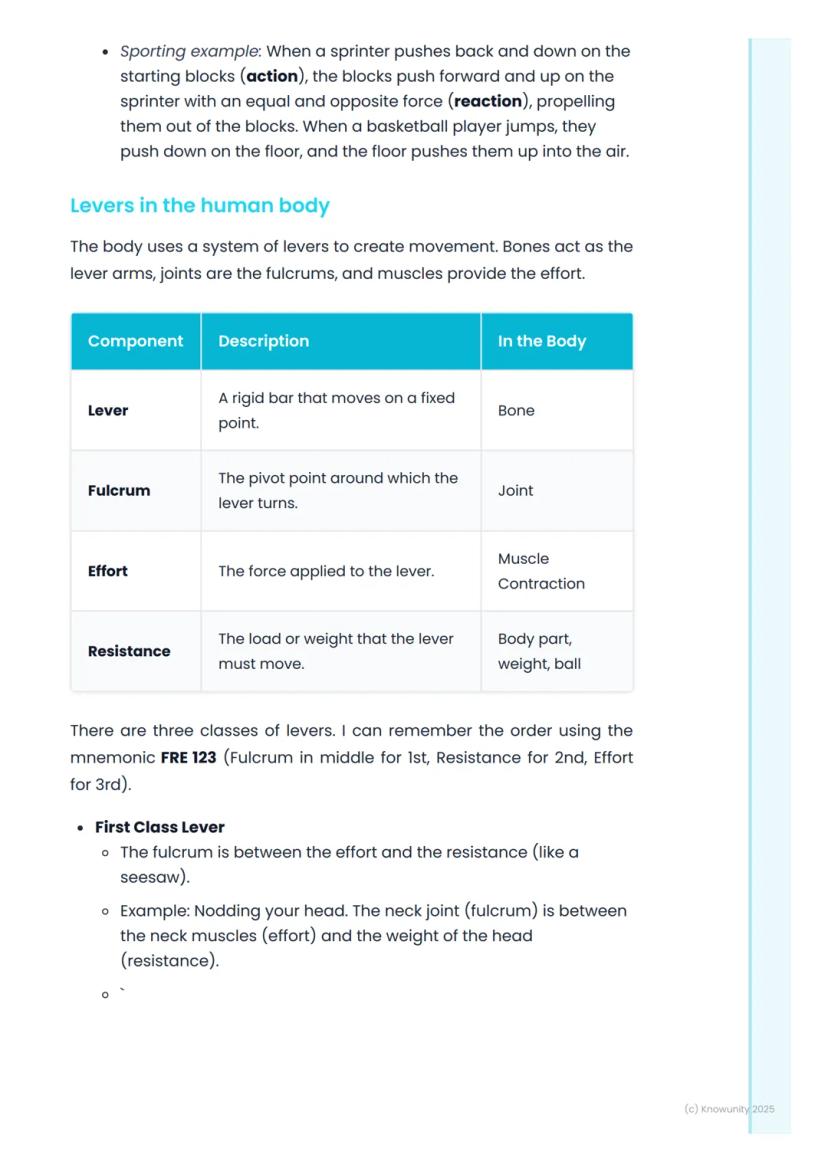
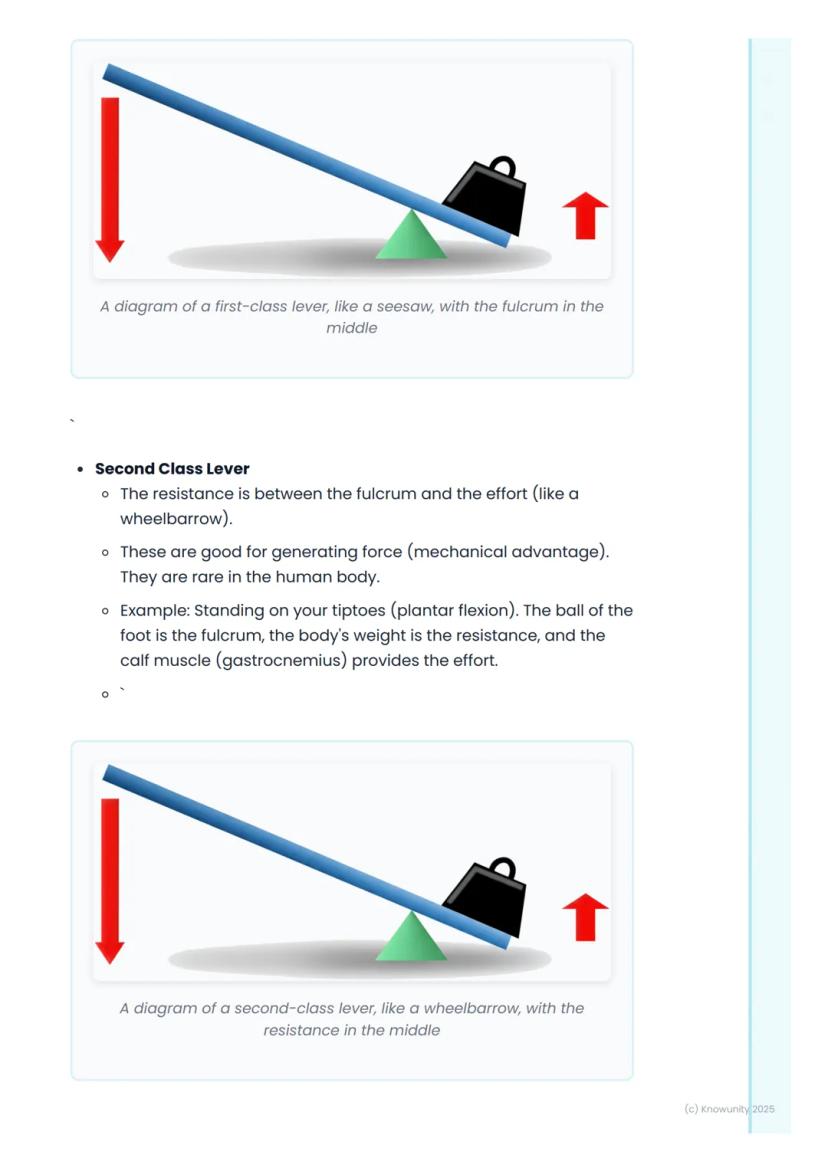
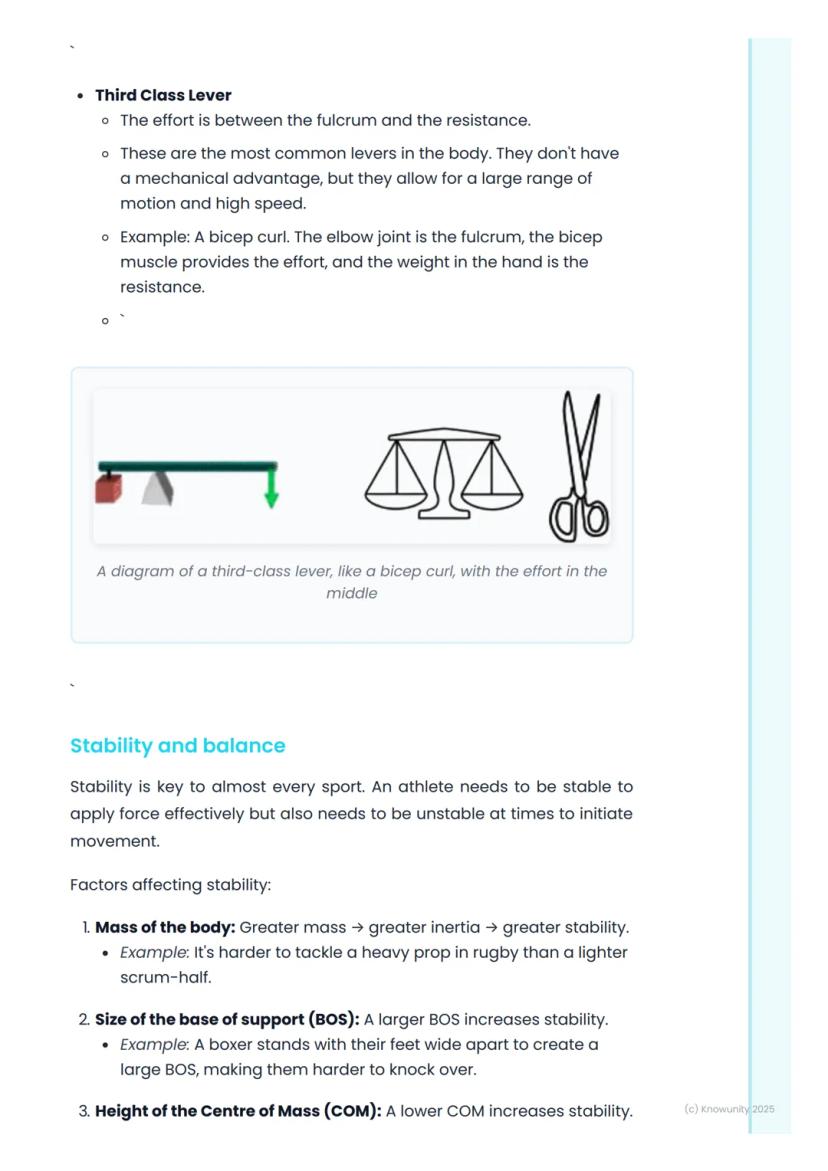
There are three classes of levers, and you can remember them with "FRE 123" – First class has the fulcrum in the middle (like nodding your head), second class has the resistance in the middle (like standing on your tiptoes), and third class has the effort in the middle (like doing a bicep curl).
Third-class levers are the most common in your body. They don't give you a mechanical advantage for strength, but they're brilliant for creating speed and range of motion. That's why you can swing a hurley or tennis racket so quickly – your arm acts as a third-class lever system.
Think About It: Every time you throw, kick, or swing something, you're using multiple lever systems working in sequence!
4
of 8
Mastering Stability and Balance
Stability isn't just about standing still – it's about controlling your body's position to perform effectively. Athletes need to be stable when applying force but unstable when they want to move quickly.
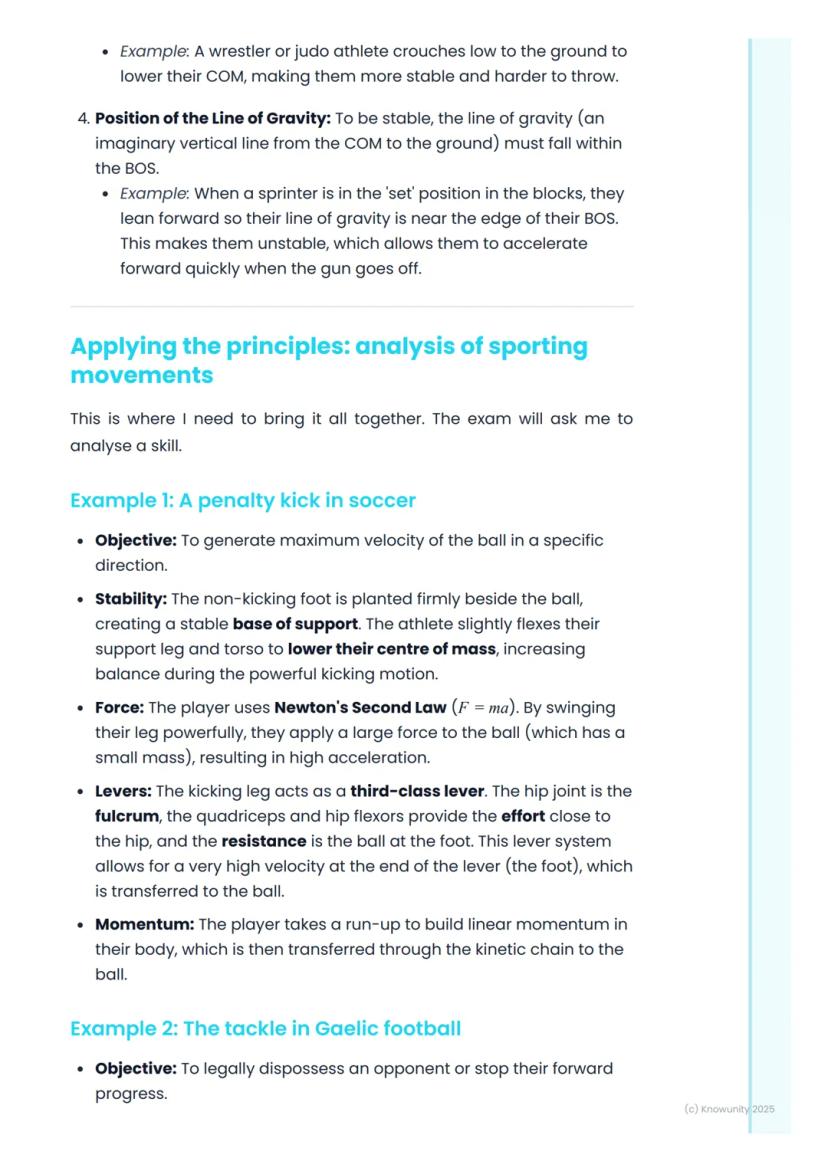
Four key factors affect your stability: greater body mass increases stability (harder to move a heavy rugby prop than a lightweight winger), wider base of support makes you more stable (boxers stand with feet apart), lower centre of mass increases stability (wrestlers crouch low), and keeping your line of gravity within your base of support maintains balance.
Smart athletes manipulate these factors constantly. A sprinter in the blocks deliberately becomes unstable by leaning forward, positioning their line of gravity at the edge of their base of support. This makes them ready to explode forward the moment the gun fires.
Pro Tip: Watch how different sports require different stability strategies – compare a gymnast on beam to a rugby player in a scrum!
5
of 8
Analysing Real Sporting Movements
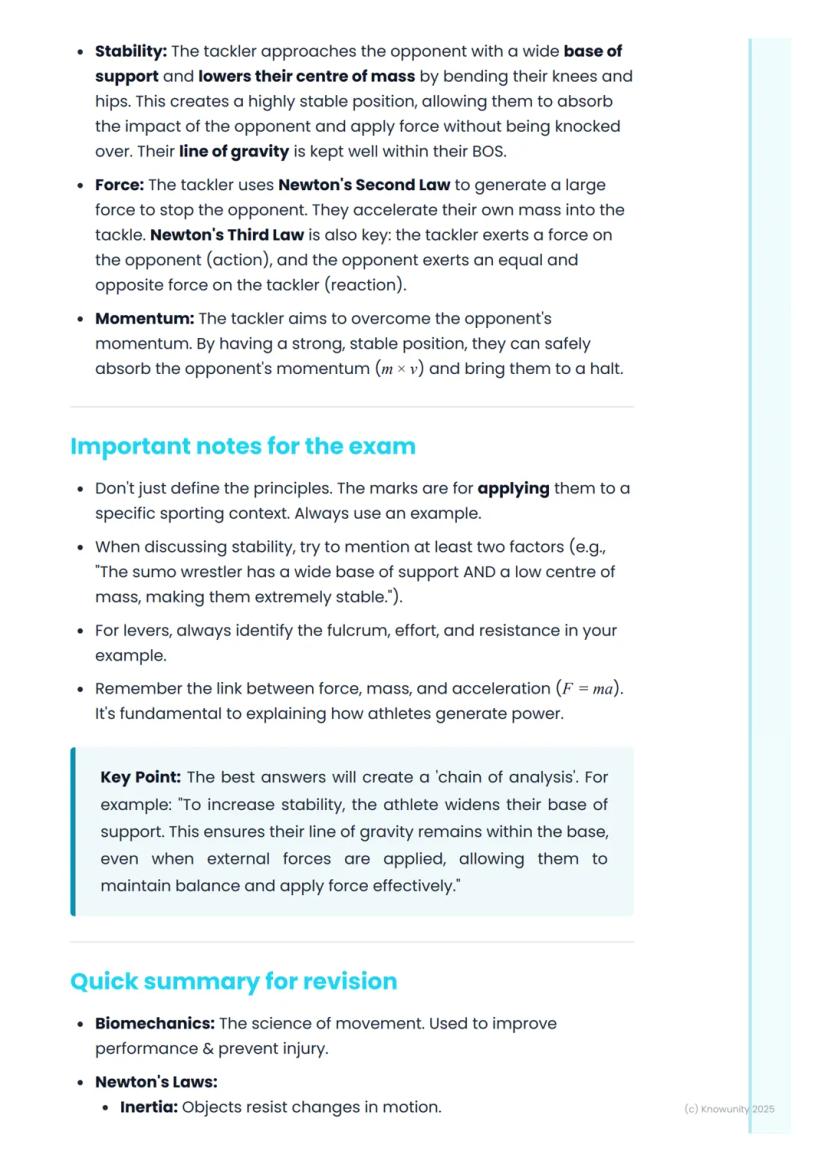
Let's put theory into practice with a penalty kick in soccer. The player plants their non-kicking foot firmly beside the ball, creating a stable base whilst slightly lowering their centre of mass. They use Newton's Second Law by swinging their leg powerfully to apply massive force to the lightweight ball, creating huge acceleration.
The kicking leg works as a third-class lever – hip joint as fulcrum, leg muscles providing effort, and the ball as resistance. This lever system allows incredible speed at the foot, which transfers to the ball. The run-up builds linear momentum that flows through the kinetic chain.
In contrast, a tackle in Gaelic football focuses on stability and force absorption. The tackler widens their base of support and lowers their centre of mass, creating a rock-solid platform. They use their own momentum to overcome the opponent's momentum, whilst Newton's Third Law explains the equal and opposite forces at impact.
Exam Success: Always link multiple principles together – show how stability enables force application, or how lever systems create the momentum needed for effective performance!
6
of 8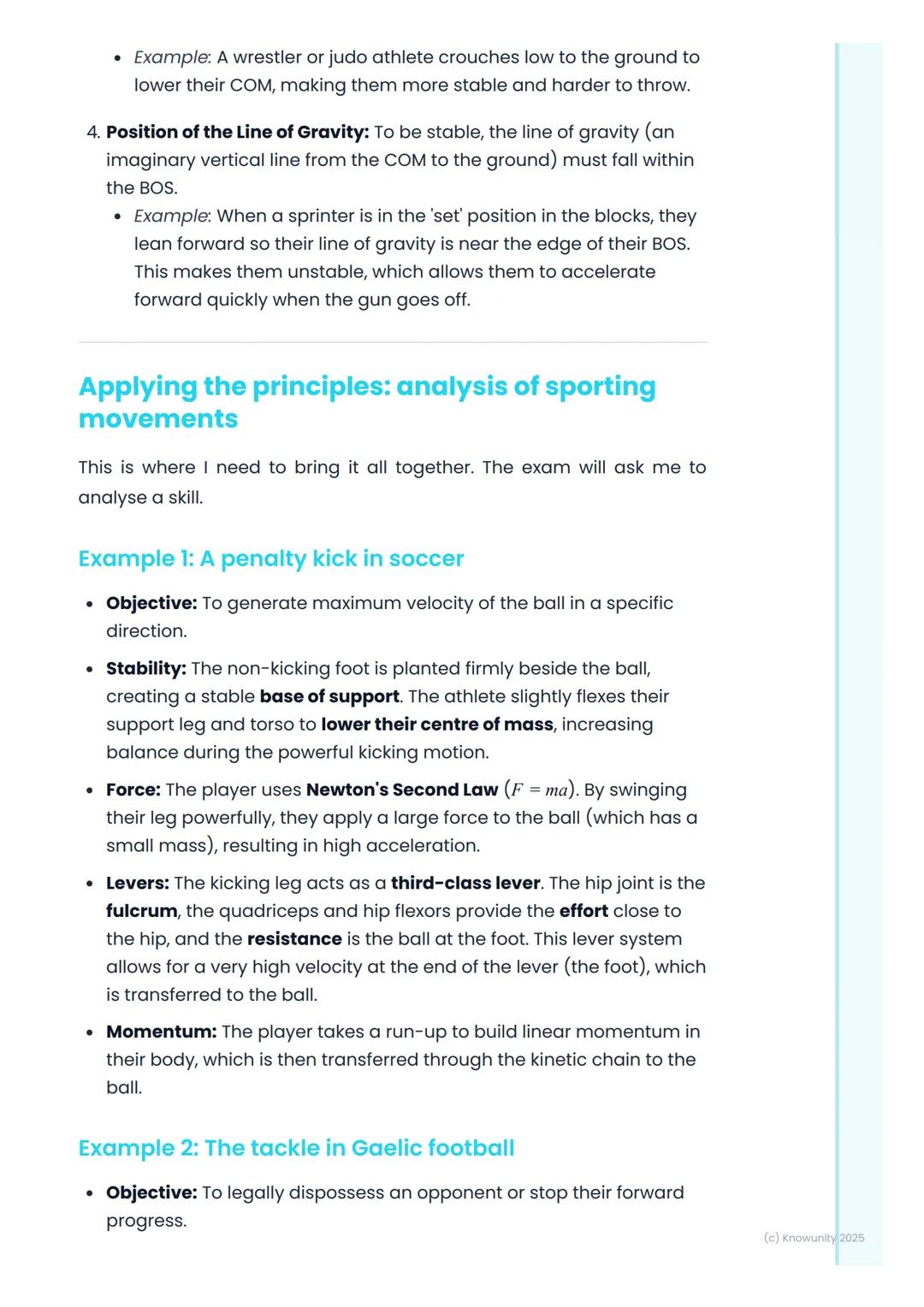
Quick Revision Summary
Newton's Laws: Inertia (objects resist change), F = ma (more force equals more acceleration), and action-reaction (forces always come in pairs). These explain every sporting movement from diving to weightlifting.
Lever Classes: First class has fulcrum in middle (neck movements), second class has resistance in middle (calf raises), third class has effort in middle (most body movements). Remember "FRE 123" for the order.
Stability Factors: High mass, wide base of support, low centre of mass, and line of gravity within base of support. Athletes manipulate these constantly – stable when applying force, unstable when initiating movement. Master these principles and you'll understand the "why" behind every technique in sport.
Final Thought: Biomechanics isn't just theory – it's the science that helps athletes break records and avoid injuries. These principles are your toolkit for understanding human movement!
7
of 8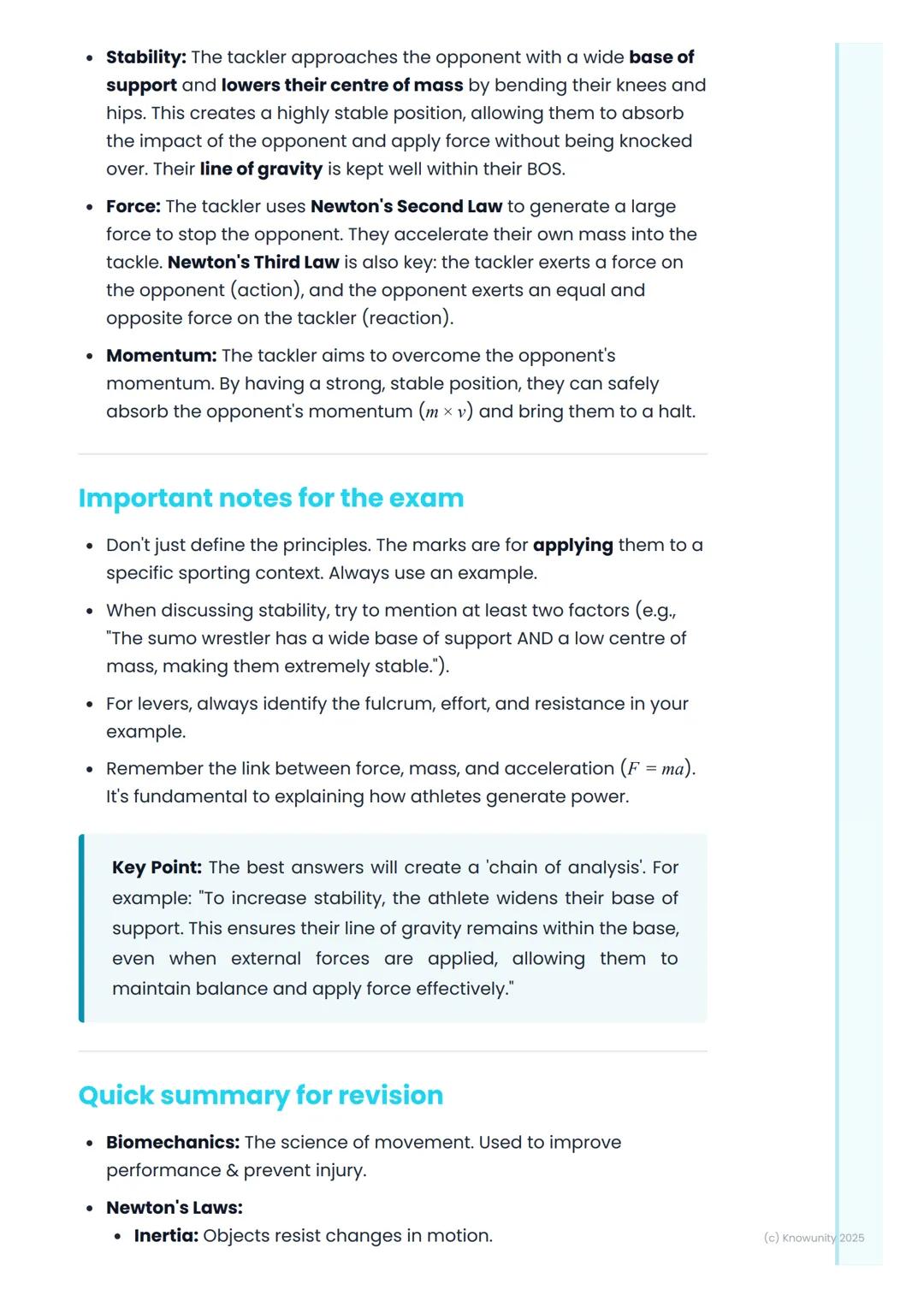
8
of 8
Si on te demande...
Qu'est-ce que le compagnon IA de Knowunity ?
Notre compagnon IA est spécialement conçu pour répondre aux besoins des étudiants. Sur la base des millions d'éléments de contenu que nous avons sur la plateforme, nous pouvons fournir des réponses vraiment significatives et pertinentes aux étudiants. Mais il ne s'agit pas seulement de réponses, le compagnon a encore plus pour but de guider les élèves dans leurs défis d'apprentissage quotidiens, avec des plans d'étude personnalisés, des quiz ou des éléments de contenu dans le chat et une personnalisation à 100% basée sur les compétences et les développements de l'étudiant.
Où puis-je télécharger l'appli Knowunity ?
Tu peux télécharger l'application dans Google Play Store et dans l'App Store d'Apple.
L'application est-elle vraiment gratuite ?
Oui, tu as un accès entièrement gratuit à tous les contenus de l'appli, tu peux chatter ou suivre les créateurs à tout moment. De plus, nous proposons Knowunity Premium, qui te permet de réviser sans limites!
Contenus les plus populaires en LCPE
3Contenus les plus populaires
9Rien ne te convient ? Explore d'autres matières.
Les étudiants nous adorent — il ne manque plus que toi.
4.6/5App Store
4.7/5Google Play
L'application est très facile d'utilisation et bien conçue. Jusqu'à présent, j'ai trouvé tout ce que je cherchais et j'ai pu apprendre beaucoup de choses grâce aux présentations ! Je vais certainement utiliser l'application pour un travail en classe ! Et comme source d'inspiration personnelle, elle est bien sûr aussi très utile.
Stefan Sutilisateur iOS
Cette application est vraiment super. Il y a tellement de fiches de révision et d'aide, [...]. Par exemple, la matière qui me pose problème est le français et l'appli a un choix d'aide très large. Grâce à cette application, je me suis améliorée en français. Je la recommanderais à tout le monde.
Samantha Klichutilisatrice Android
Waouh, je suis vraiment abasourdi. J'ai essayé l'application parce que je l'avais déjà vue plusieurs fois dans la publicité et j'ai été absolument choquée. Cette appli est L'AIDE dont on rêve pour l'école et surtout, elle propose tellement de choses, comme des rédactions et des fiches qui m'ont personnellement TRÈS bien aidé.
Annautilisatrice iOS
LCPE17 vues·Mis à jour Jun 1, 2026·8 pagesUnderstanding Biomechanics: Principles of Movement Efficiency
Biomechanics might sound complicated, but it's just the physics behind how you move – and it's everywhere in sport. Understanding these principles will help you analyse why certain techniques work better than others and how athletes can improve their performance... Affiche plus
1
of 8Inscris-toi pour voir le contenu. C'est gratuit!
- Accès à tous les documents
- Améliore tes notes
- Rejoins des millions d'étudiants
Understanding Biomechanics Basics
Biomechanics is essentially physics applied to human movement. It explains why some techniques work brilliantly whilst others fall flat, and it's your key to understanding how athletes can move more efficiently and safely.
The fundamental concepts you need to master include force (any push or pull measured in Newtons), motion (which comes in three types: linear like sprinting, angular like swinging a hurley, and general motion combining both), and velocity (speed with direction). Acceleration tells us how quickly velocity changes, whilst momentum combines mass and velocity to show how much "oomph" a moving object has.
Your centre of mass is your body's theoretical balance point – usually around your navel when standing still. Stability is your ability to resist being moved or to return to your original position. These concepts work together to explain every sporting movement you'll ever see.
Key Point: Don't just memorise definitions – think about how you see these principles in action during your favourite sports!
2
of 8Inscris-toi pour voir le contenu. C'est gratuit!
- Accès à tous les documents
- Améliore tes notes
- Rejoins des millions d'étudiants
Newton's Laws in Sport
Newton's three laws govern every sporting movement you can imagine. Newton's First Law (inertia) explains why a Gaelic football stays put until you kick it, and why it keeps flying until air resistance slows it down. Objects resist changes to their motion – the heavier they are, the more they resist.
Newton's Second Law gives us the crucial formula: Force = Mass × Acceleration. This explains why shot putters need massive force to accelerate that heavy ball, or why a lighter hurley can be swung faster than a heavier one. Want more acceleration? Apply more force or reduce the mass.
Newton's Third Law states that every action has an equal and opposite reaction. When you jump, you push down on the ground with a certain force, and the ground pushes back up on you with exactly the same force – that's what launches you into the air.
Remember: These laws work together in every sport – a sprinter uses all three when exploding from the blocks!
3
of 8Inscris-toi pour voir le contenu. C'est gratuit!
- Accès à tous les documents
- Améliore tes notes
- Rejoins des millions d'étudiants
The Body's Lever System
Your body is basically a complex system of levers working together. Bones act as lever arms, joints serve as fulcrums, and muscles provide the effort to move loads like your body weight or sports equipment.
There are three classes of levers, and you can remember them with "FRE 123" – First class has the fulcrum in the middle (like nodding your head), second class has the resistance in the middle (like standing on your tiptoes), and third class has the effort in the middle (like doing a bicep curl).
Third-class levers are the most common in your body. They don't give you a mechanical advantage for strength, but they're brilliant for creating speed and range of motion. That's why you can swing a hurley or tennis racket so quickly – your arm acts as a third-class lever system.
Think About It: Every time you throw, kick, or swing something, you're using multiple lever systems working in sequence!
4
of 8Inscris-toi pour voir le contenu. C'est gratuit!
- Accès à tous les documents
- Améliore tes notes
- Rejoins des millions d'étudiants
Mastering Stability and Balance
Stability isn't just about standing still – it's about controlling your body's position to perform effectively. Athletes need to be stable when applying force but unstable when they want to move quickly.
Four key factors affect your stability: greater body mass increases stability (harder to move a heavy rugby prop than a lightweight winger), wider base of support makes you more stable (boxers stand with feet apart), lower centre of mass increases stability (wrestlers crouch low), and keeping your line of gravity within your base of support maintains balance.
Smart athletes manipulate these factors constantly. A sprinter in the blocks deliberately becomes unstable by leaning forward, positioning their line of gravity at the edge of their base of support. This makes them ready to explode forward the moment the gun fires.
Pro Tip: Watch how different sports require different stability strategies – compare a gymnast on beam to a rugby player in a scrum!
5
of 8Inscris-toi pour voir le contenu. C'est gratuit!
- Accès à tous les documents
- Améliore tes notes
- Rejoins des millions d'étudiants
Analysing Real Sporting Movements
Let's put theory into practice with a penalty kick in soccer. The player plants their non-kicking foot firmly beside the ball, creating a stable base whilst slightly lowering their centre of mass. They use Newton's Second Law by swinging their leg powerfully to apply massive force to the lightweight ball, creating huge acceleration.
The kicking leg works as a third-class lever – hip joint as fulcrum, leg muscles providing effort, and the ball as resistance. This lever system allows incredible speed at the foot, which transfers to the ball. The run-up builds linear momentum that flows through the kinetic chain.
In contrast, a tackle in Gaelic football focuses on stability and force absorption. The tackler widens their base of support and lowers their centre of mass, creating a rock-solid platform. They use their own momentum to overcome the opponent's momentum, whilst Newton's Third Law explains the equal and opposite forces at impact.
Exam Success: Always link multiple principles together – show how stability enables force application, or how lever systems create the momentum needed for effective performance!
6
of 8Inscris-toi pour voir le contenu. C'est gratuit!
- Accès à tous les documents
- Améliore tes notes
- Rejoins des millions d'étudiants
Quick Revision Summary
Newton's Laws: Inertia (objects resist change), F = ma (more force equals more acceleration), and action-reaction (forces always come in pairs). These explain every sporting movement from diving to weightlifting.
Lever Classes: First class has fulcrum in middle (neck movements), second class has resistance in middle (calf raises), third class has effort in middle (most body movements). Remember "FRE 123" for the order.
Stability Factors: High mass, wide base of support, low centre of mass, and line of gravity within base of support. Athletes manipulate these constantly – stable when applying force, unstable when initiating movement. Master these principles and you'll understand the "why" behind every technique in sport.
Final Thought: Biomechanics isn't just theory – it's the science that helps athletes break records and avoid injuries. These principles are your toolkit for understanding human movement!
7
of 8Inscris-toi pour voir le contenu. C'est gratuit!
- Accès à tous les documents
- Améliore tes notes
- Rejoins des millions d'étudiants
8
of 8Inscris-toi pour voir le contenu. C'est gratuit!
- Accès à tous les documents
- Améliore tes notes
- Rejoins des millions d'étudiants
Si on te demande...
Qu'est-ce que le compagnon IA de Knowunity ?
Notre compagnon IA est spécialement conçu pour répondre aux besoins des étudiants. Sur la base des millions d'éléments de contenu que nous avons sur la plateforme, nous pouvons fournir des réponses vraiment significatives et pertinentes aux étudiants. Mais il ne s'agit pas seulement de réponses, le compagnon a encore plus pour but de guider les élèves dans leurs défis d'apprentissage quotidiens, avec des plans d'étude personnalisés, des quiz ou des éléments de contenu dans le chat et une personnalisation à 100% basée sur les compétences et les développements de l'étudiant.
Où puis-je télécharger l'appli Knowunity ?
Tu peux télécharger l'application dans Google Play Store et dans l'App Store d'Apple.
L'application est-elle vraiment gratuite ?
Oui, tu as un accès entièrement gratuit à tous les contenus de l'appli, tu peux chatter ou suivre les créateurs à tout moment. De plus, nous proposons Knowunity Premium, qui te permet de réviser sans limites!
Contenus les plus populaires en LCPE
3Contenus les plus populaires
9Rien ne te convient ? Explore d'autres matières.
Les étudiants nous adorent — il ne manque plus que toi.
4.6/5App Store
4.7/5Google Play
L'application est très facile d'utilisation et bien conçue. Jusqu'à présent, j'ai trouvé tout ce que je cherchais et j'ai pu apprendre beaucoup de choses grâce aux présentations ! Je vais certainement utiliser l'application pour un travail en classe ! Et comme source d'inspiration personnelle, elle est bien sûr aussi très utile.
Stefan Sutilisateur iOS
Cette application est vraiment super. Il y a tellement de fiches de révision et d'aide, [...]. Par exemple, la matière qui me pose problème est le français et l'appli a un choix d'aide très large. Grâce à cette application, je me suis améliorée en français. Je la recommanderais à tout le monde.
Samantha Klichutilisatrice Android
Waouh, je suis vraiment abasourdi. J'ai essayé l'application parce que je l'avais déjà vue plusieurs fois dans la publicité et j'ai été absolument choquée. Cette appli est L'AIDE dont on rêve pour l'école et surtout, elle propose tellement de choses, comme des rédactions et des fiches qui m'ont personnellement TRÈS bien aidé.
Annautilisatrice iOS