
Ever wonder why PE teachers are so picky about using...
 LCPE4 vues·Mis à jour Jun 12, 2026·5 pages
Understanding Physical Activity, Exercise, and Sports: Clear Definitions
1 / 5
1
of 5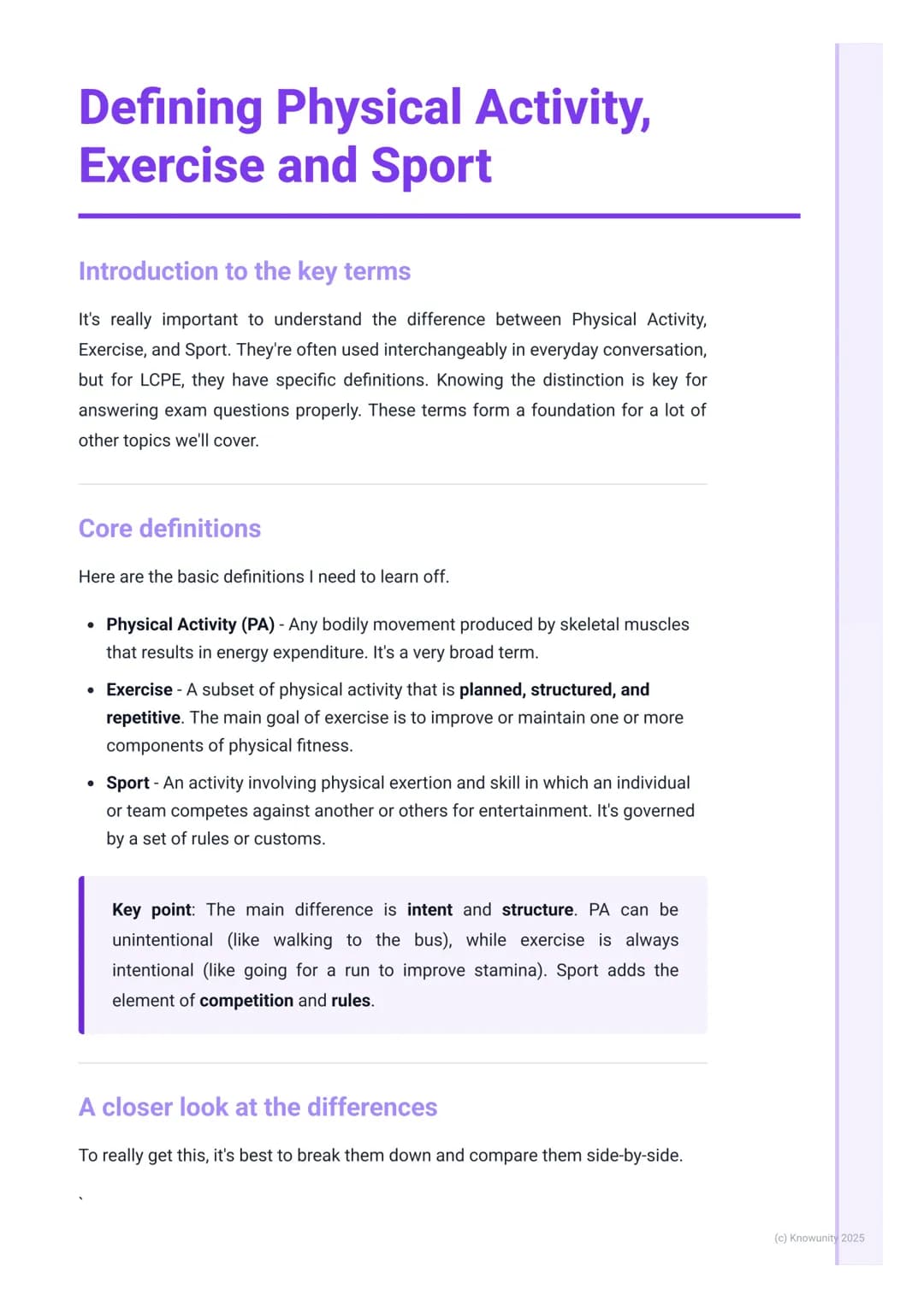
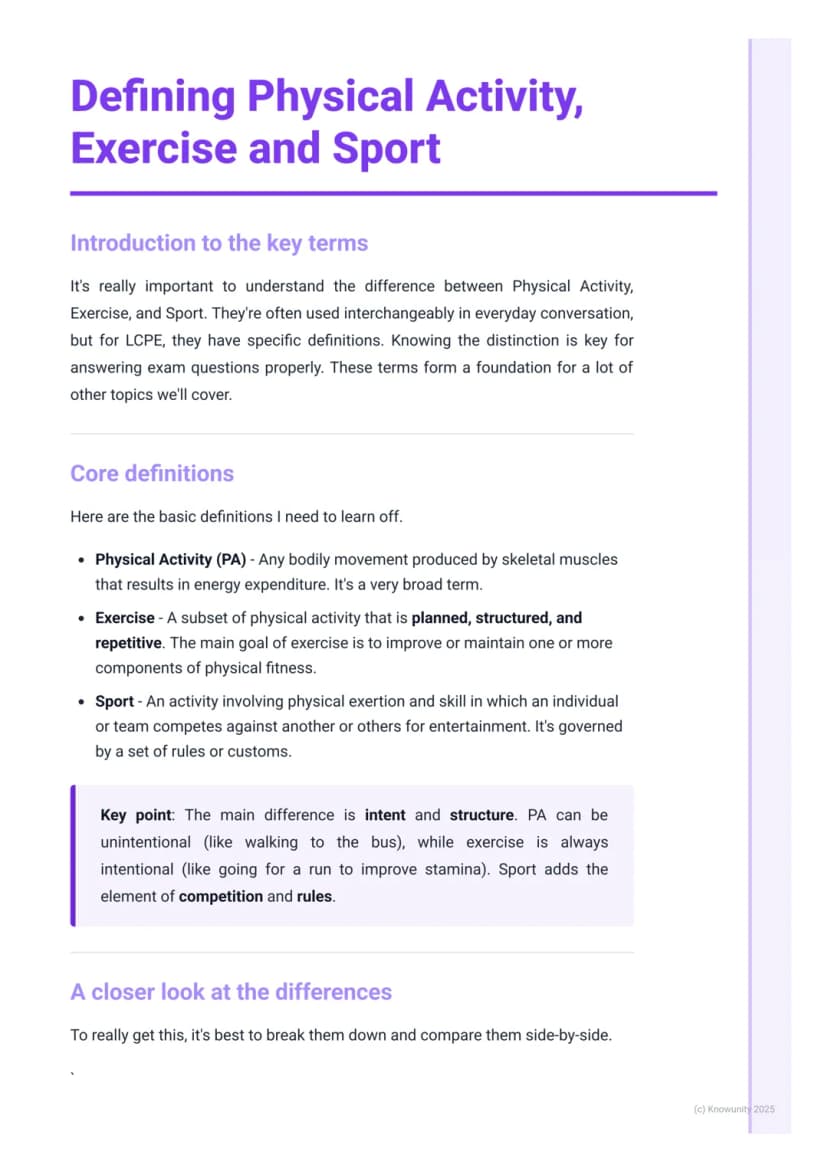
Defining Physical Activity, Exercise and Sport
These three terms get thrown around like they mean the same thing, but they don't - and the examiners know it! Getting these definitions spot-on is your foundation for loads of other LCPE topics.
Physical activity is the broadest term - it's literally any movement your skeletal muscles make that burns energy. Walking to the shops, doing the hoovering, even fidgeting in class counts.
Exercise is more specific - it's physical activity that's planned, structured, and done repeatedly with the goal of improving fitness. Think hitting the gym or going for your regular Saturday morning run.
Sport adds competition and rules into the mix. It's about skill, competing against others (or standards), and following specific regulations. Your weekly GAA training session is exercise, but the championship match is sport.
Key Point: The main difference is intent and structure. You might accidentally get a workout carrying shopping bags (physical activity), but you deliberately plan a gym session (exercise) or train for the county finals (sport).
2
of 5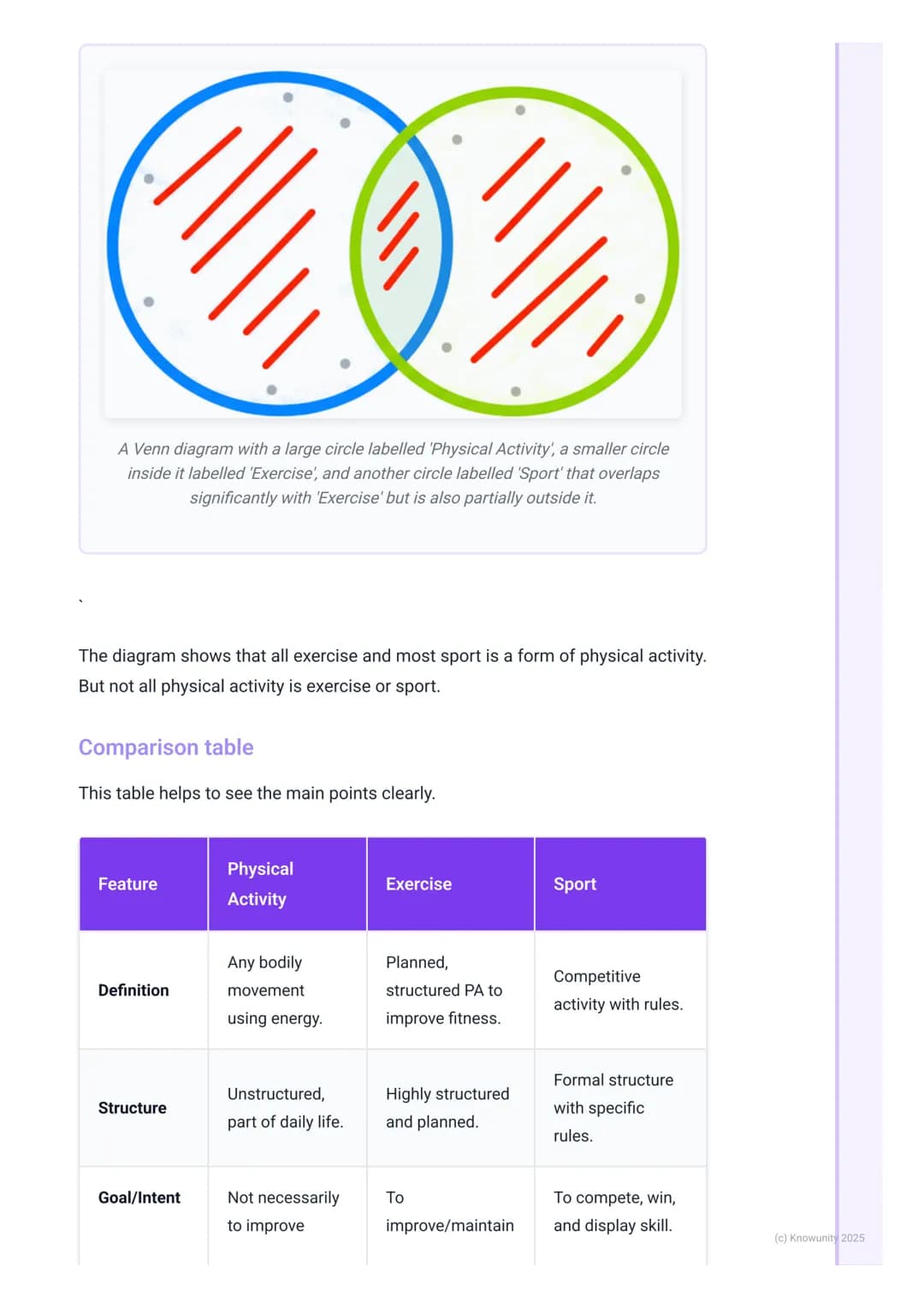
Breaking Down the Differences
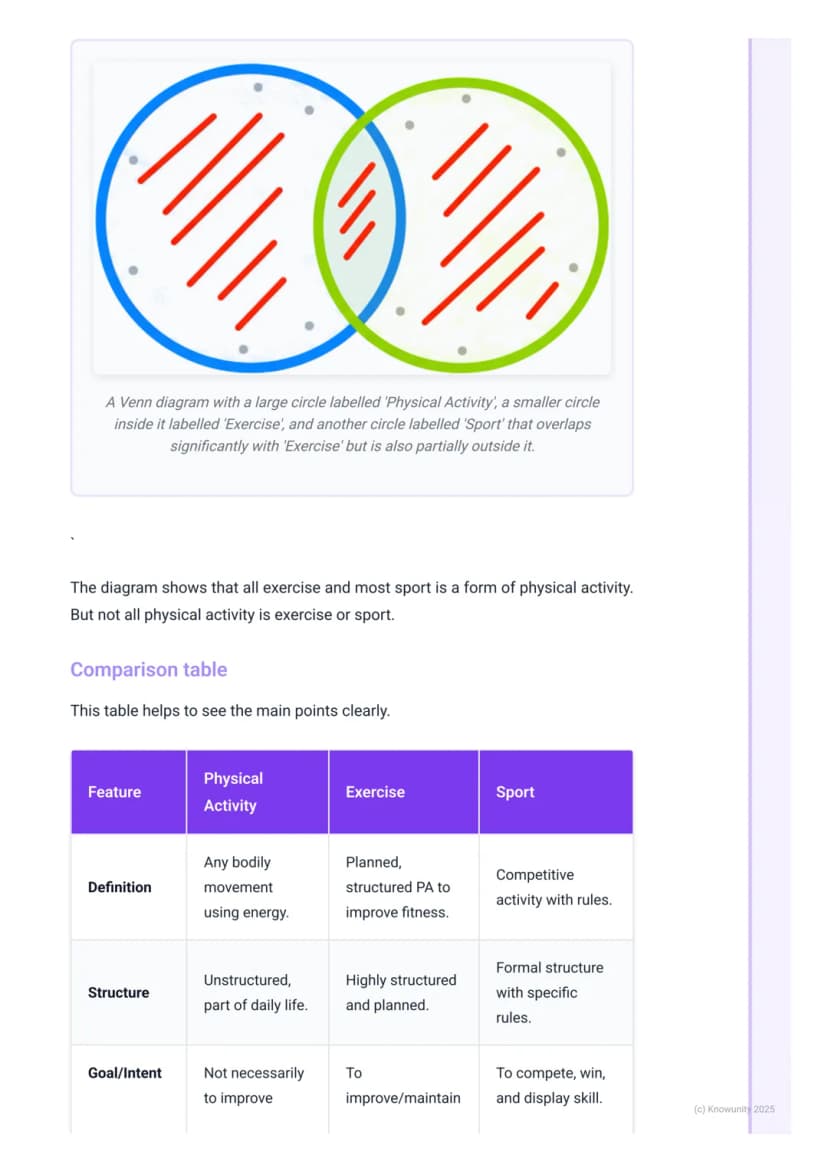
Think of these terms like a Venn diagram - physical activity is the massive outer circle that contains everything else. Exercise sits inside it, and sport overlaps significantly with exercise but has its own special characteristics.
Here's what separates them:
| Feature | Physical Activity | Exercise | Sport |
|---|---|---|---|
| **Structure** | Unstructured, part of daily life | Highly planned and structured | Formal rules and regulations |
| **Goal** | Often just transport or daily tasks | Improve/maintain fitness components | Compete, win, display skill |
| **Competition** | None | Usually against yourself | Always competitive |
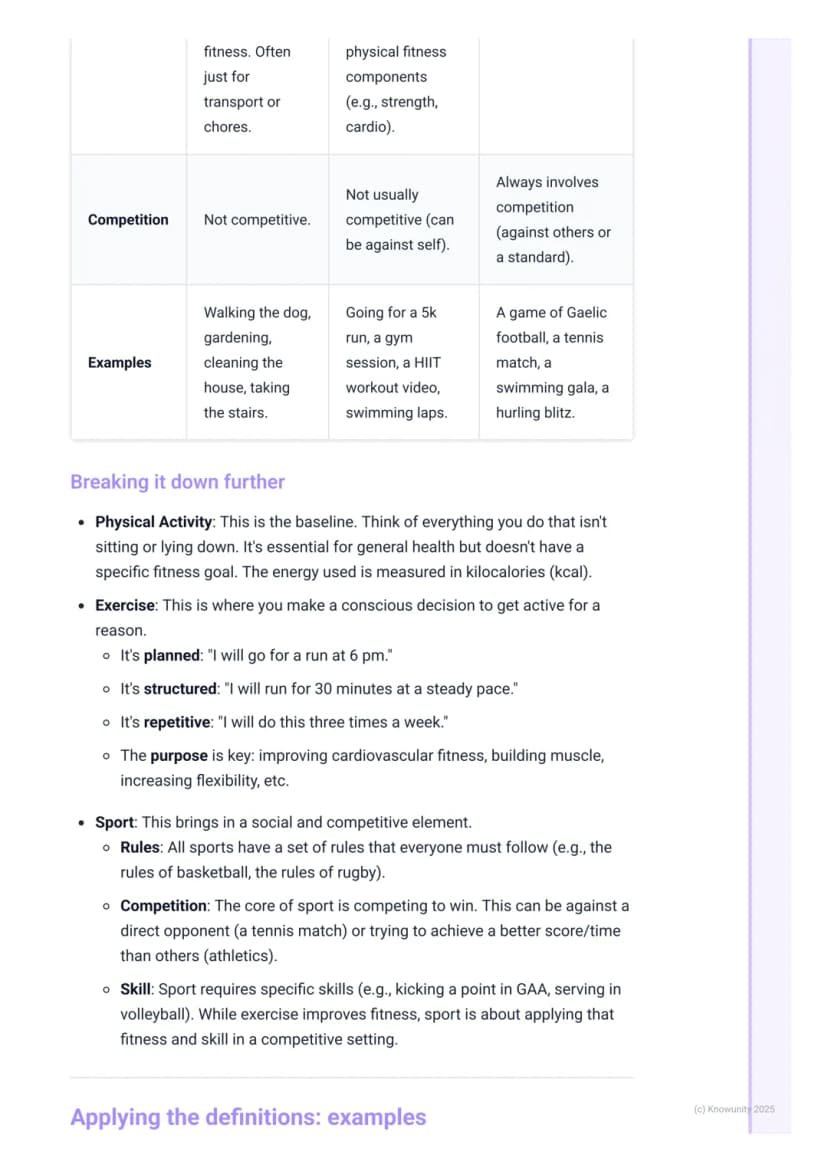
Examples help clarify this. Walking your dog is physical activity. Doing a structured 5k training run is exercise. Racing in the school athletics day is sport.
The energy expenditure happens in all three, but the reasons behind the movement completely change the category.
Remember: All exercise is physical activity, and most sport involves exercise, but not all physical activity is exercise or sport!
3
of 5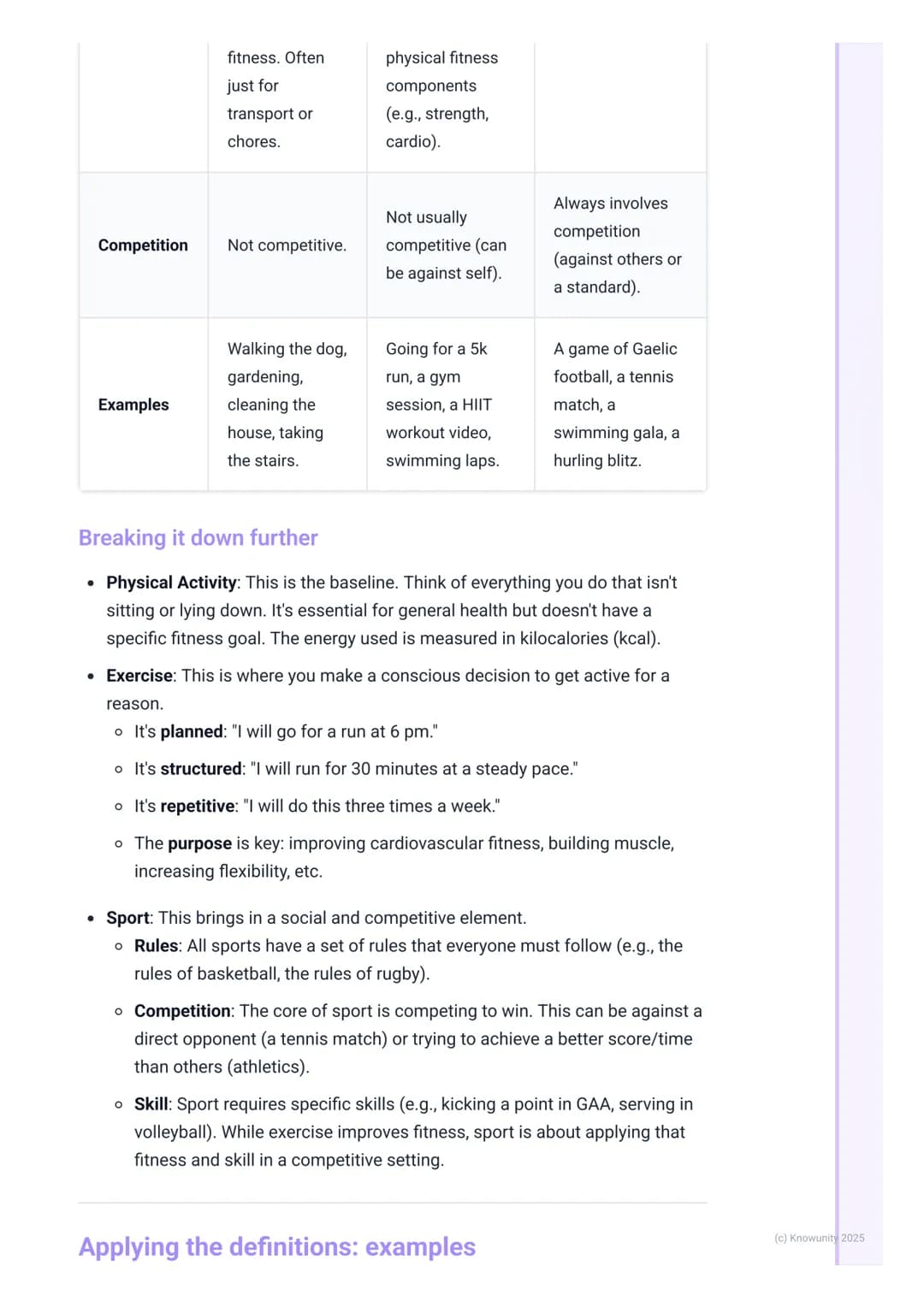
Real-Life Applications
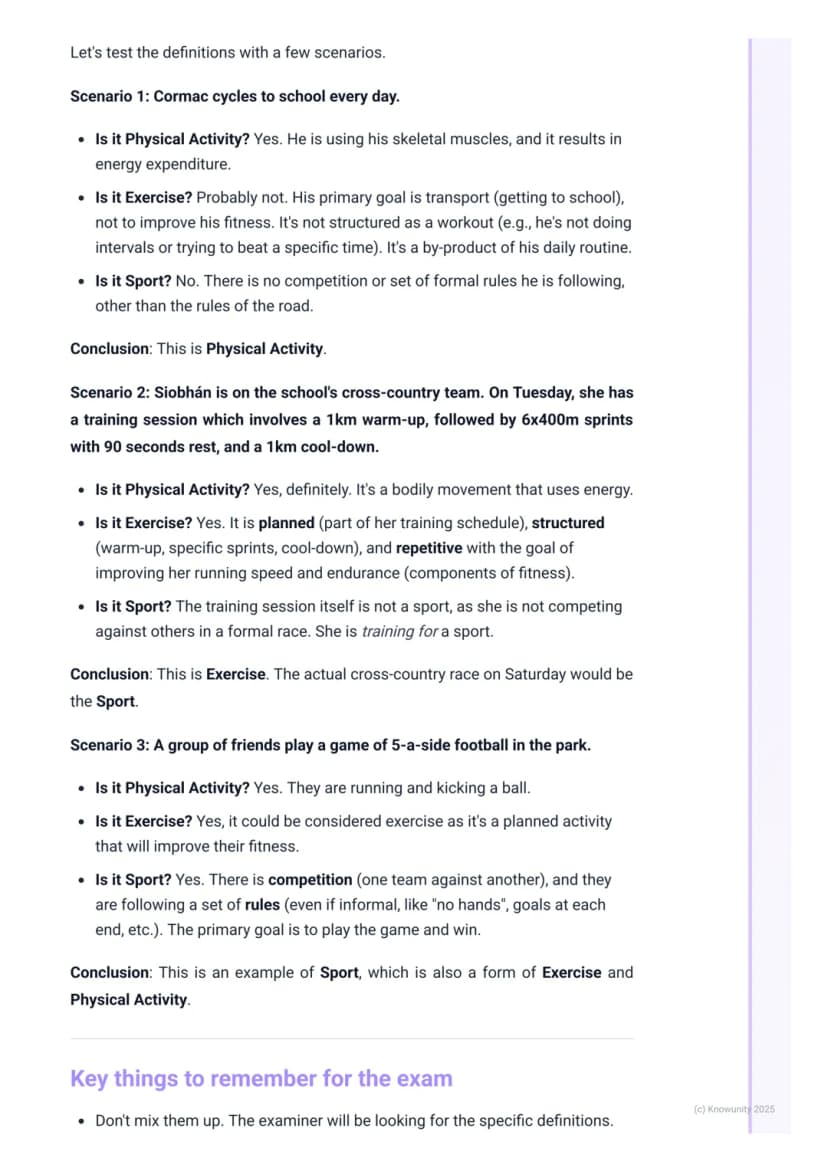
Let's test your understanding with scenarios you'll definitely recognise from exam papers.
Scenario 1: Cormac cycles to school every day. This is physical activity because he's using energy and moving his muscles, but his main goal is transport, not fitness. It's not planned as a workout, so it's not exercise.
Scenario 2: Siobhán does structured cross-country training - warm-up, timed intervals, cool-down. This is exercise because it's planned, structured, and aimed at improving her running fitness. The actual race on Saturday would be sport.
Scenario 3: Friends playing five-a-side football in the park. This ticks all three boxes - it's sport because there's competition and rules, plus it's also exercise and physical activity.
The key is looking at the intent behind the movement. Why is the person doing this activity? That usually gives you the answer.
Exam Tip: An activity can be multiple things at once. A hurling match is simultaneously sport, exercise, AND physical activity - but walking to the bus stop is only physical activity.
4
of 5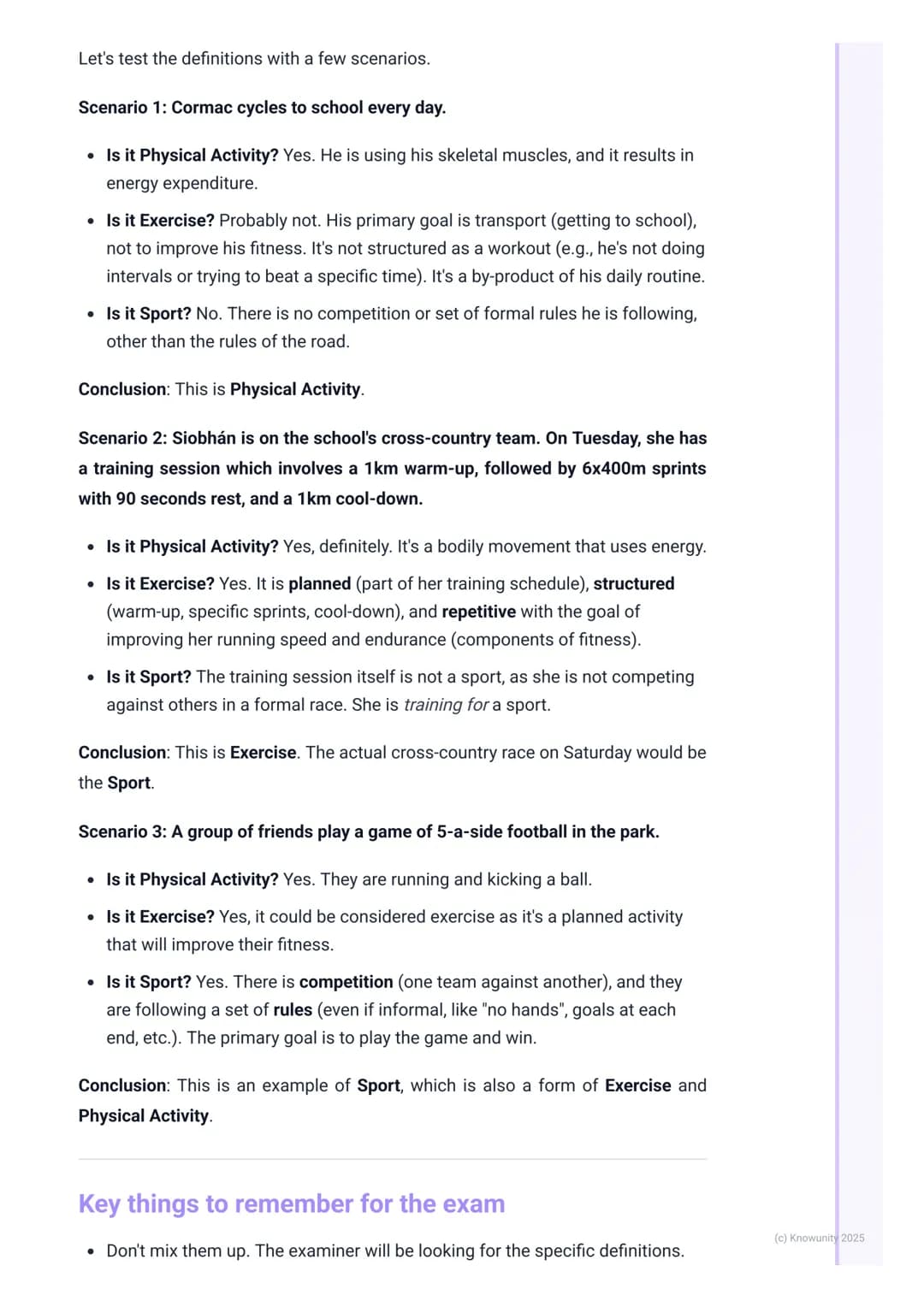
Key Points for Exam Success
Don't let the examiner catch you mixing up these terms - they're looking for precision, not general understanding.
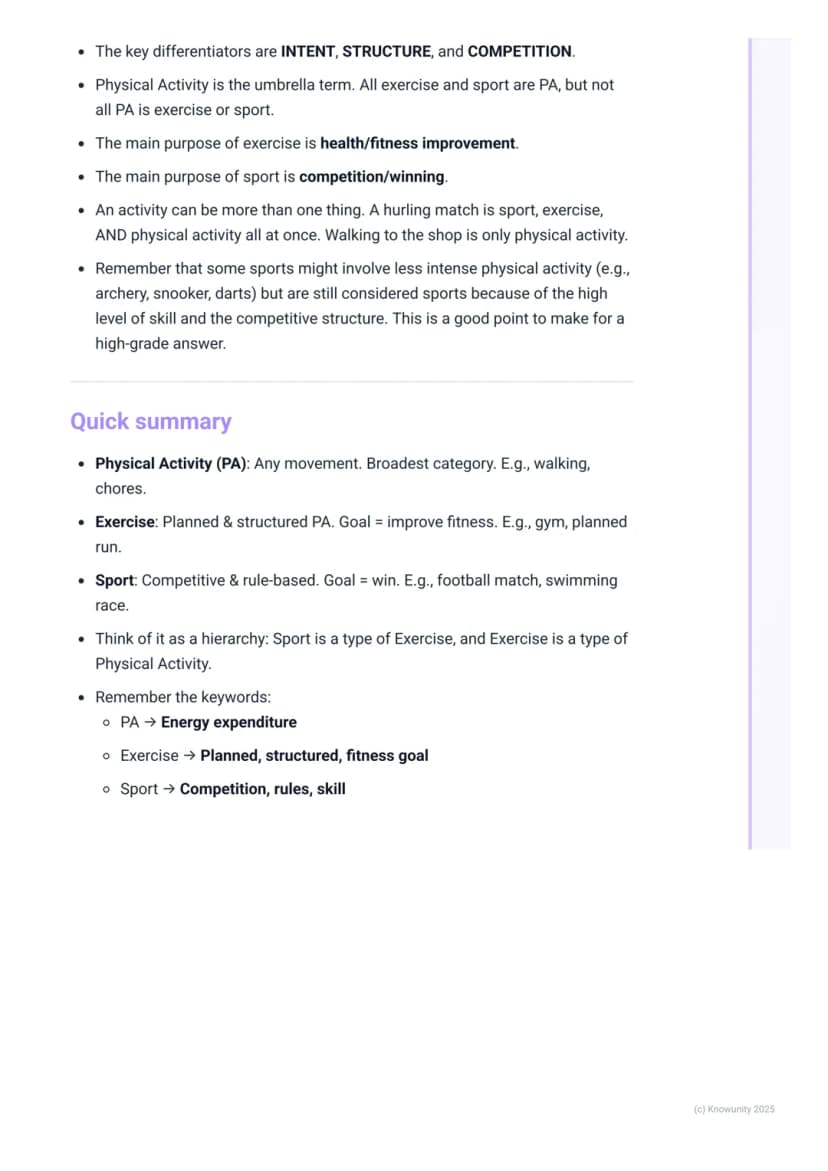
The three magic differentiators are intent, structure, and competition. Physical activity can be completely accidental (carrying heavy shopping), exercise is always deliberate (planned gym session), and sport always involves competing against someone or something.
Remember that physical activity is the umbrella term. Everything else sits underneath it. Some activities barely qualify as physical activity (like playing chess), while others hit all three categories simultaneously (like championship football).
Intent matters most. The same activity can change categories depending on why you're doing it. Cycling can be transport (physical activity), fitness training (exercise), or racing (sport) - same movement, different purpose.
High-Grade Tip: Some sports involve minimal physical exertion (archery, snooker) but still count as sports because of the skill level and competitive structure required.
5
of 5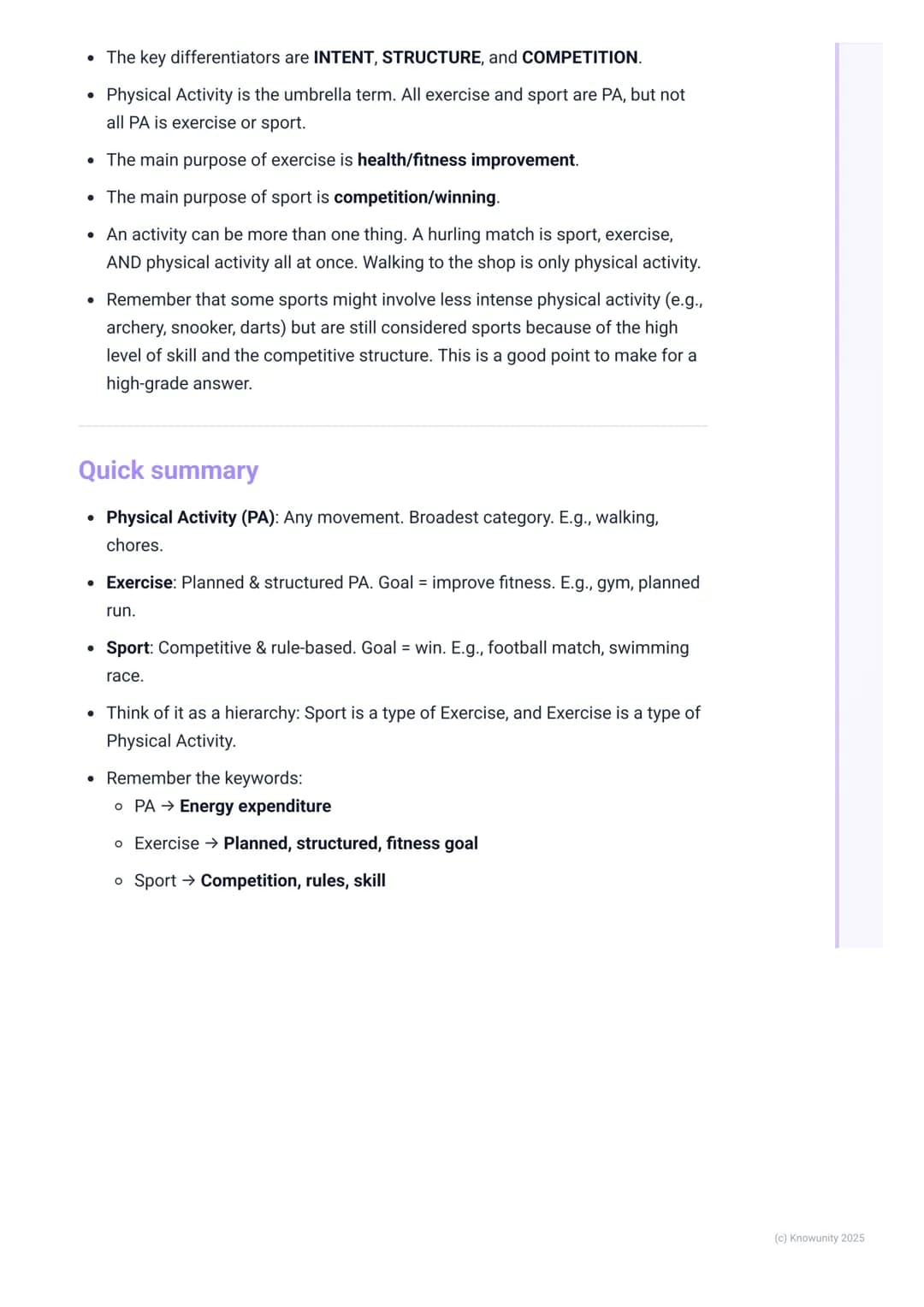
Quick Reference Summary
Here's your cheat sheet for remembering the key differences:
Physical Activity: Any movement that burns energy. Broadest category. Think daily life stuff like walking or gardening.
Exercise: Planned and structured physical activity with fitness goals. Think gym sessions, training runs, or workout videos.
Sport: Competitive, rule-based activities requiring skill. Think matches, competitions, and tournaments.
The hierarchy works like this: Sport is usually a type of exercise, and exercise is always a type of physical activity. But physical activity isn't always exercise, and exercise isn't always sport.
Memory tricks for exams: Physical Activity → Energy expenditure. Exercise → Planned, structured, fitness goals. Sport → Competition, rules, skill development.
Final Reminder: These aren't just academic definitions - understanding them helps you make better choices about your own movement and fitness throughout life!
Si on te demande...
Qu'est-ce que le compagnon IA de Knowunity ?
Notre compagnon IA est spécialement conçu pour répondre aux besoins des étudiants. Sur la base des millions d'éléments de contenu que nous avons sur la plateforme, nous pouvons fournir des réponses vraiment significatives et pertinentes aux étudiants. Mais il ne s'agit pas seulement de réponses, le compagnon a encore plus pour but de guider les élèves dans leurs défis d'apprentissage quotidiens, avec des plans d'étude personnalisés, des quiz ou des éléments de contenu dans le chat et une personnalisation à 100% basée sur les compétences et les développements de l'étudiant.
Où puis-je télécharger l'appli Knowunity ?
Tu peux télécharger l'application dans Google Play Store et dans l'App Store d'Apple.
L'application est-elle vraiment gratuite ?
Oui, tu as un accès entièrement gratuit à tous les contenus de l'appli, tu peux chatter ou suivre les créateurs à tout moment. De plus, nous proposons Knowunity Premium, qui te permet de réviser sans limites!
Contenus les plus populaires en LCPE
4LCPEHealthy Eating Guidelines
This section explores national healthy eating guidelines, such as the food pyramid or healthy eating plate, to promote balanced dietary choices.
5th Year50
LCPEBiomechanics of Movement
Applying fundamental biomechanical principles such as force, motion, levers, and stability to analyse and improve human movement efficiency and performance in sport.
6th Year200
LCPEFactors effecting sports psychology ( confidence and self efficacy)
Higher Level LCPE psychological preprration notes
5th Year230
LCPETechnology in Sport
Investigating how technology is used in areas such as performance analysis, equipment design, officiating, and athlete monitoring to enhance training and competition.
6th Year50
Contenus les plus populaires
9 Irish
IrishIrish oral questions and answers
Questions and answers for the leaving cert oral
5th Year4264
 English
Key Quotes : Sive
Key Quotes and explanations: Sive
6th Year2842
IrishIrish oral questions
Outline of oral questions
5th Year2055
IrishIníon- le hÁine Durkin
Aine Durkin’s poem, Iníon: Themes & summary
5th Year890
IrishIrish poetry 2027
Iníon + Dínit an Bhróin
5th Year1153
IrishLC HL notes- Iníon (poem)
Includes poem in English and Irish, theme, key words & phrases
5th Year2304
EnglishCultural Context : Shawshank Redemption : Sive : Small Things Like These
Comparative Study : Cultural Context : Shawshank Redemption, Sive and Small Things Like These
6th Year1430
IrishMo Ghrá-sa (Idir Lúibíní)
Notes on mo ghrá-sa
5th Year380
IrishAn Gaeilge Aiste
Irish Language essay
6th Year1320
Rien ne te convient ? Explore d'autres matières.
Les étudiants nous adorent — il ne manque plus que toi.
4.6/5App Store
4.7/5Google Play
L'application est très facile d'utilisation et bien conçue. Jusqu'à présent, j'ai trouvé tout ce que je cherchais et j'ai pu apprendre beaucoup de choses grâce aux présentations ! Je vais certainement utiliser l'application pour un travail en classe ! Et comme source d'inspiration personnelle, elle est bien sûr aussi très utile.
Stefan Sutilisateur iOS
Cette application est vraiment super. Il y a tellement de fiches de révision et d'aide, [...]. Par exemple, la matière qui me pose problème est le français et l'appli a un choix d'aide très large. Grâce à cette application, je me suis améliorée en français. Je la recommanderais à tout le monde.
Samantha Klichutilisatrice Android
Waouh, je suis vraiment abasourdi. J'ai essayé l'application parce que je l'avais déjà vue plusieurs fois dans la publicité et j'ai été absolument choquée. Cette appli est L'AIDE dont on rêve pour l'école et surtout, elle propose tellement de choses, comme des rédactions et des fiches qui m'ont personnellement TRÈS bien aidé.
Annautilisatrice iOS
LCPE4 vues·Mis à jour Jun 12, 2026·5 pagesUnderstanding Physical Activity, Exercise, and Sports: Clear Definitions
Ever wonder why PE teachers are so picky about using the right terms? Understanding the difference between physical activity, exercise, and sport isn't just academic nitpicking - it's essential for your LCPE exams and helps you think more clearly about...
1
of 5
Inscris-toi pour voir le contenu. C'est gratuit!
- Accès à tous les documents
- Améliore tes notes
- Rejoins des millions d'étudiants
Defining Physical Activity, Exercise and Sport
These three terms get thrown around like they mean the same thing, but they don't - and the examiners know it! Getting these definitions spot-on is your foundation for loads of other LCPE topics.
Physical activity is the broadest term - it's literally any movement your skeletal muscles make that burns energy. Walking to the shops, doing the hoovering, even fidgeting in class counts.
Exercise is more specific - it's physical activity that's planned, structured, and done repeatedly with the goal of improving fitness. Think hitting the gym or going for your regular Saturday morning run.
Sport adds competition and rules into the mix. It's about skill, competing against others (or standards), and following specific regulations. Your weekly GAA training session is exercise, but the championship match is sport.
Key Point: The main difference is intent and structure. You might accidentally get a workout carrying shopping bags (physical activity), but you deliberately plan a gym session (exercise) or train for the county finals (sport).
2
of 5Inscris-toi pour voir le contenu. C'est gratuit!
- Accès à tous les documents
- Améliore tes notes
- Rejoins des millions d'étudiants
Breaking Down the Differences
Think of these terms like a Venn diagram - physical activity is the massive outer circle that contains everything else. Exercise sits inside it, and sport overlaps significantly with exercise but has its own special characteristics.
Here's what separates them:
| Feature | Physical Activity | Exercise | Sport |
|---|---|---|---|
| **Structure** | Unstructured, part of daily life | Highly planned and structured | Formal rules and regulations |
| **Goal** | Often just transport or daily tasks | Improve/maintain fitness components | Compete, win, display skill |
| **Competition** | None | Usually against yourself | Always competitive |
Examples help clarify this. Walking your dog is physical activity. Doing a structured 5k training run is exercise. Racing in the school athletics day is sport.
The energy expenditure happens in all three, but the reasons behind the movement completely change the category.
Remember: All exercise is physical activity, and most sport involves exercise, but not all physical activity is exercise or sport!
3
of 5Inscris-toi pour voir le contenu. C'est gratuit!
- Accès à tous les documents
- Améliore tes notes
- Rejoins des millions d'étudiants
Real-Life Applications
Let's test your understanding with scenarios you'll definitely recognise from exam papers.
Scenario 1: Cormac cycles to school every day. This is physical activity because he's using energy and moving his muscles, but his main goal is transport, not fitness. It's not planned as a workout, so it's not exercise.
Scenario 2: Siobhán does structured cross-country training - warm-up, timed intervals, cool-down. This is exercise because it's planned, structured, and aimed at improving her running fitness. The actual race on Saturday would be sport.
Scenario 3: Friends playing five-a-side football in the park. This ticks all three boxes - it's sport because there's competition and rules, plus it's also exercise and physical activity.
The key is looking at the intent behind the movement. Why is the person doing this activity? That usually gives you the answer.
Exam Tip: An activity can be multiple things at once. A hurling match is simultaneously sport, exercise, AND physical activity - but walking to the bus stop is only physical activity.
4
of 5Inscris-toi pour voir le contenu. C'est gratuit!
- Accès à tous les documents
- Améliore tes notes
- Rejoins des millions d'étudiants
Key Points for Exam Success
Don't let the examiner catch you mixing up these terms - they're looking for precision, not general understanding.
The three magic differentiators are intent, structure, and competition. Physical activity can be completely accidental (carrying heavy shopping), exercise is always deliberate (planned gym session), and sport always involves competing against someone or something.
Remember that physical activity is the umbrella term. Everything else sits underneath it. Some activities barely qualify as physical activity (like playing chess), while others hit all three categories simultaneously (like championship football).
Intent matters most. The same activity can change categories depending on why you're doing it. Cycling can be transport (physical activity), fitness training (exercise), or racing (sport) - same movement, different purpose.
High-Grade Tip: Some sports involve minimal physical exertion (archery, snooker) but still count as sports because of the skill level and competitive structure required.
5
of 5Inscris-toi pour voir le contenu. C'est gratuit!
- Accès à tous les documents
- Améliore tes notes
- Rejoins des millions d'étudiants
Quick Reference Summary
Here's your cheat sheet for remembering the key differences:
Physical Activity: Any movement that burns energy. Broadest category. Think daily life stuff like walking or gardening.
Exercise: Planned and structured physical activity with fitness goals. Think gym sessions, training runs, or workout videos.
Sport: Competitive, rule-based activities requiring skill. Think matches, competitions, and tournaments.
The hierarchy works like this: Sport is usually a type of exercise, and exercise is always a type of physical activity. But physical activity isn't always exercise, and exercise isn't always sport.
Memory tricks for exams: Physical Activity → Energy expenditure. Exercise → Planned, structured, fitness goals. Sport → Competition, rules, skill development.
Final Reminder: These aren't just academic definitions - understanding them helps you make better choices about your own movement and fitness throughout life!
Si on te demande...
Qu'est-ce que le compagnon IA de Knowunity ?
Notre compagnon IA est spécialement conçu pour répondre aux besoins des étudiants. Sur la base des millions d'éléments de contenu que nous avons sur la plateforme, nous pouvons fournir des réponses vraiment significatives et pertinentes aux étudiants. Mais il ne s'agit pas seulement de réponses, le compagnon a encore plus pour but de guider les élèves dans leurs défis d'apprentissage quotidiens, avec des plans d'étude personnalisés, des quiz ou des éléments de contenu dans le chat et une personnalisation à 100% basée sur les compétences et les développements de l'étudiant.
Où puis-je télécharger l'appli Knowunity ?
Tu peux télécharger l'application dans Google Play Store et dans l'App Store d'Apple.
L'application est-elle vraiment gratuite ?
Oui, tu as un accès entièrement gratuit à tous les contenus de l'appli, tu peux chatter ou suivre les créateurs à tout moment. De plus, nous proposons Knowunity Premium, qui te permet de réviser sans limites!
Contenus les plus populaires en LCPE
4LCPEHealthy Eating Guidelines
This section explores national healthy eating guidelines, such as the food pyramid or healthy eating plate, to promote balanced dietary choices.
5th Year50
LCPEBiomechanics of Movement
Applying fundamental biomechanical principles such as force, motion, levers, and stability to analyse and improve human movement efficiency and performance in sport.
6th Year200
LCPEFactors effecting sports psychology ( confidence and self efficacy)
Higher Level LCPE psychological preprration notes
5th Year230
LCPETechnology in Sport
Investigating how technology is used in areas such as performance analysis, equipment design, officiating, and athlete monitoring to enhance training and competition.
6th Year50
Contenus les plus populaires
9IrishIrish oral questions and answers
Questions and answers for the leaving cert oral
5th Year4264
EnglishKey Quotes : Sive
Key Quotes and explanations: Sive
6th Year2842
IrishIrish oral questions
Outline of oral questions
5th Year2055
IrishIníon- le hÁine Durkin
Aine Durkin’s poem, Iníon: Themes & summary
5th Year890
IrishIrish poetry 2027
Iníon + Dínit an Bhróin
5th Year1153
IrishLC HL notes- Iníon (poem)
Includes poem in English and Irish, theme, key words & phrases
5th Year2304
EnglishCultural Context : Shawshank Redemption : Sive : Small Things Like These
Comparative Study : Cultural Context : Shawshank Redemption, Sive and Small Things Like These
6th Year1430
IrishMo Ghrá-sa (Idir Lúibíní)
Notes on mo ghrá-sa
5th Year380
IrishAn Gaeilge Aiste
Irish Language essay
6th Year1320
Rien ne te convient ? Explore d'autres matières.
Les étudiants nous adorent — il ne manque plus que toi.
4.6/5App Store
4.7/5Google Play
L'application est très facile d'utilisation et bien conçue. Jusqu'à présent, j'ai trouvé tout ce que je cherchais et j'ai pu apprendre beaucoup de choses grâce aux présentations ! Je vais certainement utiliser l'application pour un travail en classe ! Et comme source d'inspiration personnelle, elle est bien sûr aussi très utile.
Stefan Sutilisateur iOS
Cette application est vraiment super. Il y a tellement de fiches de révision et d'aide, [...]. Par exemple, la matière qui me pose problème est le français et l'appli a un choix d'aide très large. Grâce à cette application, je me suis améliorée en français. Je la recommanderais à tout le monde.
Samantha Klichutilisatrice Android
Waouh, je suis vraiment abasourdi. J'ai essayé l'application parce que je l'avais déjà vue plusieurs fois dans la publicité et j'ai été absolument choquée. Cette appli est L'AIDE dont on rêve pour l'école et surtout, elle propose tellement de choses, comme des rédactions et des fiches qui m'ont personnellement TRÈS bien aidé.
Annautilisatrice iOS