
Ever wondered how your body creates the power to kick...
 LCPE2 vues·Mis à jour Jun 11, 2026·6 pages
Understanding Levers in the Human Body
1 / 6
1
of 6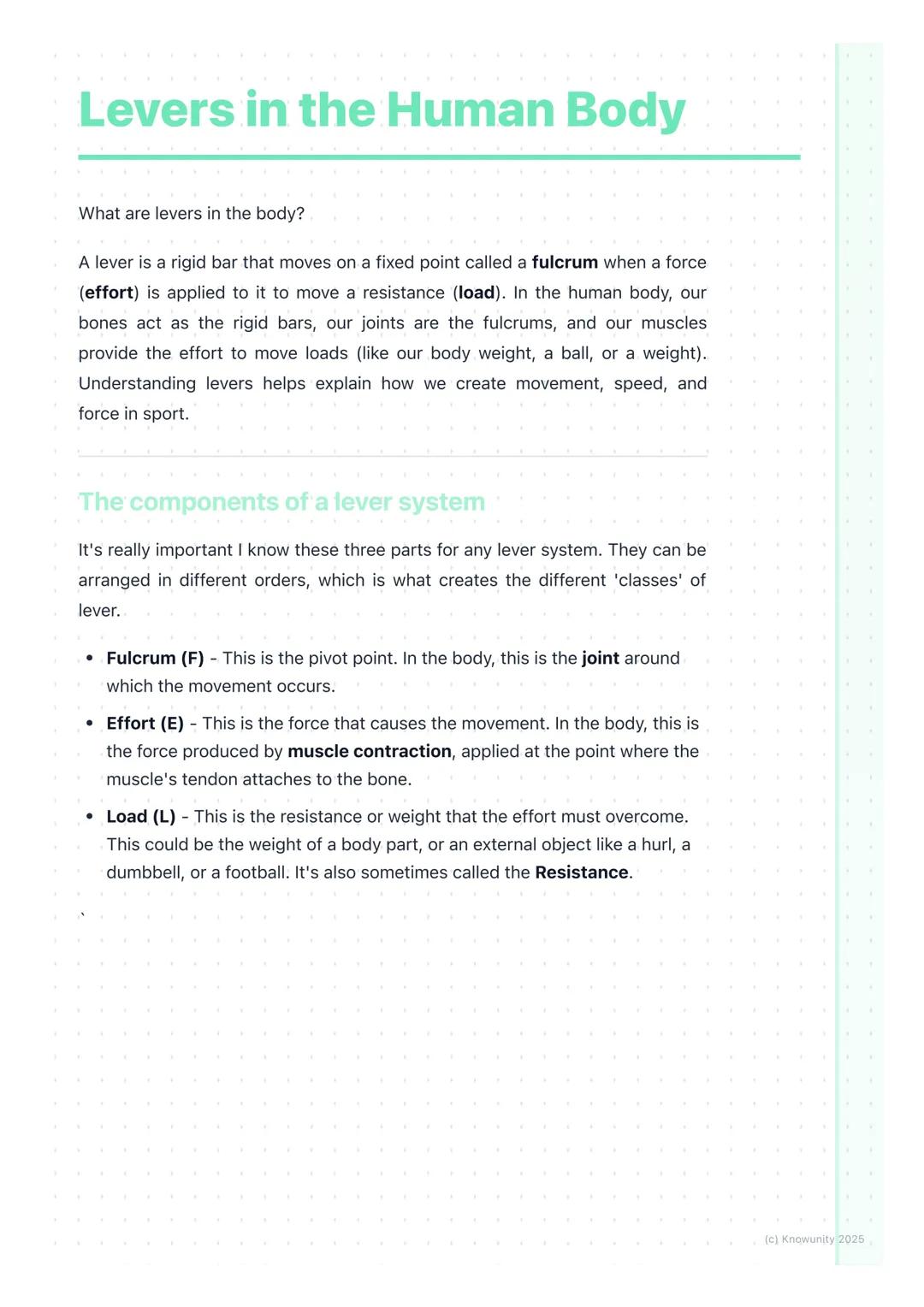
Levers in the Human Body
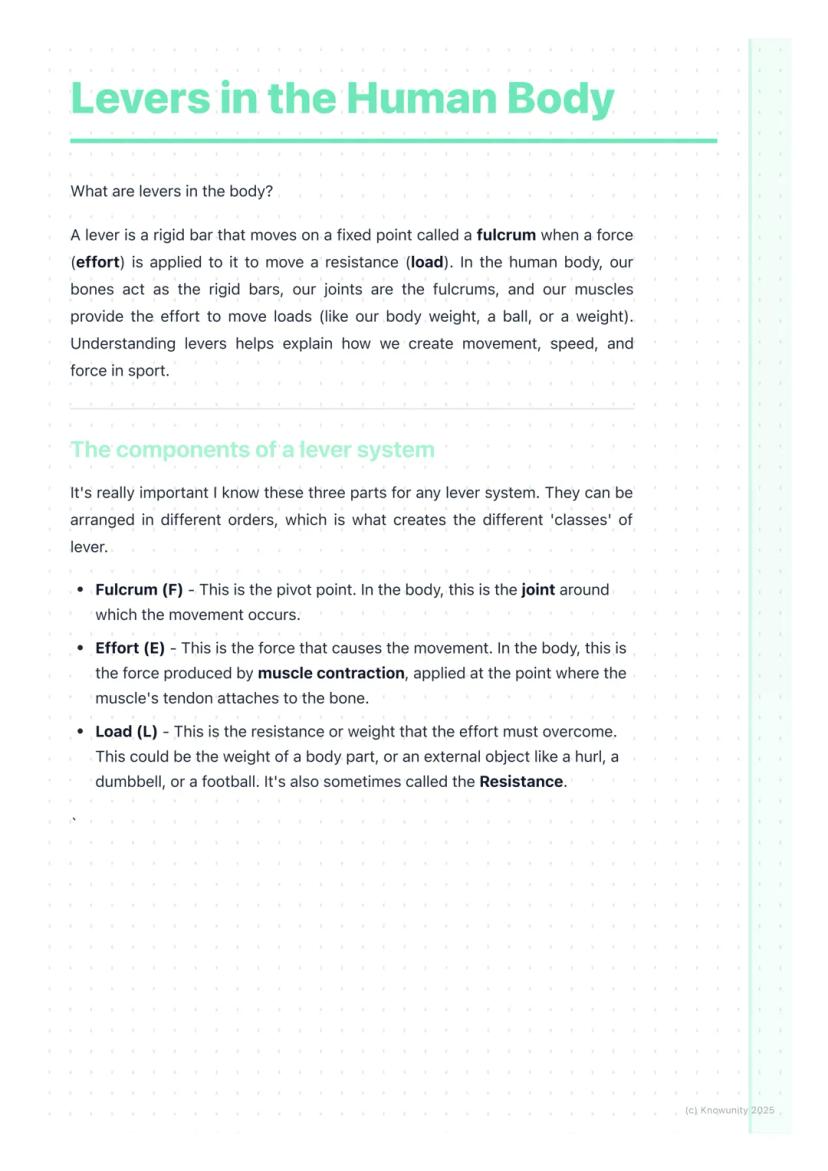
Your body is basically a collection of lever systems working together to create movement. A lever is simply a rigid bar (your bones) that moves around a fixed point (your joints) when force is applied (your muscles contracting).
Think of it this way: every time you move, you're using these three essential components. The fulcrum is your joint - the pivot point where movement happens. The effort is the force your muscles produce when they contract and pull on bones. The load (or resistance) is whatever you're trying to move - whether that's your own body weight, a hurley, or a dumbbell.
Understanding these lever systems isn't just theory - it's the key to explaining how athletes generate explosive power and lightning-fast movements in sport. Once you grasp these basics, you'll see lever systems everywhere in human movement.
Key Insight: The way these three components are arranged determines what type of lever you have and whether it's best for generating force or speed.
2
of 6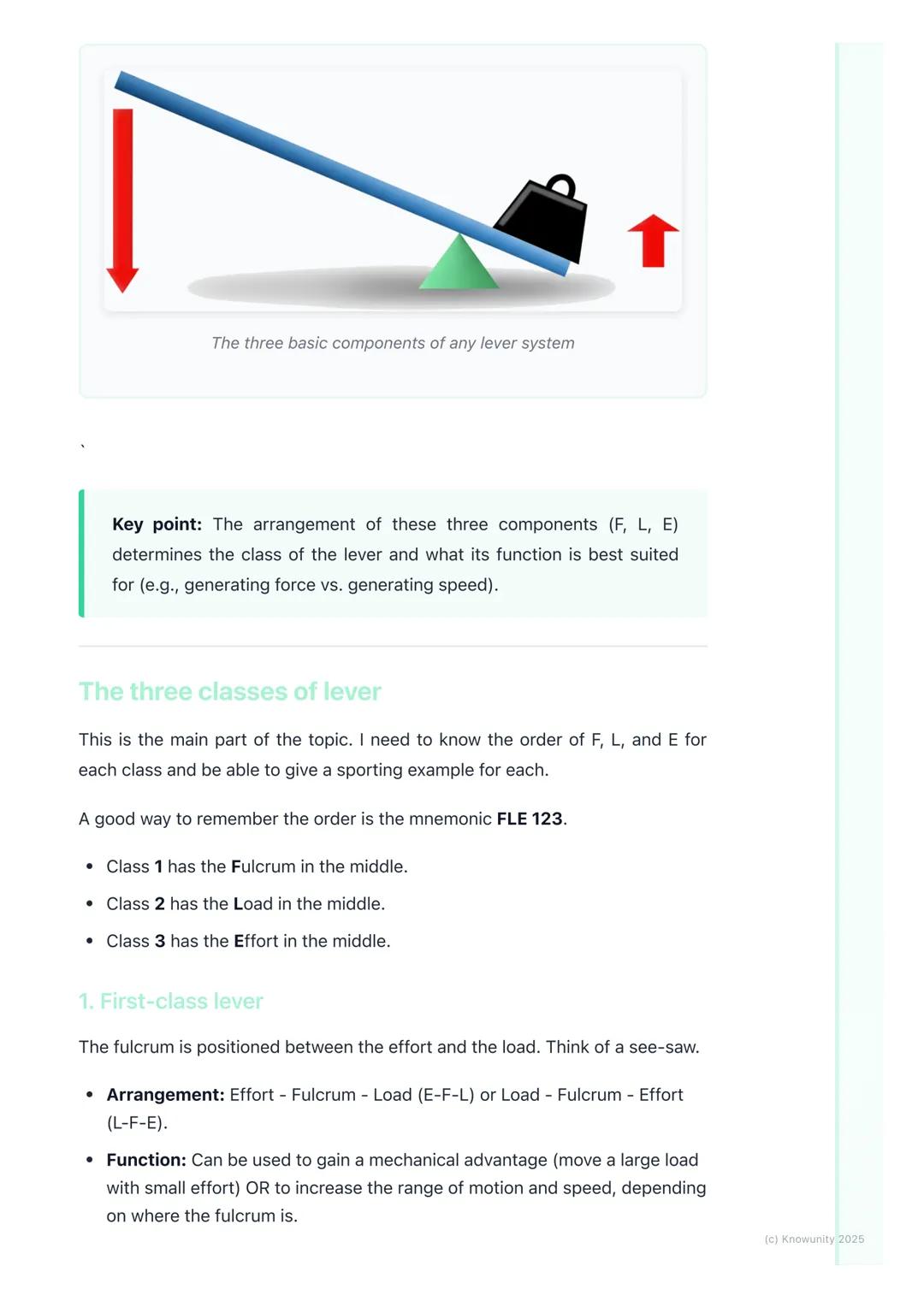
The Three Classes of Lever
Here's where it gets interesting - there are three different ways to arrange fulcrum, load, and effort, creating three distinct classes of lever. Each class has its own superpower in terms of movement.
The easiest way to remember them? Use the mnemonic FLE 123. First-class has the Fulcrum in the middle, second-class has the Load in the middle, and third-class has the Effort in the middle.
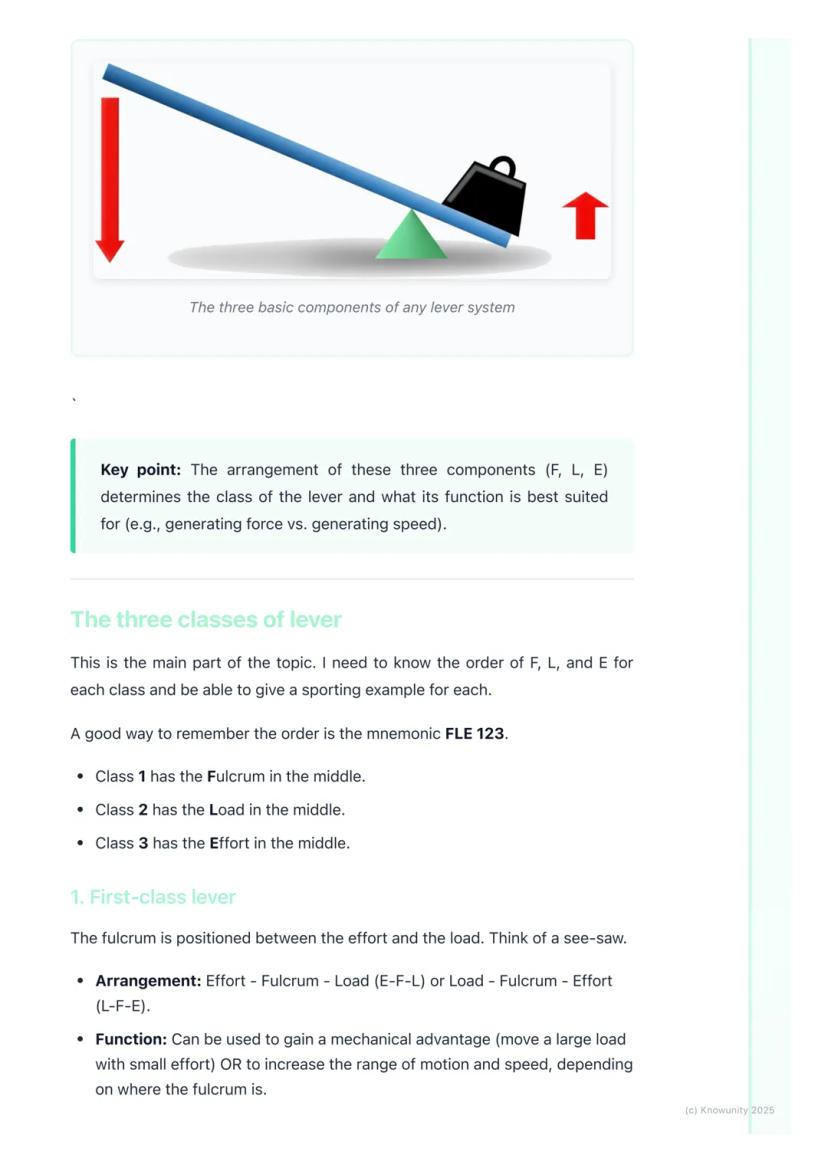
First-class levers work like a see-saw, with the fulcrum sitting between effort and load . These versatile levers can either give you a mechanical advantage to move heavy loads or help you achieve greater speed and range of motion - it all depends on where that fulcrum sits.
A perfect sporting example? Heading a football. Your neck joint acts as the fulcrum, your neck muscles provide the effort, and your head (plus the ball) is the load you're moving.
Sport Connection: First-class levers are brilliant because they're adaptable - they can be optimised for either power or speed depending on what the movement requires.
3
of 6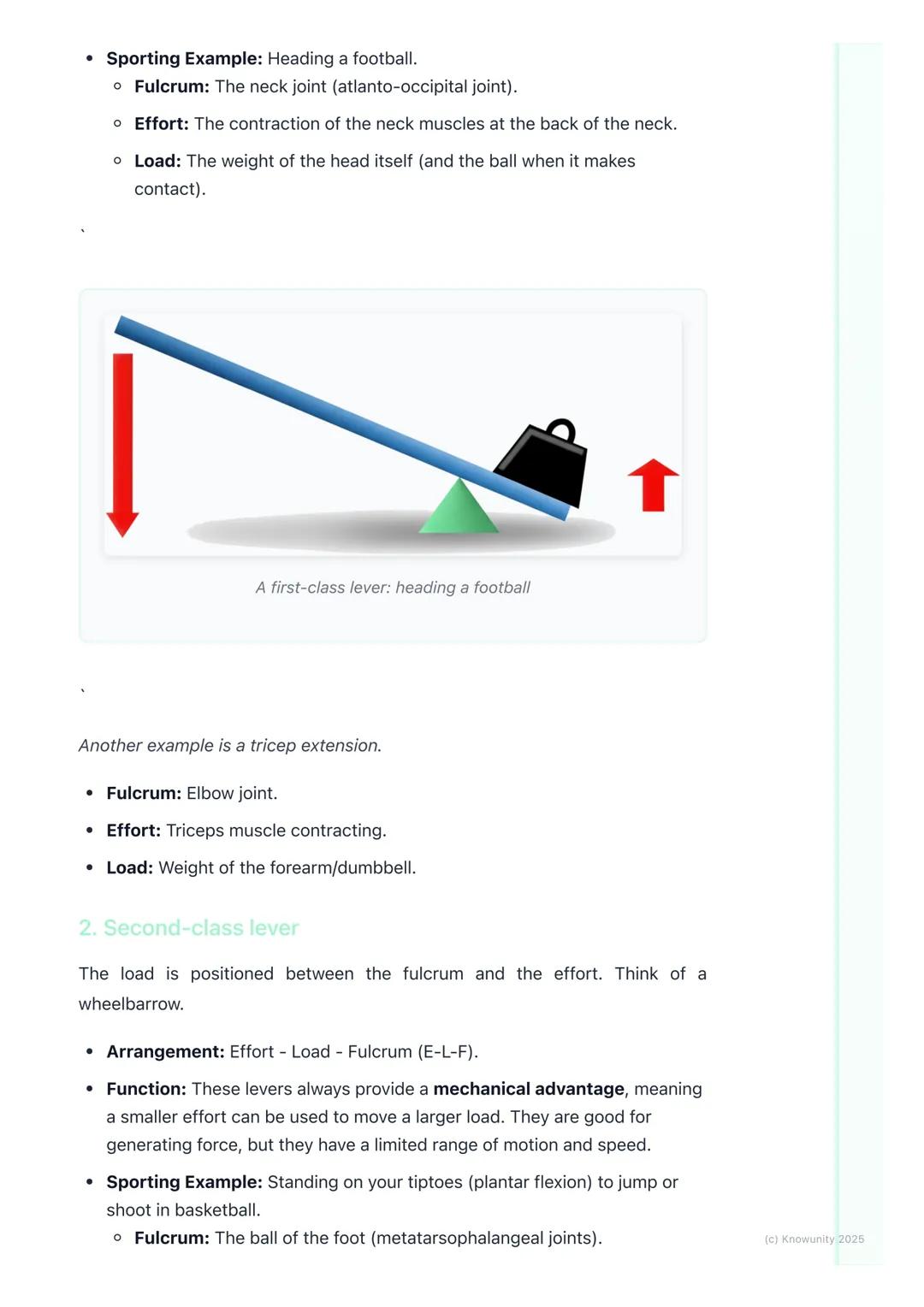
Second-Class Levers: The Powerhouses
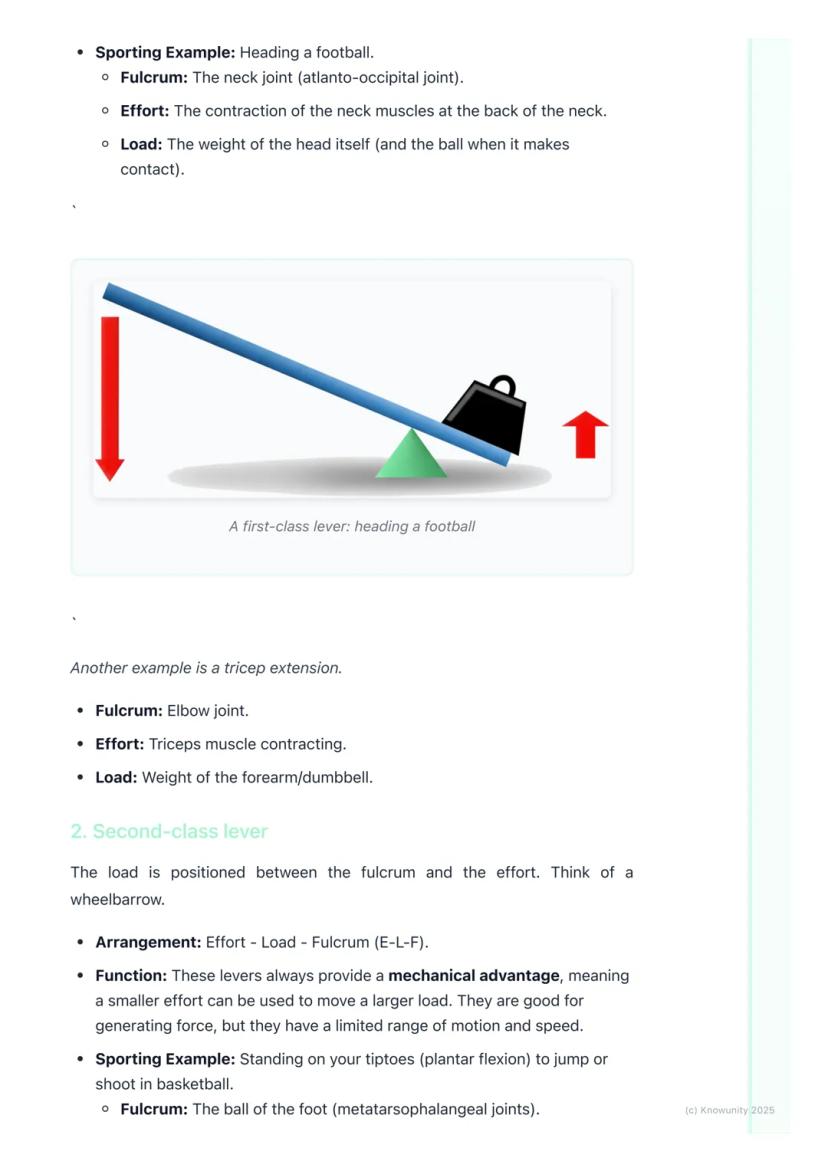
Second-class levers are the powerhouses of the body - think wheelbarrow style with the load sandwiched between effort and fulcrum . These levers always give you a mechanical advantage, meaning you can move heavy loads with relatively small effort.
The trade-off? You sacrifice speed and range of motion for that extra force. That's why second-class levers are quite rare in the human body - most sports need speed more than raw power.
The classic example you need to know is standing on your tiptoes (like when jumping for a basketball shot). Your toes act as the fulcrum, your body weight is the load pressing down through your ankle, and your powerful calf muscles provide the effort by pulling up on your heel.
Remember This: Second-class levers are uncommon in the body because sport usually demands speed over pure force - but when you need that extra power (like in a vertical jump), they're invaluable.
4
of 6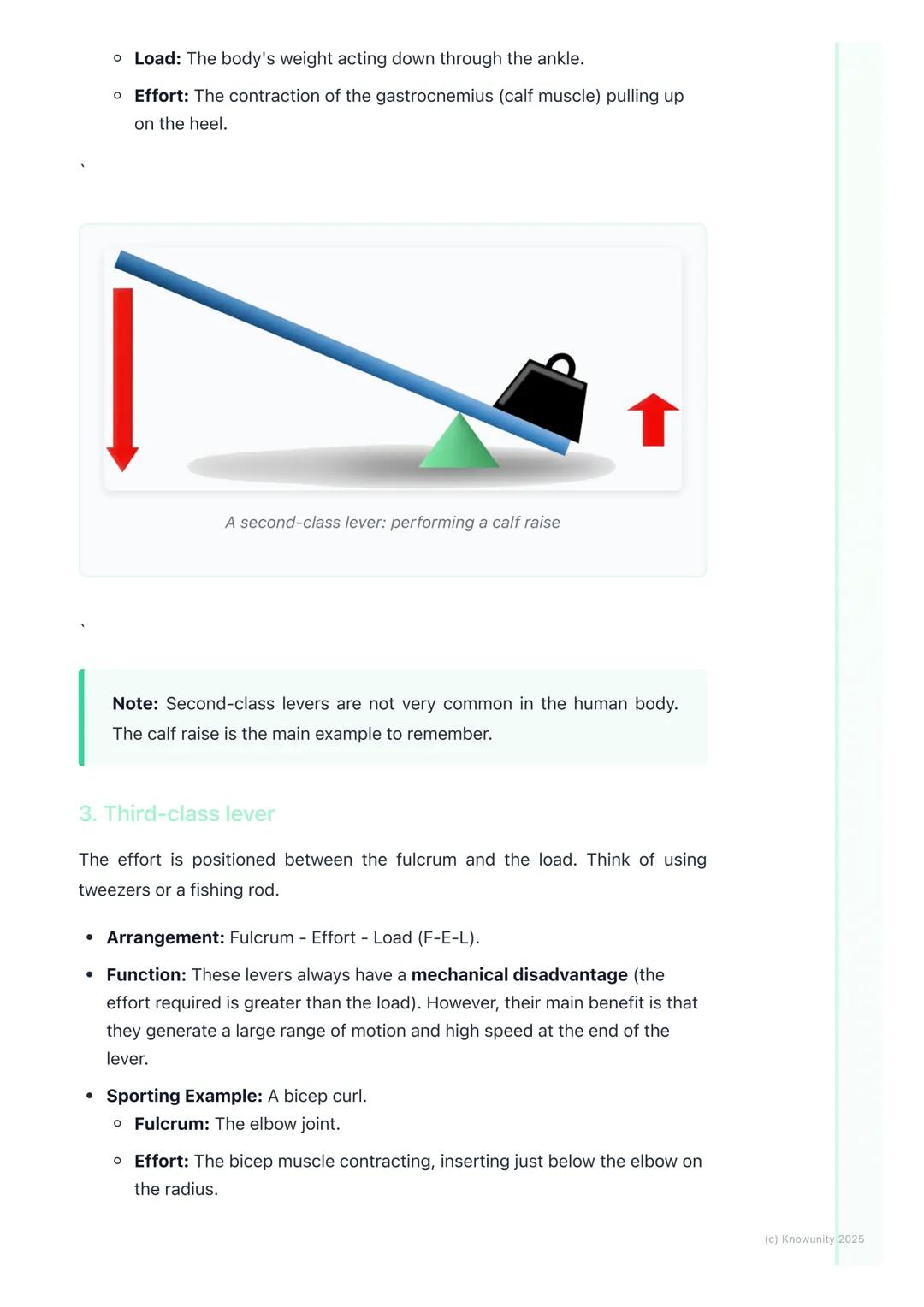
Third-Class Levers: Built for Speed
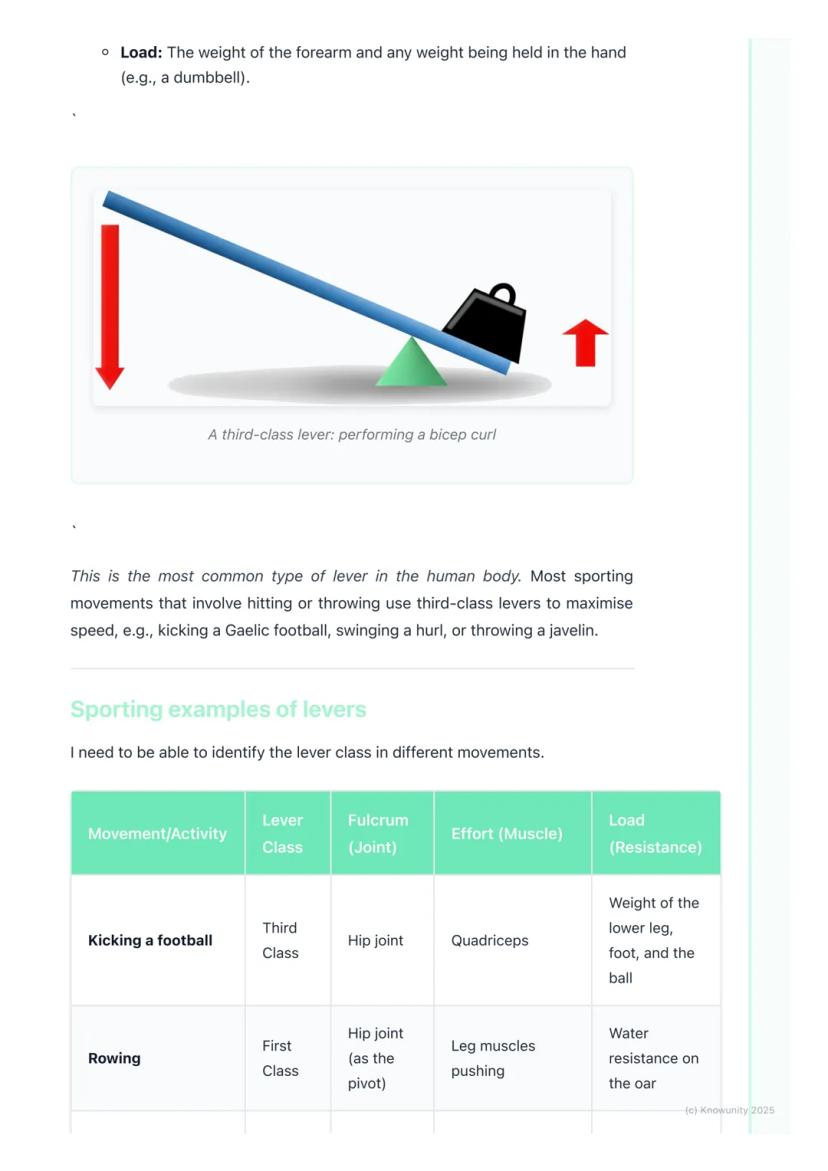
Third-class levers are absolutely everywhere in your body - they're the speed demons of human movement. With the effort positioned between fulcrum and load , they work like tweezers or a fishing rod.
Here's the catch: these levers always work at a mechanical disadvantage, meaning you need more effort than the actual load you're moving. So why does your body love them? Because they create massive speed and range of motion at the end of the lever.
A bicep curl perfectly demonstrates this. Your elbow joint is the fulcrum, your bicep muscle (attaching just below the elbow) provides the effort, and the weight of your forearm plus any dumbbell is the load.
Most explosive sporting movements use third-class levers - kicking a Gaelic football, swinging a hurley, or throwing a javelin. They sacrifice force for that crucial speed that makes the difference between a good shot and a spectacular one.
Game Changer: Third-class levers are why humans can achieve such incredible speeds in sport - your muscles work harder, but the payoff in speed and range of motion is massive.
5
of 6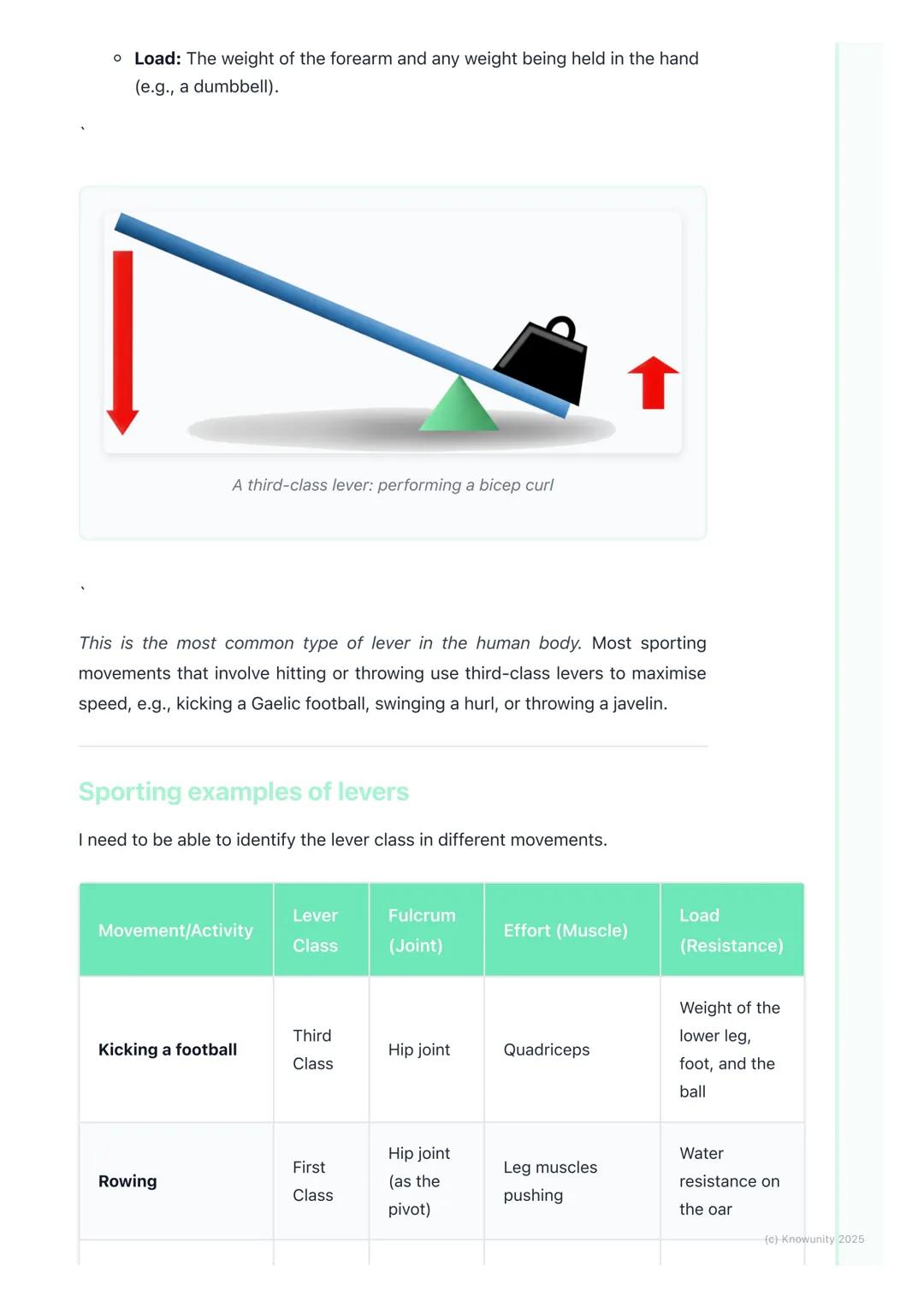
Sporting Examples You Need to Know
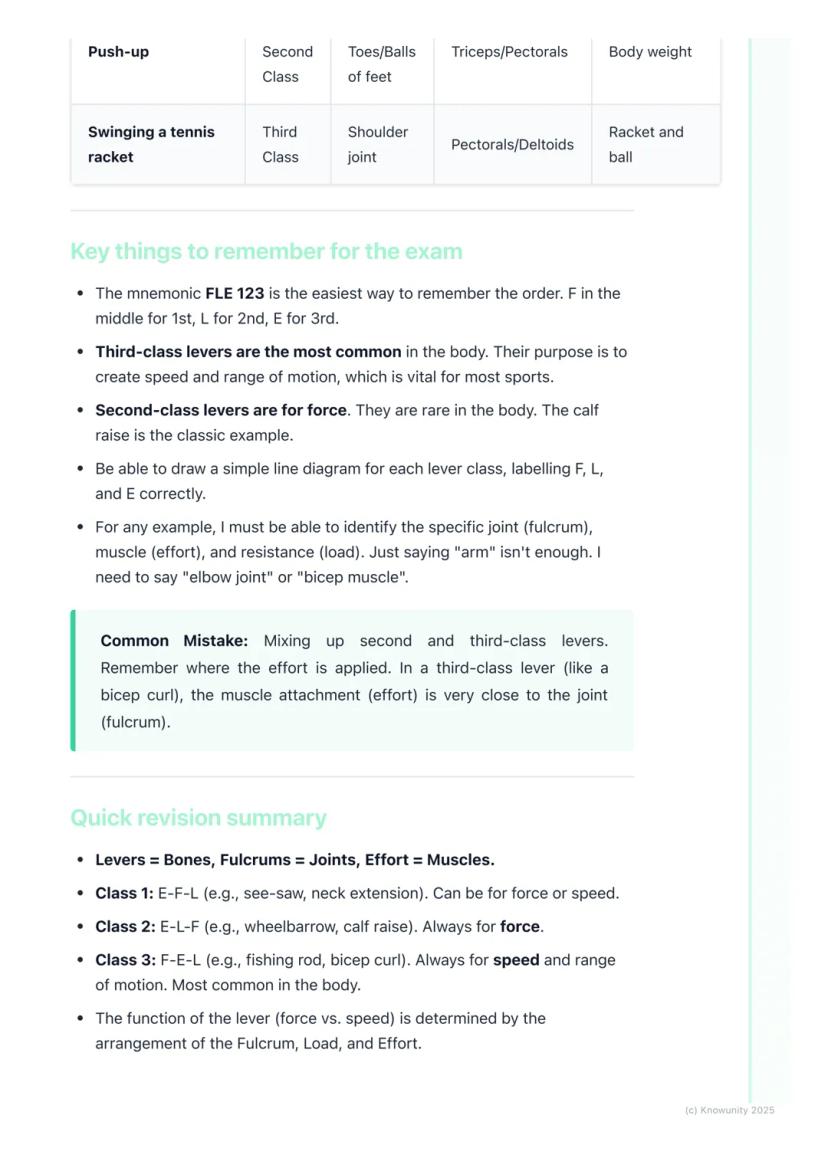
Let's put this into practice with movements you'll recognise from sport. Kicking a football uses a third-class lever: your hip joint as fulcrum, quadriceps muscles as effort, and your lower leg plus the ball as the load.
Rowing demonstrates a first-class lever in action. Your hip joint acts as the pivot point, your leg muscles provide the pushing effort, and the water resistance on the oar becomes your load to overcome.
A push-up might surprise you - it's actually a second-class lever! Your toes form the fulcrum, your triceps and pectorals provide the effort, and your body weight is the load being moved. Meanwhile, swinging a tennis racket is classic third-class: shoulder joint as fulcrum, chest and shoulder muscles as effort, racket and ball as load.
Exam Success: Don't just say "arm muscle" or "leg joint" - be specific! Say "bicep muscle" and "elbow joint" to show you really understand the anatomy.
6
of 6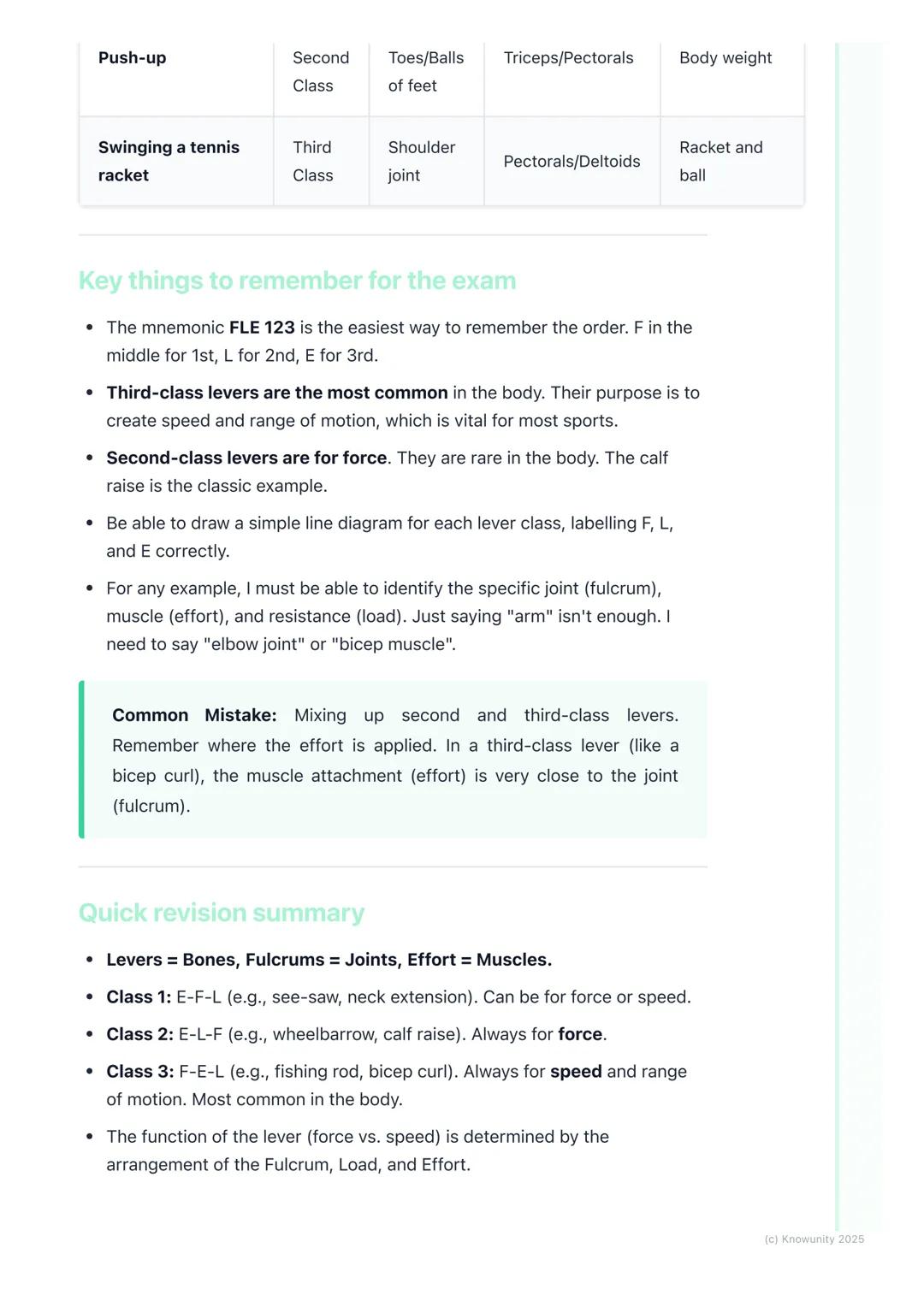
Si on te demande...
Qu'est-ce que le compagnon IA de Knowunity ?
Notre compagnon IA est spécialement conçu pour répondre aux besoins des étudiants. Sur la base des millions d'éléments de contenu que nous avons sur la plateforme, nous pouvons fournir des réponses vraiment significatives et pertinentes aux étudiants. Mais il ne s'agit pas seulement de réponses, le compagnon a encore plus pour but de guider les élèves dans leurs défis d'apprentissage quotidiens, avec des plans d'étude personnalisés, des quiz ou des éléments de contenu dans le chat et une personnalisation à 100% basée sur les compétences et les développements de l'étudiant.
Où puis-je télécharger l'appli Knowunity ?
Tu peux télécharger l'application dans Google Play Store et dans l'App Store d'Apple.
L'application est-elle vraiment gratuite ?
Oui, tu as un accès entièrement gratuit à tous les contenus de l'appli, tu peux chatter ou suivre les créateurs à tout moment. De plus, nous proposons Knowunity Premium, qui te permet de réviser sans limites!
Contenus les plus populaires en LCPE
4LCPEHealthy Eating Guidelines
This section explores national healthy eating guidelines, such as the food pyramid or healthy eating plate, to promote balanced dietary choices.
5th Year50
LCPEBiomechanics of Movement
Applying fundamental biomechanical principles such as force, motion, levers, and stability to analyse and improve human movement efficiency and performance in sport.
6th Year200
LCPEFactors effecting sports psychology ( confidence and self efficacy)
Higher Level LCPE psychological preprration notes
5th Year230
LCPETechnology in Sport
Investigating how technology is used in areas such as performance analysis, equipment design, officiating, and athlete monitoring to enhance training and competition.
6th Year50
Contenus les plus populaires
9 Irish
IrishIrish oral questions and answers
Questions and answers for the leaving cert oral
5th Year4264
 English
Key Quotes : Sive
Key Quotes and explanations: Sive
6th Year2842
IrishIrish oral questions
Outline of oral questions
5th Year2055
IrishIníon- le hÁine Durkin
Aine Durkin’s poem, Iníon: Themes & summary
5th Year850
IrishIrish poetry 2027
Iníon + Dínit an Bhróin
5th Year1133
IrishLC HL notes- Iníon (poem)
Includes poem in English and Irish, theme, key words & phrases
5th Year2284
EnglishCultural Context : Shawshank Redemption : Sive : Small Things Like These
Comparative Study : Cultural Context : Shawshank Redemption, Sive and Small Things Like These
6th Year1430
IrishMo Ghrá-sa (Idir Lúibíní)
Notes on mo ghrá-sa
5th Year380
IrishAn Gaeilge Aiste
Irish Language essay
6th Year1320
Rien ne te convient ? Explore d'autres matières.
Les étudiants nous adorent — il ne manque plus que toi.
4.6/5App Store
4.7/5Google Play
L'application est très facile d'utilisation et bien conçue. Jusqu'à présent, j'ai trouvé tout ce que je cherchais et j'ai pu apprendre beaucoup de choses grâce aux présentations ! Je vais certainement utiliser l'application pour un travail en classe ! Et comme source d'inspiration personnelle, elle est bien sûr aussi très utile.
Stefan Sutilisateur iOS
Cette application est vraiment super. Il y a tellement de fiches de révision et d'aide, [...]. Par exemple, la matière qui me pose problème est le français et l'appli a un choix d'aide très large. Grâce à cette application, je me suis améliorée en français. Je la recommanderais à tout le monde.
Samantha Klichutilisatrice Android
Waouh, je suis vraiment abasourdi. J'ai essayé l'application parce que je l'avais déjà vue plusieurs fois dans la publicité et j'ai été absolument choquée. Cette appli est L'AIDE dont on rêve pour l'école et surtout, elle propose tellement de choses, comme des rédactions et des fiches qui m'ont personnellement TRÈS bien aidé.
Annautilisatrice iOS
LCPE2 vues·Mis à jour Jun 11, 2026·6 pagesUnderstanding Levers in the Human Body
Ever wondered how your body creates the power to kick a football or lift weights? The secret lies in understanding how your bones, joints, and muscles work together as lever systems to generate movement, speed, and force in sport.
1
of 6
Inscris-toi pour voir le contenu. C'est gratuit!
- Accès à tous les documents
- Améliore tes notes
- Rejoins des millions d'étudiants
Levers in the Human Body
Your body is basically a collection of lever systems working together to create movement. A lever is simply a rigid bar (your bones) that moves around a fixed point (your joints) when force is applied (your muscles contracting).
Think of it this way: every time you move, you're using these three essential components. The fulcrum is your joint - the pivot point where movement happens. The effort is the force your muscles produce when they contract and pull on bones. The load (or resistance) is whatever you're trying to move - whether that's your own body weight, a hurley, or a dumbbell.
Understanding these lever systems isn't just theory - it's the key to explaining how athletes generate explosive power and lightning-fast movements in sport. Once you grasp these basics, you'll see lever systems everywhere in human movement.
Key Insight: The way these three components are arranged determines what type of lever you have and whether it's best for generating force or speed.
2
of 6Inscris-toi pour voir le contenu. C'est gratuit!
- Accès à tous les documents
- Améliore tes notes
- Rejoins des millions d'étudiants
The Three Classes of Lever
Here's where it gets interesting - there are three different ways to arrange fulcrum, load, and effort, creating three distinct classes of lever. Each class has its own superpower in terms of movement.
The easiest way to remember them? Use the mnemonic FLE 123. First-class has the Fulcrum in the middle, second-class has the Load in the middle, and third-class has the Effort in the middle.
First-class levers work like a see-saw, with the fulcrum sitting between effort and load . These versatile levers can either give you a mechanical advantage to move heavy loads or help you achieve greater speed and range of motion - it all depends on where that fulcrum sits.
A perfect sporting example? Heading a football. Your neck joint acts as the fulcrum, your neck muscles provide the effort, and your head (plus the ball) is the load you're moving.
Sport Connection: First-class levers are brilliant because they're adaptable - they can be optimised for either power or speed depending on what the movement requires.
3
of 6Inscris-toi pour voir le contenu. C'est gratuit!
- Accès à tous les documents
- Améliore tes notes
- Rejoins des millions d'étudiants
Second-Class Levers: The Powerhouses
Second-class levers are the powerhouses of the body - think wheelbarrow style with the load sandwiched between effort and fulcrum . These levers always give you a mechanical advantage, meaning you can move heavy loads with relatively small effort.
The trade-off? You sacrifice speed and range of motion for that extra force. That's why second-class levers are quite rare in the human body - most sports need speed more than raw power.
The classic example you need to know is standing on your tiptoes (like when jumping for a basketball shot). Your toes act as the fulcrum, your body weight is the load pressing down through your ankle, and your powerful calf muscles provide the effort by pulling up on your heel.
Remember This: Second-class levers are uncommon in the body because sport usually demands speed over pure force - but when you need that extra power (like in a vertical jump), they're invaluable.
4
of 6Inscris-toi pour voir le contenu. C'est gratuit!
- Accès à tous les documents
- Améliore tes notes
- Rejoins des millions d'étudiants
Third-Class Levers: Built for Speed
Third-class levers are absolutely everywhere in your body - they're the speed demons of human movement. With the effort positioned between fulcrum and load , they work like tweezers or a fishing rod.
Here's the catch: these levers always work at a mechanical disadvantage, meaning you need more effort than the actual load you're moving. So why does your body love them? Because they create massive speed and range of motion at the end of the lever.
A bicep curl perfectly demonstrates this. Your elbow joint is the fulcrum, your bicep muscle (attaching just below the elbow) provides the effort, and the weight of your forearm plus any dumbbell is the load.
Most explosive sporting movements use third-class levers - kicking a Gaelic football, swinging a hurley, or throwing a javelin. They sacrifice force for that crucial speed that makes the difference between a good shot and a spectacular one.
Game Changer: Third-class levers are why humans can achieve such incredible speeds in sport - your muscles work harder, but the payoff in speed and range of motion is massive.
5
of 6Inscris-toi pour voir le contenu. C'est gratuit!
- Accès à tous les documents
- Améliore tes notes
- Rejoins des millions d'étudiants
Sporting Examples You Need to Know
Let's put this into practice with movements you'll recognise from sport. Kicking a football uses a third-class lever: your hip joint as fulcrum, quadriceps muscles as effort, and your lower leg plus the ball as the load.
Rowing demonstrates a first-class lever in action. Your hip joint acts as the pivot point, your leg muscles provide the pushing effort, and the water resistance on the oar becomes your load to overcome.
A push-up might surprise you - it's actually a second-class lever! Your toes form the fulcrum, your triceps and pectorals provide the effort, and your body weight is the load being moved. Meanwhile, swinging a tennis racket is classic third-class: shoulder joint as fulcrum, chest and shoulder muscles as effort, racket and ball as load.
Exam Success: Don't just say "arm muscle" or "leg joint" - be specific! Say "bicep muscle" and "elbow joint" to show you really understand the anatomy.
6
of 6Inscris-toi pour voir le contenu. C'est gratuit!
- Accès à tous les documents
- Améliore tes notes
- Rejoins des millions d'étudiants
Si on te demande...
Qu'est-ce que le compagnon IA de Knowunity ?
Notre compagnon IA est spécialement conçu pour répondre aux besoins des étudiants. Sur la base des millions d'éléments de contenu que nous avons sur la plateforme, nous pouvons fournir des réponses vraiment significatives et pertinentes aux étudiants. Mais il ne s'agit pas seulement de réponses, le compagnon a encore plus pour but de guider les élèves dans leurs défis d'apprentissage quotidiens, avec des plans d'étude personnalisés, des quiz ou des éléments de contenu dans le chat et une personnalisation à 100% basée sur les compétences et les développements de l'étudiant.
Où puis-je télécharger l'appli Knowunity ?
Tu peux télécharger l'application dans Google Play Store et dans l'App Store d'Apple.
L'application est-elle vraiment gratuite ?
Oui, tu as un accès entièrement gratuit à tous les contenus de l'appli, tu peux chatter ou suivre les créateurs à tout moment. De plus, nous proposons Knowunity Premium, qui te permet de réviser sans limites!
Contenus les plus populaires en LCPE
4LCPEHealthy Eating Guidelines
This section explores national healthy eating guidelines, such as the food pyramid or healthy eating plate, to promote balanced dietary choices.
5th Year50
LCPEBiomechanics of Movement
Applying fundamental biomechanical principles such as force, motion, levers, and stability to analyse and improve human movement efficiency and performance in sport.
6th Year200
LCPEFactors effecting sports psychology ( confidence and self efficacy)
Higher Level LCPE psychological preprration notes
5th Year230
LCPETechnology in Sport
Investigating how technology is used in areas such as performance analysis, equipment design, officiating, and athlete monitoring to enhance training and competition.
6th Year50
Contenus les plus populaires
9IrishIrish oral questions and answers
Questions and answers for the leaving cert oral
5th Year4264
EnglishKey Quotes : Sive
Key Quotes and explanations: Sive
6th Year2842
IrishIrish oral questions
Outline of oral questions
5th Year2055
IrishIníon- le hÁine Durkin
Aine Durkin’s poem, Iníon: Themes & summary
5th Year850
IrishIrish poetry 2027
Iníon + Dínit an Bhróin
5th Year1133
IrishLC HL notes- Iníon (poem)
Includes poem in English and Irish, theme, key words & phrases
5th Year2284
EnglishCultural Context : Shawshank Redemption : Sive : Small Things Like These
Comparative Study : Cultural Context : Shawshank Redemption, Sive and Small Things Like These
6th Year1430
IrishMo Ghrá-sa (Idir Lúibíní)
Notes on mo ghrá-sa
5th Year380
IrishAn Gaeilge Aiste
Irish Language essay
6th Year1320
Rien ne te convient ? Explore d'autres matières.
Les étudiants nous adorent — il ne manque plus que toi.
4.6/5App Store
4.7/5Google Play
L'application est très facile d'utilisation et bien conçue. Jusqu'à présent, j'ai trouvé tout ce que je cherchais et j'ai pu apprendre beaucoup de choses grâce aux présentations ! Je vais certainement utiliser l'application pour un travail en classe ! Et comme source d'inspiration personnelle, elle est bien sûr aussi très utile.
Stefan Sutilisateur iOS
Cette application est vraiment super. Il y a tellement de fiches de révision et d'aide, [...]. Par exemple, la matière qui me pose problème est le français et l'appli a un choix d'aide très large. Grâce à cette application, je me suis améliorée en français. Je la recommanderais à tout le monde.
Samantha Klichutilisatrice Android
Waouh, je suis vraiment abasourdi. J'ai essayé l'application parce que je l'avais déjà vue plusieurs fois dans la publicité et j'ai été absolument choquée. Cette appli est L'AIDE dont on rêve pour l'école et surtout, elle propose tellement de choses, comme des rédactions et des fiches qui m'ont personnellement TRÈS bien aidé.
Annautilisatrice iOS