
Ever wondered why footballers curve their shots or why basketball...
 LCPE3 vues·Mis à jour Jun 9, 2026·5 pages
Understanding the Basics of Projectile Motion

1 / 5
1
of 5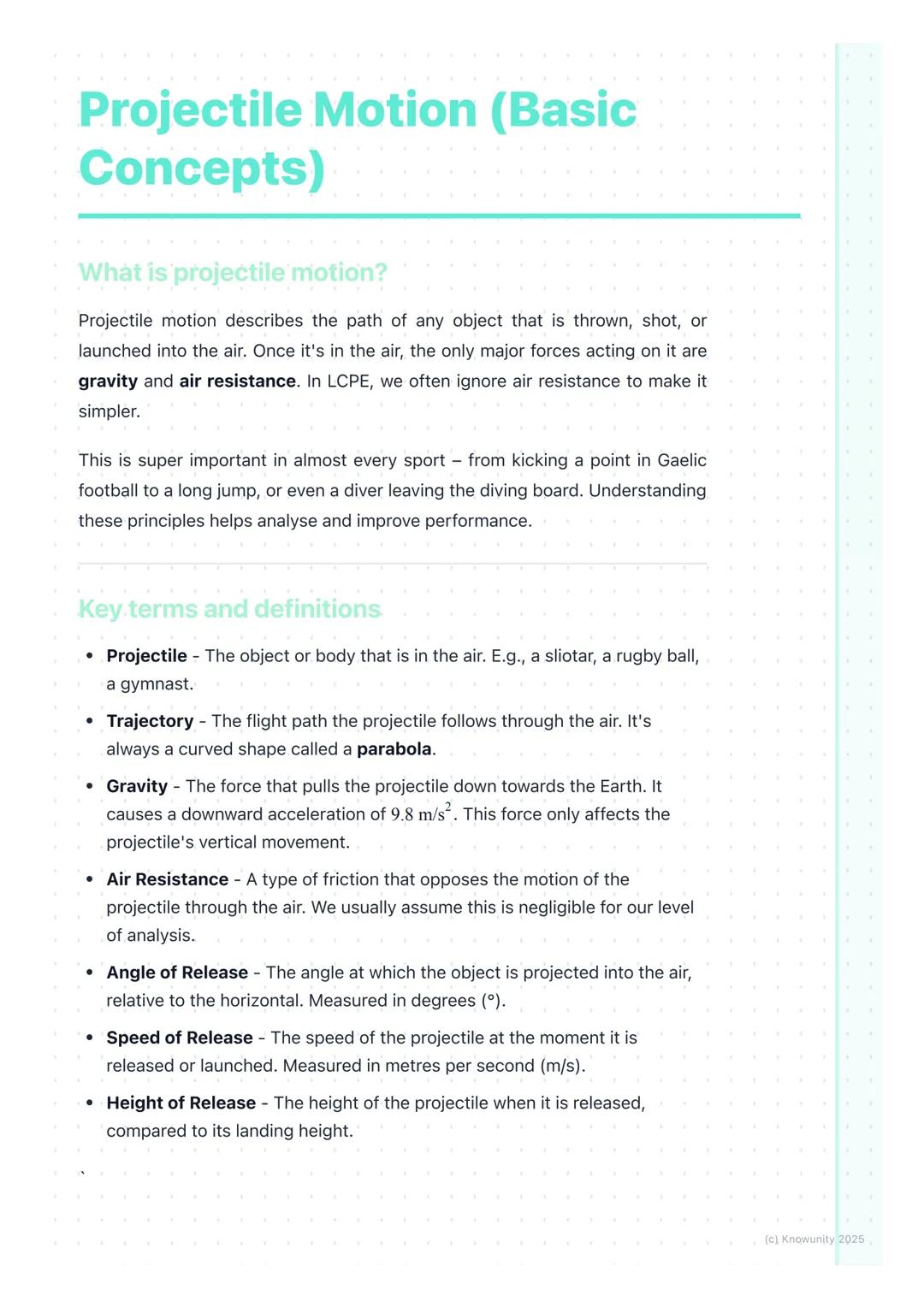
What is Projectile Motion?
Think about every time you've kicked a football or thrown something - you've created projectile motion. This describes how objects move through the air once they've been launched, with only gravity pulling them down.
The most important thing to remember? Once an object is airborne, gravity is the main force affecting it (we'll ignore air resistance to keep things simple). This creates that curved path you always see when balls fly through the air.
Key terms you absolutely need to know:
- Projectile - the object in the air (could be a ball, or even a person jumping)
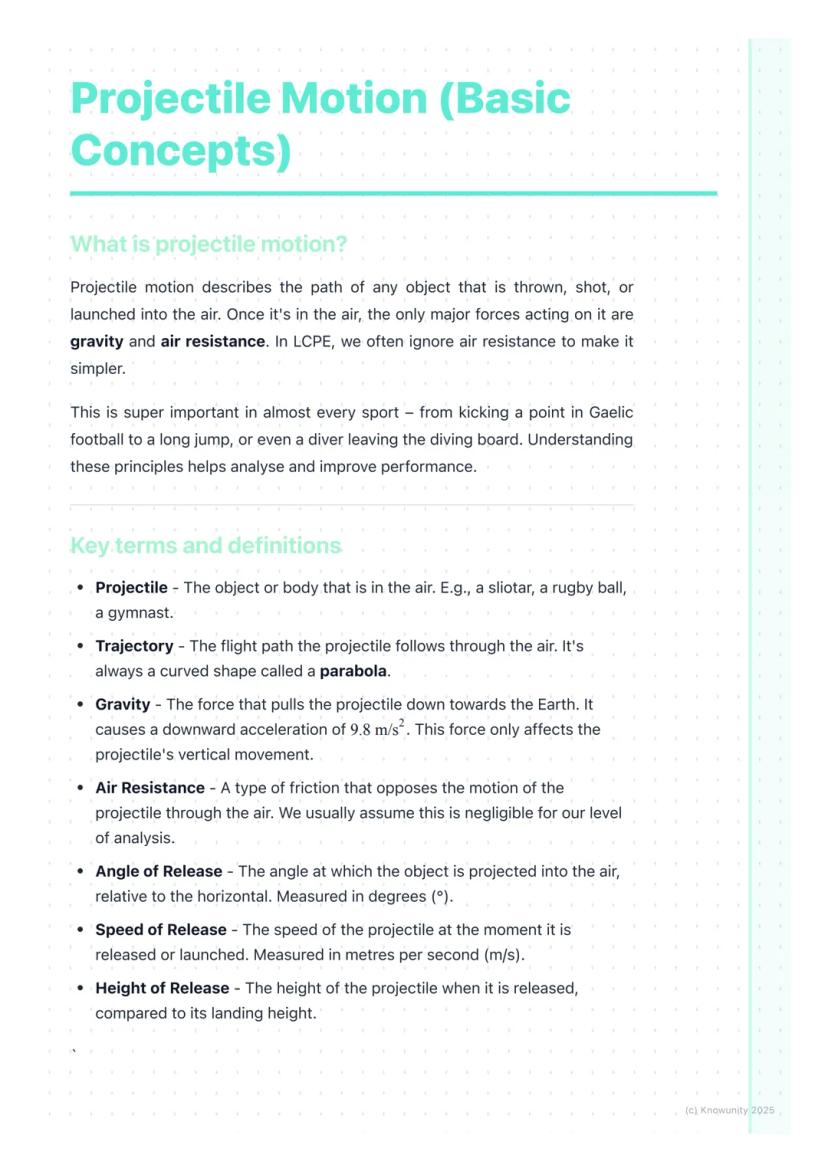
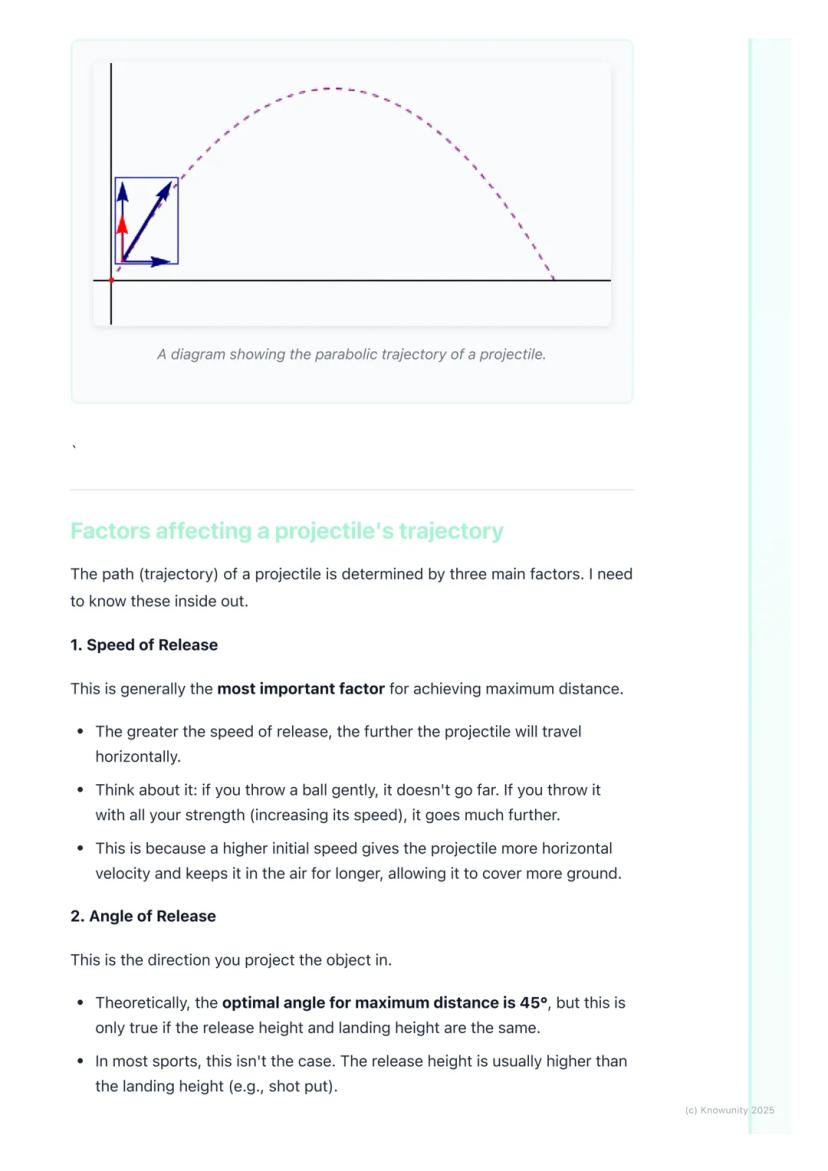
- Trajectory - the curved flight path, always shaped like a parabola
- Gravity - pulls everything down at 9.8 m/s², but only affects vertical movement
- Angle of release - the direction you launch the object (measured in degrees from horizontal)
Remember: Air resistance exists in real life, but we usually ignore it in physics problems to make calculations easier!
2
of 5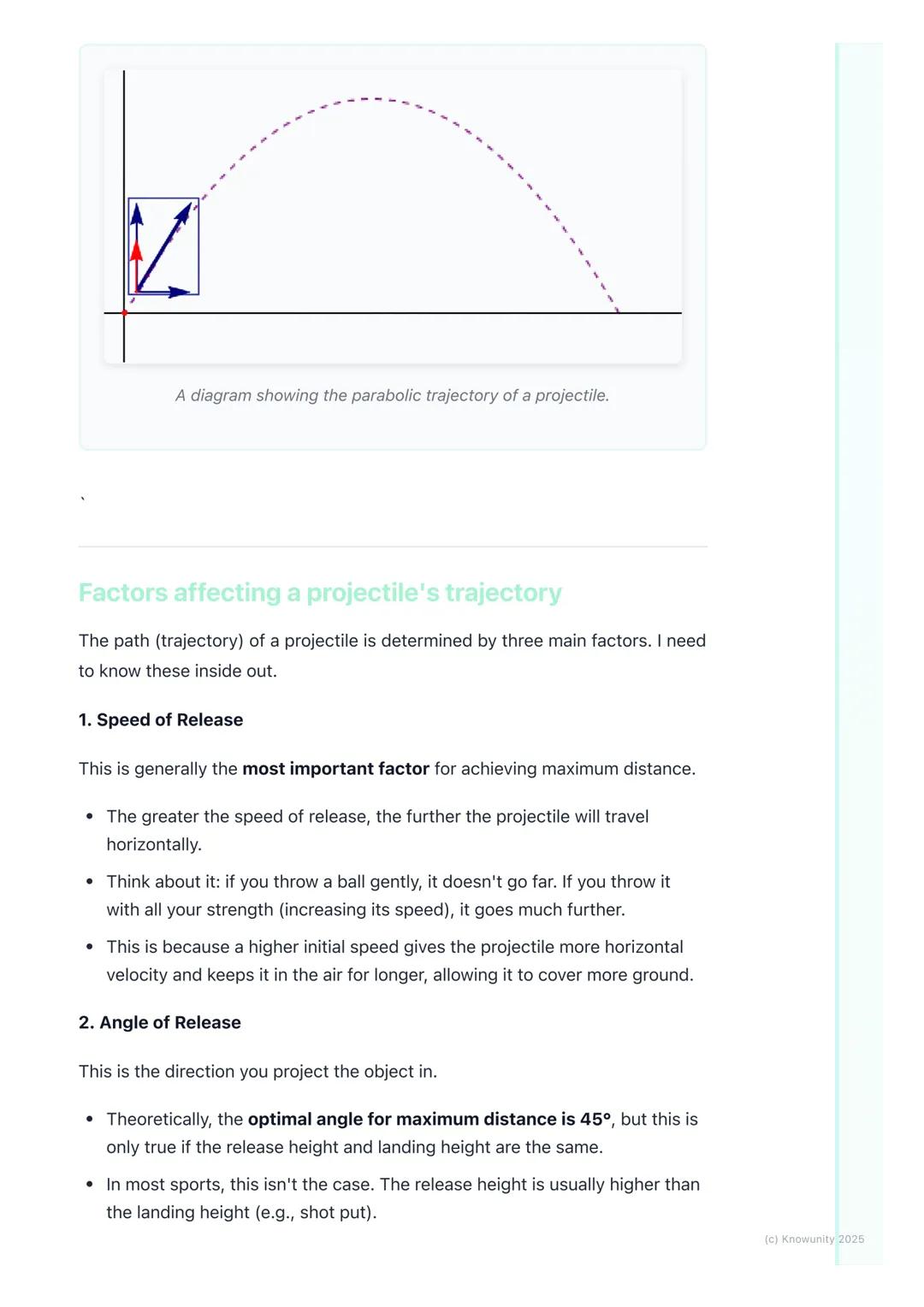
The Three Key Factors
Your projectile's path depends on three main factors that you need to master. Get these right and you'll ace any exam question about projectile motion.
Speed of release is usually the most important factor. Launch something faster and it travels further horizontally - simple as that. It's like the difference between gently tossing a ball versus hurling it with all your strength.
Angle of release determines the direction. Here's the crucial bit: whilst 45° gives maximum distance in theory, this only works when you're launching and landing at the same height. In most sports, you're releasing from a different height than where it lands.
If you're releasing higher than the landing point (like shot put), aim slightly lower than 45°. If you're aiming upwards (like chipping a football over a goalkeeper), go slightly higher than 45°.
Top tip: Don't just memorise "45° is optimal" - explain why it changes in real sports situations!
3
of 5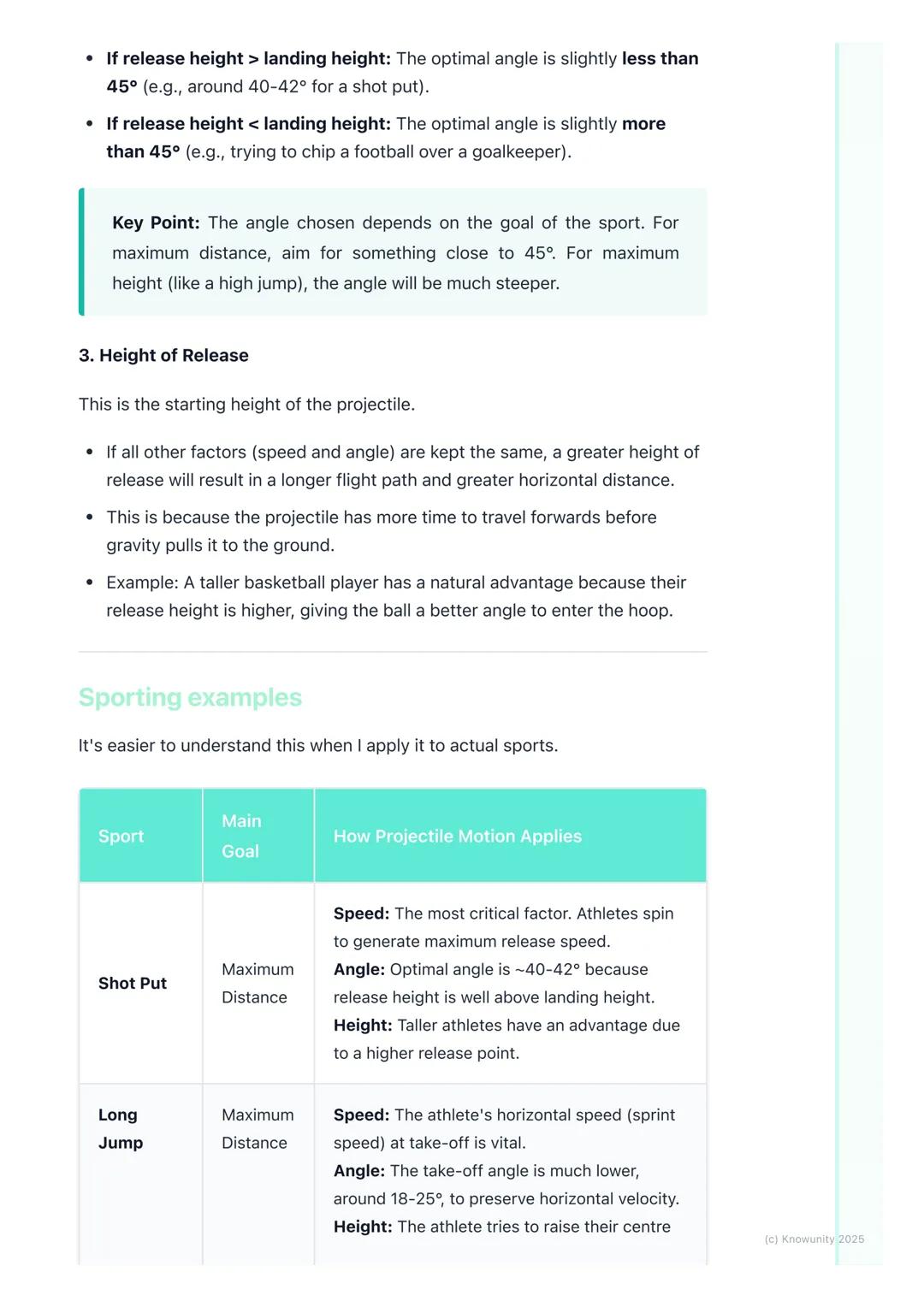
Height of Release Matters
Height of release gives you a massive advantage in many sports. Release something from higher up, and it has more time to travel forward before gravity brings it down to earth.
This explains why taller basketball players have natural advantages - their higher release point gives the ball a better angle into the hoop. It's also why shot putters try to release the shot as high as possible during their throw.
Real sporting examples make this clearer:
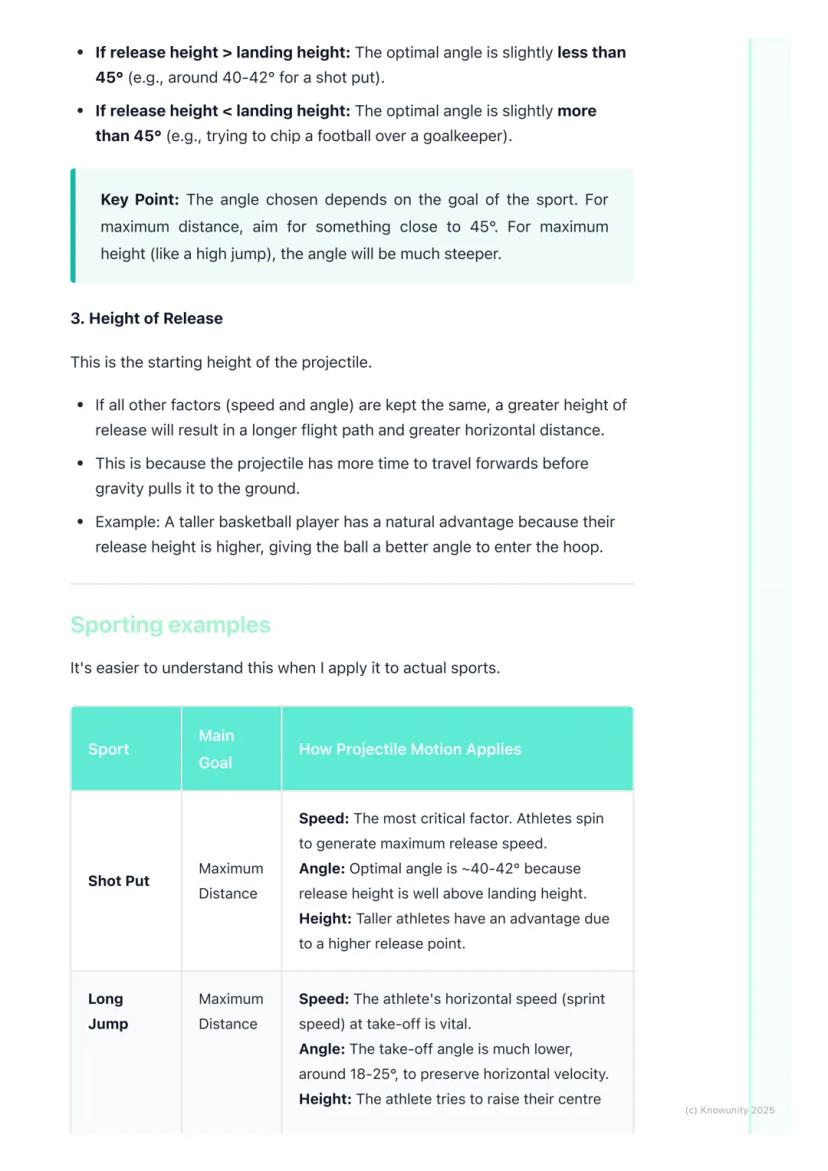
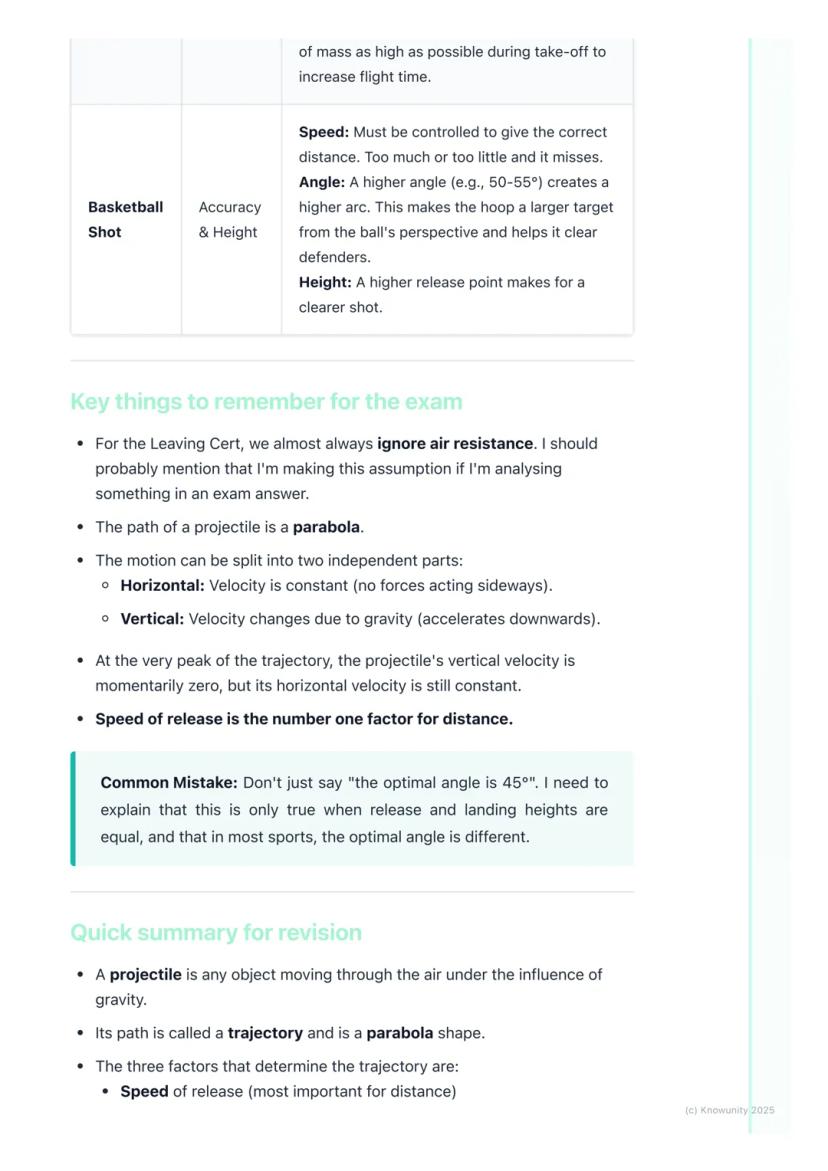
- Basketball shots need controlled speed, high angles (50-55°), and maximum release height
- Shot put requires maximum speed, optimal angles around 40-42°, and releasing as high as possible
- Long jump focuses on speed and getting your centre of mass as high as possible at take-off
The beauty of projectile motion is that you can split it into two parts: horizontal movement (constant speed) and vertical movement (constantly changing due to gravity).
Exam gold: Always mention that you're ignoring air resistance - it shows you understand the assumptions we make!
4
of 5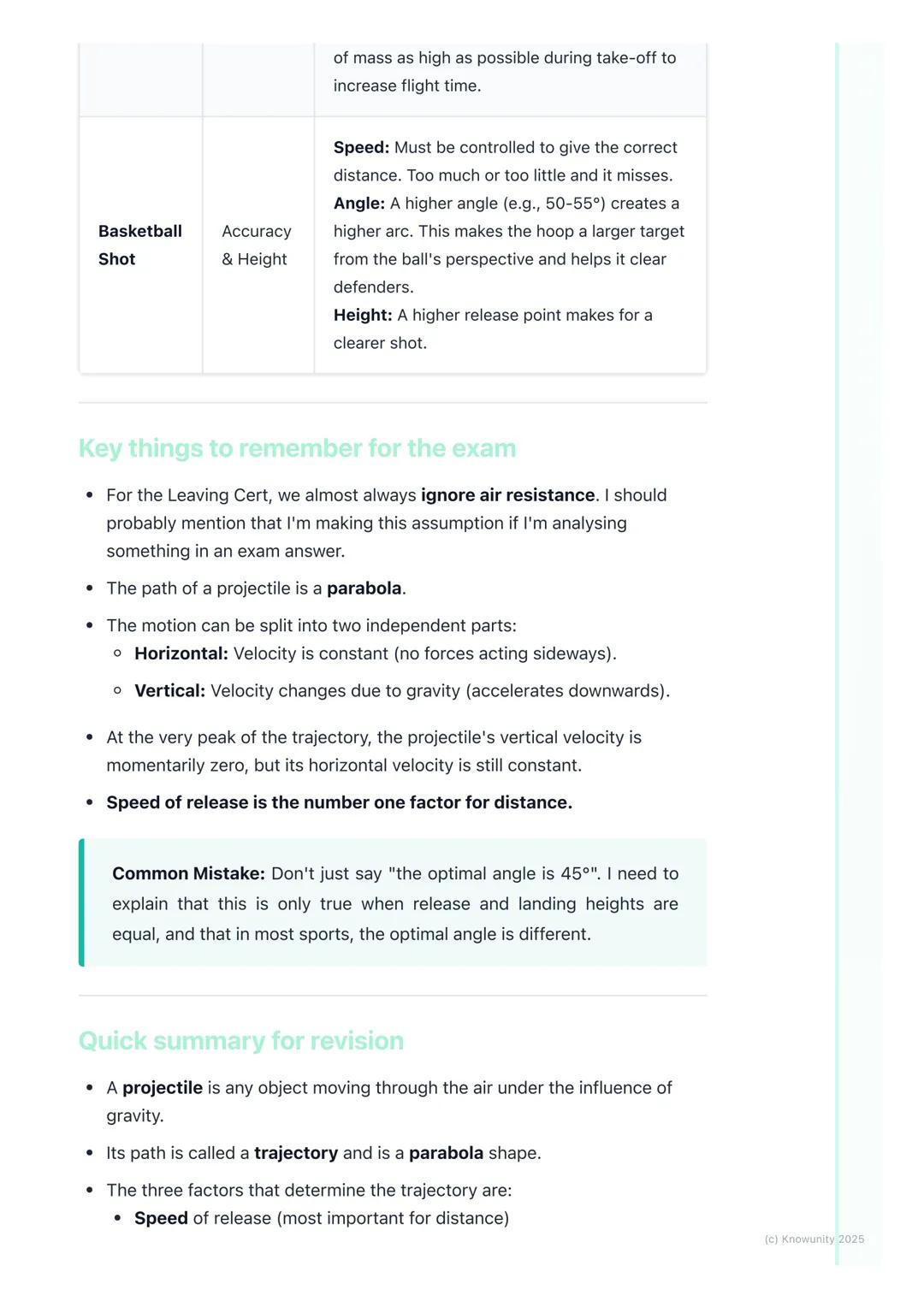
Essential Points for Success
At the peak of any trajectory, something interesting happens - the vertical speed becomes zero for a split second, but horizontal speed stays constant throughout the entire flight.
Gravity only affects the up-and-down motion, never the side-to-side movement. This is why projectiles follow that characteristic parabola shape every single time.
For your exams, remember that speed of release trumps everything else when you want maximum distance. Angle and height matter, but getting that initial speed right is crucial.
Don't fall into the common trap of saying "45° is always optimal" without explaining the conditions. Show you understand that real sports rarely have equal release and landing heights.
Quick revision checklist:
- Projectile = object in air under gravity's influence
- Trajectory = parabola-shaped flight path
- Three factors: speed (most important), angle, and height of release
- Horizontal motion = constant velocity
- Vertical motion = changes due to gravity
Confidence booster: You've got this! These concepts appear everywhere in sport, so you already have intuitive understanding from watching games.
5
of 5
Si on te demande...
Qu'est-ce que le compagnon IA de Knowunity ?
Notre compagnon IA est spécialement conçu pour répondre aux besoins des étudiants. Sur la base des millions d'éléments de contenu que nous avons sur la plateforme, nous pouvons fournir des réponses vraiment significatives et pertinentes aux étudiants. Mais il ne s'agit pas seulement de réponses, le compagnon a encore plus pour but de guider les élèves dans leurs défis d'apprentissage quotidiens, avec des plans d'étude personnalisés, des quiz ou des éléments de contenu dans le chat et une personnalisation à 100% basée sur les compétences et les développements de l'étudiant.
Où puis-je télécharger l'appli Knowunity ?
Tu peux télécharger l'application dans Google Play Store et dans l'App Store d'Apple.
L'application est-elle vraiment gratuite ?
Oui, tu as un accès entièrement gratuit à tous les contenus de l'appli, tu peux chatter ou suivre les créateurs à tout moment. De plus, nous proposons Knowunity Premium, qui te permet de réviser sans limites!
Contenus les plus populaires en LCPE
4Contenus les plus populaires
9Rien ne te convient ? Explore d'autres matières.
Les étudiants nous adorent — il ne manque plus que toi.
4.6/5App Store
4.7/5Google Play
L'application est très facile d'utilisation et bien conçue. Jusqu'à présent, j'ai trouvé tout ce que je cherchais et j'ai pu apprendre beaucoup de choses grâce aux présentations ! Je vais certainement utiliser l'application pour un travail en classe ! Et comme source d'inspiration personnelle, elle est bien sûr aussi très utile.
Stefan Sutilisateur iOS
Cette application est vraiment super. Il y a tellement de fiches de révision et d'aide, [...]. Par exemple, la matière qui me pose problème est le français et l'appli a un choix d'aide très large. Grâce à cette application, je me suis améliorée en français. Je la recommanderais à tout le monde.
Samantha Klichutilisatrice Android
Waouh, je suis vraiment abasourdi. J'ai essayé l'application parce que je l'avais déjà vue plusieurs fois dans la publicité et j'ai été absolument choquée. Cette appli est L'AIDE dont on rêve pour l'école et surtout, elle propose tellement de choses, comme des rédactions et des fiches qui m'ont personnellement TRÈS bien aidé.
Annautilisatrice iOS
LCPE3 vues·Mis à jour Jun 9, 2026·5 pagesUnderstanding the Basics of Projectile Motion
Ever wondered why footballers curve their shots or why basketball players aim high? Projectile motionexplains the path of any object flying through the air - from a sliotar in hurling to a long jumper soaring through the air. Once...
1
of 5
Inscris-toi pour voir le contenu. C'est gratuit!
- Accès à tous les documents
- Améliore tes notes
- Rejoins des millions d'étudiants
What is Projectile Motion?
Think about every time you've kicked a football or thrown something - you've created projectile motion. This describes how objects move through the air once they've been launched, with only gravity pulling them down.
The most important thing to remember? Once an object is airborne, gravity is the main force affecting it (we'll ignore air resistance to keep things simple). This creates that curved path you always see when balls fly through the air.
Key terms you absolutely need to know:
- Projectile - the object in the air (could be a ball, or even a person jumping)
- Trajectory - the curved flight path, always shaped like a parabola
- Gravity - pulls everything down at 9.8 m/s², but only affects vertical movement
- Angle of release - the direction you launch the object (measured in degrees from horizontal)
Remember: Air resistance exists in real life, but we usually ignore it in physics problems to make calculations easier!
2
of 5Inscris-toi pour voir le contenu. C'est gratuit!
- Accès à tous les documents
- Améliore tes notes
- Rejoins des millions d'étudiants
The Three Key Factors
Your projectile's path depends on three main factors that you need to master. Get these right and you'll ace any exam question about projectile motion.
Speed of release is usually the most important factor. Launch something faster and it travels further horizontally - simple as that. It's like the difference between gently tossing a ball versus hurling it with all your strength.
Angle of release determines the direction. Here's the crucial bit: whilst 45° gives maximum distance in theory, this only works when you're launching and landing at the same height. In most sports, you're releasing from a different height than where it lands.
If you're releasing higher than the landing point (like shot put), aim slightly lower than 45°. If you're aiming upwards (like chipping a football over a goalkeeper), go slightly higher than 45°.
Top tip: Don't just memorise "45° is optimal" - explain why it changes in real sports situations!
3
of 5Inscris-toi pour voir le contenu. C'est gratuit!
- Accès à tous les documents
- Améliore tes notes
- Rejoins des millions d'étudiants
Height of Release Matters
Height of release gives you a massive advantage in many sports. Release something from higher up, and it has more time to travel forward before gravity brings it down to earth.
This explains why taller basketball players have natural advantages - their higher release point gives the ball a better angle into the hoop. It's also why shot putters try to release the shot as high as possible during their throw.
Real sporting examples make this clearer:
- Basketball shots need controlled speed, high angles (50-55°), and maximum release height
- Shot put requires maximum speed, optimal angles around 40-42°, and releasing as high as possible
- Long jump focuses on speed and getting your centre of mass as high as possible at take-off
The beauty of projectile motion is that you can split it into two parts: horizontal movement (constant speed) and vertical movement (constantly changing due to gravity).
Exam gold: Always mention that you're ignoring air resistance - it shows you understand the assumptions we make!
4
of 5Inscris-toi pour voir le contenu. C'est gratuit!
- Accès à tous les documents
- Améliore tes notes
- Rejoins des millions d'étudiants
Essential Points for Success
At the peak of any trajectory, something interesting happens - the vertical speed becomes zero for a split second, but horizontal speed stays constant throughout the entire flight.
Gravity only affects the up-and-down motion, never the side-to-side movement. This is why projectiles follow that characteristic parabola shape every single time.
For your exams, remember that speed of release trumps everything else when you want maximum distance. Angle and height matter, but getting that initial speed right is crucial.
Don't fall into the common trap of saying "45° is always optimal" without explaining the conditions. Show you understand that real sports rarely have equal release and landing heights.
Quick revision checklist:
- Projectile = object in air under gravity's influence
- Trajectory = parabola-shaped flight path
- Three factors: speed (most important), angle, and height of release
- Horizontal motion = constant velocity
- Vertical motion = changes due to gravity
Confidence booster: You've got this! These concepts appear everywhere in sport, so you already have intuitive understanding from watching games.
5
of 5Inscris-toi pour voir le contenu. C'est gratuit!
- Accès à tous les documents
- Améliore tes notes
- Rejoins des millions d'étudiants
Si on te demande...
Qu'est-ce que le compagnon IA de Knowunity ?
Notre compagnon IA est spécialement conçu pour répondre aux besoins des étudiants. Sur la base des millions d'éléments de contenu que nous avons sur la plateforme, nous pouvons fournir des réponses vraiment significatives et pertinentes aux étudiants. Mais il ne s'agit pas seulement de réponses, le compagnon a encore plus pour but de guider les élèves dans leurs défis d'apprentissage quotidiens, avec des plans d'étude personnalisés, des quiz ou des éléments de contenu dans le chat et une personnalisation à 100% basée sur les compétences et les développements de l'étudiant.
Où puis-je télécharger l'appli Knowunity ?
Tu peux télécharger l'application dans Google Play Store et dans l'App Store d'Apple.
L'application est-elle vraiment gratuite ?
Oui, tu as un accès entièrement gratuit à tous les contenus de l'appli, tu peux chatter ou suivre les créateurs à tout moment. De plus, nous proposons Knowunity Premium, qui te permet de réviser sans limites!
Contenus les plus populaires en LCPE
4Contenus les plus populaires
9Rien ne te convient ? Explore d'autres matières.
Les étudiants nous adorent — il ne manque plus que toi.
4.6/5App Store
4.7/5Google Play
L'application est très facile d'utilisation et bien conçue. Jusqu'à présent, j'ai trouvé tout ce que je cherchais et j'ai pu apprendre beaucoup de choses grâce aux présentations ! Je vais certainement utiliser l'application pour un travail en classe ! Et comme source d'inspiration personnelle, elle est bien sûr aussi très utile.
Stefan Sutilisateur iOS
Cette application est vraiment super. Il y a tellement de fiches de révision et d'aide, [...]. Par exemple, la matière qui me pose problème est le français et l'appli a un choix d'aide très large. Grâce à cette application, je me suis améliorée en français. Je la recommanderais à tout le monde.
Samantha Klichutilisatrice Android
Waouh, je suis vraiment abasourdi. J'ai essayé l'application parce que je l'avais déjà vue plusieurs fois dans la publicité et j'ai été absolument choquée. Cette appli est L'AIDE dont on rêve pour l'école et surtout, elle propose tellement de choses, comme des rédactions et des fiches qui m'ont personnellement TRÈS bien aidé.
Annautilisatrice iOS