
Ever wonder how you can run full speed down a...
 LCPE2 vues·Mis à jour Jun 11, 2026·7 pages
Understanding the Respiratory System: Breathing and Lungs

1 / 7
1
of 7
Introduction to the Respiratory System
Your respiratory system has one main job that keeps you alive: getting oxygen (O₂) into your body and carbon dioxide (CO₂) out. Think of it as your body's gas station, constantly refuelling your muscles with the oxygen they need for energy.
Without this constant oxygen supply, your muscles would pack it in after just a few seconds. During sports or any physical activity, this system works overtime to meet your body's increased energy demands.
External respiration is what we're focusing on here - the process of moving gases between your lungs and blood. Don't mix this up with cellular respiration, which happens inside your cells when they actually use the oxygen to make energy.
Key Point: The terms "respiration" and "breathing" aren't the same thing - breathing is just the mechanical bit of moving air in and out!
2
of 7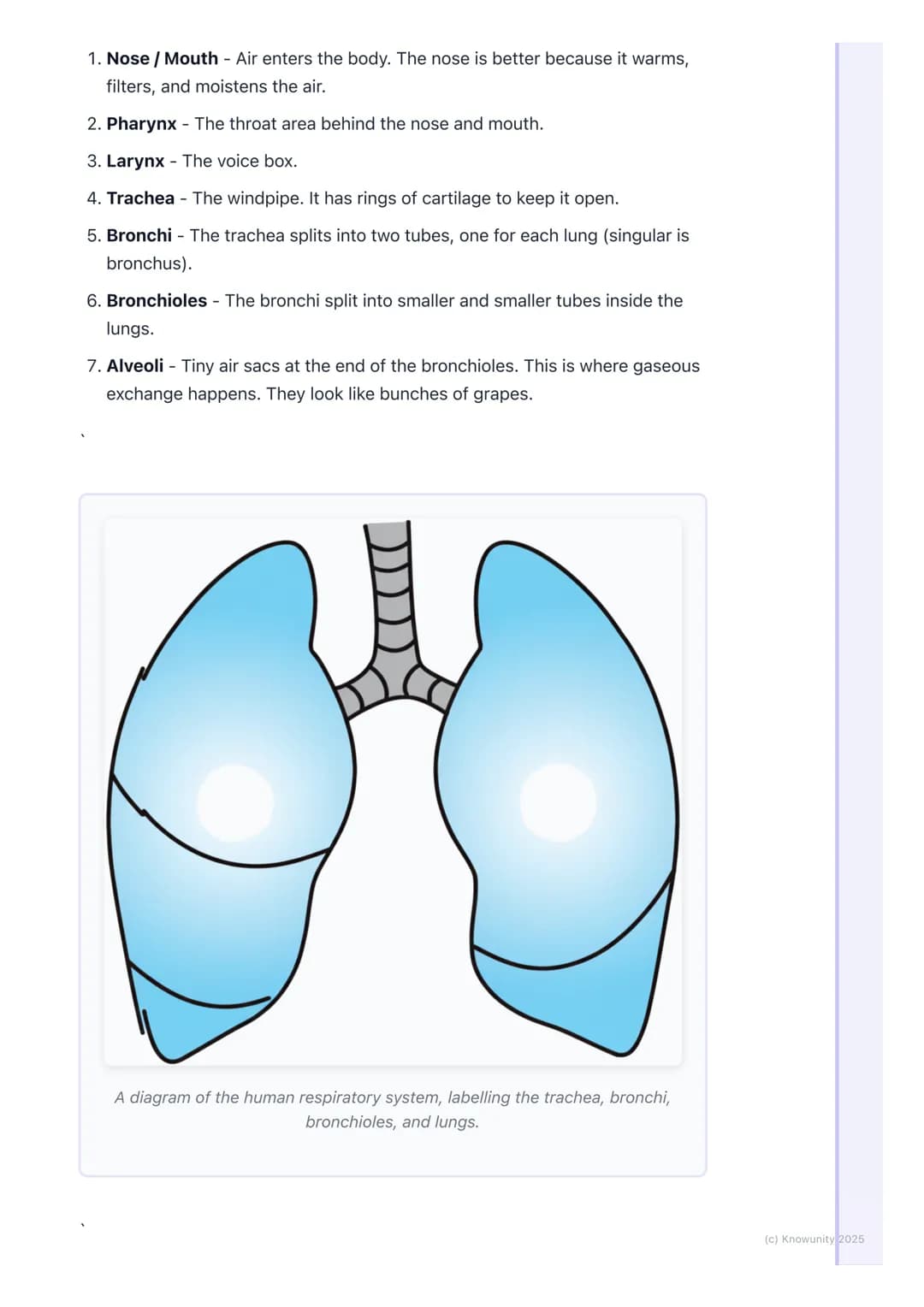
Key Terminology You Need to Know
Let's sort out the terms that'll definitely come up in your exams. Gaseous exchange happens in tiny air sacs called alveoli, where oxygen and carbon dioxide swap places between your lungs and blood through diffusion.
Diffusion is simply gases moving from areas of high concentration to low concentration - like how a strong perfume spreads across a room. Your body uses this natural process brilliantly.
Ventilation is the proper term for breathing - the mechanical process of moving air in (inspiration) and out (expiration). Tidal volume is about 500ml of air you breathe normally at rest, whilst vital capacity is the maximum amount you can forcibly breathe out after the deepest possible breath in.
Exam Tip: Elite endurance athletes have much larger vital capacities - this gives them a huge advantage!
3
of 7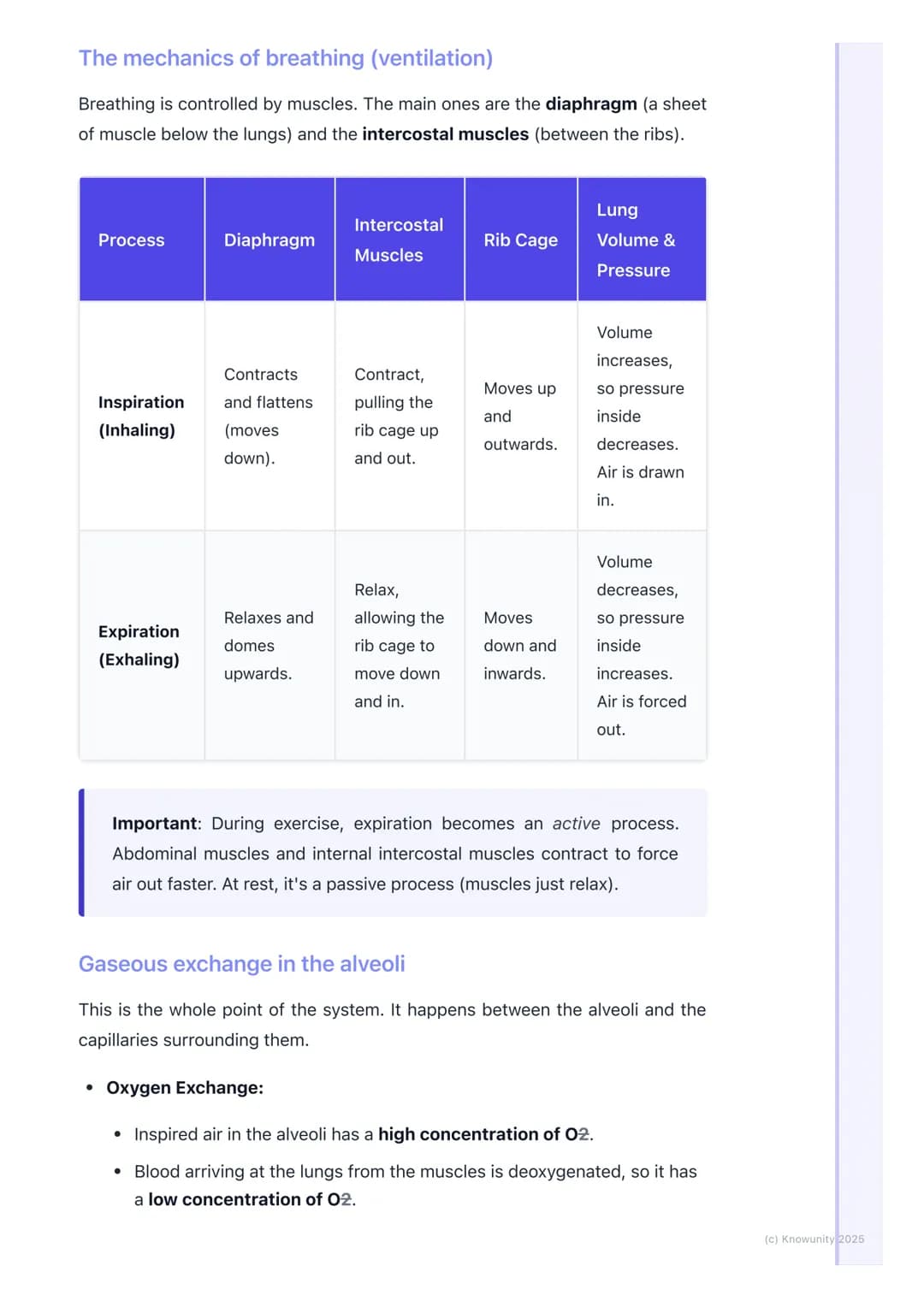
The Pathway of Air Through Your Body
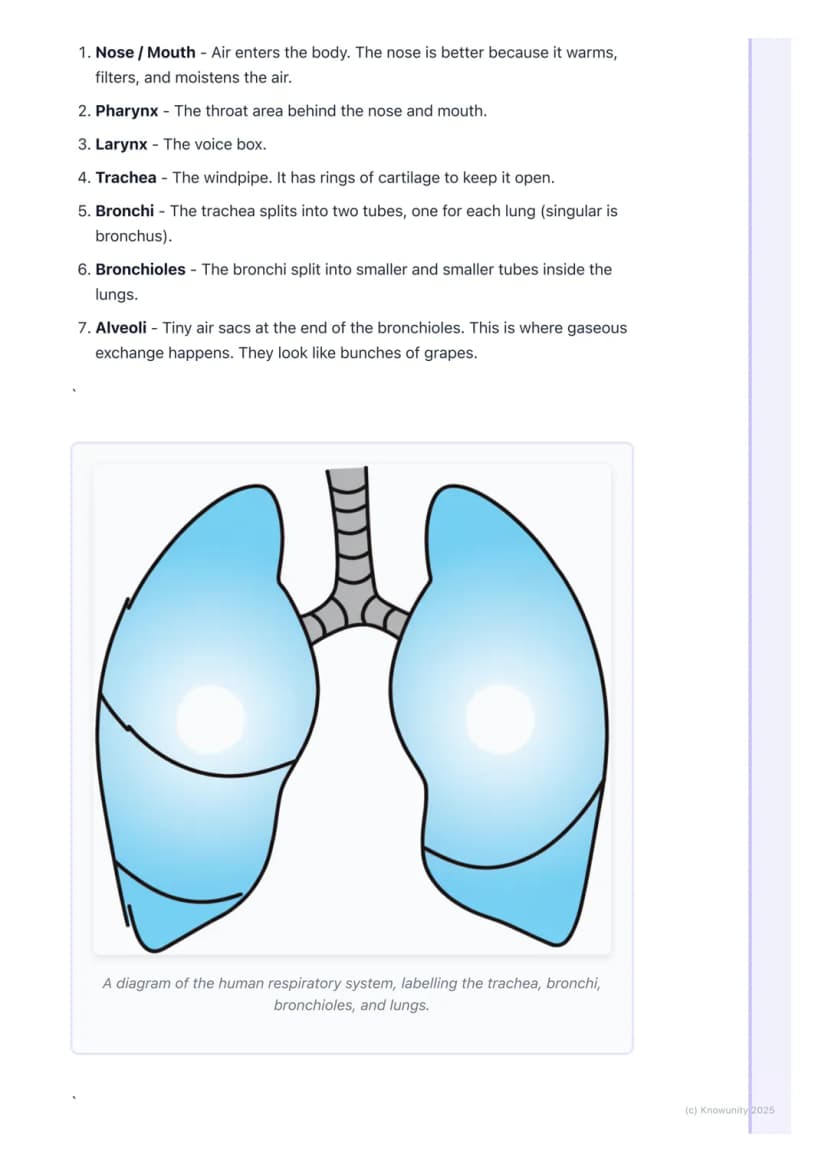
Air travels through a specific route to reach your lungs, and you'll need to know this order for exams. It starts at your nose or mouth (nose is better as it warms and filters air), then moves through the pharynx (throat area) and larynx (voice box).
Next, air travels down your trachea (windpipe), which has cartilage rings to keep it from collapsing. The trachea splits into two bronchi - one tube for each lung.
Inside your lungs, the bronchi branch into smaller bronchioles, like an upside-down tree. Finally, air reaches the alveoli - millions of tiny air sacs that look like bunches of grapes where the actual gas exchange happens.
Memory Trick: Think "Never Put Laundry Through Big Boring Afternoons" for the pathway order!
4
of 7
How Breathing Actually Works
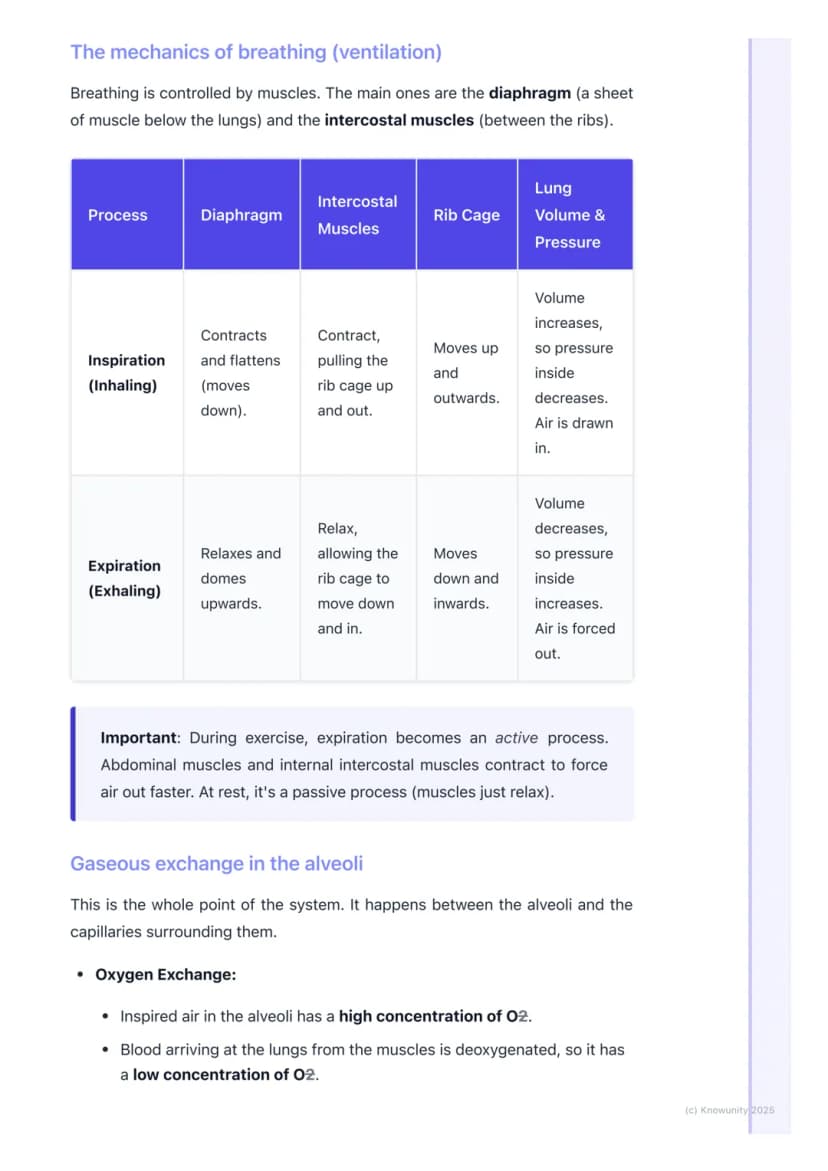
Breathing is controlled by muscles, mainly your diaphragm (a sheet of muscle below your lungs) and intercostal muscles (between your ribs). When you breathe in, your diaphragm contracts and flattens whilst intercostal muscles pull your rib cage up and out.
This increases the volume in your chest cavity, which decreases pressure inside, so air gets drawn in. It's like pulling back on a syringe - the volume increases and air rushes in.
When you breathe out at rest, these muscles simply relax. Your diaphragm domes back up, your ribs move down and in, volume decreases, pressure increases, and air gets pushed out.
Exercise Fact: During intense exercise, breathing out becomes active too - your abdominal muscles contract to force air out faster!
5
of 7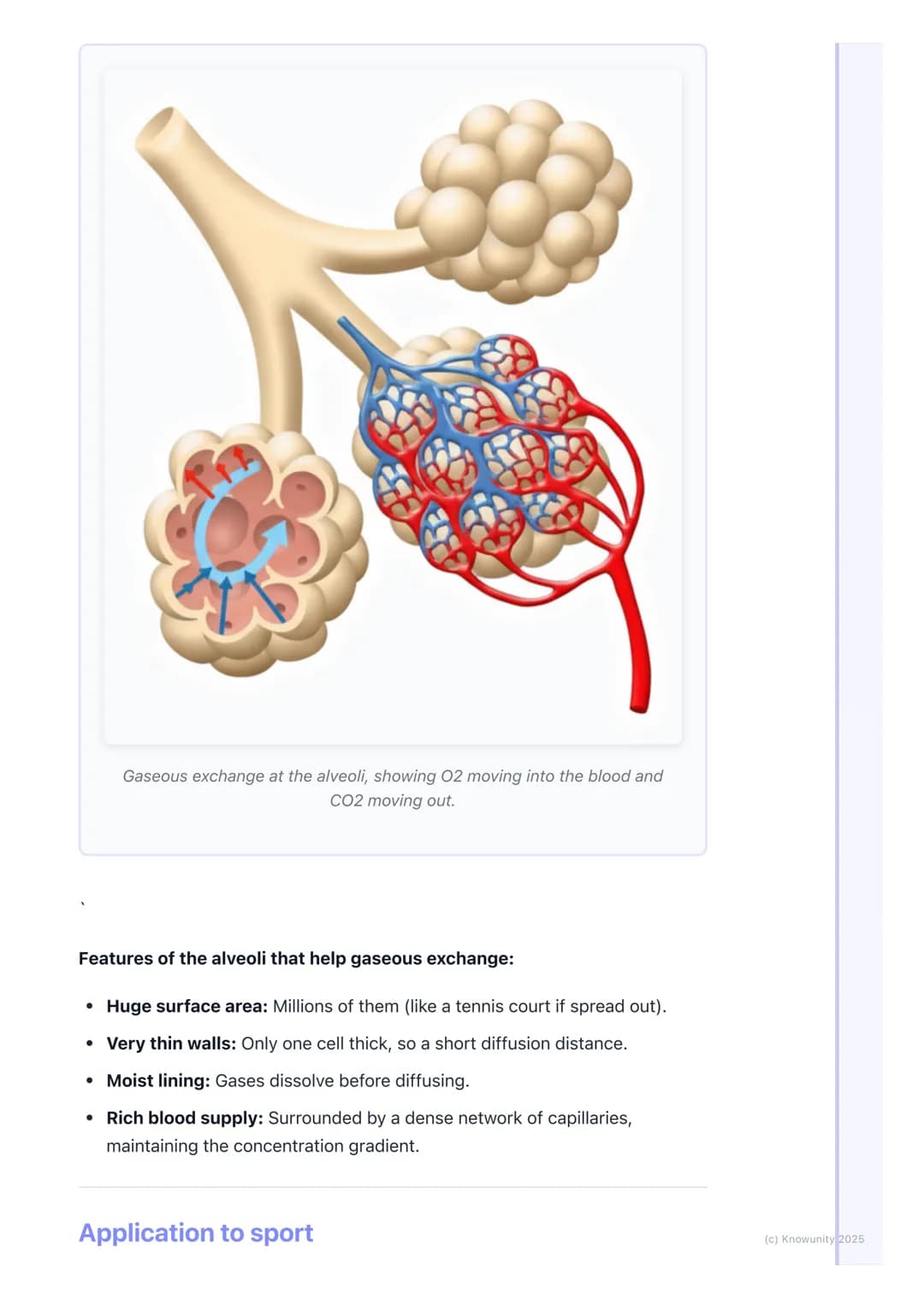
Gaseous Exchange in the Alveoli
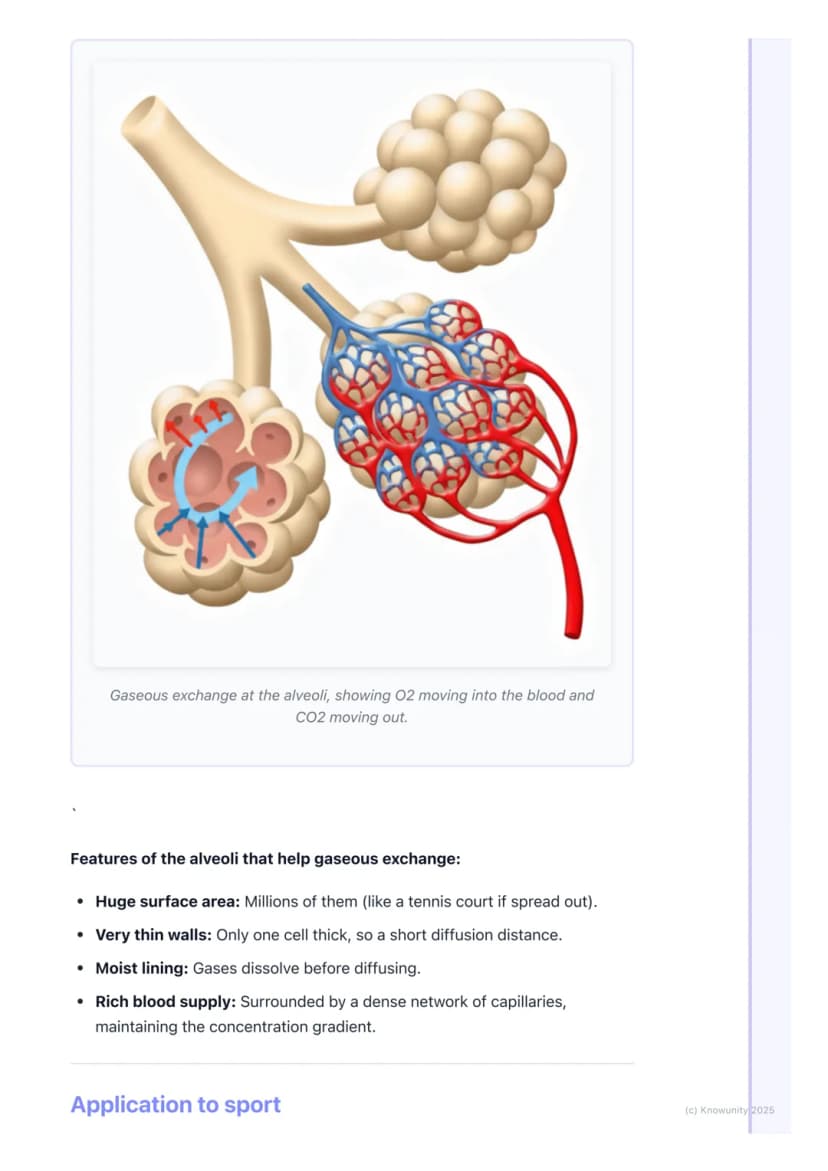
This is where the magic happens. In your alveoli, oxygen moves from the air (high concentration) into your blood (low concentration) because blood arriving from your muscles is deoxygenated. The oxygen then binds to haemoglobin in red blood cells for transport.
Meanwhile, carbon dioxide does the opposite journey. Your blood has loads of CO₂ (it's waste from your muscles), whilst the air in your alveoli has very little, so CO₂ diffuses from blood into air to be breathed out.
Your alveoli are perfectly designed for this job. They provide a massive surface area (like a tennis court if spread flat), have walls just one cell thick, stay moist so gases dissolve easily, and are surrounded by dense networks of capillaries.
Exam Gold: Those four features of alveoli come up constantly in exams - learn them off by heart!
6
of 7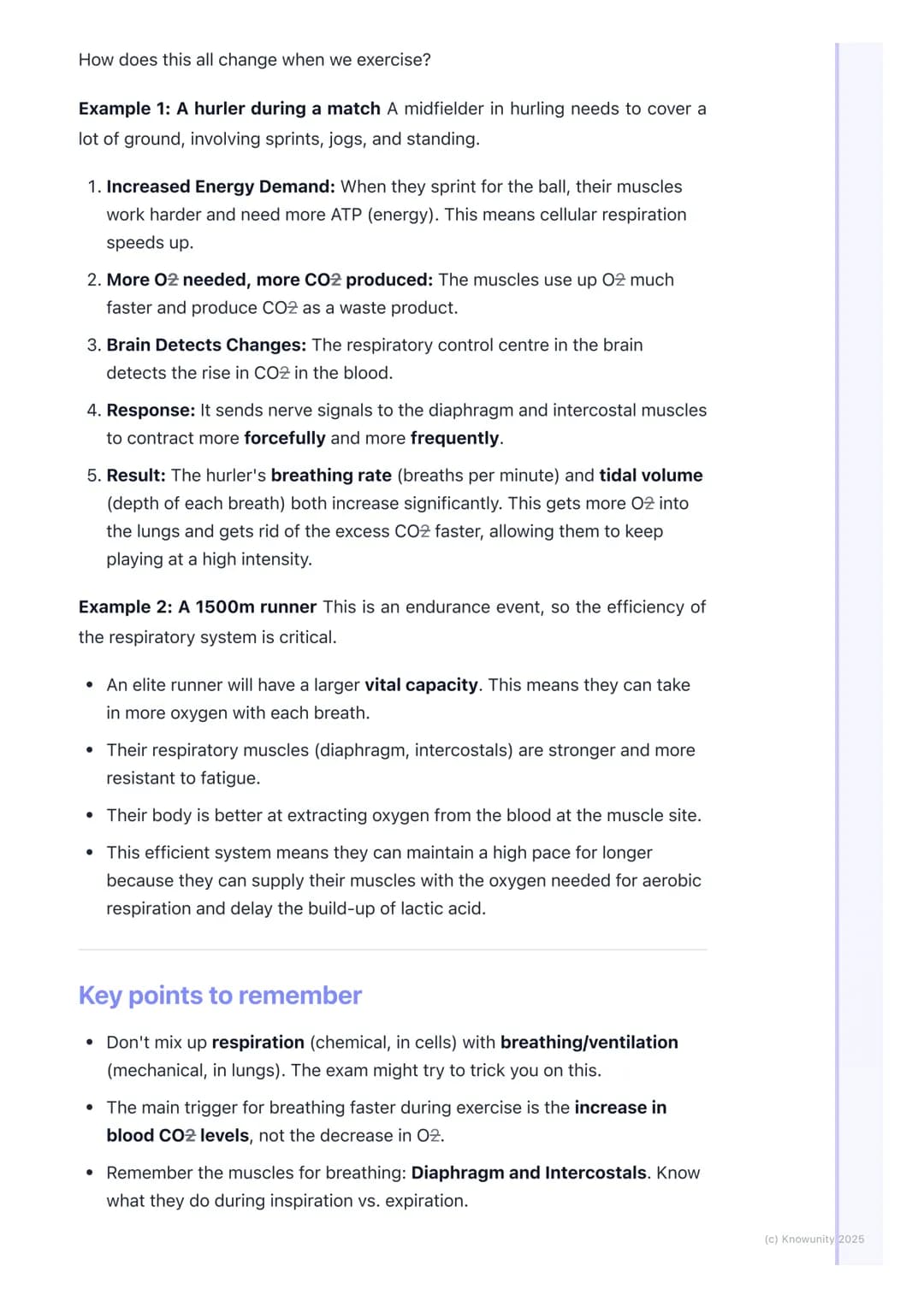
How Exercise Changes Everything
When you exercise, your muscles demand way more energy, which means they need loads more oxygen and produce much more carbon dioxide. Your brain's respiratory control centre detects the rise in CO₂ levels in your blood and responds immediately.
It sends signals to your breathing muscles to work harder and faster. Both your breathing rate (breaths per minute) and tidal volume (depth of each breath) increase dramatically to meet demand.
A hurling midfielder sprinting for the ball might increase their breathing rate from 12 breaths per minute at rest to over 40 during intense play. A 1500m runner with superior vital capacity and stronger respiratory muscles can maintain high pace for longer because their system efficiently supplies oxygen for aerobic respiration.
Important: It's actually the increase in CO₂ levels, not the decrease in O₂, that triggers faster breathing during exercise!
7
of 7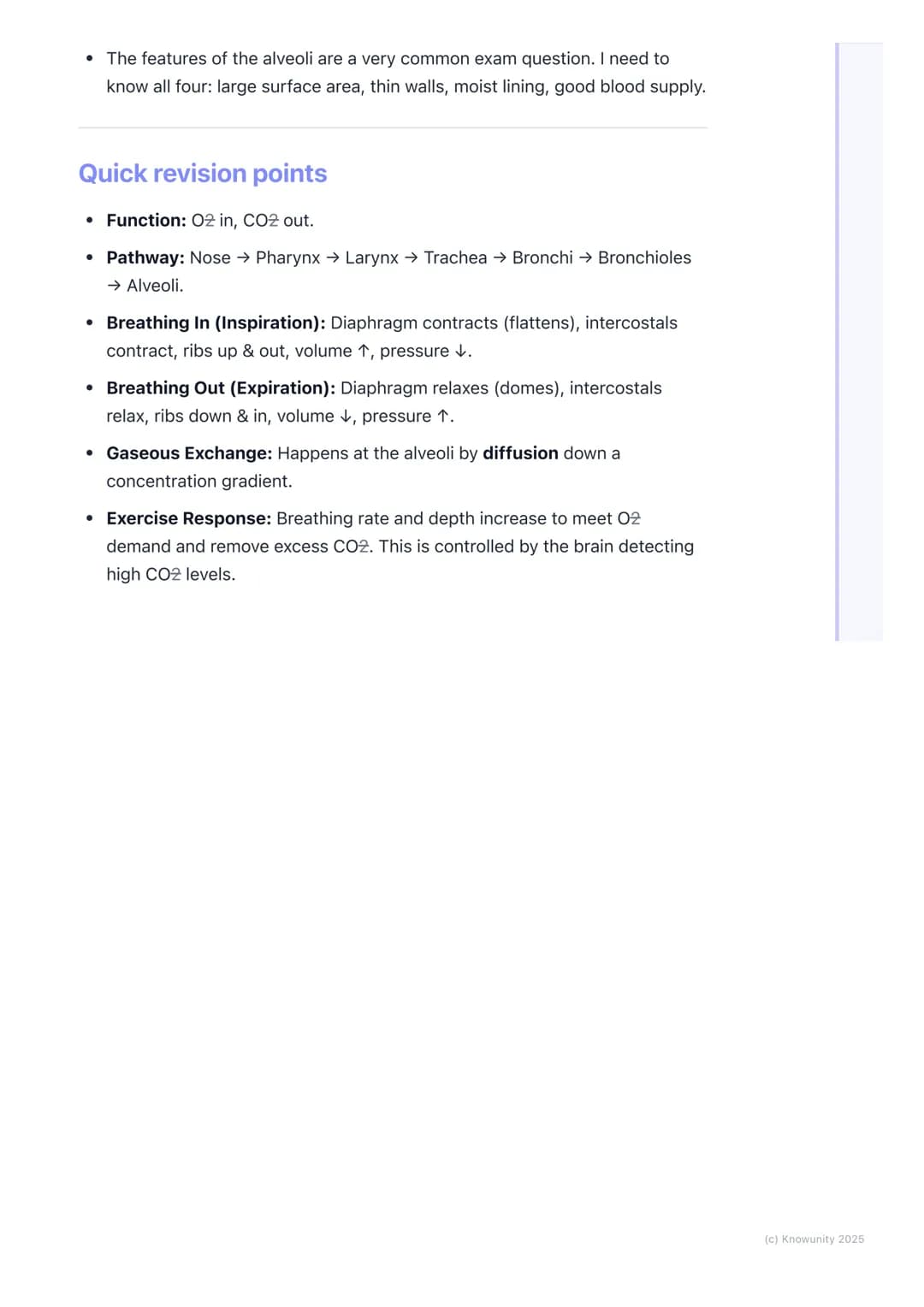
Quick Revision Summary
Your respiratory system's function is simple: O₂ in, CO₂ out. Air follows this pathway: Nose → Pharynx → Larynx → Trachea → Bronchi → Bronchioles → Alveoli.
For breathing mechanics, remember: inspiration involves diaphragm contracting (flattening), intercostals contracting, ribs moving up and out, volume increasing, and pressure decreasing. Expiration is the exact opposite.
Gaseous exchange happens at alveoli through diffusion down concentration gradients. During exercise, your breathing rate and depth increase to meet oxygen demand and remove excess CO₂, all controlled by your brain detecting high CO₂ levels.
Final Tip: Don't confuse respiration (chemical process in cells) with ventilation (mechanical breathing) - exams love to test this distinction!
Si on te demande...
Qu'est-ce que le compagnon IA de Knowunity ?
Notre compagnon IA est spécialement conçu pour répondre aux besoins des étudiants. Sur la base des millions d'éléments de contenu que nous avons sur la plateforme, nous pouvons fournir des réponses vraiment significatives et pertinentes aux étudiants. Mais il ne s'agit pas seulement de réponses, le compagnon a encore plus pour but de guider les élèves dans leurs défis d'apprentissage quotidiens, avec des plans d'étude personnalisés, des quiz ou des éléments de contenu dans le chat et une personnalisation à 100% basée sur les compétences et les développements de l'étudiant.
Où puis-je télécharger l'appli Knowunity ?
Tu peux télécharger l'application dans Google Play Store et dans l'App Store d'Apple.
L'application est-elle vraiment gratuite ?
Oui, tu as un accès entièrement gratuit à tous les contenus de l'appli, tu peux chatter ou suivre les créateurs à tout moment. De plus, nous proposons Knowunity Premium, qui te permet de réviser sans limites!
Contenus les plus populaires en LCPE
4LCPEHealthy Eating Guidelines
This section explores national healthy eating guidelines, such as the food pyramid or healthy eating plate, to promote balanced dietary choices.
5th Year50
LCPEBiomechanics of Movement
Applying fundamental biomechanical principles such as force, motion, levers, and stability to analyse and improve human movement efficiency and performance in sport.
6th Year200
LCPEFactors effecting sports psychology ( confidence and self efficacy)
Higher Level LCPE psychological preprration notes
5th Year230
LCPETechnology in Sport
Investigating how technology is used in areas such as performance analysis, equipment design, officiating, and athlete monitoring to enhance training and competition.
6th Year50
Contenus les plus populaires
9 Irish
IrishIrish oral questions and answers
Questions and answers for the leaving cert oral
5th Year4264
 English
Key Quotes : Sive
Key Quotes and explanations: Sive
6th Year2842
IrishIrish oral questions
Outline of oral questions
5th Year2055
IrishIníon- le hÁine Durkin
Aine Durkin’s poem, Iníon: Themes & summary
5th Year890
IrishIrish poetry 2027
Iníon + Dínit an Bhróin
5th Year1153
IrishLC HL notes- Iníon (poem)
Includes poem in English and Irish, theme, key words & phrases
5th Year2304
EnglishCultural Context : Shawshank Redemption : Sive : Small Things Like These
Comparative Study : Cultural Context : Shawshank Redemption, Sive and Small Things Like These
6th Year1430
IrishMo Ghrá-sa (Idir Lúibíní)
Notes on mo ghrá-sa
5th Year380
IrishAn Gaeilge Aiste
Irish Language essay
6th Year1320
Rien ne te convient ? Explore d'autres matières.
Les étudiants nous adorent — il ne manque plus que toi.
4.6/5App Store
4.7/5Google Play
L'application est très facile d'utilisation et bien conçue. Jusqu'à présent, j'ai trouvé tout ce que je cherchais et j'ai pu apprendre beaucoup de choses grâce aux présentations ! Je vais certainement utiliser l'application pour un travail en classe ! Et comme source d'inspiration personnelle, elle est bien sûr aussi très utile.
Stefan Sutilisateur iOS
Cette application est vraiment super. Il y a tellement de fiches de révision et d'aide, [...]. Par exemple, la matière qui me pose problème est le français et l'appli a un choix d'aide très large. Grâce à cette application, je me suis améliorée en français. Je la recommanderais à tout le monde.
Samantha Klichutilisatrice Android
Waouh, je suis vraiment abasourdi. J'ai essayé l'application parce que je l'avais déjà vue plusieurs fois dans la publicité et j'ai été absolument choquée. Cette appli est L'AIDE dont on rêve pour l'école et surtout, elle propose tellement de choses, comme des rédactions et des fiches qui m'ont personnellement TRÈS bien aidé.
Annautilisatrice iOS
LCPE2 vues·Mis à jour Jun 11, 2026·7 pagesUnderstanding the Respiratory System: Breathing and Lungs
Ever wonder how you can run full speed down a pitch or climb stairs without collapsing? Your respiratory systemis working flat out behind the scenes, acting like your body's personal delivery service. It's constantly bringing in fresh oxygen for...
1
of 7
Inscris-toi pour voir le contenu. C'est gratuit!
- Accès à tous les documents
- Améliore tes notes
- Rejoins des millions d'étudiants
Introduction to the Respiratory System
Your respiratory system has one main job that keeps you alive: getting oxygen (O₂) into your body and carbon dioxide (CO₂) out. Think of it as your body's gas station, constantly refuelling your muscles with the oxygen they need for energy.
Without this constant oxygen supply, your muscles would pack it in after just a few seconds. During sports or any physical activity, this system works overtime to meet your body's increased energy demands.
External respiration is what we're focusing on here - the process of moving gases between your lungs and blood. Don't mix this up with cellular respiration, which happens inside your cells when they actually use the oxygen to make energy.
Key Point: The terms "respiration" and "breathing" aren't the same thing - breathing is just the mechanical bit of moving air in and out!
2
of 7Inscris-toi pour voir le contenu. C'est gratuit!
- Accès à tous les documents
- Améliore tes notes
- Rejoins des millions d'étudiants
Key Terminology You Need to Know
Let's sort out the terms that'll definitely come up in your exams. Gaseous exchange happens in tiny air sacs called alveoli, where oxygen and carbon dioxide swap places between your lungs and blood through diffusion.
Diffusion is simply gases moving from areas of high concentration to low concentration - like how a strong perfume spreads across a room. Your body uses this natural process brilliantly.
Ventilation is the proper term for breathing - the mechanical process of moving air in (inspiration) and out (expiration). Tidal volume is about 500ml of air you breathe normally at rest, whilst vital capacity is the maximum amount you can forcibly breathe out after the deepest possible breath in.
Exam Tip: Elite endurance athletes have much larger vital capacities - this gives them a huge advantage!
3
of 7Inscris-toi pour voir le contenu. C'est gratuit!
- Accès à tous les documents
- Améliore tes notes
- Rejoins des millions d'étudiants
The Pathway of Air Through Your Body
Air travels through a specific route to reach your lungs, and you'll need to know this order for exams. It starts at your nose or mouth (nose is better as it warms and filters air), then moves through the pharynx (throat area) and larynx (voice box).
Next, air travels down your trachea (windpipe), which has cartilage rings to keep it from collapsing. The trachea splits into two bronchi - one tube for each lung.
Inside your lungs, the bronchi branch into smaller bronchioles, like an upside-down tree. Finally, air reaches the alveoli - millions of tiny air sacs that look like bunches of grapes where the actual gas exchange happens.
Memory Trick: Think "Never Put Laundry Through Big Boring Afternoons" for the pathway order!
4
of 7Inscris-toi pour voir le contenu. C'est gratuit!
- Accès à tous les documents
- Améliore tes notes
- Rejoins des millions d'étudiants
How Breathing Actually Works
Breathing is controlled by muscles, mainly your diaphragm (a sheet of muscle below your lungs) and intercostal muscles (between your ribs). When you breathe in, your diaphragm contracts and flattens whilst intercostal muscles pull your rib cage up and out.
This increases the volume in your chest cavity, which decreases pressure inside, so air gets drawn in. It's like pulling back on a syringe - the volume increases and air rushes in.
When you breathe out at rest, these muscles simply relax. Your diaphragm domes back up, your ribs move down and in, volume decreases, pressure increases, and air gets pushed out.
Exercise Fact: During intense exercise, breathing out becomes active too - your abdominal muscles contract to force air out faster!
5
of 7Inscris-toi pour voir le contenu. C'est gratuit!
- Accès à tous les documents
- Améliore tes notes
- Rejoins des millions d'étudiants
Gaseous Exchange in the Alveoli
This is where the magic happens. In your alveoli, oxygen moves from the air (high concentration) into your blood (low concentration) because blood arriving from your muscles is deoxygenated. The oxygen then binds to haemoglobin in red blood cells for transport.
Meanwhile, carbon dioxide does the opposite journey. Your blood has loads of CO₂ (it's waste from your muscles), whilst the air in your alveoli has very little, so CO₂ diffuses from blood into air to be breathed out.
Your alveoli are perfectly designed for this job. They provide a massive surface area (like a tennis court if spread flat), have walls just one cell thick, stay moist so gases dissolve easily, and are surrounded by dense networks of capillaries.
Exam Gold: Those four features of alveoli come up constantly in exams - learn them off by heart!
6
of 7Inscris-toi pour voir le contenu. C'est gratuit!
- Accès à tous les documents
- Améliore tes notes
- Rejoins des millions d'étudiants
How Exercise Changes Everything
When you exercise, your muscles demand way more energy, which means they need loads more oxygen and produce much more carbon dioxide. Your brain's respiratory control centre detects the rise in CO₂ levels in your blood and responds immediately.
It sends signals to your breathing muscles to work harder and faster. Both your breathing rate (breaths per minute) and tidal volume (depth of each breath) increase dramatically to meet demand.
A hurling midfielder sprinting for the ball might increase their breathing rate from 12 breaths per minute at rest to over 40 during intense play. A 1500m runner with superior vital capacity and stronger respiratory muscles can maintain high pace for longer because their system efficiently supplies oxygen for aerobic respiration.
Important: It's actually the increase in CO₂ levels, not the decrease in O₂, that triggers faster breathing during exercise!
7
of 7Inscris-toi pour voir le contenu. C'est gratuit!
- Accès à tous les documents
- Améliore tes notes
- Rejoins des millions d'étudiants
Quick Revision Summary
Your respiratory system's function is simple: O₂ in, CO₂ out. Air follows this pathway: Nose → Pharynx → Larynx → Trachea → Bronchi → Bronchioles → Alveoli.
For breathing mechanics, remember: inspiration involves diaphragm contracting (flattening), intercostals contracting, ribs moving up and out, volume increasing, and pressure decreasing. Expiration is the exact opposite.
Gaseous exchange happens at alveoli through diffusion down concentration gradients. During exercise, your breathing rate and depth increase to meet oxygen demand and remove excess CO₂, all controlled by your brain detecting high CO₂ levels.
Final Tip: Don't confuse respiration (chemical process in cells) with ventilation (mechanical breathing) - exams love to test this distinction!
Si on te demande...
Qu'est-ce que le compagnon IA de Knowunity ?
Notre compagnon IA est spécialement conçu pour répondre aux besoins des étudiants. Sur la base des millions d'éléments de contenu que nous avons sur la plateforme, nous pouvons fournir des réponses vraiment significatives et pertinentes aux étudiants. Mais il ne s'agit pas seulement de réponses, le compagnon a encore plus pour but de guider les élèves dans leurs défis d'apprentissage quotidiens, avec des plans d'étude personnalisés, des quiz ou des éléments de contenu dans le chat et une personnalisation à 100% basée sur les compétences et les développements de l'étudiant.
Où puis-je télécharger l'appli Knowunity ?
Tu peux télécharger l'application dans Google Play Store et dans l'App Store d'Apple.
L'application est-elle vraiment gratuite ?
Oui, tu as un accès entièrement gratuit à tous les contenus de l'appli, tu peux chatter ou suivre les créateurs à tout moment. De plus, nous proposons Knowunity Premium, qui te permet de réviser sans limites!
Contenus les plus populaires en LCPE
4LCPEHealthy Eating Guidelines
This section explores national healthy eating guidelines, such as the food pyramid or healthy eating plate, to promote balanced dietary choices.
5th Year50
LCPEBiomechanics of Movement
Applying fundamental biomechanical principles such as force, motion, levers, and stability to analyse and improve human movement efficiency and performance in sport.
6th Year200
LCPEFactors effecting sports psychology ( confidence and self efficacy)
Higher Level LCPE psychological preprration notes
5th Year230
LCPETechnology in Sport
Investigating how technology is used in areas such as performance analysis, equipment design, officiating, and athlete monitoring to enhance training and competition.
6th Year50
Contenus les plus populaires
9IrishIrish oral questions and answers
Questions and answers for the leaving cert oral
5th Year4264
EnglishKey Quotes : Sive
Key Quotes and explanations: Sive
6th Year2842
IrishIrish oral questions
Outline of oral questions
5th Year2055
IrishIníon- le hÁine Durkin
Aine Durkin’s poem, Iníon: Themes & summary
5th Year890
IrishIrish poetry 2027
Iníon + Dínit an Bhróin
5th Year1153
IrishLC HL notes- Iníon (poem)
Includes poem in English and Irish, theme, key words & phrases
5th Year2304
EnglishCultural Context : Shawshank Redemption : Sive : Small Things Like These
Comparative Study : Cultural Context : Shawshank Redemption, Sive and Small Things Like These
6th Year1430
IrishMo Ghrá-sa (Idir Lúibíní)
Notes on mo ghrá-sa
5th Year380
IrishAn Gaeilge Aiste
Irish Language essay
6th Year1320
Rien ne te convient ? Explore d'autres matières.
Les étudiants nous adorent — il ne manque plus que toi.
4.6/5App Store
4.7/5Google Play
L'application est très facile d'utilisation et bien conçue. Jusqu'à présent, j'ai trouvé tout ce que je cherchais et j'ai pu apprendre beaucoup de choses grâce aux présentations ! Je vais certainement utiliser l'application pour un travail en classe ! Et comme source d'inspiration personnelle, elle est bien sûr aussi très utile.
Stefan Sutilisateur iOS
Cette application est vraiment super. Il y a tellement de fiches de révision et d'aide, [...]. Par exemple, la matière qui me pose problème est le français et l'appli a un choix d'aide très large. Grâce à cette application, je me suis améliorée en français. Je la recommanderais à tout le monde.
Samantha Klichutilisatrice Android
Waouh, je suis vraiment abasourdi. J'ai essayé l'application parce que je l'avais déjà vue plusieurs fois dans la publicité et j'ai été absolument choquée. Cette appli est L'AIDE dont on rêve pour l'école et surtout, elle propose tellement de choses, comme des rédactions et des fiches qui m'ont personnellement TRÈS bien aidé.
Annautilisatrice iOS