
Ever wondered why we use letters in maths? Algebraic expressions... Affiche plus
 Mathematics13 vues·Mis à jour Jun 2, 2026·5 pages
Understanding and Simplifying Algebraic Expressions
1 / 5
1
of 5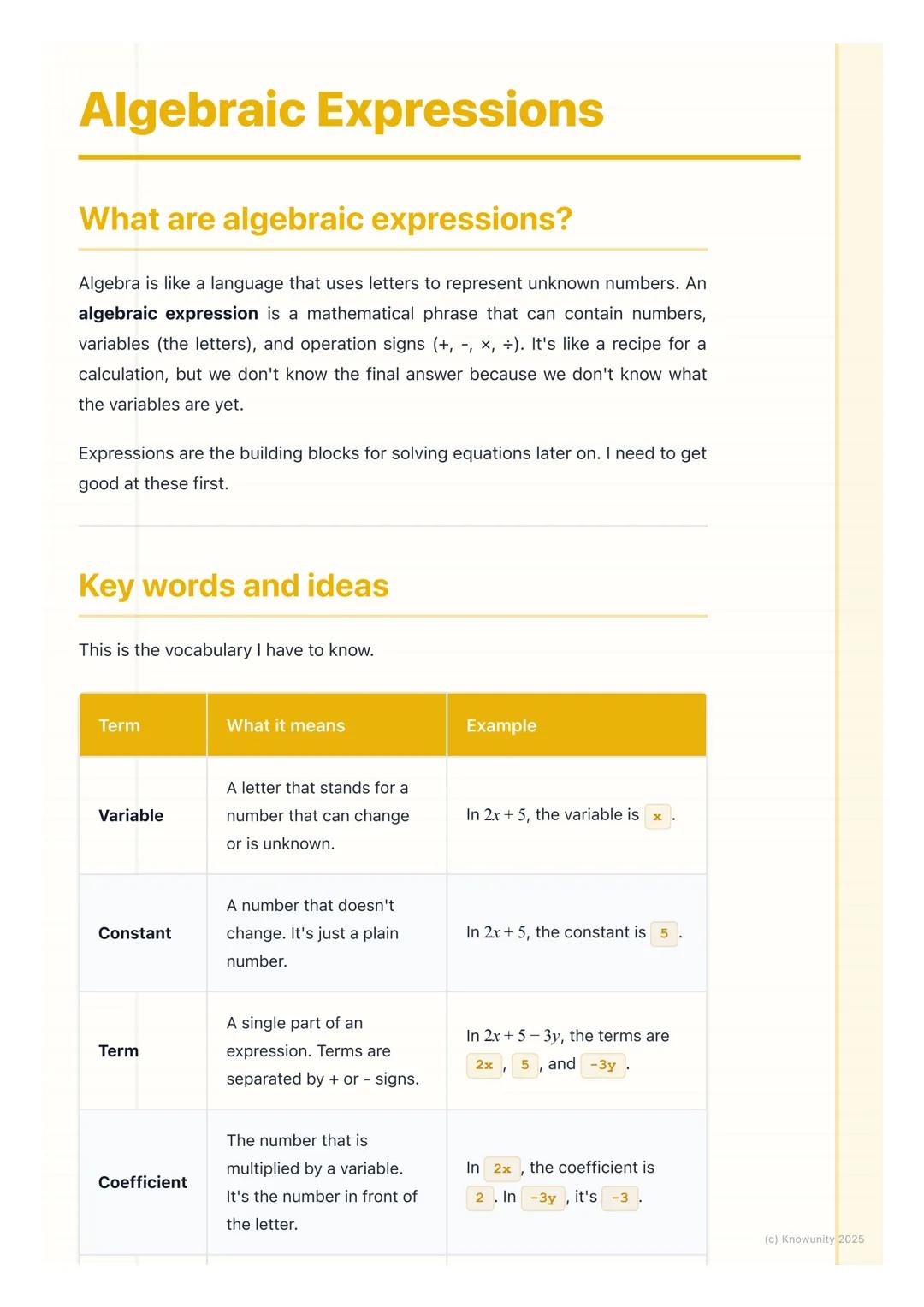
What are Algebraic Expressions?
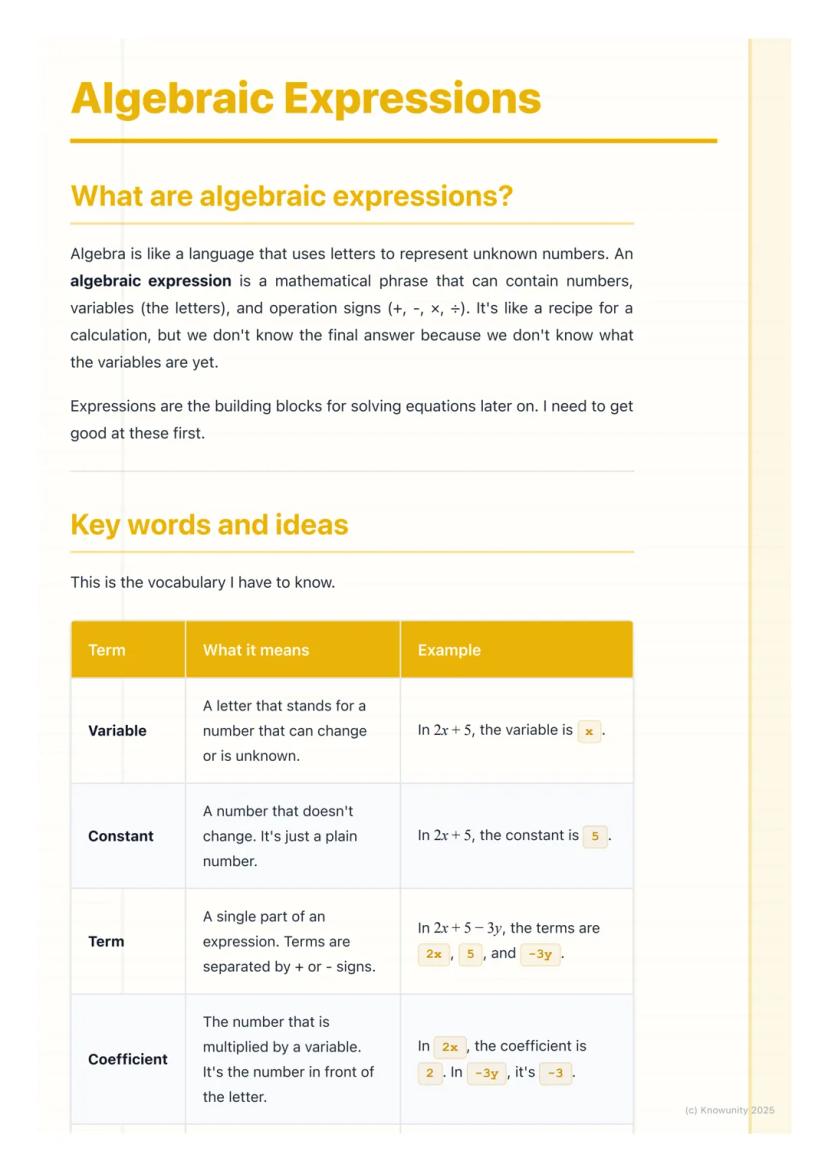
Think of algebraic expressions as mathematical phrases that mix numbers, letters, and operation signs (+, -, ×, ÷). Unlike equations, expressions don't have an equals sign - they're just a collection of mathematical terms waiting to be worked with.
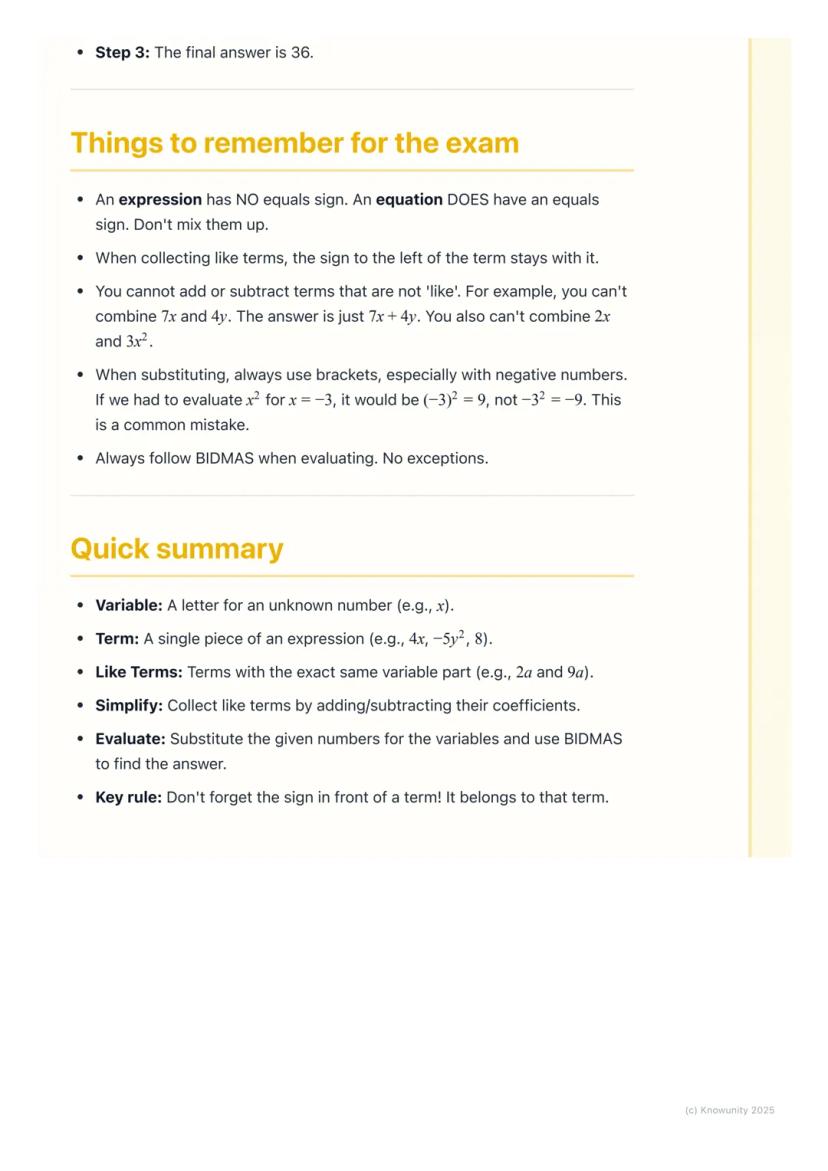
The letters in expressions are called variables, and they represent unknown numbers. A term is each separate part of an expression, like 4x, -5y, or just 8 on its own.
Like terms are terms that have exactly the same variable part, including any powers. For example, 3x and -5x are like terms because they both have just 'x'. However, 3x and 3x² are NOT like terms because one has x and the other has x².
Remember: Expressions are the foundation for solving equations later, so getting comfortable with these basics now will make your life much easier!
2
of 5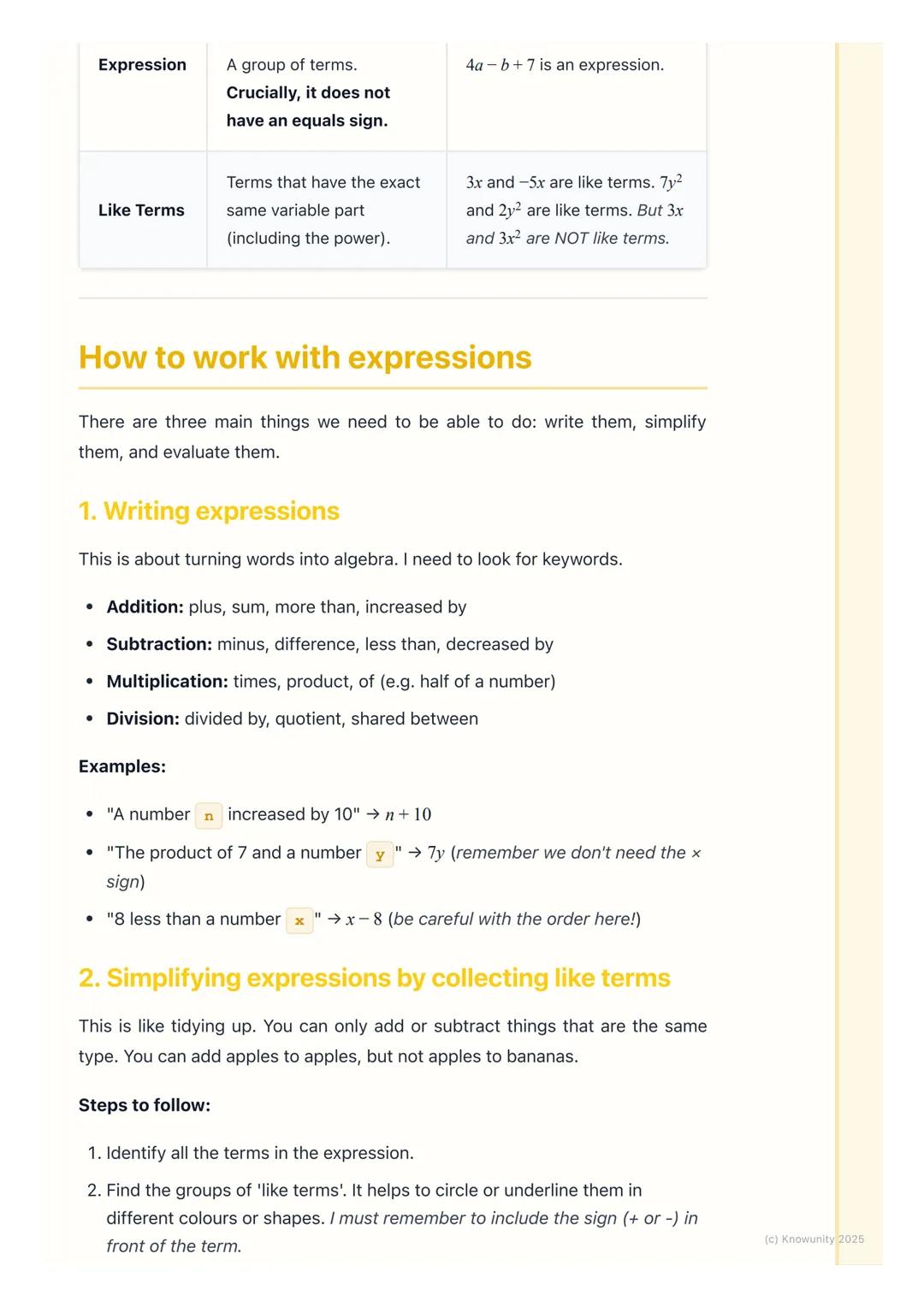
Writing Expressions from Words
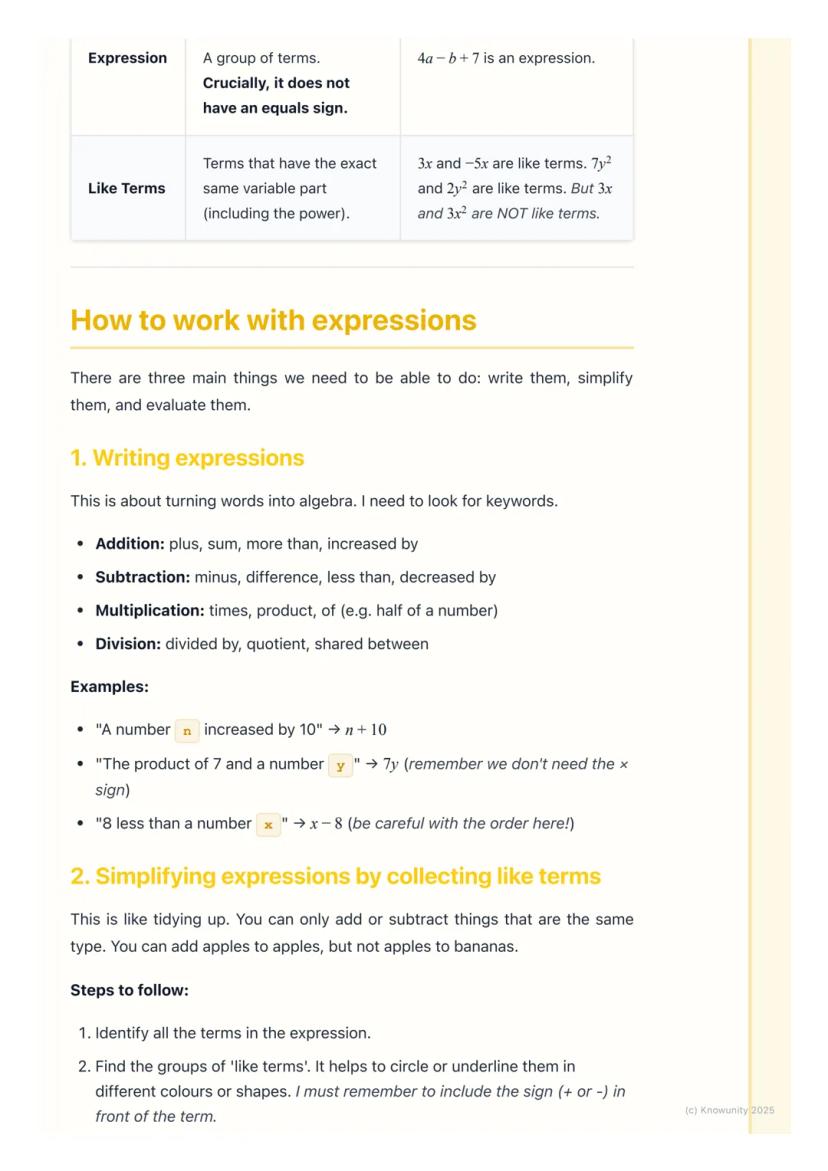
Converting word problems into algebraic expressions is all about spotting the right keywords. Once you know what to look for, it becomes like translating from English to maths.
Addition keywords: plus, sum, more than, increased by
Subtraction keywords: minus, difference, less than, decreased by
Multiplication keywords: times, product, of (like "half of a number")
Division keywords: divided by, quotient, shared between
Watch out for tricky phrases like "8 less than a number x" - this becomes x - 8, not 8 - x. The order matters! "A number n increased by 10" simply becomes n + 10, while "the product of 7 and a number y" becomes 7y (no multiplication sign needed).
Top tip: Always double-check the order, especially with subtraction. "Less than" flips the order around!
3
of 5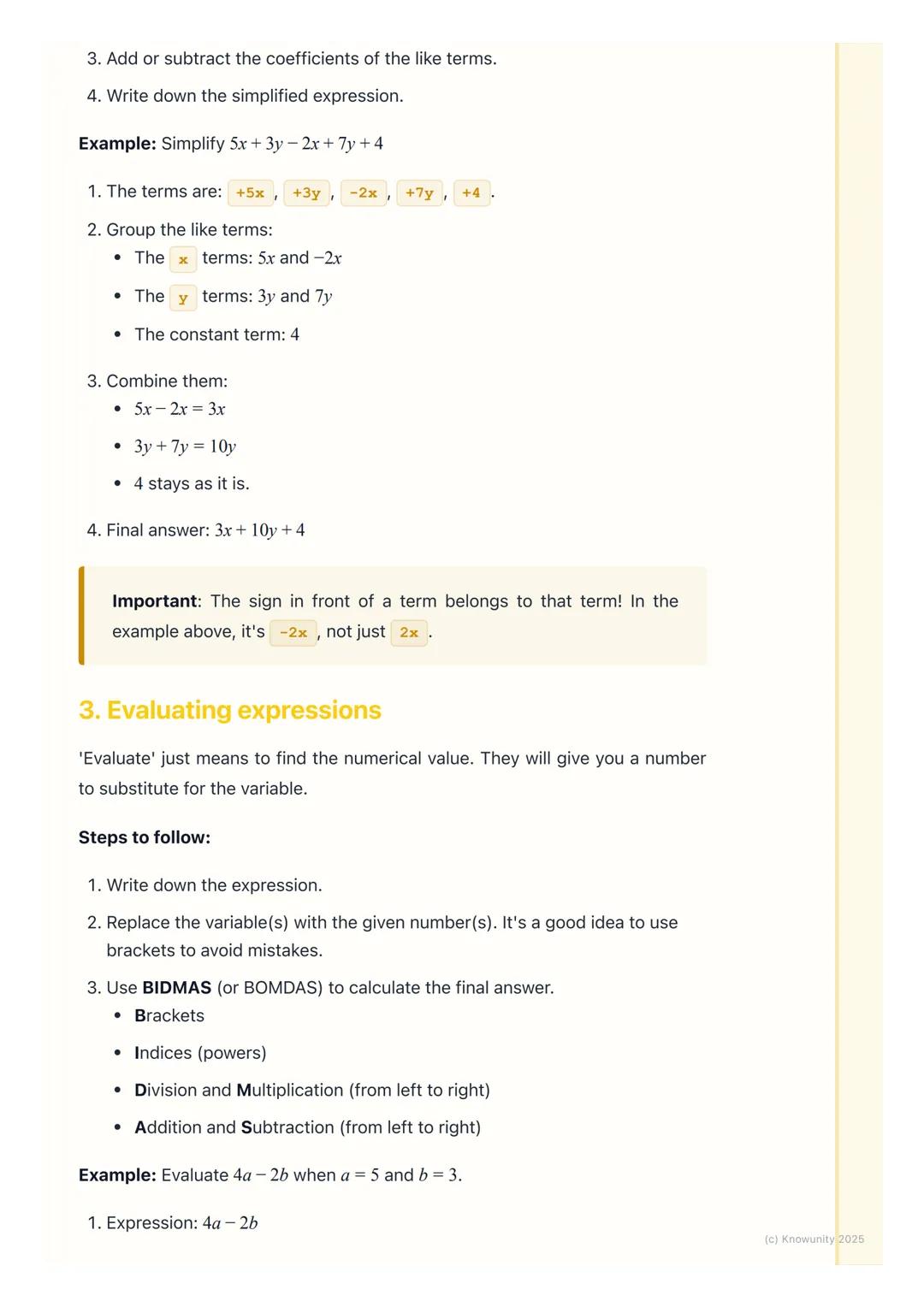
Simplifying by Collecting Like Terms
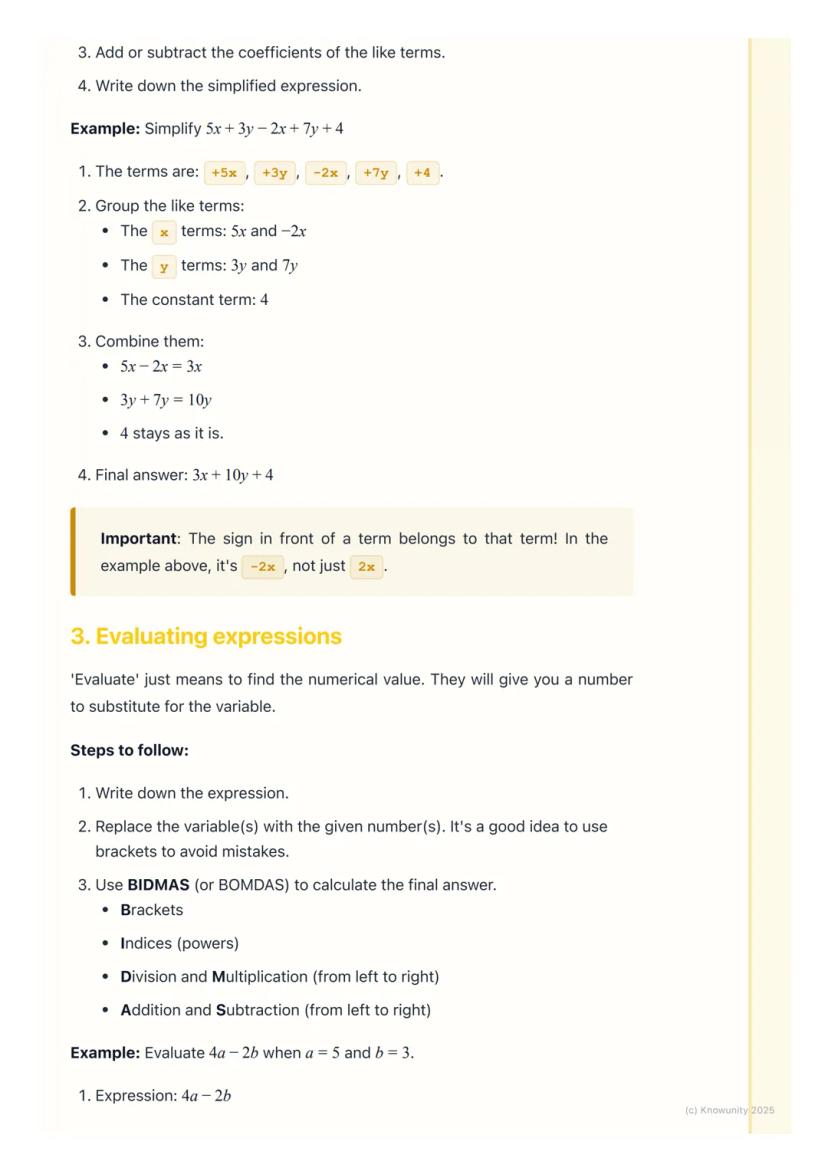
Simplifying expressions is like tidying your room - you group similar things together. You can only combine terms that are exactly the same type, just like you can add apples to apples but not apples to oranges.
Here's your step-by-step process: First, identify all the terms in the expression. Next, find groups of like terms - it helps to circle them in different colours. Remember to include the + or - sign with each term!
Then add or subtract the coefficients (the numbers in front) of like terms. Finally, write your simplified expression.
Let's try: 5x + 3y - 2x + 7y + 4. Group the x terms , the y terms (3y and 7y), and the constant (4). Combine: 5x - 2x = 3x, 3y + 7y = 10y, and 4 stays as is. Your answer: 3x + 10y + 4.
Watch out: The sign in front of a term belongs to that term! So -2x means negative 2x, not positive 2x that you subtract later.
4
of 5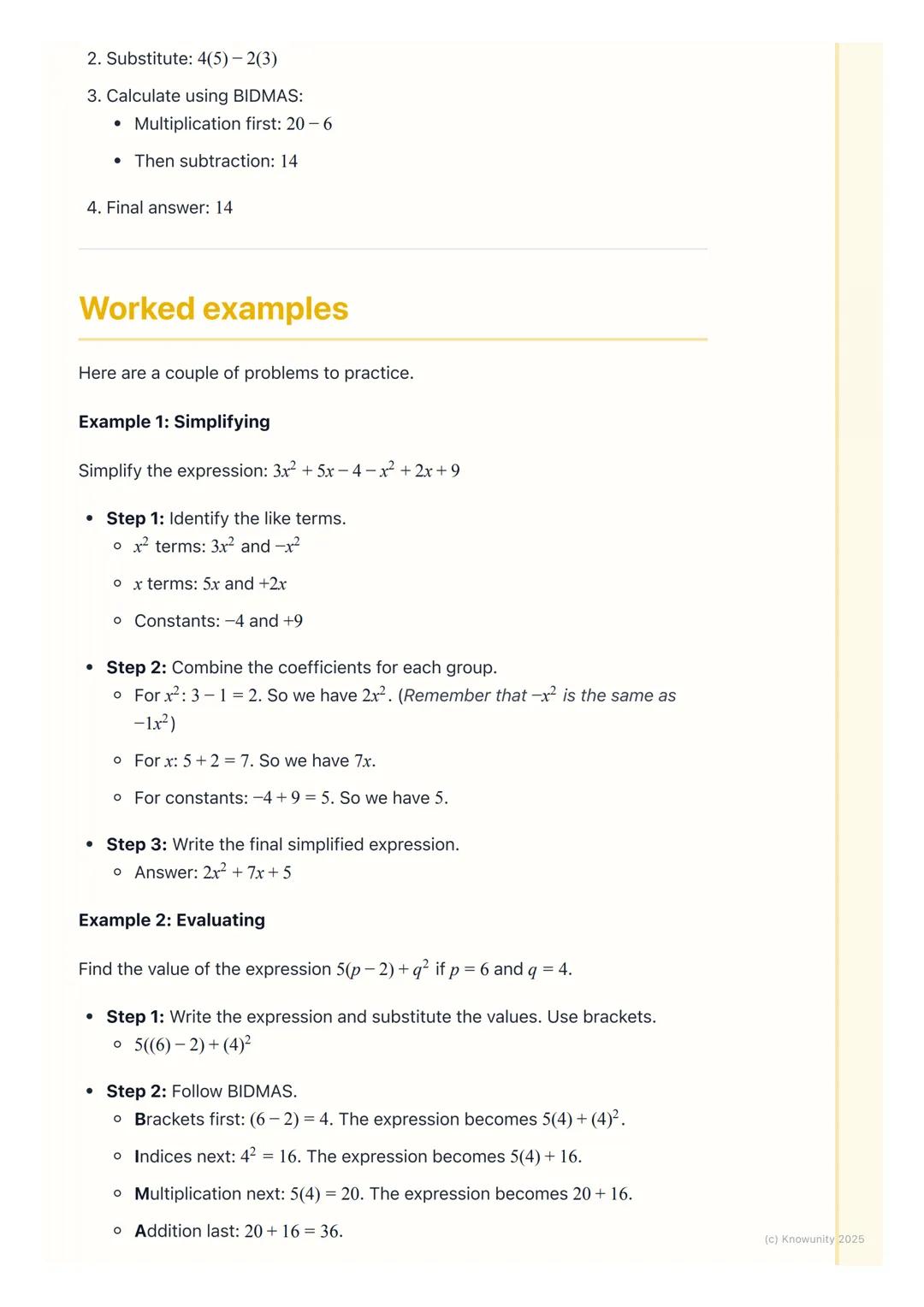
Evaluating Expressions
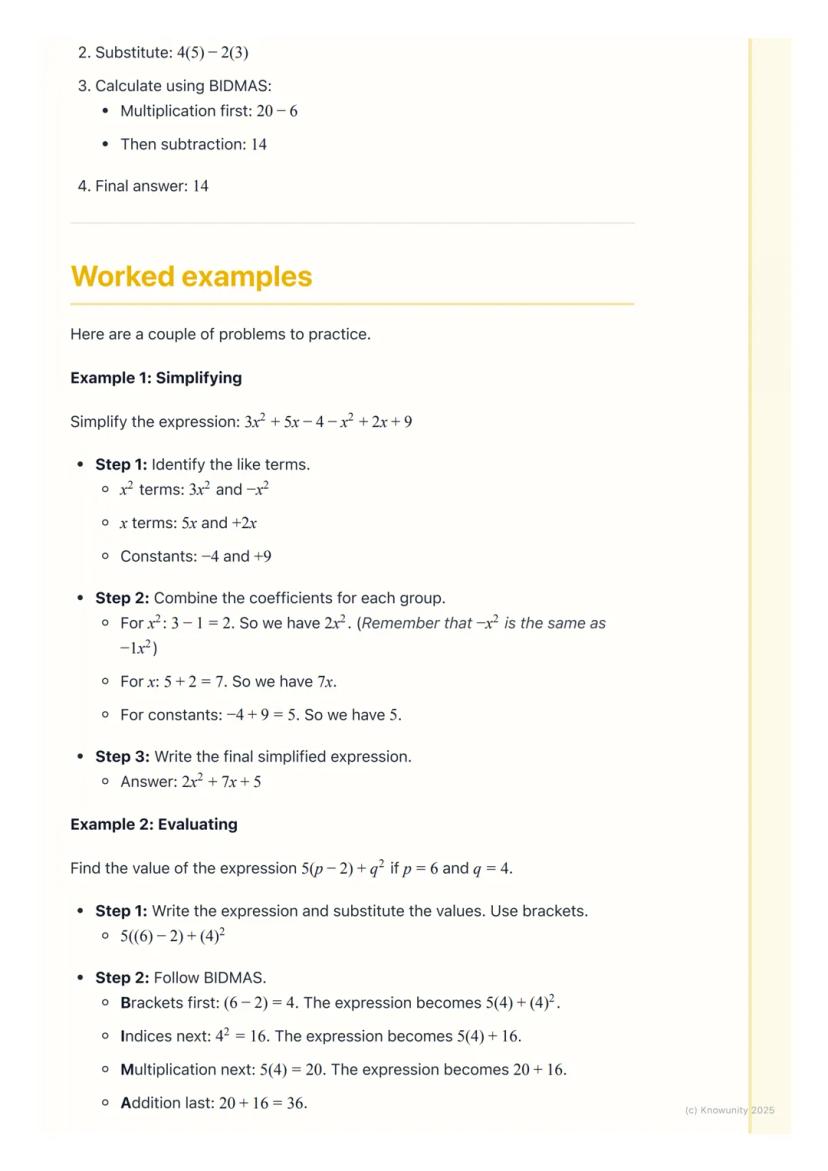
Evaluating expressions means finding the actual number value when you're given specific values for the variables. It's like following a recipe when you finally know all the ingredients.
Your method is simple: write the expression, replace each variable with its given number (use brackets to avoid mistakes!), then use BIDMAS to calculate your final answer.
BIDMAS stands for: Brackets, Indices (powers), Division and Multiplication (left to right), Addition and Subtraction (left to right).
Example: Evaluate 4a - 2b when a = 5 and b = 3. Substitute: 4(5) - 2(3). Calculate: 20 - 6 = 14.
Pro tip: Always use brackets when substituting, especially with negative numbers. If x = -3, then x² = (-3)² = 9, not -3² = -9!
5
of 5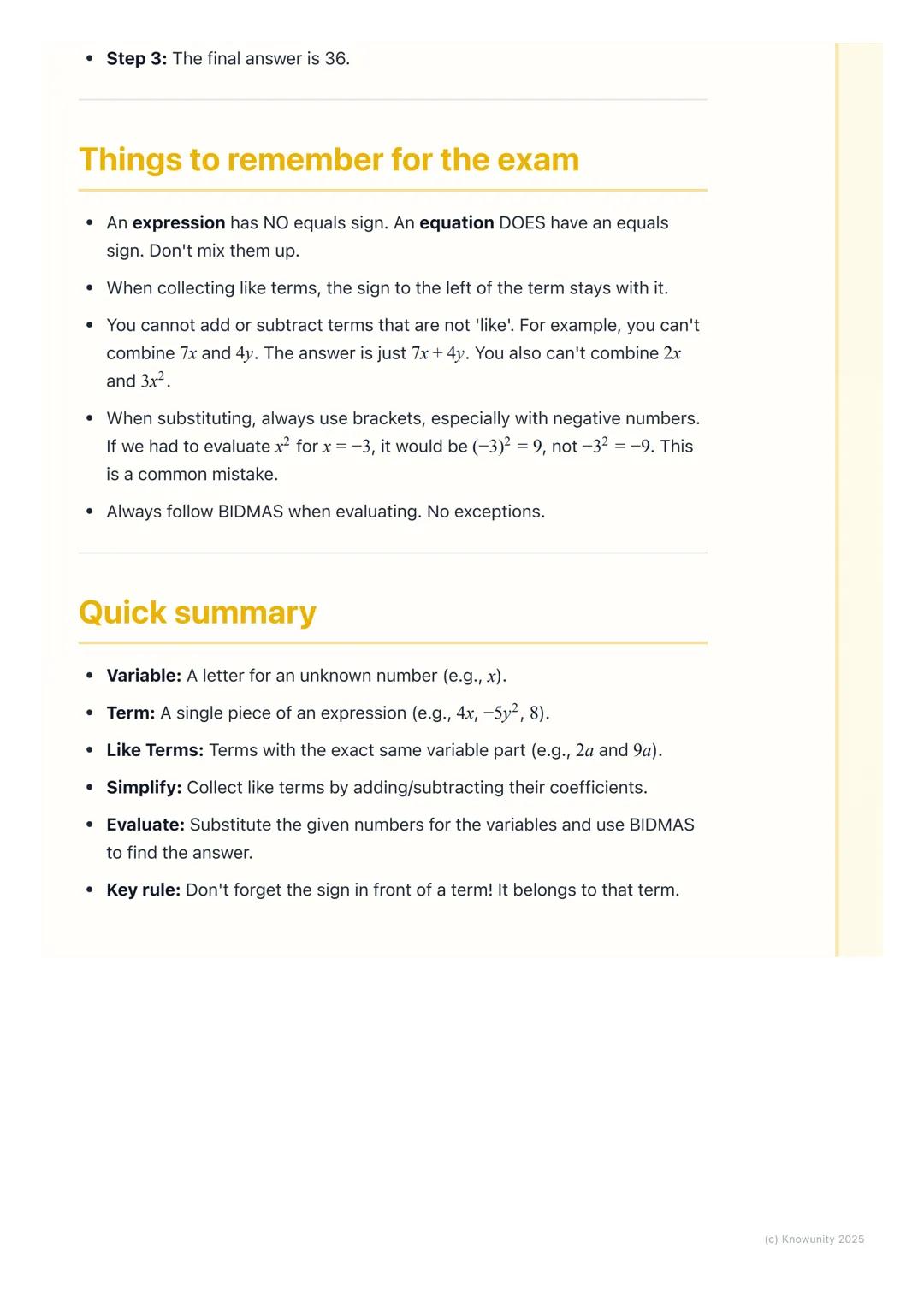
Key Points for Success
The most important thing to remember is that expressions have no equals sign, while equations do. Don't mix them up in exams!
When collecting like terms, that + or - sign stays with its term. You can't combine terms that aren't alike - 7x and 4y stay as 7x + 4y, and 2x and 3x² can't be combined either.
Always use brackets when substituting values, and never skip BIDMAS when evaluating. These simple rules will save you from most common mistakes.
Quick recap: Variables are letters for unknown numbers, terms are the separate parts of expressions, like terms have identical variable parts, simplifying means collecting like terms, and evaluating means substituting numbers and calculating.
Exam success: Master these basics now, and algebraic expressions will become your mathematical superpower for tackling more complex problems later!
Si on te demande...
Qu'est-ce que le compagnon IA de Knowunity ?
Notre compagnon IA est spécialement conçu pour répondre aux besoins des étudiants. Sur la base des millions d'éléments de contenu que nous avons sur la plateforme, nous pouvons fournir des réponses vraiment significatives et pertinentes aux étudiants. Mais il ne s'agit pas seulement de réponses, le compagnon a encore plus pour but de guider les élèves dans leurs défis d'apprentissage quotidiens, avec des plans d'étude personnalisés, des quiz ou des éléments de contenu dans le chat et une personnalisation à 100% basée sur les compétences et les développements de l'étudiant.
Où puis-je télécharger l'appli Knowunity ?
Tu peux télécharger l'application dans Google Play Store et dans l'App Store d'Apple.
L'application est-elle vraiment gratuite ?
Oui, tu as un accès entièrement gratuit à tous les contenus de l'appli, tu peux chatter ou suivre les créateurs à tout moment. De plus, nous proposons Knowunity Premium, qui te permet de réviser sans limites!
Contenus les plus populaires en Mathematics
8Contenus les plus populaires
9Rien ne te convient ? Explore d'autres matières.
Les étudiants nous adorent — il ne manque plus que toi.
4.6/5App Store
4.7/5Google Play
L'application est très facile d'utilisation et bien conçue. Jusqu'à présent, j'ai trouvé tout ce que je cherchais et j'ai pu apprendre beaucoup de choses grâce aux présentations ! Je vais certainement utiliser l'application pour un travail en classe ! Et comme source d'inspiration personnelle, elle est bien sûr aussi très utile.
Stefan Sutilisateur iOS
Cette application est vraiment super. Il y a tellement de fiches de révision et d'aide, [...]. Par exemple, la matière qui me pose problème est le français et l'appli a un choix d'aide très large. Grâce à cette application, je me suis améliorée en français. Je la recommanderais à tout le monde.
Samantha Klichutilisatrice Android
Waouh, je suis vraiment abasourdi. J'ai essayé l'application parce que je l'avais déjà vue plusieurs fois dans la publicité et j'ai été absolument choquée. Cette appli est L'AIDE dont on rêve pour l'école et surtout, elle propose tellement de choses, comme des rédactions et des fiches qui m'ont personnellement TRÈS bien aidé.
Annautilisatrice iOS
Mathematics13 vues·Mis à jour Jun 2, 2026·5 pagesUnderstanding and Simplifying Algebraic Expressions
Ever wondered why we use letters in maths? Algebraic expressions are like mathematical recipes that use letters (called variables) to represent unknown numbers. They're the building blocks you'll need to master before tackling equations, and once you get the hang... Affiche plus
1
of 5Inscris-toi pour voir le contenu. C'est gratuit!
- Accès à tous les documents
- Améliore tes notes
- Rejoins des millions d'étudiants
What are Algebraic Expressions?
Think of algebraic expressions as mathematical phrases that mix numbers, letters, and operation signs (+, -, ×, ÷). Unlike equations, expressions don't have an equals sign - they're just a collection of mathematical terms waiting to be worked with.
The letters in expressions are called variables, and they represent unknown numbers. A term is each separate part of an expression, like 4x, -5y, or just 8 on its own.
Like terms are terms that have exactly the same variable part, including any powers. For example, 3x and -5x are like terms because they both have just 'x'. However, 3x and 3x² are NOT like terms because one has x and the other has x².
Remember: Expressions are the foundation for solving equations later, so getting comfortable with these basics now will make your life much easier!
2
of 5Inscris-toi pour voir le contenu. C'est gratuit!
- Accès à tous les documents
- Améliore tes notes
- Rejoins des millions d'étudiants
Writing Expressions from Words
Converting word problems into algebraic expressions is all about spotting the right keywords. Once you know what to look for, it becomes like translating from English to maths.
Addition keywords: plus, sum, more than, increased by
Subtraction keywords: minus, difference, less than, decreased by
Multiplication keywords: times, product, of (like "half of a number")
Division keywords: divided by, quotient, shared between
Watch out for tricky phrases like "8 less than a number x" - this becomes x - 8, not 8 - x. The order matters! "A number n increased by 10" simply becomes n + 10, while "the product of 7 and a number y" becomes 7y (no multiplication sign needed).
Top tip: Always double-check the order, especially with subtraction. "Less than" flips the order around!
3
of 5Inscris-toi pour voir le contenu. C'est gratuit!
- Accès à tous les documents
- Améliore tes notes
- Rejoins des millions d'étudiants
Simplifying by Collecting Like Terms
Simplifying expressions is like tidying your room - you group similar things together. You can only combine terms that are exactly the same type, just like you can add apples to apples but not apples to oranges.
Here's your step-by-step process: First, identify all the terms in the expression. Next, find groups of like terms - it helps to circle them in different colours. Remember to include the + or - sign with each term!
Then add or subtract the coefficients (the numbers in front) of like terms. Finally, write your simplified expression.
Let's try: 5x + 3y - 2x + 7y + 4. Group the x terms , the y terms (3y and 7y), and the constant (4). Combine: 5x - 2x = 3x, 3y + 7y = 10y, and 4 stays as is. Your answer: 3x + 10y + 4.
Watch out: The sign in front of a term belongs to that term! So -2x means negative 2x, not positive 2x that you subtract later.
4
of 5Inscris-toi pour voir le contenu. C'est gratuit!
- Accès à tous les documents
- Améliore tes notes
- Rejoins des millions d'étudiants
Evaluating Expressions
Evaluating expressions means finding the actual number value when you're given specific values for the variables. It's like following a recipe when you finally know all the ingredients.
Your method is simple: write the expression, replace each variable with its given number (use brackets to avoid mistakes!), then use BIDMAS to calculate your final answer.
BIDMAS stands for: Brackets, Indices (powers), Division and Multiplication (left to right), Addition and Subtraction (left to right).
Example: Evaluate 4a - 2b when a = 5 and b = 3. Substitute: 4(5) - 2(3). Calculate: 20 - 6 = 14.
Pro tip: Always use brackets when substituting, especially with negative numbers. If x = -3, then x² = (-3)² = 9, not -3² = -9!
5
of 5Inscris-toi pour voir le contenu. C'est gratuit!
- Accès à tous les documents
- Améliore tes notes
- Rejoins des millions d'étudiants
Key Points for Success
The most important thing to remember is that expressions have no equals sign, while equations do. Don't mix them up in exams!
When collecting like terms, that + or - sign stays with its term. You can't combine terms that aren't alike - 7x and 4y stay as 7x + 4y, and 2x and 3x² can't be combined either.
Always use brackets when substituting values, and never skip BIDMAS when evaluating. These simple rules will save you from most common mistakes.
Quick recap: Variables are letters for unknown numbers, terms are the separate parts of expressions, like terms have identical variable parts, simplifying means collecting like terms, and evaluating means substituting numbers and calculating.
Exam success: Master these basics now, and algebraic expressions will become your mathematical superpower for tackling more complex problems later!
Si on te demande...
Qu'est-ce que le compagnon IA de Knowunity ?
Notre compagnon IA est spécialement conçu pour répondre aux besoins des étudiants. Sur la base des millions d'éléments de contenu que nous avons sur la plateforme, nous pouvons fournir des réponses vraiment significatives et pertinentes aux étudiants. Mais il ne s'agit pas seulement de réponses, le compagnon a encore plus pour but de guider les élèves dans leurs défis d'apprentissage quotidiens, avec des plans d'étude personnalisés, des quiz ou des éléments de contenu dans le chat et une personnalisation à 100% basée sur les compétences et les développements de l'étudiant.
Où puis-je télécharger l'appli Knowunity ?
Tu peux télécharger l'application dans Google Play Store et dans l'App Store d'Apple.
L'application est-elle vraiment gratuite ?
Oui, tu as un accès entièrement gratuit à tous les contenus de l'appli, tu peux chatter ou suivre les créateurs à tout moment. De plus, nous proposons Knowunity Premium, qui te permet de réviser sans limites!
Contenus les plus populaires en Mathematics
8Contenus les plus populaires
9Rien ne te convient ? Explore d'autres matières.
Les étudiants nous adorent — il ne manque plus que toi.
4.6/5App Store
4.7/5Google Play
L'application est très facile d'utilisation et bien conçue. Jusqu'à présent, j'ai trouvé tout ce que je cherchais et j'ai pu apprendre beaucoup de choses grâce aux présentations ! Je vais certainement utiliser l'application pour un travail en classe ! Et comme source d'inspiration personnelle, elle est bien sûr aussi très utile.
Stefan Sutilisateur iOS
Cette application est vraiment super. Il y a tellement de fiches de révision et d'aide, [...]. Par exemple, la matière qui me pose problème est le français et l'appli a un choix d'aide très large. Grâce à cette application, je me suis améliorée en français. Je la recommanderais à tout le monde.
Samantha Klichutilisatrice Android
Waouh, je suis vraiment abasourdi. J'ai essayé l'application parce que je l'avais déjà vue plusieurs fois dans la publicité et j'ai été absolument choquée. Cette appli est L'AIDE dont on rêve pour l'école et surtout, elle propose tellement de choses, comme des rédactions et des fiches qui m'ont personnellement TRÈS bien aidé.
Annautilisatrice iOS