
Probability is everywhere in your life - from the chance... Affiche plus
 Mathematics8 vues·Mis à jour May 29, 2026·5 pages
Understanding Basic Probability Concepts
1 / 5
1
of 5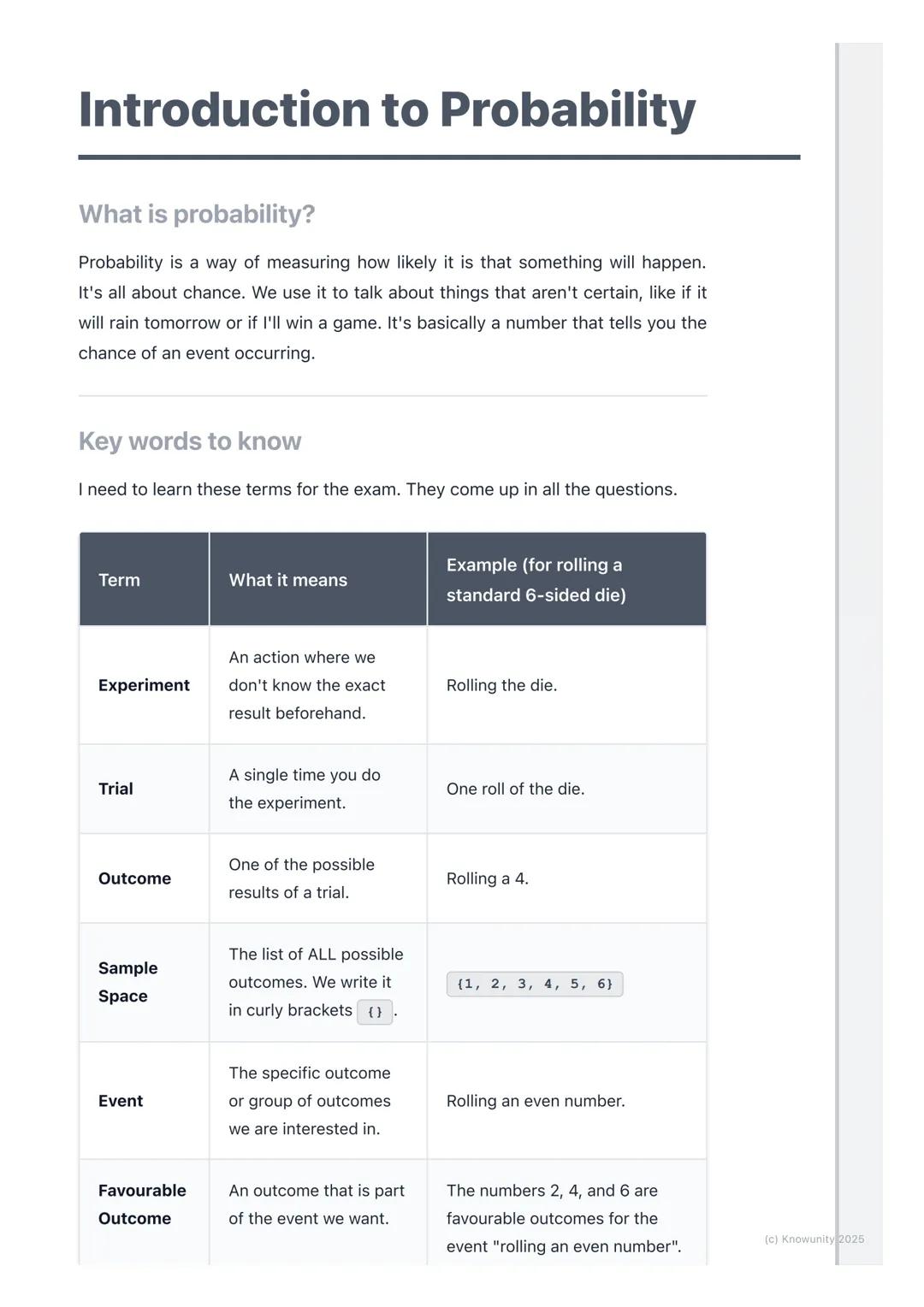
What is Probability?
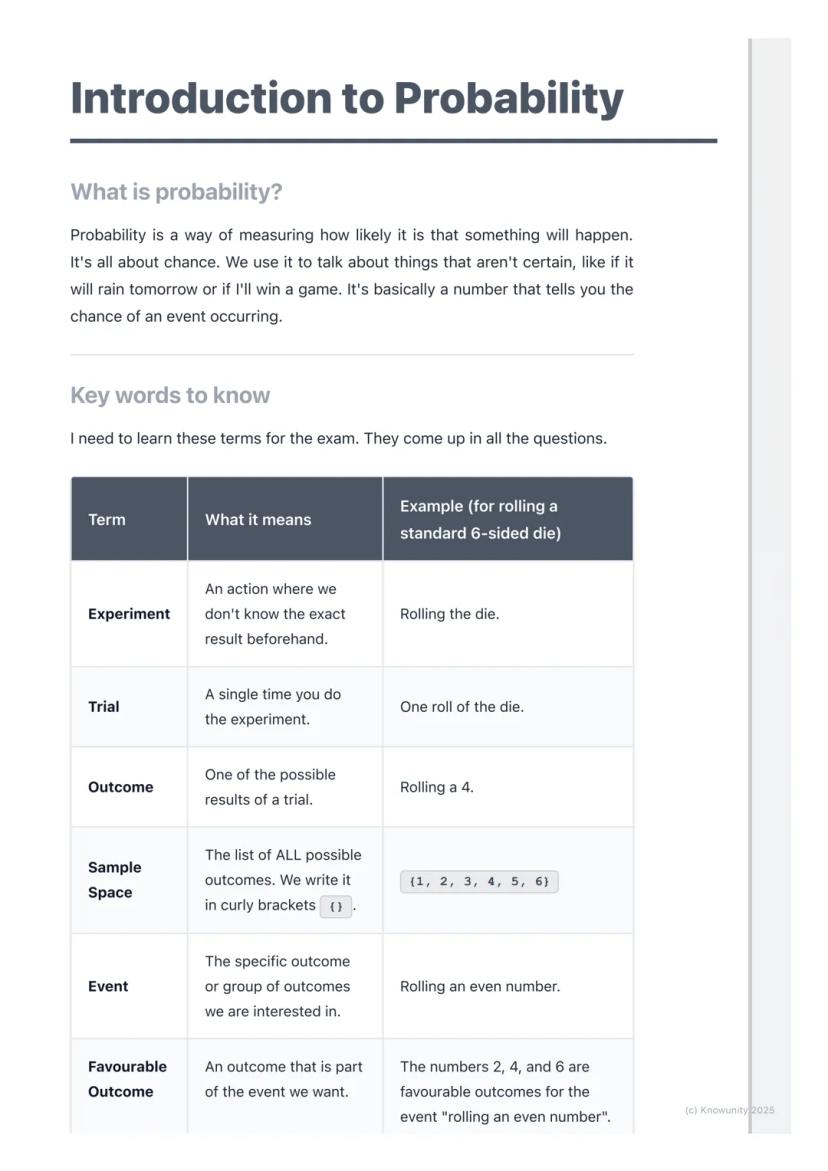
Ever wondered how to work out if something will actually happen? Probability gives you the answer by measuring chance using numbers. It's perfect for situations where you can't be 100% certain of the outcome.
Before diving into calculations, you need to master some key terms that'll pop up in every exam question. An experiment is any action where you don't know the exact result beforehand, like rolling a die. Each single attempt is called a trial.
The sample space lists every possible result in curly brackets - for a standard die, that's {1, 2, 3, 4, 5, 6}. An outcome is just one specific result, whilst an event is what you're actually interested in finding out about.
Quick Tip: Always start by writing down your sample space - it helps you spot all the possibilities and avoid missing any!
2
of 5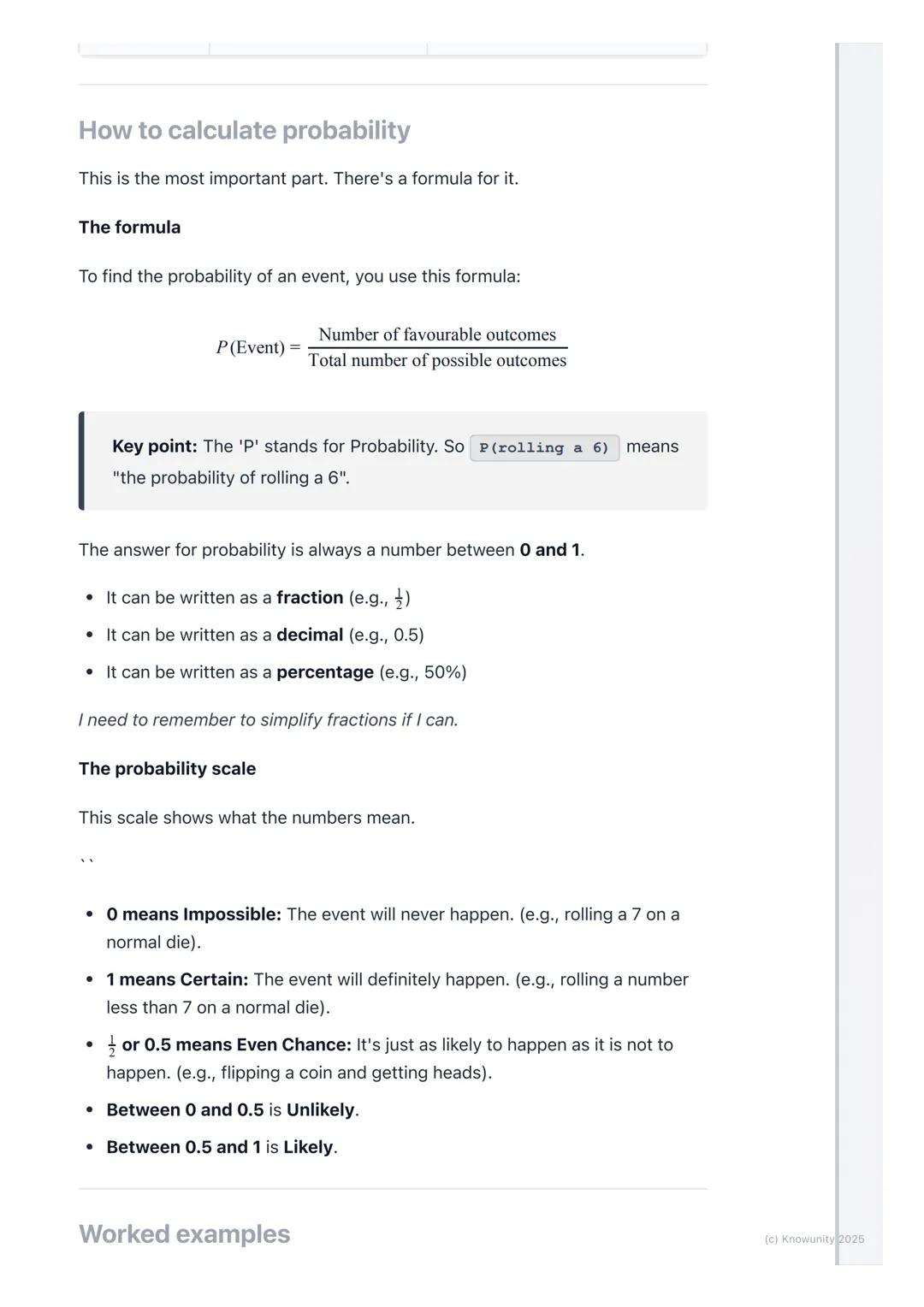
The Probability Formula
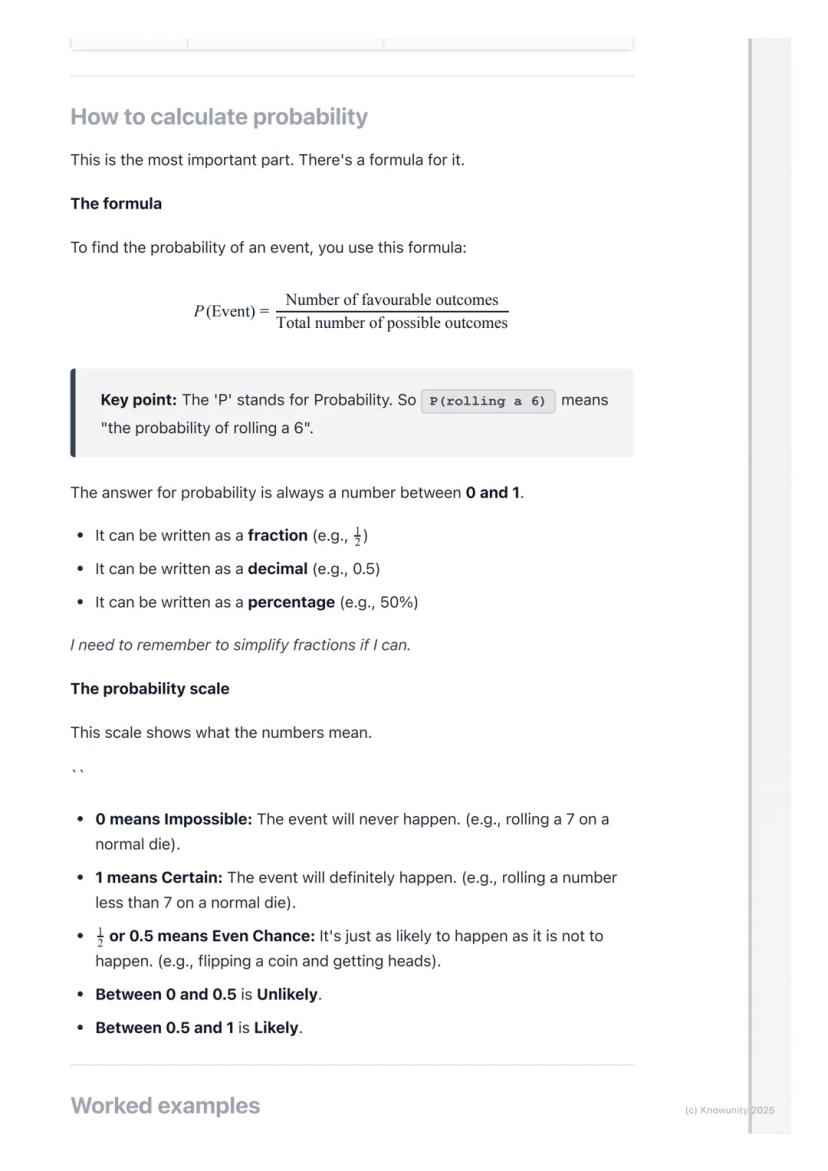
Here's the formula that'll solve every probability problem you'll face: P(Event) = Number of favourable outcomes ÷ Total number of possible outcomes. The 'P' simply stands for probability, so P(rolling a 6) means "the probability of rolling a 6".
Your answer will always be a number between 0 and 1. You can write it as a fraction, decimal, or percentage - just remember to simplify fractions when possible.
The probability scale is dead useful for understanding what your answers mean. 0 means impossible (like rolling a 7 on a normal die), whilst 1 means certain (like rolling less than 7). If you get 0.5, that's an even chance - exactly like flipping a coin.
Remember: Numbers between 0 and 0.5 are unlikely, whilst numbers between 0.5 and 1 are likely to happen.
3
of 5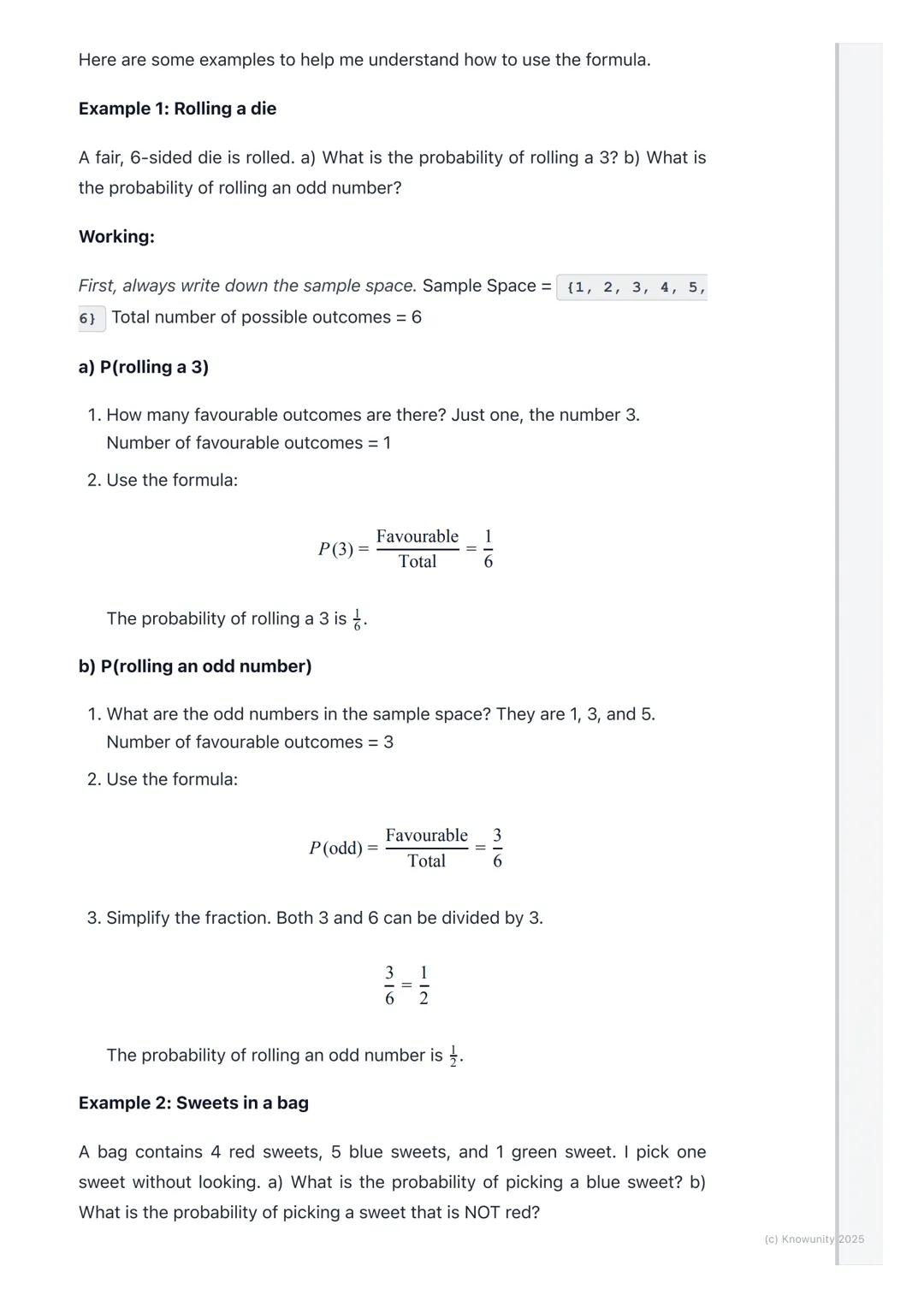
Working Through Examples
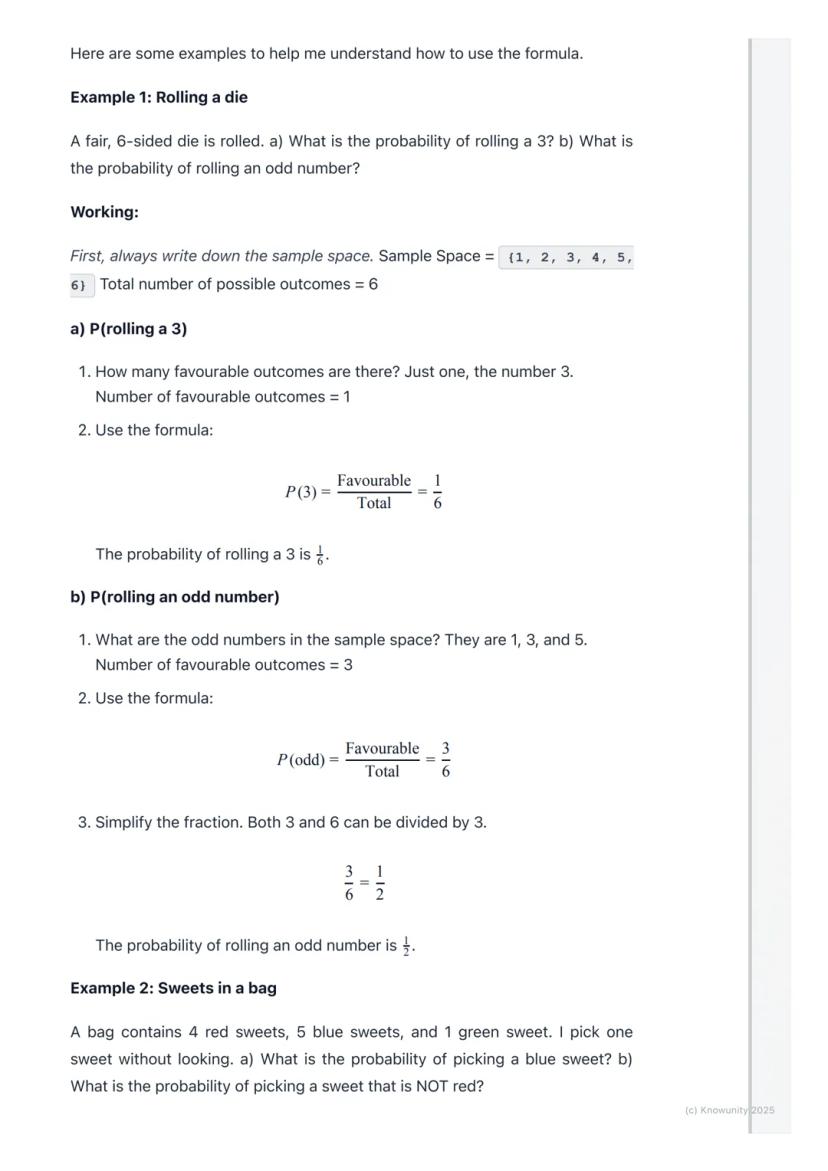
Let's tackle a classic die problem to see the formula in action. When rolling a fair 6-sided die, always start by writing your sample space: {1, 2, 3, 4, 5, 6}, giving you 6 total possible outcomes.
For finding P(rolling a 3), there's only one favourable outcome (the number 3), so you get 1÷6 = 1/6. For P(rolling an odd number), count the odd numbers: 1, 3, and 5 give you 3 favourable outcomes, so 3÷6 = 1/2 after simplifying.
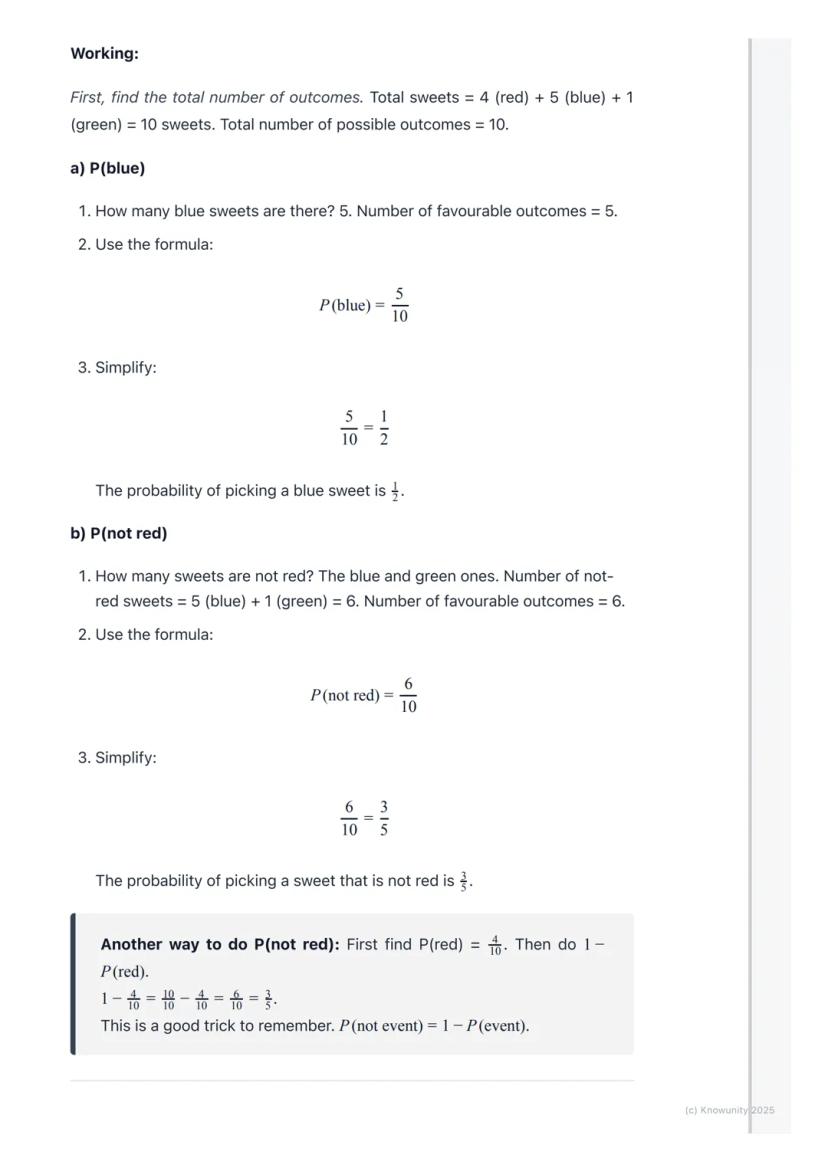
Sweet problems work exactly the same way. With 4 red, 5 blue, and 1 green sweet (10 total), P(blue) = 5÷10 = 1/2. The key is always counting your total first, then identifying what counts as "favourable" for your specific question.
Pro Tip: For "not red" events, you can either count non-red sweets directly, or use the shortcut: 1 - P(red) = 1 - 4/10 = 6/10 = 3/5.
4
of 5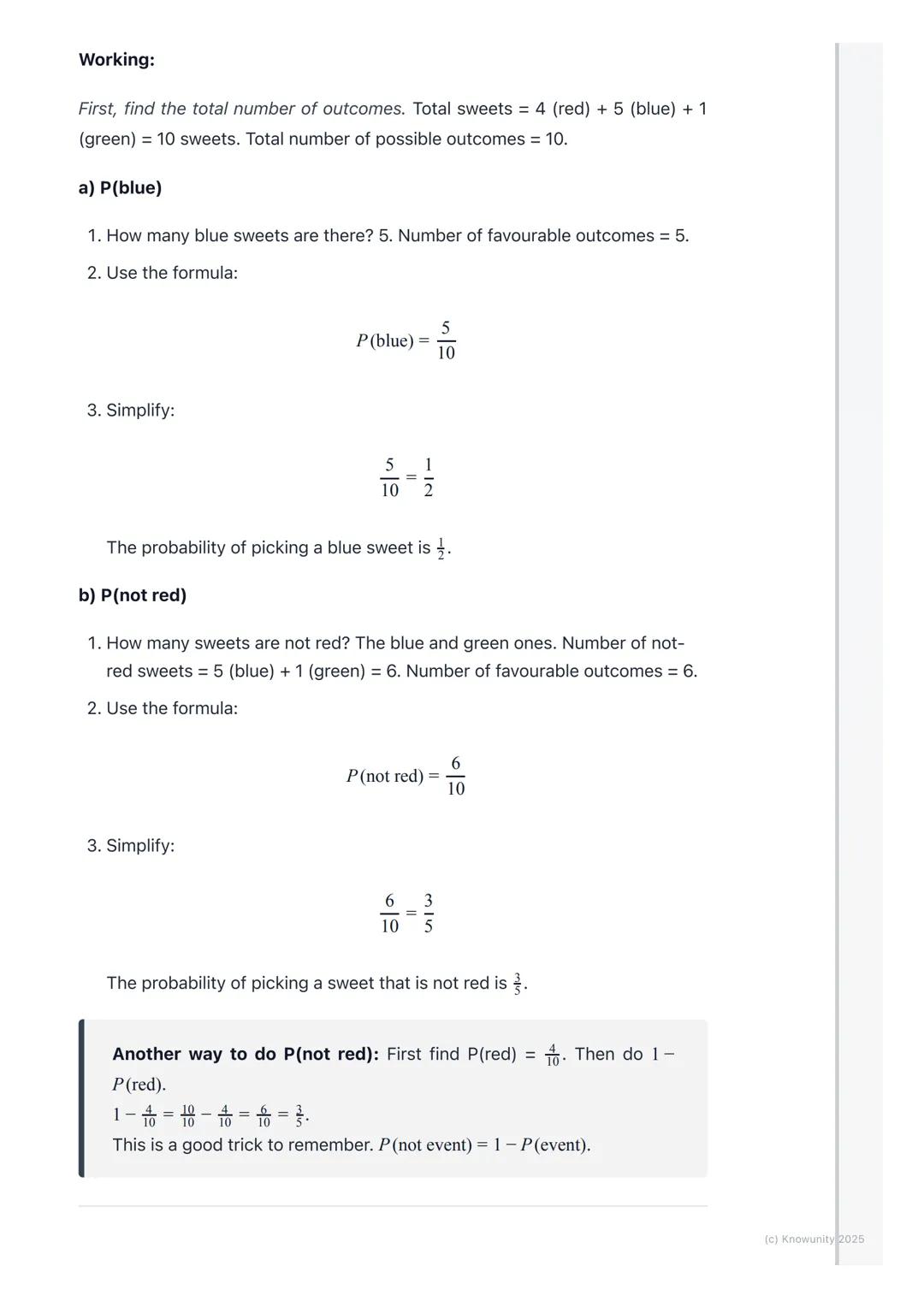
Advanced Techniques and Shortcuts
The "1 minus" trick is brilliant for complementary events. Instead of counting everything that's "not red", just work out P(red) first, then subtract from 1. This method often saves time and reduces mistakes.
Watch out for tricky wording in questions. "At least 3" includes 3, 4, 5, and 6, whilst "more than 3" only includes 4, 5, and 6. These small differences can completely change your answer.
Here's a clever way to check your work: all probabilities for every possible outcome must add up to 1. For a die, P(1) + P(2) + P(3) + P(4) + P(5) + P(6) = 6 × 1/6 = 1. If your total doesn't equal 1, you've made an error somewhere.
Check Yourself: Always verify that your fraction is the right way up - total outcomes go on the bottom, favourable outcomes on top!
5
of 5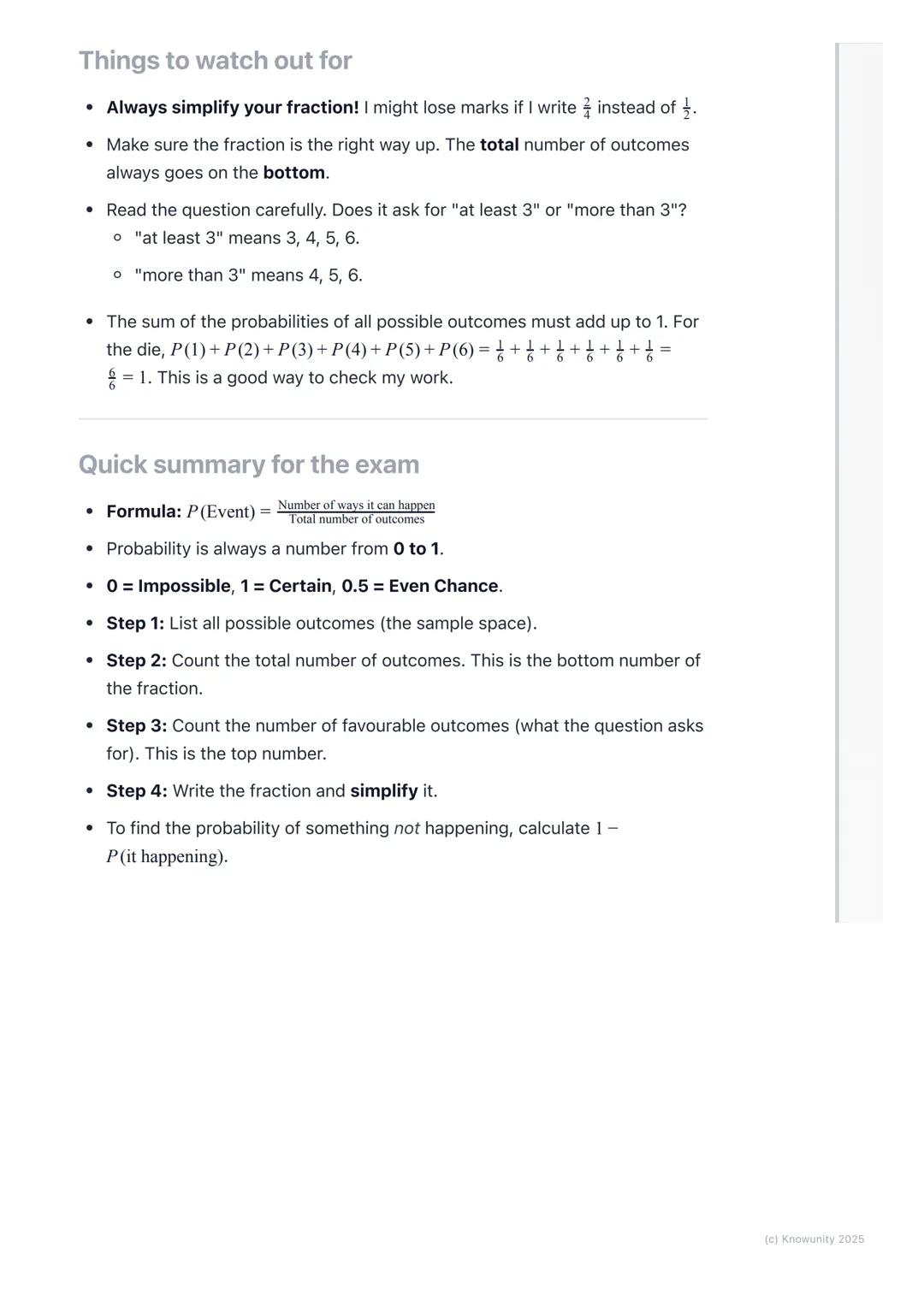
Exam Success Tips
Your step-by-step method should become automatic: list the sample space, count total outcomes (bottom of fraction), count favourable outcomes (top of fraction), then write and simplify your fraction.
Common mistakes to avoid include forgetting to simplify fractions and misreading questions. Always double-check whether the question asks for "at least" or "more than" - they're not the same thing.
Remember that probability always ranges from 0 to 1. If you get a number outside this range, you've definitely made an error. The formula P(Event) = Favourable outcomes ÷ Total outcomes will solve any basic probability problem you encounter.
Final Reminder: Take your time reading questions carefully - most mistakes happen from rushing, not from lack of understanding!
Si on te demande...
Qu'est-ce que le compagnon IA de Knowunity ?
Notre compagnon IA est spécialement conçu pour répondre aux besoins des étudiants. Sur la base des millions d'éléments de contenu que nous avons sur la plateforme, nous pouvons fournir des réponses vraiment significatives et pertinentes aux étudiants. Mais il ne s'agit pas seulement de réponses, le compagnon a encore plus pour but de guider les élèves dans leurs défis d'apprentissage quotidiens, avec des plans d'étude personnalisés, des quiz ou des éléments de contenu dans le chat et une personnalisation à 100% basée sur les compétences et les développements de l'étudiant.
Où puis-je télécharger l'appli Knowunity ?
Tu peux télécharger l'application dans Google Play Store et dans l'App Store d'Apple.
L'application est-elle vraiment gratuite ?
Oui, tu as un accès entièrement gratuit à tous les contenus de l'appli, tu peux chatter ou suivre les créateurs à tout moment. De plus, nous proposons Knowunity Premium, qui te permet de réviser sans limites!
Contenus les plus populaires en Mathematics
7Contenus les plus populaires
9Rien ne te convient ? Explore d'autres matières.
Les étudiants nous adorent — il ne manque plus que toi.
4.6/5App Store
4.7/5Google Play
L'application est très facile d'utilisation et bien conçue. Jusqu'à présent, j'ai trouvé tout ce que je cherchais et j'ai pu apprendre beaucoup de choses grâce aux présentations ! Je vais certainement utiliser l'application pour un travail en classe ! Et comme source d'inspiration personnelle, elle est bien sûr aussi très utile.
Stefan Sutilisateur iOS
Cette application est vraiment super. Il y a tellement de fiches de révision et d'aide, [...]. Par exemple, la matière qui me pose problème est le français et l'appli a un choix d'aide très large. Grâce à cette application, je me suis améliorée en français. Je la recommanderais à tout le monde.
Samantha Klichutilisatrice Android
Waouh, je suis vraiment abasourdi. J'ai essayé l'application parce que je l'avais déjà vue plusieurs fois dans la publicité et j'ai été absolument choquée. Cette appli est L'AIDE dont on rêve pour l'école et surtout, elle propose tellement de choses, comme des rédactions et des fiches qui m'ont personnellement TRÈS bien aidé.
Annautilisatrice iOS
Mathematics8 vues·Mis à jour May 29, 2026·5 pagesUnderstanding Basic Probability Concepts
Probability is everywhere in your life - from the chance of rain to winning a game or picking your favourite sweet from a bag. It's simply a way to measure how likely something is to happen, using numbers between 0... Affiche plus
1
of 5Inscris-toi pour voir le contenu. C'est gratuit!
- Accès à tous les documents
- Améliore tes notes
- Rejoins des millions d'étudiants
What is Probability?
Ever wondered how to work out if something will actually happen? Probability gives you the answer by measuring chance using numbers. It's perfect for situations where you can't be 100% certain of the outcome.
Before diving into calculations, you need to master some key terms that'll pop up in every exam question. An experiment is any action where you don't know the exact result beforehand, like rolling a die. Each single attempt is called a trial.
The sample space lists every possible result in curly brackets - for a standard die, that's {1, 2, 3, 4, 5, 6}. An outcome is just one specific result, whilst an event is what you're actually interested in finding out about.
Quick Tip: Always start by writing down your sample space - it helps you spot all the possibilities and avoid missing any!
2
of 5Inscris-toi pour voir le contenu. C'est gratuit!
- Accès à tous les documents
- Améliore tes notes
- Rejoins des millions d'étudiants
The Probability Formula
Here's the formula that'll solve every probability problem you'll face: P(Event) = Number of favourable outcomes ÷ Total number of possible outcomes. The 'P' simply stands for probability, so P(rolling a 6) means "the probability of rolling a 6".
Your answer will always be a number between 0 and 1. You can write it as a fraction, decimal, or percentage - just remember to simplify fractions when possible.
The probability scale is dead useful for understanding what your answers mean. 0 means impossible (like rolling a 7 on a normal die), whilst 1 means certain (like rolling less than 7). If you get 0.5, that's an even chance - exactly like flipping a coin.
Remember: Numbers between 0 and 0.5 are unlikely, whilst numbers between 0.5 and 1 are likely to happen.
3
of 5Inscris-toi pour voir le contenu. C'est gratuit!
- Accès à tous les documents
- Améliore tes notes
- Rejoins des millions d'étudiants
Working Through Examples
Let's tackle a classic die problem to see the formula in action. When rolling a fair 6-sided die, always start by writing your sample space: {1, 2, 3, 4, 5, 6}, giving you 6 total possible outcomes.
For finding P(rolling a 3), there's only one favourable outcome (the number 3), so you get 1÷6 = 1/6. For P(rolling an odd number), count the odd numbers: 1, 3, and 5 give you 3 favourable outcomes, so 3÷6 = 1/2 after simplifying.
Sweet problems work exactly the same way. With 4 red, 5 blue, and 1 green sweet (10 total), P(blue) = 5÷10 = 1/2. The key is always counting your total first, then identifying what counts as "favourable" for your specific question.
Pro Tip: For "not red" events, you can either count non-red sweets directly, or use the shortcut: 1 - P(red) = 1 - 4/10 = 6/10 = 3/5.
4
of 5Inscris-toi pour voir le contenu. C'est gratuit!
- Accès à tous les documents
- Améliore tes notes
- Rejoins des millions d'étudiants
Advanced Techniques and Shortcuts
The "1 minus" trick is brilliant for complementary events. Instead of counting everything that's "not red", just work out P(red) first, then subtract from 1. This method often saves time and reduces mistakes.
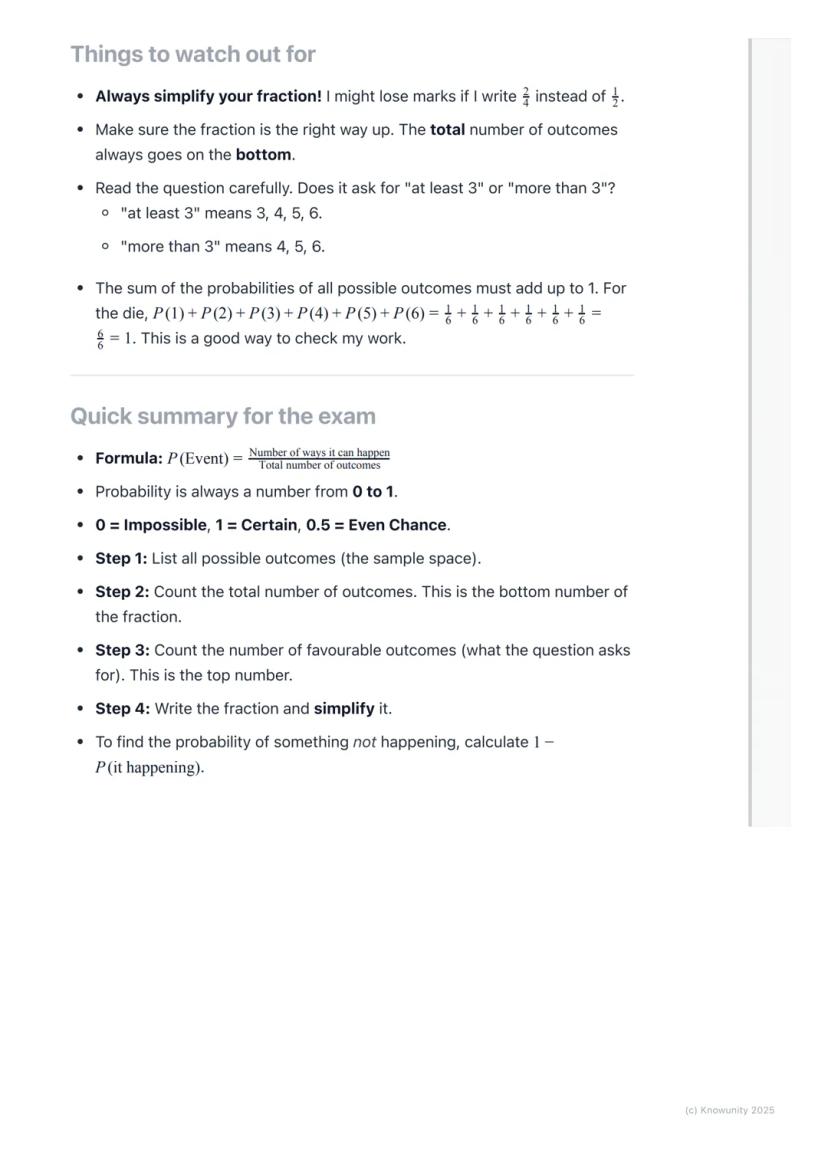
Watch out for tricky wording in questions. "At least 3" includes 3, 4, 5, and 6, whilst "more than 3" only includes 4, 5, and 6. These small differences can completely change your answer.
Here's a clever way to check your work: all probabilities for every possible outcome must add up to 1. For a die, P(1) + P(2) + P(3) + P(4) + P(5) + P(6) = 6 × 1/6 = 1. If your total doesn't equal 1, you've made an error somewhere.
Check Yourself: Always verify that your fraction is the right way up - total outcomes go on the bottom, favourable outcomes on top!
5
of 5Inscris-toi pour voir le contenu. C'est gratuit!
- Accès à tous les documents
- Améliore tes notes
- Rejoins des millions d'étudiants
Exam Success Tips
Your step-by-step method should become automatic: list the sample space, count total outcomes (bottom of fraction), count favourable outcomes (top of fraction), then write and simplify your fraction.
Common mistakes to avoid include forgetting to simplify fractions and misreading questions. Always double-check whether the question asks for "at least" or "more than" - they're not the same thing.
Remember that probability always ranges from 0 to 1. If you get a number outside this range, you've definitely made an error. The formula P(Event) = Favourable outcomes ÷ Total outcomes will solve any basic probability problem you encounter.
Final Reminder: Take your time reading questions carefully - most mistakes happen from rushing, not from lack of understanding!
Si on te demande...
Qu'est-ce que le compagnon IA de Knowunity ?
Notre compagnon IA est spécialement conçu pour répondre aux besoins des étudiants. Sur la base des millions d'éléments de contenu que nous avons sur la plateforme, nous pouvons fournir des réponses vraiment significatives et pertinentes aux étudiants. Mais il ne s'agit pas seulement de réponses, le compagnon a encore plus pour but de guider les élèves dans leurs défis d'apprentissage quotidiens, avec des plans d'étude personnalisés, des quiz ou des éléments de contenu dans le chat et une personnalisation à 100% basée sur les compétences et les développements de l'étudiant.
Où puis-je télécharger l'appli Knowunity ?
Tu peux télécharger l'application dans Google Play Store et dans l'App Store d'Apple.
L'application est-elle vraiment gratuite ?
Oui, tu as un accès entièrement gratuit à tous les contenus de l'appli, tu peux chatter ou suivre les créateurs à tout moment. De plus, nous proposons Knowunity Premium, qui te permet de réviser sans limites!
Contenus les plus populaires en Mathematics
7Contenus les plus populaires
9Rien ne te convient ? Explore d'autres matières.
Les étudiants nous adorent — il ne manque plus que toi.
4.6/5App Store
4.7/5Google Play
L'application est très facile d'utilisation et bien conçue. Jusqu'à présent, j'ai trouvé tout ce que je cherchais et j'ai pu apprendre beaucoup de choses grâce aux présentations ! Je vais certainement utiliser l'application pour un travail en classe ! Et comme source d'inspiration personnelle, elle est bien sûr aussi très utile.
Stefan Sutilisateur iOS
Cette application est vraiment super. Il y a tellement de fiches de révision et d'aide, [...]. Par exemple, la matière qui me pose problème est le français et l'appli a un choix d'aide très large. Grâce à cette application, je me suis améliorée en français. Je la recommanderais à tout le monde.
Samantha Klichutilisatrice Android
Waouh, je suis vraiment abasourdi. J'ai essayé l'application parce que je l'avais déjà vue plusieurs fois dans la publicité et j'ai été absolument choquée. Cette appli est L'AIDE dont on rêve pour l'école et surtout, elle propose tellement de choses, comme des rédactions et des fiches qui m'ont personnellement TRÈS bien aidé.
Annautilisatrice iOS