
Ever wondered why your bank balance can go negative or... Affiche plus
 Mathematics13 vues·Mis à jour May 27, 2026·5 pages
Understanding Natural Numbers and Integers
1 / 5
1
of 5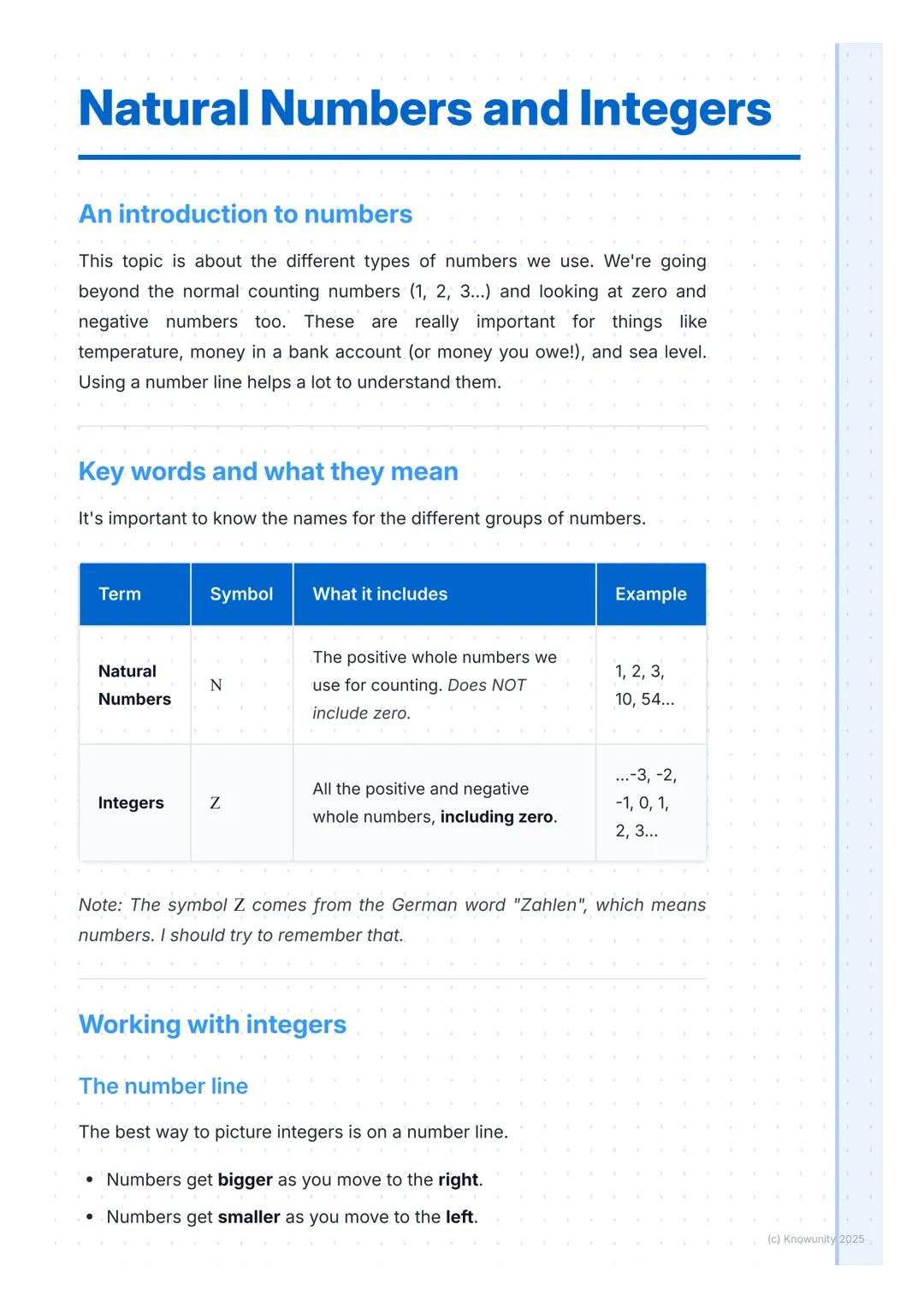
Natural Numbers and Integers - The Basics
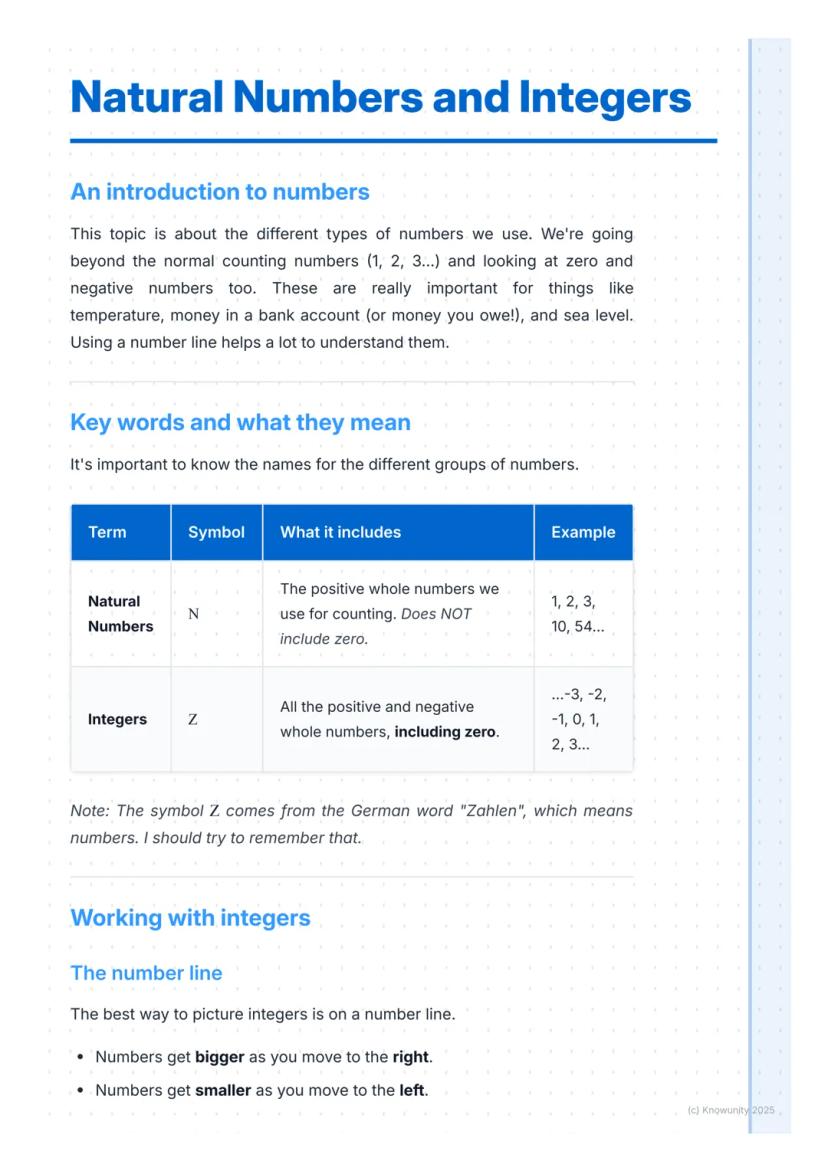
You've been using natural numbers your whole life without realising it! These are simply the counting numbers: 1, 2, 3, 4, and so on. They're called "natural" because they feel natural to use when counting objects.
Integers take things a step further by including zero and all the negative numbers too. Think of them as the complete family: ...-3, -2, -1, 0, 1, 2, 3... The symbol for integers is Z, which comes from the German word "Zahlen" meaning numbers.
Quick Tip: Remember that natural numbers don't include zero, but integers do! This catches lots of students out in tests.
The number line is your best friend here. Numbers get bigger as you move right and smaller as you move left. So -1 is actually bigger than -5 because it's further to the right!
2
of 5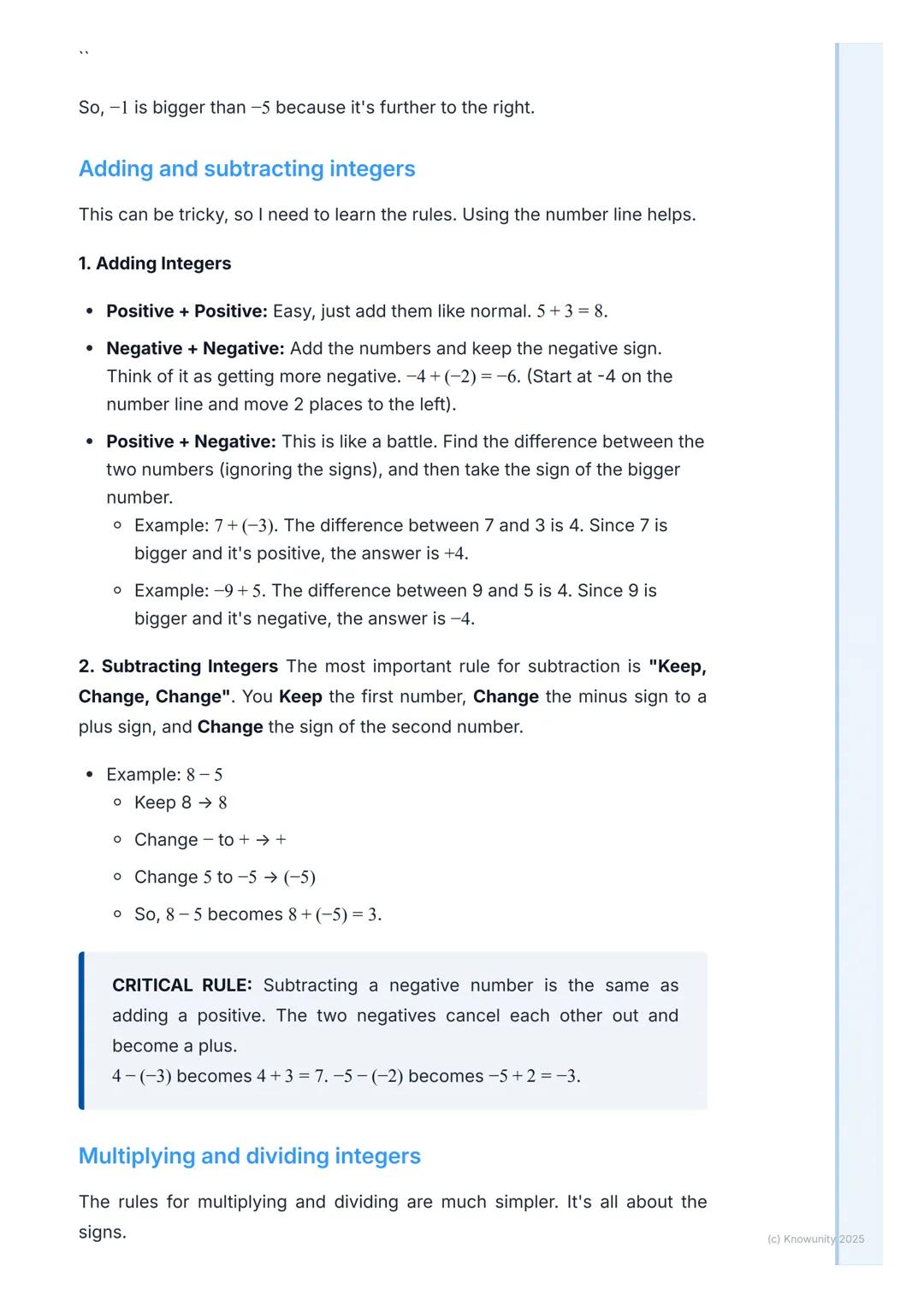
Adding and Subtracting Integers
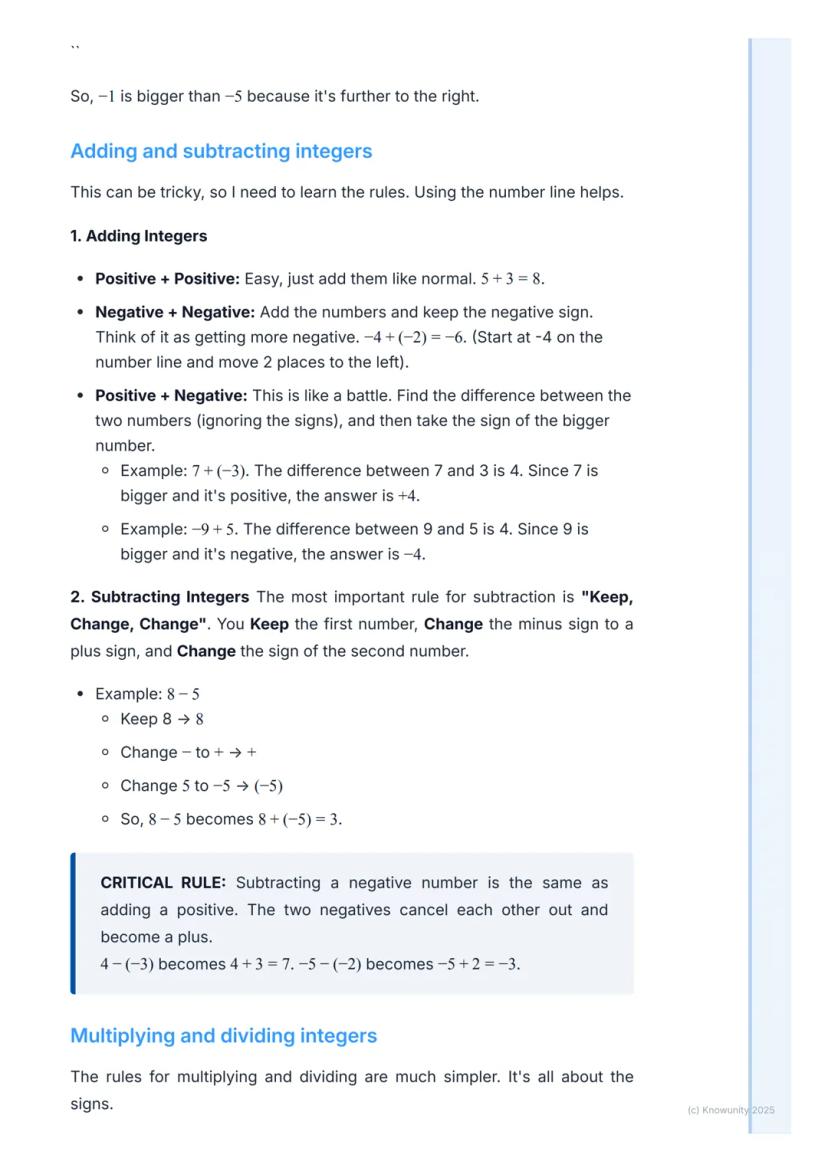
Adding integers might seem tricky at first, but there are simple patterns to follow. When you're adding two positive numbers, it's just normal addition. When adding two negative numbers, add them up and keep the negative sign - think of it as getting "more negative".
The interesting bit happens when you mix positive and negative numbers. Picture it like a battle between the numbers! Find the difference between them (ignore the signs), then use the sign of the bigger number. So 7 + (-3) = 4 because 7 is bigger and positive.
For subtraction, use the "Keep, Change, Change" rule. Keep the first number, change the minus to a plus, and change the sign of the second number. So 8 - 5 becomes 8 + (-5) = 3.
Remember: Subtracting a negative is the same as adding a positive! The two negatives cancel out: 4 - (-3) = 4 + 3 = 7.
3
of 5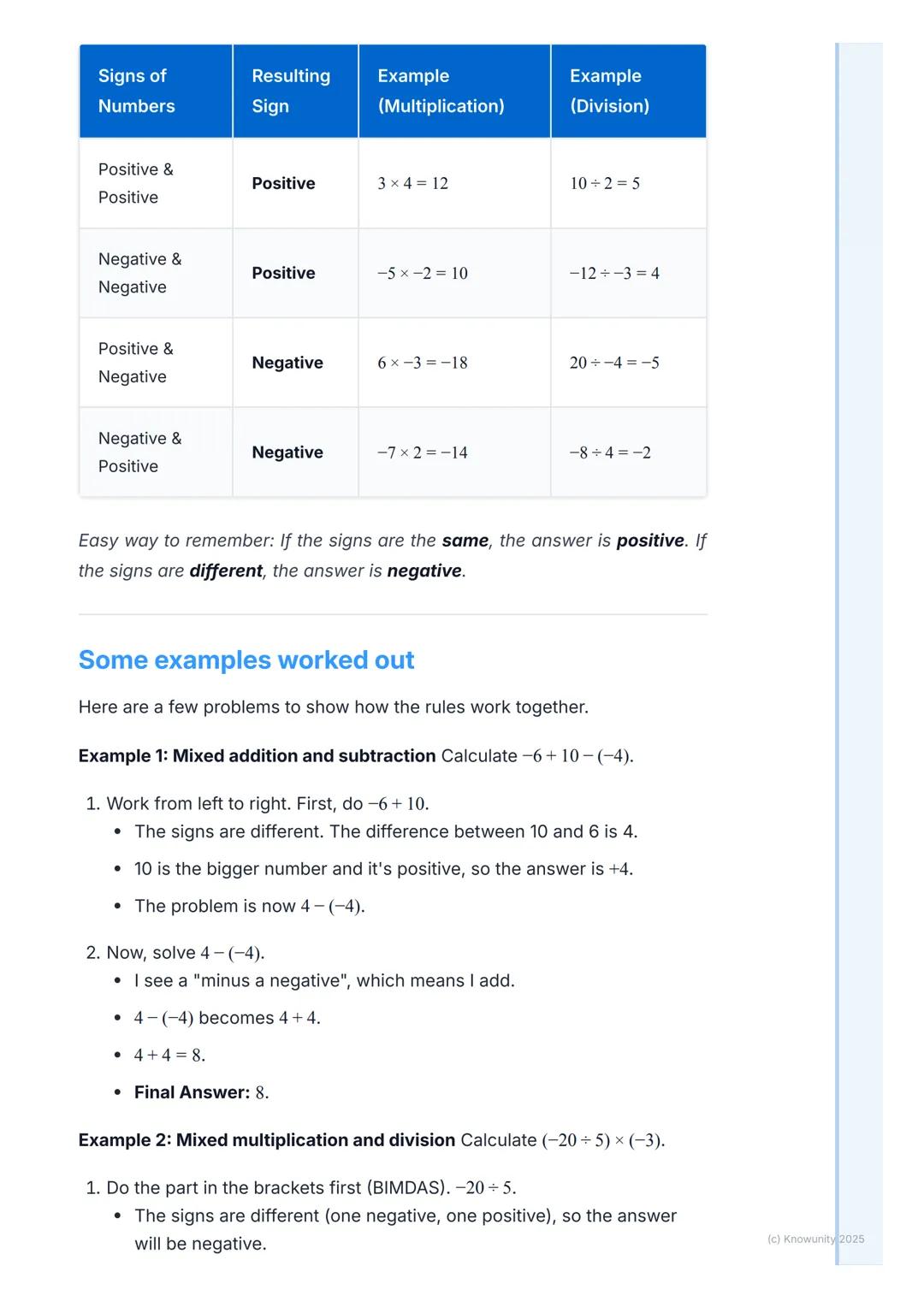
Multiplying and Dividing Integers
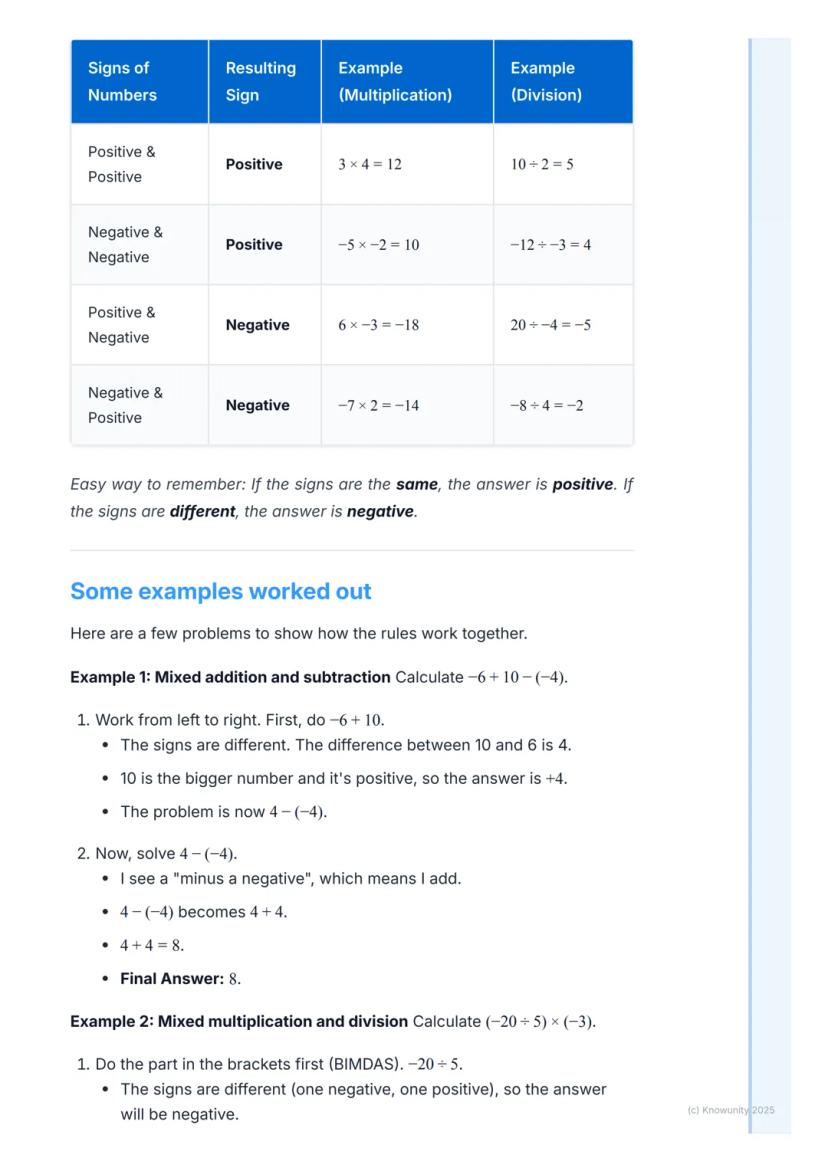
Good news - multiplying and dividing integers is much simpler than adding and subtracting! It's all about the signs, and there's just one rule to remember.
If the signs are the same (both positive or both negative), your answer is positive. If the signs are different (one positive, one negative), your answer is negative. So -5 × -2 = 10 , but 6 × -3 = -18 .
This works exactly the same for division. -12 ÷ -3 = 4 because both numbers are negative (same signs), while 20 ÷ -4 = -5 because the signs are different.
Memory Trick: Think "same = smiley face = positive" and "different = frowny face = negative"!
4
of 5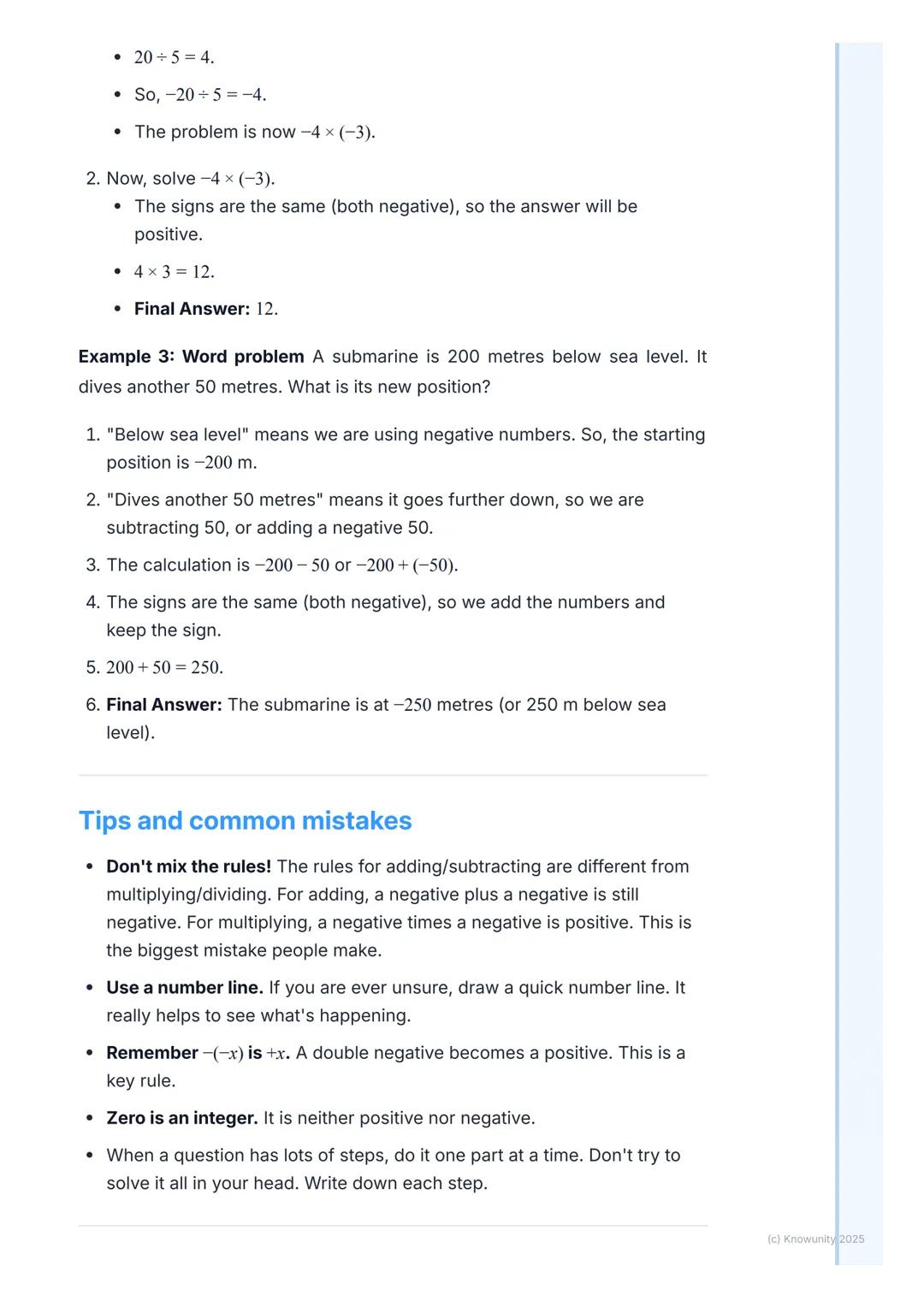
Working Through Examples
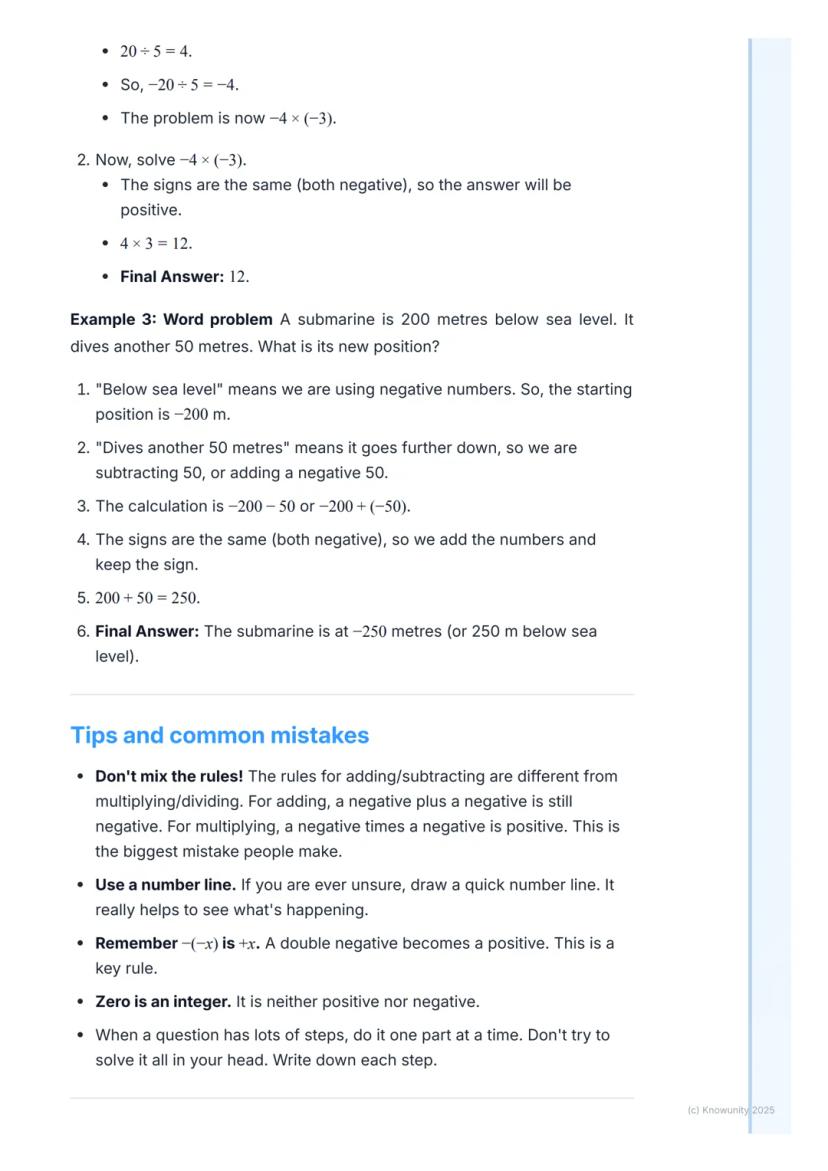
Let's tackle some real problems step by step. For -6 + 10 - (-4), work from left to right. First, -6 + 10 gives us 4 (different signs, so take the bigger number's sign). Then 4 - (-4) becomes 4 + 4 = 8.
Here's a practical example: A submarine starts 200 metres below sea level and dives another 50 metres. Since "below sea level" means negative, we calculate -200 + (-50) = -250m.
When you see brackets, always solve those first! For (-20 ÷ 5) × (-3), first work out -20 ÷ 5 = -4 . Then -4 × (-3) = 12 .
Pro Tip: Don't try to do everything in your head - write down each step. This prevents silly mistakes that cost marks!
5
of 5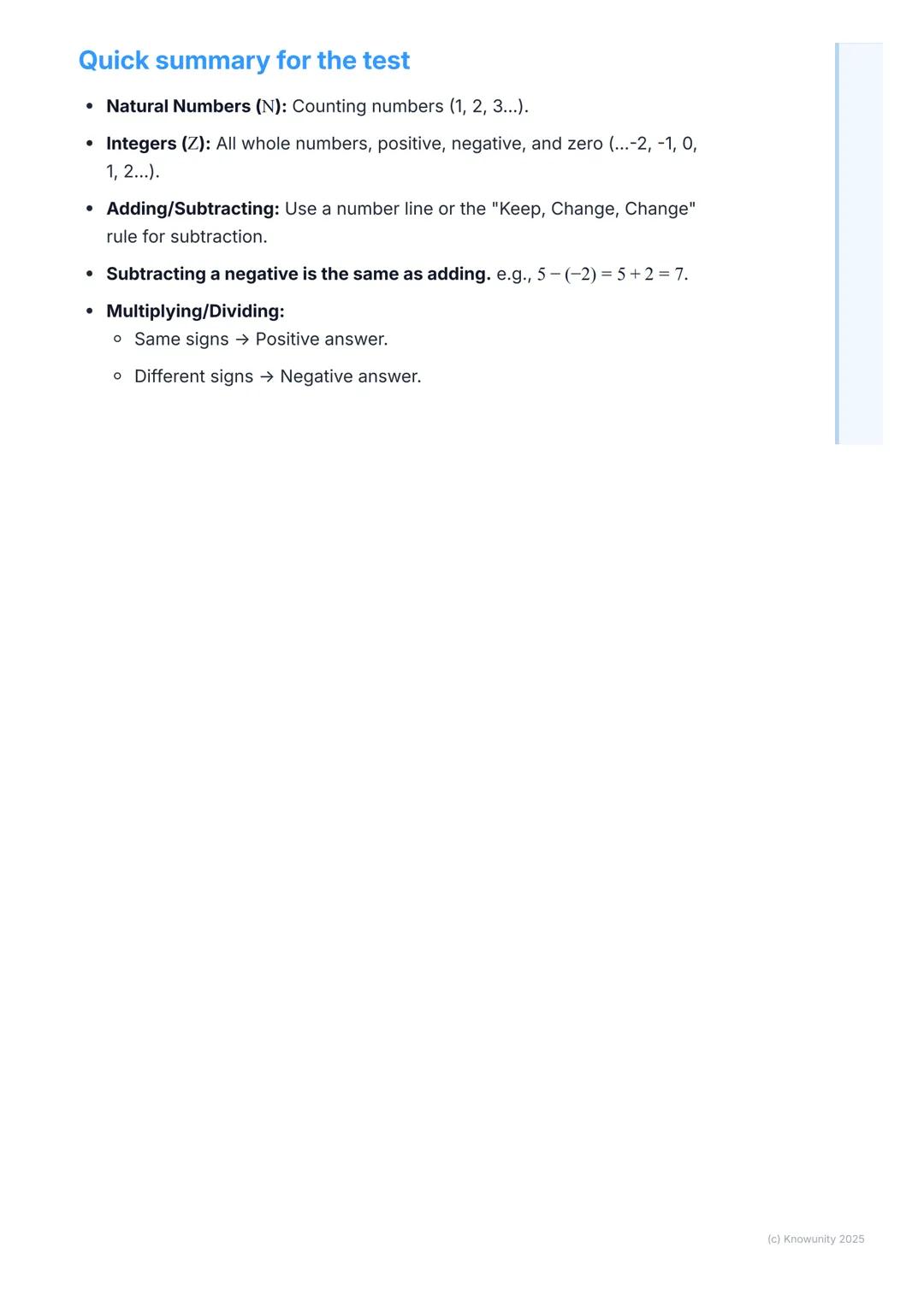
Quick Test Revision
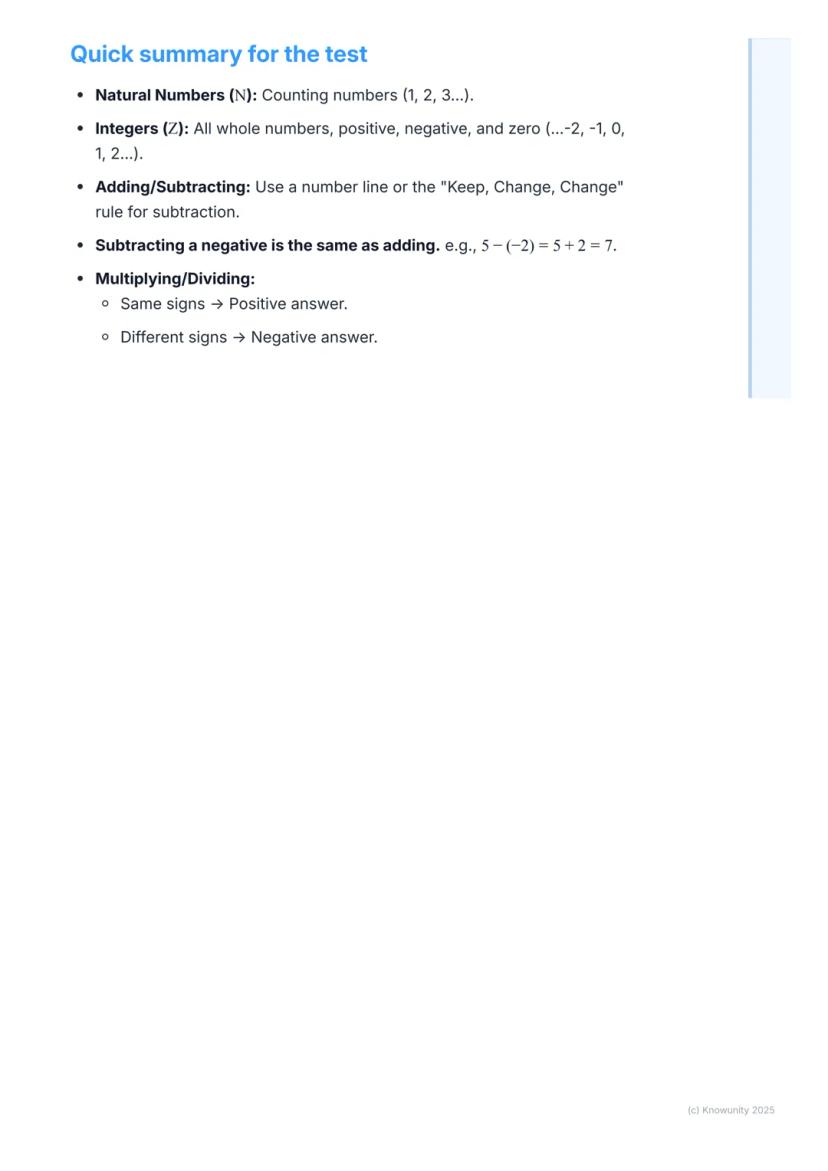
Here's everything you need for your test! Natural numbers are your basic counting numbers (1, 2, 3...), while integers include zero and all negative numbers too (...-2, -1, 0, 1, 2...).
For adding and subtracting, use the number line or remember that subtracting a negative equals adding a positive. The "Keep, Change, Change" rule is your friend for subtraction problems.
Multiplication and division follow one simple rule: same signs give positive answers, different signs give negative answers. Zero is an integer but it's neither positive nor negative.
Final Reminder: The biggest mistake students make is mixing up the rules for different operations. Adding two negatives stays negative, but multiplying two negatives becomes positive!
Si on te demande...
Qu'est-ce que le compagnon IA de Knowunity ?
Notre compagnon IA est spécialement conçu pour répondre aux besoins des étudiants. Sur la base des millions d'éléments de contenu que nous avons sur la plateforme, nous pouvons fournir des réponses vraiment significatives et pertinentes aux étudiants. Mais il ne s'agit pas seulement de réponses, le compagnon a encore plus pour but de guider les élèves dans leurs défis d'apprentissage quotidiens, avec des plans d'étude personnalisés, des quiz ou des éléments de contenu dans le chat et une personnalisation à 100% basée sur les compétences et les développements de l'étudiant.
Où puis-je télécharger l'appli Knowunity ?
Tu peux télécharger l'application dans Google Play Store et dans l'App Store d'Apple.
L'application est-elle vraiment gratuite ?
Oui, tu as un accès entièrement gratuit à tous les contenus de l'appli, tu peux chatter ou suivre les créateurs à tout moment. De plus, nous proposons Knowunity Premium, qui te permet de réviser sans limites!
Contenus les plus populaires en Mathematics
7Contenus les plus populaires
9Rien ne te convient ? Explore d'autres matières.
Les étudiants nous adorent — il ne manque plus que toi.
4.6/5App Store
4.7/5Google Play
L'application est très facile d'utilisation et bien conçue. Jusqu'à présent, j'ai trouvé tout ce que je cherchais et j'ai pu apprendre beaucoup de choses grâce aux présentations ! Je vais certainement utiliser l'application pour un travail en classe ! Et comme source d'inspiration personnelle, elle est bien sûr aussi très utile.
Stefan Sutilisateur iOS
Cette application est vraiment super. Il y a tellement de fiches de révision et d'aide, [...]. Par exemple, la matière qui me pose problème est le français et l'appli a un choix d'aide très large. Grâce à cette application, je me suis améliorée en français. Je la recommanderais à tout le monde.
Samantha Klichutilisatrice Android
Waouh, je suis vraiment abasourdi. J'ai essayé l'application parce que je l'avais déjà vue plusieurs fois dans la publicité et j'ai été absolument choquée. Cette appli est L'AIDE dont on rêve pour l'école et surtout, elle propose tellement de choses, comme des rédactions et des fiches qui m'ont personnellement TRÈS bien aidé.
Annautilisatrice iOS
Mathematics13 vues·Mis à jour May 27, 2026·5 pagesUnderstanding Natural Numbers and Integers
Ever wondered why your bank balance can go negative or how we measure temperatures below zero? Understanding natural numbers and integers is the key to making sense of these everyday situations. These number systems help us work with everything from... Affiche plus
1
of 5Inscris-toi pour voir le contenu. C'est gratuit!
- Accès à tous les documents
- Améliore tes notes
- Rejoins des millions d'étudiants
Natural Numbers and Integers - The Basics
You've been using natural numbers your whole life without realising it! These are simply the counting numbers: 1, 2, 3, 4, and so on. They're called "natural" because they feel natural to use when counting objects.
Integers take things a step further by including zero and all the negative numbers too. Think of them as the complete family: ...-3, -2, -1, 0, 1, 2, 3... The symbol for integers is Z, which comes from the German word "Zahlen" meaning numbers.
Quick Tip: Remember that natural numbers don't include zero, but integers do! This catches lots of students out in tests.
The number line is your best friend here. Numbers get bigger as you move right and smaller as you move left. So -1 is actually bigger than -5 because it's further to the right!
2
of 5Inscris-toi pour voir le contenu. C'est gratuit!
- Accès à tous les documents
- Améliore tes notes
- Rejoins des millions d'étudiants
Adding and Subtracting Integers
Adding integers might seem tricky at first, but there are simple patterns to follow. When you're adding two positive numbers, it's just normal addition. When adding two negative numbers, add them up and keep the negative sign - think of it as getting "more negative".
The interesting bit happens when you mix positive and negative numbers. Picture it like a battle between the numbers! Find the difference between them (ignore the signs), then use the sign of the bigger number. So 7 + (-3) = 4 because 7 is bigger and positive.
For subtraction, use the "Keep, Change, Change" rule. Keep the first number, change the minus to a plus, and change the sign of the second number. So 8 - 5 becomes 8 + (-5) = 3.
Remember: Subtracting a negative is the same as adding a positive! The two negatives cancel out: 4 - (-3) = 4 + 3 = 7.
3
of 5Inscris-toi pour voir le contenu. C'est gratuit!
- Accès à tous les documents
- Améliore tes notes
- Rejoins des millions d'étudiants
Multiplying and Dividing Integers
Good news - multiplying and dividing integers is much simpler than adding and subtracting! It's all about the signs, and there's just one rule to remember.
If the signs are the same (both positive or both negative), your answer is positive. If the signs are different (one positive, one negative), your answer is negative. So -5 × -2 = 10 , but 6 × -3 = -18 .
This works exactly the same for division. -12 ÷ -3 = 4 because both numbers are negative (same signs), while 20 ÷ -4 = -5 because the signs are different.
Memory Trick: Think "same = smiley face = positive" and "different = frowny face = negative"!
4
of 5Inscris-toi pour voir le contenu. C'est gratuit!
- Accès à tous les documents
- Améliore tes notes
- Rejoins des millions d'étudiants
Working Through Examples
Let's tackle some real problems step by step. For -6 + 10 - (-4), work from left to right. First, -6 + 10 gives us 4 (different signs, so take the bigger number's sign). Then 4 - (-4) becomes 4 + 4 = 8.
Here's a practical example: A submarine starts 200 metres below sea level and dives another 50 metres. Since "below sea level" means negative, we calculate -200 + (-50) = -250m.
When you see brackets, always solve those first! For (-20 ÷ 5) × (-3), first work out -20 ÷ 5 = -4 . Then -4 × (-3) = 12 .
Pro Tip: Don't try to do everything in your head - write down each step. This prevents silly mistakes that cost marks!
5
of 5Inscris-toi pour voir le contenu. C'est gratuit!
- Accès à tous les documents
- Améliore tes notes
- Rejoins des millions d'étudiants
Quick Test Revision
Here's everything you need for your test! Natural numbers are your basic counting numbers (1, 2, 3...), while integers include zero and all negative numbers too (...-2, -1, 0, 1, 2...).
For adding and subtracting, use the number line or remember that subtracting a negative equals adding a positive. The "Keep, Change, Change" rule is your friend for subtraction problems.
Multiplication and division follow one simple rule: same signs give positive answers, different signs give negative answers. Zero is an integer but it's neither positive nor negative.
Final Reminder: The biggest mistake students make is mixing up the rules for different operations. Adding two negatives stays negative, but multiplying two negatives becomes positive!
Si on te demande...
Qu'est-ce que le compagnon IA de Knowunity ?
Notre compagnon IA est spécialement conçu pour répondre aux besoins des étudiants. Sur la base des millions d'éléments de contenu que nous avons sur la plateforme, nous pouvons fournir des réponses vraiment significatives et pertinentes aux étudiants. Mais il ne s'agit pas seulement de réponses, le compagnon a encore plus pour but de guider les élèves dans leurs défis d'apprentissage quotidiens, avec des plans d'étude personnalisés, des quiz ou des éléments de contenu dans le chat et une personnalisation à 100% basée sur les compétences et les développements de l'étudiant.
Où puis-je télécharger l'appli Knowunity ?
Tu peux télécharger l'application dans Google Play Store et dans l'App Store d'Apple.
L'application est-elle vraiment gratuite ?
Oui, tu as un accès entièrement gratuit à tous les contenus de l'appli, tu peux chatter ou suivre les créateurs à tout moment. De plus, nous proposons Knowunity Premium, qui te permet de réviser sans limites!
Contenus les plus populaires en Mathematics
7Contenus les plus populaires
9Rien ne te convient ? Explore d'autres matières.
Les étudiants nous adorent — il ne manque plus que toi.
4.6/5App Store
4.7/5Google Play
L'application est très facile d'utilisation et bien conçue. Jusqu'à présent, j'ai trouvé tout ce que je cherchais et j'ai pu apprendre beaucoup de choses grâce aux présentations ! Je vais certainement utiliser l'application pour un travail en classe ! Et comme source d'inspiration personnelle, elle est bien sûr aussi très utile.
Stefan Sutilisateur iOS
Cette application est vraiment super. Il y a tellement de fiches de révision et d'aide, [...]. Par exemple, la matière qui me pose problème est le français et l'appli a un choix d'aide très large. Grâce à cette application, je me suis améliorée en français. Je la recommanderais à tout le monde.
Samantha Klichutilisatrice Android
Waouh, je suis vraiment abasourdi. J'ai essayé l'application parce que je l'avais déjà vue plusieurs fois dans la publicité et j'ai été absolument choquée. Cette appli est L'AIDE dont on rêve pour l'école et surtout, elle propose tellement de choses, comme des rédactions et des fiches qui m'ont personnellement TRÈS bien aidé.
Annautilisatrice iOS