
Solving equations is like being a detective - you're hunting... Affiche plus
 Mathematics13 vues·Mis à jour May 27, 2026·5 pages
Mastering Linear Equations: Solve Like a Pro
1 / 5
1
of 5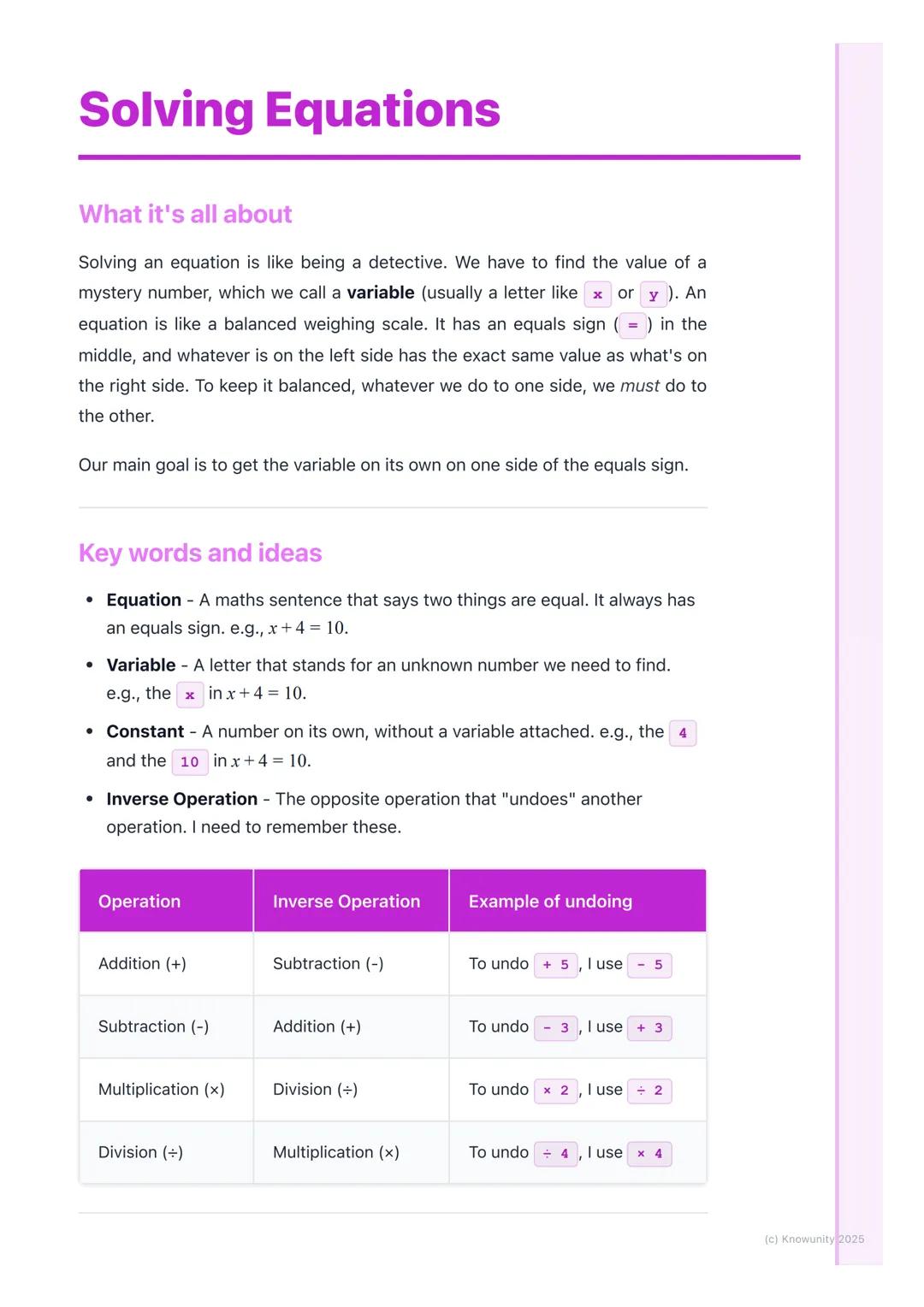
What's All This About?
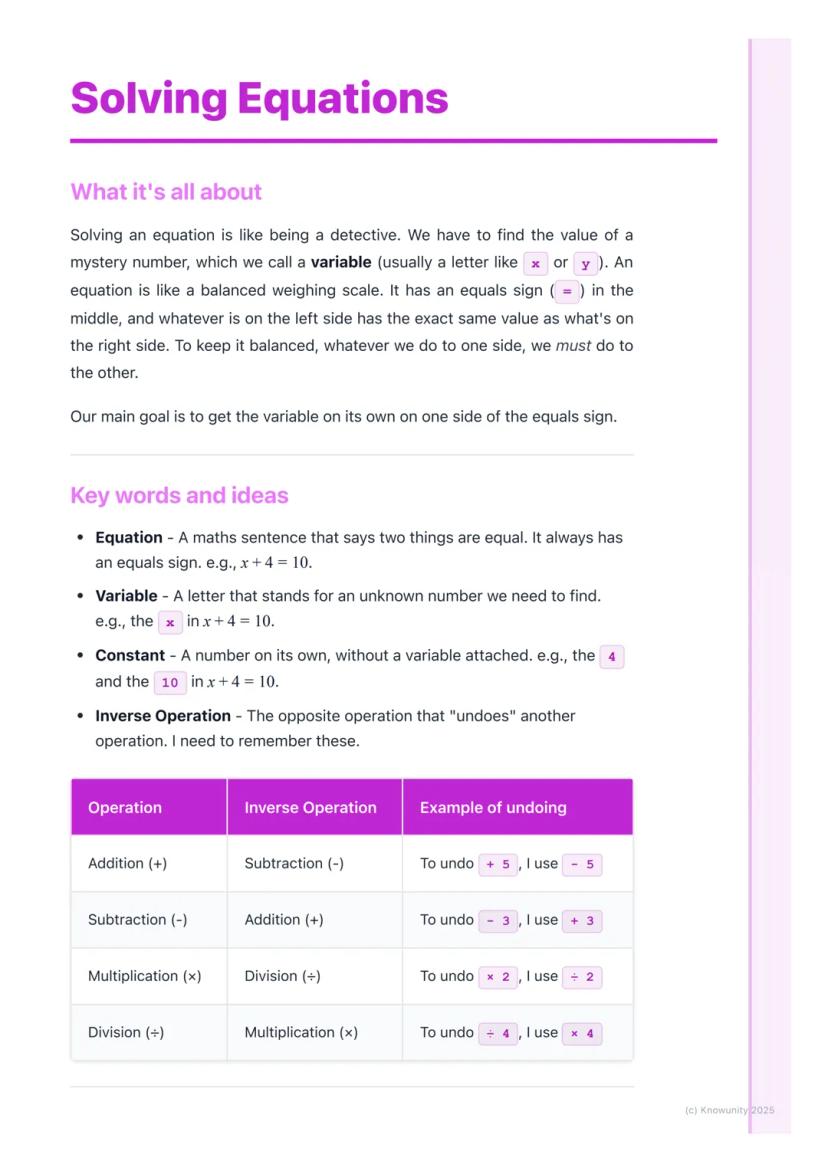
Solving equations means finding the value of an unknown number, called a variable. Your main mission is simple: get that variable all by itself on one side of the equals sign.
An equation is just a maths sentence saying two things are equal - it always has that equals sign in the middle. The variable is the mystery letter (like x or y) you need to find, while constants are just regular numbers hanging about.
Here's your secret weapon: inverse operations. These are opposite operations that undo each other - addition undoes subtraction, multiplication undoes division, and so on.
Remember: Addition ↔ Subtraction and Multiplication ↔ Division are perfect pairs!
2
of 5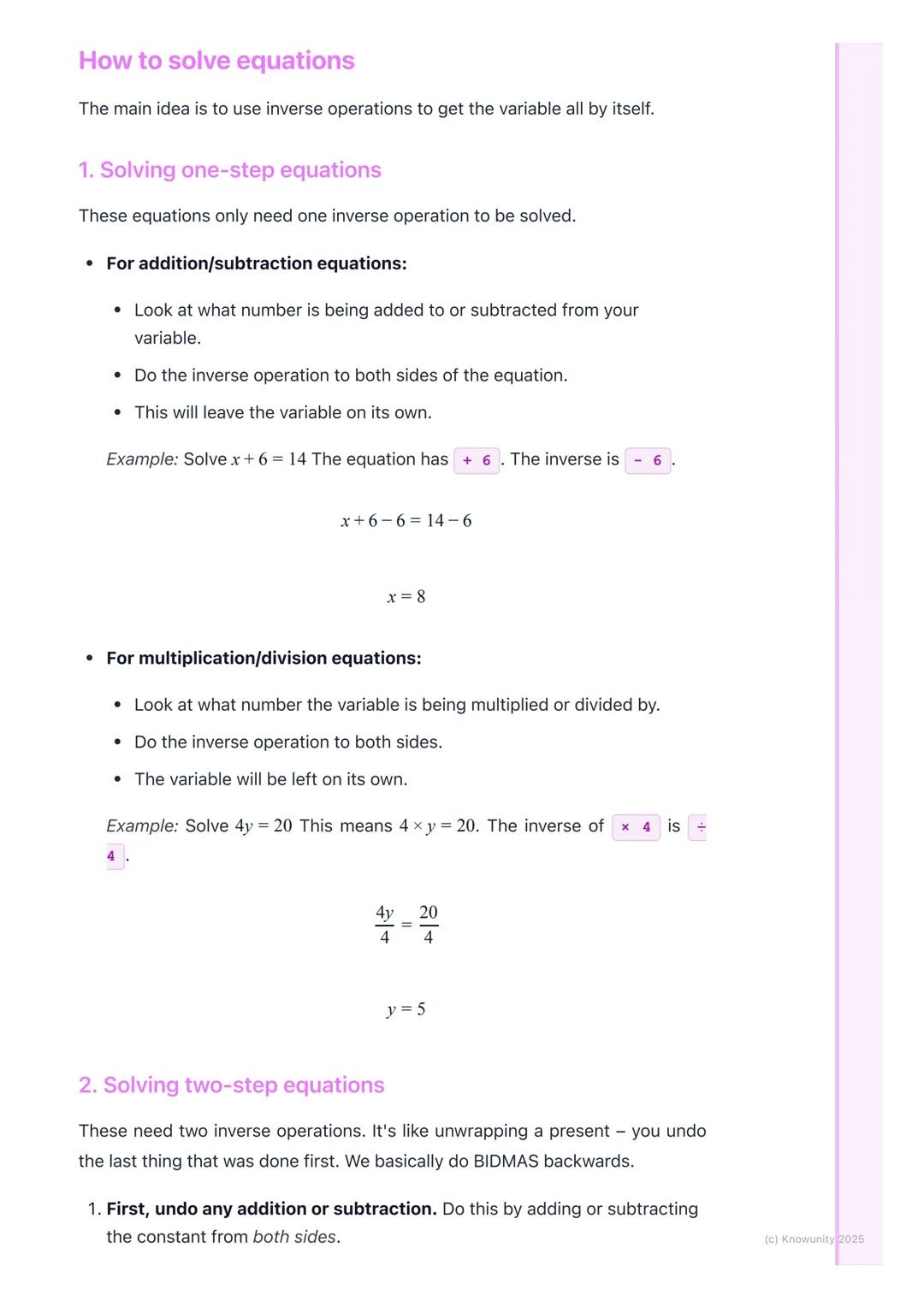
Cracking One-Step Equations
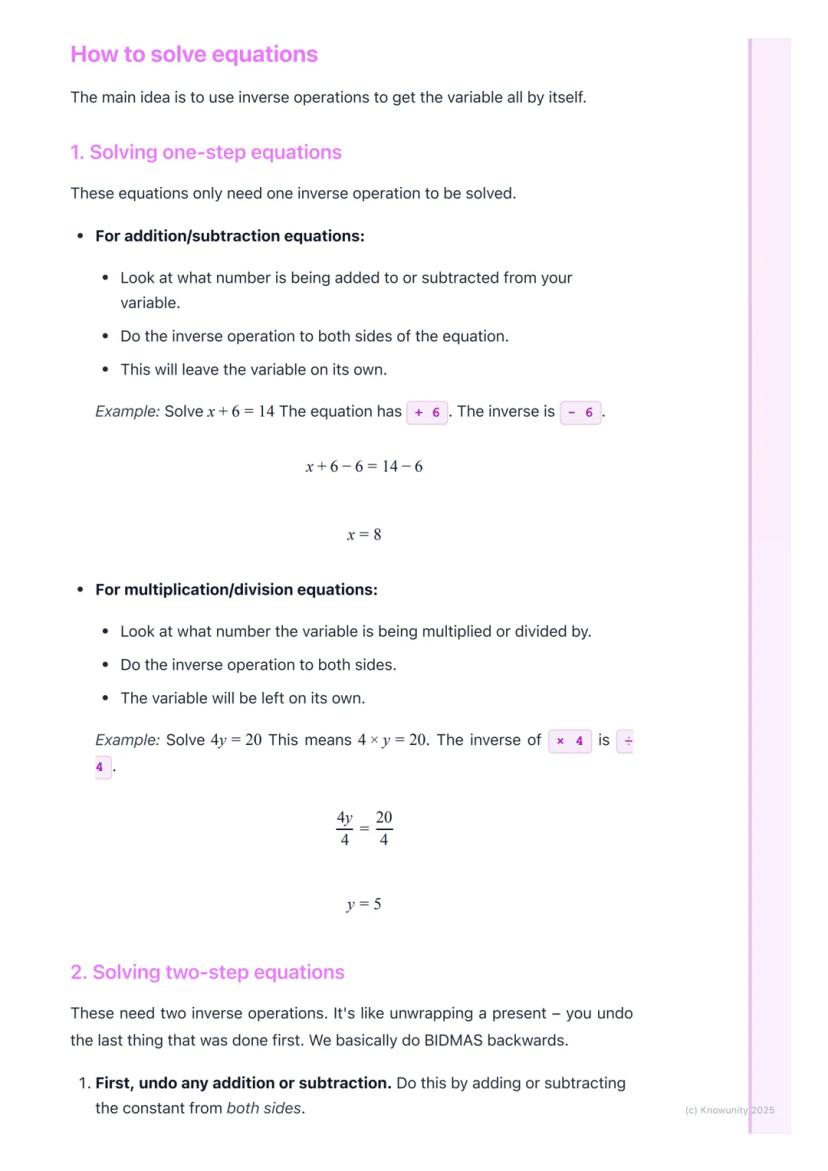
These are the easiest equations because they only need one inverse operation to solve. You've basically got two types to deal with.
For addition and subtraction equations, spot what number is being added or subtracted from your variable. Then do the opposite to both sides. If you see x + 6 = 14, subtract 6 from both sides to get x = 8.
For multiplication and division equations, look at what number your variable is being multiplied or divided by. Then do the reverse to both sides. If you have 4y = 20, divide both sides by 4 to get y = 5.
Top Tip: Always do the same operation to both sides - this keeps your equation balanced like a perfect seesaw!
3
of 5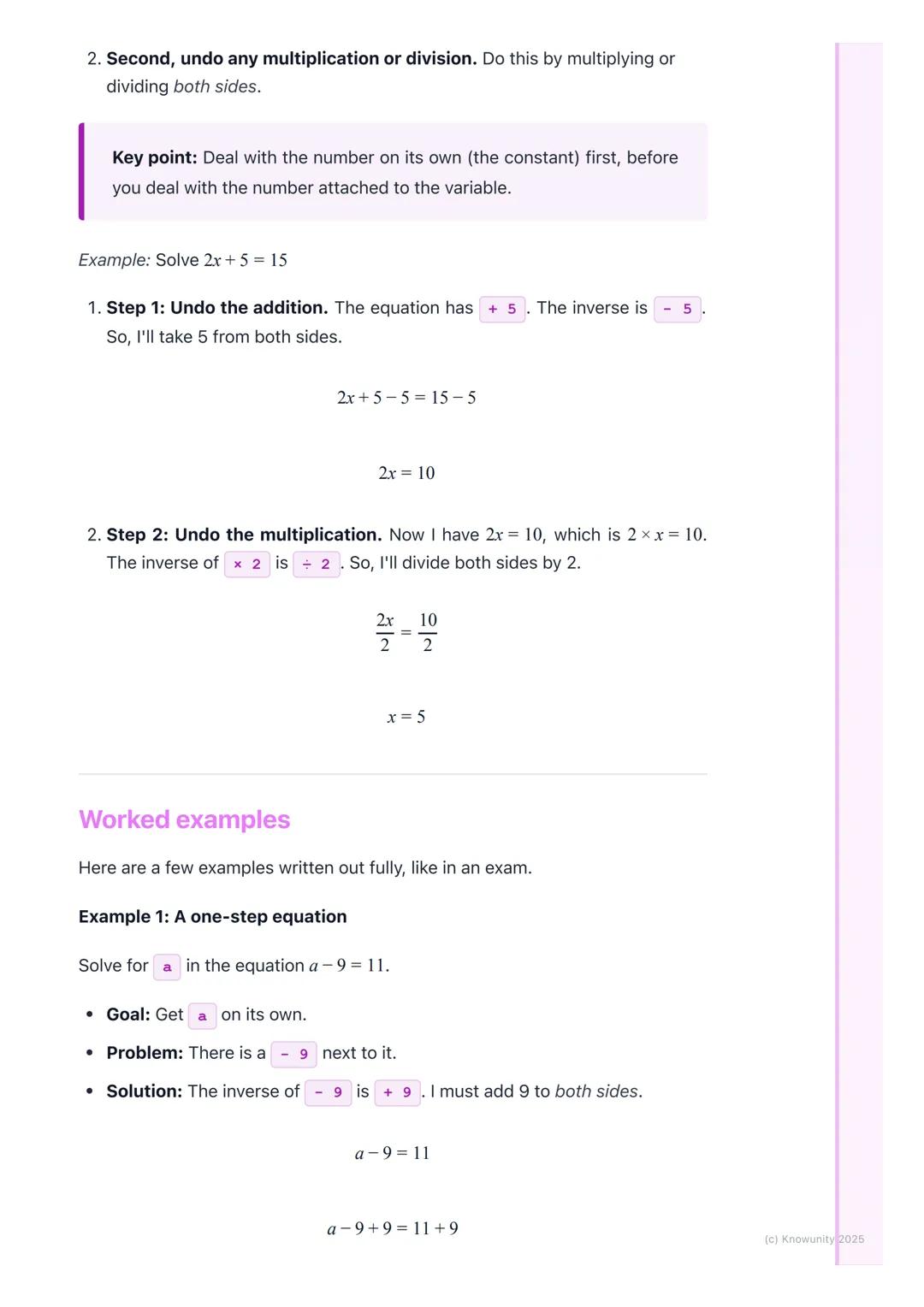
Tackling Two-Step Equations
Two-step equations need two moves to solve, and here's the clever bit - you work backwards through BIDMAS. Think of it like unwrapping a present where you undo the last thing that was done first.
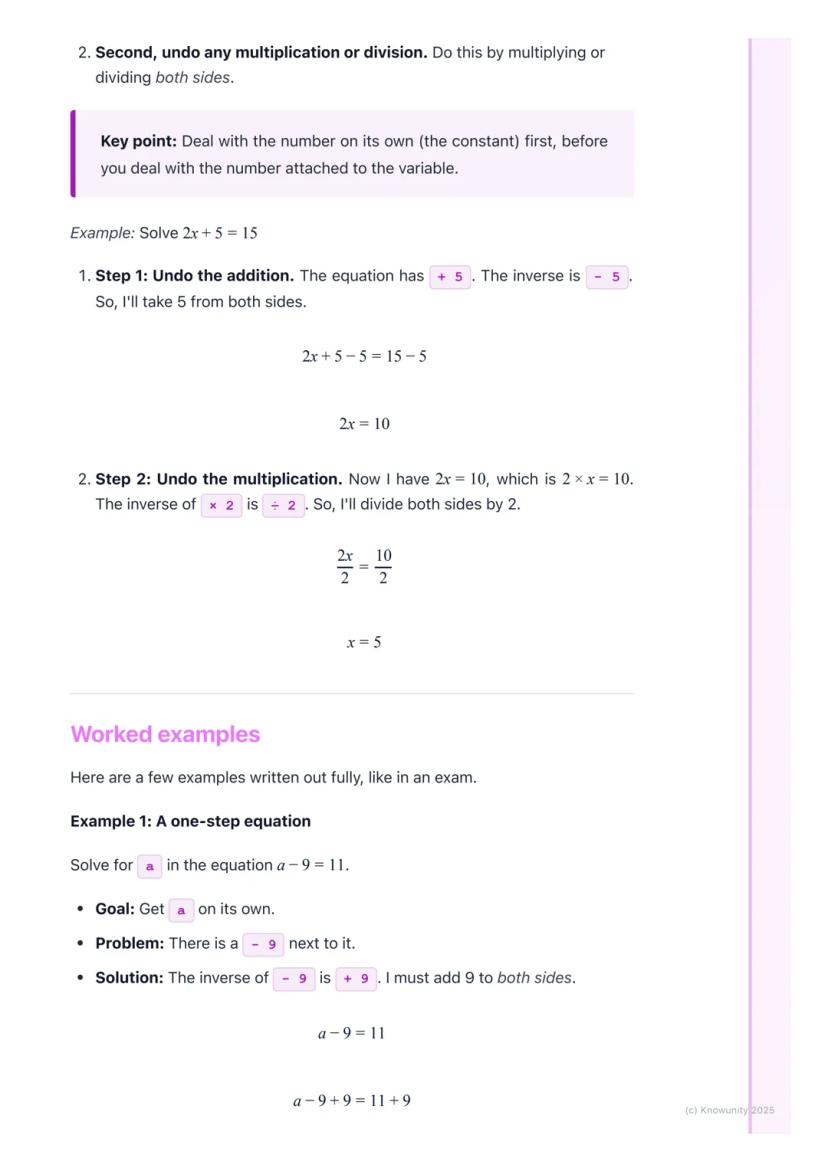
Step 1: Deal with any addition or subtraction first. Get rid of the constant (the number on its own) by doing the opposite operation to both sides.
Step 2: Then handle any multiplication or division. Work on the number attached to your variable by using its inverse operation.
For example, with 2x + 5 = 15, first subtract 5 from both sides , then divide both sides by 2 .
Golden Rule: Always tackle the lone number first, then deal with whatever's attached to your variable!
4
of 5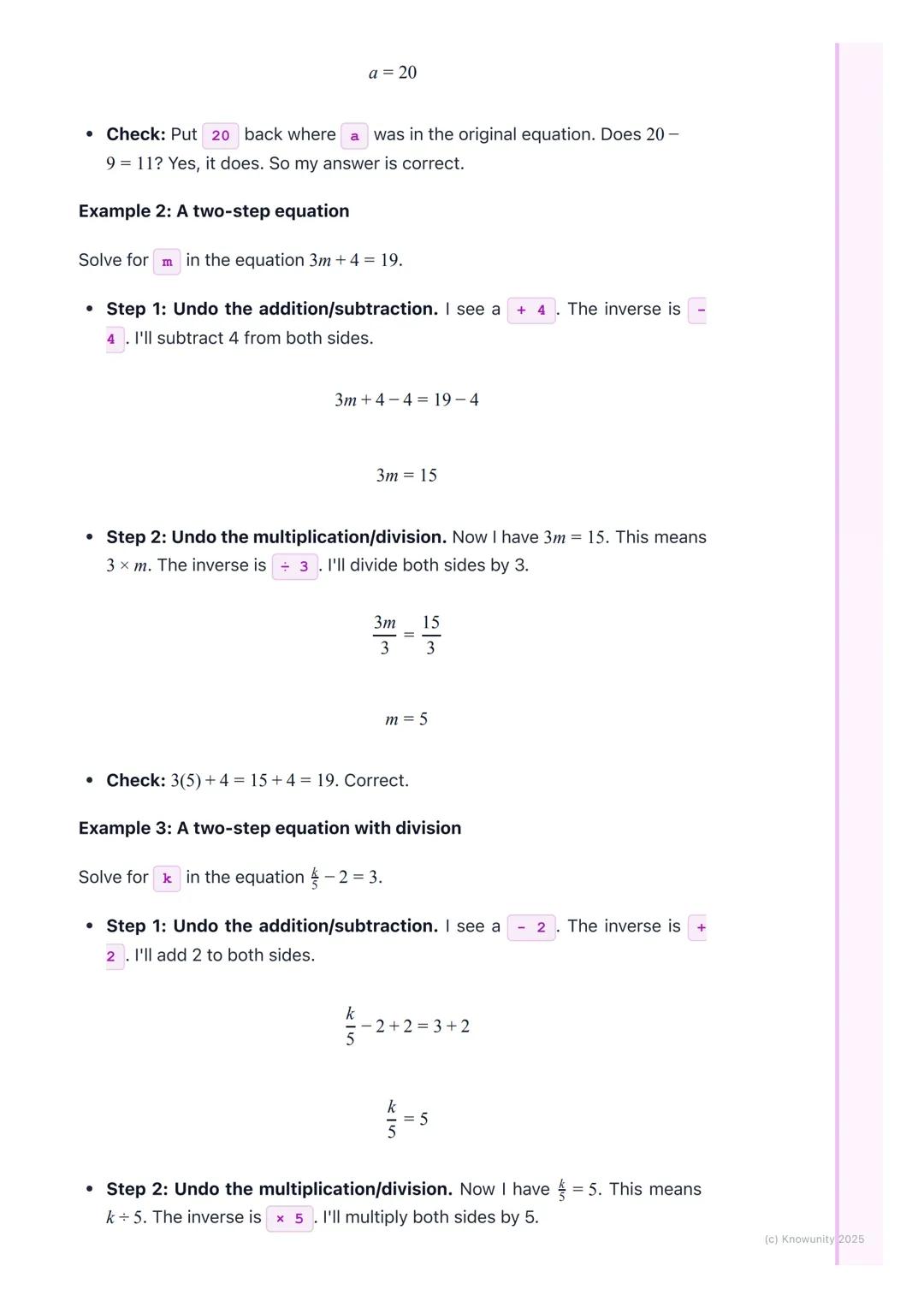
Working Through Real Examples
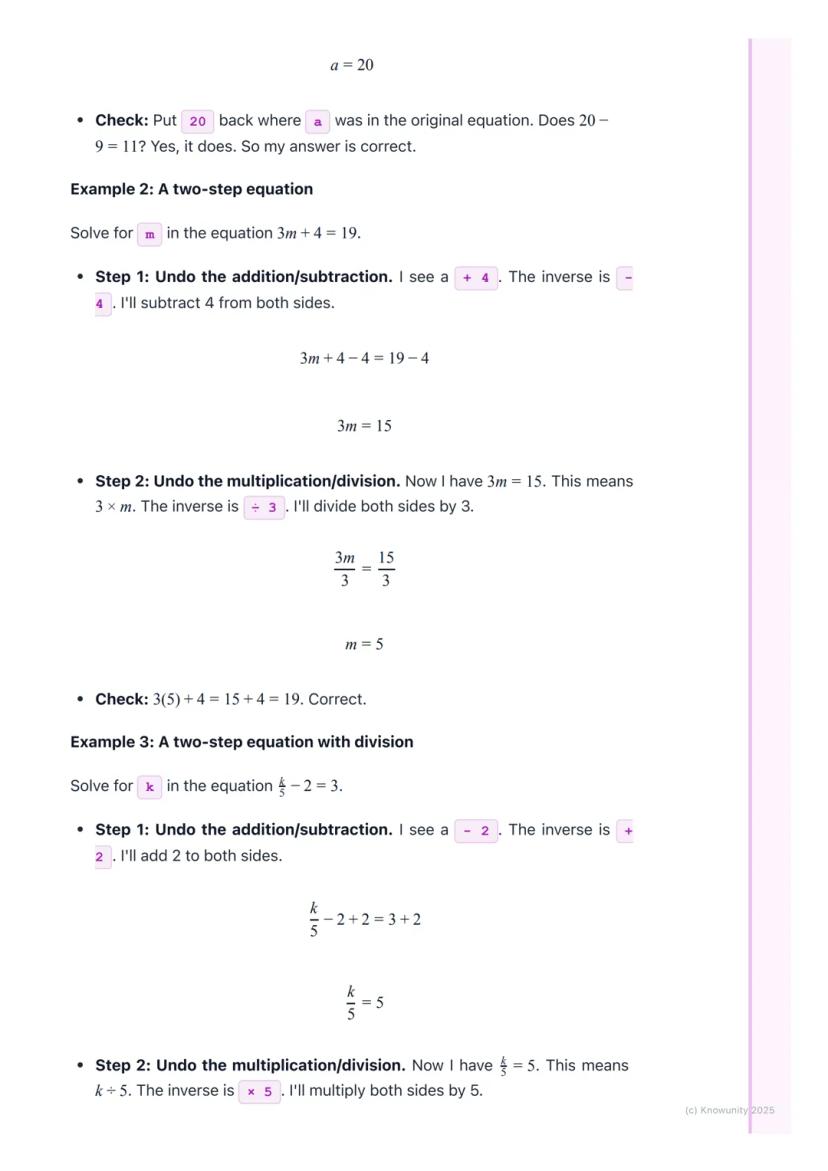
Let's see how this works with proper exam-style examples. For a simple equation like a - 9 = 11, you add 9 to both sides to get a = 20.
With two-step equations like 3m + 4 = 19, first subtract 4 from both sides , then divide both sides by 3 . Easy when you know the steps!
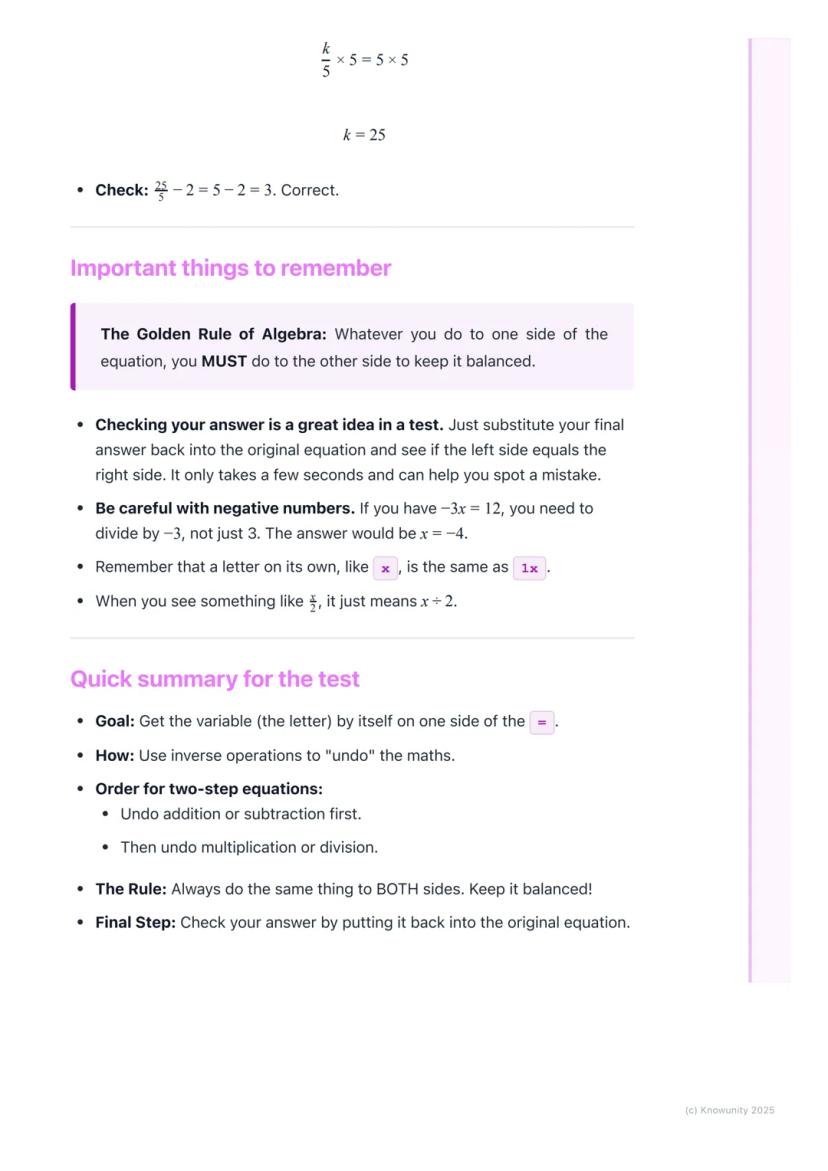
Even trickier ones like k/5 - 2 = 3 follow the same pattern. Add 2 to both sides first , then multiply both sides by 5 .
Always check your answer by popping it back into the original equation. It takes seconds and can save you marks in a test!
Pro Move: Checking your answer is like having a safety net - it catches mistakes before they cost you points!
5
of 5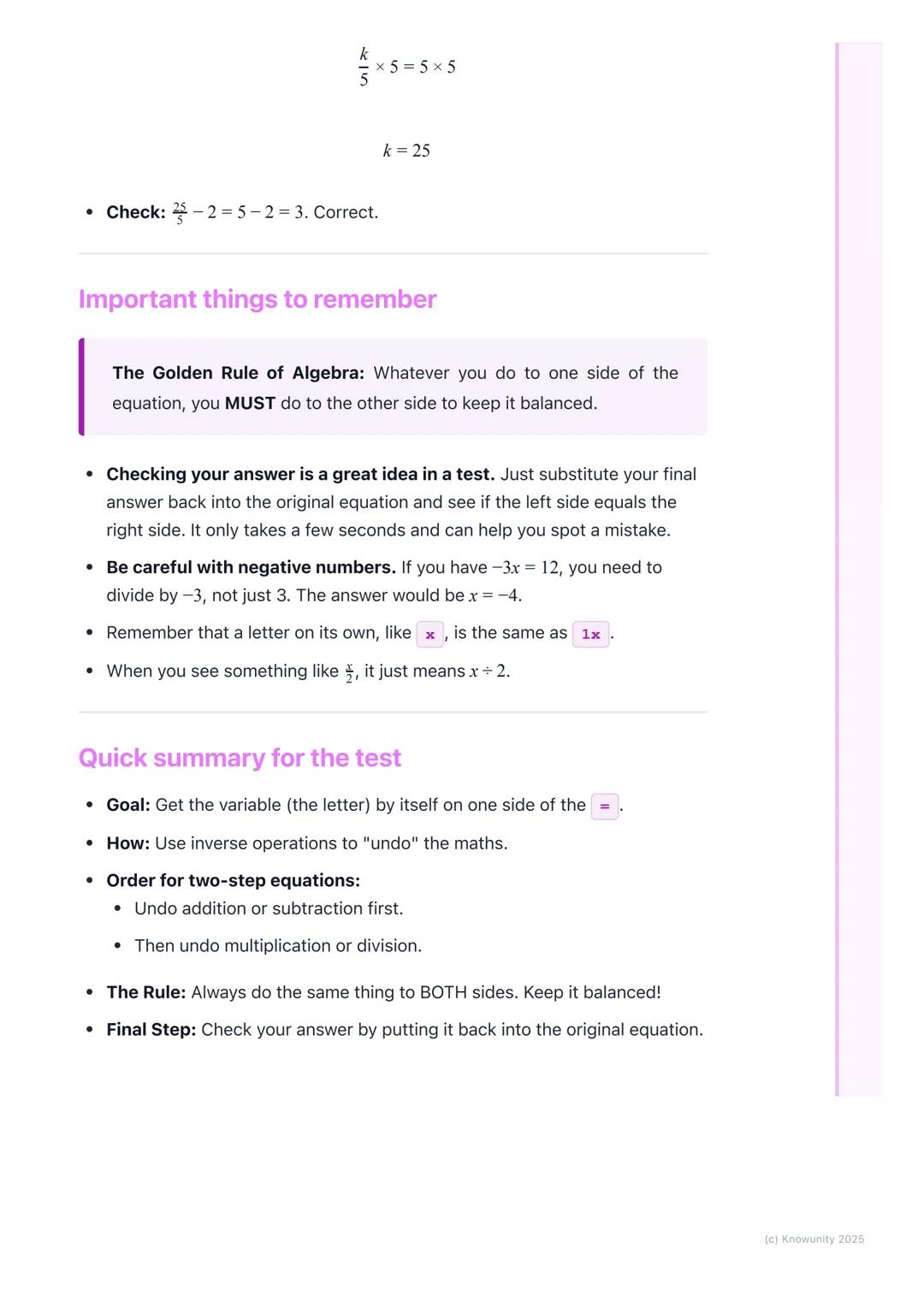
Key Things to Remember
The golden rule of algebra is sacred: whatever you do to one side, you absolutely must do to the other. No exceptions, ever!
Watch out for negative numbers - if you have -3x = 12, you divide by -3 (not just 3) to get x = -4. Also remember that x on its own is really 1x, and x/2 just means x ÷ 2.
For two-step equations, your order of attack is: undo addition or subtraction first, then tackle multiplication or division. Keep everything balanced and always check your final answer.
Test Strategy: Goal → Get the variable alone. Method → Use inverse operations. Rule → Do the same to both sides. Check → Put your answer back in!
Si on te demande...
Qu'est-ce que le compagnon IA de Knowunity ?
Notre compagnon IA est spécialement conçu pour répondre aux besoins des étudiants. Sur la base des millions d'éléments de contenu que nous avons sur la plateforme, nous pouvons fournir des réponses vraiment significatives et pertinentes aux étudiants. Mais il ne s'agit pas seulement de réponses, le compagnon a encore plus pour but de guider les élèves dans leurs défis d'apprentissage quotidiens, avec des plans d'étude personnalisés, des quiz ou des éléments de contenu dans le chat et une personnalisation à 100% basée sur les compétences et les développements de l'étudiant.
Où puis-je télécharger l'appli Knowunity ?
Tu peux télécharger l'application dans Google Play Store et dans l'App Store d'Apple.
L'application est-elle vraiment gratuite ?
Oui, tu as un accès entièrement gratuit à tous les contenus de l'appli, tu peux chatter ou suivre les créateurs à tout moment. De plus, nous proposons Knowunity Premium, qui te permet de réviser sans limites!
Contenus les plus populaires en Mathematics
7Contenus les plus populaires
9Rien ne te convient ? Explore d'autres matières.
Les étudiants nous adorent — il ne manque plus que toi.
4.6/5App Store
4.7/5Google Play
L'application est très facile d'utilisation et bien conçue. Jusqu'à présent, j'ai trouvé tout ce que je cherchais et j'ai pu apprendre beaucoup de choses grâce aux présentations ! Je vais certainement utiliser l'application pour un travail en classe ! Et comme source d'inspiration personnelle, elle est bien sûr aussi très utile.
Stefan Sutilisateur iOS
Cette application est vraiment super. Il y a tellement de fiches de révision et d'aide, [...]. Par exemple, la matière qui me pose problème est le français et l'appli a un choix d'aide très large. Grâce à cette application, je me suis améliorée en français. Je la recommanderais à tout le monde.
Samantha Klichutilisatrice Android
Waouh, je suis vraiment abasourdi. J'ai essayé l'application parce que je l'avais déjà vue plusieurs fois dans la publicité et j'ai été absolument choquée. Cette appli est L'AIDE dont on rêve pour l'école et surtout, elle propose tellement de choses, comme des rédactions et des fiches qui m'ont personnellement TRÈS bien aidé.
Annautilisatrice iOS
Mathematics13 vues·Mis à jour May 27, 2026·5 pagesMastering Linear Equations: Solve Like a Pro
Solving equations is like being a detective - you're hunting for the mystery value of a variable (usually x or y). Think of an equation as a perfectly balanced weighing scale, where whatever you do to one side, you must... Affiche plus
1
of 5Inscris-toi pour voir le contenu. C'est gratuit!
- Accès à tous les documents
- Améliore tes notes
- Rejoins des millions d'étudiants
What's All This About?
Solving equations means finding the value of an unknown number, called a variable. Your main mission is simple: get that variable all by itself on one side of the equals sign.
An equation is just a maths sentence saying two things are equal - it always has that equals sign in the middle. The variable is the mystery letter (like x or y) you need to find, while constants are just regular numbers hanging about.
Here's your secret weapon: inverse operations. These are opposite operations that undo each other - addition undoes subtraction, multiplication undoes division, and so on.
Remember: Addition ↔ Subtraction and Multiplication ↔ Division are perfect pairs!
2
of 5Inscris-toi pour voir le contenu. C'est gratuit!
- Accès à tous les documents
- Améliore tes notes
- Rejoins des millions d'étudiants
Cracking One-Step Equations
These are the easiest equations because they only need one inverse operation to solve. You've basically got two types to deal with.
For addition and subtraction equations, spot what number is being added or subtracted from your variable. Then do the opposite to both sides. If you see x + 6 = 14, subtract 6 from both sides to get x = 8.
For multiplication and division equations, look at what number your variable is being multiplied or divided by. Then do the reverse to both sides. If you have 4y = 20, divide both sides by 4 to get y = 5.
Top Tip: Always do the same operation to both sides - this keeps your equation balanced like a perfect seesaw!
3
of 5Inscris-toi pour voir le contenu. C'est gratuit!
- Accès à tous les documents
- Améliore tes notes
- Rejoins des millions d'étudiants
Tackling Two-Step Equations
Two-step equations need two moves to solve, and here's the clever bit - you work backwards through BIDMAS. Think of it like unwrapping a present where you undo the last thing that was done first.
Step 1: Deal with any addition or subtraction first. Get rid of the constant (the number on its own) by doing the opposite operation to both sides.
Step 2: Then handle any multiplication or division. Work on the number attached to your variable by using its inverse operation.
For example, with 2x + 5 = 15, first subtract 5 from both sides , then divide both sides by 2 .
Golden Rule: Always tackle the lone number first, then deal with whatever's attached to your variable!
4
of 5Inscris-toi pour voir le contenu. C'est gratuit!
- Accès à tous les documents
- Améliore tes notes
- Rejoins des millions d'étudiants
Working Through Real Examples
Let's see how this works with proper exam-style examples. For a simple equation like a - 9 = 11, you add 9 to both sides to get a = 20.
With two-step equations like 3m + 4 = 19, first subtract 4 from both sides , then divide both sides by 3 . Easy when you know the steps!
Even trickier ones like k/5 - 2 = 3 follow the same pattern. Add 2 to both sides first , then multiply both sides by 5 .
Always check your answer by popping it back into the original equation. It takes seconds and can save you marks in a test!
Pro Move: Checking your answer is like having a safety net - it catches mistakes before they cost you points!
5
of 5Inscris-toi pour voir le contenu. C'est gratuit!
- Accès à tous les documents
- Améliore tes notes
- Rejoins des millions d'étudiants
Key Things to Remember
The golden rule of algebra is sacred: whatever you do to one side, you absolutely must do to the other. No exceptions, ever!
Watch out for negative numbers - if you have -3x = 12, you divide by -3 (not just 3) to get x = -4. Also remember that x on its own is really 1x, and x/2 just means x ÷ 2.
For two-step equations, your order of attack is: undo addition or subtraction first, then tackle multiplication or division. Keep everything balanced and always check your final answer.
Test Strategy: Goal → Get the variable alone. Method → Use inverse operations. Rule → Do the same to both sides. Check → Put your answer back in!
Si on te demande...
Qu'est-ce que le compagnon IA de Knowunity ?
Notre compagnon IA est spécialement conçu pour répondre aux besoins des étudiants. Sur la base des millions d'éléments de contenu que nous avons sur la plateforme, nous pouvons fournir des réponses vraiment significatives et pertinentes aux étudiants. Mais il ne s'agit pas seulement de réponses, le compagnon a encore plus pour but de guider les élèves dans leurs défis d'apprentissage quotidiens, avec des plans d'étude personnalisés, des quiz ou des éléments de contenu dans le chat et une personnalisation à 100% basée sur les compétences et les développements de l'étudiant.
Où puis-je télécharger l'appli Knowunity ?
Tu peux télécharger l'application dans Google Play Store et dans l'App Store d'Apple.
L'application est-elle vraiment gratuite ?
Oui, tu as un accès entièrement gratuit à tous les contenus de l'appli, tu peux chatter ou suivre les créateurs à tout moment. De plus, nous proposons Knowunity Premium, qui te permet de réviser sans limites!
Contenus les plus populaires en Mathematics
7Contenus les plus populaires
9Rien ne te convient ? Explore d'autres matières.
Les étudiants nous adorent — il ne manque plus que toi.
4.6/5App Store
4.7/5Google Play
L'application est très facile d'utilisation et bien conçue. Jusqu'à présent, j'ai trouvé tout ce que je cherchais et j'ai pu apprendre beaucoup de choses grâce aux présentations ! Je vais certainement utiliser l'application pour un travail en classe ! Et comme source d'inspiration personnelle, elle est bien sûr aussi très utile.
Stefan Sutilisateur iOS
Cette application est vraiment super. Il y a tellement de fiches de révision et d'aide, [...]. Par exemple, la matière qui me pose problème est le français et l'appli a un choix d'aide très large. Grâce à cette application, je me suis améliorée en français. Je la recommanderais à tout le monde.
Samantha Klichutilisatrice Android
Waouh, je suis vraiment abasourdi. J'ai essayé l'application parce que je l'avais déjà vue plusieurs fois dans la publicité et j'ai été absolument choquée. Cette appli est L'AIDE dont on rêve pour l'école et surtout, elle propose tellement de choses, comme des rédactions et des fiches qui m'ont personnellement TRÈS bien aidé.
Annautilisatrice iOS