
Ever wondered why your favourite songs feel so catchy and...
 Music4 vues·Mis à jour Jun 15, 2026·5 pages
Understanding Musical Forms and Structures
1 / 5
1
of 5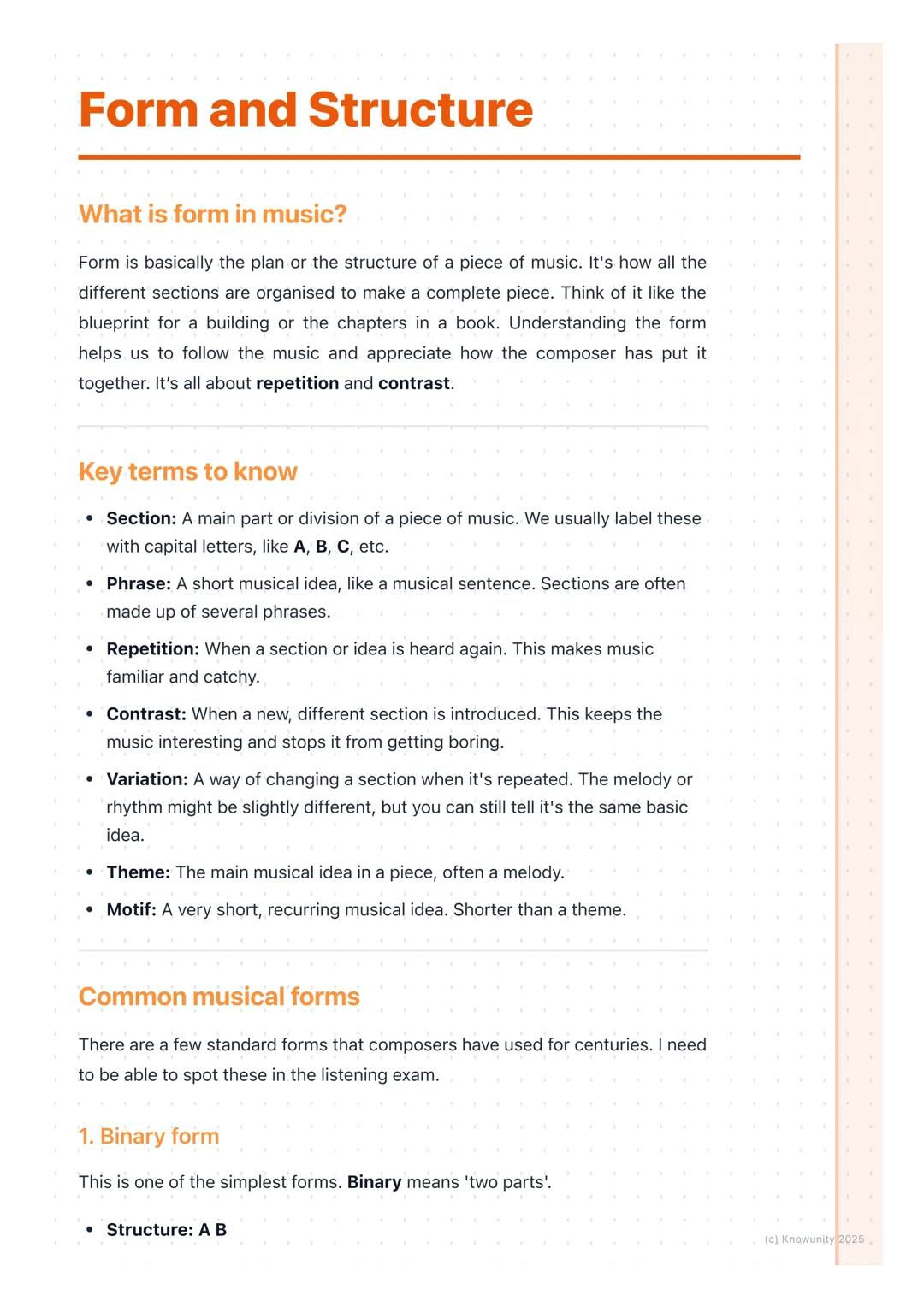
What is Form in Music?
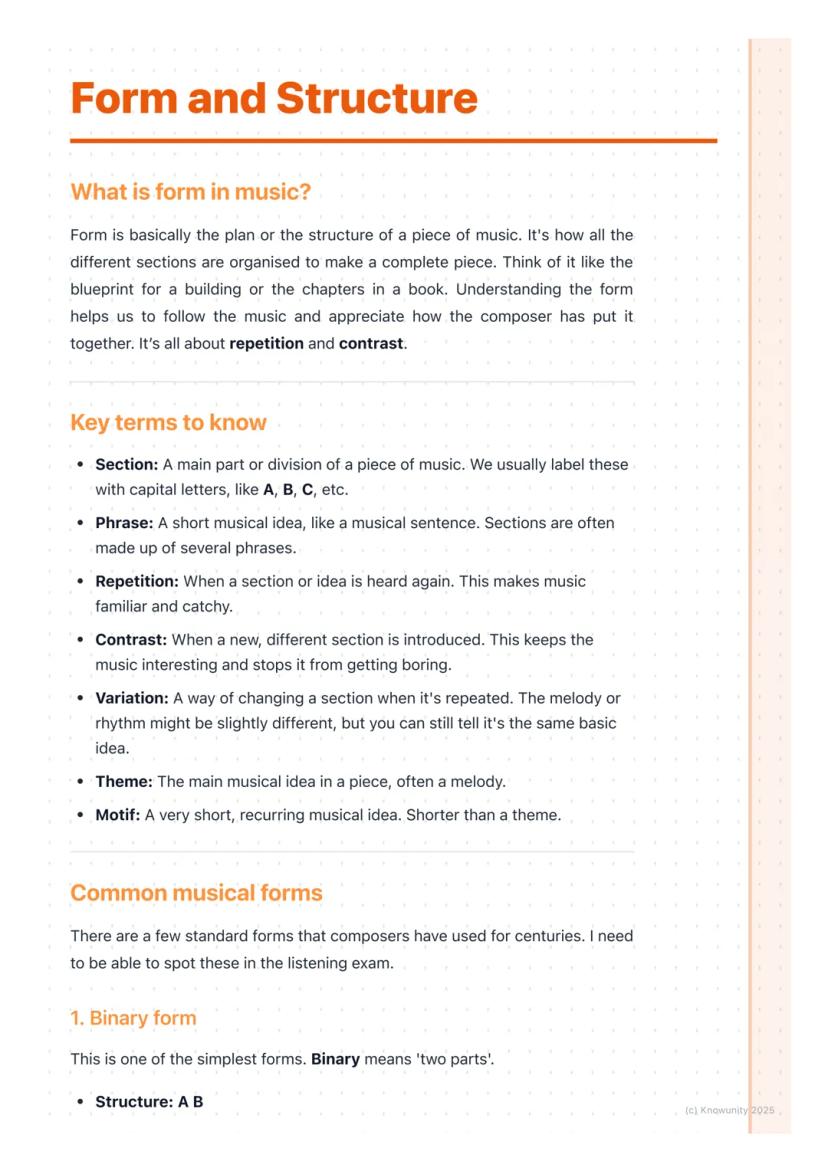
Think of form as the skeleton of a song - it's how composers organise different sections to create a complete piece. Just like a good story needs a beginning, middle, and end, music needs structure to make sense and keep you engaged.
Form works through two main principles: repetition (bringing back familiar bits) and contrast (introducing new sections). This balance keeps music both memorable and interesting - too much repetition gets boring, whilst too much contrast becomes confusing.
The building blocks are simple: sections (the main parts, labelled A, B, C), phrases (short musical sentences), and themes (the main melodies you remember). Master these basics, and you'll crack any listening exam question about structure.
Quick Tip: In exams, always listen for when the music changes significantly - that's usually where one section ends and another begins!
2
of 5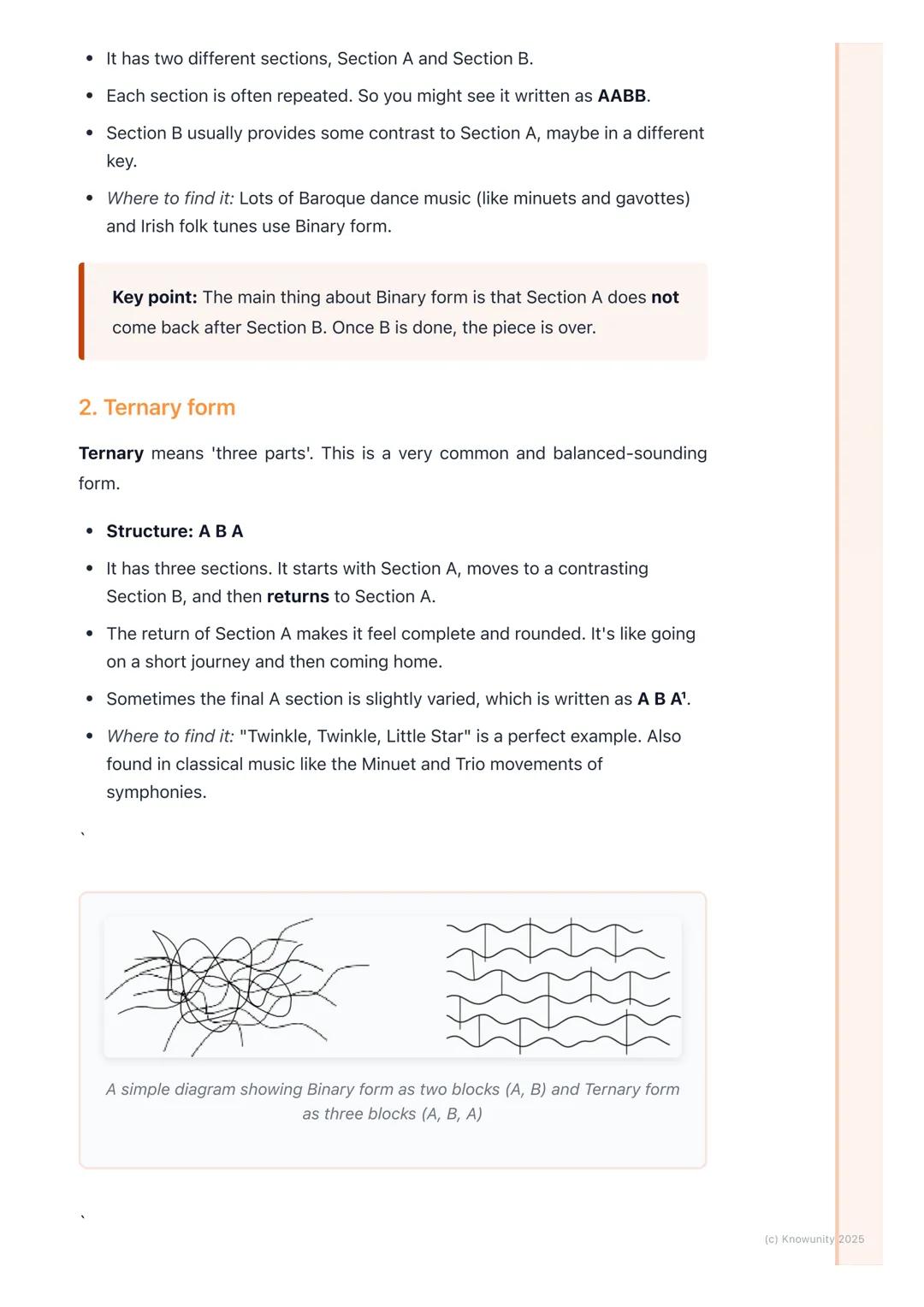
Binary and Ternary Forms
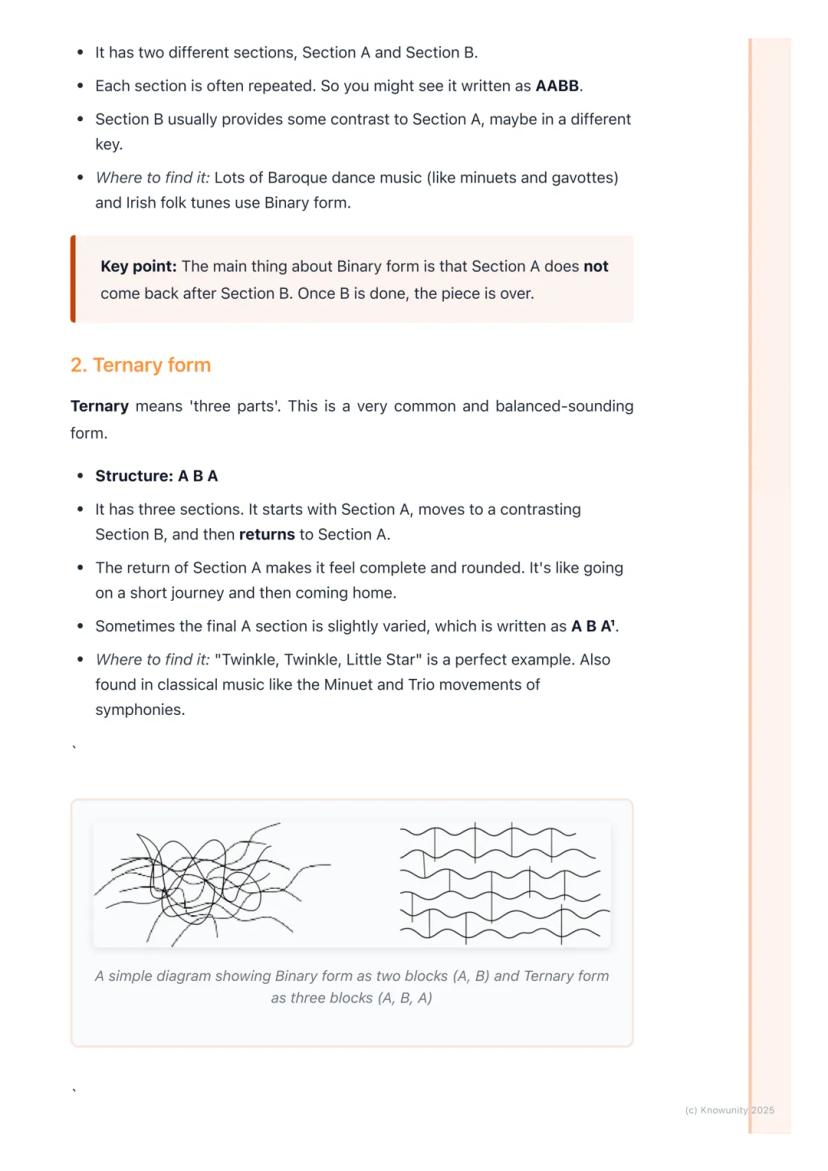
Binary form is dead simple - it's just two contrasting sections (A B). Think of it like a question and answer: Section A sets up an idea, Section B responds with something different, then it's over. You'll often hear each section repeated, making it A A B B.
Ternary form follows the classic journey structure: home, away, home again (A B A). "Twinkle, Twinkle, Little Star" is the perfect example - same melody at the start and end, with a contrasting middle bit. This form feels naturally satisfying because it brings you back to familiar territory.
The key difference? Binary never returns to the opening section, whilst ternary always does. In your listening exam, ask yourself: "Does the opening melody come back at the end?" If yes, it's ternary; if no, it's binary.
Exam Hack: Hum the first melody you hear, then listen for it returning later - instant ternary form identification!
3
of 5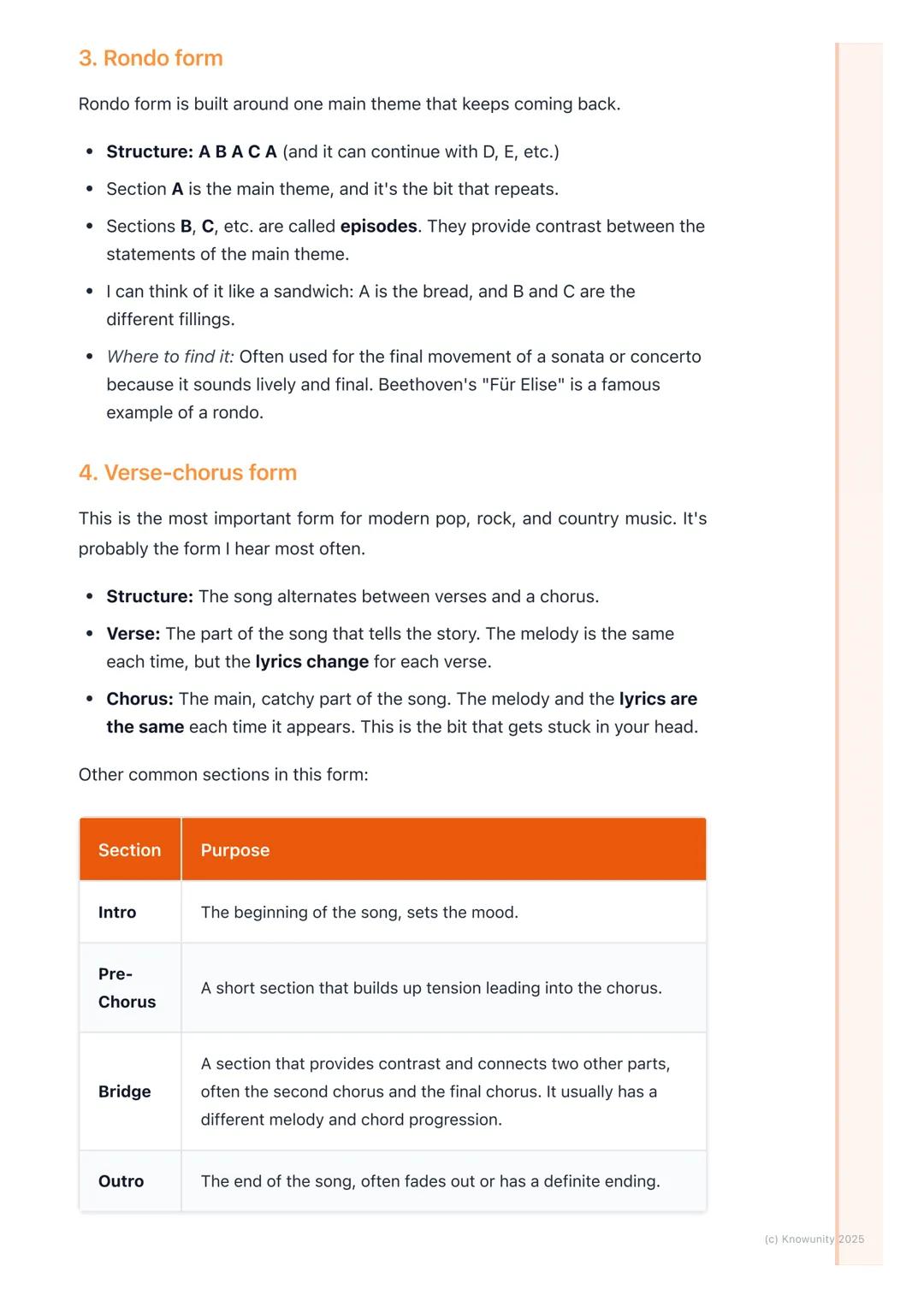
Pop Song Structures and Analysis
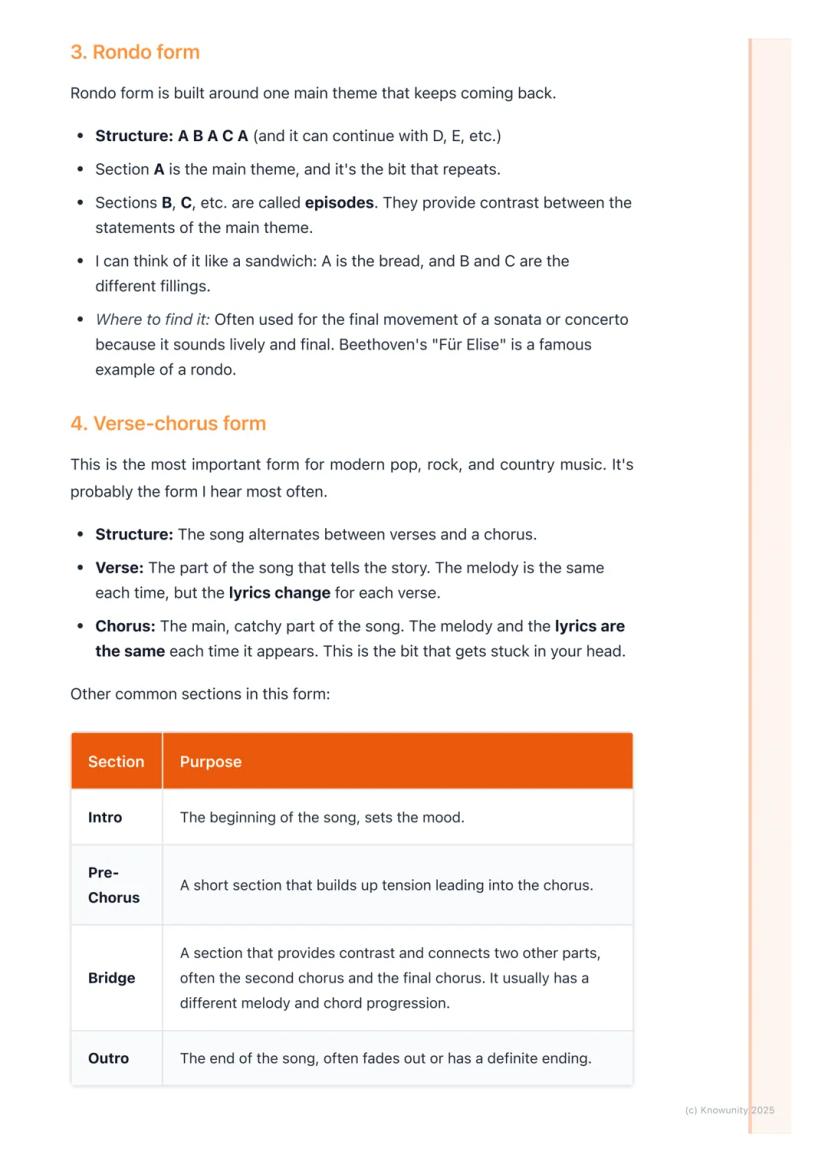
Most pop songs follow verse-chorus form, which is basically verses alternating with a chorus (the catchy, repeated hook). Add an intro, maybe a bridge, and an outro, and you've got your typical chart hit.
When analysing any piece, start by listening to the whole thing first - get the big picture. Then focus on the melody and lyrics (if there are any). Same tune with different words? That's repetition with variation. Completely new melody? That's a new section.
For "Castle on the Hill" by Ed Sheeran, you'd spot the storytelling verses ("When I was six years old..."), the soaring chorus ("I'm on my way..."), and the bridge that breaks things up before the final chorus. Each serves a different purpose in the song's emotional journey.
Pro Tip: Practise with songs you know well - it's much easier to spot structural changes when you're familiar with the music!
4
of 5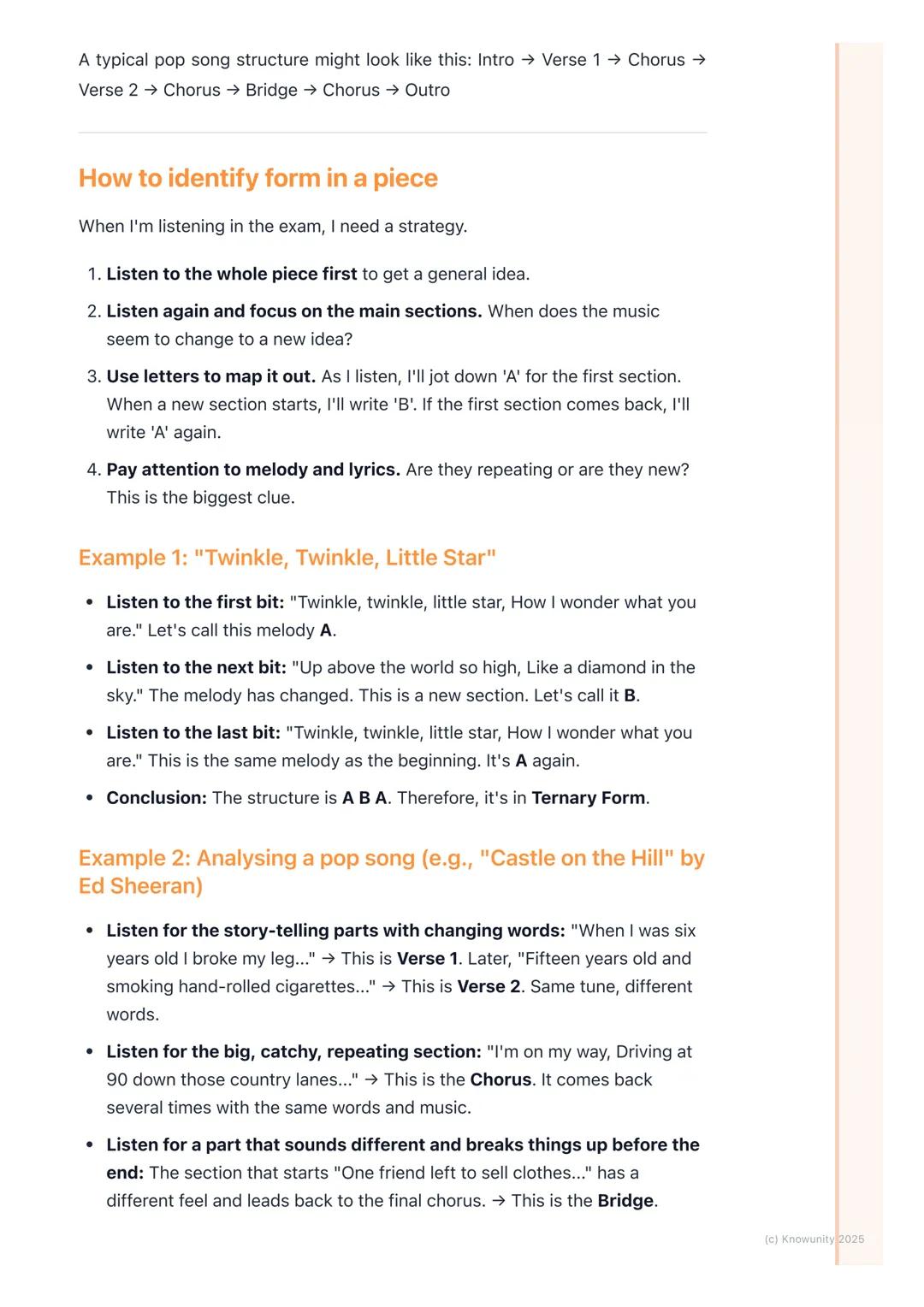
Exam Success Strategies
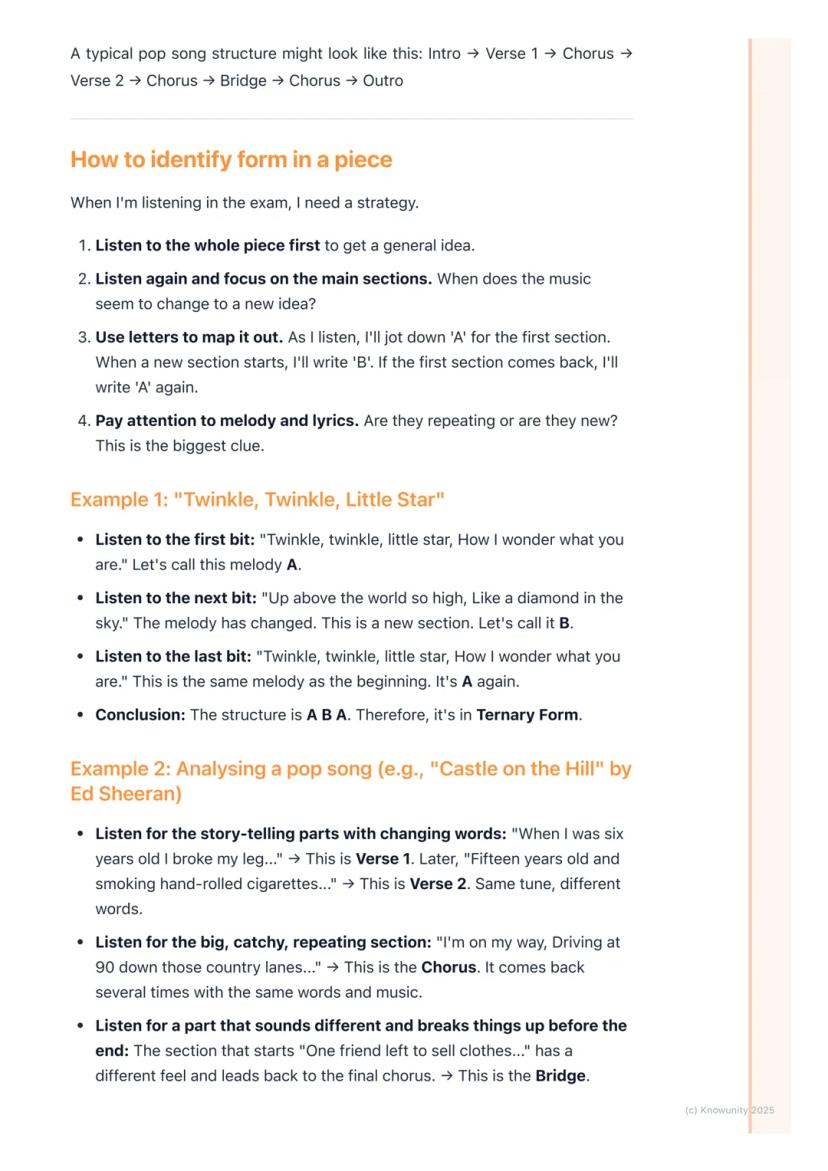
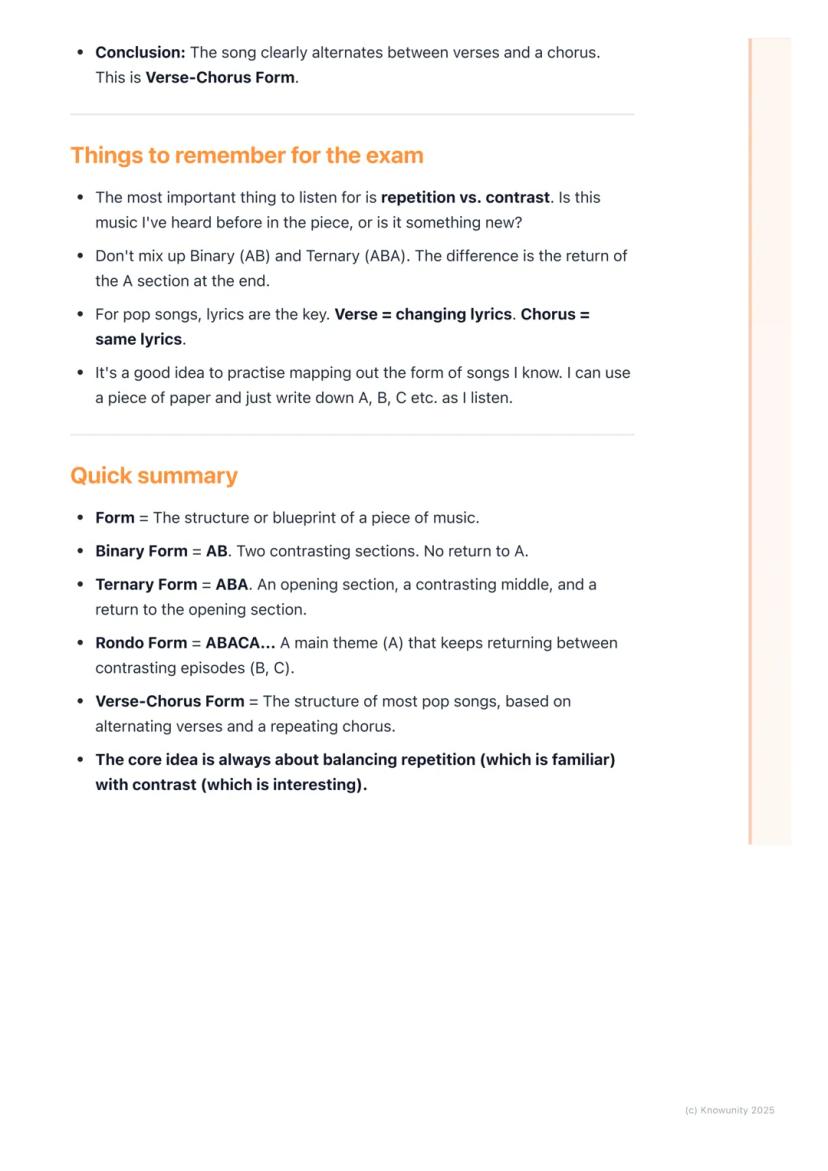
The golden rule for identifying form is simple: listen for repetition versus contrast. When you hear music you've heard before in the piece, it's repetition. When something sounds completely new, it's contrast.
Never confuse binary with ternary . For pop songs, lyrics are your best friend - verses change their words but keep similar melodies, whilst the chorus stays exactly the same each time.
Practice makes perfect, so grab some paper and map out songs you love using letters (A, B, C). Start with simple pieces like nursery rhymes, then work up to complex pop songs or classical pieces.
Remember, form is all about balance - composers mix the familiar (repetition) with the surprising (contrast) to create music that's both memorable and engaging. Once you understand this basic principle, you'll never struggle with structural analysis again.
Final Exam Tip: If you're stuck between two forms, trust your instincts about what sounds familiar versus what sounds new - your ears rarely lie!
5
of 5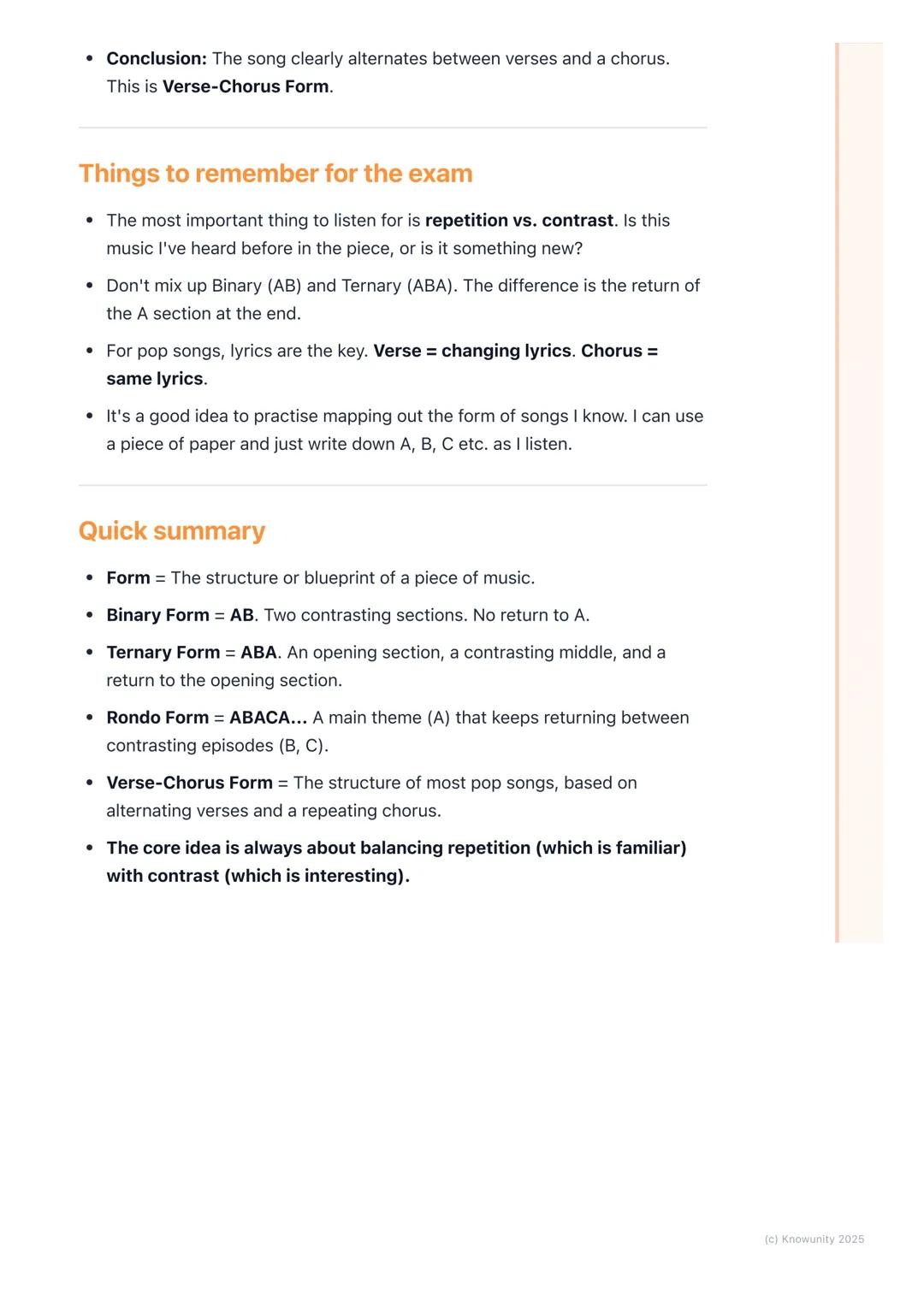
Si on te demande...
Qu'est-ce que le compagnon IA de Knowunity ?
Notre compagnon IA est spécialement conçu pour répondre aux besoins des étudiants. Sur la base des millions d'éléments de contenu que nous avons sur la plateforme, nous pouvons fournir des réponses vraiment significatives et pertinentes aux étudiants. Mais il ne s'agit pas seulement de réponses, le compagnon a encore plus pour but de guider les élèves dans leurs défis d'apprentissage quotidiens, avec des plans d'étude personnalisés, des quiz ou des éléments de contenu dans le chat et une personnalisation à 100% basée sur les compétences et les développements de l'étudiant.
Où puis-je télécharger l'appli Knowunity ?
Tu peux télécharger l'application dans Google Play Store et dans l'App Store d'Apple.
L'application est-elle vraiment gratuite ?
Oui, tu as un accès entièrement gratuit à tous les contenus de l'appli, tu peux chatter ou suivre les créateurs à tout moment. De plus, nous proposons Knowunity Premium, qui te permet de réviser sans limites!
Contenus les plus populaires en Music
2MusicRhythm and Beat
Students will explore the steady pulse (beat) and the patterns of sounds and silences (rhythm) in music, including tempo (speed) and duration of notes.
1st Year50
MusicSean-nós singing
Main aspects of this Irish essay into bulkier material (may need to add a little more content, otherwise great for studying)
5th Year51
Contenus les plus populaires
9 Irish
IrishIrish oral questions and answers
Questions and answers for the leaving cert oral
5th Year4264
 English
Key Quotes : Sive
Key Quotes and explanations: Sive
6th Year2842
IrishIrish oral questions
Outline of oral questions
5th Year2055
IrishIníon- le hÁine Durkin
Aine Durkin’s poem, Iníon: Themes & summary
5th Year850
IrishIrish poetry 2027
Iníon + Dínit an Bhróin
5th Year1133
IrishLC HL notes- Iníon (poem)
Includes poem in English and Irish, theme, key words & phrases
5th Year2284
EnglishCultural Context : Shawshank Redemption : Sive : Small Things Like These
Comparative Study : Cultural Context : Shawshank Redemption, Sive and Small Things Like These
6th Year1430
IrishMo Ghrá-sa (Idir Lúibíní)
Notes on mo ghrá-sa
5th Year380
IrishAn Gaeilge Aiste
Irish Language essay
6th Year1320
Rien ne te convient ? Explore d'autres matières.
Les étudiants nous adorent — il ne manque plus que toi.
4.6/5App Store
4.7/5Google Play
L'application est très facile d'utilisation et bien conçue. Jusqu'à présent, j'ai trouvé tout ce que je cherchais et j'ai pu apprendre beaucoup de choses grâce aux présentations ! Je vais certainement utiliser l'application pour un travail en classe ! Et comme source d'inspiration personnelle, elle est bien sûr aussi très utile.
Stefan Sutilisateur iOS
Cette application est vraiment super. Il y a tellement de fiches de révision et d'aide, [...]. Par exemple, la matière qui me pose problème est le français et l'appli a un choix d'aide très large. Grâce à cette application, je me suis améliorée en français. Je la recommanderais à tout le monde.
Samantha Klichutilisatrice Android
Waouh, je suis vraiment abasourdi. J'ai essayé l'application parce que je l'avais déjà vue plusieurs fois dans la publicité et j'ai été absolument choquée. Cette appli est L'AIDE dont on rêve pour l'école et surtout, elle propose tellement de choses, comme des rédactions et des fiches qui m'ont personnellement TRÈS bien aidé.
Annautilisatrice iOS
Music4 vues·Mis à jour Jun 15, 2026·5 pagesUnderstanding Musical Forms and Structures
Ever wondered why your favourite songs feel so catchy and well-organised? It's all down to form- the blueprint that holds every piece of music together. Understanding musical form is like having a map that helps you navigate through any...
1
of 5
Inscris-toi pour voir le contenu. C'est gratuit!
- Accès à tous les documents
- Améliore tes notes
- Rejoins des millions d'étudiants
What is Form in Music?
Think of form as the skeleton of a song - it's how composers organise different sections to create a complete piece. Just like a good story needs a beginning, middle, and end, music needs structure to make sense and keep you engaged.
Form works through two main principles: repetition (bringing back familiar bits) and contrast (introducing new sections). This balance keeps music both memorable and interesting - too much repetition gets boring, whilst too much contrast becomes confusing.
The building blocks are simple: sections (the main parts, labelled A, B, C), phrases (short musical sentences), and themes (the main melodies you remember). Master these basics, and you'll crack any listening exam question about structure.
Quick Tip: In exams, always listen for when the music changes significantly - that's usually where one section ends and another begins!
2
of 5Inscris-toi pour voir le contenu. C'est gratuit!
- Accès à tous les documents
- Améliore tes notes
- Rejoins des millions d'étudiants
Binary and Ternary Forms
Binary form is dead simple - it's just two contrasting sections (A B). Think of it like a question and answer: Section A sets up an idea, Section B responds with something different, then it's over. You'll often hear each section repeated, making it A A B B.
Ternary form follows the classic journey structure: home, away, home again (A B A). "Twinkle, Twinkle, Little Star" is the perfect example - same melody at the start and end, with a contrasting middle bit. This form feels naturally satisfying because it brings you back to familiar territory.
The key difference? Binary never returns to the opening section, whilst ternary always does. In your listening exam, ask yourself: "Does the opening melody come back at the end?" If yes, it's ternary; if no, it's binary.
Exam Hack: Hum the first melody you hear, then listen for it returning later - instant ternary form identification!
3
of 5Inscris-toi pour voir le contenu. C'est gratuit!
- Accès à tous les documents
- Améliore tes notes
- Rejoins des millions d'étudiants
Pop Song Structures and Analysis
Most pop songs follow verse-chorus form, which is basically verses alternating with a chorus (the catchy, repeated hook). Add an intro, maybe a bridge, and an outro, and you've got your typical chart hit.
When analysing any piece, start by listening to the whole thing first - get the big picture. Then focus on the melody and lyrics (if there are any). Same tune with different words? That's repetition with variation. Completely new melody? That's a new section.
For "Castle on the Hill" by Ed Sheeran, you'd spot the storytelling verses ("When I was six years old..."), the soaring chorus ("I'm on my way..."), and the bridge that breaks things up before the final chorus. Each serves a different purpose in the song's emotional journey.
Pro Tip: Practise with songs you know well - it's much easier to spot structural changes when you're familiar with the music!
4
of 5Inscris-toi pour voir le contenu. C'est gratuit!
- Accès à tous les documents
- Améliore tes notes
- Rejoins des millions d'étudiants
Exam Success Strategies
The golden rule for identifying form is simple: listen for repetition versus contrast. When you hear music you've heard before in the piece, it's repetition. When something sounds completely new, it's contrast.
Never confuse binary with ternary . For pop songs, lyrics are your best friend - verses change their words but keep similar melodies, whilst the chorus stays exactly the same each time.
Practice makes perfect, so grab some paper and map out songs you love using letters (A, B, C). Start with simple pieces like nursery rhymes, then work up to complex pop songs or classical pieces.
Remember, form is all about balance - composers mix the familiar (repetition) with the surprising (contrast) to create music that's both memorable and engaging. Once you understand this basic principle, you'll never struggle with structural analysis again.
Final Exam Tip: If you're stuck between two forms, trust your instincts about what sounds familiar versus what sounds new - your ears rarely lie!
5
of 5Inscris-toi pour voir le contenu. C'est gratuit!
- Accès à tous les documents
- Améliore tes notes
- Rejoins des millions d'étudiants
Si on te demande...
Qu'est-ce que le compagnon IA de Knowunity ?
Notre compagnon IA est spécialement conçu pour répondre aux besoins des étudiants. Sur la base des millions d'éléments de contenu que nous avons sur la plateforme, nous pouvons fournir des réponses vraiment significatives et pertinentes aux étudiants. Mais il ne s'agit pas seulement de réponses, le compagnon a encore plus pour but de guider les élèves dans leurs défis d'apprentissage quotidiens, avec des plans d'étude personnalisés, des quiz ou des éléments de contenu dans le chat et une personnalisation à 100% basée sur les compétences et les développements de l'étudiant.
Où puis-je télécharger l'appli Knowunity ?
Tu peux télécharger l'application dans Google Play Store et dans l'App Store d'Apple.
L'application est-elle vraiment gratuite ?
Oui, tu as un accès entièrement gratuit à tous les contenus de l'appli, tu peux chatter ou suivre les créateurs à tout moment. De plus, nous proposons Knowunity Premium, qui te permet de réviser sans limites!
Contenus les plus populaires en Music
2MusicRhythm and Beat
Students will explore the steady pulse (beat) and the patterns of sounds and silences (rhythm) in music, including tempo (speed) and duration of notes.
1st Year50
MusicSean-nós singing
Main aspects of this Irish essay into bulkier material (may need to add a little more content, otherwise great for studying)
5th Year51
Contenus les plus populaires
9IrishIrish oral questions and answers
Questions and answers for the leaving cert oral
5th Year4264
EnglishKey Quotes : Sive
Key Quotes and explanations: Sive
6th Year2842
IrishIrish oral questions
Outline of oral questions
5th Year2055
IrishIníon- le hÁine Durkin
Aine Durkin’s poem, Iníon: Themes & summary
5th Year850
IrishIrish poetry 2027
Iníon + Dínit an Bhróin
5th Year1133
IrishLC HL notes- Iníon (poem)
Includes poem in English and Irish, theme, key words & phrases
5th Year2284
EnglishCultural Context : Shawshank Redemption : Sive : Small Things Like These
Comparative Study : Cultural Context : Shawshank Redemption, Sive and Small Things Like These
6th Year1430
IrishMo Ghrá-sa (Idir Lúibíní)
Notes on mo ghrá-sa
5th Year380
IrishAn Gaeilge Aiste
Irish Language essay
6th Year1320
Rien ne te convient ? Explore d'autres matières.
Les étudiants nous adorent — il ne manque plus que toi.
4.6/5App Store
4.7/5Google Play
L'application est très facile d'utilisation et bien conçue. Jusqu'à présent, j'ai trouvé tout ce que je cherchais et j'ai pu apprendre beaucoup de choses grâce aux présentations ! Je vais certainement utiliser l'application pour un travail en classe ! Et comme source d'inspiration personnelle, elle est bien sûr aussi très utile.
Stefan Sutilisateur iOS
Cette application est vraiment super. Il y a tellement de fiches de révision et d'aide, [...]. Par exemple, la matière qui me pose problème est le français et l'appli a un choix d'aide très large. Grâce à cette application, je me suis améliorée en français. Je la recommanderais à tout le monde.
Samantha Klichutilisatrice Android
Waouh, je suis vraiment abasourdi. J'ai essayé l'application parce que je l'avais déjà vue plusieurs fois dans la publicité et j'ai été absolument choquée. Cette appli est L'AIDE dont on rêve pour l'école et surtout, elle propose tellement de choses, comme des rédactions et des fiches qui m'ont personnellement TRÈS bien aidé.
Annautilisatrice iOS