
Irish traditional music, or "trad" music, is the heartbeat of... Affiche plus
 Music2 vues·Mis à jour Jun 4, 2026·5 pages
Exploring Irish Traditional Music: Instruments, Forms, and Culture
1 / 5
1
of 5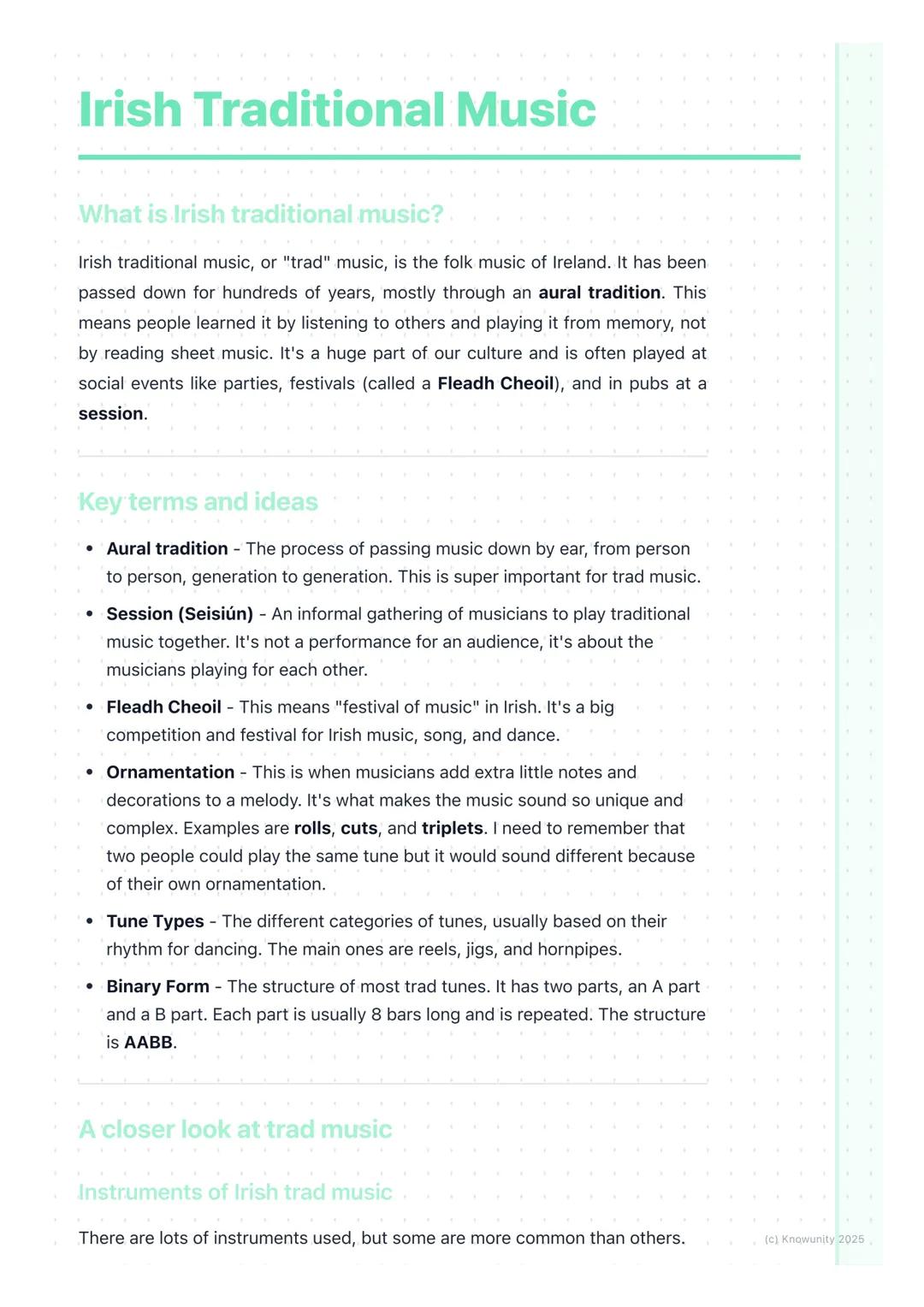
What is Irish Traditional Music?
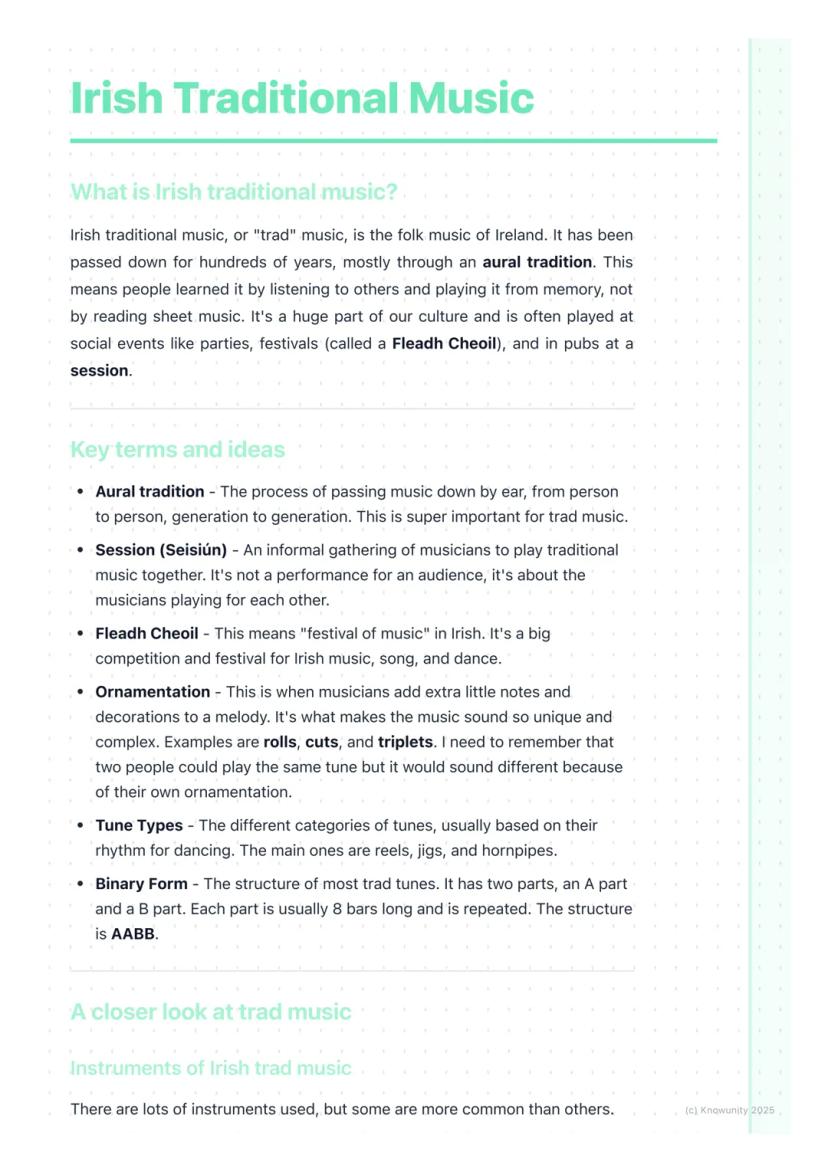
Ever wondered why Irish music sounds so distinctive and alive? Irish traditional music has survived for centuries through something called aural tradition - meaning people learned tunes by listening and playing from memory rather than reading sheet music. This creates a personal connection between musicians that you can actually hear in the music.
You'll encounter this music everywhere in Ireland, from informal sessions in pubs where musicians gather to play together, to massive Fleadh Cheoil festivals that celebrate Irish culture. These aren't performances for audiences - they're musicians playing for the pure joy of it.
The magic happens through ornamentation - those little decorative notes like rolls, cuts, and triplets that make each musician's version unique. Two people can play the same tune, but it'll sound completely different because of their personal ornamental style.
💡 Remember: Most Irish tunes follow binary form (AABB structure) - an A section and B section, each 8 bars long and repeated.
2
of 5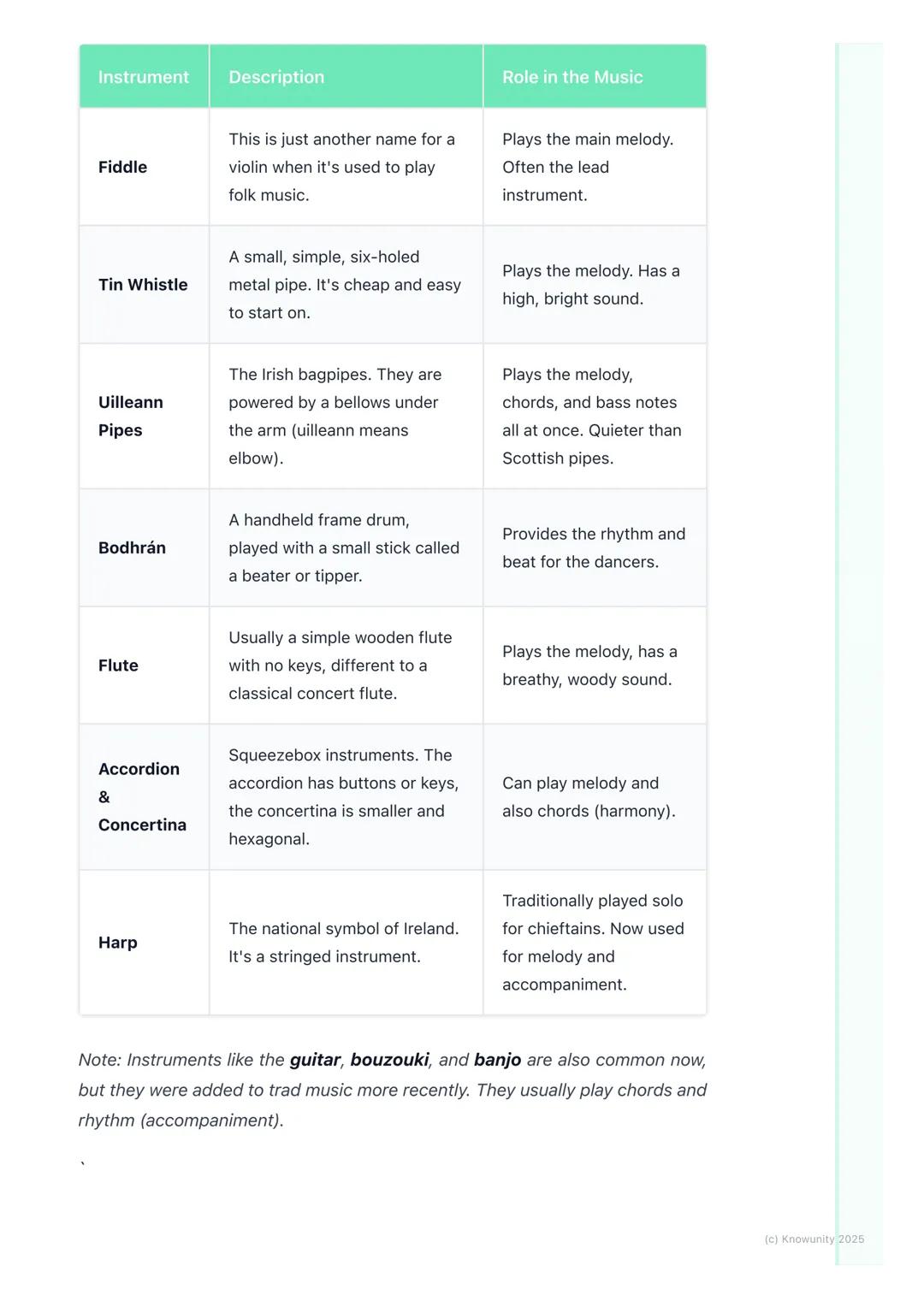
Traditional Irish Instruments
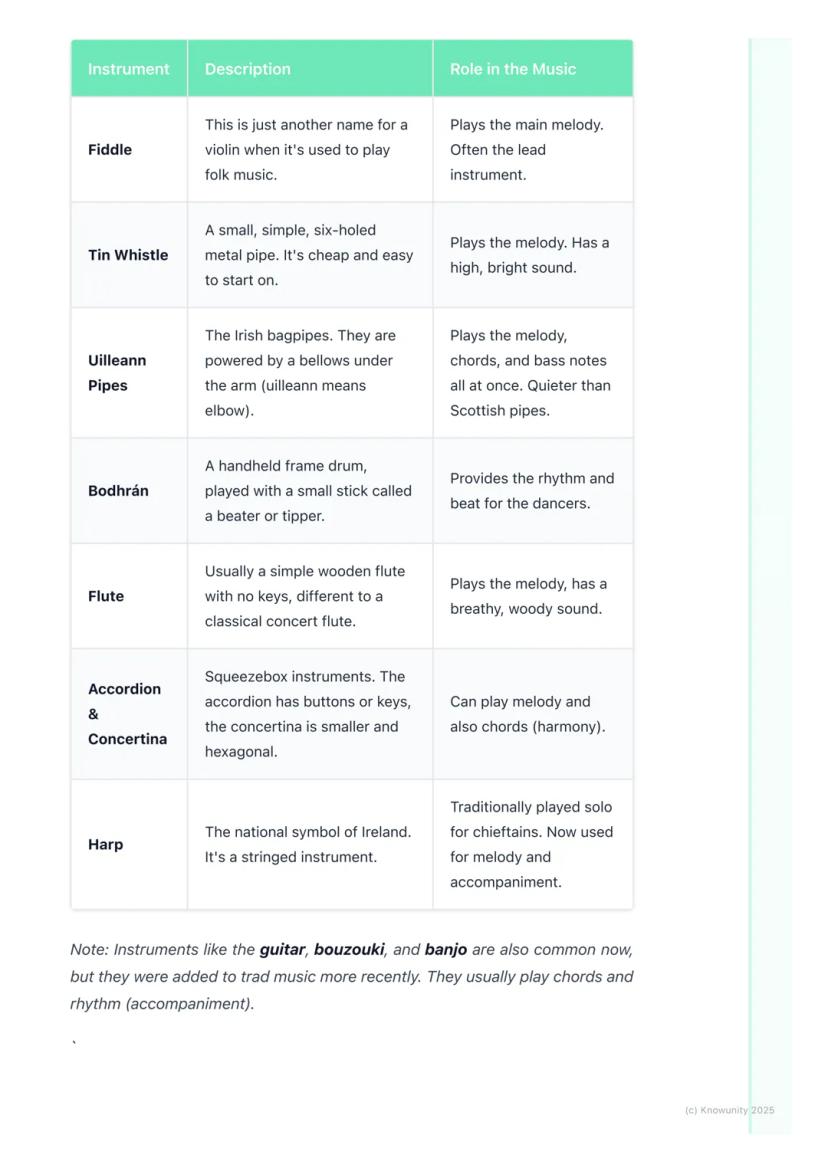
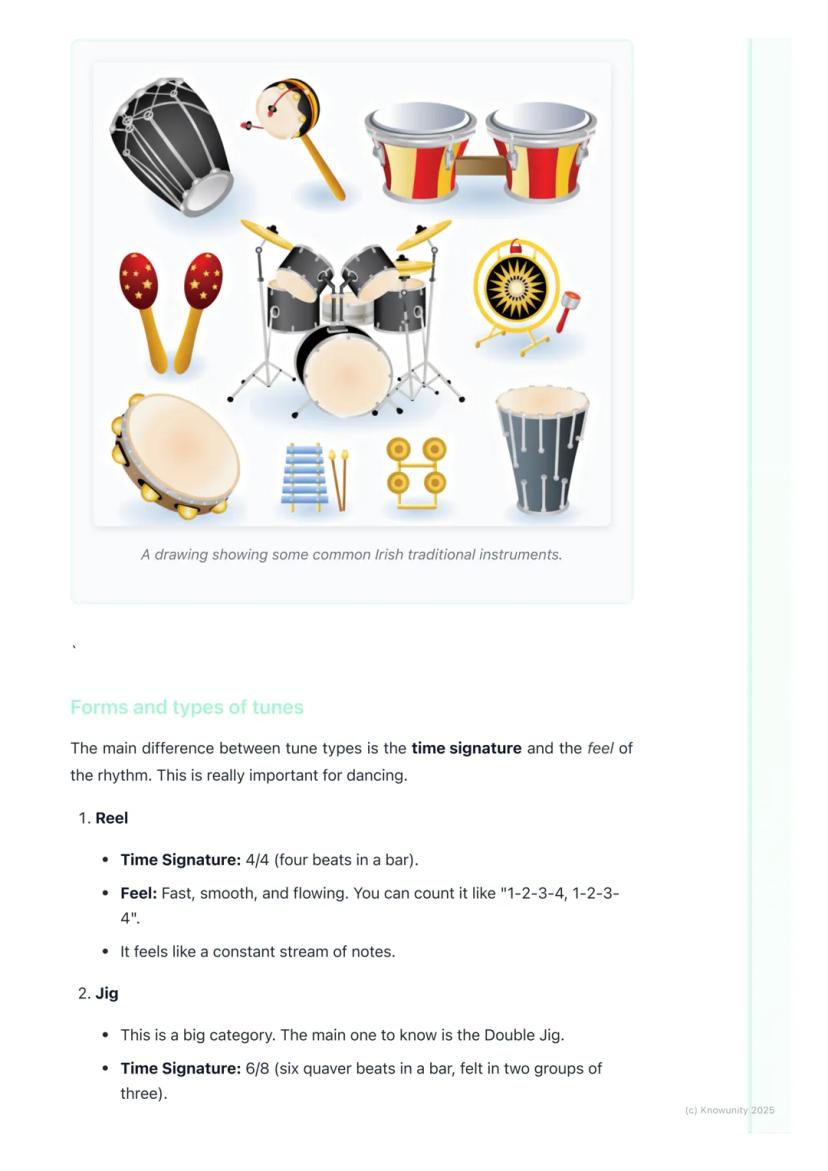
The fiddle (which is just a violin playing folk music) often leads the melody with its expressive, singing tone. For beginners, the tin whistle is brilliant - it's cheap, portable, and produces that bright, piercing sound you hear in Irish music.
Uilleann pipes are Ireland's answer to bagpipes, but they're powered by bellows under your arm (uilleann means "elbow") rather than breath. They're much quieter than Scottish pipes and can play melody, harmony, and bass all at once. The bodhrán provides the driving rhythm that gets dancers moving.
Traditional melody instruments also include wooden flutes and accordions or concertinas. The harp, Ireland's national symbol, was historically played for chieftains but now fits into modern sessions too.
💡 Quick tip: Instruments like guitar and banjo were added later for accompaniment - they're common now but aren't originally Irish.
3
of 5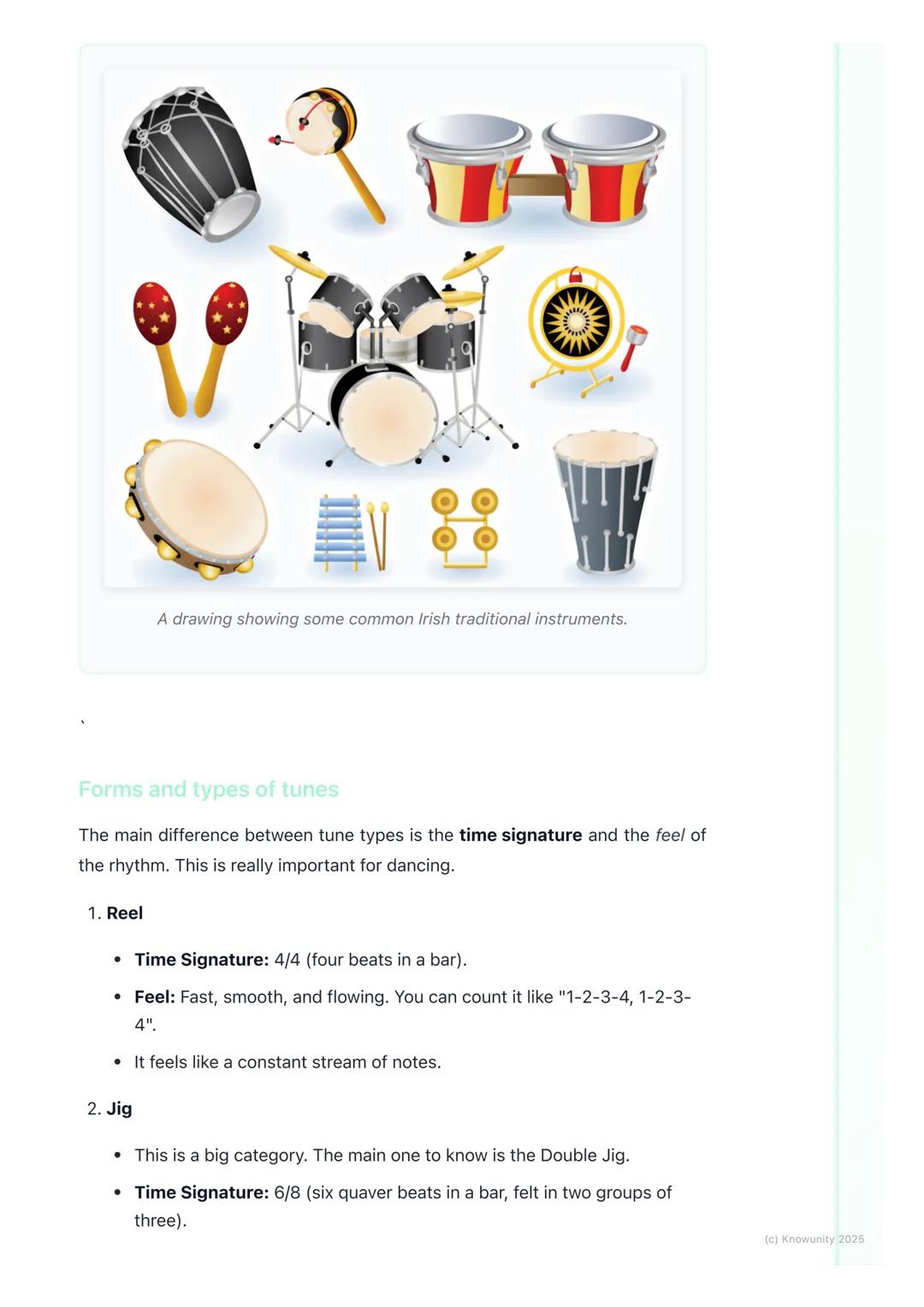
Understanding Tune Types
Learning to recognise different tune types is crucial because they determine how people dance. The rhythm and time signature completely change the feel of the music.
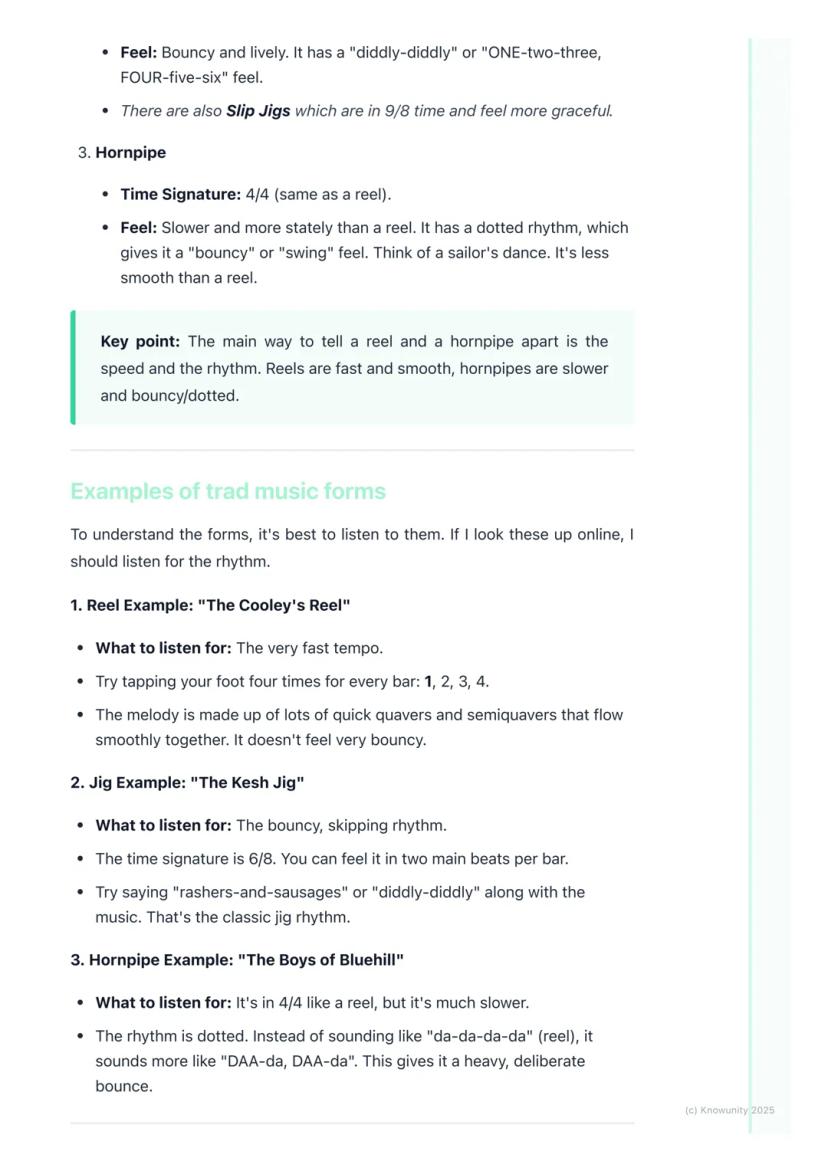
Reels are in 4/4 time and feel fast, smooth, and flowing like a constant stream of notes. Count "1-2-3-4" and tap your foot - that's a reel's steady pulse. They're probably the most common type you'll hear.
Jigs are the bouncy ones in 6/8 time that make you want to skip. The classic double jig has that "diddly-diddly" or "ONE-two-three, FOUR-five-six" feel. There are also slip jigs in 9/8 time that feel more graceful and flowing.
💡 Listen for: "The Cooley's Reel" and "The Kesh Jig" online to hear the difference - your ears will pick up the rhythmic patterns quickly.
4
of 5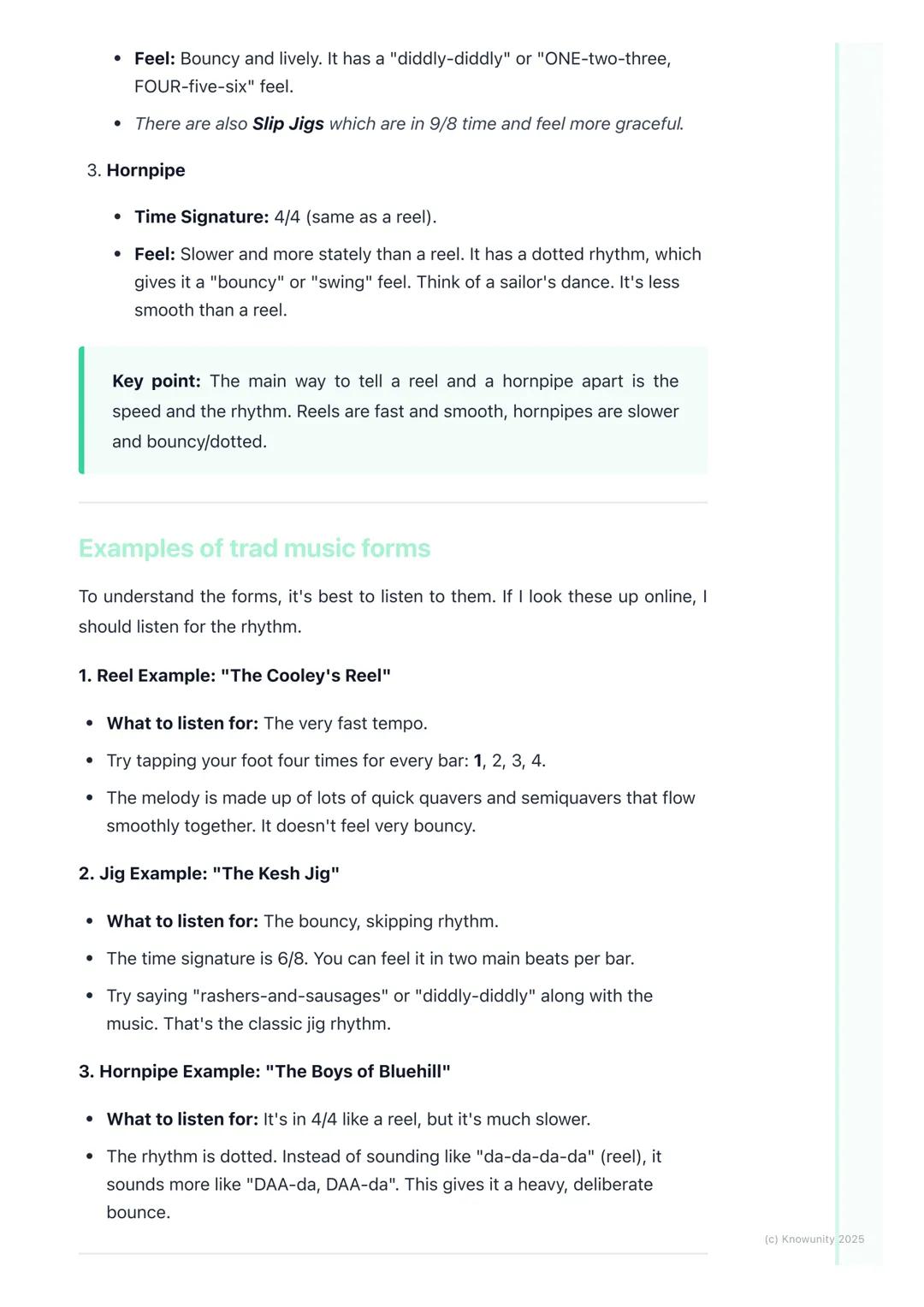
Hornpipes and Musical Examples
Hornpipes often confuse students because they're also in 4/4 like reels, but they're completely different in character. They're slower and have a dotted, bouncy rhythm that sounds like "DAA-da, DAA-da" instead of a reel's smooth "da-da-da-da". Think of a sailor's dance - deliberate and stately.
"The Boys of Bluehill" is a perfect hornpipe example. When you listen, notice how much heavier and more deliberate it sounds compared to a flowing reel. The dotted rhythms give it that characteristic swing feel.
The key difference between reels and hornpipes isn't just tempo - it's the entire rhythmic character. Reels flow like water, whilst hornpipes bounce with purpose.
💡 Exam tip: If you can distinguish between smooth flowing (reel) and bouncy dotted (hornpipe), you'll nail this topic in tests.
5
of 5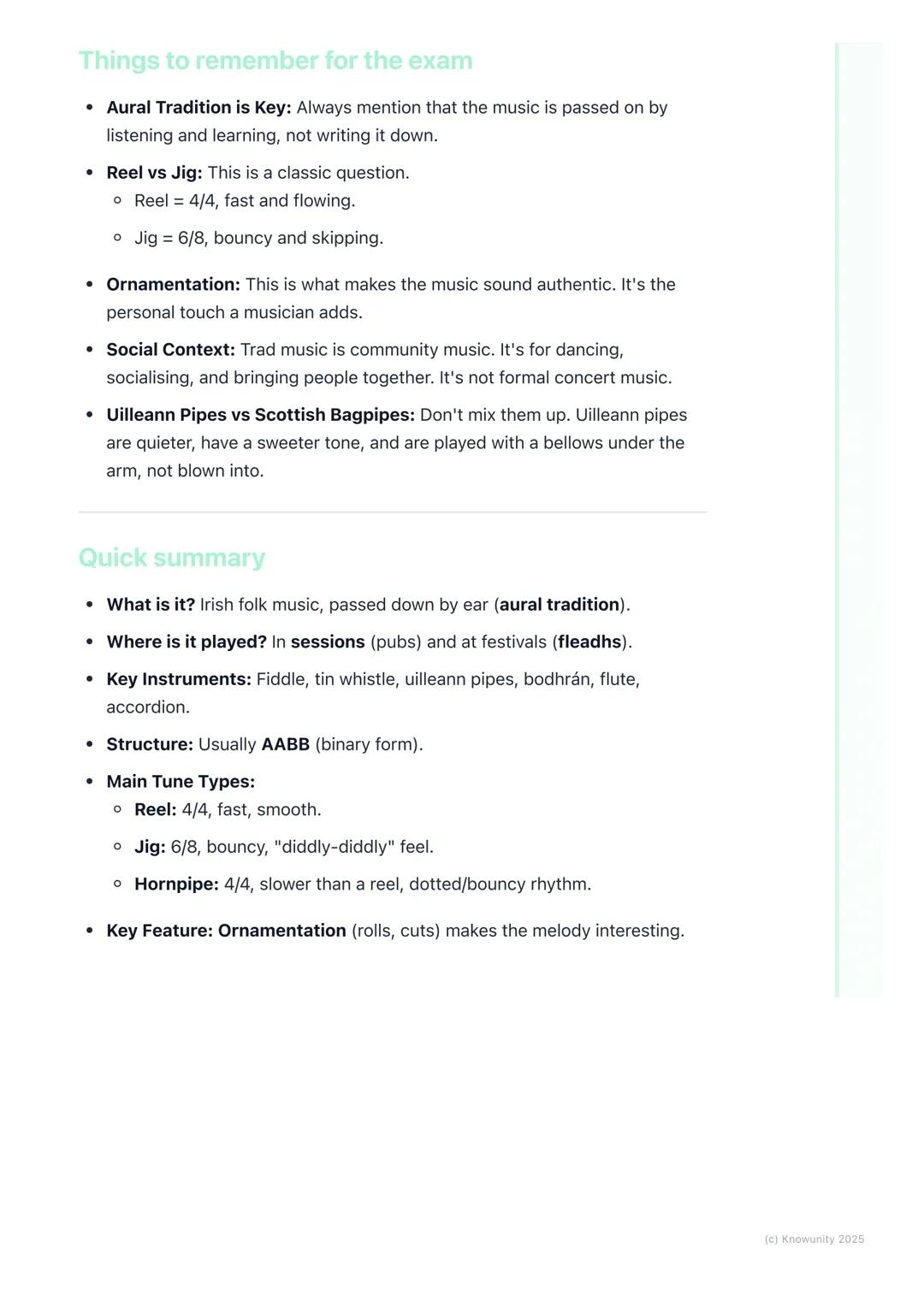
Key Points for Success
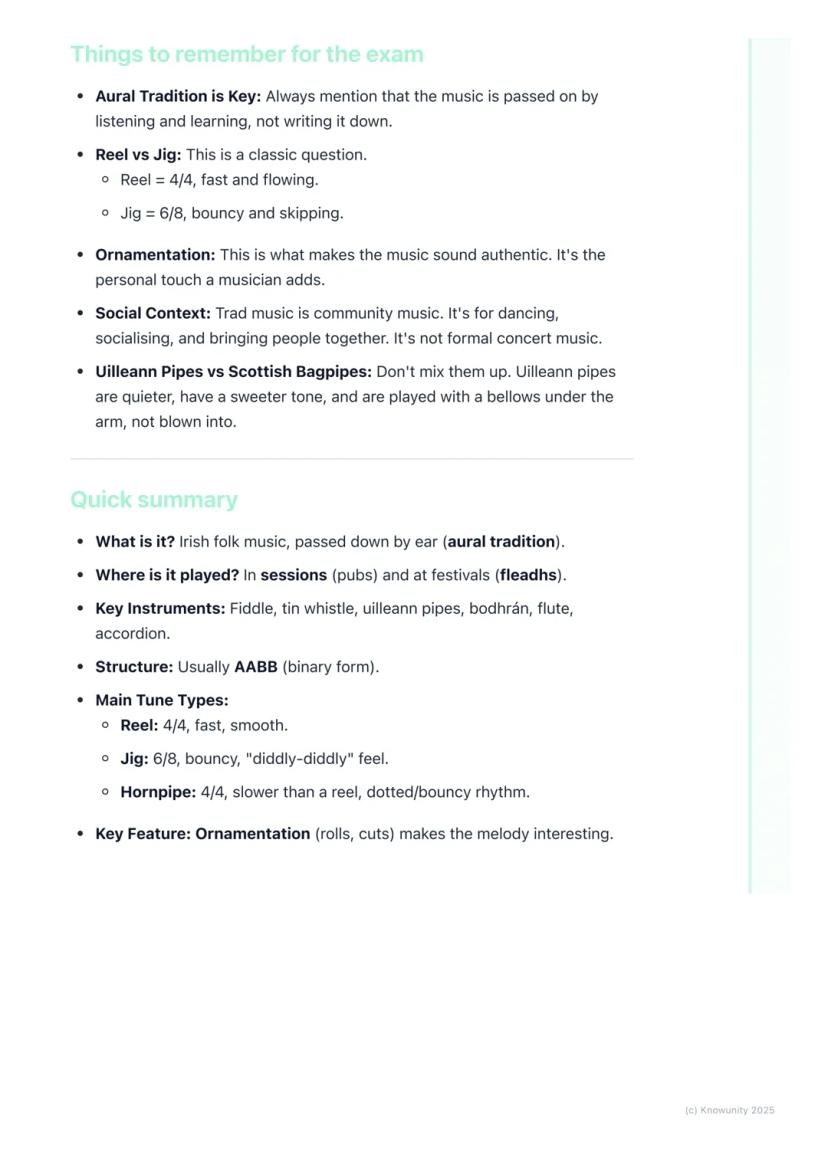
Aural tradition is the foundation of everything - always mention that this music lives through listening and learning by ear, not written notation. This creates the personal, intimate quality that makes Irish music so special.
Social context matters hugely. This isn't formal concert music - it's community music for dancing, socialising, and bringing people together. Sessions and fleadhs are where the tradition stays alive.
Ornamentation is what makes the music authentic and personal. It's how musicians add their own voice to ancient tunes, making each performance unique even when playing the same melody.
💡 Quick reference: Reel = 4/4 fast and smooth; Jig = 6/8 bouncy "diddly-diddly"; Hornpipe = 4/4 slower with dotted rhythm.
Remember that uilleann pipes are distinctly Irish - don't confuse them with Scottish bagpipes. They're quieter, sweeter, and use bellows instead of breath. Master these distinctions and you'll understand the heart of Irish traditional music.
Si on te demande...
Qu'est-ce que le compagnon IA de Knowunity ?
Notre compagnon IA est spécialement conçu pour répondre aux besoins des étudiants. Sur la base des millions d'éléments de contenu que nous avons sur la plateforme, nous pouvons fournir des réponses vraiment significatives et pertinentes aux étudiants. Mais il ne s'agit pas seulement de réponses, le compagnon a encore plus pour but de guider les élèves dans leurs défis d'apprentissage quotidiens, avec des plans d'étude personnalisés, des quiz ou des éléments de contenu dans le chat et une personnalisation à 100% basée sur les compétences et les développements de l'étudiant.
Où puis-je télécharger l'appli Knowunity ?
Tu peux télécharger l'application dans Google Play Store et dans l'App Store d'Apple.
L'application est-elle vraiment gratuite ?
Oui, tu as un accès entièrement gratuit à tous les contenus de l'appli, tu peux chatter ou suivre les créateurs à tout moment. De plus, nous proposons Knowunity Premium, qui te permet de réviser sans limites!
Contenus les plus populaires en Music
1Contenus les plus populaires
9Rien ne te convient ? Explore d'autres matières.
Les étudiants nous adorent — il ne manque plus que toi.
4.6/5App Store
4.7/5Google Play
L'application est très facile d'utilisation et bien conçue. Jusqu'à présent, j'ai trouvé tout ce que je cherchais et j'ai pu apprendre beaucoup de choses grâce aux présentations ! Je vais certainement utiliser l'application pour un travail en classe ! Et comme source d'inspiration personnelle, elle est bien sûr aussi très utile.
Stefan Sutilisateur iOS
Cette application est vraiment super. Il y a tellement de fiches de révision et d'aide, [...]. Par exemple, la matière qui me pose problème est le français et l'appli a un choix d'aide très large. Grâce à cette application, je me suis améliorée en français. Je la recommanderais à tout le monde.
Samantha Klichutilisatrice Android
Waouh, je suis vraiment abasourdi. J'ai essayé l'application parce que je l'avais déjà vue plusieurs fois dans la publicité et j'ai été absolument choquée. Cette appli est L'AIDE dont on rêve pour l'école et surtout, elle propose tellement de choses, comme des rédactions et des fiches qui m'ont personnellement TRÈS bien aidé.
Annautilisatrice iOS
Music2 vues·Mis à jour Jun 4, 2026·5 pagesExploring Irish Traditional Music: Instruments, Forms, and Culture
Irish traditional music, or "trad" music, is the heartbeat of Irish culture that's been passed down through generations by ear. This folk music isn't just entertainment - it's a living tradition that brings communities together in pubs, festivals, and social... Affiche plus
1
of 5Inscris-toi pour voir le contenu. C'est gratuit!
- Accès à tous les documents
- Améliore tes notes
- Rejoins des millions d'étudiants
What is Irish Traditional Music?
Ever wondered why Irish music sounds so distinctive and alive? Irish traditional music has survived for centuries through something called aural tradition - meaning people learned tunes by listening and playing from memory rather than reading sheet music. This creates a personal connection between musicians that you can actually hear in the music.
You'll encounter this music everywhere in Ireland, from informal sessions in pubs where musicians gather to play together, to massive Fleadh Cheoil festivals that celebrate Irish culture. These aren't performances for audiences - they're musicians playing for the pure joy of it.
The magic happens through ornamentation - those little decorative notes like rolls, cuts, and triplets that make each musician's version unique. Two people can play the same tune, but it'll sound completely different because of their personal ornamental style.
💡 Remember: Most Irish tunes follow binary form (AABB structure) - an A section and B section, each 8 bars long and repeated.
2
of 5Inscris-toi pour voir le contenu. C'est gratuit!
- Accès à tous les documents
- Améliore tes notes
- Rejoins des millions d'étudiants
Traditional Irish Instruments
The fiddle (which is just a violin playing folk music) often leads the melody with its expressive, singing tone. For beginners, the tin whistle is brilliant - it's cheap, portable, and produces that bright, piercing sound you hear in Irish music.
Uilleann pipes are Ireland's answer to bagpipes, but they're powered by bellows under your arm (uilleann means "elbow") rather than breath. They're much quieter than Scottish pipes and can play melody, harmony, and bass all at once. The bodhrán provides the driving rhythm that gets dancers moving.
Traditional melody instruments also include wooden flutes and accordions or concertinas. The harp, Ireland's national symbol, was historically played for chieftains but now fits into modern sessions too.
💡 Quick tip: Instruments like guitar and banjo were added later for accompaniment - they're common now but aren't originally Irish.
3
of 5Inscris-toi pour voir le contenu. C'est gratuit!
- Accès à tous les documents
- Améliore tes notes
- Rejoins des millions d'étudiants
Understanding Tune Types
Learning to recognise different tune types is crucial because they determine how people dance. The rhythm and time signature completely change the feel of the music.
Reels are in 4/4 time and feel fast, smooth, and flowing like a constant stream of notes. Count "1-2-3-4" and tap your foot - that's a reel's steady pulse. They're probably the most common type you'll hear.
Jigs are the bouncy ones in 6/8 time that make you want to skip. The classic double jig has that "diddly-diddly" or "ONE-two-three, FOUR-five-six" feel. There are also slip jigs in 9/8 time that feel more graceful and flowing.
💡 Listen for: "The Cooley's Reel" and "The Kesh Jig" online to hear the difference - your ears will pick up the rhythmic patterns quickly.
4
of 5Inscris-toi pour voir le contenu. C'est gratuit!
- Accès à tous les documents
- Améliore tes notes
- Rejoins des millions d'étudiants
Hornpipes and Musical Examples
Hornpipes often confuse students because they're also in 4/4 like reels, but they're completely different in character. They're slower and have a dotted, bouncy rhythm that sounds like "DAA-da, DAA-da" instead of a reel's smooth "da-da-da-da". Think of a sailor's dance - deliberate and stately.
"The Boys of Bluehill" is a perfect hornpipe example. When you listen, notice how much heavier and more deliberate it sounds compared to a flowing reel. The dotted rhythms give it that characteristic swing feel.
The key difference between reels and hornpipes isn't just tempo - it's the entire rhythmic character. Reels flow like water, whilst hornpipes bounce with purpose.
💡 Exam tip: If you can distinguish between smooth flowing (reel) and bouncy dotted (hornpipe), you'll nail this topic in tests.
5
of 5Inscris-toi pour voir le contenu. C'est gratuit!
- Accès à tous les documents
- Améliore tes notes
- Rejoins des millions d'étudiants
Key Points for Success
Aural tradition is the foundation of everything - always mention that this music lives through listening and learning by ear, not written notation. This creates the personal, intimate quality that makes Irish music so special.
Social context matters hugely. This isn't formal concert music - it's community music for dancing, socialising, and bringing people together. Sessions and fleadhs are where the tradition stays alive.
Ornamentation is what makes the music authentic and personal. It's how musicians add their own voice to ancient tunes, making each performance unique even when playing the same melody.
💡 Quick reference: Reel = 4/4 fast and smooth; Jig = 6/8 bouncy "diddly-diddly"; Hornpipe = 4/4 slower with dotted rhythm.
Remember that uilleann pipes are distinctly Irish - don't confuse them with Scottish bagpipes. They're quieter, sweeter, and use bellows instead of breath. Master these distinctions and you'll understand the heart of Irish traditional music.
Si on te demande...
Qu'est-ce que le compagnon IA de Knowunity ?
Notre compagnon IA est spécialement conçu pour répondre aux besoins des étudiants. Sur la base des millions d'éléments de contenu que nous avons sur la plateforme, nous pouvons fournir des réponses vraiment significatives et pertinentes aux étudiants. Mais il ne s'agit pas seulement de réponses, le compagnon a encore plus pour but de guider les élèves dans leurs défis d'apprentissage quotidiens, avec des plans d'étude personnalisés, des quiz ou des éléments de contenu dans le chat et une personnalisation à 100% basée sur les compétences et les développements de l'étudiant.
Où puis-je télécharger l'appli Knowunity ?
Tu peux télécharger l'application dans Google Play Store et dans l'App Store d'Apple.
L'application est-elle vraiment gratuite ?
Oui, tu as un accès entièrement gratuit à tous les contenus de l'appli, tu peux chatter ou suivre les créateurs à tout moment. De plus, nous proposons Knowunity Premium, qui te permet de réviser sans limites!
Contenus les plus populaires en Music
1Contenus les plus populaires
9Rien ne te convient ? Explore d'autres matières.
Les étudiants nous adorent — il ne manque plus que toi.
4.6/5App Store
4.7/5Google Play
L'application est très facile d'utilisation et bien conçue. Jusqu'à présent, j'ai trouvé tout ce que je cherchais et j'ai pu apprendre beaucoup de choses grâce aux présentations ! Je vais certainement utiliser l'application pour un travail en classe ! Et comme source d'inspiration personnelle, elle est bien sûr aussi très utile.
Stefan Sutilisateur iOS
Cette application est vraiment super. Il y a tellement de fiches de révision et d'aide, [...]. Par exemple, la matière qui me pose problème est le français et l'appli a un choix d'aide très large. Grâce à cette application, je me suis améliorée en français. Je la recommanderais à tout le monde.
Samantha Klichutilisatrice Android
Waouh, je suis vraiment abasourdi. J'ai essayé l'application parce que je l'avais déjà vue plusieurs fois dans la publicité et j'ai été absolument choquée. Cette appli est L'AIDE dont on rêve pour l'école et surtout, elle propose tellement de choses, comme des rédactions et des fiches qui m'ont personnellement TRÈS bien aidé.
Annautilisatrice iOS