
Ever wonder why some songs make you feel happy whilst... Affiche plus
 Irish
Irish English
 Mathematics
Inscris-toi pour voir le contenuC'est gratuit!
Accès à tous les documents
Améliore tes notes
Rejoins des millions d'étudiants
Knowunity AI
Matières
Triangle Congruence and Similarity Theorems
Triangle Properties and Classification
Linear Equations and Graphs
Geometric Angle Relationships
Trigonometric Functions and Identities
Equation Solving Techniques
Circle Geometry Fundamentals
Division Operations and Methods
Basic Differentiation Rules
Exponent and Logarithm Properties
Affiche tous les sujets
Human Organ Systems
Reproductive Cell Cycles
Biological Sciences Subdisciplines
Cellular Energy Metabolism
Autotrophic Energy Processes
Inheritance Patterns and Principles
Biomolecular Structure and Organization
Cell Cycle and Division Mechanics
Cellular Organization and Development
Biological Structural Organization
Affiche tous les sujets
Chemical Sciences and Applications
Atomic Structure and Composition
Molecular Electron Structure Representation
Atomic Electron Behavior
Matter Properties and Water
Mole Concept and Calculations
Gas Laws and Behavior
Periodic Table Organization
Chemical Thermodynamics Fundamentals
Chemical Bond Types and Properties
Affiche tous les sujets
European Renaissance and Enlightenment
European Cultural Movements 800-1920
American Revolution Era 1763-1797
American Civil War 1861-1865
Global Imperial Systems
Mongol and Chinese Dynasties
U.S. Presidents and World Leaders
Historical Sources and Documentation
World Wars Era and Impact
World Religious Systems
Affiche tous les sujets
Classic and Contemporary Novels
Literary Character Analysis
Rhetorical Theory and Practice
Classic Literary Narratives
Reading Analysis and Interpretation
Narrative Structure and Techniques
English Language Components
Influential English-Language Authors
Basic Sentence Structure
Narrative Voice and Perspective
Affiche tous les sujets
1
•
Mis à jour Mar 12, 2026
•
Ever wonder why some songs make you feel happy whilst... Affiche plus
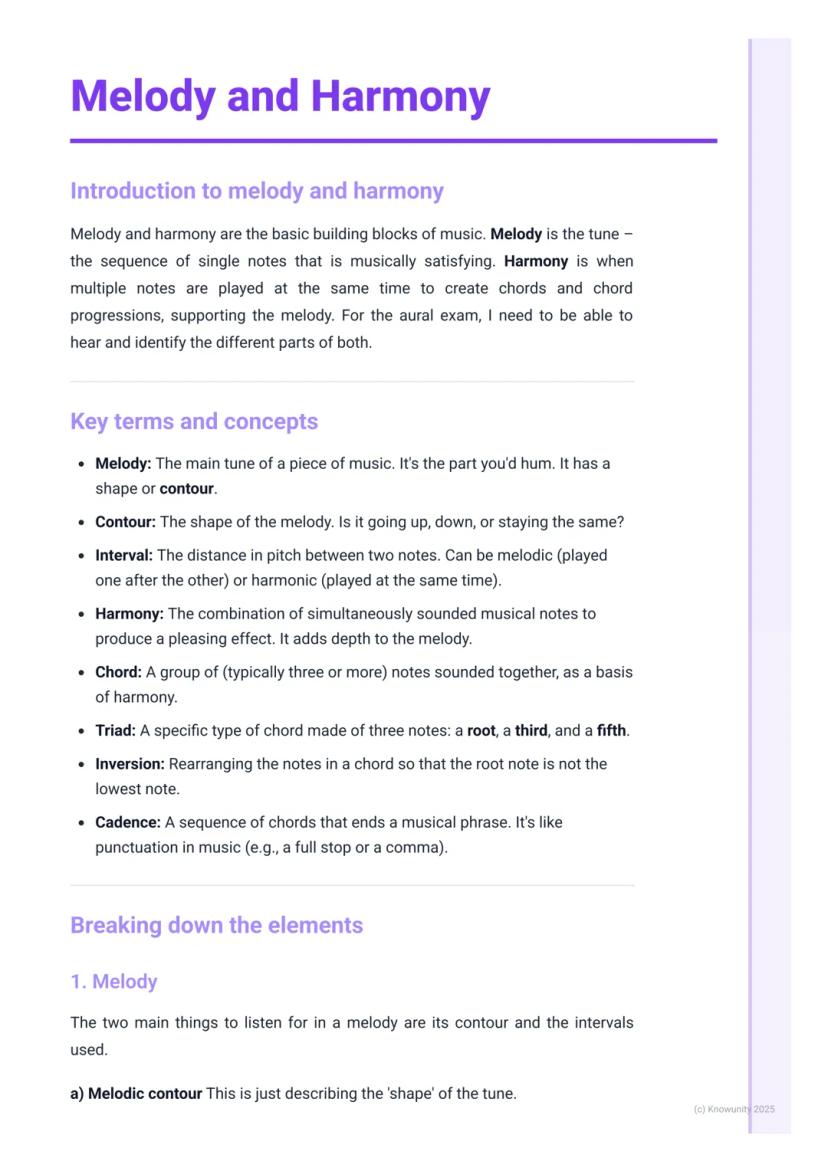
Music is basically made up of two main elements that work together. Melody is the tune you'd hum along to - that sequence of single notes that gets stuck in your head. Harmony happens when multiple notes are played simultaneously to create chords that support and enhance the melody.
Think of melody as the main character in a film, whilst harmony is the supporting cast that makes the story richer. For your aural exam, you'll need to identify different parts of both by ear.
Melody has a shape called contour - it can go up, down, or stay roughly the same. The distance between any two notes is called an interval, and these can be played one after another (melodic) or at the same time (harmonic).
Exam Tip: The contour is often the easiest thing to identify first - just trace the shape with your finger in the air as you listen!
Your melody can move in several different ways, and each creates a distinct sound. Ascending melodies go up in pitch, whilst descending ones go down. Some melodies create an arch shape - rising then falling like a wave.
Conjunct motion means the melody moves by step (like C to D to E), creating a smooth, flowing sound. Disjunct motion involves leaps between notes (like C to G to E), which sounds more dramatic and jagged.
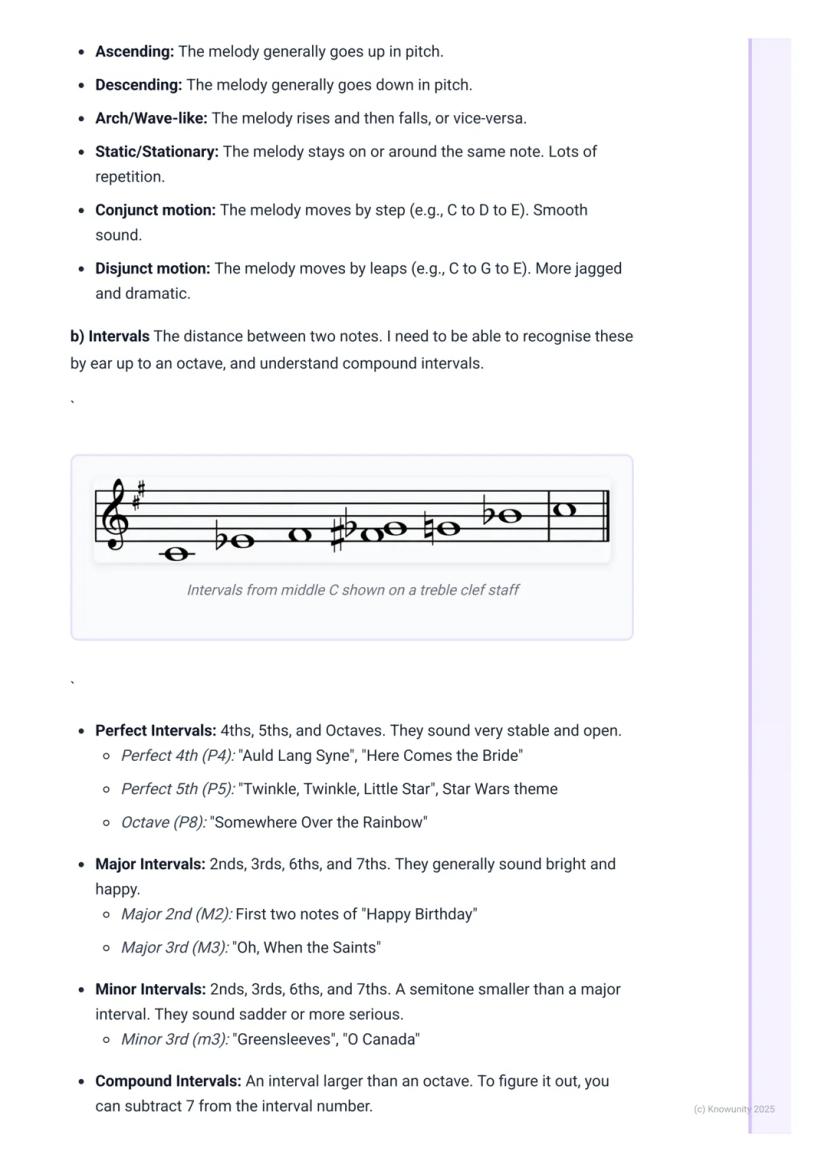
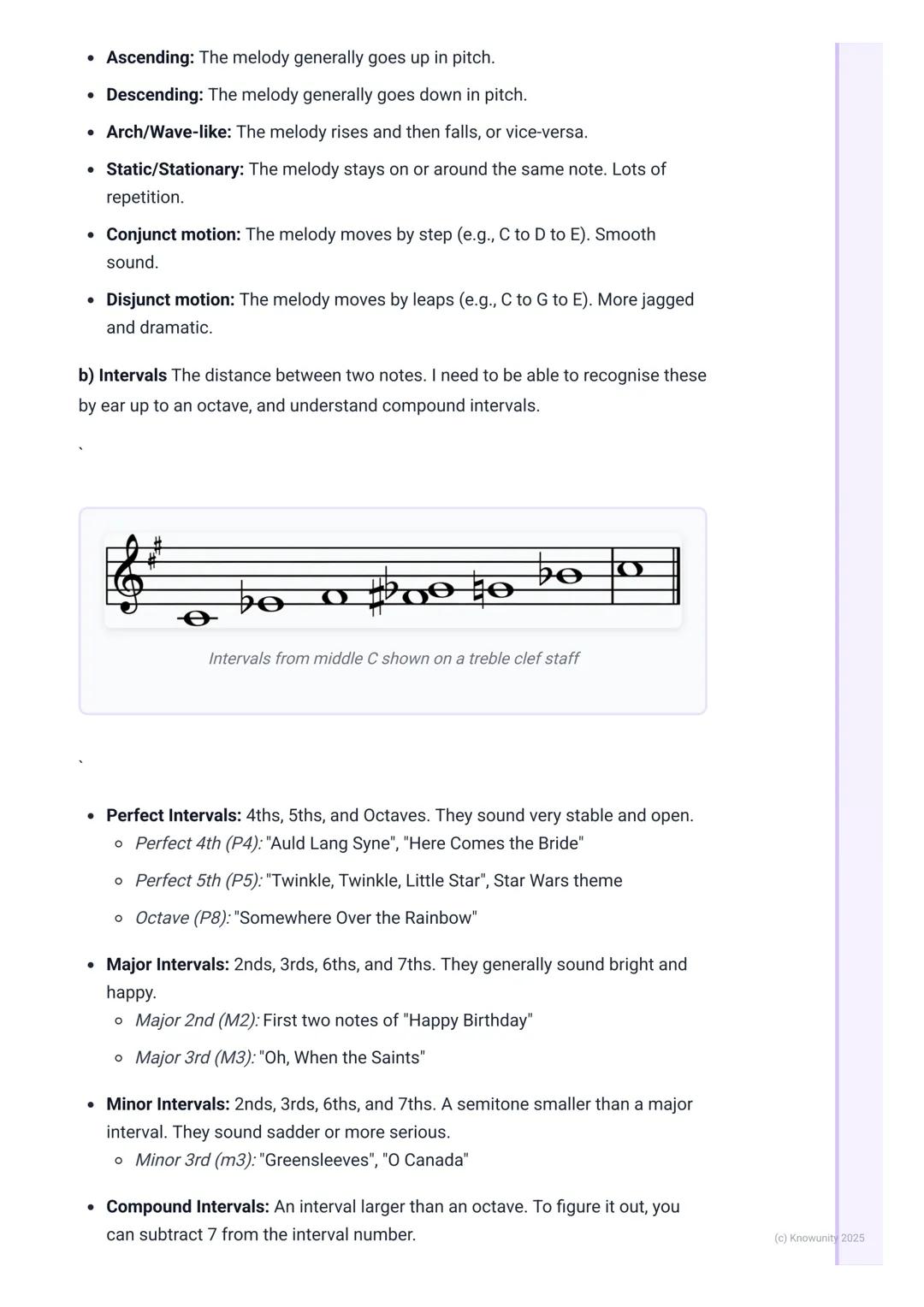
Intervals are crucial for aural recognition. Perfect intervals (4ths, 5ths, and octaves) sound very stable and open. Think "Here Comes the Bride" for a perfect 4th, or the Star Wars theme for a perfect 5th. Major intervals generally sound bright and happy, whilst minor intervals are a semitone smaller and sound sadder.
Compound intervals are simply intervals larger than an octave. To work them out, subtract 7 from the interval number - so a major 9th is really just a major 2nd played much further apart.
Memory Trick: Use familiar songs as references - "Somewhere Over the Rainbow" starts with an octave leap!
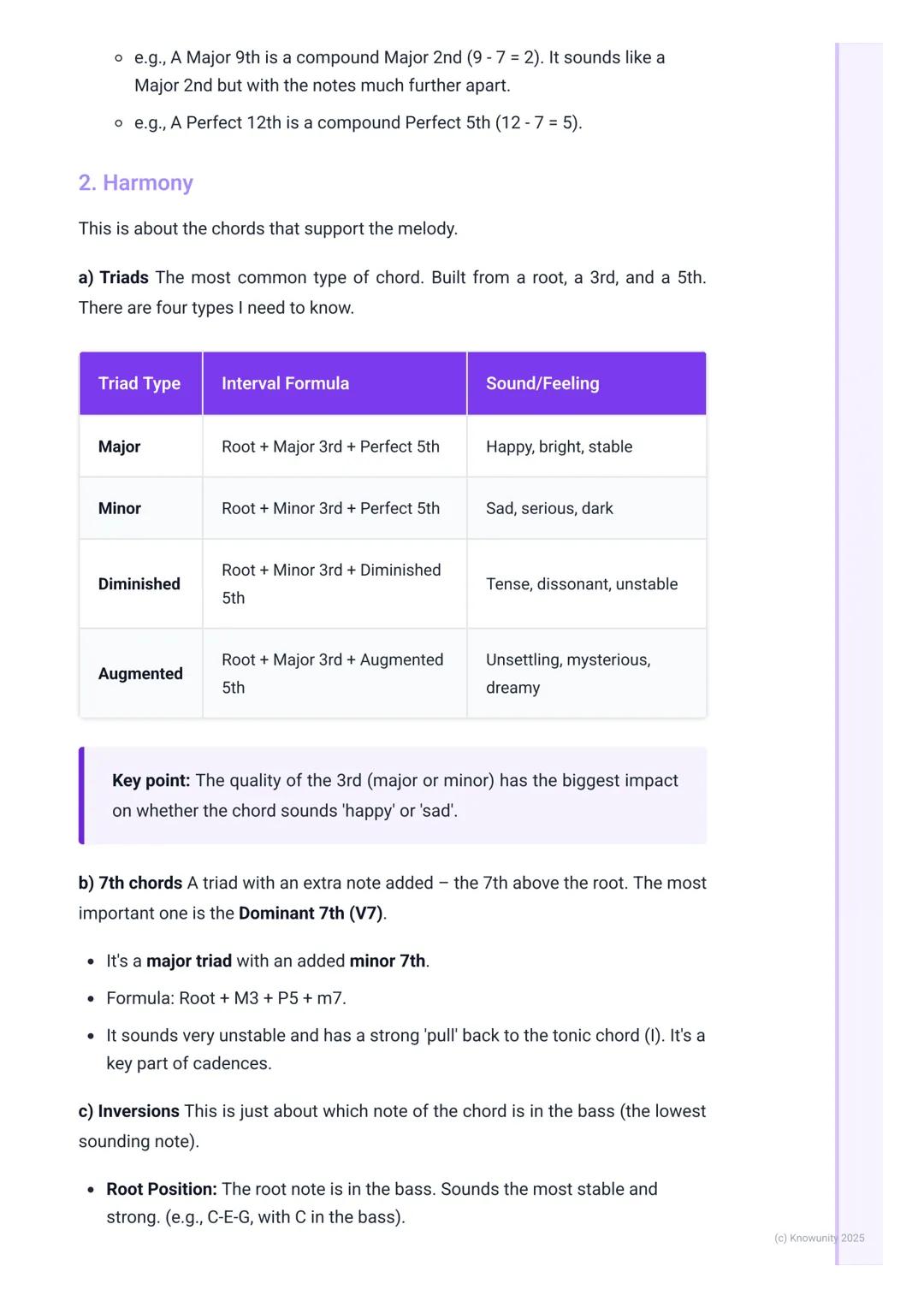
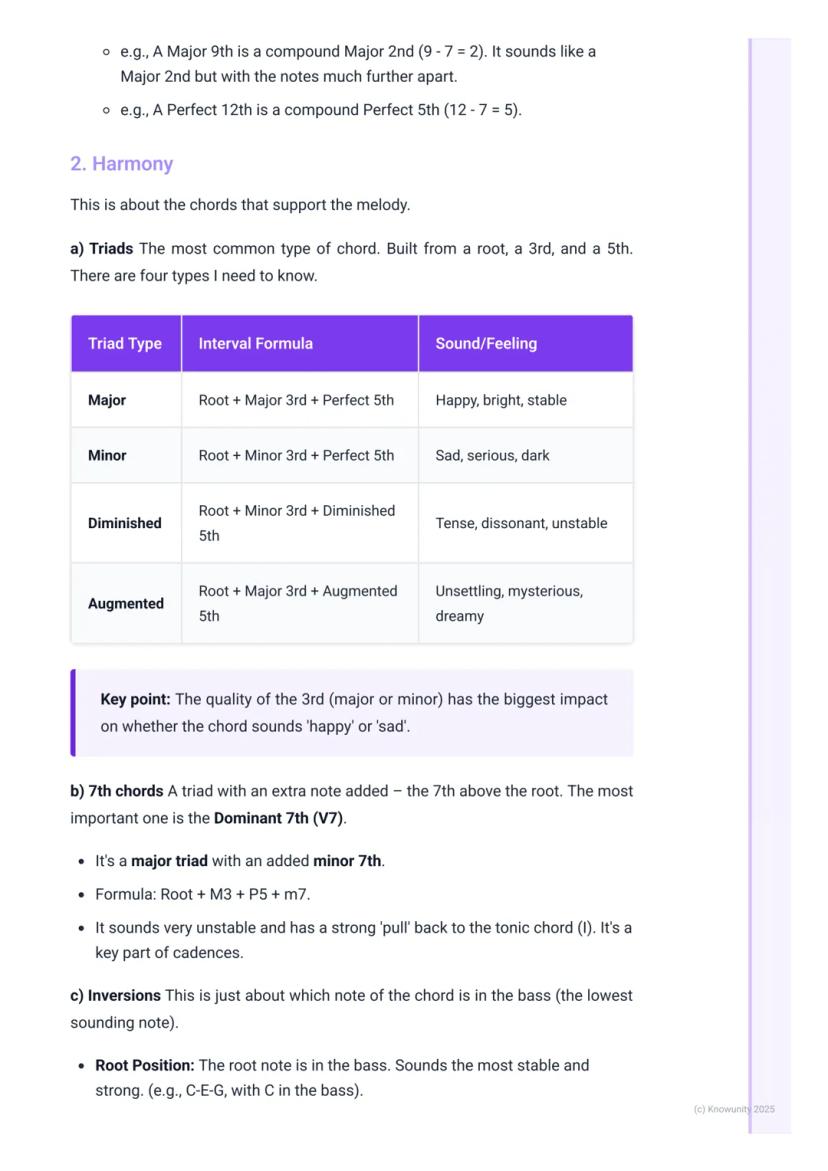
Triads are the most common chords you'll encounter, built from three notes: a root, a 3rd, and a 5th. There are four main types you need to recognise by ear.
Major triads sound happy, bright, and stable. Minor triads use a minor 3rd instead, creating that sad or serious feeling. Diminished triads sound tense and unstable, whilst augmented triads have an unsettling, mysterious quality.
The secret is that the quality of the 3rd (major or minor) has the biggest impact on whether a chord sounds happy or sad. This makes it the most important note to focus on when identifying triads.
Seventh chords add an extra layer of complexity. The most important is the dominant 7th (V7), which creates a strong pull back to the home chord. It's built from a major triad with an added minor 7th, giving it that distinctive "needs to resolve" sound.
Quick Check: If a chord sounds like it desperately wants to go somewhere else, it's probably a dominant 7th!
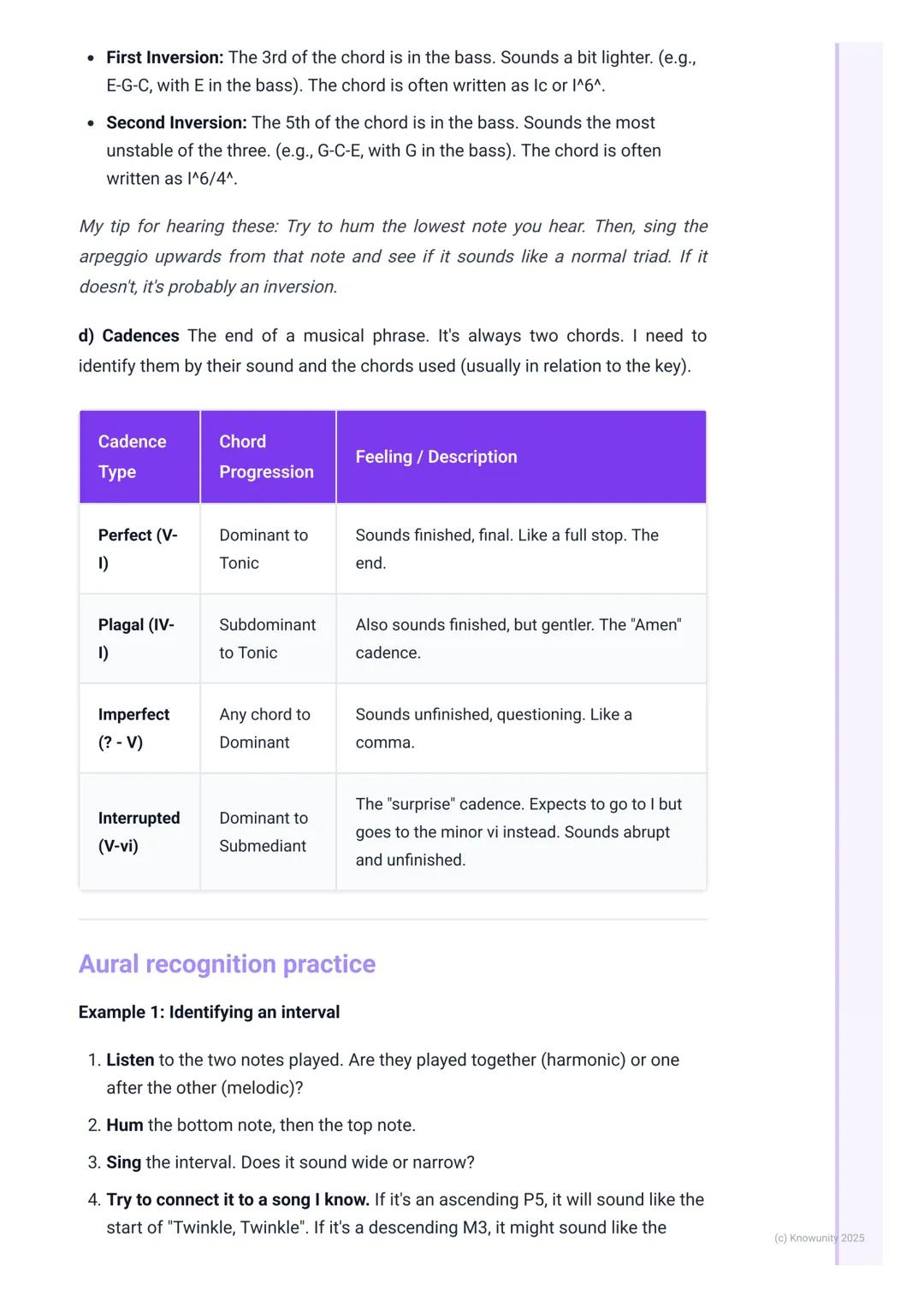
Inversions simply refer to which note of the chord is in the bass (lowest part). Root position has the root note in the bass and sounds most stable. First inversion puts the 3rd in the bass, creating a lighter feel, whilst second inversion has the 5th in the bass and sounds the most unstable.
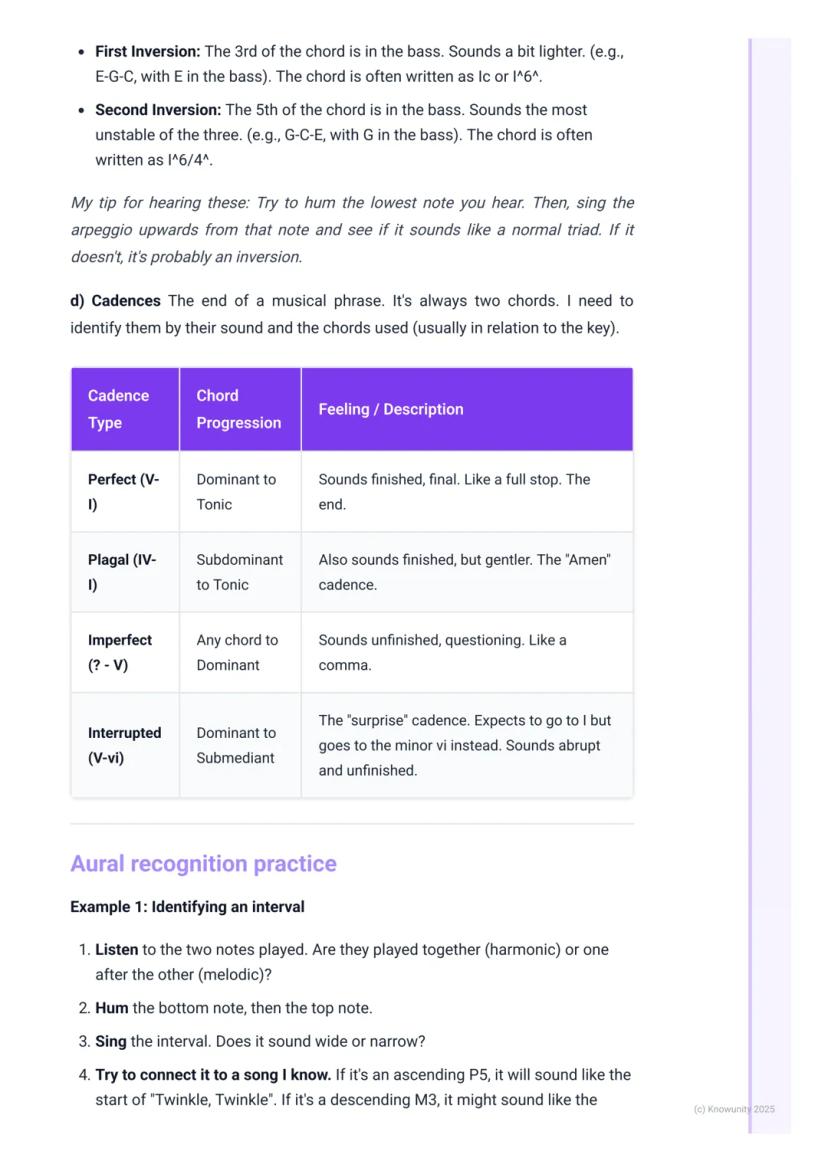
Cadences are like punctuation marks in music - they're always two chords that end a musical phrase. Perfect cadences sound completely finished, like a full stop. Plagal cadences also sound finished but gentler, often called the "Amen" cadence.
Imperfect cadences end on the dominant chord and sound unfinished, like a comma asking a question. Interrupted cadences are the surprise ending - they trick your ear by going to the minor vi chord instead of the expected I.
For your exam, don't just memorise chord numbers - learn how each cadence feels. Under pressure, recognising the emotional effect is much more reliable than trying to analyse chord progressions.
Exam Strategy: Always listen to the bass line first when identifying inversions - it's your biggest clue!
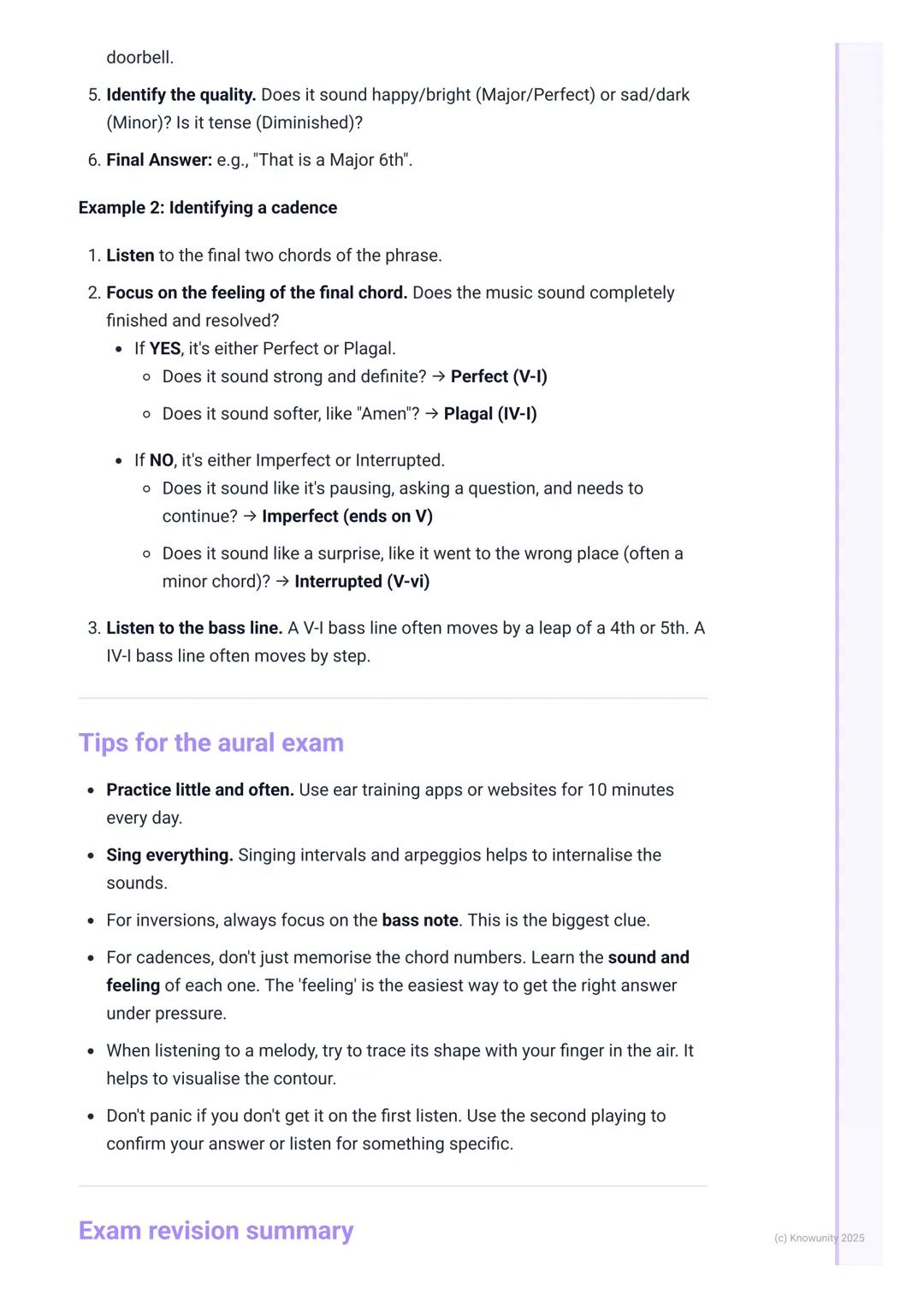
When identifying intervals in your exam, start by determining if they're played together (harmonic) or separately (melodic). Hum both notes, then connect the sound to a song you know - this reference method is incredibly reliable under exam pressure.
For cadences, focus on the feeling of the final chord first. Does the music sound completely resolved and finished? If yes, it's either perfect or plagal. If it sounds unfinished or questioning, it's either imperfect or interrupted.
The bass line movement gives you additional clues. A V-I progression often moves by a leap of a 4th or 5th, whilst a IV-I progression typically moves by step.
Singing everything helps massively with internalising these sounds. Spend just 10 minutes daily with ear training apps, and always sing intervals and arpeggios rather than just listening passively.
Golden Rule: Don't panic if you don't get it on first listen - use the second playing to confirm your answer or focus on one specific element!
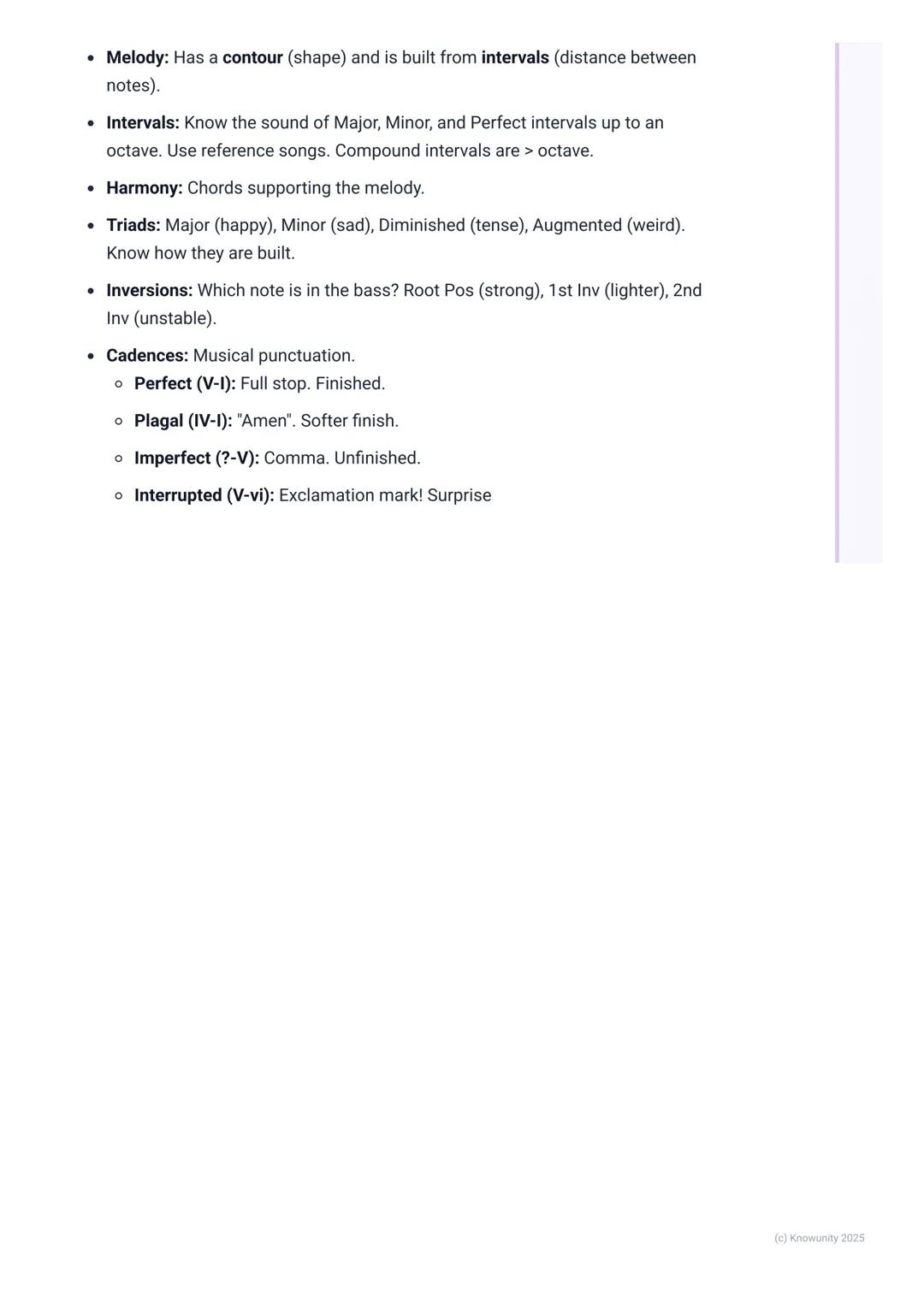
Melody is all about contour (shape) and intervals (distances between notes). Know your major, minor, and perfect intervals up to an octave, and remember that compound intervals are just regular intervals played more than an octave apart.
Harmony centres on chords supporting the melody. Master your triad recognition: major sounds happy, minor sounds sad, diminished sounds tense, and augmented sounds mysterious.
Inversions depend on which note is in the bass - root position sounds strongest, first inversion lighter, and second inversion most unstable.
Cadences are musical punctuation: perfect is a full stop, plagal is a gentle "Amen," imperfect ending on V is a questioning comma, and interrupted is a surprise exclamation mark.
Remember, the feeling of the music is often more reliable than technical analysis during exams. Trust your ears and the emotional responses these musical elements create.
Final Tip: Practice tracing melodic contours with your finger in the air - it helps visualise what you're hearing!
Notre compagnon IA est spécialement conçu pour répondre aux besoins des étudiants. Sur la base des millions d'éléments de contenu que nous avons sur la plateforme, nous pouvons fournir des réponses vraiment significatives et pertinentes aux étudiants. Mais il ne s'agit pas seulement de réponses, le compagnon a encore plus pour but de guider les élèves dans leurs défis d'apprentissage quotidiens, avec des plans d'étude personnalisés, des quiz ou des éléments de contenu dans le chat et une personnalisation à 100% basée sur les compétences et les développements de l'étudiant.
Tu peux télécharger l'application dans Google Play Store et dans l'App Store d'Apple.
Oui, tu as un accès entièrement gratuit à tous les contenus de l'appli, tu peux chatter ou suivre les créateurs à tout moment. De plus, nous proposons Knowunity Premium, qui te permet de réviser sans limites!
App Store
Google Play
L'application est très facile d'utilisation et bien conçue. Jusqu'à présent, j'ai trouvé tout ce que je cherchais et j'ai pu apprendre beaucoup de choses grâce aux présentations ! Je vais certainement utiliser l'application pour un travail en classe ! Et comme source d'inspiration personnelle, elle est bien sûr aussi très utile.
Stefan S
utilisateur iOS
Cette application est vraiment super. Il y a tellement de fiches de révision et d'aide, [...]. Par exemple, la matière qui me pose problème est le français et l'appli a un choix d'aide très large. Grâce à cette application, je me suis améliorée en français. Je la recommanderais à tout le monde.
Samantha Klich
utilisatrice Android
Waouh, je suis vraiment abasourdi. J'ai essayé l'application parce que je l'avais déjà vue plusieurs fois dans la publicité et j'ai été absolument choquée. Cette appli est L'AIDE dont on rêve pour l'école et surtout, elle propose tellement de choses, comme des rédactions et des fiches qui m'ont personnellement TRÈS bien aidé.
Anna
utilisatrice iOS
Meilleur application je voulais m'entraîner pour mes maths puis j'ai tout compris d'un coup c'est mon nouveau prof maintenant 🤣🤣
Thomas R
utilisateur d' Android
super application pour réviser je révise tout les soirs
Esteban M
utilisateur d'Android
Permet de vraiment comprendre les cours sous forme de fiches de révisions déjà faites ! Incroyable, je recommande vraiment
Leny
utilisateur d'Android
L'application est tout simplement géniale ! Il me suffit de taper mon sujet dans la barre de recherche et je le vérifie très rapidement. Je ne dois plus regarder 10 vidéos YouTube pour comprendre quelque chose et j'économise ainsi mon temps. Je te le recommande !
Sudenaz Ocak
utilisateur Android
Cette application m'a vraiment fait m'améliorer ! J'étais vraiment nul en maths à l'école et grâce à l'appli, je suis meilleur en maths ! Je suis tellement reconnaissante que vous ayez créé cette application.
Greenlight Bonnie
utilisateur Android
PARFAIT 🌟 💕🔥 ça facilite Vrmt la révision avec des fiches de révisions fascinants✨🥰
Khady
utilisatrice d'Android
Je conseille vraiment ! je galère à avoir des cours clairs et ça aide énormément !!
Claire
utilisatrice iOS
LES QUIZ ET CARTES MÉMOIRE SONT TROP UTILES ET J'ADORE Knowunity IA. C'EST LITTÉRALEMENT COMME CHATGPT MAIS EN PLUS INTELLIGENT !! ÇA M'A AIDÉ AVEC MES PROBLÈMES DE MASCARA AUSSI !! AINSI QUE MES VRAIES MATIÈRES ! ÉVIDEMMENT 😍😁😲🤑💗✨🎀😮
Raoul
utilisateur IOS
Knowunity est vraiment une application incroyable elle est pour tous les âges et s’adapte à tous les niveaux.Elle permet de mieux comprendre et apprendre. Cette application est super pour les devoirs et pour les contrôles je la recommande à tous le monde petit ou grands
Ella
utilisatrice iOS
L'application est très facile d'utilisation et bien conçue. Jusqu'à présent, j'ai trouvé tout ce que je cherchais et j'ai pu apprendre beaucoup de choses grâce aux présentations ! Je vais certainement utiliser l'application pour un travail en classe ! Et comme source d'inspiration personnelle, elle est bien sûr aussi très utile.
Stefan S
utilisateur iOS
Cette application est vraiment super. Il y a tellement de fiches de révision et d'aide, [...]. Par exemple, la matière qui me pose problème est le français et l'appli a un choix d'aide très large. Grâce à cette application, je me suis améliorée en français. Je la recommanderais à tout le monde.
Samantha Klich
utilisatrice Android
Waouh, je suis vraiment abasourdi. J'ai essayé l'application parce que je l'avais déjà vue plusieurs fois dans la publicité et j'ai été absolument choquée. Cette appli est L'AIDE dont on rêve pour l'école et surtout, elle propose tellement de choses, comme des rédactions et des fiches qui m'ont personnellement TRÈS bien aidé.
Anna
utilisatrice iOS
Meilleur application je voulais m'entraîner pour mes maths puis j'ai tout compris d'un coup c'est mon nouveau prof maintenant 🤣🤣
Thomas R
utilisateur d' Android
super application pour réviser je révise tout les soirs
Esteban M
utilisateur d'Android
Permet de vraiment comprendre les cours sous forme de fiches de révisions déjà faites ! Incroyable, je recommande vraiment
Leny
utilisateur d'Android
L'application est tout simplement géniale ! Il me suffit de taper mon sujet dans la barre de recherche et je le vérifie très rapidement. Je ne dois plus regarder 10 vidéos YouTube pour comprendre quelque chose et j'économise ainsi mon temps. Je te le recommande !
Sudenaz Ocak
utilisateur Android
Cette application m'a vraiment fait m'améliorer ! J'étais vraiment nul en maths à l'école et grâce à l'appli, je suis meilleur en maths ! Je suis tellement reconnaissante que vous ayez créé cette application.
Greenlight Bonnie
utilisateur Android
PARFAIT 🌟 💕🔥 ça facilite Vrmt la révision avec des fiches de révisions fascinants✨🥰
Khady
utilisatrice d'Android
Je conseille vraiment ! je galère à avoir des cours clairs et ça aide énormément !!
Claire
utilisatrice iOS
LES QUIZ ET CARTES MÉMOIRE SONT TROP UTILES ET J'ADORE Knowunity IA. C'EST LITTÉRALEMENT COMME CHATGPT MAIS EN PLUS INTELLIGENT !! ÇA M'A AIDÉ AVEC MES PROBLÈMES DE MASCARA AUSSI !! AINSI QUE MES VRAIES MATIÈRES ! ÉVIDEMMENT 😍😁😲🤑💗✨🎀😮
Raoul
utilisateur IOS
Knowunity est vraiment une application incroyable elle est pour tous les âges et s’adapte à tous les niveaux.Elle permet de mieux comprendre et apprendre. Cette application est super pour les devoirs et pour les contrôles je la recommande à tous le monde petit ou grands
Ella
utilisatrice iOS
Ever wonder why some songs make you feel happy whilst others sound sad, or how musicians know when a song is "finished"? It all comes down to melody and harmony- the fundamental building blocks that create every piece of... Affiche plus
Accès à tous les documents
Améliore tes notes
Rejoins des millions d'étudiants
Music is basically made up of two main elements that work together. Melody is the tune you'd hum along to - that sequence of single notes that gets stuck in your head. Harmony happens when multiple notes are played simultaneously to create chords that support and enhance the melody.
Think of melody as the main character in a film, whilst harmony is the supporting cast that makes the story richer. For your aural exam, you'll need to identify different parts of both by ear.
Melody has a shape called contour - it can go up, down, or stay roughly the same. The distance between any two notes is called an interval, and these can be played one after another (melodic) or at the same time (harmonic).
Exam Tip: The contour is often the easiest thing to identify first - just trace the shape with your finger in the air as you listen!
Accès à tous les documents
Améliore tes notes
Rejoins des millions d'étudiants
Your melody can move in several different ways, and each creates a distinct sound. Ascending melodies go up in pitch, whilst descending ones go down. Some melodies create an arch shape - rising then falling like a wave.
Conjunct motion means the melody moves by step (like C to D to E), creating a smooth, flowing sound. Disjunct motion involves leaps between notes (like C to G to E), which sounds more dramatic and jagged.
Intervals are crucial for aural recognition. Perfect intervals (4ths, 5ths, and octaves) sound very stable and open. Think "Here Comes the Bride" for a perfect 4th, or the Star Wars theme for a perfect 5th. Major intervals generally sound bright and happy, whilst minor intervals are a semitone smaller and sound sadder.
Compound intervals are simply intervals larger than an octave. To work them out, subtract 7 from the interval number - so a major 9th is really just a major 2nd played much further apart.
Memory Trick: Use familiar songs as references - "Somewhere Over the Rainbow" starts with an octave leap!
Accès à tous les documents
Améliore tes notes
Rejoins des millions d'étudiants
Triads are the most common chords you'll encounter, built from three notes: a root, a 3rd, and a 5th. There are four main types you need to recognise by ear.
Major triads sound happy, bright, and stable. Minor triads use a minor 3rd instead, creating that sad or serious feeling. Diminished triads sound tense and unstable, whilst augmented triads have an unsettling, mysterious quality.
The secret is that the quality of the 3rd (major or minor) has the biggest impact on whether a chord sounds happy or sad. This makes it the most important note to focus on when identifying triads.
Seventh chords add an extra layer of complexity. The most important is the dominant 7th (V7), which creates a strong pull back to the home chord. It's built from a major triad with an added minor 7th, giving it that distinctive "needs to resolve" sound.
Quick Check: If a chord sounds like it desperately wants to go somewhere else, it's probably a dominant 7th!
Accès à tous les documents
Améliore tes notes
Rejoins des millions d'étudiants
Inversions simply refer to which note of the chord is in the bass (lowest part). Root position has the root note in the bass and sounds most stable. First inversion puts the 3rd in the bass, creating a lighter feel, whilst second inversion has the 5th in the bass and sounds the most unstable.
Cadences are like punctuation marks in music - they're always two chords that end a musical phrase. Perfect cadences sound completely finished, like a full stop. Plagal cadences also sound finished but gentler, often called the "Amen" cadence.
Imperfect cadences end on the dominant chord and sound unfinished, like a comma asking a question. Interrupted cadences are the surprise ending - they trick your ear by going to the minor vi chord instead of the expected I.
For your exam, don't just memorise chord numbers - learn how each cadence feels. Under pressure, recognising the emotional effect is much more reliable than trying to analyse chord progressions.
Exam Strategy: Always listen to the bass line first when identifying inversions - it's your biggest clue!
Accès à tous les documents
Améliore tes notes
Rejoins des millions d'étudiants
When identifying intervals in your exam, start by determining if they're played together (harmonic) or separately (melodic). Hum both notes, then connect the sound to a song you know - this reference method is incredibly reliable under exam pressure.
For cadences, focus on the feeling of the final chord first. Does the music sound completely resolved and finished? If yes, it's either perfect or plagal. If it sounds unfinished or questioning, it's either imperfect or interrupted.
The bass line movement gives you additional clues. A V-I progression often moves by a leap of a 4th or 5th, whilst a IV-I progression typically moves by step.
Singing everything helps massively with internalising these sounds. Spend just 10 minutes daily with ear training apps, and always sing intervals and arpeggios rather than just listening passively.
Golden Rule: Don't panic if you don't get it on first listen - use the second playing to confirm your answer or focus on one specific element!
Accès à tous les documents
Améliore tes notes
Rejoins des millions d'étudiants
Melody is all about contour (shape) and intervals (distances between notes). Know your major, minor, and perfect intervals up to an octave, and remember that compound intervals are just regular intervals played more than an octave apart.
Harmony centres on chords supporting the melody. Master your triad recognition: major sounds happy, minor sounds sad, diminished sounds tense, and augmented sounds mysterious.
Inversions depend on which note is in the bass - root position sounds strongest, first inversion lighter, and second inversion most unstable.
Cadences are musical punctuation: perfect is a full stop, plagal is a gentle "Amen," imperfect ending on V is a questioning comma, and interrupted is a surprise exclamation mark.
Remember, the feeling of the music is often more reliable than technical analysis during exams. Trust your ears and the emotional responses these musical elements create.
Final Tip: Practice tracing melodic contours with your finger in the air - it helps visualise what you're hearing!
Notre compagnon IA est spécialement conçu pour répondre aux besoins des étudiants. Sur la base des millions d'éléments de contenu que nous avons sur la plateforme, nous pouvons fournir des réponses vraiment significatives et pertinentes aux étudiants. Mais il ne s'agit pas seulement de réponses, le compagnon a encore plus pour but de guider les élèves dans leurs défis d'apprentissage quotidiens, avec des plans d'étude personnalisés, des quiz ou des éléments de contenu dans le chat et une personnalisation à 100% basée sur les compétences et les développements de l'étudiant.
Tu peux télécharger l'application dans Google Play Store et dans l'App Store d'Apple.
Oui, tu as un accès entièrement gratuit à tous les contenus de l'appli, tu peux chatter ou suivre les créateurs à tout moment. De plus, nous proposons Knowunity Premium, qui te permet de réviser sans limites!
0
Outils Intelligents NOUVEAU
Transforme cette fiche en : ✓ 50+ Questions d'Entraînement ✓ Cartes Mémoire Interactives ✓ Examen blanc complet ✓ Plans de Dissertation
App Store
Google Play
L'application est très facile d'utilisation et bien conçue. Jusqu'à présent, j'ai trouvé tout ce que je cherchais et j'ai pu apprendre beaucoup de choses grâce aux présentations ! Je vais certainement utiliser l'application pour un travail en classe ! Et comme source d'inspiration personnelle, elle est bien sûr aussi très utile.
Stefan S
utilisateur iOS
Cette application est vraiment super. Il y a tellement de fiches de révision et d'aide, [...]. Par exemple, la matière qui me pose problème est le français et l'appli a un choix d'aide très large. Grâce à cette application, je me suis améliorée en français. Je la recommanderais à tout le monde.
Samantha Klich
utilisatrice Android
Waouh, je suis vraiment abasourdi. J'ai essayé l'application parce que je l'avais déjà vue plusieurs fois dans la publicité et j'ai été absolument choquée. Cette appli est L'AIDE dont on rêve pour l'école et surtout, elle propose tellement de choses, comme des rédactions et des fiches qui m'ont personnellement TRÈS bien aidé.
Anna
utilisatrice iOS
Meilleur application je voulais m'entraîner pour mes maths puis j'ai tout compris d'un coup c'est mon nouveau prof maintenant 🤣🤣
Thomas R
utilisateur d' Android
super application pour réviser je révise tout les soirs
Esteban M
utilisateur d'Android
Permet de vraiment comprendre les cours sous forme de fiches de révisions déjà faites ! Incroyable, je recommande vraiment
Leny
utilisateur d'Android
L'application est tout simplement géniale ! Il me suffit de taper mon sujet dans la barre de recherche et je le vérifie très rapidement. Je ne dois plus regarder 10 vidéos YouTube pour comprendre quelque chose et j'économise ainsi mon temps. Je te le recommande !
Sudenaz Ocak
utilisateur Android
Cette application m'a vraiment fait m'améliorer ! J'étais vraiment nul en maths à l'école et grâce à l'appli, je suis meilleur en maths ! Je suis tellement reconnaissante que vous ayez créé cette application.
Greenlight Bonnie
utilisateur Android
PARFAIT 🌟 💕🔥 ça facilite Vrmt la révision avec des fiches de révisions fascinants✨🥰
Khady
utilisatrice d'Android
Je conseille vraiment ! je galère à avoir des cours clairs et ça aide énormément !!
Claire
utilisatrice iOS
LES QUIZ ET CARTES MÉMOIRE SONT TROP UTILES ET J'ADORE Knowunity IA. C'EST LITTÉRALEMENT COMME CHATGPT MAIS EN PLUS INTELLIGENT !! ÇA M'A AIDÉ AVEC MES PROBLÈMES DE MASCARA AUSSI !! AINSI QUE MES VRAIES MATIÈRES ! ÉVIDEMMENT 😍😁😲🤑💗✨🎀😮
Raoul
utilisateur IOS
Knowunity est vraiment une application incroyable elle est pour tous les âges et s’adapte à tous les niveaux.Elle permet de mieux comprendre et apprendre. Cette application est super pour les devoirs et pour les contrôles je la recommande à tous le monde petit ou grands
Ella
utilisatrice iOS
L'application est très facile d'utilisation et bien conçue. Jusqu'à présent, j'ai trouvé tout ce que je cherchais et j'ai pu apprendre beaucoup de choses grâce aux présentations ! Je vais certainement utiliser l'application pour un travail en classe ! Et comme source d'inspiration personnelle, elle est bien sûr aussi très utile.
Stefan S
utilisateur iOS
Cette application est vraiment super. Il y a tellement de fiches de révision et d'aide, [...]. Par exemple, la matière qui me pose problème est le français et l'appli a un choix d'aide très large. Grâce à cette application, je me suis améliorée en français. Je la recommanderais à tout le monde.
Samantha Klich
utilisatrice Android
Waouh, je suis vraiment abasourdi. J'ai essayé l'application parce que je l'avais déjà vue plusieurs fois dans la publicité et j'ai été absolument choquée. Cette appli est L'AIDE dont on rêve pour l'école et surtout, elle propose tellement de choses, comme des rédactions et des fiches qui m'ont personnellement TRÈS bien aidé.
Anna
utilisatrice iOS
Meilleur application je voulais m'entraîner pour mes maths puis j'ai tout compris d'un coup c'est mon nouveau prof maintenant 🤣🤣
Thomas R
utilisateur d' Android
super application pour réviser je révise tout les soirs
Esteban M
utilisateur d'Android
Permet de vraiment comprendre les cours sous forme de fiches de révisions déjà faites ! Incroyable, je recommande vraiment
Leny
utilisateur d'Android
L'application est tout simplement géniale ! Il me suffit de taper mon sujet dans la barre de recherche et je le vérifie très rapidement. Je ne dois plus regarder 10 vidéos YouTube pour comprendre quelque chose et j'économise ainsi mon temps. Je te le recommande !
Sudenaz Ocak
utilisateur Android
Cette application m'a vraiment fait m'améliorer ! J'étais vraiment nul en maths à l'école et grâce à l'appli, je suis meilleur en maths ! Je suis tellement reconnaissante que vous ayez créé cette application.
Greenlight Bonnie
utilisateur Android
PARFAIT 🌟 💕🔥 ça facilite Vrmt la révision avec des fiches de révisions fascinants✨🥰
Khady
utilisatrice d'Android
Je conseille vraiment ! je galère à avoir des cours clairs et ça aide énormément !!
Claire
utilisatrice iOS
LES QUIZ ET CARTES MÉMOIRE SONT TROP UTILES ET J'ADORE Knowunity IA. C'EST LITTÉRALEMENT COMME CHATGPT MAIS EN PLUS INTELLIGENT !! ÇA M'A AIDÉ AVEC MES PROBLÈMES DE MASCARA AUSSI !! AINSI QUE MES VRAIES MATIÈRES ! ÉVIDEMMENT 😍😁😲🤑💗✨🎀😮
Raoul
utilisateur IOS
Knowunity est vraiment une application incroyable elle est pour tous les âges et s’adapte à tous les niveaux.Elle permet de mieux comprendre et apprendre. Cette application est super pour les devoirs et pour les contrôles je la recommande à tous le monde petit ou grands
Ella
utilisatrice iOS