
Ever wondered what makes your favourite songs so catchy? It's... Affiche plus
 Music5 vues·Mis à jour May 31, 2026·5 pages
Understanding Beat and Rhythm in Music
1 / 5
1
of 5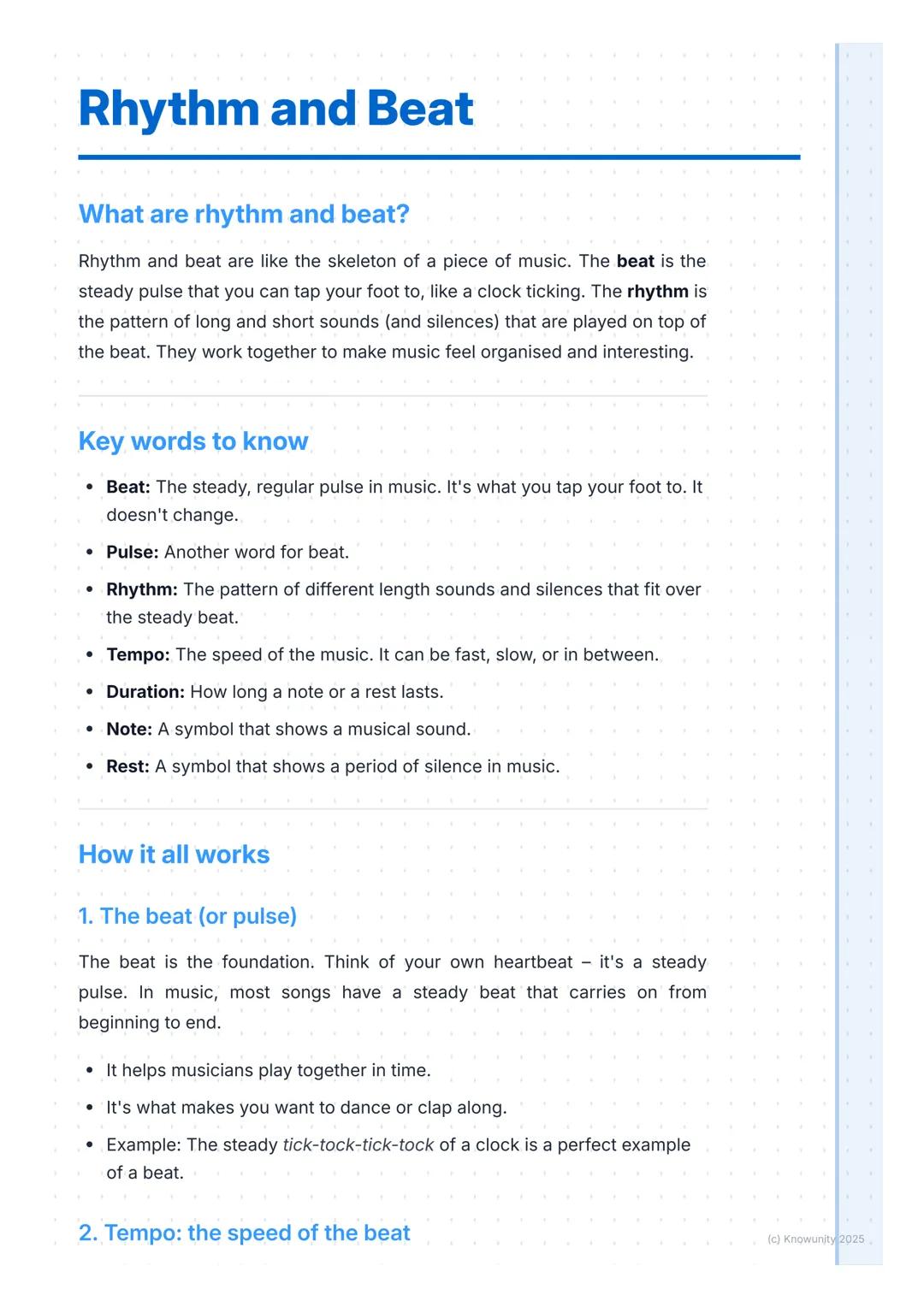
What Are Rhythm and Beat?
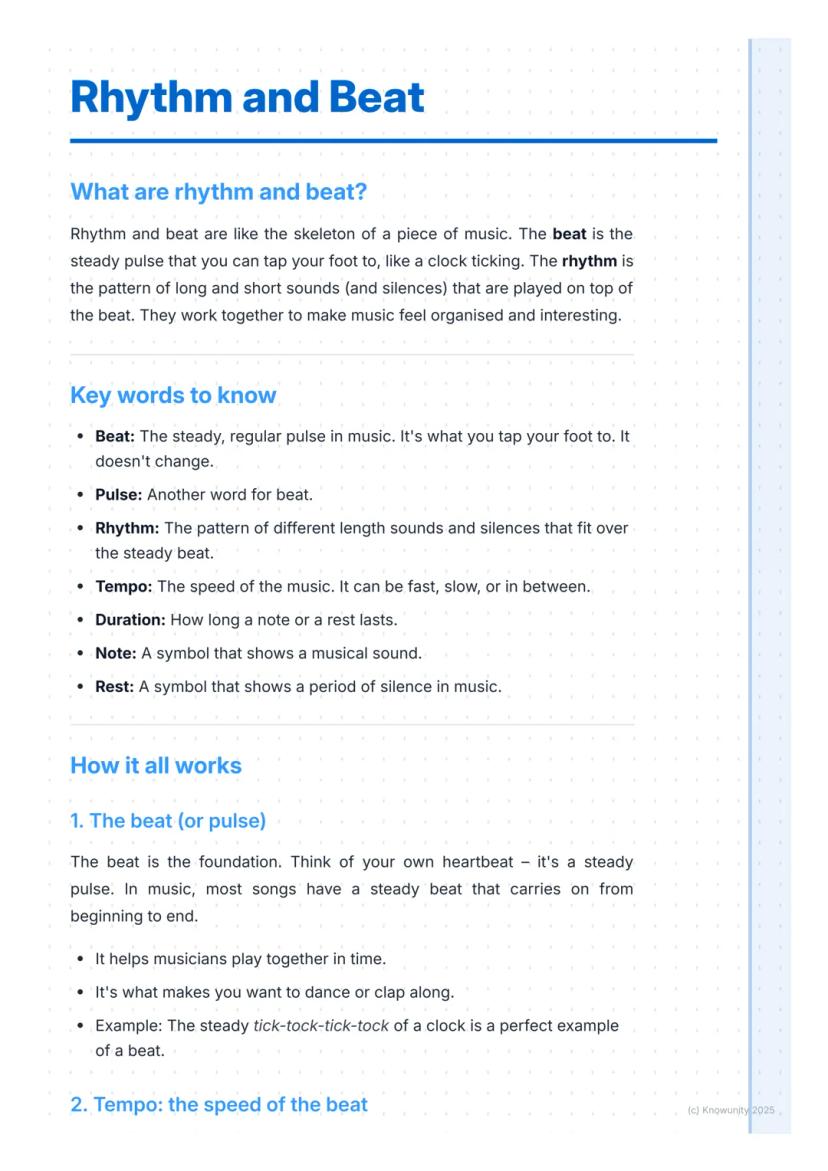
Think of music like a skeleton - the beat is the steady backbone that holds everything together, whilst the rhythm is the exciting pattern that dances on top. The beat is that steady pulse you naturally tap your foot to, just like a clock ticking away. It never changes and keeps everything organised.
Rhythm is much more interesting - it's the pattern of long and short sounds (plus the silences) that make each song unique. When you combine beat and rhythm, you get music that feels both steady and exciting at the same time.
Musicians use the beat to stay together when playing, which is why bands don't fall apart on stage! The pulse is just another word for beat, so don't get confused if you see both terms.
Quick Tip: Try listening to any song and tapping your foot - that steady tap is the beat, whilst everything else happening is the rhythm!
2
of 5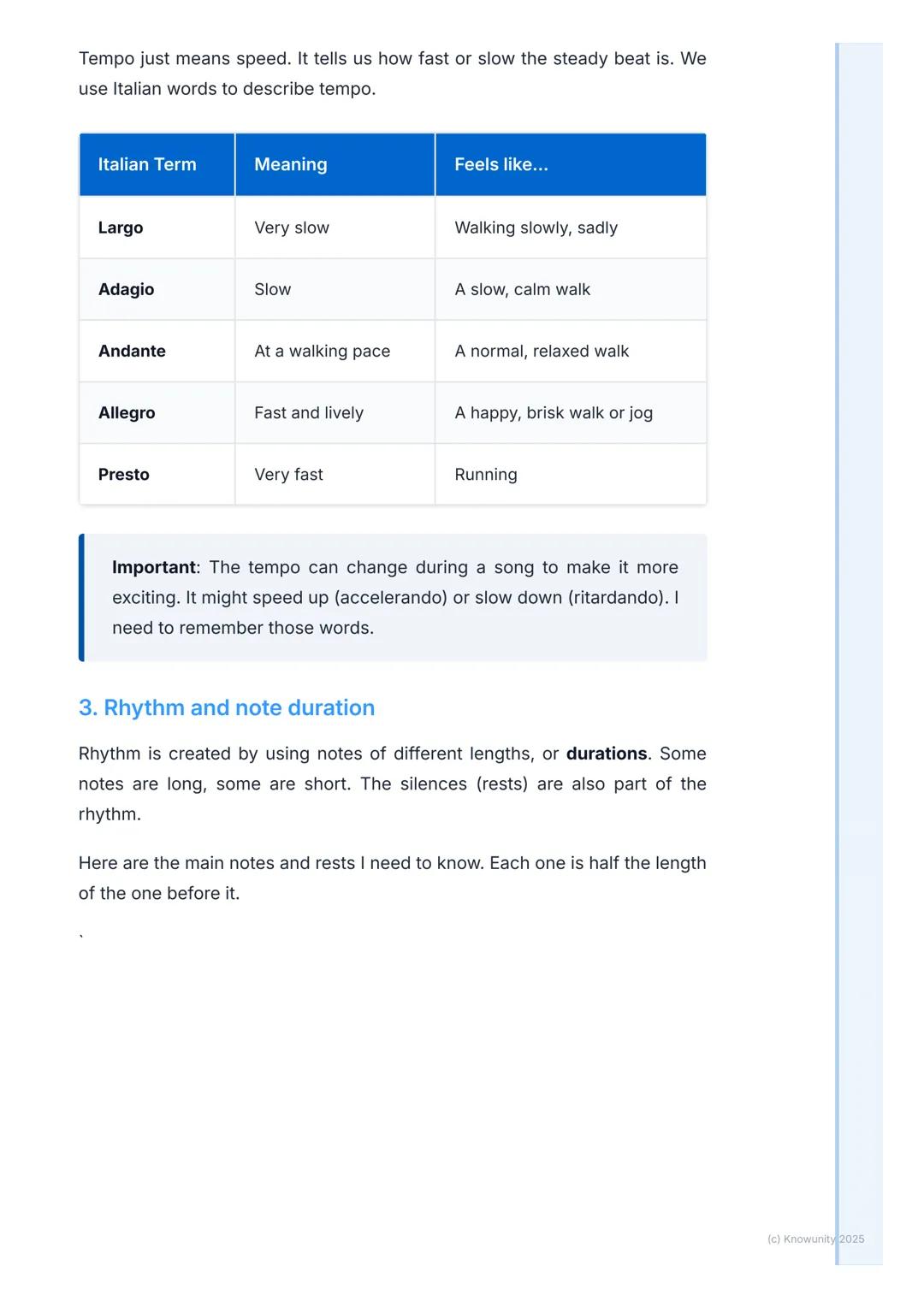
Understanding Tempo
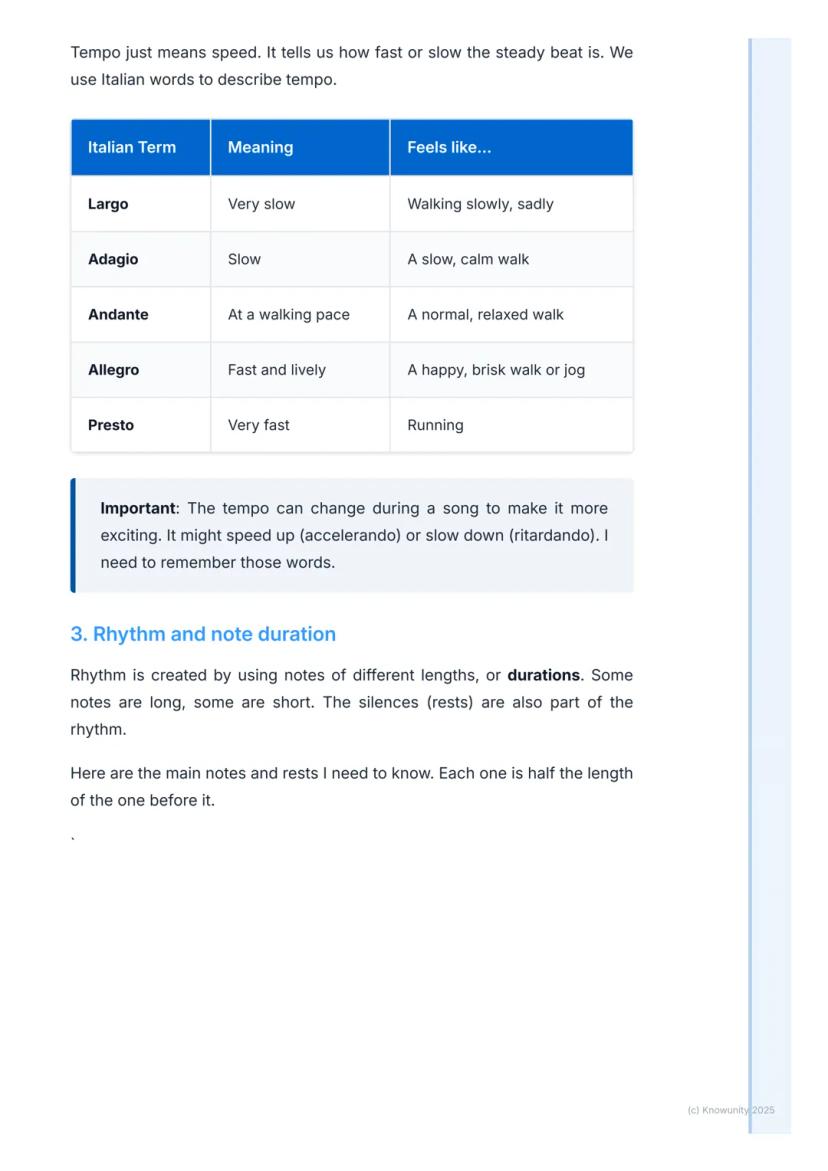
Tempo simply means how fast or slow the music goes. Musicians use fancy Italian words to describe different speeds, but they're actually quite logical once you think about them as different types of walking.
Largo means very slow - imagine walking sadly after losing a match. Adagio is slow like a calm, peaceful walk. Andante feels like your normal walking pace to school. Allegro is fast and lively, like rushing to meet your mates. Presto is super fast - basically running!
Here's the cool bit: tempo can change during a song to create excitement. When music speeds up, it's called accelerando. When it slows down, it's called ritardando. Think about how film music builds up during action scenes!
Remember This: Most Irish jigs are Allegro or Presto, whilst traditional ballads like "Molly Malone" are usually Andante or Adagio.
3
of 5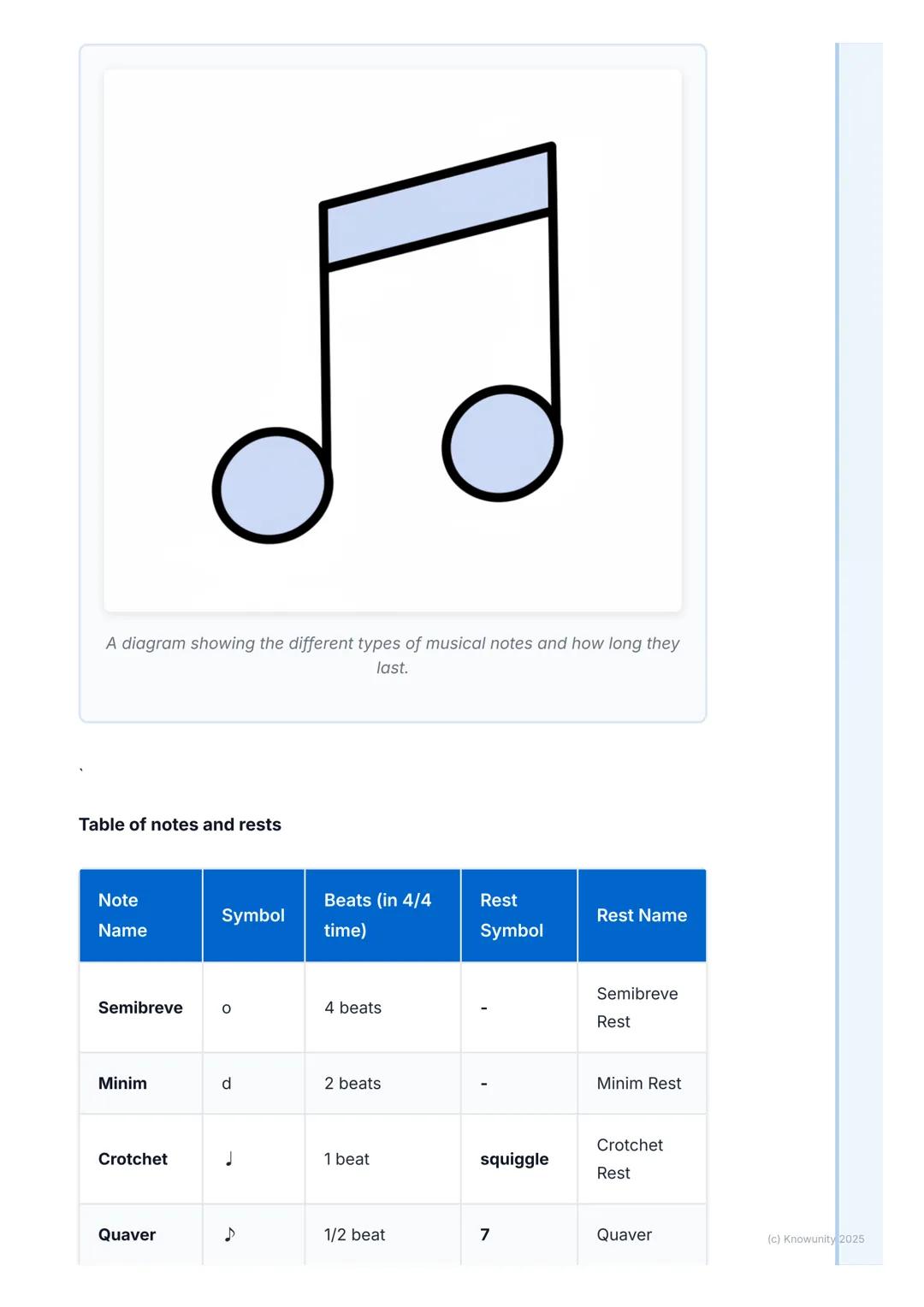
Note Values and Duration
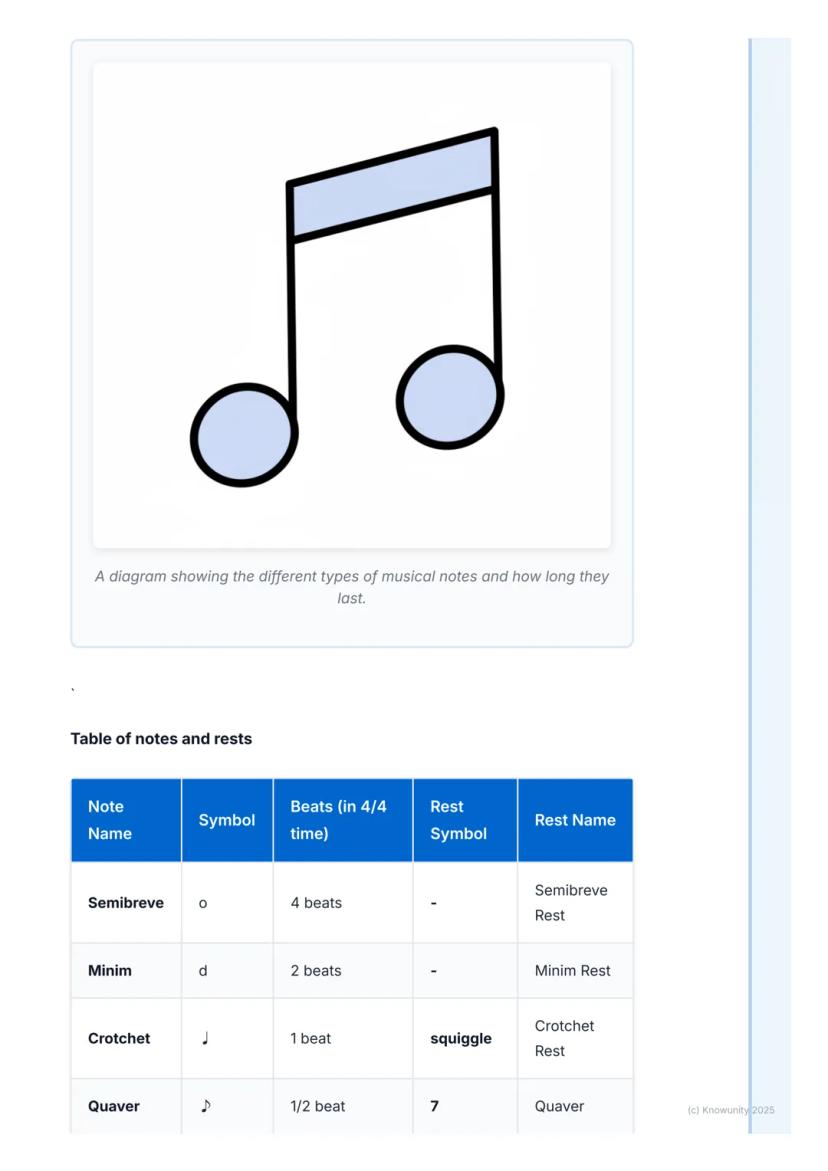
This is where rhythm gets its building blocks. Different notes last for different amounts of time - some are long, some are short. Think of it like a family tree where each note is exactly half the length of the one above it.
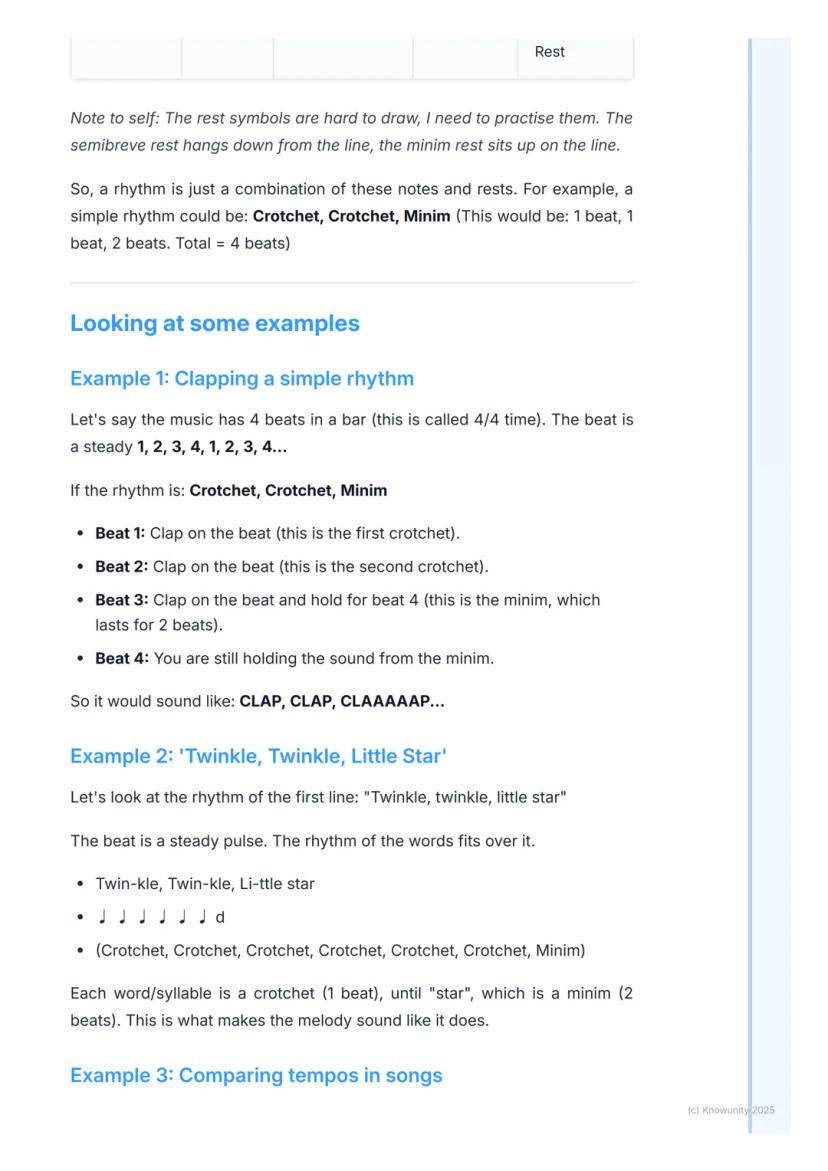
A semibreve lasts for 4 beats (the longest), a minim lasts for 2 beats, a crotchet lasts for 1 beat, and a quaver lasts for half a beat. It's like cutting a pizza in half, then in half again!
Rests are the silent gaps in music, and they're just as important as the notes themselves. Each note has a matching rest that lasts the same amount of time. The silences often make rhythms more interesting than constant noise would.
Memory Trick: Remember "1 semibreve = 2 minims = 4 crotchets = 8 quavers" - it's like a mathematical pattern that never changes!
4
of 5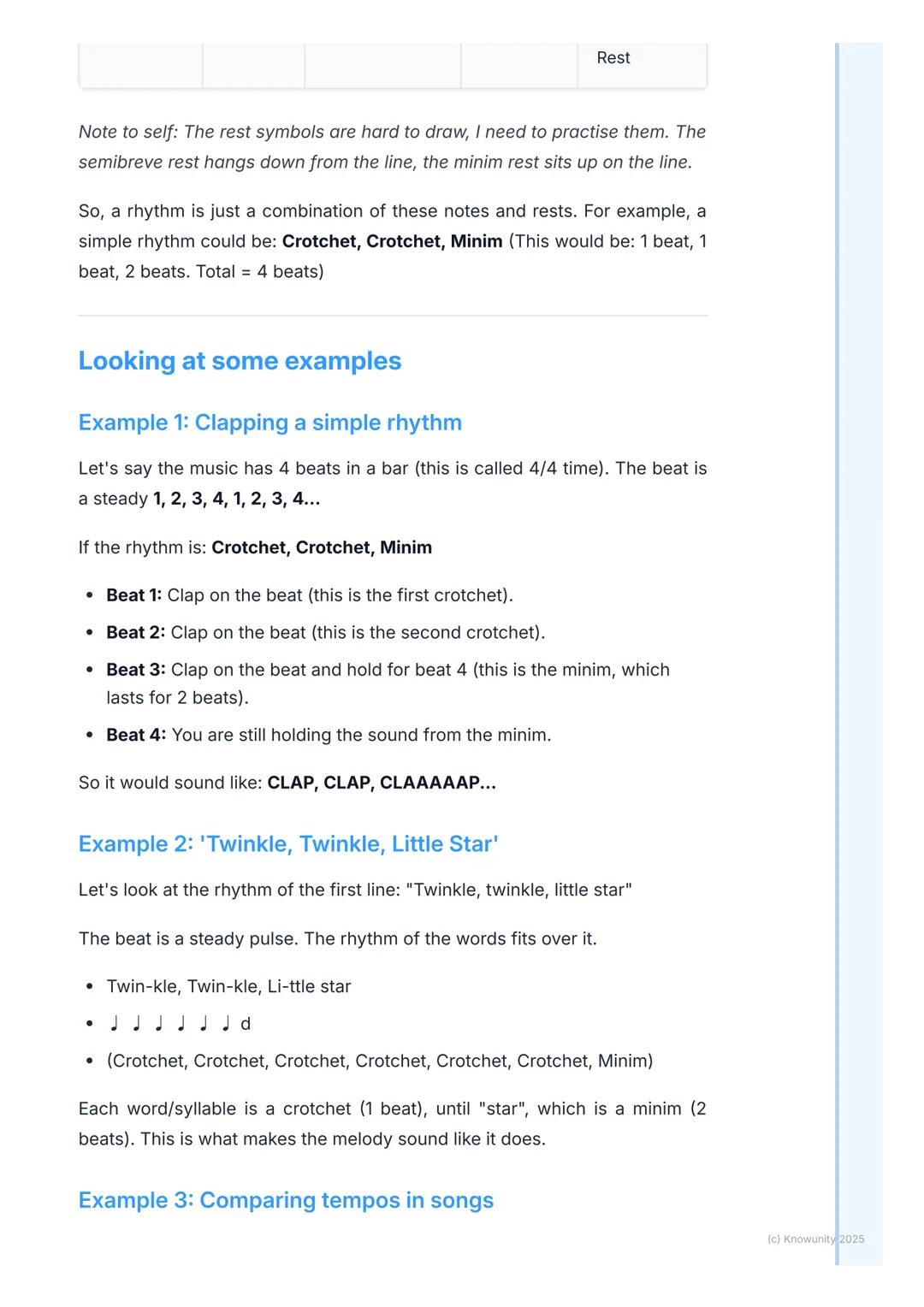
Putting It All Together
Let's see how this works with something you know. In "Twinkle, Twinkle, Little Star", each syllable gets one beat (crotchet), but "star" gets stretched out for two beats (minim). That's why it sounds complete at the end of the line.
When you're clapping rhythms, keep your foot tapping the steady beat whilst your hands clap the rhythm pattern. It's like patting your head and rubbing your stomach - tricky at first, but brilliant once you've got it!
Most popular music uses 4/4 time, which means there are 4 beats in each section (called a bar). Count along: 1, 2, 3, 4, 1, 2, 3, 4... and you'll hear how songs are organised into these groups.
Practice Tip: Try clapping simple patterns like "clap, clap, clap-hold-hold, clap" whilst keeping your foot tapping steadily - this builds your rhythm skills!
5
of 5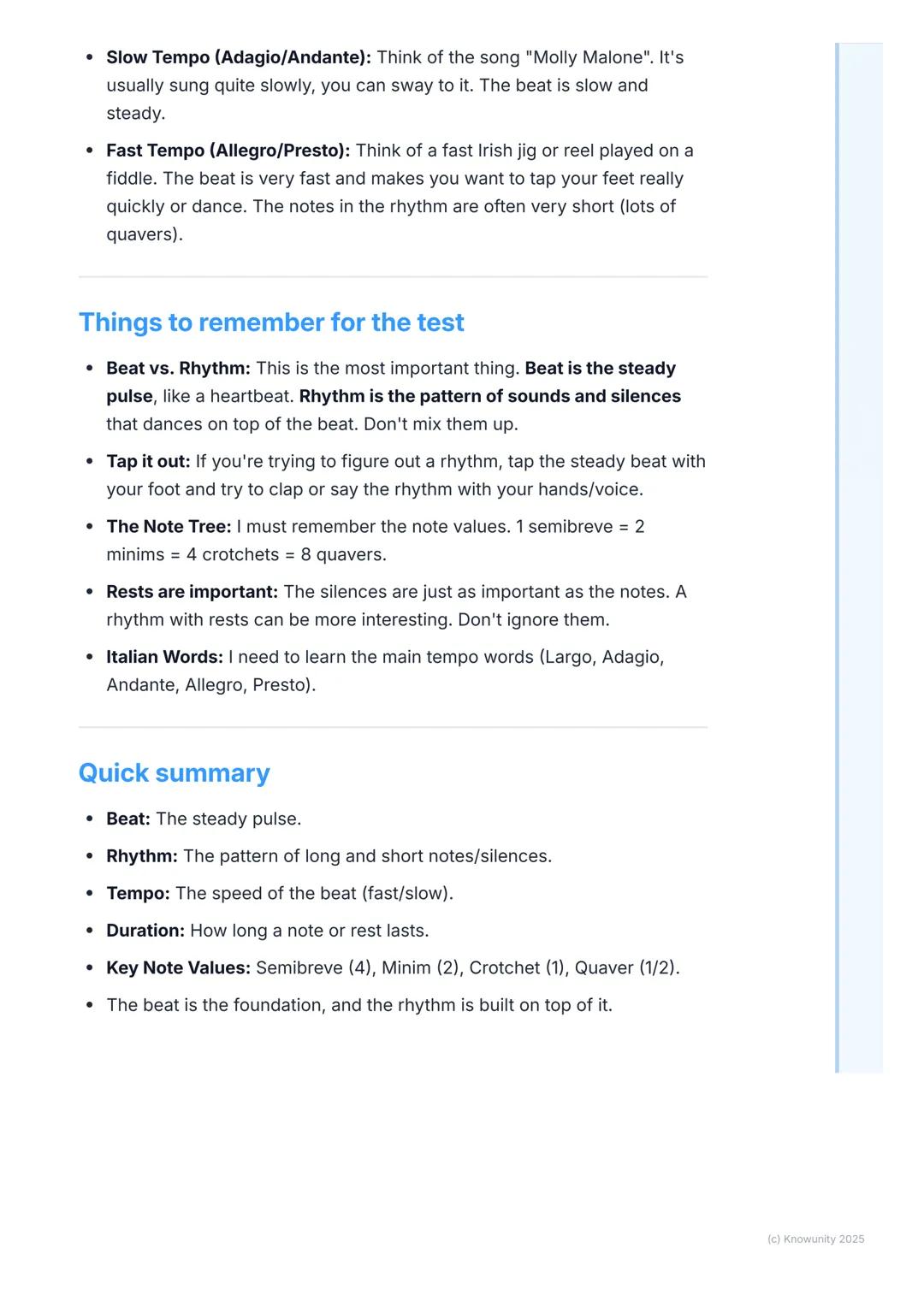
Test Success Tips
The most important thing to remember is that beat and rhythm are different. Beat = steady pulse (like your heartbeat), rhythm = the exciting pattern on top. Mix these up and you'll lose marks, so drill this difference into your brain!
For your exams, practice the note value relationships. Know that a semibreve equals 4 crotchets, and be able to work out simple rhythm patterns. The Italian tempo terms pop up regularly, so memorise Largo through to Presto.
Don't forget about rests - they're not just empty space, they're crucial parts of rhythms that create interest and breathing room. Many students ignore rests in exams and miss easy marks.
Exam Strategy: If you're stuck on a rhythm question, tap out the beat first, then work out where the sounds and silences fit over that steady pulse.
Si on te demande...
Qu'est-ce que le compagnon IA de Knowunity ?
Notre compagnon IA est spécialement conçu pour répondre aux besoins des étudiants. Sur la base des millions d'éléments de contenu que nous avons sur la plateforme, nous pouvons fournir des réponses vraiment significatives et pertinentes aux étudiants. Mais il ne s'agit pas seulement de réponses, le compagnon a encore plus pour but de guider les élèves dans leurs défis d'apprentissage quotidiens, avec des plans d'étude personnalisés, des quiz ou des éléments de contenu dans le chat et une personnalisation à 100% basée sur les compétences et les développements de l'étudiant.
Où puis-je télécharger l'appli Knowunity ?
Tu peux télécharger l'application dans Google Play Store et dans l'App Store d'Apple.
L'application est-elle vraiment gratuite ?
Oui, tu as un accès entièrement gratuit à tous les contenus de l'appli, tu peux chatter ou suivre les créateurs à tout moment. De plus, nous proposons Knowunity Premium, qui te permet de réviser sans limites!
Contenus les plus populaires en Music
1Contenus les plus populaires
9Rien ne te convient ? Explore d'autres matières.
Les étudiants nous adorent — il ne manque plus que toi.
4.6/5App Store
4.7/5Google Play
L'application est très facile d'utilisation et bien conçue. Jusqu'à présent, j'ai trouvé tout ce que je cherchais et j'ai pu apprendre beaucoup de choses grâce aux présentations ! Je vais certainement utiliser l'application pour un travail en classe ! Et comme source d'inspiration personnelle, elle est bien sûr aussi très utile.
Stefan Sutilisateur iOS
Cette application est vraiment super. Il y a tellement de fiches de révision et d'aide, [...]. Par exemple, la matière qui me pose problème est le français et l'appli a un choix d'aide très large. Grâce à cette application, je me suis améliorée en français. Je la recommanderais à tout le monde.
Samantha Klichutilisatrice Android
Waouh, je suis vraiment abasourdi. J'ai essayé l'application parce que je l'avais déjà vue plusieurs fois dans la publicité et j'ai été absolument choquée. Cette appli est L'AIDE dont on rêve pour l'école et surtout, elle propose tellement de choses, comme des rédactions et des fiches qui m'ont personnellement TRÈS bien aidé.
Annautilisatrice iOS
Music5 vues·Mis à jour May 31, 2026·5 pagesUnderstanding Beat and Rhythm in Music
Ever wondered what makes your favourite songs so catchy? It's all about rhythm and beat - the musical elements that make you want to tap your feet and dance along. Understanding these concepts is like learning the secret language that... Affiche plus
1
of 5Inscris-toi pour voir le contenu. C'est gratuit!
- Accès à tous les documents
- Améliore tes notes
- Rejoins des millions d'étudiants
What Are Rhythm and Beat?
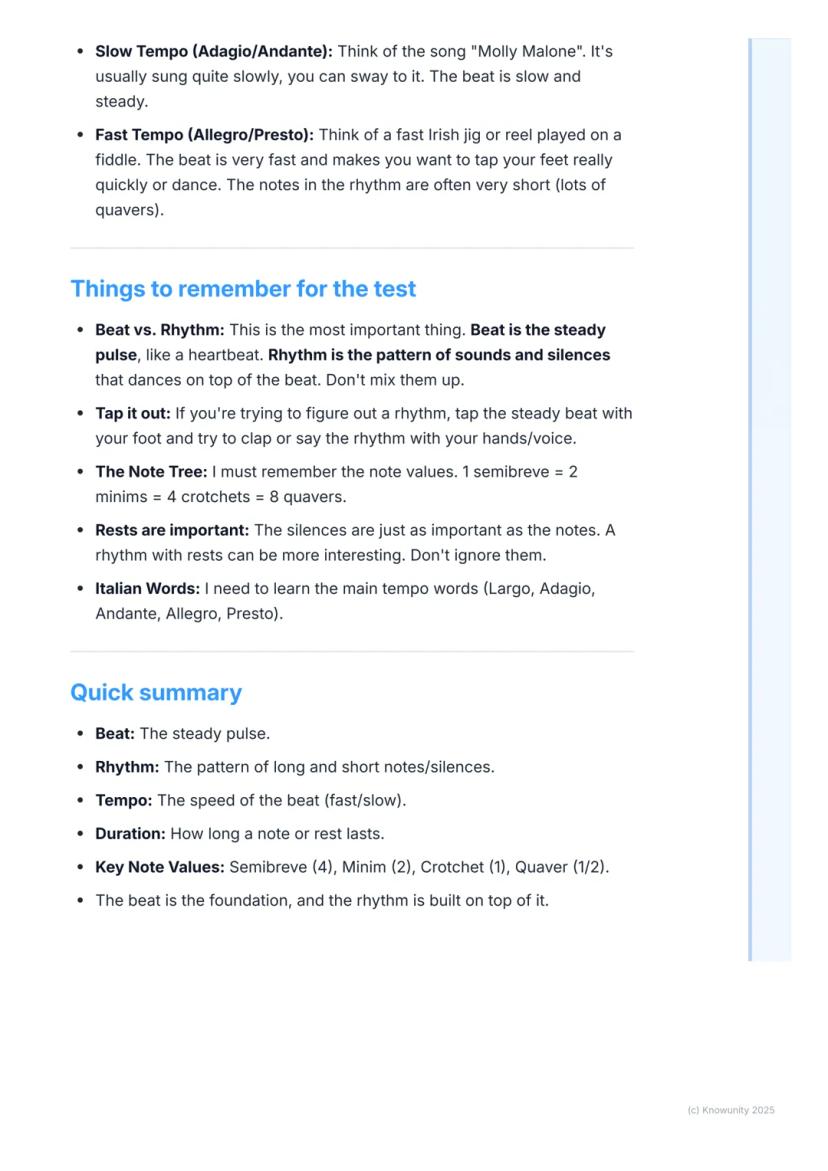
Think of music like a skeleton - the beat is the steady backbone that holds everything together, whilst the rhythm is the exciting pattern that dances on top. The beat is that steady pulse you naturally tap your foot to, just like a clock ticking away. It never changes and keeps everything organised.
Rhythm is much more interesting - it's the pattern of long and short sounds (plus the silences) that make each song unique. When you combine beat and rhythm, you get music that feels both steady and exciting at the same time.
Musicians use the beat to stay together when playing, which is why bands don't fall apart on stage! The pulse is just another word for beat, so don't get confused if you see both terms.
Quick Tip: Try listening to any song and tapping your foot - that steady tap is the beat, whilst everything else happening is the rhythm!
2
of 5Inscris-toi pour voir le contenu. C'est gratuit!
- Accès à tous les documents
- Améliore tes notes
- Rejoins des millions d'étudiants
Understanding Tempo
Tempo simply means how fast or slow the music goes. Musicians use fancy Italian words to describe different speeds, but they're actually quite logical once you think about them as different types of walking.
Largo means very slow - imagine walking sadly after losing a match. Adagio is slow like a calm, peaceful walk. Andante feels like your normal walking pace to school. Allegro is fast and lively, like rushing to meet your mates. Presto is super fast - basically running!
Here's the cool bit: tempo can change during a song to create excitement. When music speeds up, it's called accelerando. When it slows down, it's called ritardando. Think about how film music builds up during action scenes!
Remember This: Most Irish jigs are Allegro or Presto, whilst traditional ballads like "Molly Malone" are usually Andante or Adagio.
3
of 5Inscris-toi pour voir le contenu. C'est gratuit!
- Accès à tous les documents
- Améliore tes notes
- Rejoins des millions d'étudiants
Note Values and Duration
This is where rhythm gets its building blocks. Different notes last for different amounts of time - some are long, some are short. Think of it like a family tree where each note is exactly half the length of the one above it.
A semibreve lasts for 4 beats (the longest), a minim lasts for 2 beats, a crotchet lasts for 1 beat, and a quaver lasts for half a beat. It's like cutting a pizza in half, then in half again!
Rests are the silent gaps in music, and they're just as important as the notes themselves. Each note has a matching rest that lasts the same amount of time. The silences often make rhythms more interesting than constant noise would.
Memory Trick: Remember "1 semibreve = 2 minims = 4 crotchets = 8 quavers" - it's like a mathematical pattern that never changes!
4
of 5Inscris-toi pour voir le contenu. C'est gratuit!
- Accès à tous les documents
- Améliore tes notes
- Rejoins des millions d'étudiants
Putting It All Together
Let's see how this works with something you know. In "Twinkle, Twinkle, Little Star", each syllable gets one beat (crotchet), but "star" gets stretched out for two beats (minim). That's why it sounds complete at the end of the line.
When you're clapping rhythms, keep your foot tapping the steady beat whilst your hands clap the rhythm pattern. It's like patting your head and rubbing your stomach - tricky at first, but brilliant once you've got it!
Most popular music uses 4/4 time, which means there are 4 beats in each section (called a bar). Count along: 1, 2, 3, 4, 1, 2, 3, 4... and you'll hear how songs are organised into these groups.
Practice Tip: Try clapping simple patterns like "clap, clap, clap-hold-hold, clap" whilst keeping your foot tapping steadily - this builds your rhythm skills!
5
of 5Inscris-toi pour voir le contenu. C'est gratuit!
- Accès à tous les documents
- Améliore tes notes
- Rejoins des millions d'étudiants
Test Success Tips
The most important thing to remember is that beat and rhythm are different. Beat = steady pulse (like your heartbeat), rhythm = the exciting pattern on top. Mix these up and you'll lose marks, so drill this difference into your brain!
For your exams, practice the note value relationships. Know that a semibreve equals 4 crotchets, and be able to work out simple rhythm patterns. The Italian tempo terms pop up regularly, so memorise Largo through to Presto.
Don't forget about rests - they're not just empty space, they're crucial parts of rhythms that create interest and breathing room. Many students ignore rests in exams and miss easy marks.
Exam Strategy: If you're stuck on a rhythm question, tap out the beat first, then work out where the sounds and silences fit over that steady pulse.
Si on te demande...
Qu'est-ce que le compagnon IA de Knowunity ?
Notre compagnon IA est spécialement conçu pour répondre aux besoins des étudiants. Sur la base des millions d'éléments de contenu que nous avons sur la plateforme, nous pouvons fournir des réponses vraiment significatives et pertinentes aux étudiants. Mais il ne s'agit pas seulement de réponses, le compagnon a encore plus pour but de guider les élèves dans leurs défis d'apprentissage quotidiens, avec des plans d'étude personnalisés, des quiz ou des éléments de contenu dans le chat et une personnalisation à 100% basée sur les compétences et les développements de l'étudiant.
Où puis-je télécharger l'appli Knowunity ?
Tu peux télécharger l'application dans Google Play Store et dans l'App Store d'Apple.
L'application est-elle vraiment gratuite ?
Oui, tu as un accès entièrement gratuit à tous les contenus de l'appli, tu peux chatter ou suivre les créateurs à tout moment. De plus, nous proposons Knowunity Premium, qui te permet de réviser sans limites!
Contenus les plus populaires en Music
1Contenus les plus populaires
9Rien ne te convient ? Explore d'autres matières.
Les étudiants nous adorent — il ne manque plus que toi.
4.6/5App Store
4.7/5Google Play
L'application est très facile d'utilisation et bien conçue. Jusqu'à présent, j'ai trouvé tout ce que je cherchais et j'ai pu apprendre beaucoup de choses grâce aux présentations ! Je vais certainement utiliser l'application pour un travail en classe ! Et comme source d'inspiration personnelle, elle est bien sûr aussi très utile.
Stefan Sutilisateur iOS
Cette application est vraiment super. Il y a tellement de fiches de révision et d'aide, [...]. Par exemple, la matière qui me pose problème est le français et l'appli a un choix d'aide très large. Grâce à cette application, je me suis améliorée en français. Je la recommanderais à tout le monde.
Samantha Klichutilisatrice Android
Waouh, je suis vraiment abasourdi. J'ai essayé l'application parce que je l'avais déjà vue plusieurs fois dans la publicité et j'ai été absolument choquée. Cette appli est L'AIDE dont on rêve pour l'école et surtout, elle propose tellement de choses, comme des rédactions et des fiches qui m'ont personnellement TRÈS bien aidé.
Annautilisatrice iOS