
Ever wondered how your phone calculates arrival times for journeys,... Affiche plus
 Physics10 vues·Mis à jour May 19, 2026·6 pages
Understanding Speed, Distance, and Time Made Simple
1 / 6
1
of 6
Understanding Motion: The Basics
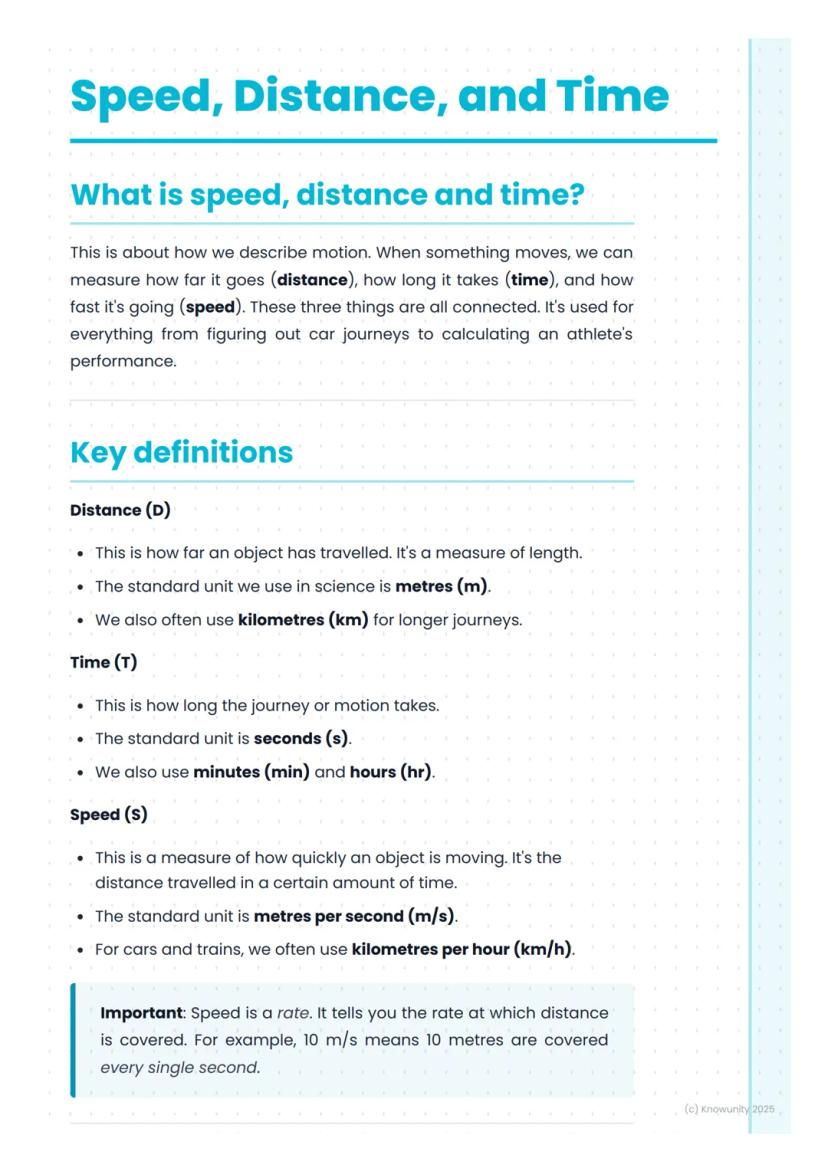
When anything moves - whether it's you cycling to school or a car on the motorway - we can describe that motion using three key measurements. Distance tells us how far something has travelled, measured in metres (m) or kilometres (km). Time shows us how long the journey took, measured in seconds (s), minutes, or hours.
Speed is where things get interesting - it's how quickly something moves by measuring distance covered in a specific time. We measure speed in metres per second or kilometres per hour . Think of speed as a rate: if something travels at 10 m/s, it covers 10 metres every single second.
Quick Tip: In science, we always use metres for distance, seconds for time, and metres per second for speed as our standard units. But for everyday situations like car journeys, kilometres and hours work better!
These three measurements are completely connected - change one, and you affect the others. That's what makes motion calculations so useful and powerful.
2
of 6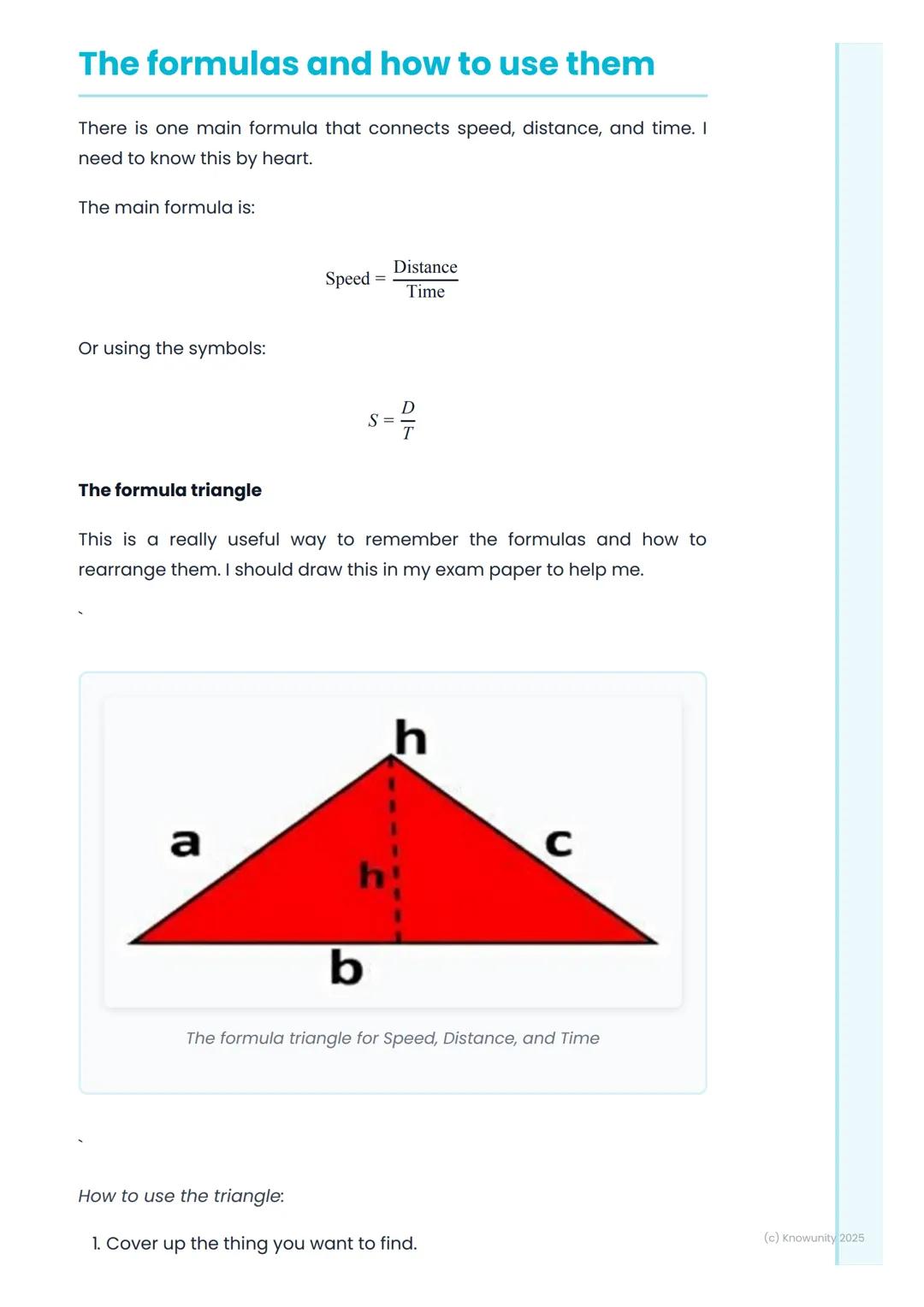
The Magic Formula Triangle
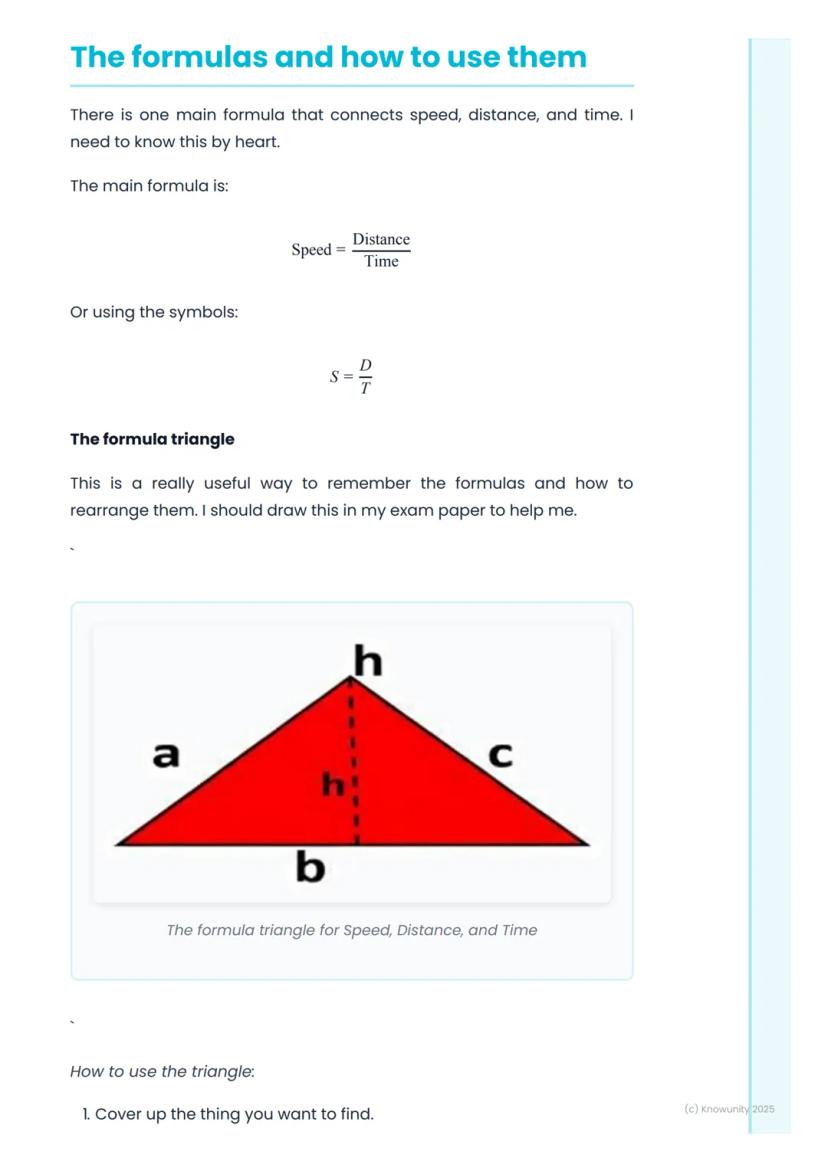
Here's the formula that connects everything: Speed = Distance ÷ Time, or S = D/T. But there's a brilliant trick called the formula triangle that makes rearranging this equation dead easy.
Draw a triangle with D at the top, and S and T at the bottom. To find any value, simply cover it up with your finger. The position of the remaining letters shows you exactly what to do.
Need distance? Cover D - you see S and T side by side, so D = S × T. Want to find time? Cover T - you see D over S, so T = D/S. Looking for speed? Cover S - you see D over T, so S = D/T.
Exam Hack: Always draw this triangle on your test paper first. It prevents formula mix-ups and shows the examiner you know what you're doing!
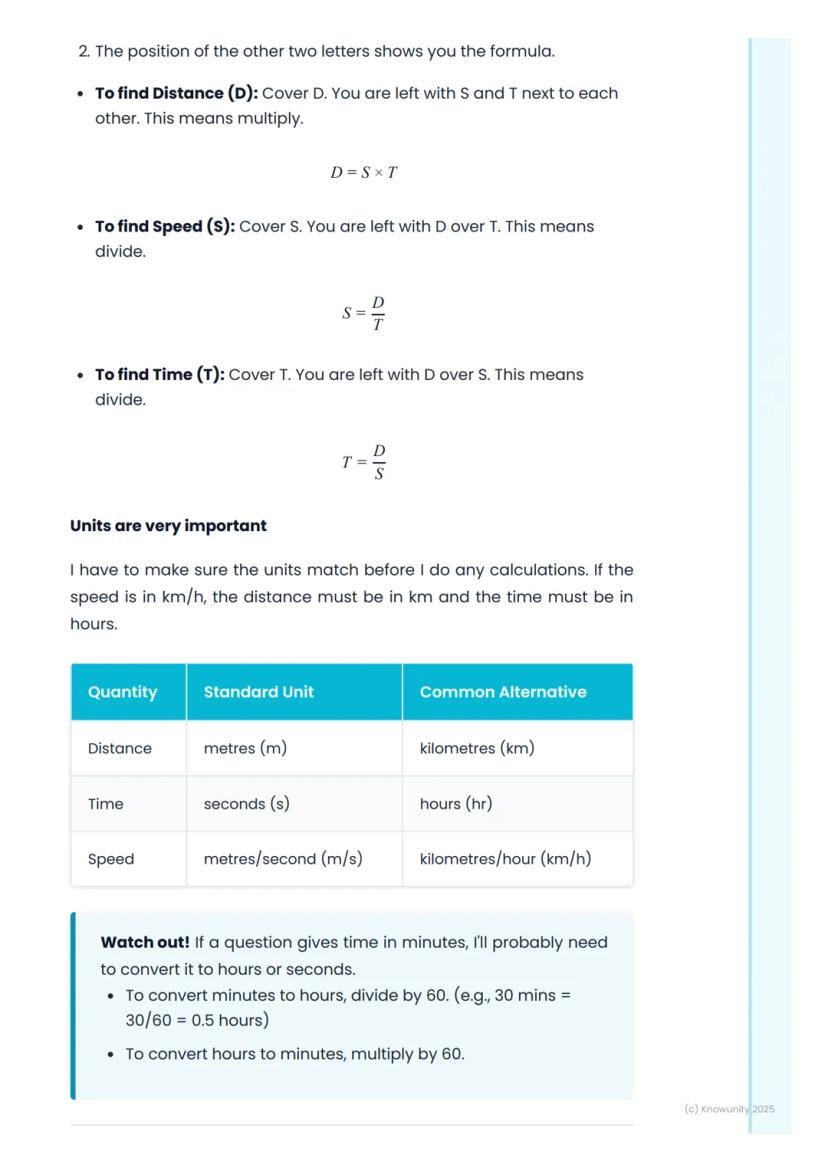
Remember: units must match perfectly before you calculate anything. If speed is in km/h, then distance needs to be in km and time in hours.
3
of 6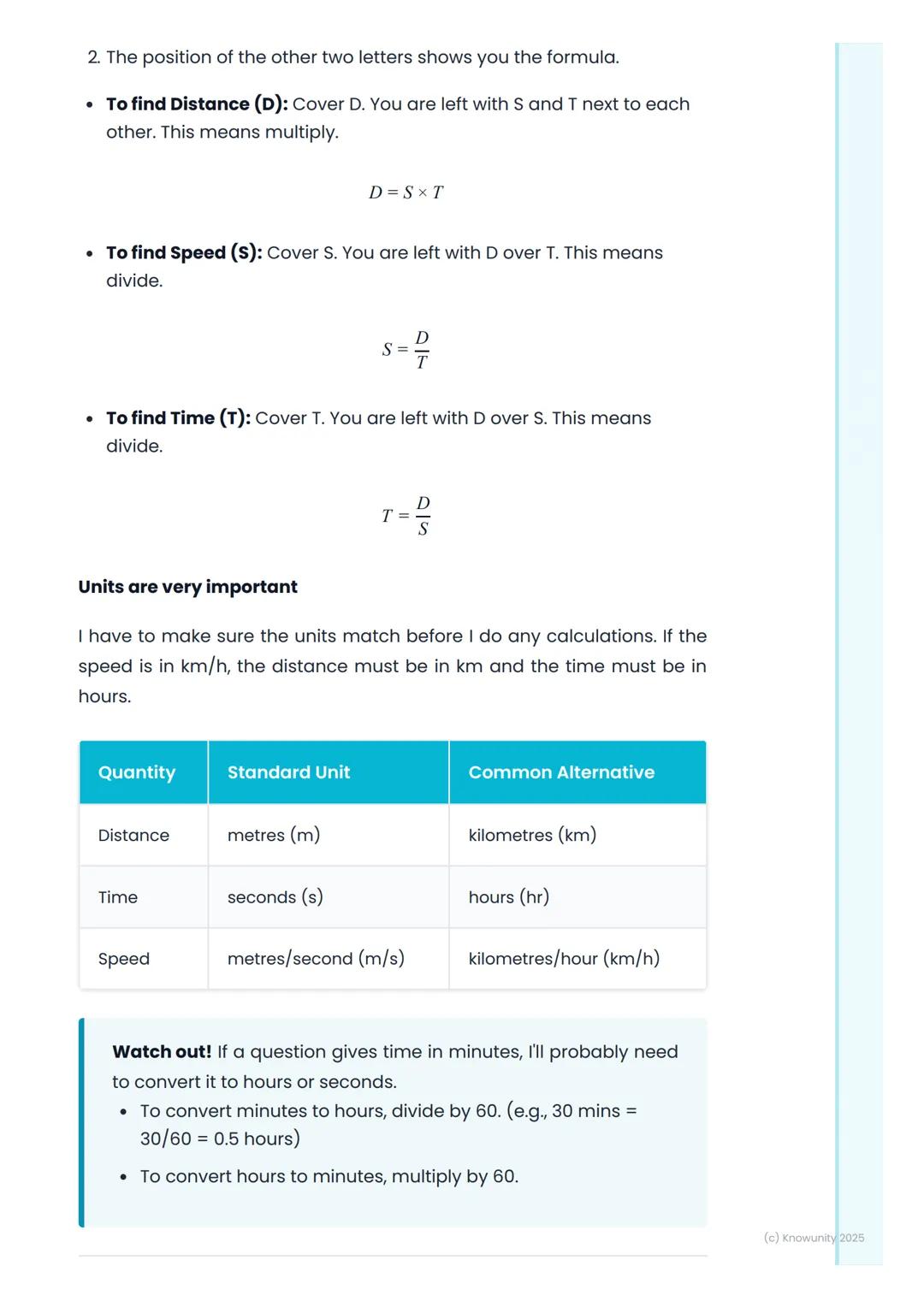
Getting Units Right Every Time
Units will make or break your calculations - they're the most common place students lose marks. Before doing any calculation, check that your units work together properly.
If you're working with km/h speeds, use kilometres for distance and hours for time. For m/s speeds, stick with metres and seconds. When questions give you minutes, you'll usually need to convert: divide by 60 to get hours or multiply by 60 to get from hours to minutes.
Here's what commonly trips people up: mixing units without converting first. See a speed in km/h but time in minutes? Convert the time to hours before calculating. It's this attention to detail that separates top students from everyone else.
Watch Out: Questions often give time in minutes just to test if you'll convert properly. Don't rush - take that extra moment to check your units match!
Always write your final answer with the correct units. A number without units is like a sentence without a full stop - it's incomplete.
4
of 6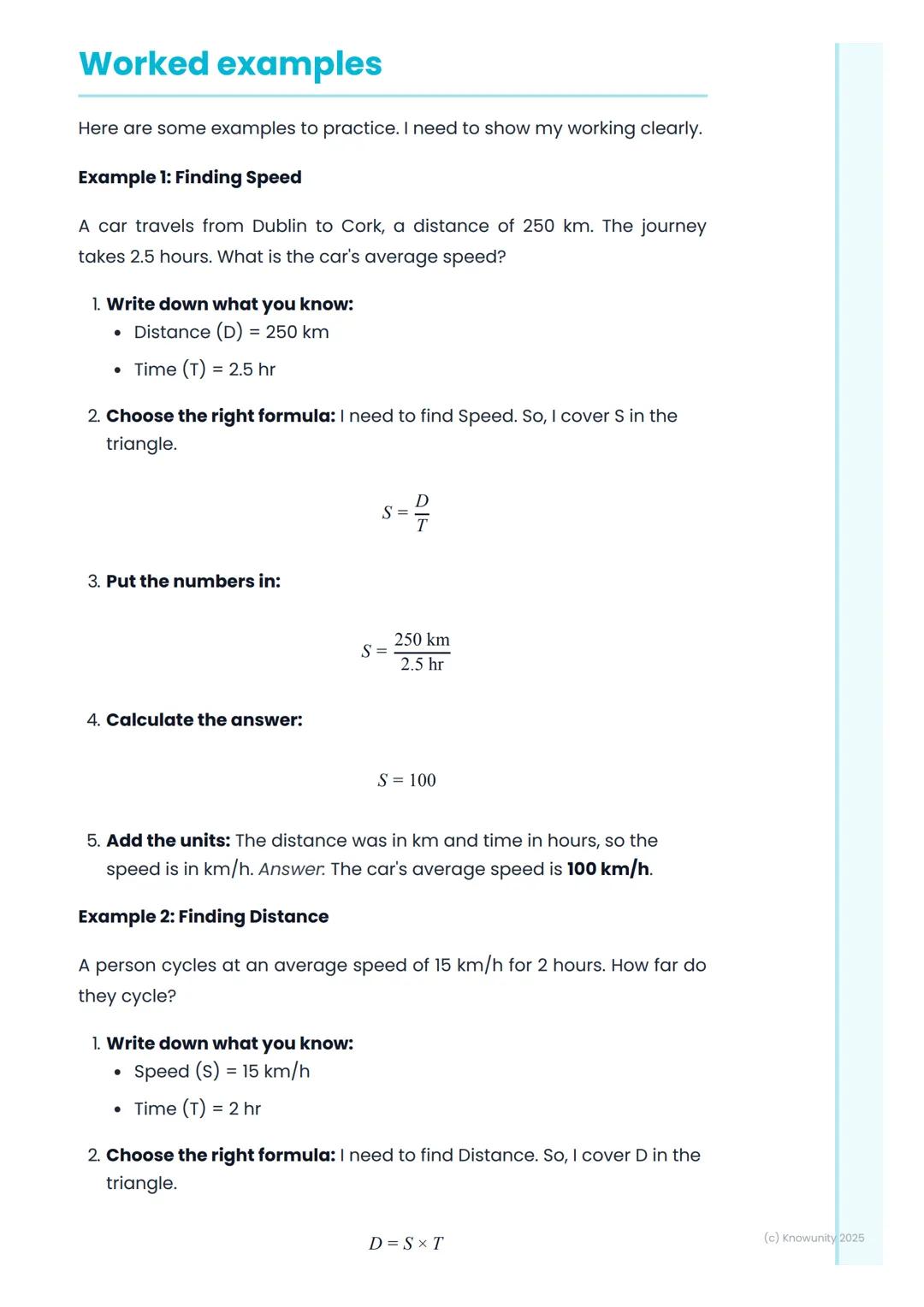
Real-World Example: Finding Speed
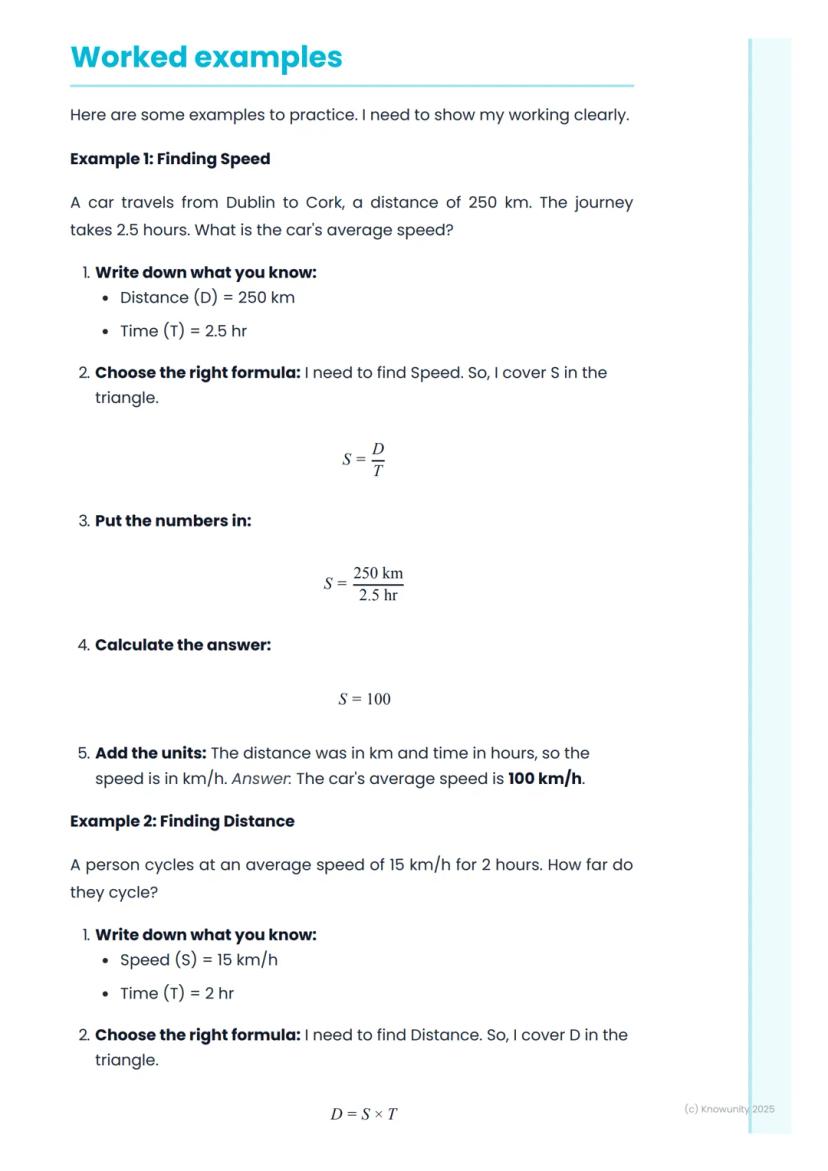
Let's work through a proper example that shows how these calculations work in practice. A car travels from Dublin to Cork - that's 250 km - and the journey takes 2.5 hours. What's the car's average speed?
Start by writing down what you know: Distance = 250 km, Time = 2.5 hours. Since you need speed, cover the S in your triangle. You're left with D over T, so S = D/T.
Substitute your numbers: S = 250 km ÷ 2.5 hr = 100. Add the units: since distance was in km and time in hours, speed is in km/h. Answer: 100 km/h.
Study Tip: Always show your working in this clear, step-by-step format. Even if your final answer is wrong, you can still pick up most of the marks for using the right method!
Notice we calculated average speed here. The car didn't travel at exactly 100 km/h the entire time - it probably stopped at traffic lights and sped up on motorways. The formula gives us the overall average for the complete journey.
5
of 6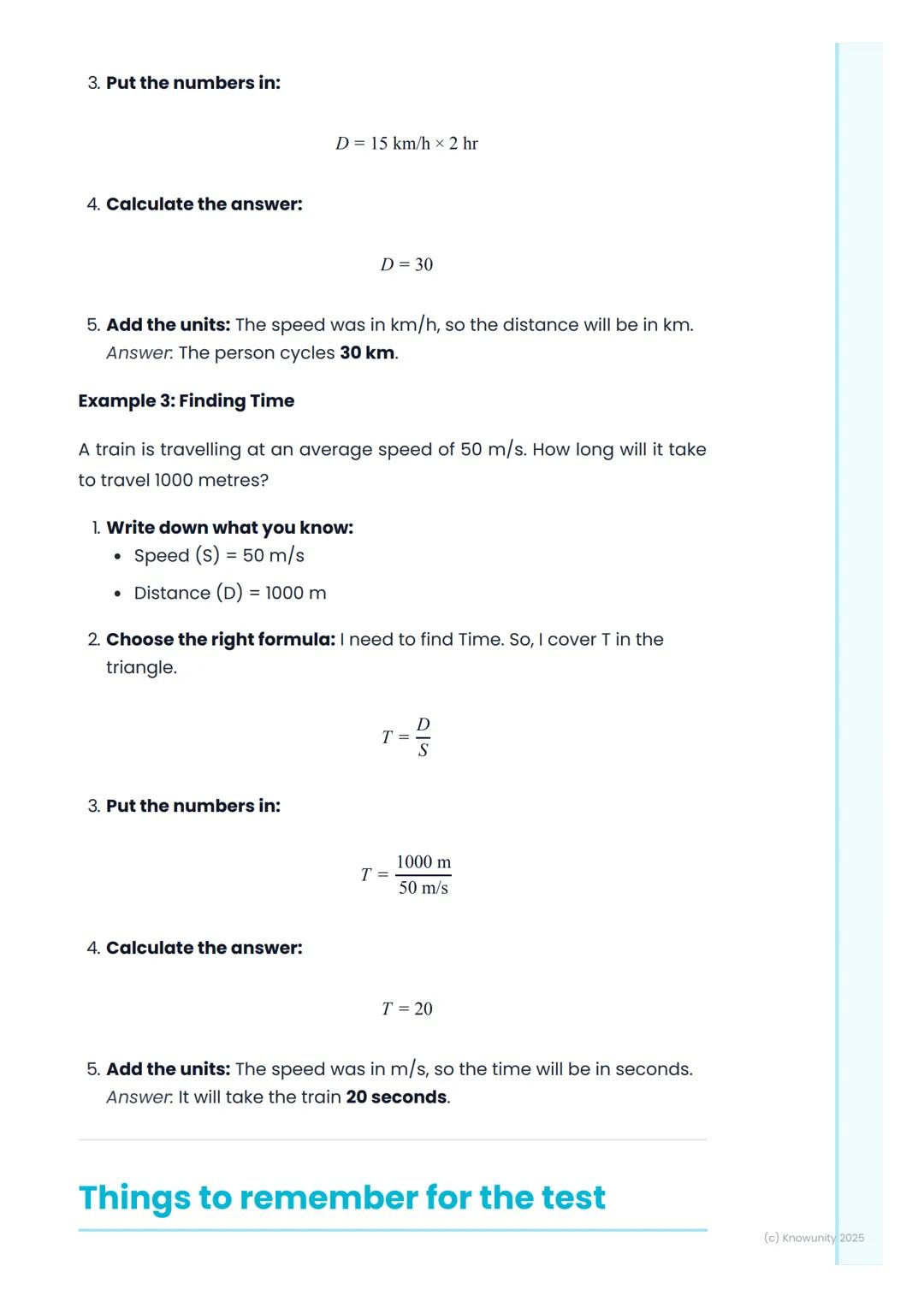
Calculating Distance and Time
Finding distance is straightforward when you know speed and time. If someone cycles at 15 km/h for 2 hours, how far do they travel? Cover D in your triangle - you see S and T side by side, so D = S × T.
Calculate: D = 15 km/h × 2 hr = 30 km. The person cycles 30 kilometres total.
For time calculations, imagine a train travelling at 50 m/s needs to cover 1000 metres. Cover T in the triangle - you see D over S, so T = D/S. Calculate: T = 1000 m ÷ 50 m/s = 20 seconds.
Notice how the units work out perfectly each time. When you multiply km/h by hours, the hours cancel out leaving just km. When you divide metres by m/s, you get seconds.
Confidence Booster: Once you understand the triangle method, these problems become almost automatic. Practice a few examples and you'll wonder why they ever seemed difficult!
The key is always writing down what you know first, then picking the right formula from your triangle.
6
of 6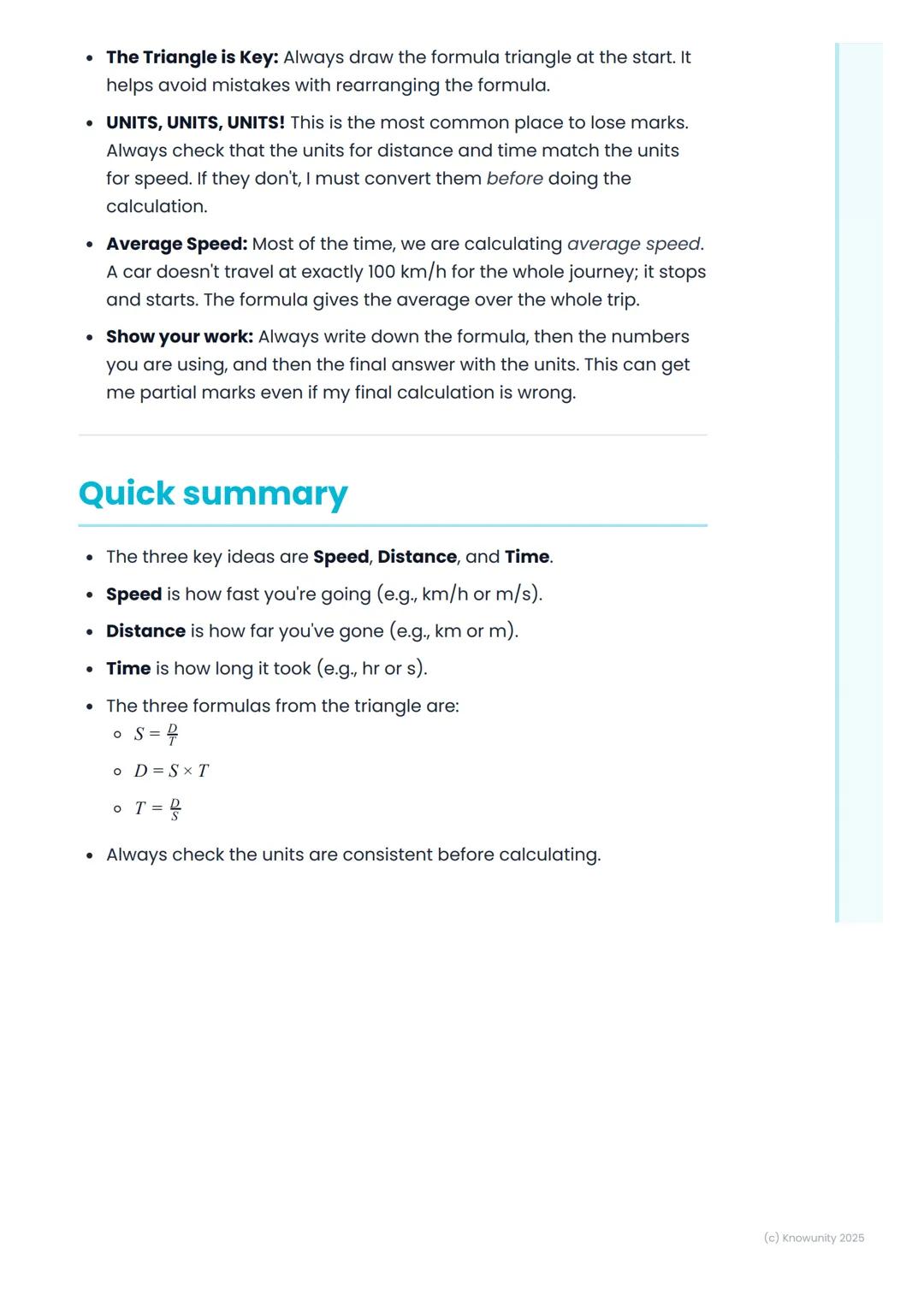
Test Success Strategy
Here's your winning approach for any speed, distance, and time question. Always draw the triangle first - it shows you're organised and prevents costly formula errors.
Check your units obsessively. If they don't match the speed format, convert them before calculating. Write down the formula, substitute your numbers clearly, then calculate your answer with proper units.
Remember that most real-world problems involve average speed rather than constant speed. Your phone's GPS calculates average speed when estimating journey times, accounting for traffic, stops, and speed changes.
The three essential formulas from your triangle:
- S = D/T (speed equals distance divided by time)
- D = S × T (distance equals speed times time)
- T = D/S (time equals distance divided by speed)
Final Tip: Even if your calculation goes wrong, clear working can earn you most of the marks. Show every step and you'll succeed!
Master these concepts and you'll find motion problems become routine. Whether you're calculating how long your commute takes or figuring out an athlete's performance, these skills apply everywhere.
Si on te demande...
Qu'est-ce que le compagnon IA de Knowunity ?
Notre compagnon IA est spécialement conçu pour répondre aux besoins des étudiants. Sur la base des millions d'éléments de contenu que nous avons sur la plateforme, nous pouvons fournir des réponses vraiment significatives et pertinentes aux étudiants. Mais il ne s'agit pas seulement de réponses, le compagnon a encore plus pour but de guider les élèves dans leurs défis d'apprentissage quotidiens, avec des plans d'étude personnalisés, des quiz ou des éléments de contenu dans le chat et une personnalisation à 100% basée sur les compétences et les développements de l'étudiant.
Où puis-je télécharger l'appli Knowunity ?
Tu peux télécharger l'application dans Google Play Store et dans l'App Store d'Apple.
L'application est-elle vraiment gratuite ?
Oui, tu as un accès entièrement gratuit à tous les contenus de l'appli, tu peux chatter ou suivre les créateurs à tout moment. De plus, nous proposons Knowunity Premium, qui te permet de réviser sans limites!
Contenus les plus populaires en Physics
2PhysicsBalanced and Unbalanced Forces
Students will explore how balanced forces result in no change in motion, while unbalanced forces cause an object to accelerate or change direction.
2nd Year421
PhysicsTypes of Forces
Students will identify common forces such as gravity (pulling objects down), friction (opposing motion), and air resistance (slowing objects in the air).
2nd Year460
Contenus les plus populaires
9 Irish
IrishIrish oral questions and answers
Questions and answers for the leaving cert oral
5th Year4254
IrishIrish oral questions
Outline of oral questions
5th Year2055
 English
Key Quotes : Sive
Key Quotes and explanations: Sive
6th Year2822
IrishIníon- le hÁine Durkin
Aine Durkin’s poem, Iníon: Themes & summary
5th Year850
IrishIrish poetry 2027
Iníon + Dínit an Bhróin
5th Year1133
IrishLC HL notes- Iníon (poem)
Includes poem in English and Irish, theme, key words & phrases
5th Year2284
IrishGaeilge Grammar Office
All the basics you need to know on Irish grammar.
6th Year1013
EnglishCultural Context : Shawshank Redemption : Sive : Small Things Like These
Comparative Study : Cultural Context : Shawshank Redemption, Sive and Small Things Like These
6th Year1420
IrishAn Gaeilge Aiste
Irish Language essay
6th Year1310
Rien ne te convient ? Explore d'autres matières.
Les étudiants nous adorent — il ne manque plus que toi.
4.6/5App Store
4.7/5Google Play
L'application est très facile d'utilisation et bien conçue. Jusqu'à présent, j'ai trouvé tout ce que je cherchais et j'ai pu apprendre beaucoup de choses grâce aux présentations ! Je vais certainement utiliser l'application pour un travail en classe ! Et comme source d'inspiration personnelle, elle est bien sûr aussi très utile.
Stefan Sutilisateur iOS
Cette application est vraiment super. Il y a tellement de fiches de révision et d'aide, [...]. Par exemple, la matière qui me pose problème est le français et l'appli a un choix d'aide très large. Grâce à cette application, je me suis améliorée en français. Je la recommanderais à tout le monde.
Samantha Klichutilisatrice Android
Waouh, je suis vraiment abasourdi. J'ai essayé l'application parce que je l'avais déjà vue plusieurs fois dans la publicité et j'ai été absolument choquée. Cette appli est L'AIDE dont on rêve pour l'école et surtout, elle propose tellement de choses, comme des rédactions et des fiches qui m'ont personnellement TRÈS bien aidé.
Annautilisatrice iOS
Physics10 vues·Mis à jour May 19, 2026·6 pagesUnderstanding Speed, Distance, and Time Made Simple
Ever wondered how your phone calculates arrival times for journeys, or how athletes track their performance? It's all about understanding the relationship between speed, distance, and time - three connected measurements that describe motion in our everyday world.
1
of 6Inscris-toi pour voir le contenu. C'est gratuit!
- Accès à tous les documents
- Améliore tes notes
- Rejoins des millions d'étudiants
Understanding Motion: The Basics
When anything moves - whether it's you cycling to school or a car on the motorway - we can describe that motion using three key measurements. Distance tells us how far something has travelled, measured in metres (m) or kilometres (km). Time shows us how long the journey took, measured in seconds (s), minutes, or hours.
Speed is where things get interesting - it's how quickly something moves by measuring distance covered in a specific time. We measure speed in metres per second or kilometres per hour . Think of speed as a rate: if something travels at 10 m/s, it covers 10 metres every single second.
Quick Tip: In science, we always use metres for distance, seconds for time, and metres per second for speed as our standard units. But for everyday situations like car journeys, kilometres and hours work better!
These three measurements are completely connected - change one, and you affect the others. That's what makes motion calculations so useful and powerful.
2
of 6Inscris-toi pour voir le contenu. C'est gratuit!
- Accès à tous les documents
- Améliore tes notes
- Rejoins des millions d'étudiants
The Magic Formula Triangle
Here's the formula that connects everything: Speed = Distance ÷ Time, or S = D/T. But there's a brilliant trick called the formula triangle that makes rearranging this equation dead easy.
Draw a triangle with D at the top, and S and T at the bottom. To find any value, simply cover it up with your finger. The position of the remaining letters shows you exactly what to do.
Need distance? Cover D - you see S and T side by side, so D = S × T. Want to find time? Cover T - you see D over S, so T = D/S. Looking for speed? Cover S - you see D over T, so S = D/T.
Exam Hack: Always draw this triangle on your test paper first. It prevents formula mix-ups and shows the examiner you know what you're doing!
Remember: units must match perfectly before you calculate anything. If speed is in km/h, then distance needs to be in km and time in hours.
3
of 6Inscris-toi pour voir le contenu. C'est gratuit!
- Accès à tous les documents
- Améliore tes notes
- Rejoins des millions d'étudiants
Getting Units Right Every Time
Units will make or break your calculations - they're the most common place students lose marks. Before doing any calculation, check that your units work together properly.
If you're working with km/h speeds, use kilometres for distance and hours for time. For m/s speeds, stick with metres and seconds. When questions give you minutes, you'll usually need to convert: divide by 60 to get hours or multiply by 60 to get from hours to minutes.
Here's what commonly trips people up: mixing units without converting first. See a speed in km/h but time in minutes? Convert the time to hours before calculating. It's this attention to detail that separates top students from everyone else.
Watch Out: Questions often give time in minutes just to test if you'll convert properly. Don't rush - take that extra moment to check your units match!
Always write your final answer with the correct units. A number without units is like a sentence without a full stop - it's incomplete.
4
of 6Inscris-toi pour voir le contenu. C'est gratuit!
- Accès à tous les documents
- Améliore tes notes
- Rejoins des millions d'étudiants
Real-World Example: Finding Speed
Let's work through a proper example that shows how these calculations work in practice. A car travels from Dublin to Cork - that's 250 km - and the journey takes 2.5 hours. What's the car's average speed?
Start by writing down what you know: Distance = 250 km, Time = 2.5 hours. Since you need speed, cover the S in your triangle. You're left with D over T, so S = D/T.
Substitute your numbers: S = 250 km ÷ 2.5 hr = 100. Add the units: since distance was in km and time in hours, speed is in km/h. Answer: 100 km/h.
Study Tip: Always show your working in this clear, step-by-step format. Even if your final answer is wrong, you can still pick up most of the marks for using the right method!
Notice we calculated average speed here. The car didn't travel at exactly 100 km/h the entire time - it probably stopped at traffic lights and sped up on motorways. The formula gives us the overall average for the complete journey.
5
of 6Inscris-toi pour voir le contenu. C'est gratuit!
- Accès à tous les documents
- Améliore tes notes
- Rejoins des millions d'étudiants
Calculating Distance and Time
Finding distance is straightforward when you know speed and time. If someone cycles at 15 km/h for 2 hours, how far do they travel? Cover D in your triangle - you see S and T side by side, so D = S × T.
Calculate: D = 15 km/h × 2 hr = 30 km. The person cycles 30 kilometres total.
For time calculations, imagine a train travelling at 50 m/s needs to cover 1000 metres. Cover T in the triangle - you see D over S, so T = D/S. Calculate: T = 1000 m ÷ 50 m/s = 20 seconds.
Notice how the units work out perfectly each time. When you multiply km/h by hours, the hours cancel out leaving just km. When you divide metres by m/s, you get seconds.
Confidence Booster: Once you understand the triangle method, these problems become almost automatic. Practice a few examples and you'll wonder why they ever seemed difficult!
The key is always writing down what you know first, then picking the right formula from your triangle.
6
of 6Inscris-toi pour voir le contenu. C'est gratuit!
- Accès à tous les documents
- Améliore tes notes
- Rejoins des millions d'étudiants
Test Success Strategy
Here's your winning approach for any speed, distance, and time question. Always draw the triangle first - it shows you're organised and prevents costly formula errors.
Check your units obsessively. If they don't match the speed format, convert them before calculating. Write down the formula, substitute your numbers clearly, then calculate your answer with proper units.
Remember that most real-world problems involve average speed rather than constant speed. Your phone's GPS calculates average speed when estimating journey times, accounting for traffic, stops, and speed changes.
The three essential formulas from your triangle:
- S = D/T (speed equals distance divided by time)
- D = S × T (distance equals speed times time)
- T = D/S (time equals distance divided by speed)
Final Tip: Even if your calculation goes wrong, clear working can earn you most of the marks. Show every step and you'll succeed!
Master these concepts and you'll find motion problems become routine. Whether you're calculating how long your commute takes or figuring out an athlete's performance, these skills apply everywhere.
Si on te demande...
Qu'est-ce que le compagnon IA de Knowunity ?
Notre compagnon IA est spécialement conçu pour répondre aux besoins des étudiants. Sur la base des millions d'éléments de contenu que nous avons sur la plateforme, nous pouvons fournir des réponses vraiment significatives et pertinentes aux étudiants. Mais il ne s'agit pas seulement de réponses, le compagnon a encore plus pour but de guider les élèves dans leurs défis d'apprentissage quotidiens, avec des plans d'étude personnalisés, des quiz ou des éléments de contenu dans le chat et une personnalisation à 100% basée sur les compétences et les développements de l'étudiant.
Où puis-je télécharger l'appli Knowunity ?
Tu peux télécharger l'application dans Google Play Store et dans l'App Store d'Apple.
L'application est-elle vraiment gratuite ?
Oui, tu as un accès entièrement gratuit à tous les contenus de l'appli, tu peux chatter ou suivre les créateurs à tout moment. De plus, nous proposons Knowunity Premium, qui te permet de réviser sans limites!
Contenus les plus populaires en Physics
2PhysicsBalanced and Unbalanced Forces
Students will explore how balanced forces result in no change in motion, while unbalanced forces cause an object to accelerate or change direction.
2nd Year421
PhysicsTypes of Forces
Students will identify common forces such as gravity (pulling objects down), friction (opposing motion), and air resistance (slowing objects in the air).
2nd Year460
Contenus les plus populaires
9IrishIrish oral questions and answers
Questions and answers for the leaving cert oral
5th Year4254
IrishIrish oral questions
Outline of oral questions
5th Year2055
EnglishKey Quotes : Sive
Key Quotes and explanations: Sive
6th Year2822
IrishIníon- le hÁine Durkin
Aine Durkin’s poem, Iníon: Themes & summary
5th Year850
IrishIrish poetry 2027
Iníon + Dínit an Bhróin
5th Year1133
IrishLC HL notes- Iníon (poem)
Includes poem in English and Irish, theme, key words & phrases
5th Year2284
IrishGaeilge Grammar Office
All the basics you need to know on Irish grammar.
6th Year1013
EnglishCultural Context : Shawshank Redemption : Sive : Small Things Like These
Comparative Study : Cultural Context : Shawshank Redemption, Sive and Small Things Like These
6th Year1420
IrishAn Gaeilge Aiste
Irish Language essay
6th Year1310
Rien ne te convient ? Explore d'autres matières.
Les étudiants nous adorent — il ne manque plus que toi.
4.6/5App Store
4.7/5Google Play
L'application est très facile d'utilisation et bien conçue. Jusqu'à présent, j'ai trouvé tout ce que je cherchais et j'ai pu apprendre beaucoup de choses grâce aux présentations ! Je vais certainement utiliser l'application pour un travail en classe ! Et comme source d'inspiration personnelle, elle est bien sûr aussi très utile.
Stefan Sutilisateur iOS
Cette application est vraiment super. Il y a tellement de fiches de révision et d'aide, [...]. Par exemple, la matière qui me pose problème est le français et l'appli a un choix d'aide très large. Grâce à cette application, je me suis améliorée en français. Je la recommanderais à tout le monde.
Samantha Klichutilisatrice Android
Waouh, je suis vraiment abasourdi. J'ai essayé l'application parce que je l'avais déjà vue plusieurs fois dans la publicité et j'ai été absolument choquée. Cette appli est L'AIDE dont on rêve pour l'école et surtout, elle propose tellement de choses, comme des rédactions et des fiches qui m'ont personnellement TRÈS bien aidé.
Annautilisatrice iOS