
La spectrophotométrie UV-visible et loi de Beer-Lambertest une technique...
 Physique/Chimie997 vues·Mis à jour May 28, 2026·2 pages
Découvre la Spectroscopie UV-Visible et le Dosage Colorimétrique : Des Principes Simples pour les Enfants

mloof@mloof
1
of 2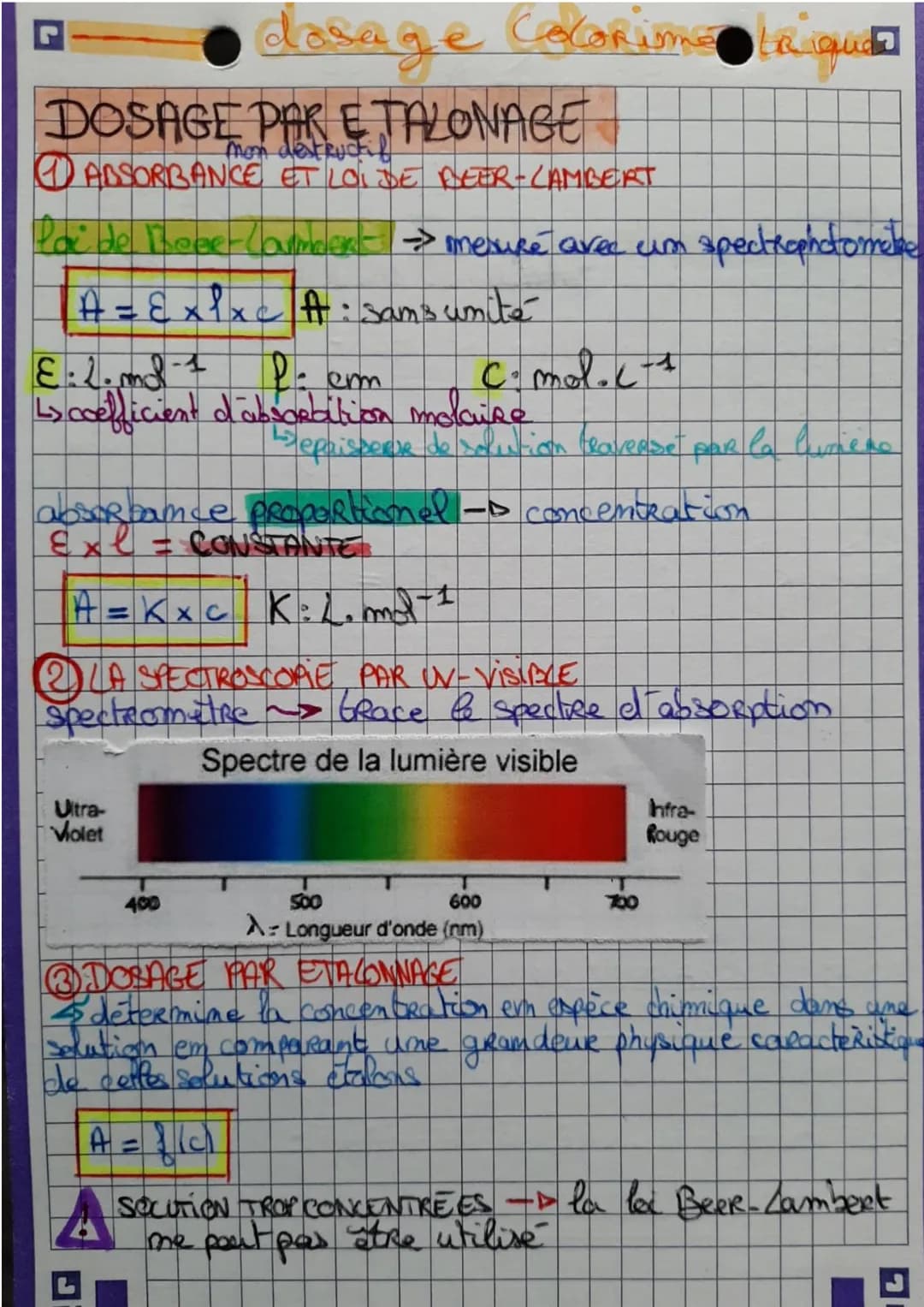
Titration Methods and Concentration Determination
This page focuses on titration techniques, particularly dosage colorimétrique (colorimetric titration), and the mathematical relationships used to determine concentrations.
Titration is described as a method to determine the quantity or concentration of a dissolved chemical species. The concept of equivalence point is introduced as a crucial aspect of titration.
Definition: The equivalence point in a titration is reached when the reactants are mixed in exact stoichiometric proportions, resulting in complete consumption of both the analyte and titrant.
For colorimetric titrations, the equivalence point is identified by a color change in the reaction mixture.
Example: In a titrage colorimétrique, the end point might be signaled by the solution turning from colorless to pink upon addition of a pH indicator like phenolphthalein.
The document presents the mathematical relationships used at the equivalence point:
- Before titration: n(A) = n(B)
- At equivalence: C_A × V_A = × C_B × V_E
Where:
- C_A and C_B are concentrations of reactants A and B
- V_A is the initial volume of A
- V_E is the volume of B added at equivalence
- a and b are stoichiometric coefficients
Highlight: The concentration of the titrated reactant can be calculated using the formula: C_A = × / V_A
This relationship allows for the determination of unknown concentrations based on the volumes and concentrations of known reactants.
Vocabulary: Titrage conductimétrique refers to a titration method where the endpoint is determined by measuring changes in the electrical conductivity of the solution.
The page emphasizes the importance of understanding these relationships for accurate quantitative analysis in chemistry.
2
of 2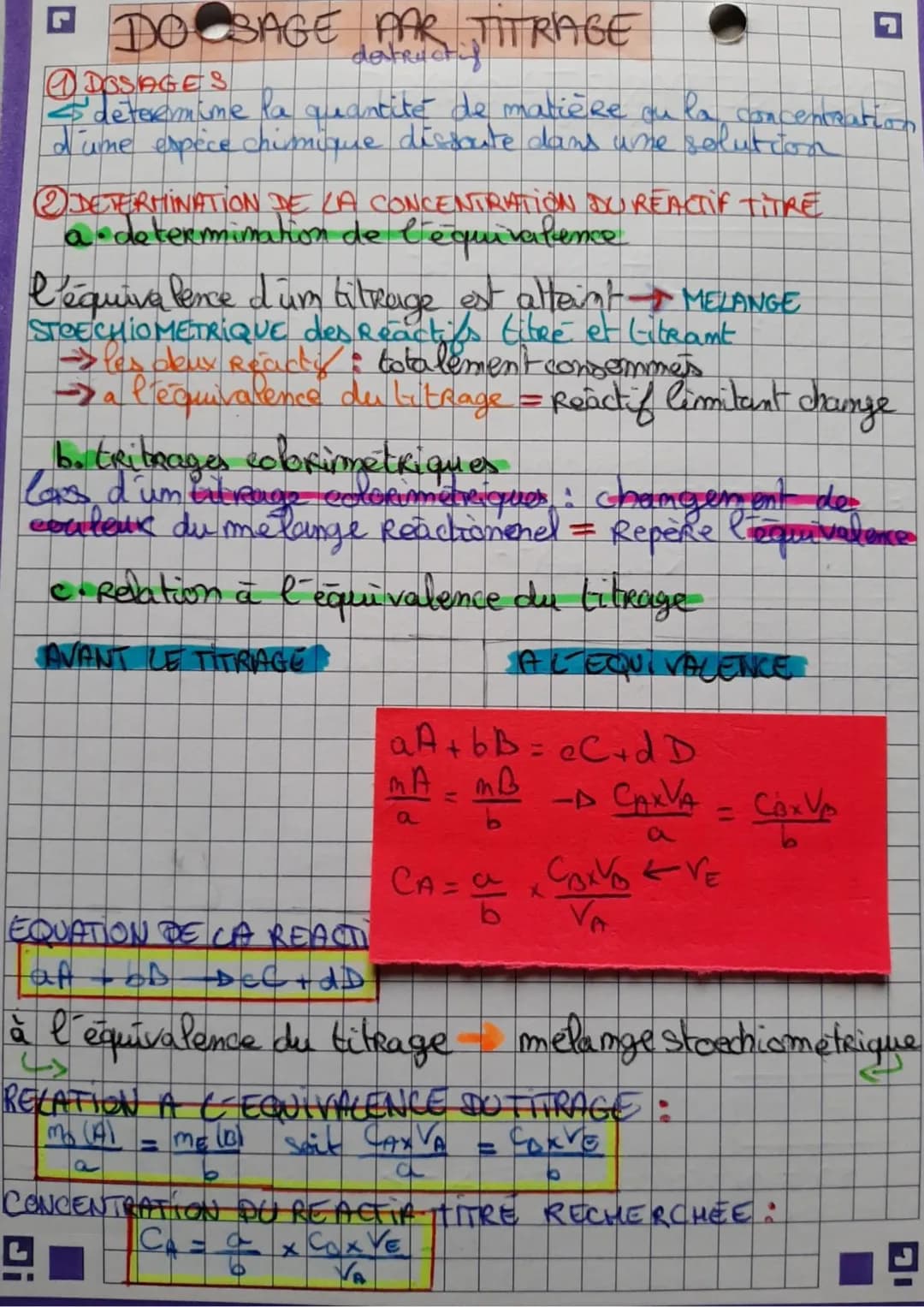
Dosage by Calibration and Beer-Lambert Law
This page introduces the fundamental concepts of dosage par étalonnage (calibration dosage) and spectrophotometry. The Beer-Lambert law is presented as the cornerstone of absorbance measurements.
The Beer-Lambert law is expressed as A = ε × l × c, where:
- A is absorbance (unitless)
- ε is the molar attenuation coefficient
- l is the path length of the sample (cm)
- c is the concentration of the absorbing species
Definition: The Beer-Lambert law states that the absorbance of a solution is directly proportional to the concentration of the absorbing species in the solution and the path length.
For constant path length and molar attenuation coefficient, the law simplifies to A = K × c, where K is a constant.
The document explains that spectrophotometry utilizes UV-visible light to measure absorption spectra of solutions. A diagram illustrates the visible light spectrum from 400 nm to 700 nm.
Highlight: Spectrophotometry is a powerful analytical technique that allows for quantitative determination of chemical species in solution based on their light absorption properties.
The principle of calibration dosage is introduced, which involves comparing a physical property (like absorbance) of an unknown solution to a series of standard solutions.
Vocabulary: Dosage par étalonnage refers to the analytical method of determining the concentration of a chemical species by comparing its physical properties to those of known standard solutions.
The document notes that the Beer-Lambert law has limitations and cannot be used for very concentrated solutions.
Si on te demande...
Qu'est-ce que le compagnon IA de Knowunity ?
Notre compagnon IA est spécialement conçu pour répondre aux besoins des étudiants. Sur la base des millions d'éléments de contenu que nous avons sur la plateforme, nous pouvons fournir des réponses vraiment significatives et pertinentes aux étudiants. Mais il ne s'agit pas seulement de réponses, le compagnon a encore plus pour but de guider les élèves dans leurs défis d'apprentissage quotidiens, avec des plans d'étude personnalisés, des quiz ou des éléments de contenu dans le chat et une personnalisation à 100% basée sur les compétences et les développements de l'étudiant.
Où puis-je télécharger l'appli Knowunity ?
Tu peux télécharger l'application dans Google Play Store et dans l'App Store d'Apple.
L'application est-elle vraiment gratuite ?
Oui, tu as un accès entièrement gratuit à tous les contenus de l'appli, tu peux chatter ou suivre les créateurs à tout moment. De plus, nous proposons Knowunity Premium, qui te permet de réviser sans limites!
Contenus similaires
Contenus les plus populaires : absorption
9Contenus les plus populaires en Physique/Chimie
9Contenus les plus populaires
9Rien ne te convient ? Explore d'autres matières.
Les étudiants nous adorent — il ne manque plus que toi.
4.6/5App Store
4.7/5Google Play
L'application est très facile d'utilisation et bien conçue. Jusqu'à présent, j'ai trouvé tout ce que je cherchais et j'ai pu apprendre beaucoup de choses grâce aux présentations ! Je vais certainement utiliser l'application pour un travail en classe ! Et comme source d'inspiration personnelle, elle est bien sûr aussi très utile.
Stefan Sutilisateur iOS
Cette application est vraiment super. Il y a tellement de fiches de révision et d'aide, [...]. Par exemple, la matière qui me pose problème est le français et l'appli a un choix d'aide très large. Grâce à cette application, je me suis améliorée en français. Je la recommanderais à tout le monde.
Samantha Klichutilisatrice Android
Waouh, je suis vraiment abasourdi. J'ai essayé l'application parce que je l'avais déjà vue plusieurs fois dans la publicité et j'ai été absolument choquée. Cette appli est L'AIDE dont on rêve pour l'école et surtout, elle propose tellement de choses, comme des rédactions et des fiches qui m'ont personnellement TRÈS bien aidé.
Annautilisatrice iOS
Physique/Chimie997 vues·Mis à jour May 28, 2026·2 pagesDécouvre la Spectroscopie UV-Visible et le Dosage Colorimétrique : Des Principes Simples pour les Enfants
mloof@mloof
La spectrophotométrie UV-visible et loi de Beer-Lambert est une technique essentielle pour le dosage par titrage pour concentration de réactif. Cette méthode utilise l'absorption spectrale et étalonnage en chimie pour déterminer précisément la concentration d'espèces chimiques en solution....
1
of 2
Inscris-toi pour voir le contenu. C'est gratuit!
- Accès à tous les documents
- Améliore tes notes
- Rejoins des millions d'étudiants
Titration Methods and Concentration Determination
This page focuses on titration techniques, particularly dosage colorimétrique (colorimetric titration), and the mathematical relationships used to determine concentrations.
Titration is described as a method to determine the quantity or concentration of a dissolved chemical species. The concept of equivalence point is introduced as a crucial aspect of titration.
Definition: The equivalence point in a titration is reached when the reactants are mixed in exact stoichiometric proportions, resulting in complete consumption of both the analyte and titrant.
For colorimetric titrations, the equivalence point is identified by a color change in the reaction mixture.
Example: In a titrage colorimétrique, the end point might be signaled by the solution turning from colorless to pink upon addition of a pH indicator like phenolphthalein.
The document presents the mathematical relationships used at the equivalence point:
- Before titration: n(A) = n(B)
- At equivalence: C_A × V_A = × C_B × V_E
Where:
- C_A and C_B are concentrations of reactants A and B
- V_A is the initial volume of A
- V_E is the volume of B added at equivalence
- a and b are stoichiometric coefficients
Highlight: The concentration of the titrated reactant can be calculated using the formula: C_A = × / V_A
This relationship allows for the determination of unknown concentrations based on the volumes and concentrations of known reactants.
Vocabulary: Titrage conductimétrique refers to a titration method where the endpoint is determined by measuring changes in the electrical conductivity of the solution.
The page emphasizes the importance of understanding these relationships for accurate quantitative analysis in chemistry.
2
of 2Inscris-toi pour voir le contenu. C'est gratuit!
- Accès à tous les documents
- Améliore tes notes
- Rejoins des millions d'étudiants
Dosage by Calibration and Beer-Lambert Law
This page introduces the fundamental concepts of dosage par étalonnage (calibration dosage) and spectrophotometry. The Beer-Lambert law is presented as the cornerstone of absorbance measurements.
The Beer-Lambert law is expressed as A = ε × l × c, where:
- A is absorbance (unitless)
- ε is the molar attenuation coefficient
- l is the path length of the sample (cm)
- c is the concentration of the absorbing species
Definition: The Beer-Lambert law states that the absorbance of a solution is directly proportional to the concentration of the absorbing species in the solution and the path length.
For constant path length and molar attenuation coefficient, the law simplifies to A = K × c, where K is a constant.
The document explains that spectrophotometry utilizes UV-visible light to measure absorption spectra of solutions. A diagram illustrates the visible light spectrum from 400 nm to 700 nm.
Highlight: Spectrophotometry is a powerful analytical technique that allows for quantitative determination of chemical species in solution based on their light absorption properties.
The principle of calibration dosage is introduced, which involves comparing a physical property (like absorbance) of an unknown solution to a series of standard solutions.
Vocabulary: Dosage par étalonnage refers to the analytical method of determining the concentration of a chemical species by comparing its physical properties to those of known standard solutions.
The document notes that the Beer-Lambert law has limitations and cannot be used for very concentrated solutions.
Si on te demande...
Qu'est-ce que le compagnon IA de Knowunity ?
Notre compagnon IA est spécialement conçu pour répondre aux besoins des étudiants. Sur la base des millions d'éléments de contenu que nous avons sur la plateforme, nous pouvons fournir des réponses vraiment significatives et pertinentes aux étudiants. Mais il ne s'agit pas seulement de réponses, le compagnon a encore plus pour but de guider les élèves dans leurs défis d'apprentissage quotidiens, avec des plans d'étude personnalisés, des quiz ou des éléments de contenu dans le chat et une personnalisation à 100% basée sur les compétences et les développements de l'étudiant.
Où puis-je télécharger l'appli Knowunity ?
Tu peux télécharger l'application dans Google Play Store et dans l'App Store d'Apple.
L'application est-elle vraiment gratuite ?
Oui, tu as un accès entièrement gratuit à tous les contenus de l'appli, tu peux chatter ou suivre les créateurs à tout moment. De plus, nous proposons Knowunity Premium, qui te permet de réviser sans limites!
Contenus similaires
Contenus les plus populaires : absorption
9Contenus les plus populaires en Physique/Chimie
9Contenus les plus populaires
9Rien ne te convient ? Explore d'autres matières.
Les étudiants nous adorent — il ne manque plus que toi.
4.6/5App Store
4.7/5Google Play
L'application est très facile d'utilisation et bien conçue. Jusqu'à présent, j'ai trouvé tout ce que je cherchais et j'ai pu apprendre beaucoup de choses grâce aux présentations ! Je vais certainement utiliser l'application pour un travail en classe ! Et comme source d'inspiration personnelle, elle est bien sûr aussi très utile.
Stefan Sutilisateur iOS
Cette application est vraiment super. Il y a tellement de fiches de révision et d'aide, [...]. Par exemple, la matière qui me pose problème est le français et l'appli a un choix d'aide très large. Grâce à cette application, je me suis améliorée en français. Je la recommanderais à tout le monde.
Samantha Klichutilisatrice Android
Waouh, je suis vraiment abasourdi. J'ai essayé l'application parce que je l'avais déjà vue plusieurs fois dans la publicité et j'ai été absolument choquée. Cette appli est L'AIDE dont on rêve pour l'école et surtout, elle propose tellement de choses, comme des rédactions et des fiches qui m'ont personnellement TRÈS bien aidé.
Annautilisatrice iOS