
Ever wondered how a forest actually works or why foxes...
 Science5 vues·Mis à jour Jun 7, 2026·6 pages
Understanding Ecology and Ecosystems
1 / 6
1
of 6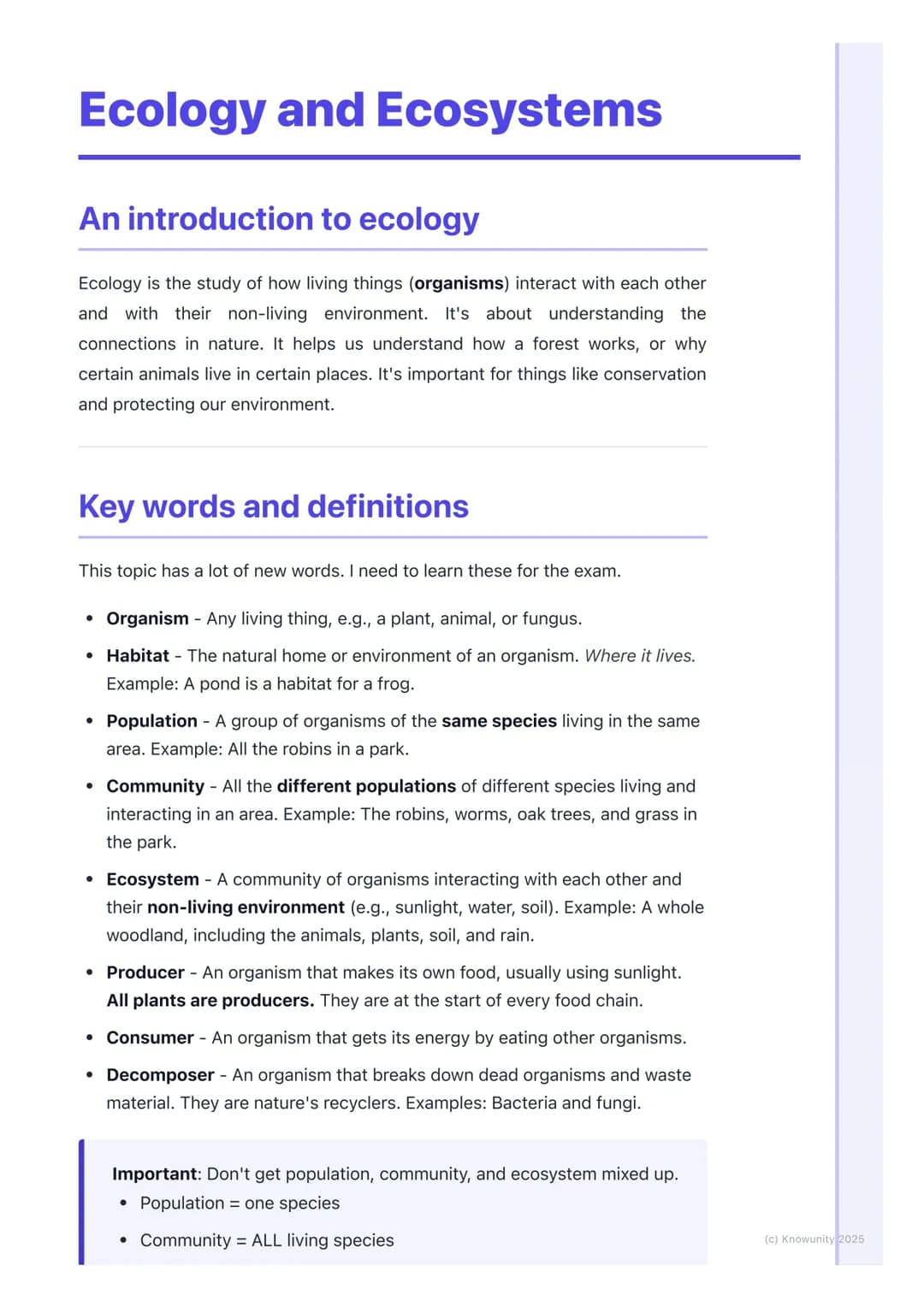
Introduction to Ecology and Key Definitions
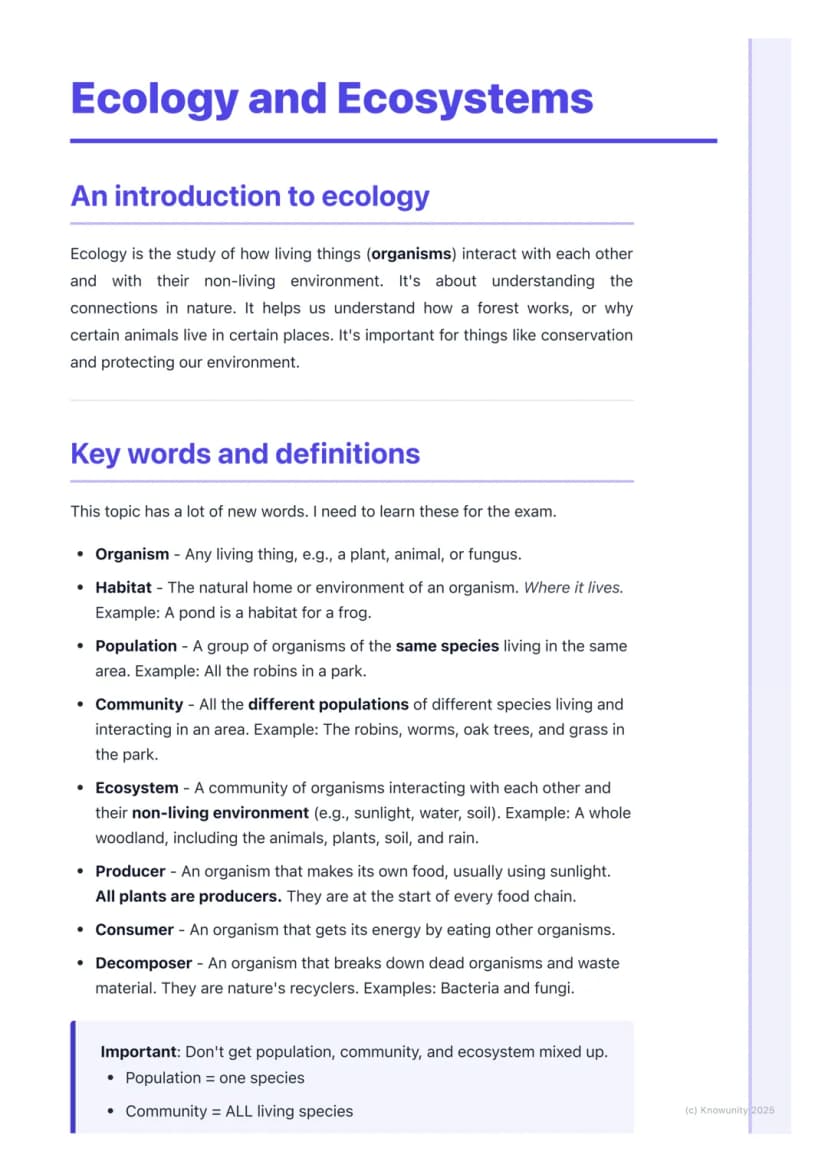
Ecology is basically nature's way of showing us how everything is connected. It's the study of how living things interact with each other and their surroundings. This knowledge helps scientists protect wildlife and understand why certain animals thrive in specific places.
You'll need to master several key terms for your exams. An organism is any living thing - from tiny bacteria to massive oak trees. A habitat is where an organism naturally lives (like a pond for frogs). A population includes all organisms of the same species in one area, whilst a community contains all different species living together.
The biggest concept is an ecosystem - this includes the entire community plus non-living elements like soil, water, and sunlight. Think of a woodland ecosystem containing all the animals, plants, rocks, and rain working together.
Remember: Population = one species, Community = all living species, Ecosystem = everything
2
of 6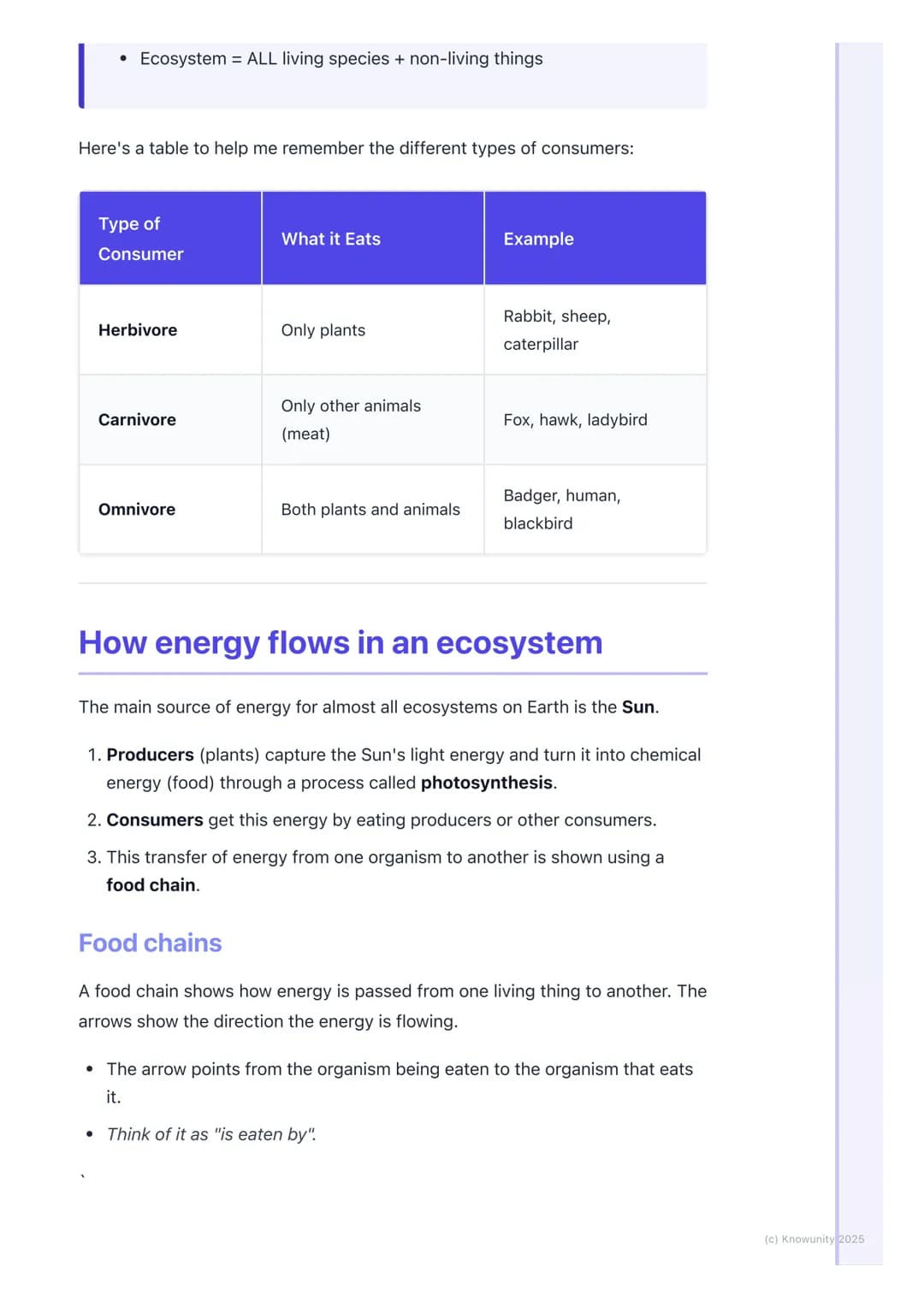
Producers, Consumers, and Energy Flow
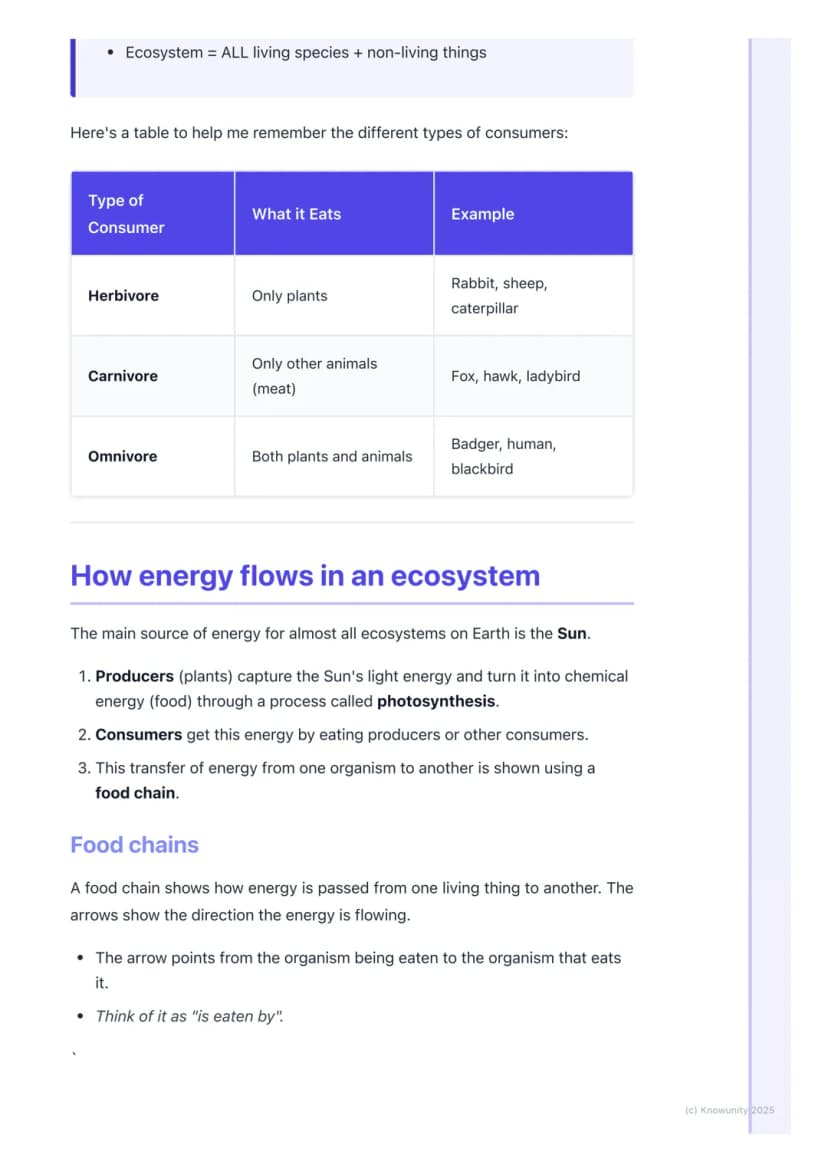
Here's where things get exciting - energy flow drives everything in nature! The Sun provides energy for almost all ecosystems on Earth. Producers (mainly plants) capture this solar energy through photosynthesis and convert it into chemical energy that other organisms can use.
Consumers get their energy by eating other organisms. Herbivores munch only on plants (like rabbits), carnivores hunt other animals (like foxes), and omnivores enjoy both plants and meat (like badgers and humans). Don't forget about decomposers - bacteria and fungi that break down dead material and recycle nutrients back into the soil.
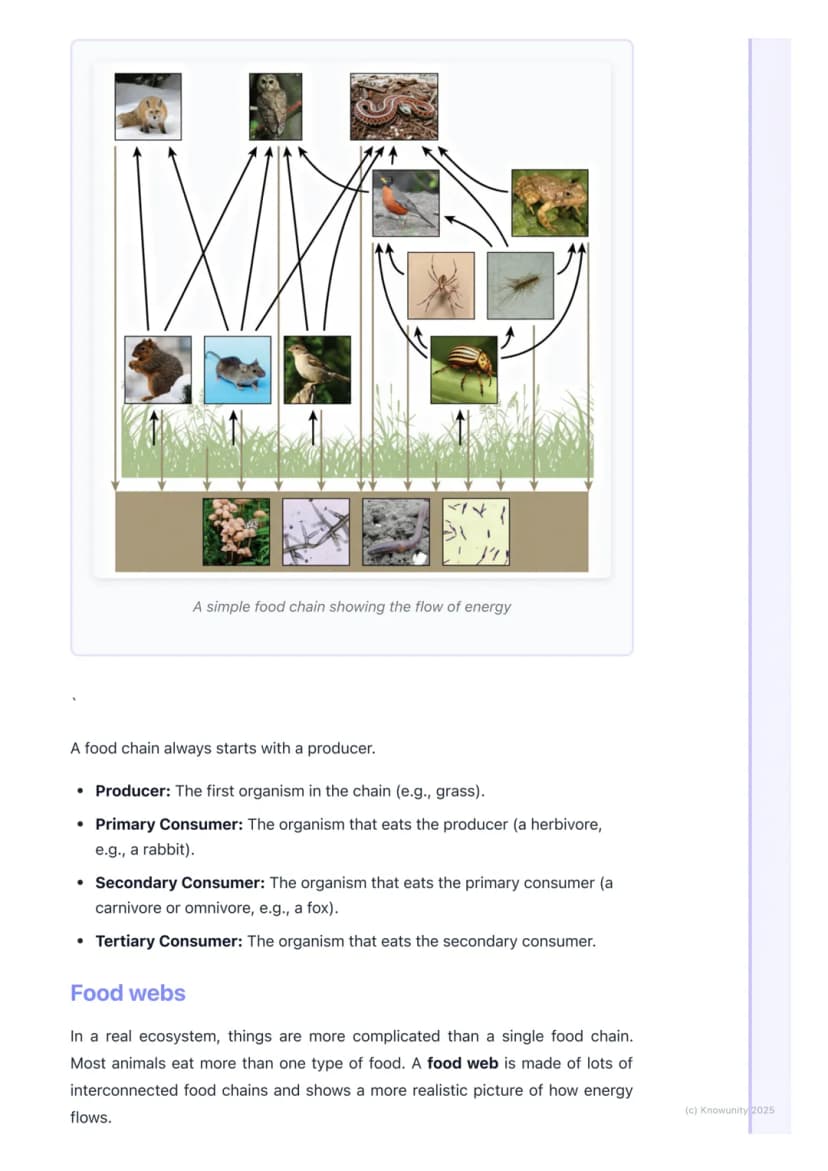
This energy transfer happens through food chains, which show exactly how energy moves from one living thing to another. The arrows are crucial - they point in the direction energy flows, from the organism being eaten to the one doing the eating.
Top Tip: Think of food chain arrows as "is eaten by" - this will help you get the direction right every time!
3
of 6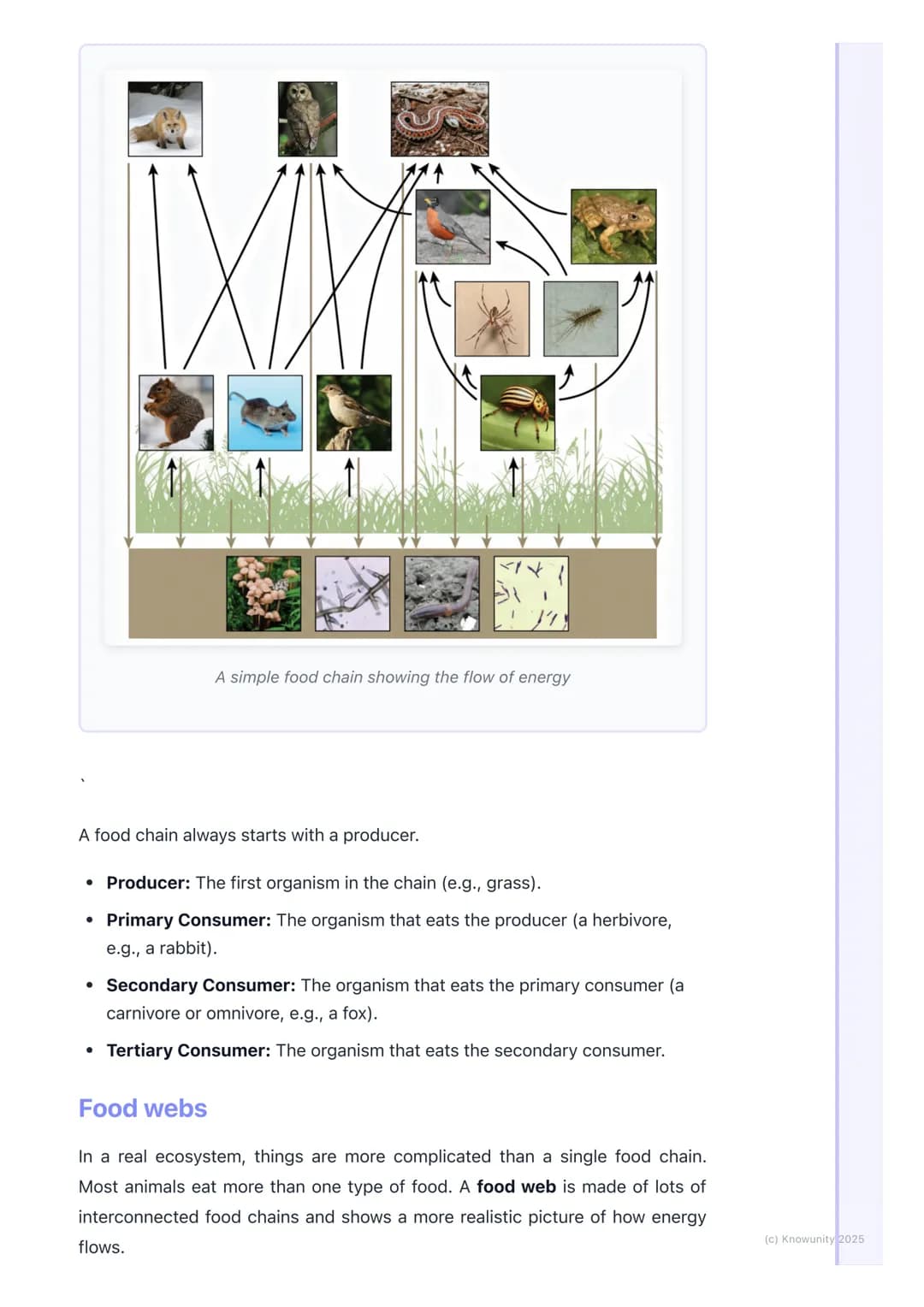
Food Chains and Food Webs
A food chain always starts with a producer and shows a single pathway of energy transfer. The primary consumer eats the producer (always a herbivore), the secondary consumer eats the primary consumer, and so on up the chain.
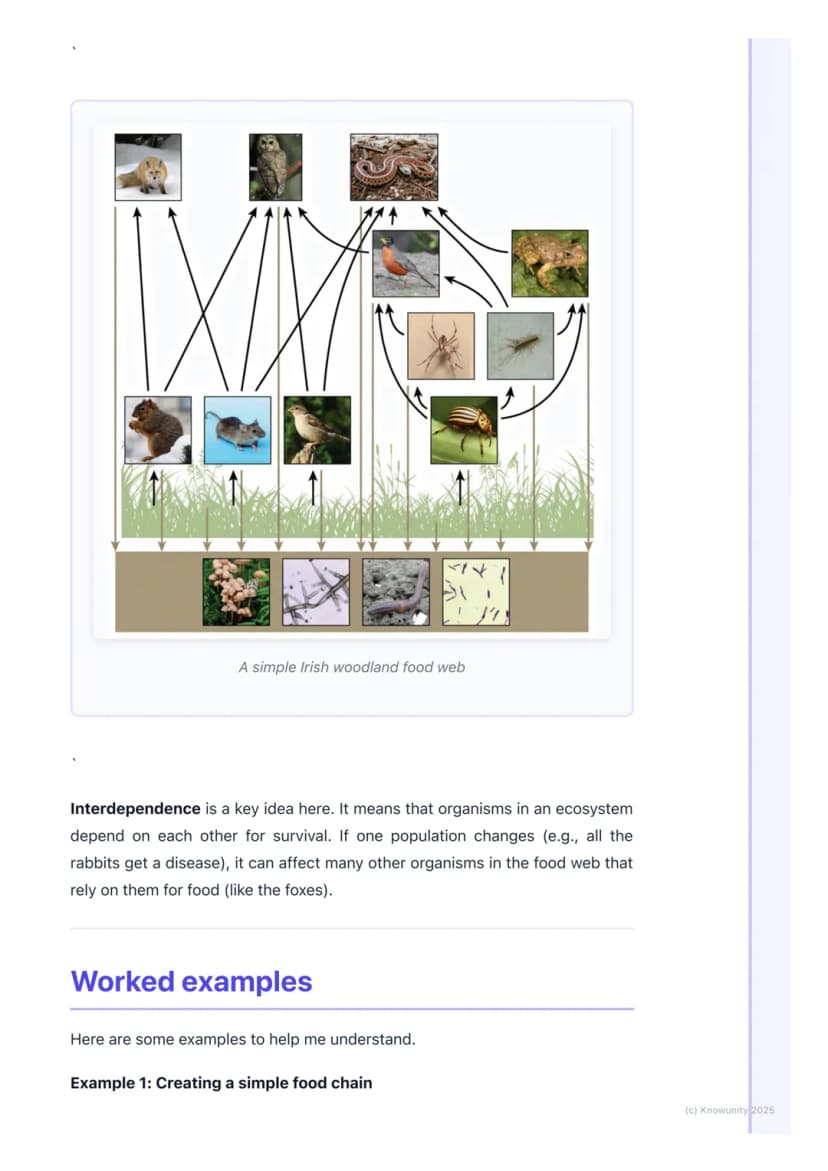
However, real ecosystems are much more complex than simple chains. Most animals eat various foods, which is where food webs come in. These show multiple interconnected food chains and give us a realistic picture of how energy actually flows through an ecosystem.
Interdependence is the key concept here - organisms depend on each other for survival. If rabbit populations suddenly crash due to disease, foxes that rely on them for food will struggle too. This ripple effect demonstrates how connected everything truly is in nature.
Think About It: In Irish woodlands, if oak trees died from disease, it wouldn't just affect the trees - caterpillars, blue tits, and eventually kestrels would all feel the impact!
4
of 6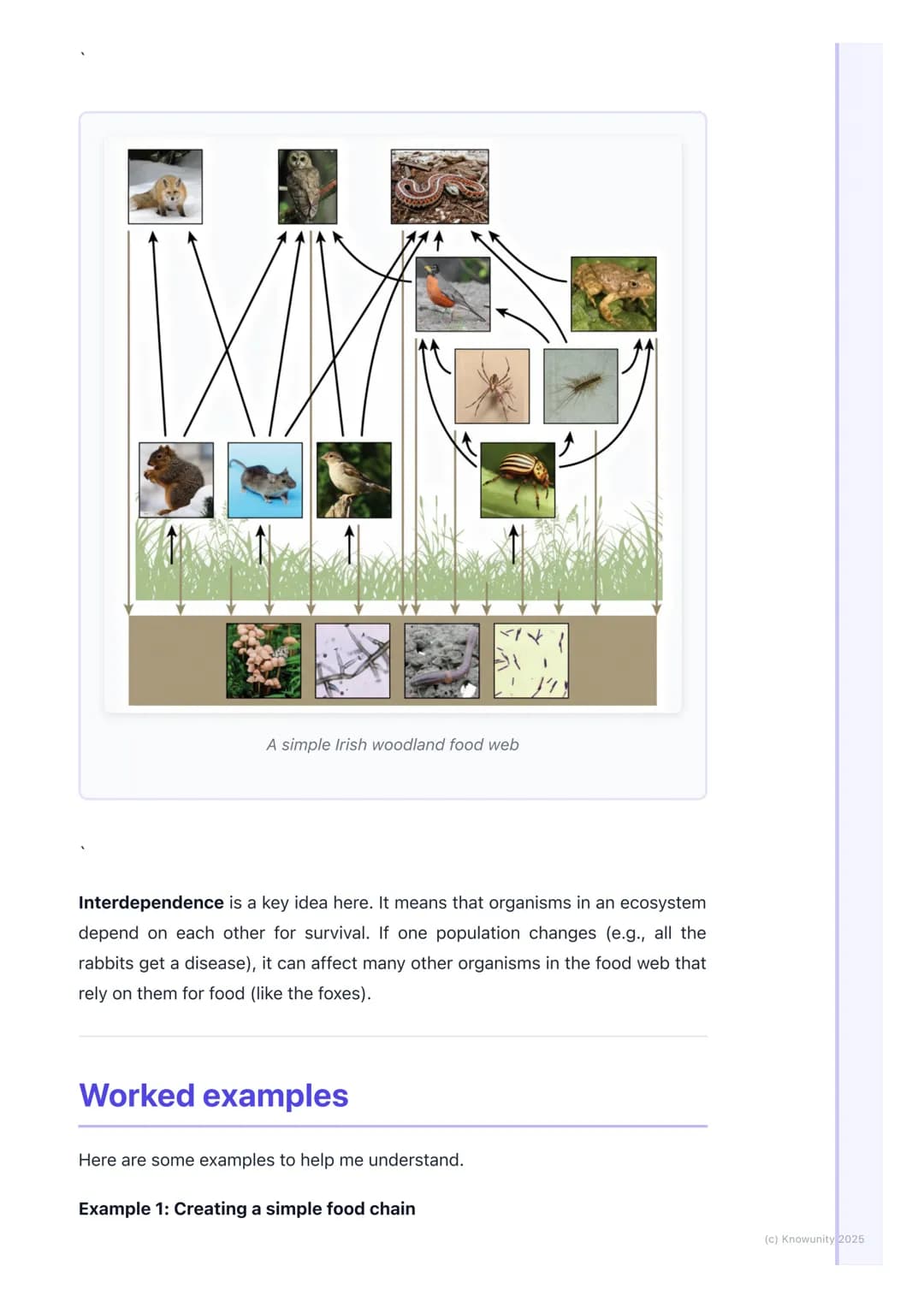
Worked Examples from Irish Ecosystems
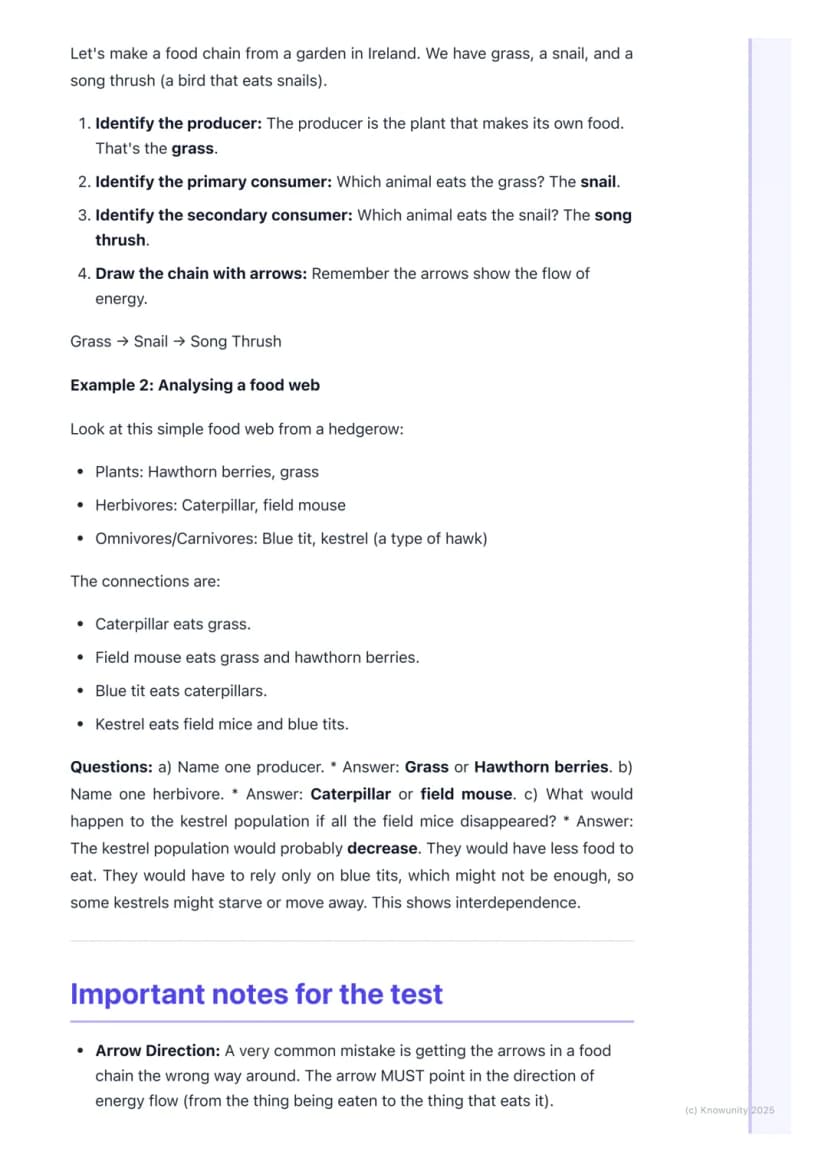
Let's work through creating a food chain using common Irish species. Starting with grass (our producer), a snail (primary consumer), and a song thrush (secondary consumer), we get: Grass → Snail → Song Thrush. The arrows show energy flowing from each organism to its predator.
Analysing food webs requires careful thinking about connections. In an Irish hedgerow containing hawthorn berries, grass, caterpillars, field mice, blue tits, and kestrels, you need to trace who eats whom. If field mice disappeared, kestrel populations would likely decrease since they'd have less food available.
Competition also plays a role - organisms often compete for the same resources. If another insect-eating bird moved into our hedgerow, it would compete directly with blue tits for caterpillars.
Exam Success: Always mention the Sun as the ultimate energy source - it's an easy mark that many students forget!
5
of 6
Common Mistakes and Study Tips
The biggest mistake students make is drawing food chain arrows backwards. Remember, arrows show energy flow - they point from the organism being eaten towards the organism that eats it. Practice this repeatedly until it becomes automatic.
Don't overlook decomposers in your answers. Whilst they're often missing from food web diagrams, they're essential for recycling nutrients back to producers. Also, always consider the Sun as your starting point when discussing energy flow.
Understanding competition helps explain population changes. When organisms compete for the same food source, the more successful species will thrive whilst others might decline or relocate.
Study Smart: Create your own food chains using local Irish species - it makes the concepts much more memorable and relevant!
6
of 6
Quick Review and Exam Preparation
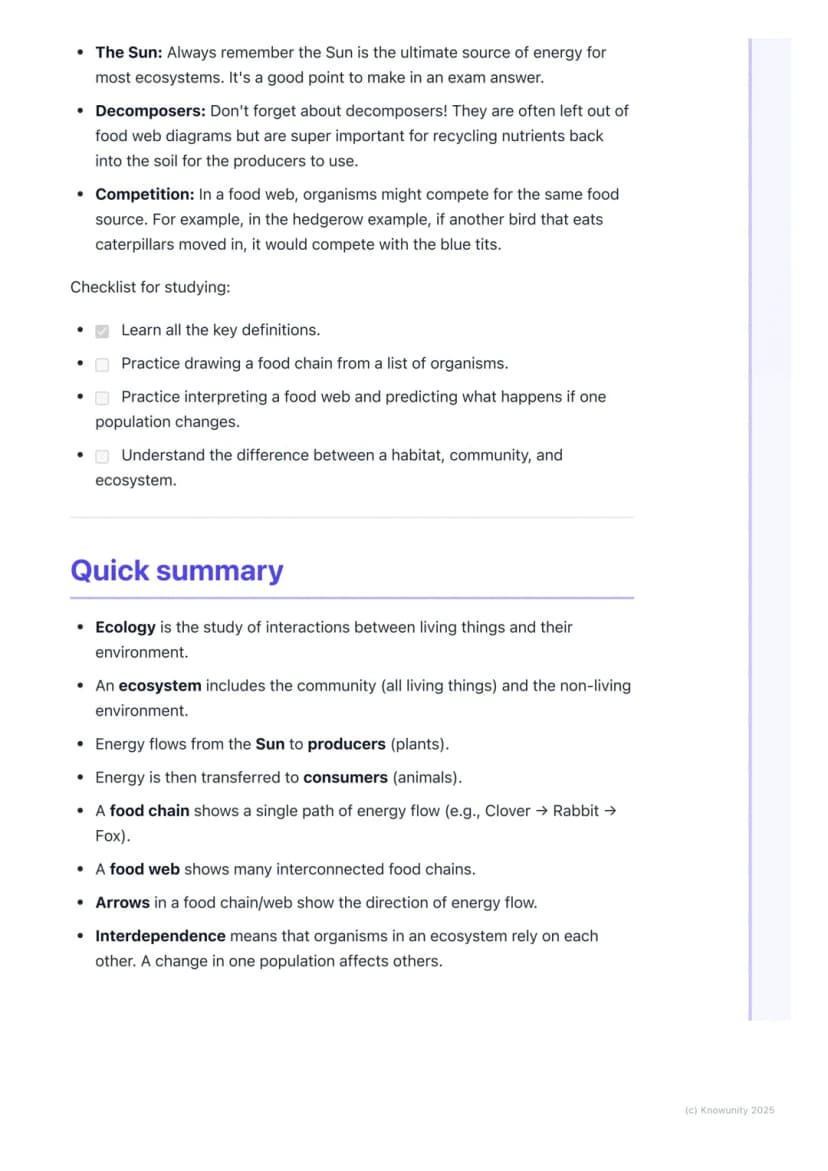
Ecology reveals the fascinating connections between organisms and their environment. Energy flows from the Sun to producers (plants), then to various levels of consumers through food chains and food webs. Remember that ecosystems include both living communities and non-living environmental factors.
Interdependence means changes in one population affect others throughout the web. Decomposers recycle nutrients, keeping ecosystems healthy and functioning. Arrow direction in food chains shows energy flow - from prey to predator.
Your exam success depends on learning key definitions, practising food chain construction, and understanding how population changes ripple through ecosystems. Focus on local Irish examples as they're often used in questions.
Final Check: Can you explain what happens in a food web when one species disappears? This type of question appears frequently on tests!
Si on te demande...
Qu'est-ce que le compagnon IA de Knowunity ?
Notre compagnon IA est spécialement conçu pour répondre aux besoins des étudiants. Sur la base des millions d'éléments de contenu que nous avons sur la plateforme, nous pouvons fournir des réponses vraiment significatives et pertinentes aux étudiants. Mais il ne s'agit pas seulement de réponses, le compagnon a encore plus pour but de guider les élèves dans leurs défis d'apprentissage quotidiens, avec des plans d'étude personnalisés, des quiz ou des éléments de contenu dans le chat et une personnalisation à 100% basée sur les compétences et les développements de l'étudiant.
Où puis-je télécharger l'appli Knowunity ?
Tu peux télécharger l'application dans Google Play Store et dans l'App Store d'Apple.
L'application est-elle vraiment gratuite ?
Oui, tu as un accès entièrement gratuit à tous les contenus de l'appli, tu peux chatter ou suivre les créateurs à tout moment. De plus, nous proposons Knowunity Premium, qui te permet de réviser sans limites!
Contenus les plus populaires en Science
7ScienceScience/Physics notes - Speed, density, work
Speed density work formulas
5th Year81
ScienceAtomic Structure and the Periodic Table
Students will learn about the structure of atoms, including protons, neutrons, and electrons, and how elements are organised and classified in the Periodic Table based on their electronic configuration and chemical properties.
5th Year41
ScienceHuman Body Systems
An introduction to major human body systems such as the digestive, circulatory, respiratory, and nervous systems, understanding their basic functions.
2nd Year131
ScienceJunior Cert Science Notes: The Cell
Notes on the Cell
3rd Year261
ScienceCells
Junior cert science cells summary
1st Year611
ScienceHuman Reproductive System
A basic overview of the male and female reproductive systems, including their main structures and functions.
TY191
ScienceLight and Optics
Exploring the properties of light, including how it travels, reflects, and refracts, and how we perceive colours.
2nd Year50
Contenus les plus populaires
9 Irish
IrishIrish oral questions and answers
Questions and answers for the leaving cert oral
5th Year4264
 English
Key Quotes : Sive
Key Quotes and explanations: Sive
6th Year2842
IrishIrish oral questions
Outline of oral questions
5th Year2055
IrishIníon- le hÁine Durkin
Aine Durkin’s poem, Iníon: Themes & summary
5th Year890
IrishIrish poetry 2027
Iníon + Dínit an Bhróin
5th Year1153
IrishLC HL notes- Iníon (poem)
Includes poem in English and Irish, theme, key words & phrases
5th Year2304
EnglishCultural Context : Shawshank Redemption : Sive : Small Things Like These
Comparative Study : Cultural Context : Shawshank Redemption, Sive and Small Things Like These
6th Year1430
IrishMo Ghrá-sa (Idir Lúibíní)
Notes on mo ghrá-sa
5th Year380
IrishAn Gaeilge Aiste
Irish Language essay
6th Year1320
Rien ne te convient ? Explore d'autres matières.
Les étudiants nous adorent — il ne manque plus que toi.
4.6/5App Store
4.7/5Google Play
L'application est très facile d'utilisation et bien conçue. Jusqu'à présent, j'ai trouvé tout ce que je cherchais et j'ai pu apprendre beaucoup de choses grâce aux présentations ! Je vais certainement utiliser l'application pour un travail en classe ! Et comme source d'inspiration personnelle, elle est bien sûr aussi très utile.
Stefan Sutilisateur iOS
Cette application est vraiment super. Il y a tellement de fiches de révision et d'aide, [...]. Par exemple, la matière qui me pose problème est le français et l'appli a un choix d'aide très large. Grâce à cette application, je me suis améliorée en français. Je la recommanderais à tout le monde.
Samantha Klichutilisatrice Android
Waouh, je suis vraiment abasourdi. J'ai essayé l'application parce que je l'avais déjà vue plusieurs fois dans la publicité et j'ai été absolument choquée. Cette appli est L'AIDE dont on rêve pour l'école et surtout, elle propose tellement de choses, comme des rédactions et des fiches qui m'ont personnellement TRÈS bien aidé.
Annautilisatrice iOS
Science5 vues·Mis à jour Jun 7, 2026·6 pagesUnderstanding Ecology and Ecosystems
Ever wondered how a forest actually works or why foxes live in certain places? Ecology is all about understanding the amazing connections between living things and their environment - and it's way more interesting than you might think!
1
of 6
Inscris-toi pour voir le contenu. C'est gratuit!
- Accès à tous les documents
- Améliore tes notes
- Rejoins des millions d'étudiants
Introduction to Ecology and Key Definitions
Ecology is basically nature's way of showing us how everything is connected. It's the study of how living things interact with each other and their surroundings. This knowledge helps scientists protect wildlife and understand why certain animals thrive in specific places.
You'll need to master several key terms for your exams. An organism is any living thing - from tiny bacteria to massive oak trees. A habitat is where an organism naturally lives (like a pond for frogs). A population includes all organisms of the same species in one area, whilst a community contains all different species living together.
The biggest concept is an ecosystem - this includes the entire community plus non-living elements like soil, water, and sunlight. Think of a woodland ecosystem containing all the animals, plants, rocks, and rain working together.
Remember: Population = one species, Community = all living species, Ecosystem = everything
2
of 6Inscris-toi pour voir le contenu. C'est gratuit!
- Accès à tous les documents
- Améliore tes notes
- Rejoins des millions d'étudiants
Producers, Consumers, and Energy Flow
Here's where things get exciting - energy flow drives everything in nature! The Sun provides energy for almost all ecosystems on Earth. Producers (mainly plants) capture this solar energy through photosynthesis and convert it into chemical energy that other organisms can use.
Consumers get their energy by eating other organisms. Herbivores munch only on plants (like rabbits), carnivores hunt other animals (like foxes), and omnivores enjoy both plants and meat (like badgers and humans). Don't forget about decomposers - bacteria and fungi that break down dead material and recycle nutrients back into the soil.
This energy transfer happens through food chains, which show exactly how energy moves from one living thing to another. The arrows are crucial - they point in the direction energy flows, from the organism being eaten to the one doing the eating.
Top Tip: Think of food chain arrows as "is eaten by" - this will help you get the direction right every time!
3
of 6Inscris-toi pour voir le contenu. C'est gratuit!
- Accès à tous les documents
- Améliore tes notes
- Rejoins des millions d'étudiants
Food Chains and Food Webs
A food chain always starts with a producer and shows a single pathway of energy transfer. The primary consumer eats the producer (always a herbivore), the secondary consumer eats the primary consumer, and so on up the chain.
However, real ecosystems are much more complex than simple chains. Most animals eat various foods, which is where food webs come in. These show multiple interconnected food chains and give us a realistic picture of how energy actually flows through an ecosystem.
Interdependence is the key concept here - organisms depend on each other for survival. If rabbit populations suddenly crash due to disease, foxes that rely on them for food will struggle too. This ripple effect demonstrates how connected everything truly is in nature.
Think About It: In Irish woodlands, if oak trees died from disease, it wouldn't just affect the trees - caterpillars, blue tits, and eventually kestrels would all feel the impact!
4
of 6Inscris-toi pour voir le contenu. C'est gratuit!
- Accès à tous les documents
- Améliore tes notes
- Rejoins des millions d'étudiants
Worked Examples from Irish Ecosystems
Let's work through creating a food chain using common Irish species. Starting with grass (our producer), a snail (primary consumer), and a song thrush (secondary consumer), we get: Grass → Snail → Song Thrush. The arrows show energy flowing from each organism to its predator.
Analysing food webs requires careful thinking about connections. In an Irish hedgerow containing hawthorn berries, grass, caterpillars, field mice, blue tits, and kestrels, you need to trace who eats whom. If field mice disappeared, kestrel populations would likely decrease since they'd have less food available.
Competition also plays a role - organisms often compete for the same resources. If another insect-eating bird moved into our hedgerow, it would compete directly with blue tits for caterpillars.
Exam Success: Always mention the Sun as the ultimate energy source - it's an easy mark that many students forget!
5
of 6Inscris-toi pour voir le contenu. C'est gratuit!
- Accès à tous les documents
- Améliore tes notes
- Rejoins des millions d'étudiants
Common Mistakes and Study Tips
The biggest mistake students make is drawing food chain arrows backwards. Remember, arrows show energy flow - they point from the organism being eaten towards the organism that eats it. Practice this repeatedly until it becomes automatic.
Don't overlook decomposers in your answers. Whilst they're often missing from food web diagrams, they're essential for recycling nutrients back to producers. Also, always consider the Sun as your starting point when discussing energy flow.
Understanding competition helps explain population changes. When organisms compete for the same food source, the more successful species will thrive whilst others might decline or relocate.
Study Smart: Create your own food chains using local Irish species - it makes the concepts much more memorable and relevant!
6
of 6Inscris-toi pour voir le contenu. C'est gratuit!
- Accès à tous les documents
- Améliore tes notes
- Rejoins des millions d'étudiants
Quick Review and Exam Preparation
Ecology reveals the fascinating connections between organisms and their environment. Energy flows from the Sun to producers (plants), then to various levels of consumers through food chains and food webs. Remember that ecosystems include both living communities and non-living environmental factors.
Interdependence means changes in one population affect others throughout the web. Decomposers recycle nutrients, keeping ecosystems healthy and functioning. Arrow direction in food chains shows energy flow - from prey to predator.
Your exam success depends on learning key definitions, practising food chain construction, and understanding how population changes ripple through ecosystems. Focus on local Irish examples as they're often used in questions.
Final Check: Can you explain what happens in a food web when one species disappears? This type of question appears frequently on tests!
Si on te demande...
Qu'est-ce que le compagnon IA de Knowunity ?
Notre compagnon IA est spécialement conçu pour répondre aux besoins des étudiants. Sur la base des millions d'éléments de contenu que nous avons sur la plateforme, nous pouvons fournir des réponses vraiment significatives et pertinentes aux étudiants. Mais il ne s'agit pas seulement de réponses, le compagnon a encore plus pour but de guider les élèves dans leurs défis d'apprentissage quotidiens, avec des plans d'étude personnalisés, des quiz ou des éléments de contenu dans le chat et une personnalisation à 100% basée sur les compétences et les développements de l'étudiant.
Où puis-je télécharger l'appli Knowunity ?
Tu peux télécharger l'application dans Google Play Store et dans l'App Store d'Apple.
L'application est-elle vraiment gratuite ?
Oui, tu as un accès entièrement gratuit à tous les contenus de l'appli, tu peux chatter ou suivre les créateurs à tout moment. De plus, nous proposons Knowunity Premium, qui te permet de réviser sans limites!
Contenus les plus populaires en Science
7ScienceScience/Physics notes - Speed, density, work
Speed density work formulas
5th Year81
ScienceAtomic Structure and the Periodic Table
Students will learn about the structure of atoms, including protons, neutrons, and electrons, and how elements are organised and classified in the Periodic Table based on their electronic configuration and chemical properties.
5th Year41
ScienceHuman Body Systems
An introduction to major human body systems such as the digestive, circulatory, respiratory, and nervous systems, understanding their basic functions.
2nd Year131
ScienceJunior Cert Science Notes: The Cell
Notes on the Cell
3rd Year261
ScienceCells
Junior cert science cells summary
1st Year611
ScienceHuman Reproductive System
A basic overview of the male and female reproductive systems, including their main structures and functions.
TY191
ScienceLight and Optics
Exploring the properties of light, including how it travels, reflects, and refracts, and how we perceive colours.
2nd Year50
Contenus les plus populaires
9IrishIrish oral questions and answers
Questions and answers for the leaving cert oral
5th Year4264
EnglishKey Quotes : Sive
Key Quotes and explanations: Sive
6th Year2842
IrishIrish oral questions
Outline of oral questions
5th Year2055
IrishIníon- le hÁine Durkin
Aine Durkin’s poem, Iníon: Themes & summary
5th Year890
IrishIrish poetry 2027
Iníon + Dínit an Bhróin
5th Year1153
IrishLC HL notes- Iníon (poem)
Includes poem in English and Irish, theme, key words & phrases
5th Year2304
EnglishCultural Context : Shawshank Redemption : Sive : Small Things Like These
Comparative Study : Cultural Context : Shawshank Redemption, Sive and Small Things Like These
6th Year1430
IrishMo Ghrá-sa (Idir Lúibíní)
Notes on mo ghrá-sa
5th Year380
IrishAn Gaeilge Aiste
Irish Language essay
6th Year1320
Rien ne te convient ? Explore d'autres matières.
Les étudiants nous adorent — il ne manque plus que toi.
4.6/5App Store
4.7/5Google Play
L'application est très facile d'utilisation et bien conçue. Jusqu'à présent, j'ai trouvé tout ce que je cherchais et j'ai pu apprendre beaucoup de choses grâce aux présentations ! Je vais certainement utiliser l'application pour un travail en classe ! Et comme source d'inspiration personnelle, elle est bien sûr aussi très utile.
Stefan Sutilisateur iOS
Cette application est vraiment super. Il y a tellement de fiches de révision et d'aide, [...]. Par exemple, la matière qui me pose problème est le français et l'appli a un choix d'aide très large. Grâce à cette application, je me suis améliorée en français. Je la recommanderais à tout le monde.
Samantha Klichutilisatrice Android
Waouh, je suis vraiment abasourdi. J'ai essayé l'application parce que je l'avais déjà vue plusieurs fois dans la publicité et j'ai été absolument choquée. Cette appli est L'AIDE dont on rêve pour l'école et surtout, elle propose tellement de choses, comme des rédactions et des fiches qui m'ont personnellement TRÈS bien aidé.
Annautilisatrice iOS