
Your body is like a well-coordinated team where different systems...
 Science19 vues·Mis à jour Jun 8, 2026·9 pages
Understanding the Human Body Systems: A Simple Guide
1 / 9
1
of 9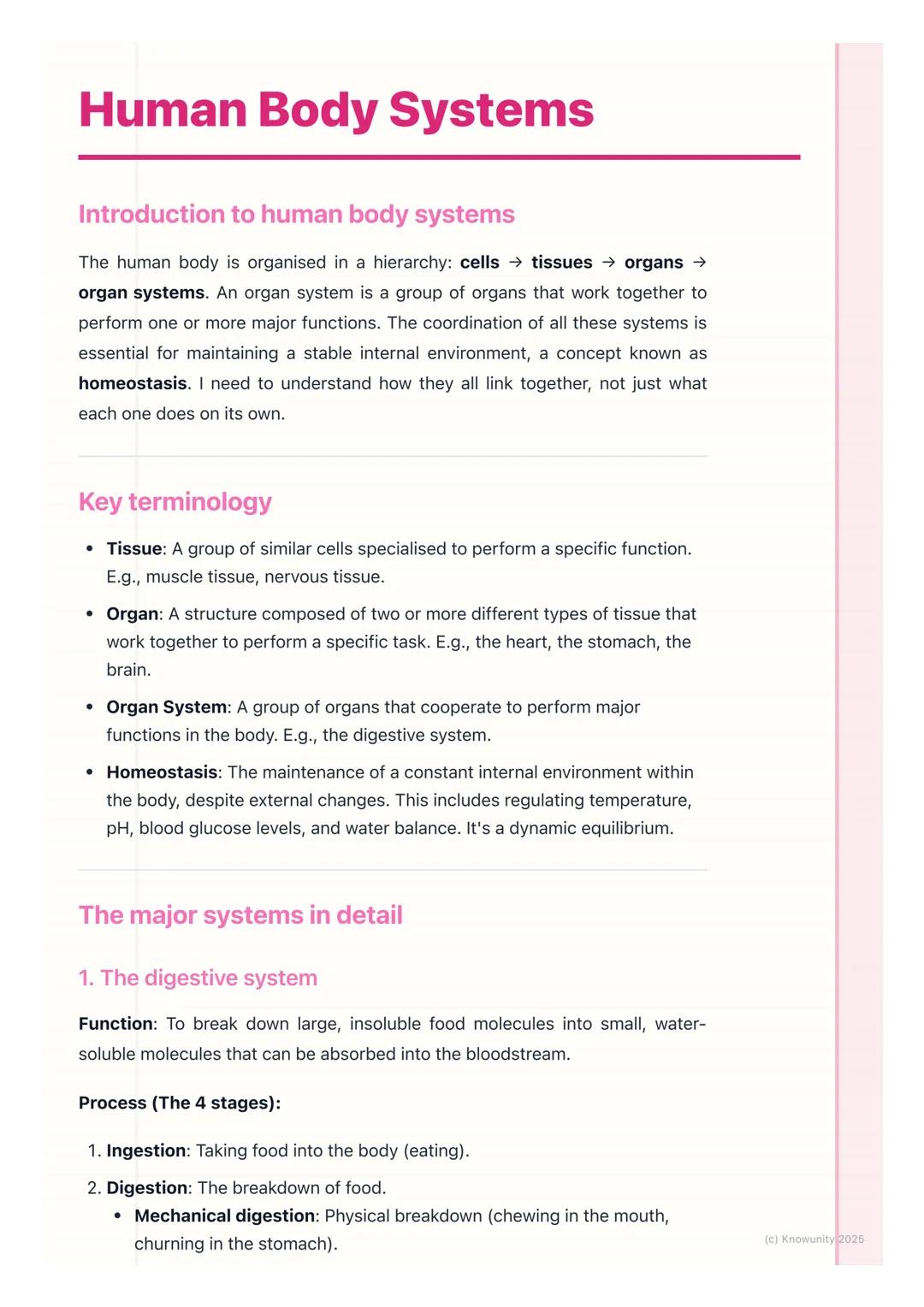
Introduction to Body Systems
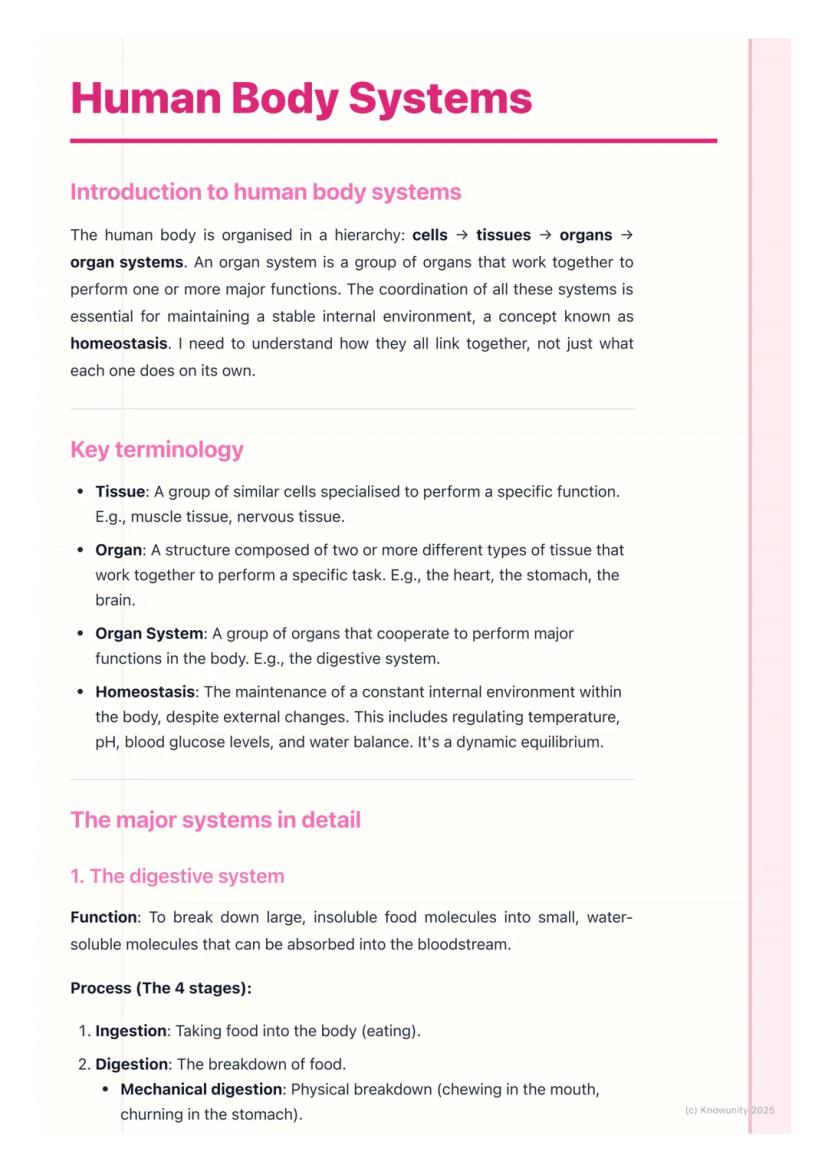
Think of your body as the ultimate teamwork example - every system depends on others to function properly. The organisation goes from cells (the basic units) → tissues (groups of similar cells) → organs (different tissues working together) → organ systems (organs with a common goal).
Homeostasis is the star concept here - it's how your body maintains a stable internal environment despite what's happening outside. Whether you're sweating in PE class or shivering in winter, your body is constantly adjusting to keep everything balanced.
The key insight? No system works alone. Your digestive system needs your circulatory system to transport nutrients, which needs your respiratory system for oxygen. It's all interconnected, and that's exactly what examiners love to test you on.
Exam Tip: Always think about how systems work together, not just what each one does individually. This interconnection is a favourite topic for longer exam questions.
2
of 9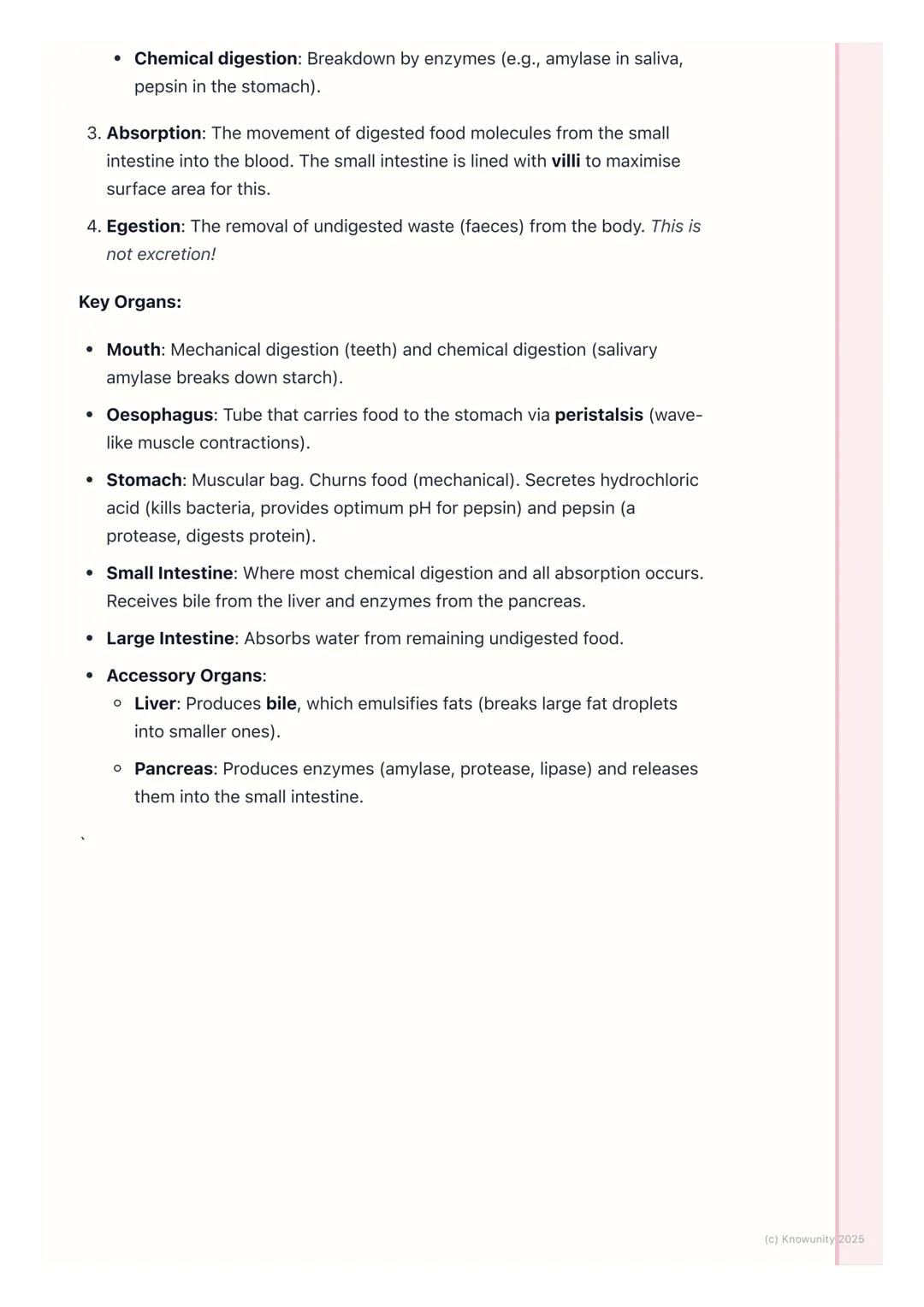
The Digestive System
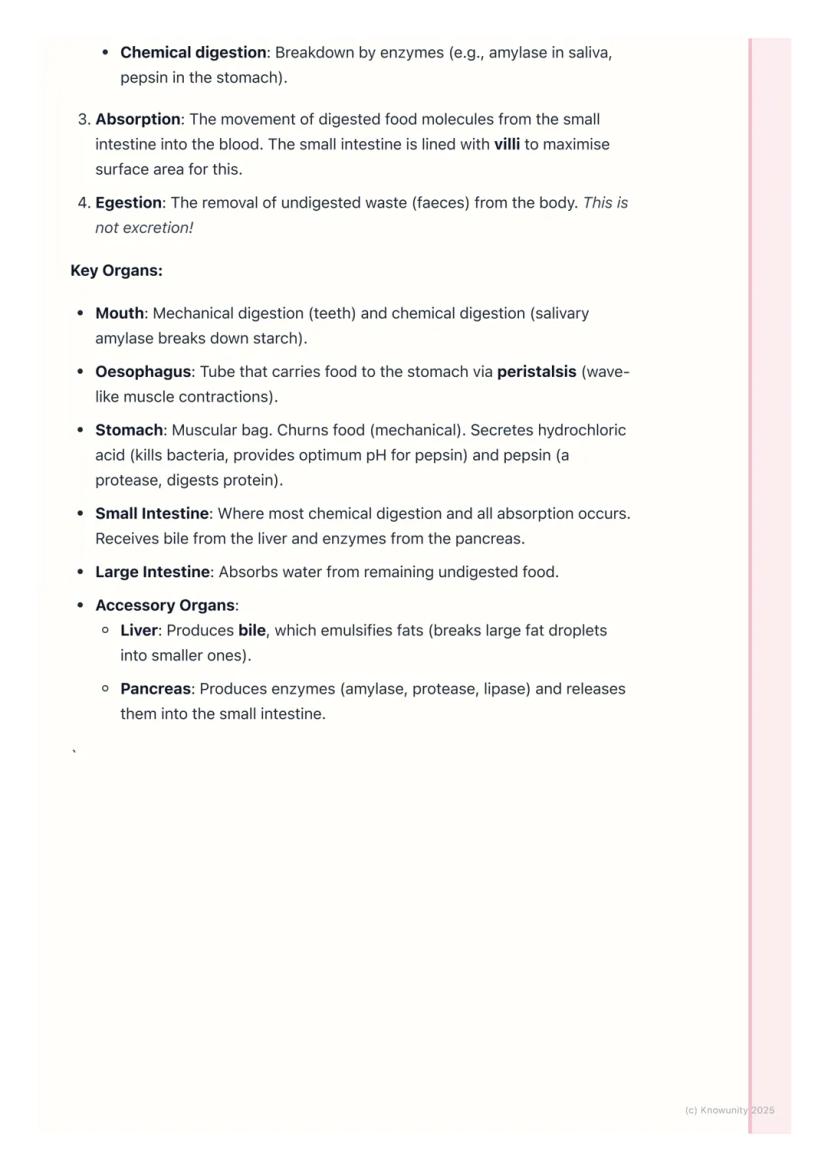
Your digestive system is basically a sophisticated food processor that turns your lunch into molecules small enough to enter your bloodstream. The four main stages are ingestion (eating), digestion (breaking down), absorption (taking in nutrients), and egestion (removing waste).
Mechanical digestion happens when you chew or when your stomach churns food around. Chemical digestion uses enzymes like amylase in your saliva to break down starch, or pepsin in your stomach to tackle proteins. Your stomach also produces hydrochloric acid - strong enough to kill bacteria and create the perfect pH for pepsin to work.
The small intestine is where the magic happens - most digestion and ALL absorption occurs here. Those tiny finger-like projections called villi massively increase surface area for absorption. Meanwhile, your liver produces bile to break up fats , and your pancreas churns out enzymes for all the major food groups.
Don't confuse egestion (removing undigested food as faeces) with excretion (removing metabolic waste like urea). This mix-up costs students marks every year!
3
of 9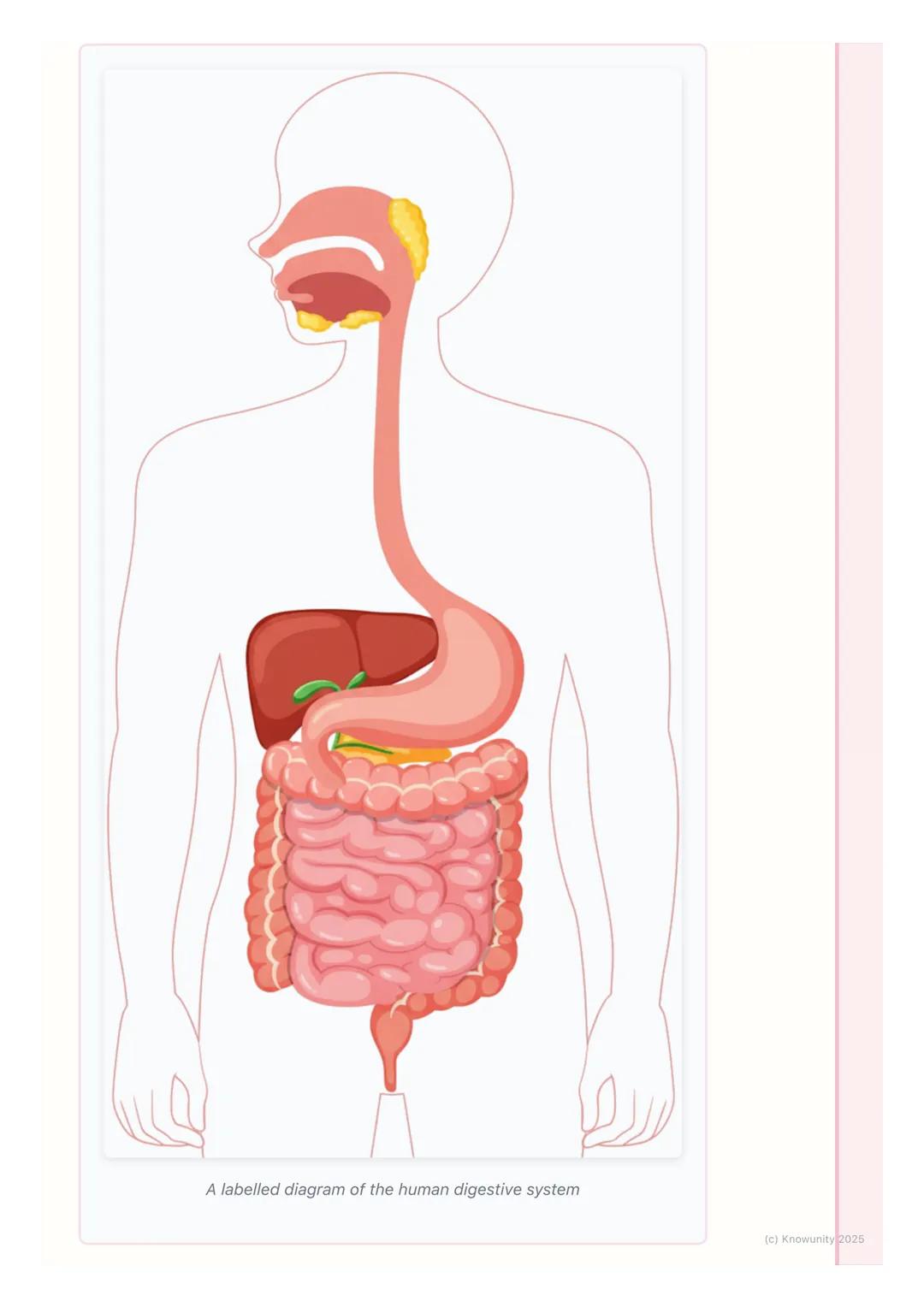
Digestive System Structure
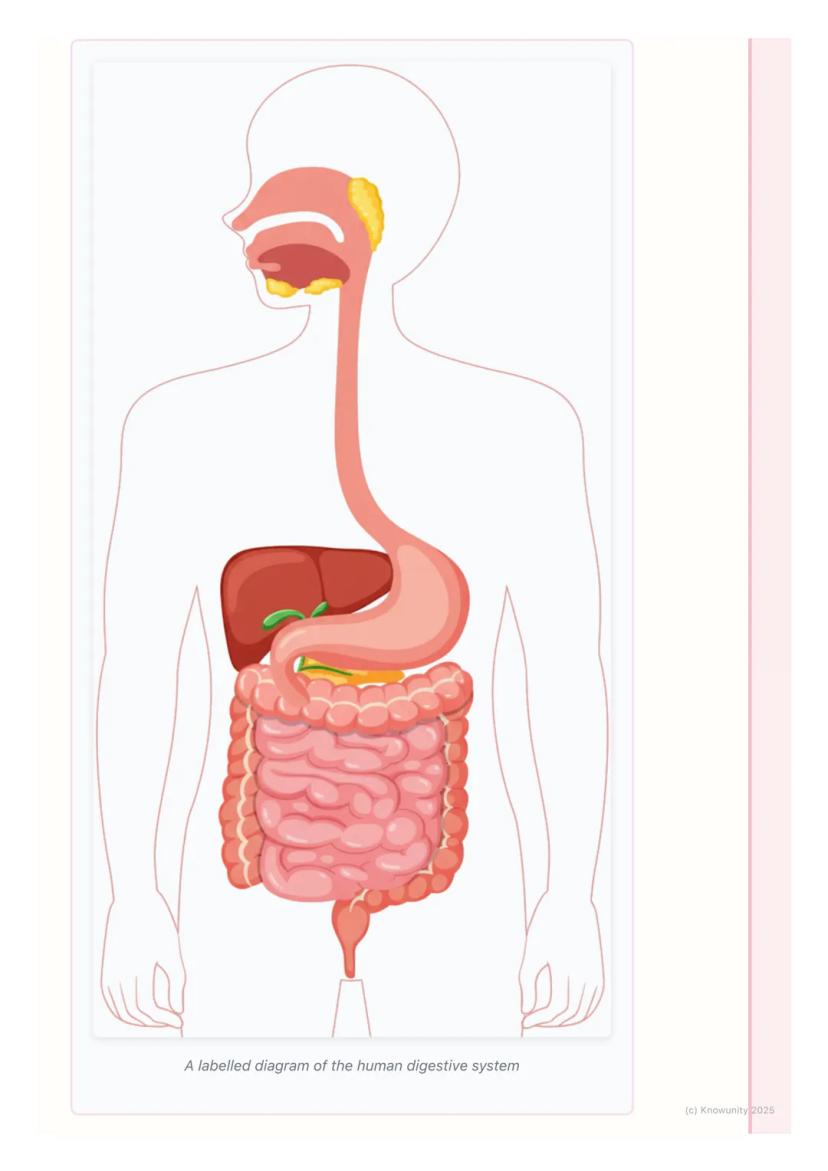
The diagram shows how food travels through your body in a logical sequence. From your mouth where mechanical digestion begins with chewing and chemical digestion starts with salivary amylase, food moves down the oesophagus via wave-like muscle contractions called peristalsis.
Your stomach acts like a muscular bag that churns food while secreting hydrochloric acid and pepsin. The real action happens in the small intestine, where bile from the liver and enzymes from the pancreas complete the breakdown process.
The large intestine has one main job - absorbing water from whatever's left over. This is why you get dehydrated when you have diarrhea - your large intestine isn't doing its water-absorption job properly.
Memory Trick: Remember that the liver produces bile (which emulsifies fats) while the pancreas produces the three main enzymes: amylase, protease, and lipase.
4
of 9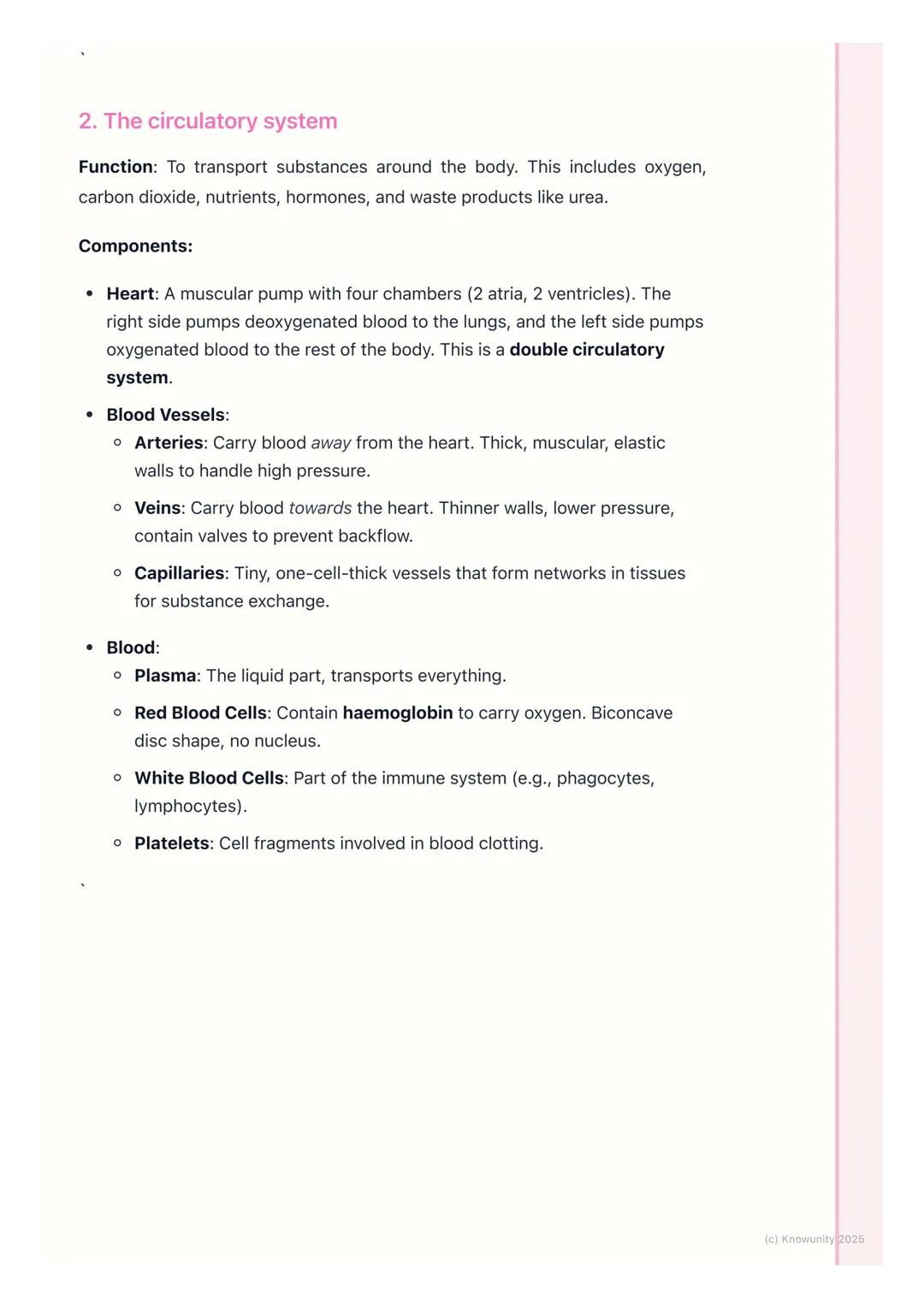
The Circulatory System
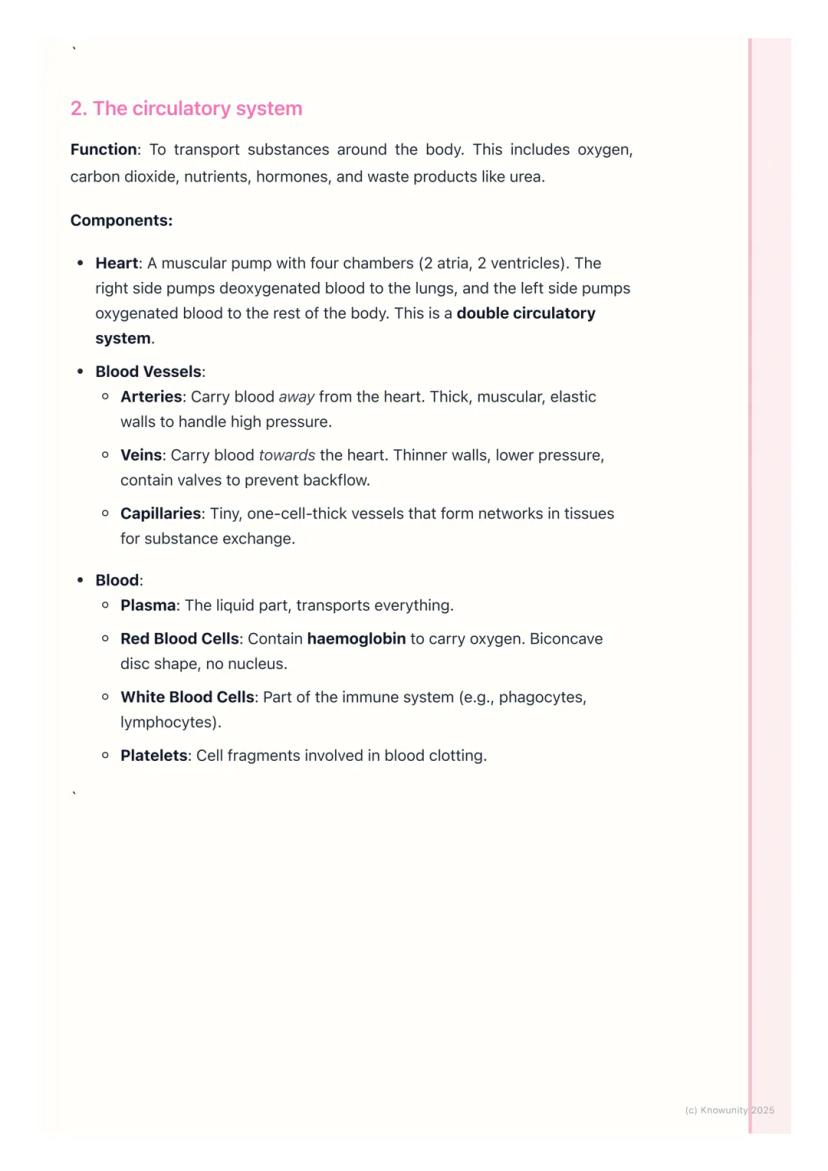
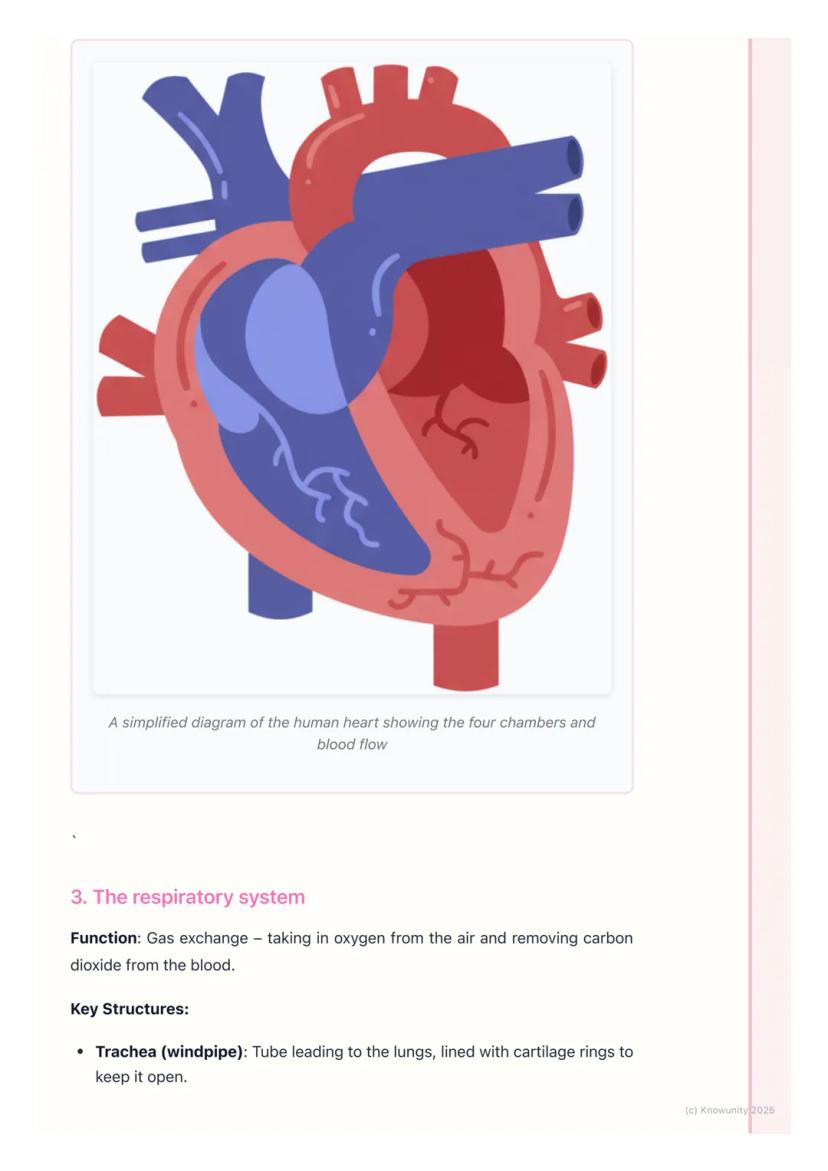
Your circulatory system is the body's transport network, moving oxygen, nutrients, hormones, and waste products around via blood. The heart is a muscular pump with four chambers - two atria (top chambers) and two ventricles (bottom chambers). The right side handles deoxygenated blood to the lungs, while the left side pumps oxygenated blood to the rest of your body.
Arteries carry blood away from the heart and have thick, muscular walls to handle high pressure. Veins bring blood back to the heart, have thinner walls, and contain valves to prevent backflow. Capillaries are where the actual exchange happens - they're only one cell thick to allow easy diffusion.
Your blood contains plasma (the liquid bit that transports everything), red blood cells (packed with haemoglobin to carry oxygen), white blood cells (your immune system's soldiers), and platelets (for blood clotting when you get cut).
This double circulatory system is incredibly efficient - blood goes through the heart twice in each complete circuit, ensuring high pressure delivery of oxygenated blood to your tissues.
5
of 9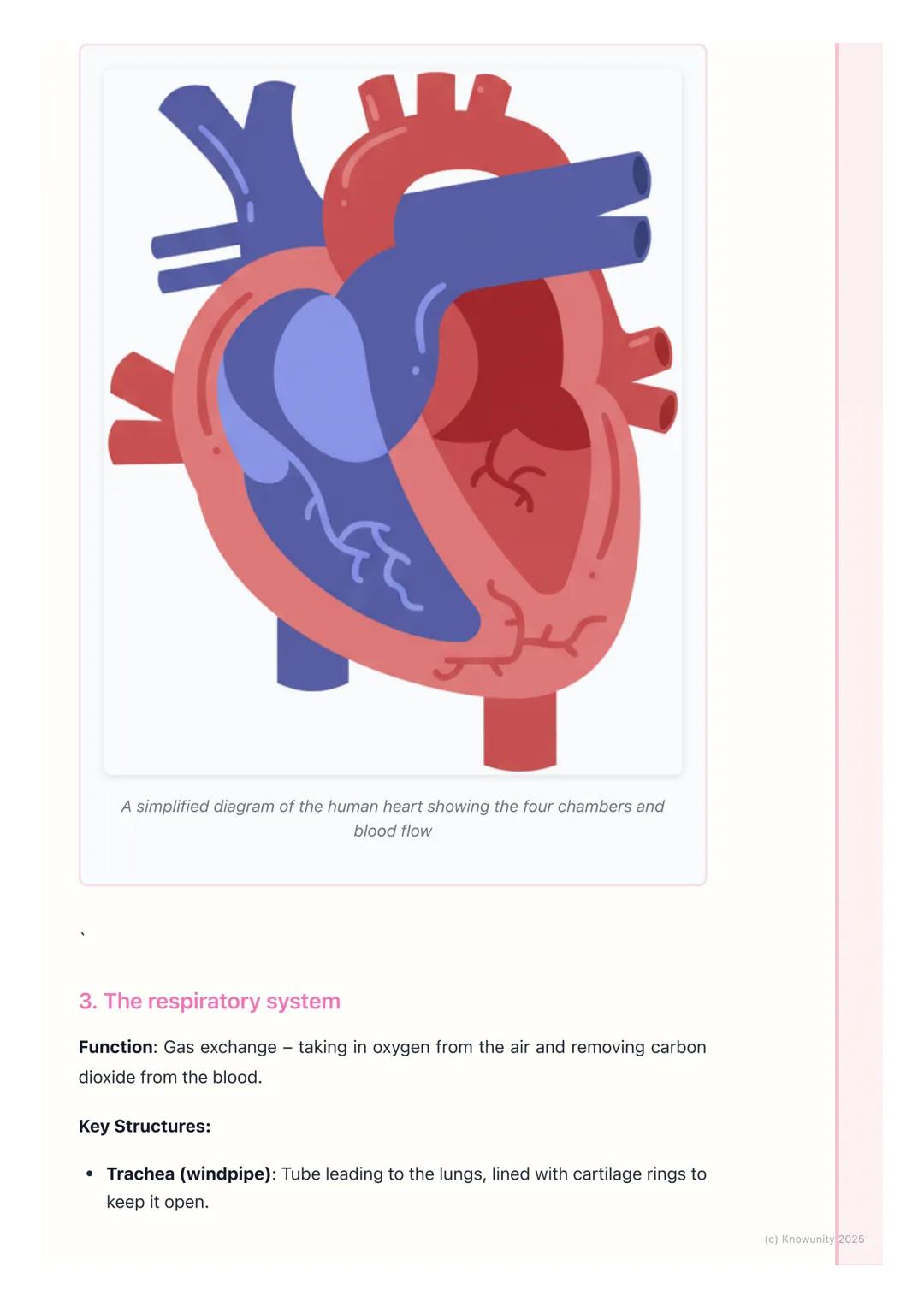
The Respiratory System
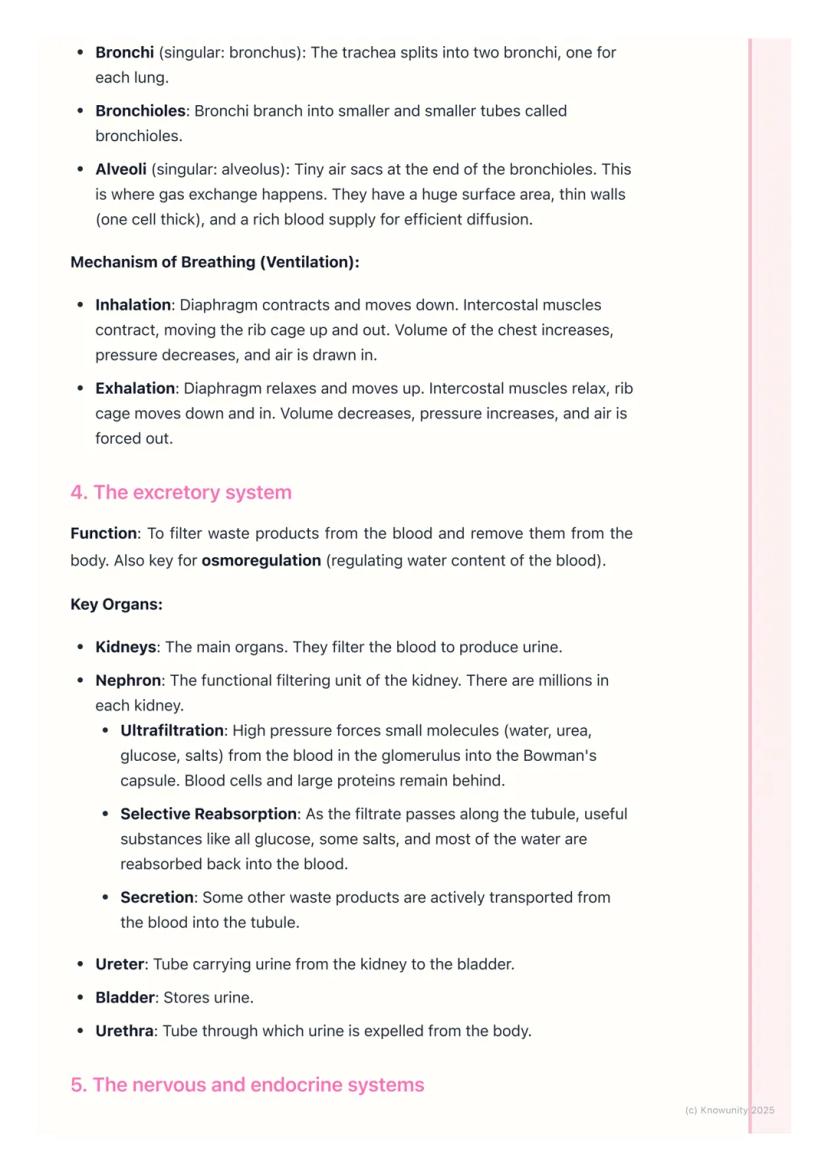
Gas exchange is the respiratory system's main job - getting oxygen in and carbon dioxide out. Air travels through your trachea (windpipe), which splits into two bronchi (one for each lung), then branches into smaller bronchioles, finally reaching tiny air sacs called alveoli.
Alveoli are perfectly designed for gas exchange - they have enormous surface area, walls just one cell thick, and rich blood supply. This allows oxygen and carbon dioxide to diffuse efficiently between air and blood.
Breathing involves your diaphragm and intercostal muscles working together. When you breathe in, your diaphragm contracts and moves down while your rib cage moves up and out, increasing chest volume and drawing air in. Breathing out is basically the reverse process.
Common Mistake: Don't confuse breathing (moving air in and out) with respiration (the chemical process that releases energy in cells). They're related but different processes.
6
of 9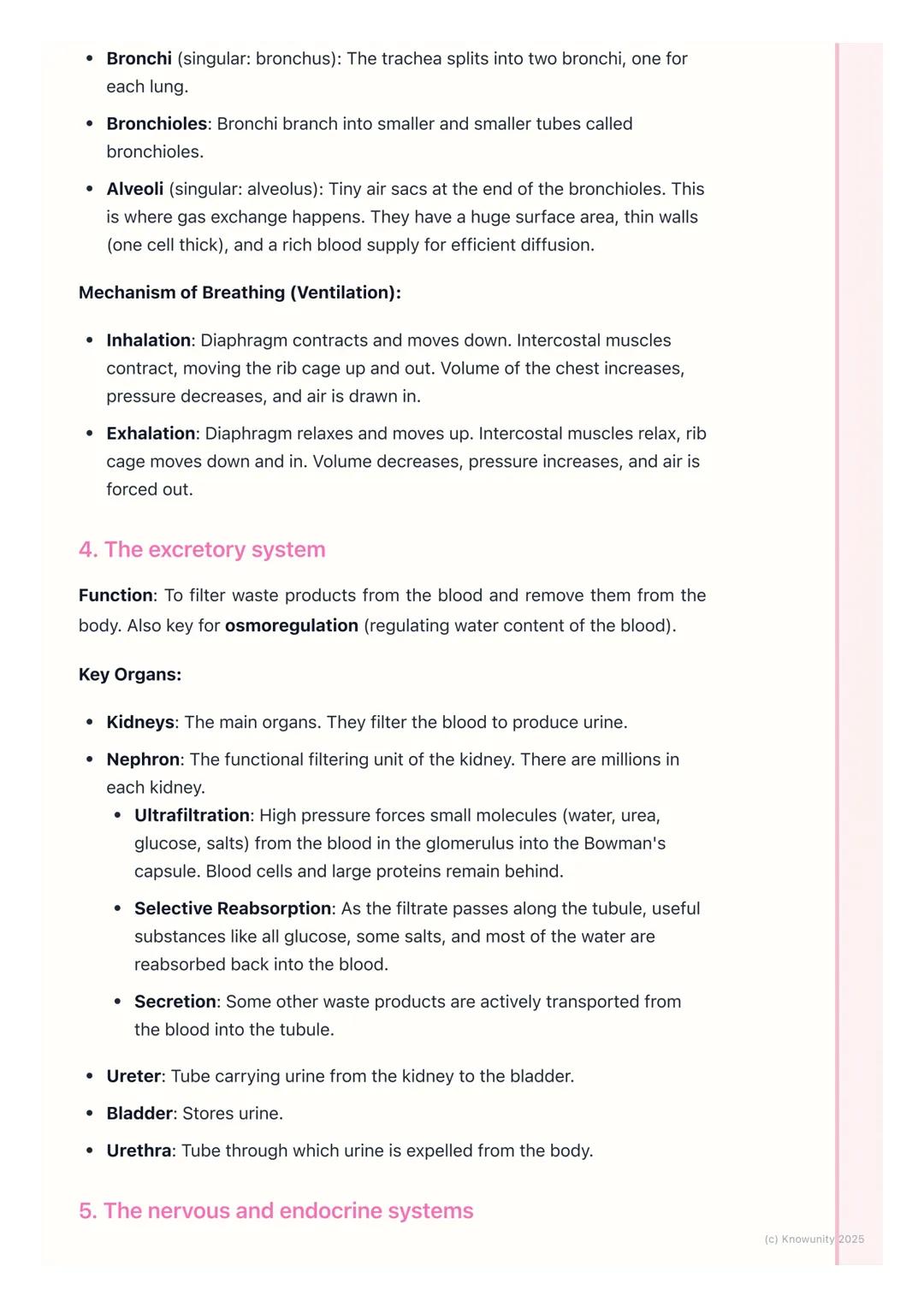
Excretory and Control Systems
The excretory system filters waste from your blood and regulates water content. Your kidneys contain millions of nephrons (filtering units) that use ultrafiltration to force small molecules out of blood, then selective reabsorption to reclaim useful substances like glucose and most water back into your bloodstream.
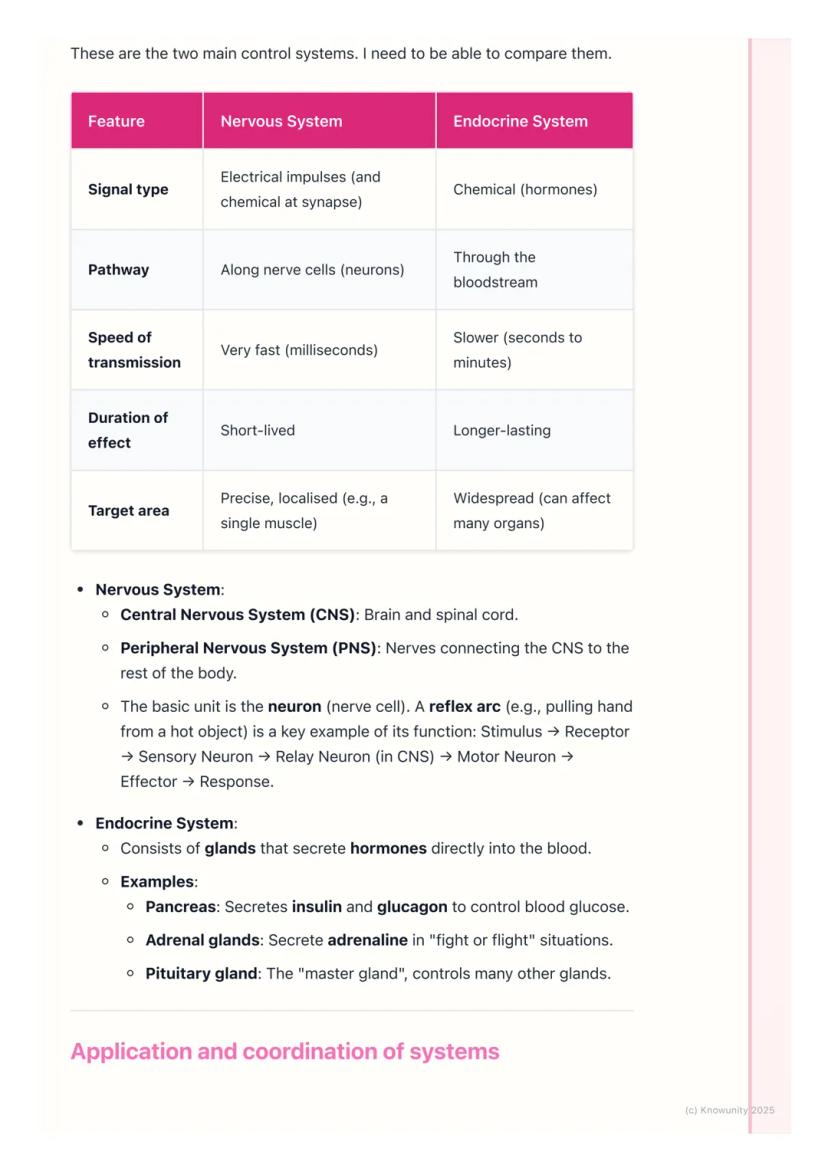
The nervous system and endocrine system are your body's control networks, but they work very differently. Nervous signals are electrical impulses that travel along neurons - super fast but short-lived, perfect for precise responses like reflexes. Hormones from the endocrine system travel through blood - slower but longer-lasting, ideal for widespread effects.
A reflex arc demonstrates nervous system efficiency: stimulus → receptor → sensory neuron → relay neuron → motor neuron → effector → response. No conscious thought needed! Meanwhile, hormones like insulin from the pancreas control blood glucose, and adrenaline from adrenal glands prepares you for "fight or flight" situations.
Negative feedback maintains homeostasis - when something increases, the body responds to decrease it, and vice versa. Think blood sugar regulation or temperature control.
7
of 9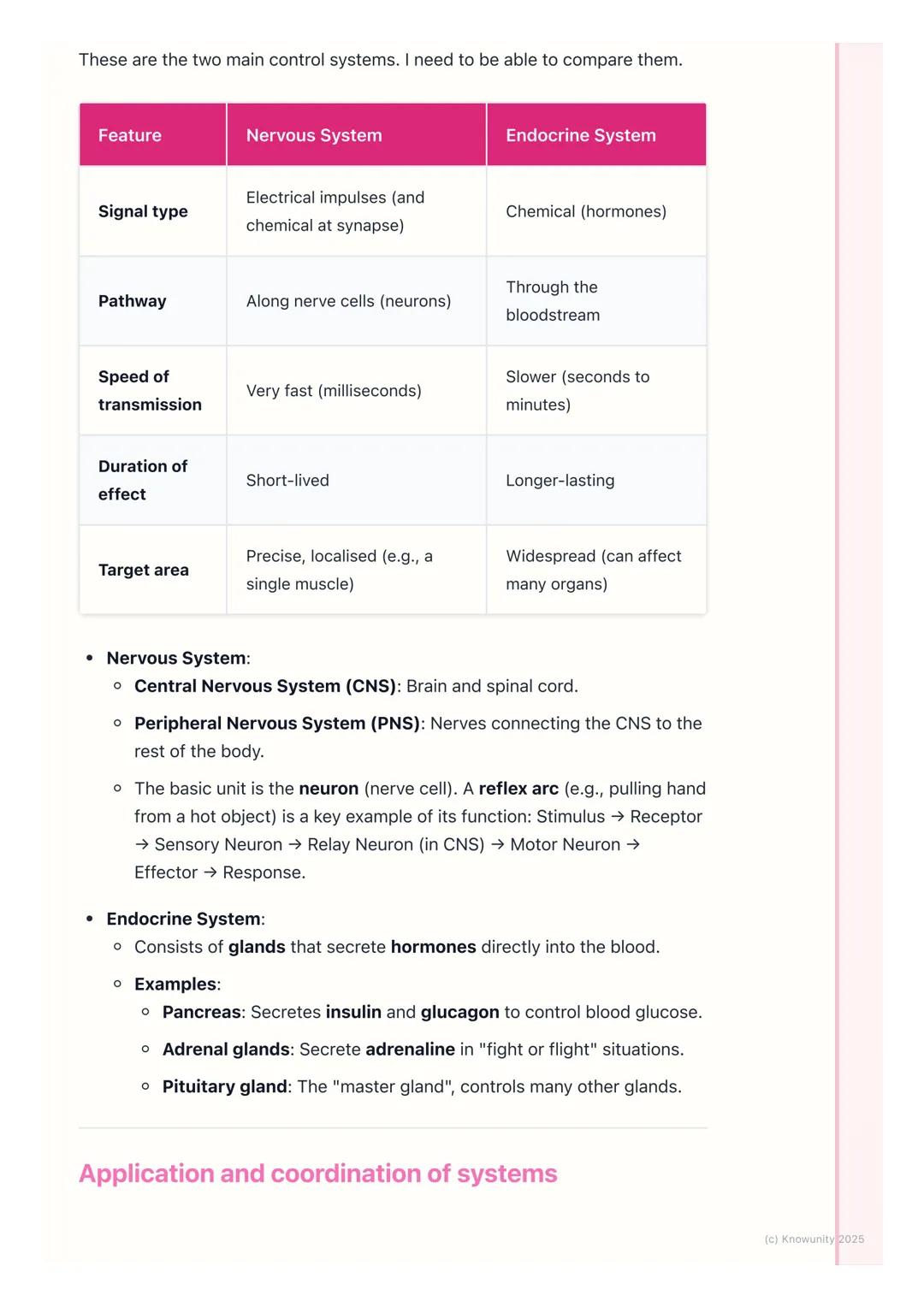
System Comparison and Control
The table clearly shows why your body needs both control systems. Nervous system signals are electrical impulses along neurons - lightning fast (milliseconds) but brief, perfect for precise targeting like moving a specific muscle. Endocrine system uses chemical messengers (hormones) in blood - slower (seconds to minutes) but longer-lasting with widespread effects.
Key endocrine glands include the pancreas (insulin and glucagon for blood glucose), adrenal glands (adrenaline for stress response), and pituitary gland (the "master gland" controlling other glands). These work alongside your brain and spinal cord (central nervous system) and the nerves connecting everywhere else (peripheral nervous system).
Understanding the reflex arc is crucial - it shows how your nervous system can respond without conscious thought. When you touch something hot, sensory neurons detect the stimulus, relay neurons in your spinal cord process it, and motor neurons trigger muscle contraction to pull your hand away.
Exam Gold: Be able to compare nervous and endocrine systems using the table format - it's a classic exam question that students often mess up.
8
of 9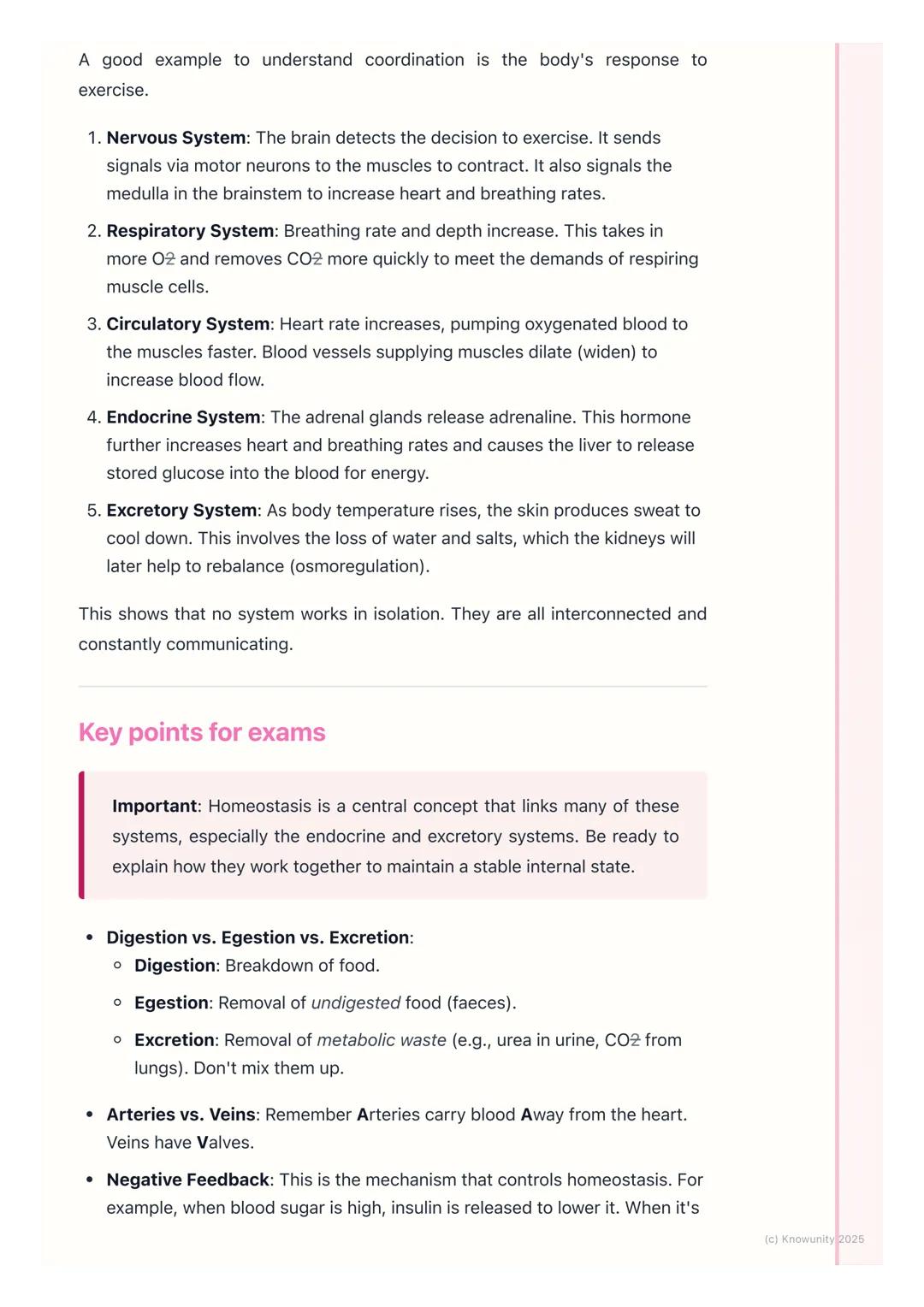
System Coordination During Exercise
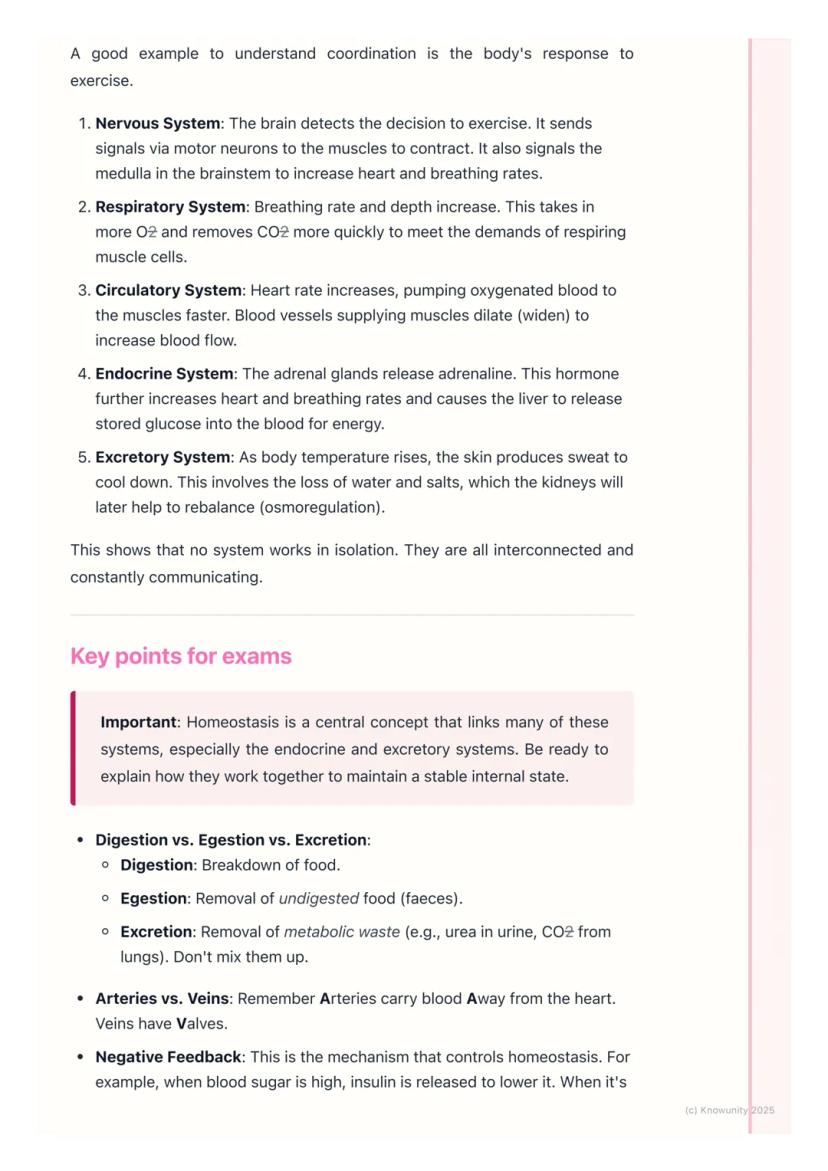
Exercise perfectly demonstrates how all systems coordinate. When you decide to run, your nervous system sends signals to muscles while telling your brainstem to increase heart and breathing rates. Your respiratory system responds by increasing breathing rate and depth to supply more oxygen and remove carbon dioxide faster.
Your circulatory system kicks into high gear - heart rate increases, blood vessels to muscles dilate (widen) for increased blood flow. The endocrine system joins in as adrenal glands release adrenaline, further boosting heart and breathing rates while triggering glucose release from the liver for energy.
Meanwhile, your excretory system helps with temperature regulation through sweating, though this means losing water and salts that kidneys must later rebalance through osmoregulation. This shows that homeostasis involves constant communication between systems.
Negative feedback mechanisms ensure everything stays balanced - when carbon dioxide builds up, breathing increases to remove it; when body temperature rises, sweating increases to cool you down.
9
of 9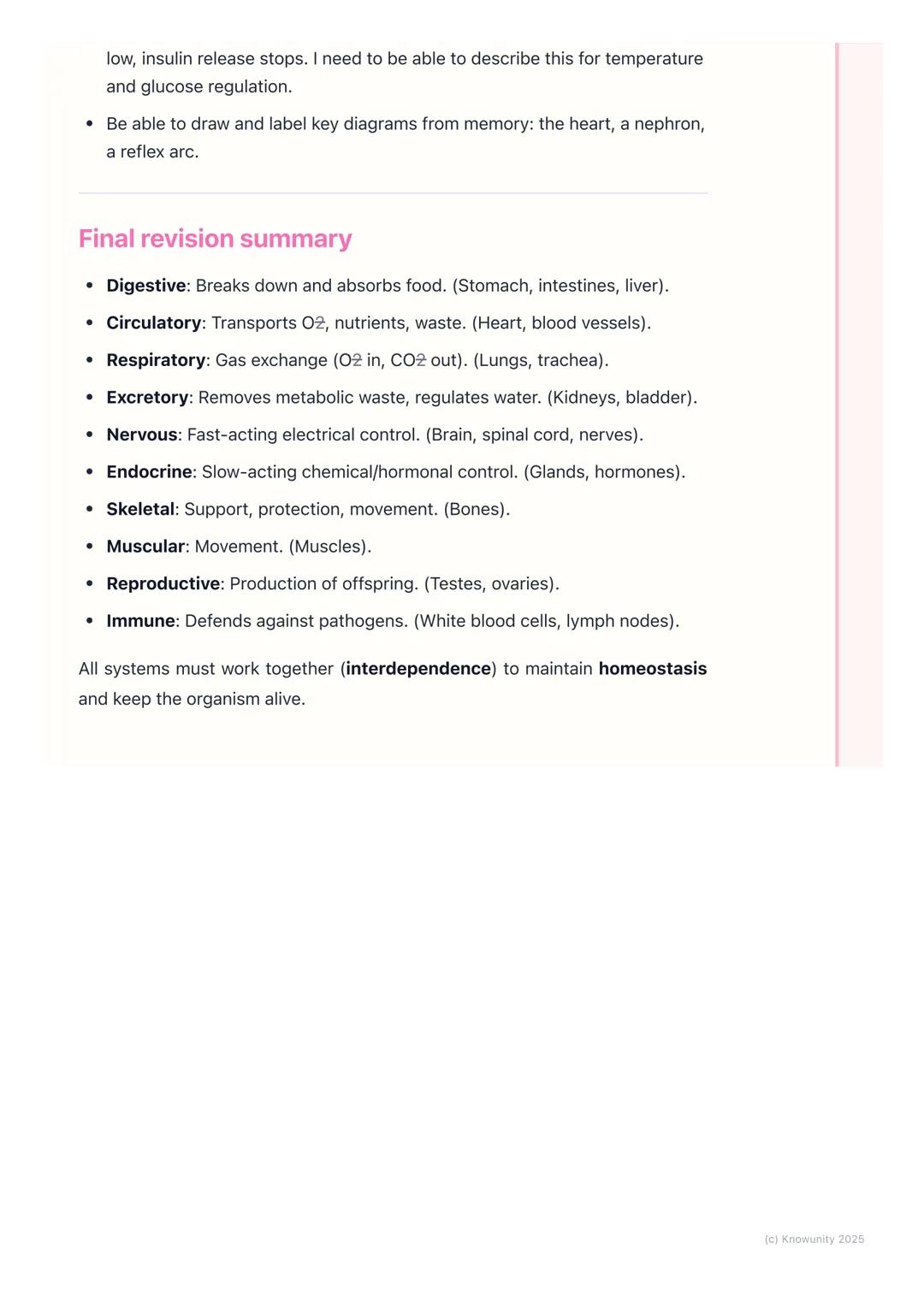
Exam Success and Key Concepts
Master these crucial distinctions that trip up students: Digestion breaks down food, egestion removes undigested waste (faeces), and excretion removes metabolic waste like urea and carbon dioxide. Don't mix them up - it's a classic examiner trick!
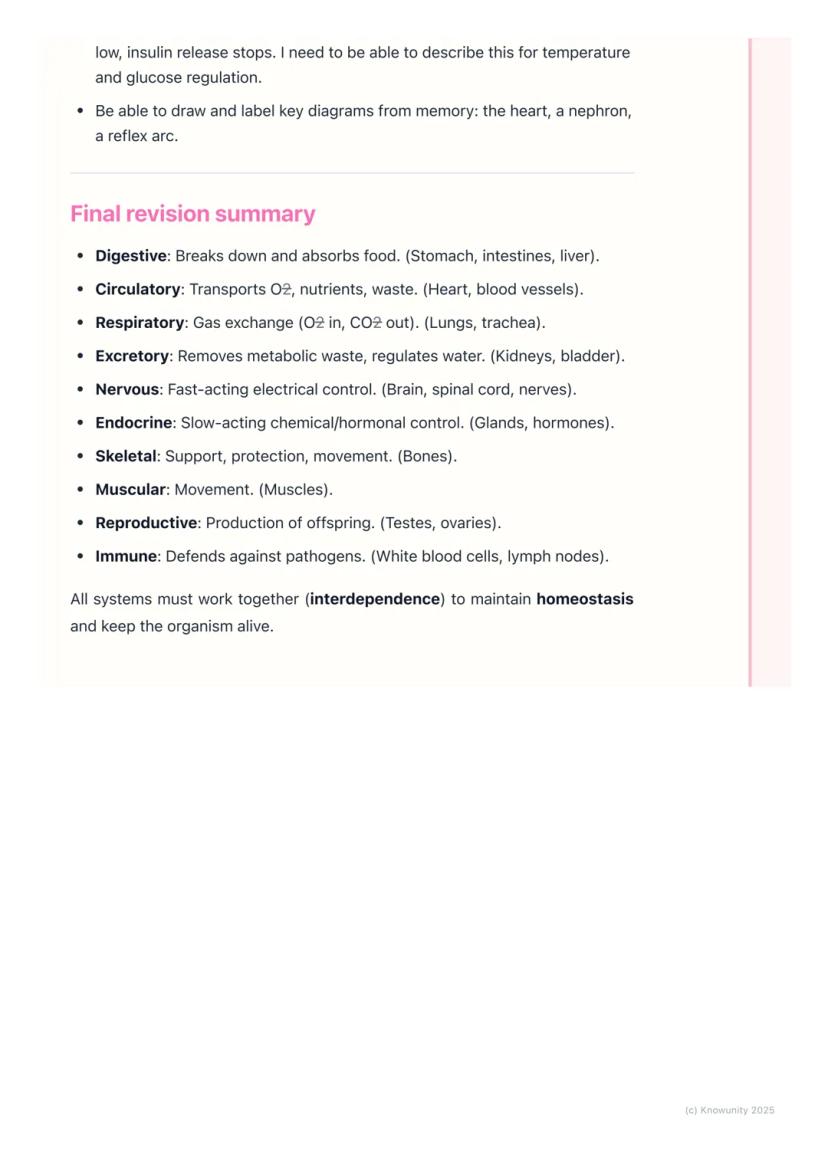
Remember that homeostasis links everything together, especially through negative feedback mechanisms. When blood glucose rises, insulin is released to lower it; when it falls, insulin release stops. Same principle applies to temperature regulation and water balance.
For exam success, memorise key diagrams: the heart's four chambers, a nephron's structure, and a complete reflex arc. These appear frequently and are easy marks if you know them properly. Also remember: Arteries carry blood Away from the heart, Veins have Valves.
The bottom line? All systems are interdependent - they work together to maintain homeostasis and keep you alive. This interconnection concept is what separates top students from average ones in exams.
Final Tip: Practice explaining how systems work together in different scenarios (exercise, eating, stress). This deeper understanding will help you tackle any question the examiners throw at you.
Si on te demande...
Qu'est-ce que le compagnon IA de Knowunity ?
Notre compagnon IA est spécialement conçu pour répondre aux besoins des étudiants. Sur la base des millions d'éléments de contenu que nous avons sur la plateforme, nous pouvons fournir des réponses vraiment significatives et pertinentes aux étudiants. Mais il ne s'agit pas seulement de réponses, le compagnon a encore plus pour but de guider les élèves dans leurs défis d'apprentissage quotidiens, avec des plans d'étude personnalisés, des quiz ou des éléments de contenu dans le chat et une personnalisation à 100% basée sur les compétences et les développements de l'étudiant.
Où puis-je télécharger l'appli Knowunity ?
Tu peux télécharger l'application dans Google Play Store et dans l'App Store d'Apple.
L'application est-elle vraiment gratuite ?
Oui, tu as un accès entièrement gratuit à tous les contenus de l'appli, tu peux chatter ou suivre les créateurs à tout moment. De plus, nous proposons Knowunity Premium, qui te permet de réviser sans limites!
Contenus les plus populaires en Science
7ScienceScience/Physics notes - Speed, density, work
Speed density work formulas
3rd Year81
ScienceAtomic Structure and the Periodic Table
Students will learn about the structure of atoms, including protons, neutrons, and electrons, and how elements are organised and classified in the Periodic Table based on their electronic configuration and chemical properties.
5th Year41
ScienceHuman Body Systems
An introduction to major human body systems such as the digestive, circulatory, respiratory, and nervous systems, understanding their basic functions.
2nd Year131
ScienceJunior Cert Science Notes: The Cell
Notes on the Cell
3rd Year261
ScienceCells
Junior cert science cells summary
1st Year611
ScienceHuman Reproductive System
A basic overview of the male and female reproductive systems, including their main structures and functions.
TY191
ScienceLight and Optics
Exploring the properties of light, including how it travels, reflects, and refracts, and how we perceive colours.
2nd Year50
Contenus les plus populaires
9 Irish
IrishIrish oral questions and answers
Questions and answers for the leaving cert oral
5th Year4264
 English
Key Quotes : Sive
Key Quotes and explanations: Sive
6th Year2842
IrishIrish oral questions
Outline of oral questions
5th Year2055
IrishIníon- le hÁine Durkin
Aine Durkin’s poem, Iníon: Themes & summary
5th Year890
IrishIrish poetry 2027
Iníon + Dínit an Bhróin
5th Year1153
IrishLC HL notes- Iníon (poem)
Includes poem in English and Irish, theme, key words & phrases
5th Year2304
EnglishCultural Context : Shawshank Redemption : Sive : Small Things Like These
Comparative Study : Cultural Context : Shawshank Redemption, Sive and Small Things Like These
6th Year1430
IrishMo Ghrá-sa (Idir Lúibíní)
Notes on mo ghrá-sa
5th Year380
IrishAn Gaeilge Aiste
Irish Language essay
6th Year1320
Rien ne te convient ? Explore d'autres matières.
Les étudiants nous adorent — il ne manque plus que toi.
4.6/5App Store
4.7/5Google Play
L'application est très facile d'utilisation et bien conçue. Jusqu'à présent, j'ai trouvé tout ce que je cherchais et j'ai pu apprendre beaucoup de choses grâce aux présentations ! Je vais certainement utiliser l'application pour un travail en classe ! Et comme source d'inspiration personnelle, elle est bien sûr aussi très utile.
Stefan Sutilisateur iOS
Cette application est vraiment super. Il y a tellement de fiches de révision et d'aide, [...]. Par exemple, la matière qui me pose problème est le français et l'appli a un choix d'aide très large. Grâce à cette application, je me suis améliorée en français. Je la recommanderais à tout le monde.
Samantha Klichutilisatrice Android
Waouh, je suis vraiment abasourdi. J'ai essayé l'application parce que je l'avais déjà vue plusieurs fois dans la publicité et j'ai été absolument choquée. Cette appli est L'AIDE dont on rêve pour l'école et surtout, elle propose tellement de choses, comme des rédactions et des fiches qui m'ont personnellement TRÈS bien aidé.
Annautilisatrice iOS
Science19 vues·Mis à jour Jun 8, 2026·9 pagesUnderstanding the Human Body Systems: A Simple Guide
Your body is like a well-coordinated team where different systems work together to keep you alive and healthy. Understanding how these systems connect and communicate is crucial for your Leaving Cert Biology - and it's actually pretty fascinating once you...
1
of 9
Inscris-toi pour voir le contenu. C'est gratuit!
- Accès à tous les documents
- Améliore tes notes
- Rejoins des millions d'étudiants
Introduction to Body Systems
Think of your body as the ultimate teamwork example - every system depends on others to function properly. The organisation goes from cells (the basic units) → tissues (groups of similar cells) → organs (different tissues working together) → organ systems (organs with a common goal).
Homeostasis is the star concept here - it's how your body maintains a stable internal environment despite what's happening outside. Whether you're sweating in PE class or shivering in winter, your body is constantly adjusting to keep everything balanced.
The key insight? No system works alone. Your digestive system needs your circulatory system to transport nutrients, which needs your respiratory system for oxygen. It's all interconnected, and that's exactly what examiners love to test you on.
Exam Tip: Always think about how systems work together, not just what each one does individually. This interconnection is a favourite topic for longer exam questions.
2
of 9Inscris-toi pour voir le contenu. C'est gratuit!
- Accès à tous les documents
- Améliore tes notes
- Rejoins des millions d'étudiants
The Digestive System
Your digestive system is basically a sophisticated food processor that turns your lunch into molecules small enough to enter your bloodstream. The four main stages are ingestion (eating), digestion (breaking down), absorption (taking in nutrients), and egestion (removing waste).
Mechanical digestion happens when you chew or when your stomach churns food around. Chemical digestion uses enzymes like amylase in your saliva to break down starch, or pepsin in your stomach to tackle proteins. Your stomach also produces hydrochloric acid - strong enough to kill bacteria and create the perfect pH for pepsin to work.
The small intestine is where the magic happens - most digestion and ALL absorption occurs here. Those tiny finger-like projections called villi massively increase surface area for absorption. Meanwhile, your liver produces bile to break up fats , and your pancreas churns out enzymes for all the major food groups.
Don't confuse egestion (removing undigested food as faeces) with excretion (removing metabolic waste like urea). This mix-up costs students marks every year!
3
of 9Inscris-toi pour voir le contenu. C'est gratuit!
- Accès à tous les documents
- Améliore tes notes
- Rejoins des millions d'étudiants
Digestive System Structure
The diagram shows how food travels through your body in a logical sequence. From your mouth where mechanical digestion begins with chewing and chemical digestion starts with salivary amylase, food moves down the oesophagus via wave-like muscle contractions called peristalsis.
Your stomach acts like a muscular bag that churns food while secreting hydrochloric acid and pepsin. The real action happens in the small intestine, where bile from the liver and enzymes from the pancreas complete the breakdown process.
The large intestine has one main job - absorbing water from whatever's left over. This is why you get dehydrated when you have diarrhea - your large intestine isn't doing its water-absorption job properly.
Memory Trick: Remember that the liver produces bile (which emulsifies fats) while the pancreas produces the three main enzymes: amylase, protease, and lipase.
4
of 9Inscris-toi pour voir le contenu. C'est gratuit!
- Accès à tous les documents
- Améliore tes notes
- Rejoins des millions d'étudiants
The Circulatory System
Your circulatory system is the body's transport network, moving oxygen, nutrients, hormones, and waste products around via blood. The heart is a muscular pump with four chambers - two atria (top chambers) and two ventricles (bottom chambers). The right side handles deoxygenated blood to the lungs, while the left side pumps oxygenated blood to the rest of your body.
Arteries carry blood away from the heart and have thick, muscular walls to handle high pressure. Veins bring blood back to the heart, have thinner walls, and contain valves to prevent backflow. Capillaries are where the actual exchange happens - they're only one cell thick to allow easy diffusion.
Your blood contains plasma (the liquid bit that transports everything), red blood cells (packed with haemoglobin to carry oxygen), white blood cells (your immune system's soldiers), and platelets (for blood clotting when you get cut).
This double circulatory system is incredibly efficient - blood goes through the heart twice in each complete circuit, ensuring high pressure delivery of oxygenated blood to your tissues.
5
of 9Inscris-toi pour voir le contenu. C'est gratuit!
- Accès à tous les documents
- Améliore tes notes
- Rejoins des millions d'étudiants
The Respiratory System
Gas exchange is the respiratory system's main job - getting oxygen in and carbon dioxide out. Air travels through your trachea (windpipe), which splits into two bronchi (one for each lung), then branches into smaller bronchioles, finally reaching tiny air sacs called alveoli.
Alveoli are perfectly designed for gas exchange - they have enormous surface area, walls just one cell thick, and rich blood supply. This allows oxygen and carbon dioxide to diffuse efficiently between air and blood.
Breathing involves your diaphragm and intercostal muscles working together. When you breathe in, your diaphragm contracts and moves down while your rib cage moves up and out, increasing chest volume and drawing air in. Breathing out is basically the reverse process.
Common Mistake: Don't confuse breathing (moving air in and out) with respiration (the chemical process that releases energy in cells). They're related but different processes.
6
of 9Inscris-toi pour voir le contenu. C'est gratuit!
- Accès à tous les documents
- Améliore tes notes
- Rejoins des millions d'étudiants
Excretory and Control Systems
The excretory system filters waste from your blood and regulates water content. Your kidneys contain millions of nephrons (filtering units) that use ultrafiltration to force small molecules out of blood, then selective reabsorption to reclaim useful substances like glucose and most water back into your bloodstream.
The nervous system and endocrine system are your body's control networks, but they work very differently. Nervous signals are electrical impulses that travel along neurons - super fast but short-lived, perfect for precise responses like reflexes. Hormones from the endocrine system travel through blood - slower but longer-lasting, ideal for widespread effects.
A reflex arc demonstrates nervous system efficiency: stimulus → receptor → sensory neuron → relay neuron → motor neuron → effector → response. No conscious thought needed! Meanwhile, hormones like insulin from the pancreas control blood glucose, and adrenaline from adrenal glands prepares you for "fight or flight" situations.
Negative feedback maintains homeostasis - when something increases, the body responds to decrease it, and vice versa. Think blood sugar regulation or temperature control.
7
of 9Inscris-toi pour voir le contenu. C'est gratuit!
- Accès à tous les documents
- Améliore tes notes
- Rejoins des millions d'étudiants
System Comparison and Control
The table clearly shows why your body needs both control systems. Nervous system signals are electrical impulses along neurons - lightning fast (milliseconds) but brief, perfect for precise targeting like moving a specific muscle. Endocrine system uses chemical messengers (hormones) in blood - slower (seconds to minutes) but longer-lasting with widespread effects.
Key endocrine glands include the pancreas (insulin and glucagon for blood glucose), adrenal glands (adrenaline for stress response), and pituitary gland (the "master gland" controlling other glands). These work alongside your brain and spinal cord (central nervous system) and the nerves connecting everywhere else (peripheral nervous system).
Understanding the reflex arc is crucial - it shows how your nervous system can respond without conscious thought. When you touch something hot, sensory neurons detect the stimulus, relay neurons in your spinal cord process it, and motor neurons trigger muscle contraction to pull your hand away.
Exam Gold: Be able to compare nervous and endocrine systems using the table format - it's a classic exam question that students often mess up.
8
of 9Inscris-toi pour voir le contenu. C'est gratuit!
- Accès à tous les documents
- Améliore tes notes
- Rejoins des millions d'étudiants
System Coordination During Exercise
Exercise perfectly demonstrates how all systems coordinate. When you decide to run, your nervous system sends signals to muscles while telling your brainstem to increase heart and breathing rates. Your respiratory system responds by increasing breathing rate and depth to supply more oxygen and remove carbon dioxide faster.
Your circulatory system kicks into high gear - heart rate increases, blood vessels to muscles dilate (widen) for increased blood flow. The endocrine system joins in as adrenal glands release adrenaline, further boosting heart and breathing rates while triggering glucose release from the liver for energy.
Meanwhile, your excretory system helps with temperature regulation through sweating, though this means losing water and salts that kidneys must later rebalance through osmoregulation. This shows that homeostasis involves constant communication between systems.
Negative feedback mechanisms ensure everything stays balanced - when carbon dioxide builds up, breathing increases to remove it; when body temperature rises, sweating increases to cool you down.
9
of 9Inscris-toi pour voir le contenu. C'est gratuit!
- Accès à tous les documents
- Améliore tes notes
- Rejoins des millions d'étudiants
Exam Success and Key Concepts
Master these crucial distinctions that trip up students: Digestion breaks down food, egestion removes undigested waste (faeces), and excretion removes metabolic waste like urea and carbon dioxide. Don't mix them up - it's a classic examiner trick!
Remember that homeostasis links everything together, especially through negative feedback mechanisms. When blood glucose rises, insulin is released to lower it; when it falls, insulin release stops. Same principle applies to temperature regulation and water balance.
For exam success, memorise key diagrams: the heart's four chambers, a nephron's structure, and a complete reflex arc. These appear frequently and are easy marks if you know them properly. Also remember: Arteries carry blood Away from the heart, Veins have Valves.
The bottom line? All systems are interdependent - they work together to maintain homeostasis and keep you alive. This interconnection concept is what separates top students from average ones in exams.
Final Tip: Practice explaining how systems work together in different scenarios (exercise, eating, stress). This deeper understanding will help you tackle any question the examiners throw at you.
Si on te demande...
Qu'est-ce que le compagnon IA de Knowunity ?
Notre compagnon IA est spécialement conçu pour répondre aux besoins des étudiants. Sur la base des millions d'éléments de contenu que nous avons sur la plateforme, nous pouvons fournir des réponses vraiment significatives et pertinentes aux étudiants. Mais il ne s'agit pas seulement de réponses, le compagnon a encore plus pour but de guider les élèves dans leurs défis d'apprentissage quotidiens, avec des plans d'étude personnalisés, des quiz ou des éléments de contenu dans le chat et une personnalisation à 100% basée sur les compétences et les développements de l'étudiant.
Où puis-je télécharger l'appli Knowunity ?
Tu peux télécharger l'application dans Google Play Store et dans l'App Store d'Apple.
L'application est-elle vraiment gratuite ?
Oui, tu as un accès entièrement gratuit à tous les contenus de l'appli, tu peux chatter ou suivre les créateurs à tout moment. De plus, nous proposons Knowunity Premium, qui te permet de réviser sans limites!
Contenus les plus populaires en Science
7ScienceScience/Physics notes - Speed, density, work
Speed density work formulas
3rd Year81
ScienceAtomic Structure and the Periodic Table
Students will learn about the structure of atoms, including protons, neutrons, and electrons, and how elements are organised and classified in the Periodic Table based on their electronic configuration and chemical properties.
5th Year41
ScienceHuman Body Systems
An introduction to major human body systems such as the digestive, circulatory, respiratory, and nervous systems, understanding their basic functions.
2nd Year131
ScienceJunior Cert Science Notes: The Cell
Notes on the Cell
3rd Year261
ScienceCells
Junior cert science cells summary
1st Year611
ScienceHuman Reproductive System
A basic overview of the male and female reproductive systems, including their main structures and functions.
TY191
ScienceLight and Optics
Exploring the properties of light, including how it travels, reflects, and refracts, and how we perceive colours.
2nd Year50
Contenus les plus populaires
9IrishIrish oral questions and answers
Questions and answers for the leaving cert oral
5th Year4264
EnglishKey Quotes : Sive
Key Quotes and explanations: Sive
6th Year2842
IrishIrish oral questions
Outline of oral questions
5th Year2055
IrishIníon- le hÁine Durkin
Aine Durkin’s poem, Iníon: Themes & summary
5th Year890
IrishIrish poetry 2027
Iníon + Dínit an Bhróin
5th Year1153
IrishLC HL notes- Iníon (poem)
Includes poem in English and Irish, theme, key words & phrases
5th Year2304
EnglishCultural Context : Shawshank Redemption : Sive : Small Things Like These
Comparative Study : Cultural Context : Shawshank Redemption, Sive and Small Things Like These
6th Year1430
IrishMo Ghrá-sa (Idir Lúibíní)
Notes on mo ghrá-sa
5th Year380
IrishAn Gaeilge Aiste
Irish Language essay
6th Year1320
Rien ne te convient ? Explore d'autres matières.
Les étudiants nous adorent — il ne manque plus que toi.
4.6/5App Store
4.7/5Google Play
L'application est très facile d'utilisation et bien conçue. Jusqu'à présent, j'ai trouvé tout ce que je cherchais et j'ai pu apprendre beaucoup de choses grâce aux présentations ! Je vais certainement utiliser l'application pour un travail en classe ! Et comme source d'inspiration personnelle, elle est bien sûr aussi très utile.
Stefan Sutilisateur iOS
Cette application est vraiment super. Il y a tellement de fiches de révision et d'aide, [...]. Par exemple, la matière qui me pose problème est le français et l'appli a un choix d'aide très large. Grâce à cette application, je me suis améliorée en français. Je la recommanderais à tout le monde.
Samantha Klichutilisatrice Android
Waouh, je suis vraiment abasourdi. J'ai essayé l'application parce que je l'avais déjà vue plusieurs fois dans la publicité et j'ai été absolument choquée. Cette appli est L'AIDE dont on rêve pour l'école et surtout, elle propose tellement de choses, comme des rédactions et des fiches qui m'ont personnellement TRÈS bien aidé.
Annautilisatrice iOS