
Ever wondered how the ground beneath your feet is constantly...
 Science3 vues·Mis à jour Jun 2, 2026·6 pages
Understanding the Rock Cycle
1 / 6
1
of 6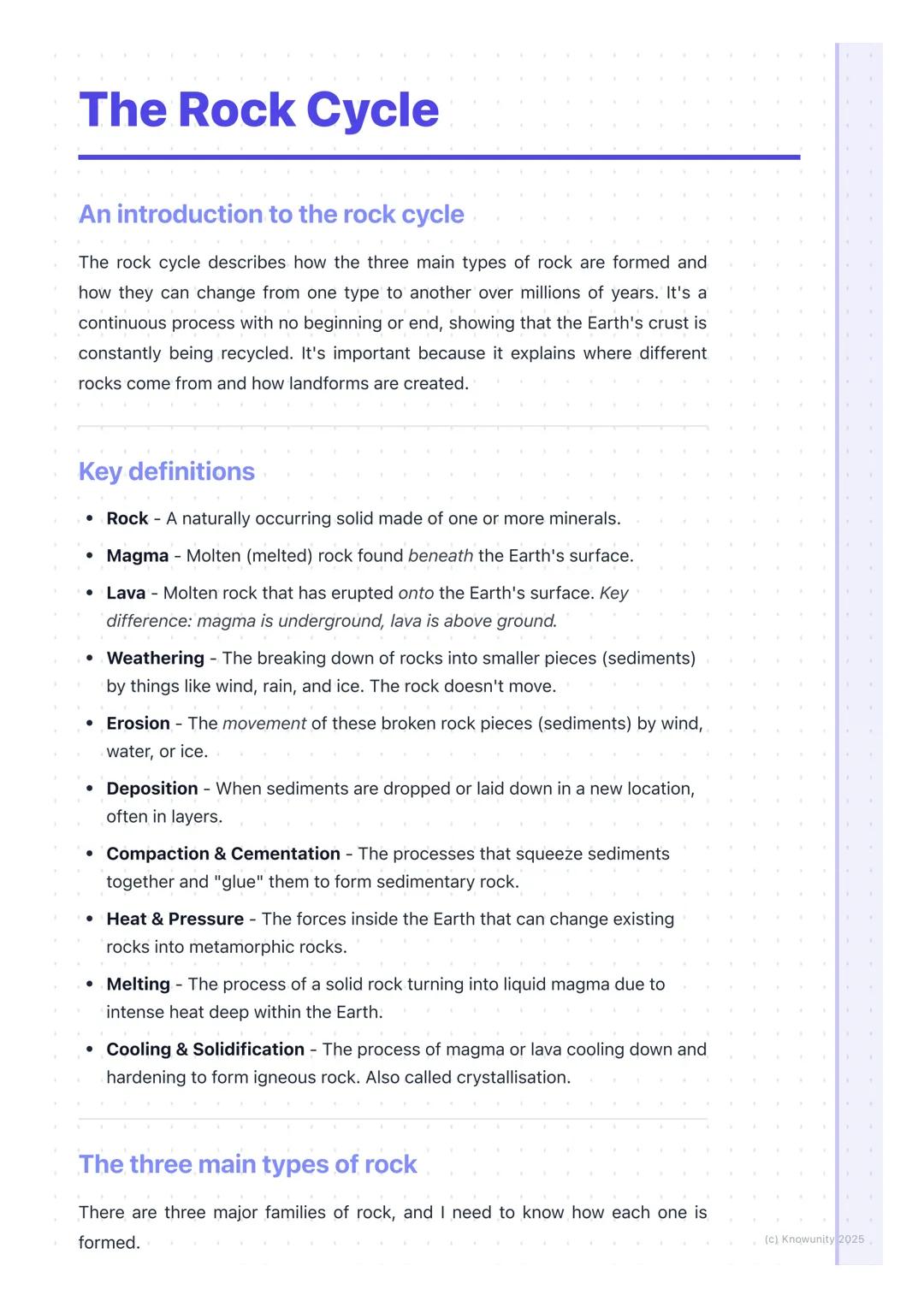
The Rock Cycle Basics
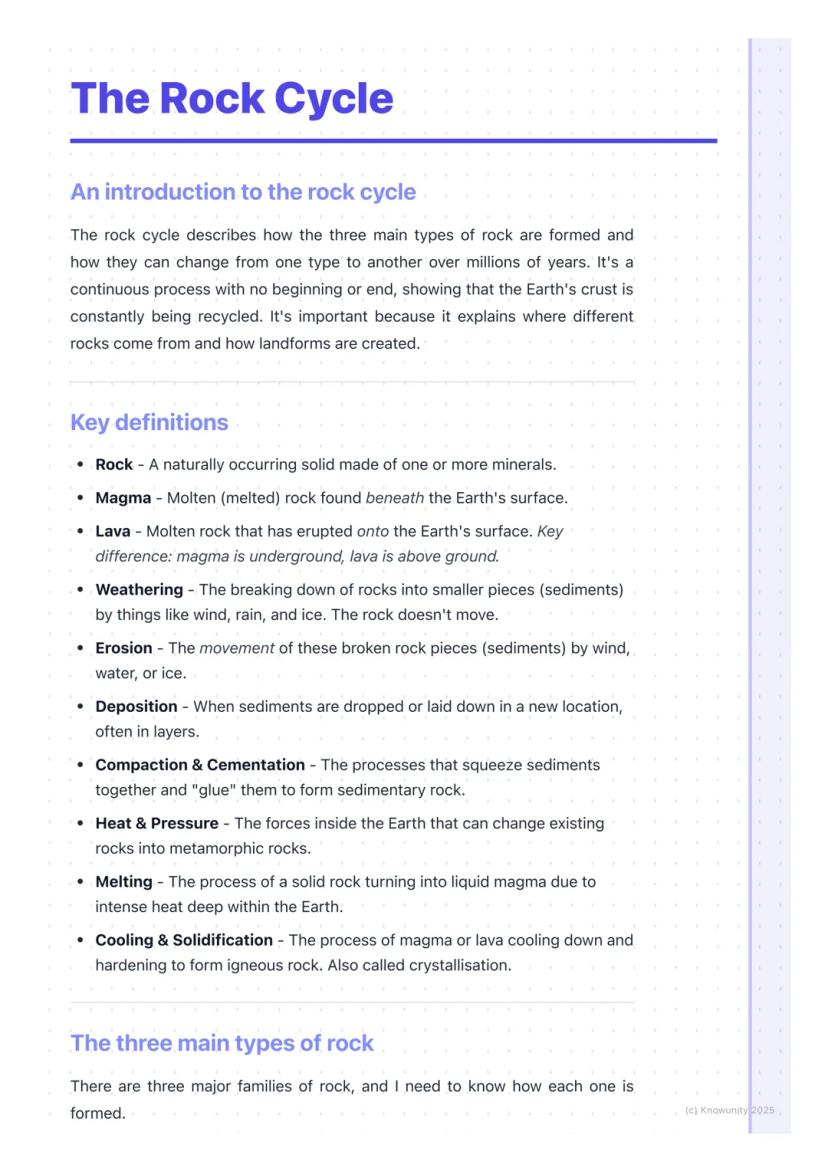
Think of the rock cycle as the Earth's way of recycling - it never stops, and there's no real beginning or end. This continuous process explains how three main types of rock are formed and how they can transform into each other over geological time.
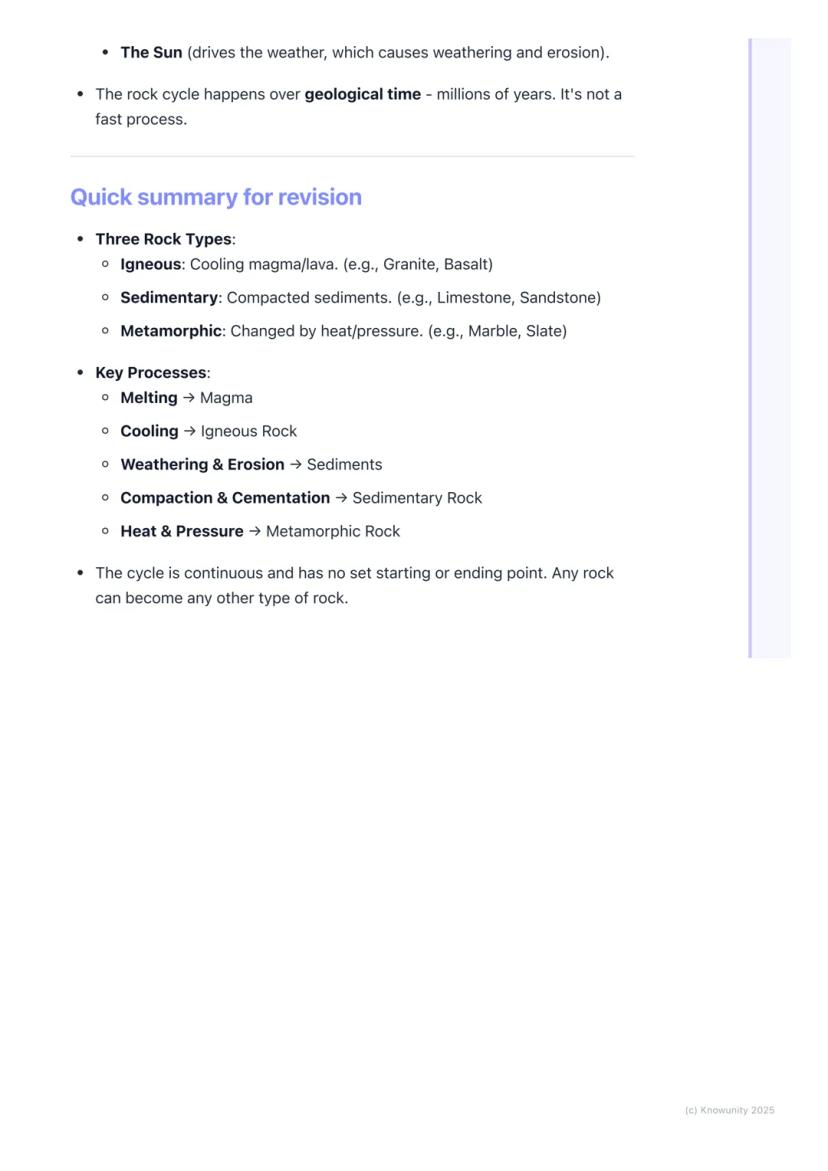
The cycle is powered by two main energy sources: the Earth's internal heat (which melts rocks and creates metamorphism) and the Sun (which drives weather patterns that break down rocks). This means the process happens both deep underground and right at the surface.
Key processes you need to know include weathering (breaking rocks down), erosion (moving the pieces), and the powerful effects of heat and pressure deep within the Earth. Remember, we're talking about changes that take millions of years - not something you'll see happening in your lifetime!
Quick tip: Magma is molten rock underground, whilst lava is molten rock that's erupted onto the surface. This difference is crucial for understanding igneous rocks.
2
of 6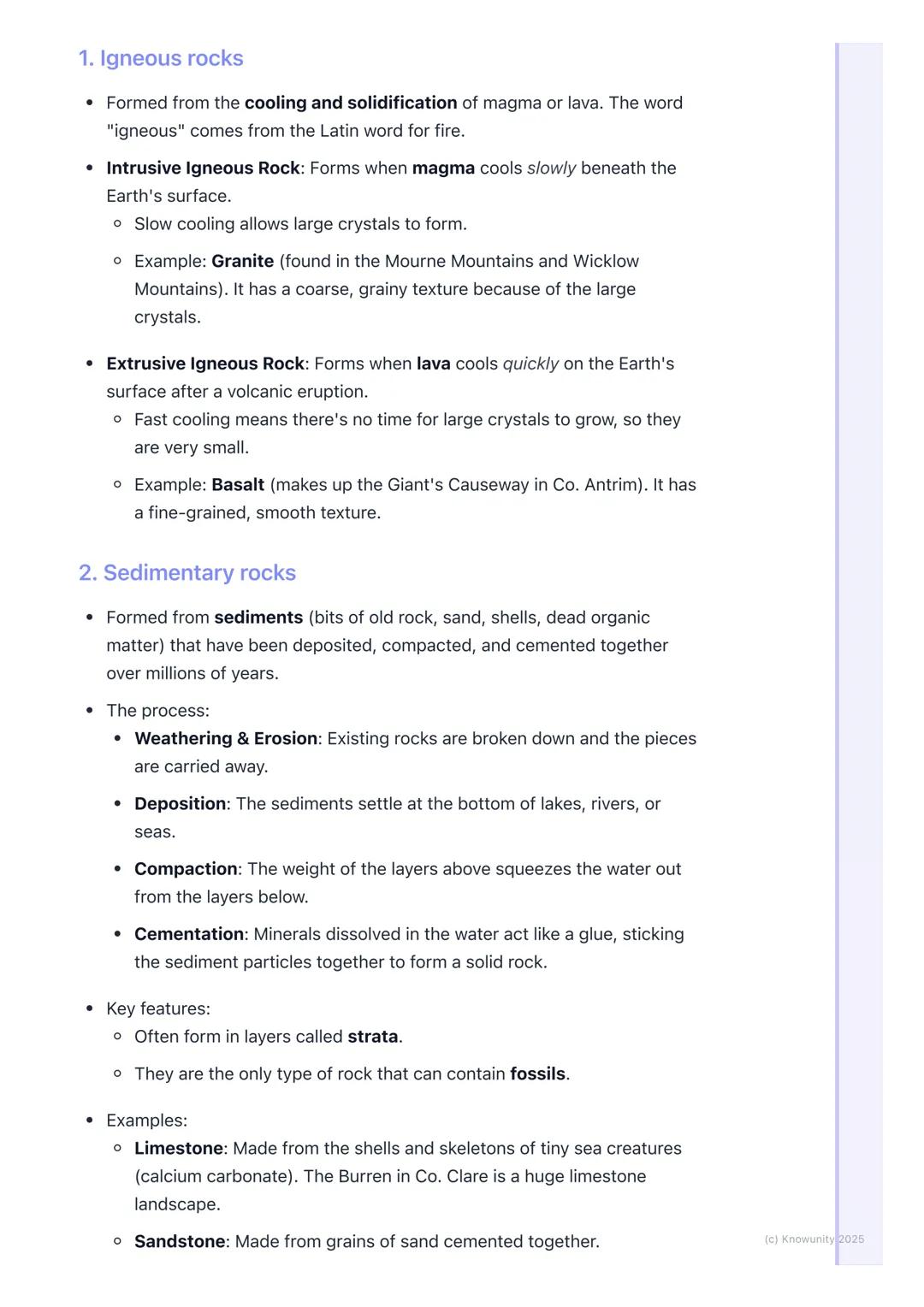
Igneous Rocks: Born from Fire
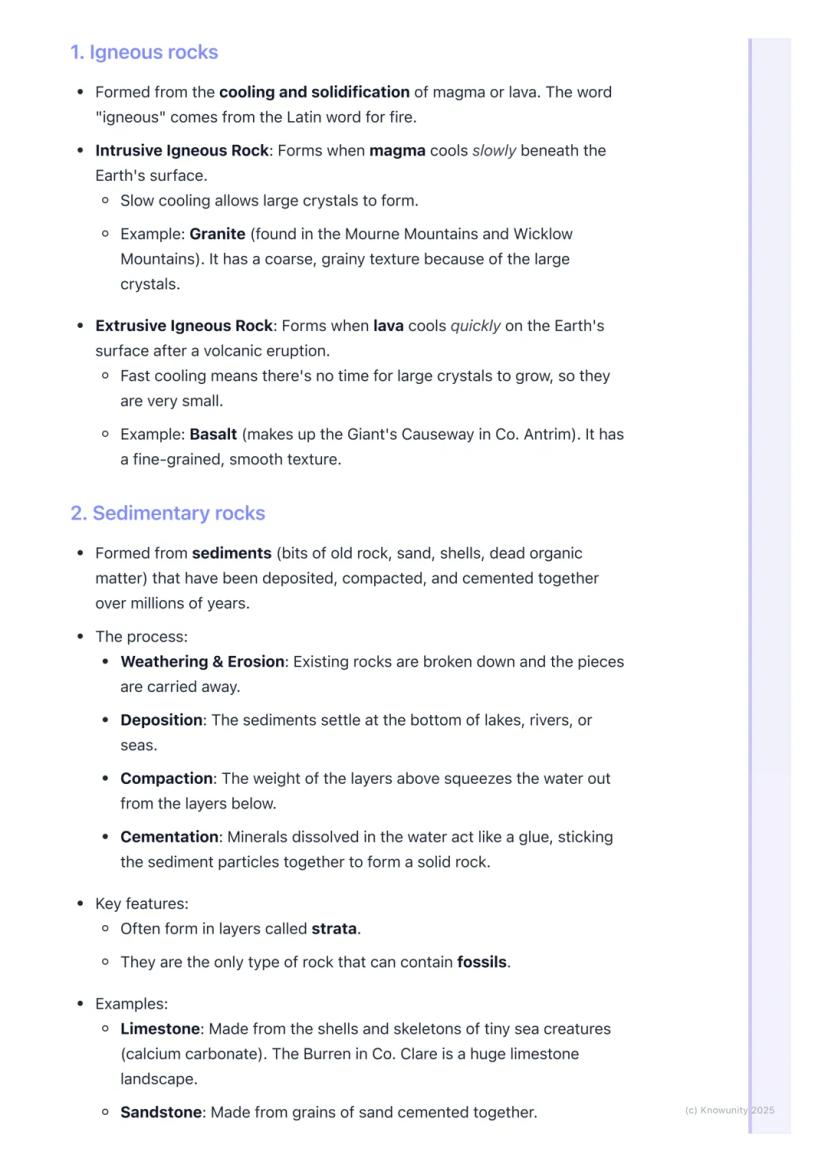
Igneous rocks form when molten rock cools and solidifies - the name literally comes from the Latin word for fire. The speed of cooling makes all the difference in how these rocks look and feel.
Intrusive igneous rocks like granite form when magma cools slowly deep underground. This slow cooling gives crystals time to grow large, creating that coarse, grainy texture you see in places like the Wicklow Mountains. Extrusive igneous rocks like basalt form when lava cools quickly on the Earth's surface after volcanic eruptions.
The Giant's Causeway in County Antrim is a perfect example of basalt - its fine-grained, smooth texture shows how quickly the lava cooled. The faster the cooling, the smaller the crystals, which is why extrusive rocks often look much smoother than their intrusive cousins.
Remember: Slow cooling = large crystals (intrusive). Fast cooling = small crystals (extrusive).
3
of 6
Sedimentary Rocks: Built Layer by Layer
Sedimentary rocks are like nature's history books, formed from sediments that get squashed and glued together over millions of years. These sediments can be bits of old rock, sand, shells, or even dead organic matter.
The formation process follows a clear sequence: weathering breaks down existing rocks, erosion carries the pieces away, and deposition dumps them in layers at the bottom of lakes, rivers, or seas. Then comes compaction (the weight of upper layers squeezing out water) and cementation (minerals acting like glue to stick particles together).
What makes sedimentary rocks special is that they often form in layers called strata, and they're the only rocks that can contain fossils. The Burren in County Clare showcases limestone - formed from tiny sea creatures' shells and skeletons - whilst sandstone is simply sand grains cemented together.
Exam tip: Only sedimentary rocks contain fossils because they form from layers of sediment that can trap and preserve ancient life.
4
of 6
Metamorphic Rocks: Changed by Heat and Pressure
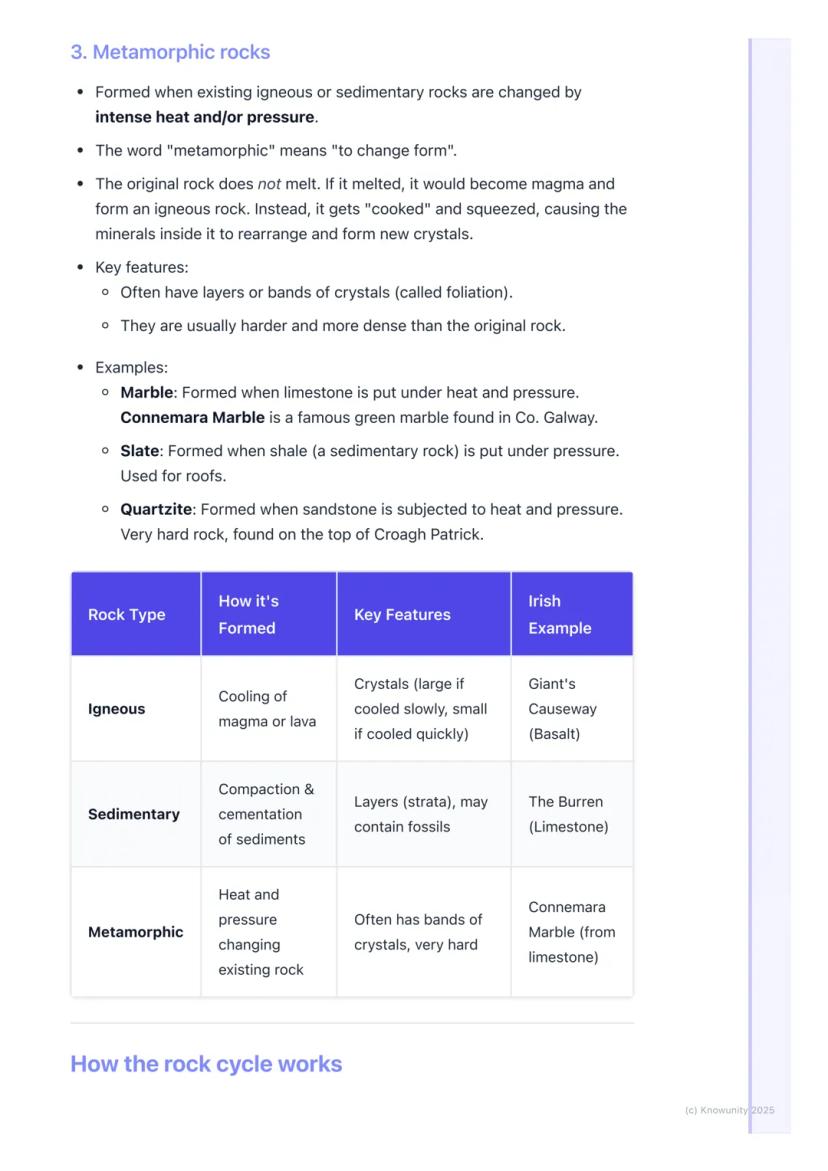
Metamorphic rocks are the transformers of the rock world - existing rocks that have been "cooked" and squeezed by intense heat and pressure deep underground. The word metamorphic literally means "to change form."
Here's the crucial bit: the original rock doesn't melt during this process. If it melted, it would become magma and form an igneous rock instead. The heat and pressure cause minerals inside to rearrange and form new crystals, often creating distinctive bands or layers called foliation.
Ireland has some brilliant examples: Connemara marble (green marble from transformed limestone) in County Galway, slate (from compressed shale) used on roofs, and quartzite (from sandstone) that you'll find on top of Croagh Patrick. These metamorphic rocks are typically much harder and denser than their original forms.
Key point: Metamorphic rocks are changed by heat and pressure but do NOT melt. Melting creates magma, which forms igneous rocks.
5
of 6
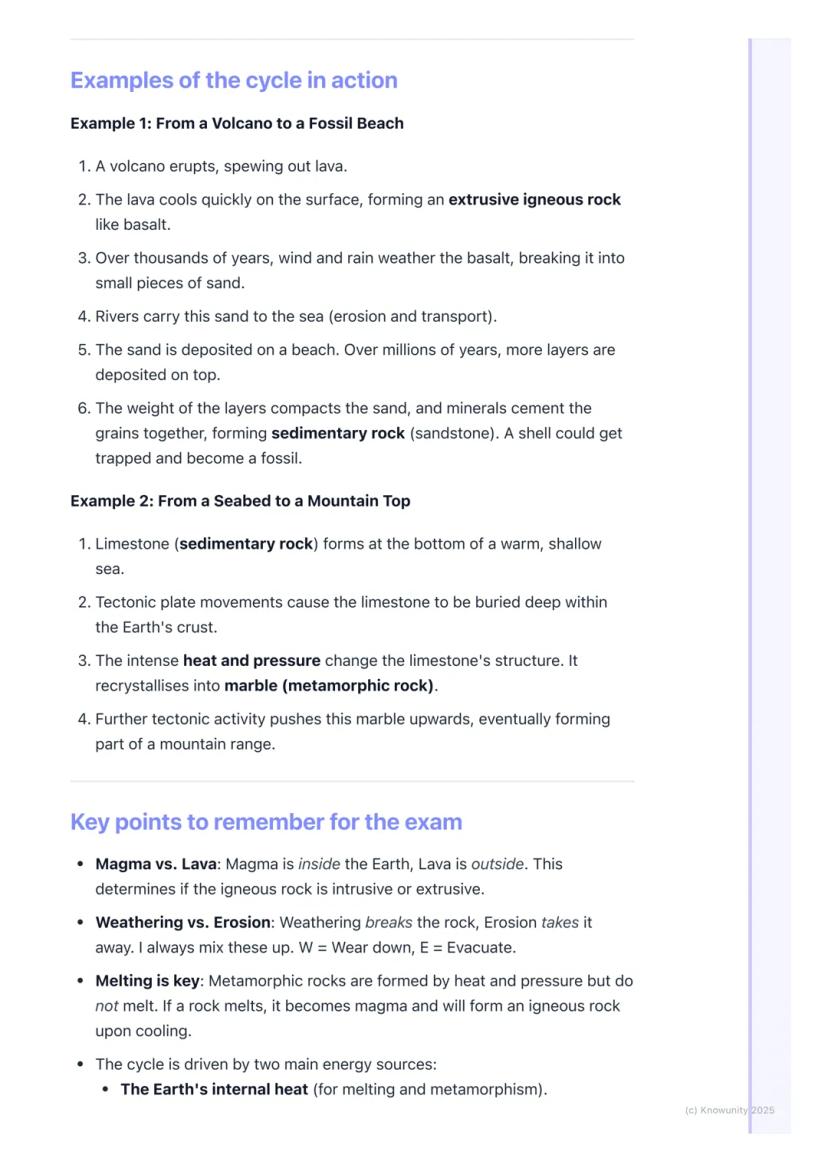
How the Rock Cycle Works
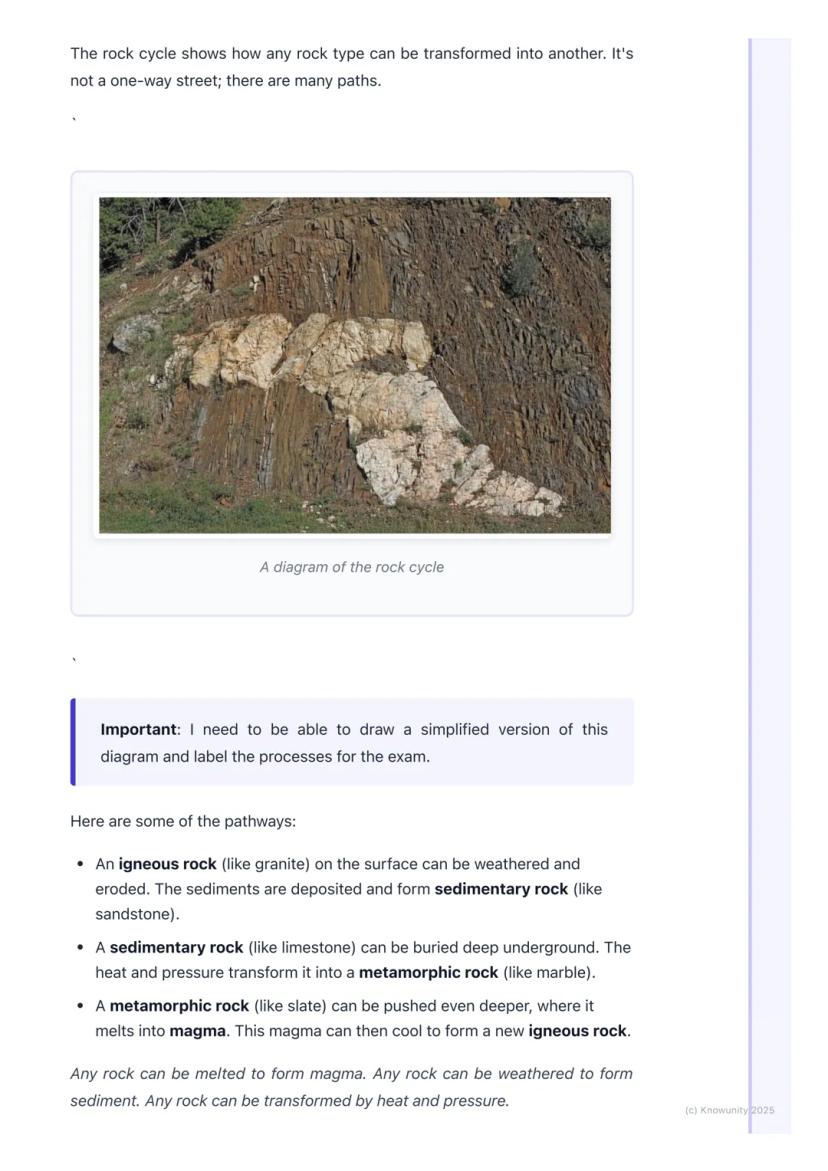
The brilliant thing about the rock cycle is that any rock type can transform into any other - there's no set pathway or direction. Think of it as a web of possibilities rather than a simple circle.
A granite mountain can be weathered into sediments that form sandstone. That sandstone might get buried and transformed by heat and pressure into quartzite. The quartzite could then melt completely, becoming magma that cools into a new igneous rock. The cycle continues endlessly.
Here's a real-world example: volcanic lava cools to form basalt, which gets weathered into sand, transported to beaches, and eventually compacted into sandstone. Meanwhile, limestone formed on ancient seabeds gets pushed deep underground by tectonic forces, transforming into marble before being thrust upward to form mountain peaks.
Exam essential: You need to be able to draw and label a simple rock cycle diagram showing how the three rock types connect through different processes.
6
of 6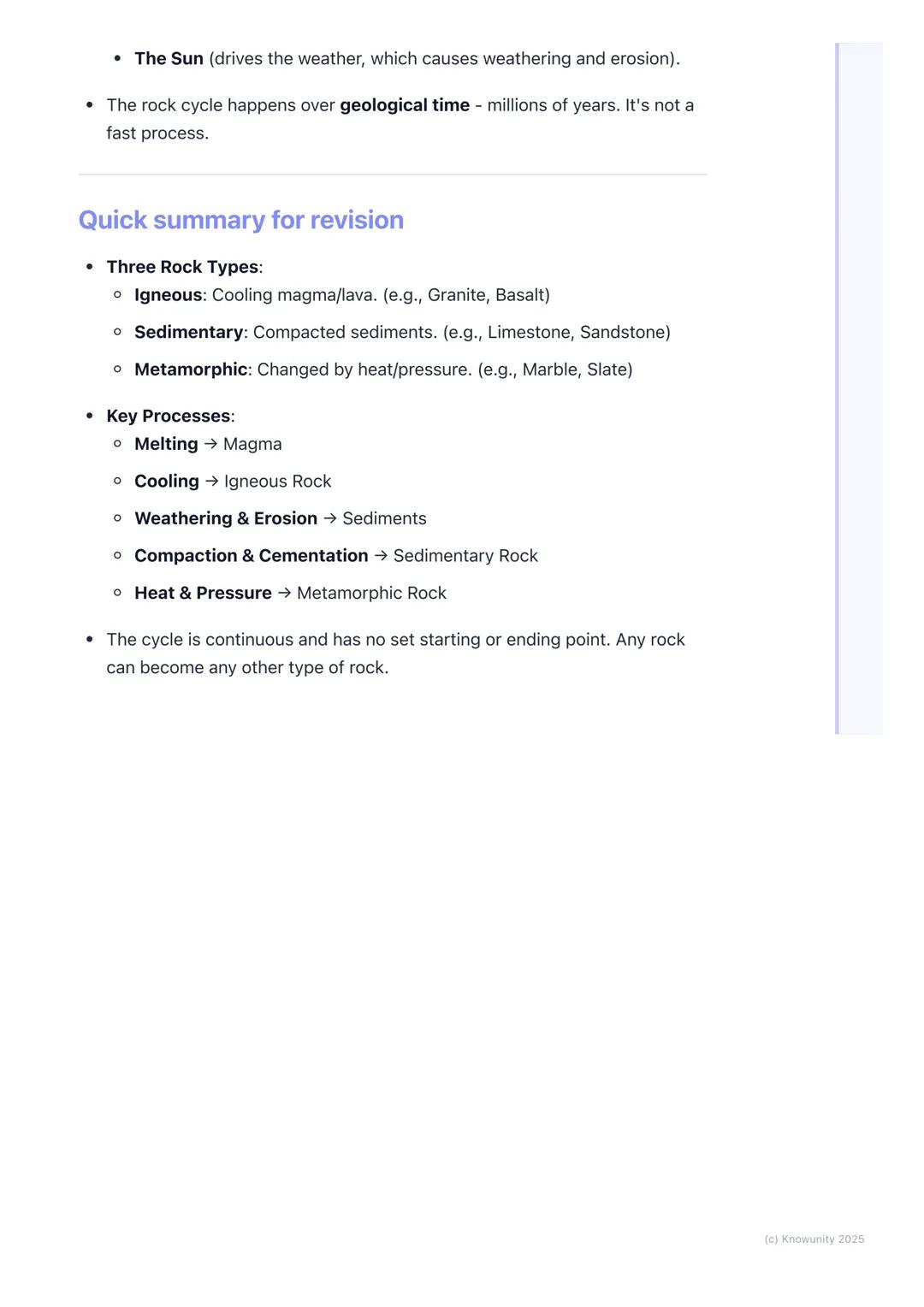
Key Points for Your Exams
Getting the processes straight is crucial for exam success. Weathering breaks rocks down (think "wear down"), whilst erosion takes the pieces away (think "evacuate"). This distinction trips up loads of students, so nail it down now.
Remember that geological time means millions of years - the rock cycle isn't something that happens quickly. The Earth's internal heat drives melting and metamorphism, whilst the Sun powers the weather systems that cause weathering and erosion.
For quick revision, remember the three rock types and their key features: igneous rocks have crystals from cooling magma/lava, sedimentary rocks form in layers and can contain fossils, and metamorphic rocks are changed by heat and pressure. Each type can transform into either of the other two through the right processes.
Revision hack: Create flashcards linking Irish examples (Giant's Causeway, Burren, Connemara marble) to rock types - it helps everything stick in your memory.
Si on te demande...
Qu'est-ce que le compagnon IA de Knowunity ?
Notre compagnon IA est spécialement conçu pour répondre aux besoins des étudiants. Sur la base des millions d'éléments de contenu que nous avons sur la plateforme, nous pouvons fournir des réponses vraiment significatives et pertinentes aux étudiants. Mais il ne s'agit pas seulement de réponses, le compagnon a encore plus pour but de guider les élèves dans leurs défis d'apprentissage quotidiens, avec des plans d'étude personnalisés, des quiz ou des éléments de contenu dans le chat et une personnalisation à 100% basée sur les compétences et les développements de l'étudiant.
Où puis-je télécharger l'appli Knowunity ?
Tu peux télécharger l'application dans Google Play Store et dans l'App Store d'Apple.
L'application est-elle vraiment gratuite ?
Oui, tu as un accès entièrement gratuit à tous les contenus de l'appli, tu peux chatter ou suivre les créateurs à tout moment. De plus, nous proposons Knowunity Premium, qui te permet de réviser sans limites!
Contenus les plus populaires en Science
7ScienceScience/Physics notes - Speed, density, work
Speed density work formulas
3rd Year81
ScienceAtomic Structure and the Periodic Table
Students will learn about the structure of atoms, including protons, neutrons, and electrons, and how elements are organised and classified in the Periodic Table based on their electronic configuration and chemical properties.
5th Year41
ScienceHuman Body Systems
An introduction to major human body systems such as the digestive, circulatory, respiratory, and nervous systems, understanding their basic functions.
2nd Year131
ScienceJunior Cert Science Notes: The Cell
Notes on the Cell
3rd Year261
ScienceCells
Junior cert science cells summary
1st Year611
ScienceHuman Reproductive System
A basic overview of the male and female reproductive systems, including their main structures and functions.
TY191
ScienceLight and Optics
Exploring the properties of light, including how it travels, reflects, and refracts, and how we perceive colours.
2nd Year50
Contenus les plus populaires
9 Irish
IrishIrish oral questions and answers
Questions and answers for the leaving cert oral
5th Year4264
 English
Key Quotes : Sive
Key Quotes and explanations: Sive
6th Year2842
IrishIrish oral questions
Outline of oral questions
5th Year2055
IrishIníon- le hÁine Durkin
Aine Durkin’s poem, Iníon: Themes & summary
5th Year850
IrishIrish poetry 2027
Iníon + Dínit an Bhróin
5th Year1133
IrishLC HL notes- Iníon (poem)
Includes poem in English and Irish, theme, key words & phrases
5th Year2284
EnglishCultural Context : Shawshank Redemption : Sive : Small Things Like These
Comparative Study : Cultural Context : Shawshank Redemption, Sive and Small Things Like These
6th Year1430
IrishMo Ghrá-sa (Idir Lúibíní)
Notes on mo ghrá-sa
5th Year380
IrishAn Gaeilge Aiste
Irish Language essay
6th Year1320
Rien ne te convient ? Explore d'autres matières.
Les étudiants nous adorent — il ne manque plus que toi.
4.6/5App Store
4.7/5Google Play
L'application est très facile d'utilisation et bien conçue. Jusqu'à présent, j'ai trouvé tout ce que je cherchais et j'ai pu apprendre beaucoup de choses grâce aux présentations ! Je vais certainement utiliser l'application pour un travail en classe ! Et comme source d'inspiration personnelle, elle est bien sûr aussi très utile.
Stefan Sutilisateur iOS
Cette application est vraiment super. Il y a tellement de fiches de révision et d'aide, [...]. Par exemple, la matière qui me pose problème est le français et l'appli a un choix d'aide très large. Grâce à cette application, je me suis améliorée en français. Je la recommanderais à tout le monde.
Samantha Klichutilisatrice Android
Waouh, je suis vraiment abasourdi. J'ai essayé l'application parce que je l'avais déjà vue plusieurs fois dans la publicité et j'ai été absolument choquée. Cette appli est L'AIDE dont on rêve pour l'école et surtout, elle propose tellement de choses, comme des rédactions et des fiches qui m'ont personnellement TRÈS bien aidé.
Annautilisatrice iOS
Science3 vues·Mis à jour Jun 2, 2026·6 pagesUnderstanding the Rock Cycle
Ever wondered how the ground beneath your feet is constantly changing? The rock cycle is like nature's ultimate recycling system, transforming rocks from one type to another over millions of years. Understanding this process helps explain everything from why the...
1
of 6
Inscris-toi pour voir le contenu. C'est gratuit!
- Accès à tous les documents
- Améliore tes notes
- Rejoins des millions d'étudiants
The Rock Cycle Basics
Think of the rock cycle as the Earth's way of recycling - it never stops, and there's no real beginning or end. This continuous process explains how three main types of rock are formed and how they can transform into each other over geological time.
The cycle is powered by two main energy sources: the Earth's internal heat (which melts rocks and creates metamorphism) and the Sun (which drives weather patterns that break down rocks). This means the process happens both deep underground and right at the surface.
Key processes you need to know include weathering (breaking rocks down), erosion (moving the pieces), and the powerful effects of heat and pressure deep within the Earth. Remember, we're talking about changes that take millions of years - not something you'll see happening in your lifetime!
Quick tip: Magma is molten rock underground, whilst lava is molten rock that's erupted onto the surface. This difference is crucial for understanding igneous rocks.
2
of 6Inscris-toi pour voir le contenu. C'est gratuit!
- Accès à tous les documents
- Améliore tes notes
- Rejoins des millions d'étudiants
Igneous Rocks: Born from Fire
Igneous rocks form when molten rock cools and solidifies - the name literally comes from the Latin word for fire. The speed of cooling makes all the difference in how these rocks look and feel.
Intrusive igneous rocks like granite form when magma cools slowly deep underground. This slow cooling gives crystals time to grow large, creating that coarse, grainy texture you see in places like the Wicklow Mountains. Extrusive igneous rocks like basalt form when lava cools quickly on the Earth's surface after volcanic eruptions.
The Giant's Causeway in County Antrim is a perfect example of basalt - its fine-grained, smooth texture shows how quickly the lava cooled. The faster the cooling, the smaller the crystals, which is why extrusive rocks often look much smoother than their intrusive cousins.
Remember: Slow cooling = large crystals (intrusive). Fast cooling = small crystals (extrusive).
3
of 6Inscris-toi pour voir le contenu. C'est gratuit!
- Accès à tous les documents
- Améliore tes notes
- Rejoins des millions d'étudiants
Sedimentary Rocks: Built Layer by Layer
Sedimentary rocks are like nature's history books, formed from sediments that get squashed and glued together over millions of years. These sediments can be bits of old rock, sand, shells, or even dead organic matter.
The formation process follows a clear sequence: weathering breaks down existing rocks, erosion carries the pieces away, and deposition dumps them in layers at the bottom of lakes, rivers, or seas. Then comes compaction (the weight of upper layers squeezing out water) and cementation (minerals acting like glue to stick particles together).
What makes sedimentary rocks special is that they often form in layers called strata, and they're the only rocks that can contain fossils. The Burren in County Clare showcases limestone - formed from tiny sea creatures' shells and skeletons - whilst sandstone is simply sand grains cemented together.
Exam tip: Only sedimentary rocks contain fossils because they form from layers of sediment that can trap and preserve ancient life.
4
of 6Inscris-toi pour voir le contenu. C'est gratuit!
- Accès à tous les documents
- Améliore tes notes
- Rejoins des millions d'étudiants
Metamorphic Rocks: Changed by Heat and Pressure
Metamorphic rocks are the transformers of the rock world - existing rocks that have been "cooked" and squeezed by intense heat and pressure deep underground. The word metamorphic literally means "to change form."
Here's the crucial bit: the original rock doesn't melt during this process. If it melted, it would become magma and form an igneous rock instead. The heat and pressure cause minerals inside to rearrange and form new crystals, often creating distinctive bands or layers called foliation.
Ireland has some brilliant examples: Connemara marble (green marble from transformed limestone) in County Galway, slate (from compressed shale) used on roofs, and quartzite (from sandstone) that you'll find on top of Croagh Patrick. These metamorphic rocks are typically much harder and denser than their original forms.
Key point: Metamorphic rocks are changed by heat and pressure but do NOT melt. Melting creates magma, which forms igneous rocks.
5
of 6Inscris-toi pour voir le contenu. C'est gratuit!
- Accès à tous les documents
- Améliore tes notes
- Rejoins des millions d'étudiants
How the Rock Cycle Works
The brilliant thing about the rock cycle is that any rock type can transform into any other - there's no set pathway or direction. Think of it as a web of possibilities rather than a simple circle.
A granite mountain can be weathered into sediments that form sandstone. That sandstone might get buried and transformed by heat and pressure into quartzite. The quartzite could then melt completely, becoming magma that cools into a new igneous rock. The cycle continues endlessly.
Here's a real-world example: volcanic lava cools to form basalt, which gets weathered into sand, transported to beaches, and eventually compacted into sandstone. Meanwhile, limestone formed on ancient seabeds gets pushed deep underground by tectonic forces, transforming into marble before being thrust upward to form mountain peaks.
Exam essential: You need to be able to draw and label a simple rock cycle diagram showing how the three rock types connect through different processes.
6
of 6Inscris-toi pour voir le contenu. C'est gratuit!
- Accès à tous les documents
- Améliore tes notes
- Rejoins des millions d'étudiants
Key Points for Your Exams
Getting the processes straight is crucial for exam success. Weathering breaks rocks down (think "wear down"), whilst erosion takes the pieces away (think "evacuate"). This distinction trips up loads of students, so nail it down now.
Remember that geological time means millions of years - the rock cycle isn't something that happens quickly. The Earth's internal heat drives melting and metamorphism, whilst the Sun powers the weather systems that cause weathering and erosion.
For quick revision, remember the three rock types and their key features: igneous rocks have crystals from cooling magma/lava, sedimentary rocks form in layers and can contain fossils, and metamorphic rocks are changed by heat and pressure. Each type can transform into either of the other two through the right processes.
Revision hack: Create flashcards linking Irish examples (Giant's Causeway, Burren, Connemara marble) to rock types - it helps everything stick in your memory.
Si on te demande...
Qu'est-ce que le compagnon IA de Knowunity ?
Notre compagnon IA est spécialement conçu pour répondre aux besoins des étudiants. Sur la base des millions d'éléments de contenu que nous avons sur la plateforme, nous pouvons fournir des réponses vraiment significatives et pertinentes aux étudiants. Mais il ne s'agit pas seulement de réponses, le compagnon a encore plus pour but de guider les élèves dans leurs défis d'apprentissage quotidiens, avec des plans d'étude personnalisés, des quiz ou des éléments de contenu dans le chat et une personnalisation à 100% basée sur les compétences et les développements de l'étudiant.
Où puis-je télécharger l'appli Knowunity ?
Tu peux télécharger l'application dans Google Play Store et dans l'App Store d'Apple.
L'application est-elle vraiment gratuite ?
Oui, tu as un accès entièrement gratuit à tous les contenus de l'appli, tu peux chatter ou suivre les créateurs à tout moment. De plus, nous proposons Knowunity Premium, qui te permet de réviser sans limites!
Contenus les plus populaires en Science
7ScienceScience/Physics notes - Speed, density, work
Speed density work formulas
3rd Year81
ScienceAtomic Structure and the Periodic Table
Students will learn about the structure of atoms, including protons, neutrons, and electrons, and how elements are organised and classified in the Periodic Table based on their electronic configuration and chemical properties.
5th Year41
ScienceHuman Body Systems
An introduction to major human body systems such as the digestive, circulatory, respiratory, and nervous systems, understanding their basic functions.
2nd Year131
ScienceJunior Cert Science Notes: The Cell
Notes on the Cell
3rd Year261
ScienceCells
Junior cert science cells summary
1st Year611
ScienceHuman Reproductive System
A basic overview of the male and female reproductive systems, including their main structures and functions.
TY191
ScienceLight and Optics
Exploring the properties of light, including how it travels, reflects, and refracts, and how we perceive colours.
2nd Year50
Contenus les plus populaires
9IrishIrish oral questions and answers
Questions and answers for the leaving cert oral
5th Year4264
EnglishKey Quotes : Sive
Key Quotes and explanations: Sive
6th Year2842
IrishIrish oral questions
Outline of oral questions
5th Year2055
IrishIníon- le hÁine Durkin
Aine Durkin’s poem, Iníon: Themes & summary
5th Year850
IrishIrish poetry 2027
Iníon + Dínit an Bhróin
5th Year1133
IrishLC HL notes- Iníon (poem)
Includes poem in English and Irish, theme, key words & phrases
5th Year2284
EnglishCultural Context : Shawshank Redemption : Sive : Small Things Like These
Comparative Study : Cultural Context : Shawshank Redemption, Sive and Small Things Like These
6th Year1430
IrishMo Ghrá-sa (Idir Lúibíní)
Notes on mo ghrá-sa
5th Year380
IrishAn Gaeilge Aiste
Irish Language essay
6th Year1320
Rien ne te convient ? Explore d'autres matières.
Les étudiants nous adorent — il ne manque plus que toi.
4.6/5App Store
4.7/5Google Play
L'application est très facile d'utilisation et bien conçue. Jusqu'à présent, j'ai trouvé tout ce que je cherchais et j'ai pu apprendre beaucoup de choses grâce aux présentations ! Je vais certainement utiliser l'application pour un travail en classe ! Et comme source d'inspiration personnelle, elle est bien sûr aussi très utile.
Stefan Sutilisateur iOS
Cette application est vraiment super. Il y a tellement de fiches de révision et d'aide, [...]. Par exemple, la matière qui me pose problème est le français et l'appli a un choix d'aide très large. Grâce à cette application, je me suis améliorée en français. Je la recommanderais à tout le monde.
Samantha Klichutilisatrice Android
Waouh, je suis vraiment abasourdi. J'ai essayé l'application parce que je l'avais déjà vue plusieurs fois dans la publicité et j'ai été absolument choquée. Cette appli est L'AIDE dont on rêve pour l'école et surtout, elle propose tellement de choses, comme des rédactions et des fiches qui m'ont personnellement TRÈS bien aidé.
Annautilisatrice iOS