
Science is the study of our world that helps us... Affiche plus
 Science2 vues·Mis à jour Jun 14, 2026·5 pages
Understanding Science: Its Role in Everyday Life
1 / 5
1
of 5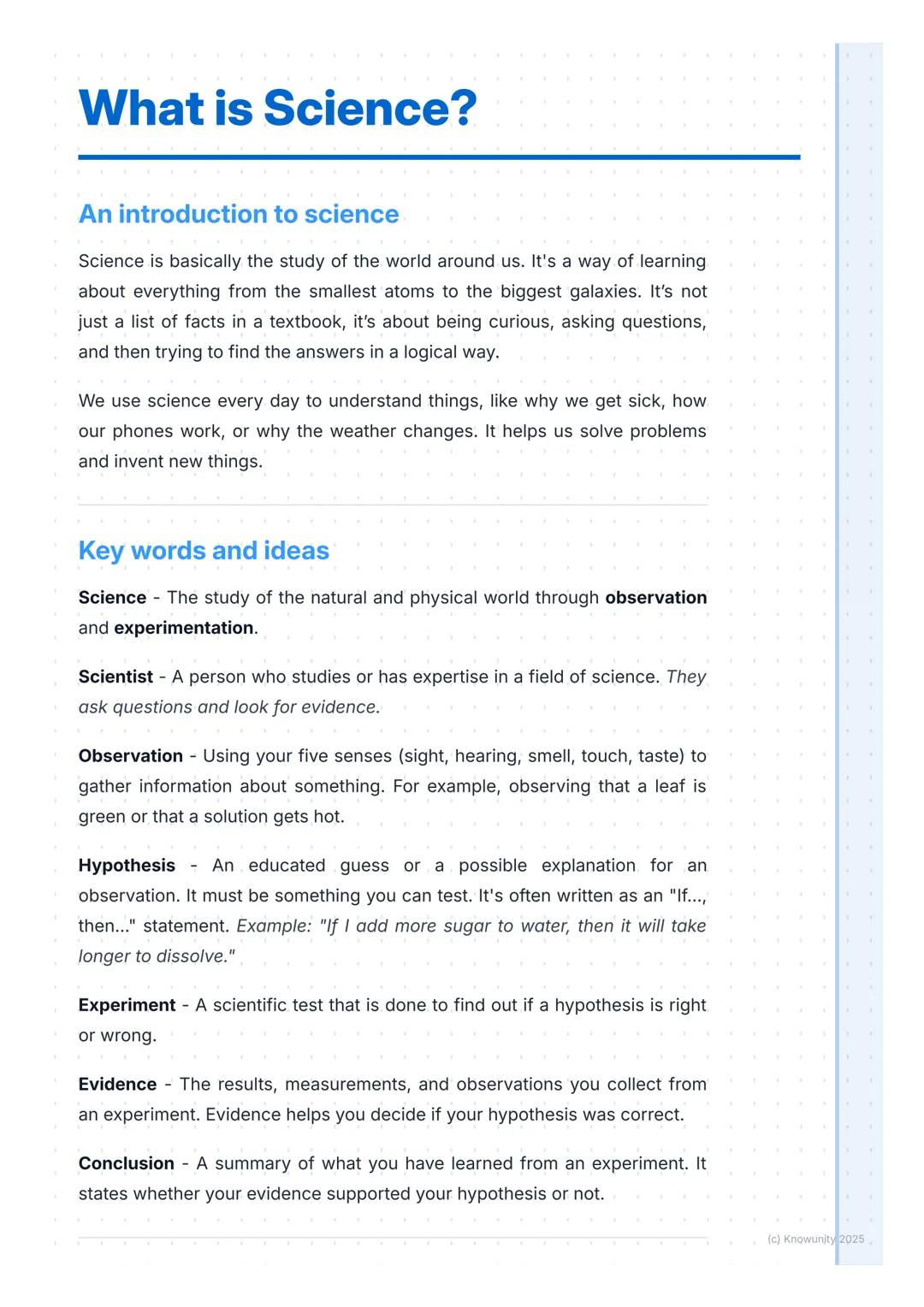
What is Science?
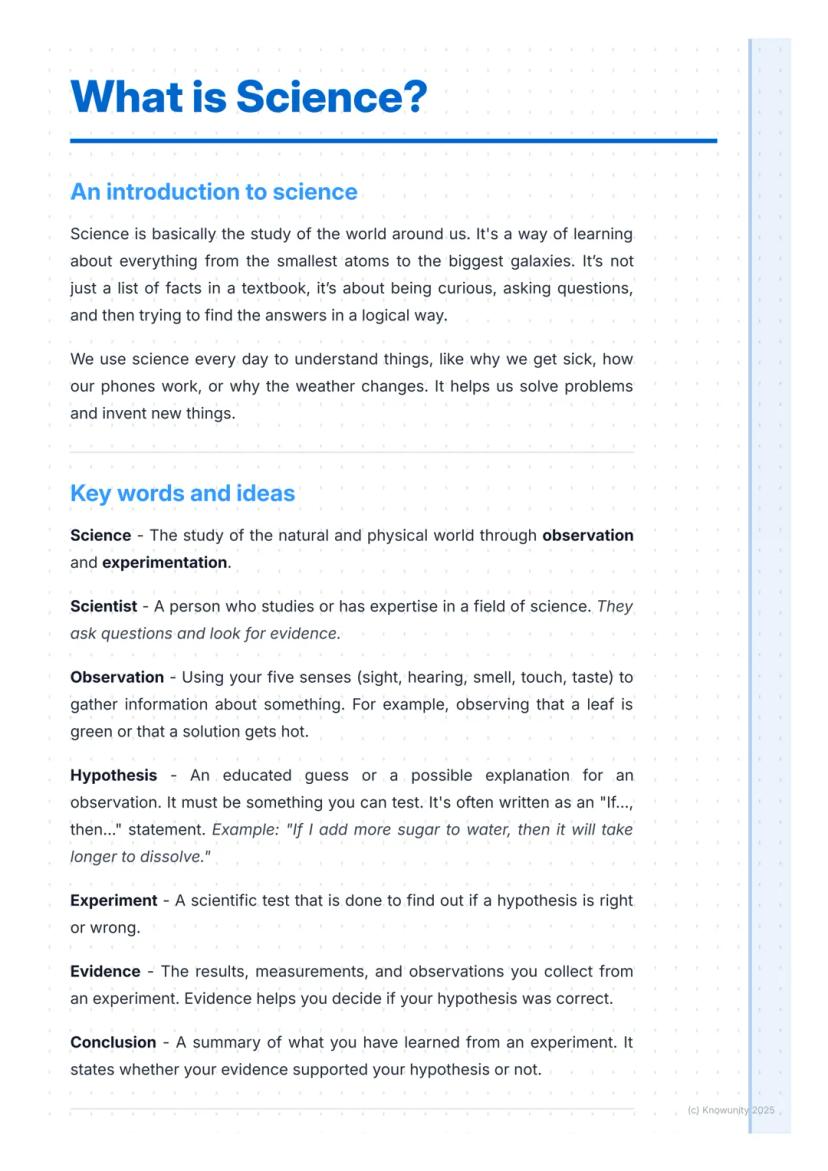
Science is all about exploring the world around us by asking questions and finding answers. When you wonder why your ice lolly melts or how birds fly, you're thinking like a scientist! It's a way of understanding everything through careful observation and testing.
Scientists are curious people who look for evidence before reaching conclusions. They use observations (information gathered using their five senses) to understand what's happening around them. For instance, noticing that leaves change colour in autumn is an observation.
When scientists have an idea about why something happens, they create a hypothesis - an educated guess that can be tested. For example: "If I water this plant more often, then it will grow taller." They then conduct an experiment to test this idea, collect evidence, and form a conclusion about whether their guess was right.
Did you know? Making mistakes is actually an important part of science! When an experiment doesn't work as expected, scientists often make their best discoveries.
2
of 5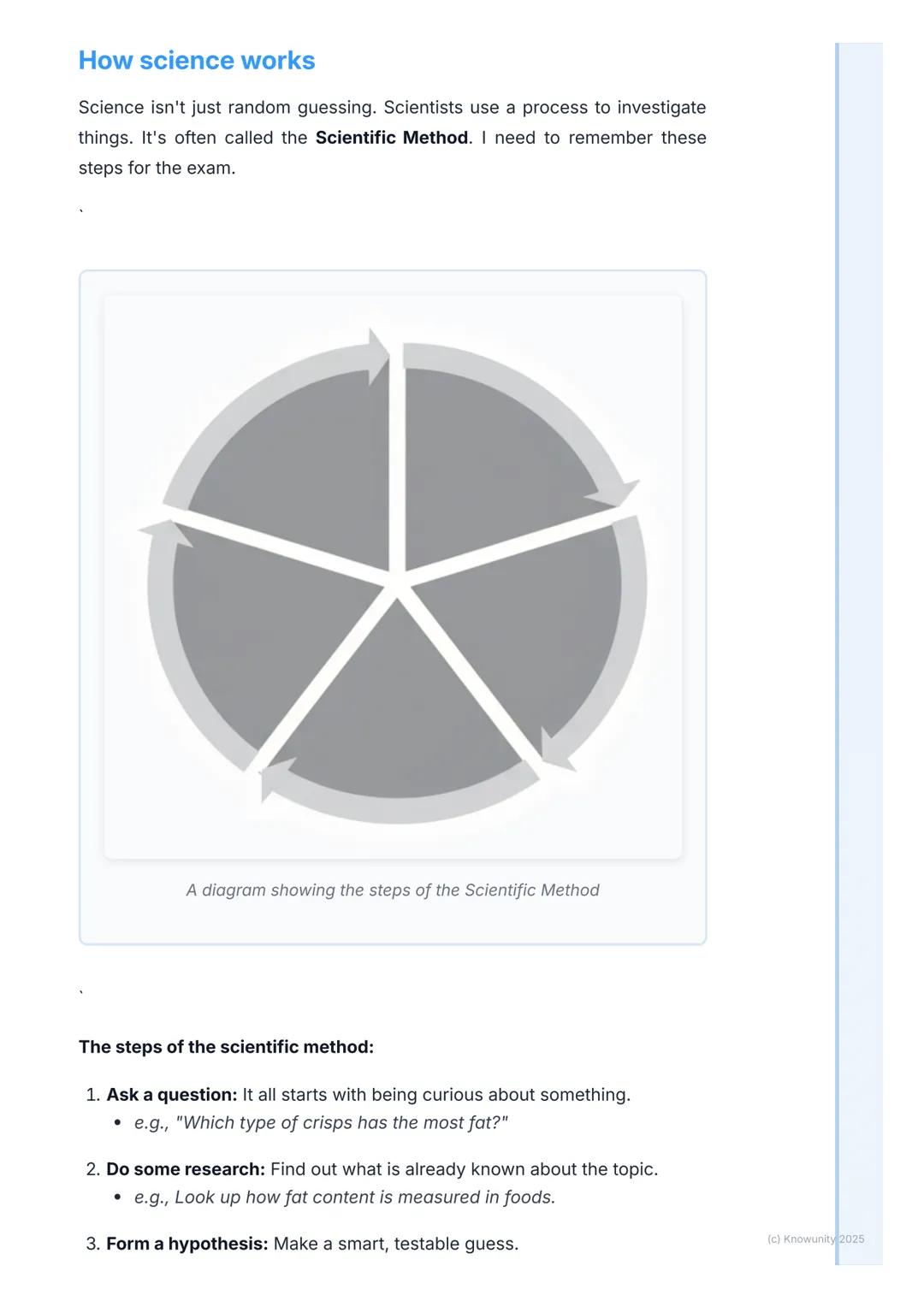
How Science Works
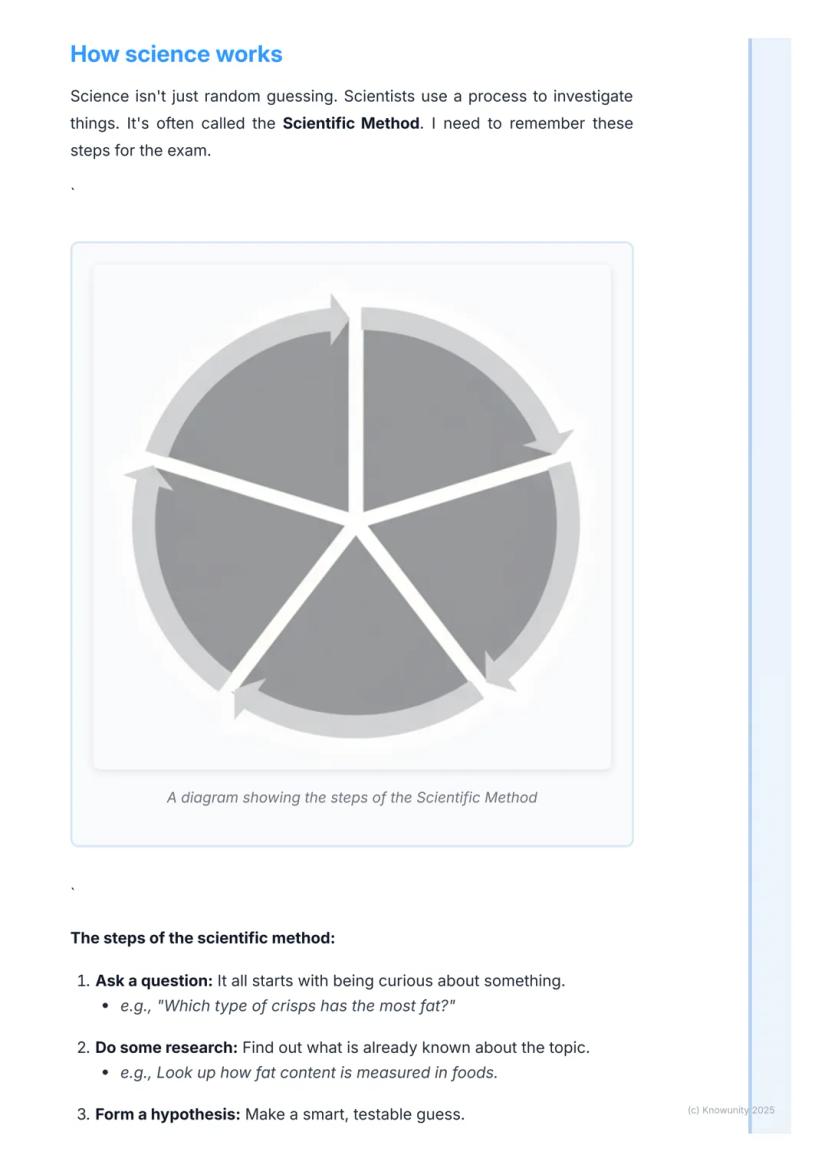
The Scientific Method is like a recipe that scientists follow to investigate questions properly. You'll need to know these steps for your exams, but don't worry - they actually make a lot of sense!
First, you ask a question about something you're curious about - like "Which type of crisps has the most fat?" Then you do some research to find out what's already known about your topic. This helps you form a hypothesis, which is your best guess at the answer - perhaps "I think cheese and onion crisps will have the most fat."
Next comes the fun part - you do an experiment to test your hypothesis. This might involve crushing different crisp types and measuring the grease spots they leave on paper. After collecting your data, you analyse your results and draw a conclusion about whether your hypothesis was correct.
Important! A fair test is crucial in science. This means only changing one thing (the variable) while keeping everything else exactly the same. Without a fair test, your results won't be reliable!
3
of 5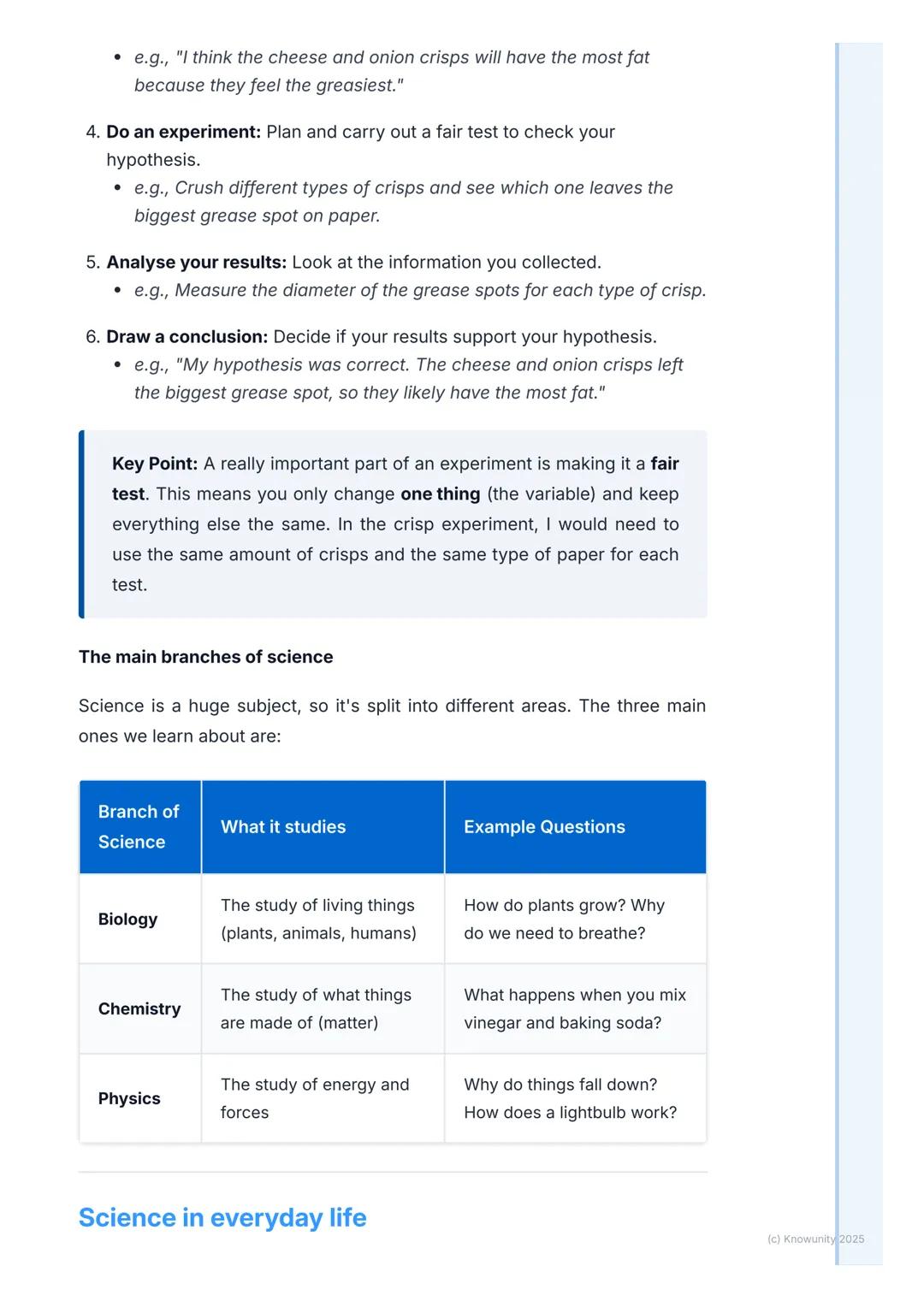
The Main Branches of Science
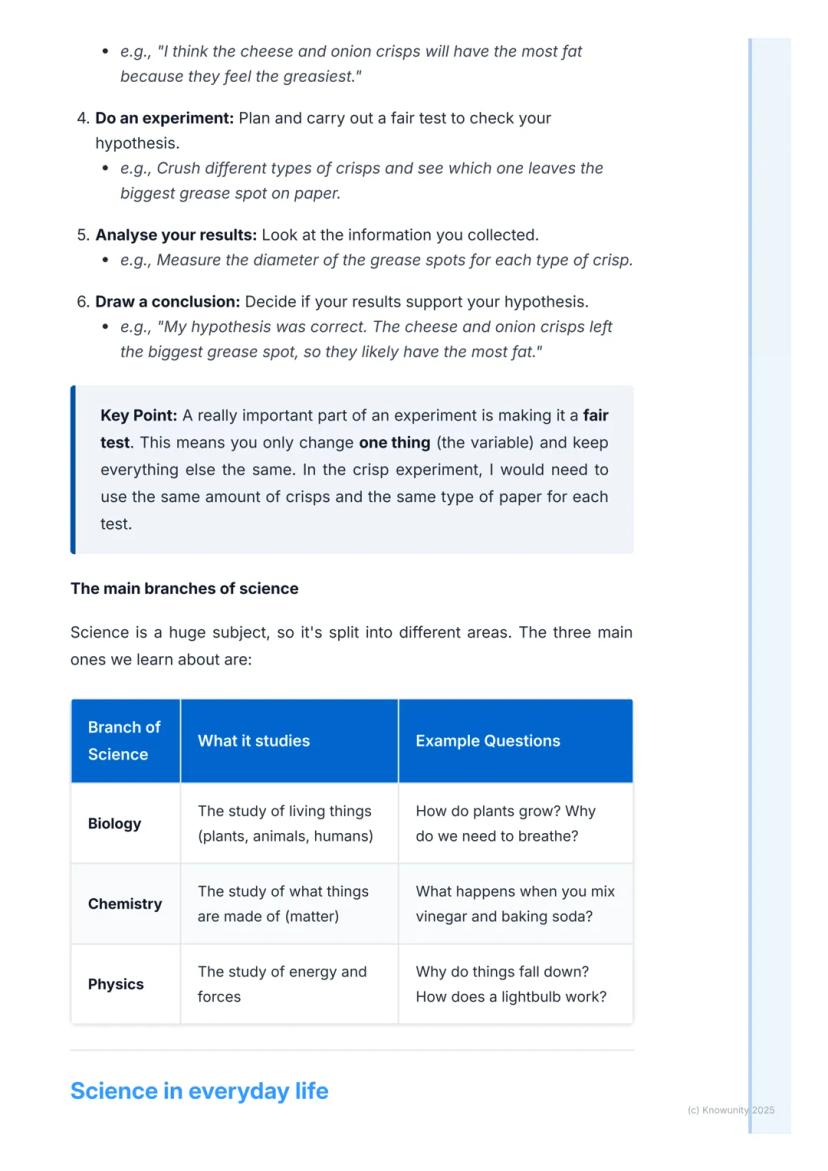
Science is so big that we divide it into three main branches to make it easier to study. Each branch focuses on different questions about our world.
Biology is all about living things. When you learn how your body works, why plants need sunlight, or how animals adapt to their environments - that's biology! Questions like "How do plants grow?" and "Why do we need to breathe?" fall under this branch.
Chemistry explores what things are made of (matter) and how substances interact. When you mix vinegar and baking soda to make a volcano eruption, you're doing chemistry! It helps explain questions like "What happens when you mix different substances?" or "How do things change state?"
Physics investigates energy and forces. It helps us understand why things fall down, how light travels, or what makes a roller coaster work. If you've ever wondered how a lightbulb works or why magnets stick together, you're thinking about physics questions.
Try this: Next time you're at home, see if you can identify which branch of science explains everyday activities like cooking, playing sports, or using technology!
4
of 5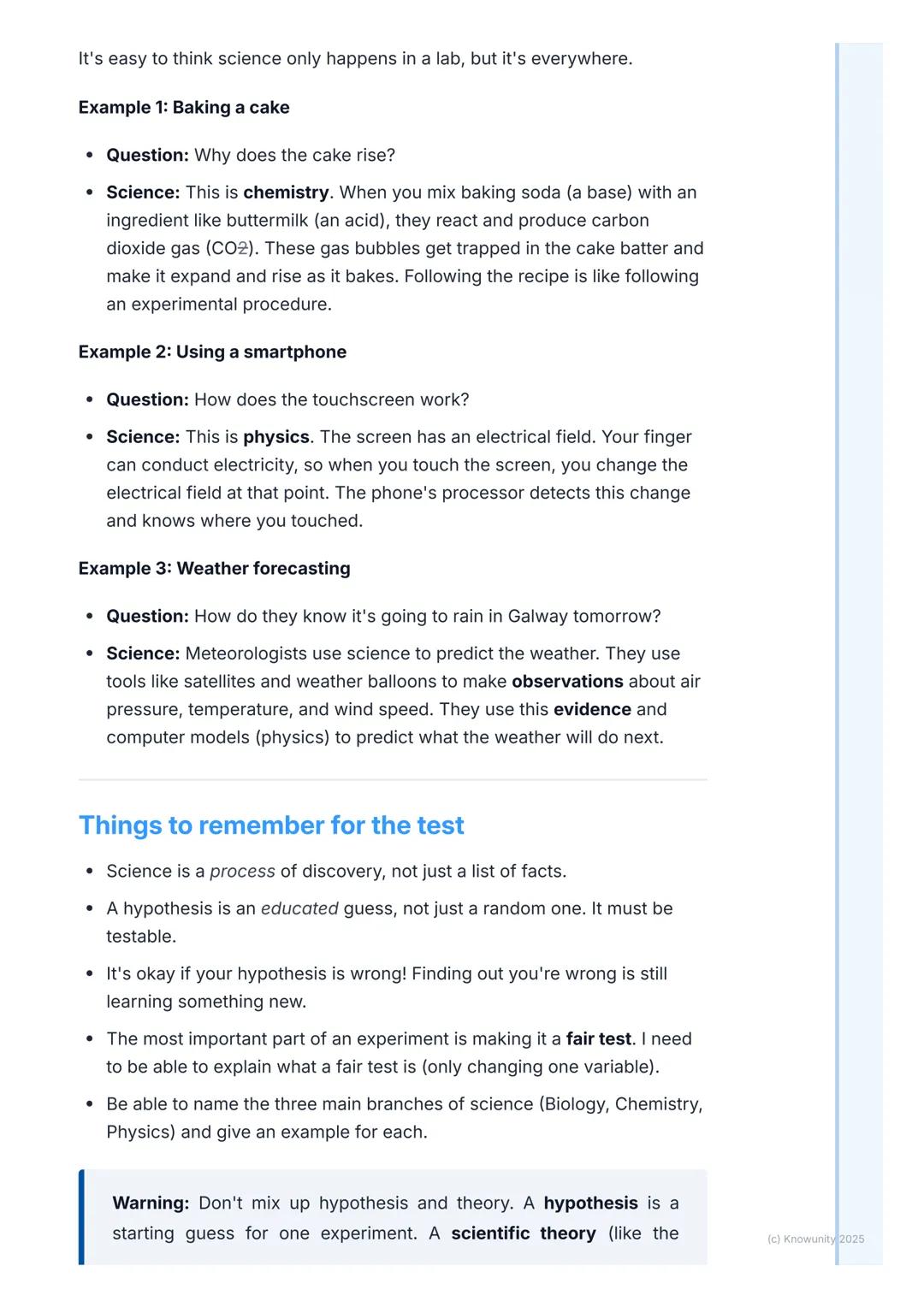
Science in Everyday Life
Science isn't just something that happens in laboratories with people in white coats - it's happening all around you every day!
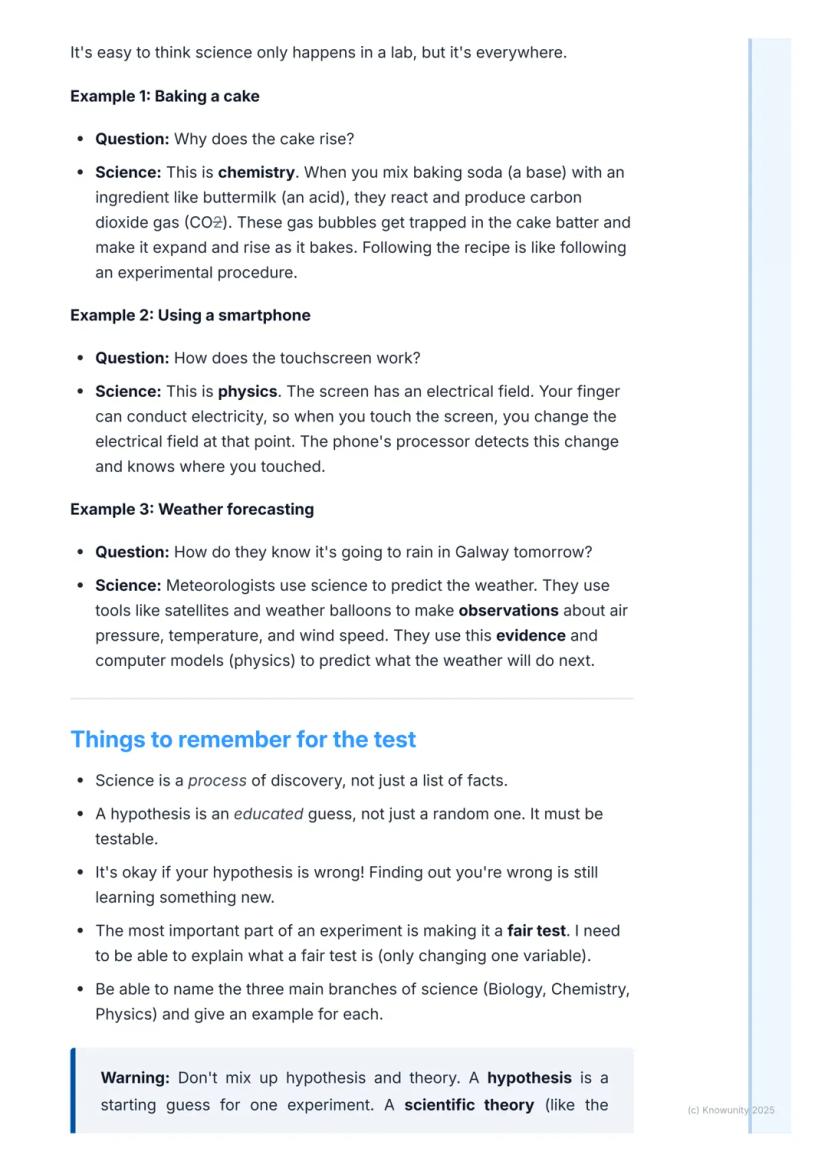
When you're baking a cake, you're actually doing chemistry. The rising of your cake involves a chemical reaction between baking soda and acidic ingredients that produces carbon dioxide gas. These bubbles get trapped in the batter, causing it to expand as it bakes. Following your recipe is like following an experimental procedure!
Your smartphone works because of physics principles. When you touch the screen, your finger (which can conduct electricity) changes the electrical field at that point. The phone's processor detects this change and knows exactly where you touched - clever, right?
Even weather forecasting relies heavily on science. Meteorologists collect data about air pressure, temperature, and wind speed using satellites and weather balloons. They then use this evidence along with computer models to predict whether you'll need an umbrella tomorrow!
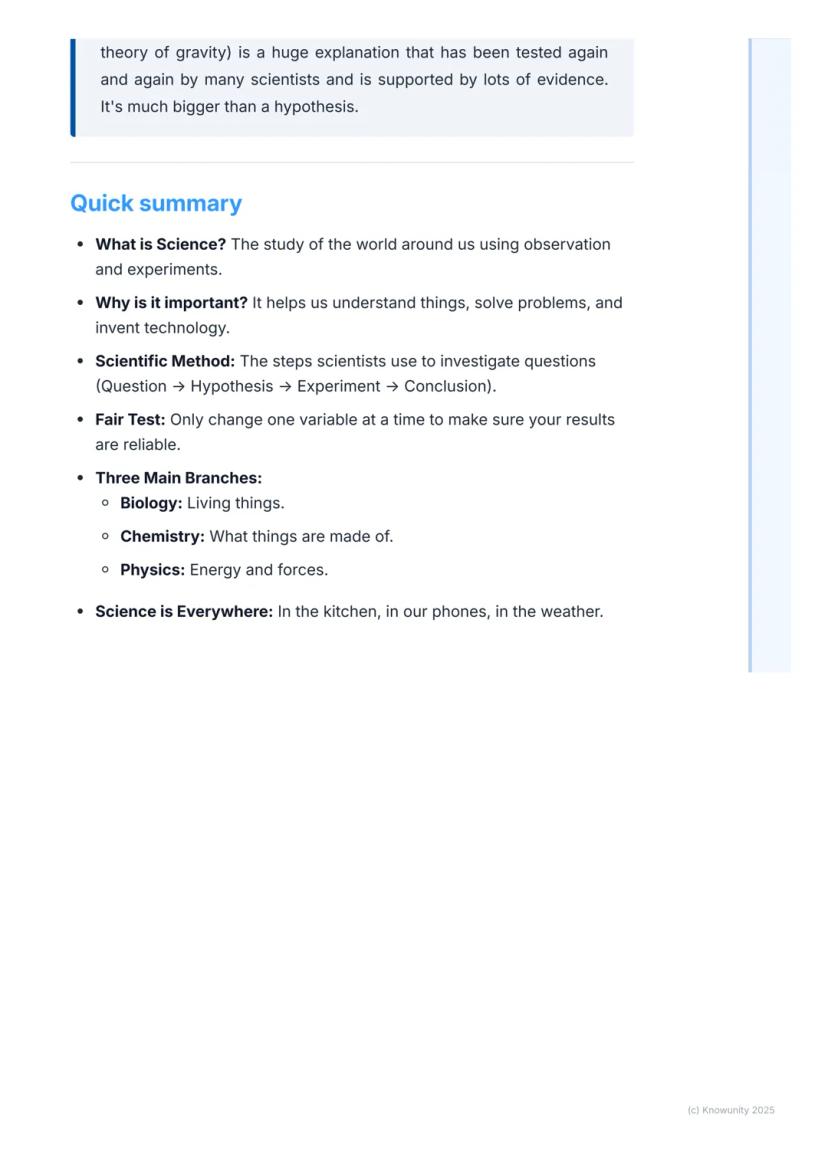
Remember: For tests, know that a hypothesis is just an educated guess for one experiment, while a scientific theory (like gravity) is a major explanation supported by loads of evidence from many scientists over time.
5
of 5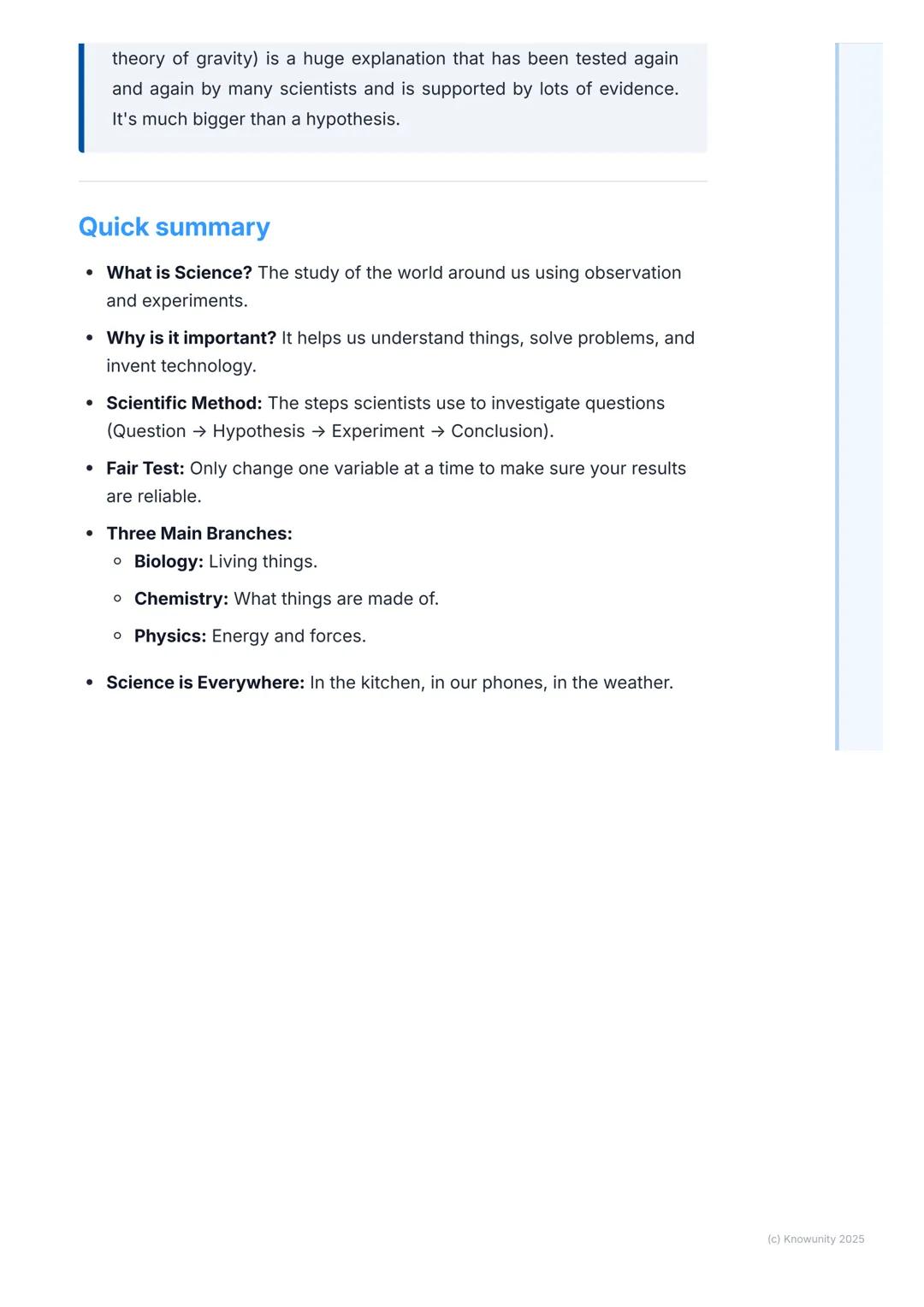
Quick Summary of Science
Science helps you make sense of the world through careful observation and testing. It's not just memorising facts but learning how to think critically and solve problems - skills you'll use throughout your life!
The Scientific Method gives us a reliable way to investigate questions by following logical steps: asking questions, forming hypotheses, conducting experiments, and drawing conclusions. Remember that a fair test (changing only one variable) is essential for reliable results.
Science connects to everything in your daily life - from understanding why your toast burns to how your video games work. The three main branches (Biology, Chemistry, and Physics) help us organise this vast field, but they often overlap in fascinating ways. For example, the study of how medicines work in your body combines biology and chemistry!
You've got this! Science might seem complicated at times, but remember - it started with people just being curious about the world, just like you are. Every scientist began as a student asking "why?" and "how?"
Si on te demande...
Qu'est-ce que le compagnon IA de Knowunity ?
Notre compagnon IA est spécialement conçu pour répondre aux besoins des étudiants. Sur la base des millions d'éléments de contenu que nous avons sur la plateforme, nous pouvons fournir des réponses vraiment significatives et pertinentes aux étudiants. Mais il ne s'agit pas seulement de réponses, le compagnon a encore plus pour but de guider les élèves dans leurs défis d'apprentissage quotidiens, avec des plans d'étude personnalisés, des quiz ou des éléments de contenu dans le chat et une personnalisation à 100% basée sur les compétences et les développements de l'étudiant.
Où puis-je télécharger l'appli Knowunity ?
Tu peux télécharger l'application dans Google Play Store et dans l'App Store d'Apple.
L'application est-elle vraiment gratuite ?
Oui, tu as un accès entièrement gratuit à tous les contenus de l'appli, tu peux chatter ou suivre les créateurs à tout moment. De plus, nous proposons Knowunity Premium, qui te permet de réviser sans limites!
Contenus les plus populaires en Science
7ScienceScience/Physics notes - Speed, density, work
Speed density work formulas
3rd Year81
ScienceAtomic Structure and the Periodic Table
Students will learn about the structure of atoms, including protons, neutrons, and electrons, and how elements are organised and classified in the Periodic Table based on their electronic configuration and chemical properties.
5th Year41
ScienceHuman Body Systems
An introduction to major human body systems such as the digestive, circulatory, respiratory, and nervous systems, understanding their basic functions.
2nd Year131
ScienceJunior Cert Science Notes: The Cell
Notes on the Cell
3rd Year261
ScienceCells
Junior cert science cells summary
1st Year611
ScienceHuman Reproductive System
A basic overview of the male and female reproductive systems, including their main structures and functions.
TY191
ScienceLight and Optics
Exploring the properties of light, including how it travels, reflects, and refracts, and how we perceive colours.
2nd Year50
Contenus les plus populaires
9 Irish
IrishIrish oral questions and answers
Questions and answers for the leaving cert oral
5th Year4264
 English
Key Quotes : Sive
Key Quotes and explanations: Sive
6th Year2842
IrishIrish oral questions
Outline of oral questions
5th Year2055
IrishIníon- le hÁine Durkin
Aine Durkin’s poem, Iníon: Themes & summary
5th Year850
IrishIrish poetry 2027
Iníon + Dínit an Bhróin
5th Year1133
IrishLC HL notes- Iníon (poem)
Includes poem in English and Irish, theme, key words & phrases
5th Year2284
EnglishCultural Context : Shawshank Redemption : Sive : Small Things Like These
Comparative Study : Cultural Context : Shawshank Redemption, Sive and Small Things Like These
6th Year1430
IrishMo Ghrá-sa (Idir Lúibíní)
Notes on mo ghrá-sa
5th Year380
IrishAn Gaeilge Aiste
Irish Language essay
6th Year1320
Rien ne te convient ? Explore d'autres matières.
Les étudiants nous adorent — il ne manque plus que toi.
4.6/5App Store
4.7/5Google Play
L'application est très facile d'utilisation et bien conçue. Jusqu'à présent, j'ai trouvé tout ce que je cherchais et j'ai pu apprendre beaucoup de choses grâce aux présentations ! Je vais certainement utiliser l'application pour un travail en classe ! Et comme source d'inspiration personnelle, elle est bien sûr aussi très utile.
Stefan Sutilisateur iOS
Cette application est vraiment super. Il y a tellement de fiches de révision et d'aide, [...]. Par exemple, la matière qui me pose problème est le français et l'appli a un choix d'aide très large. Grâce à cette application, je me suis améliorée en français. Je la recommanderais à tout le monde.
Samantha Klichutilisatrice Android
Waouh, je suis vraiment abasourdi. J'ai essayé l'application parce que je l'avais déjà vue plusieurs fois dans la publicité et j'ai été absolument choquée. Cette appli est L'AIDE dont on rêve pour l'école et surtout, elle propose tellement de choses, comme des rédactions et des fiches qui m'ont personnellement TRÈS bien aidé.
Annautilisatrice iOS
Science2 vues·Mis à jour Jun 14, 2026·5 pagesUnderstanding Science: Its Role in Everyday Life
Science is the study of our world that helps us understand everything from atoms to galaxies. It's not just facts in a textbook but a process of being curious and finding answers through logical investigation. You use science every day,... Affiche plus
1
of 5Inscris-toi pour voir le contenu. C'est gratuit!
- Accès à tous les documents
- Améliore tes notes
- Rejoins des millions d'étudiants
What is Science?
Science is all about exploring the world around us by asking questions and finding answers. When you wonder why your ice lolly melts or how birds fly, you're thinking like a scientist! It's a way of understanding everything through careful observation and testing.
Scientists are curious people who look for evidence before reaching conclusions. They use observations (information gathered using their five senses) to understand what's happening around them. For instance, noticing that leaves change colour in autumn is an observation.
When scientists have an idea about why something happens, they create a hypothesis - an educated guess that can be tested. For example: "If I water this plant more often, then it will grow taller." They then conduct an experiment to test this idea, collect evidence, and form a conclusion about whether their guess was right.
Did you know? Making mistakes is actually an important part of science! When an experiment doesn't work as expected, scientists often make their best discoveries.
2
of 5Inscris-toi pour voir le contenu. C'est gratuit!
- Accès à tous les documents
- Améliore tes notes
- Rejoins des millions d'étudiants
How Science Works
The Scientific Method is like a recipe that scientists follow to investigate questions properly. You'll need to know these steps for your exams, but don't worry - they actually make a lot of sense!
First, you ask a question about something you're curious about - like "Which type of crisps has the most fat?" Then you do some research to find out what's already known about your topic. This helps you form a hypothesis, which is your best guess at the answer - perhaps "I think cheese and onion crisps will have the most fat."
Next comes the fun part - you do an experiment to test your hypothesis. This might involve crushing different crisp types and measuring the grease spots they leave on paper. After collecting your data, you analyse your results and draw a conclusion about whether your hypothesis was correct.
Important! A fair test is crucial in science. This means only changing one thing (the variable) while keeping everything else exactly the same. Without a fair test, your results won't be reliable!
3
of 5Inscris-toi pour voir le contenu. C'est gratuit!
- Accès à tous les documents
- Améliore tes notes
- Rejoins des millions d'étudiants
The Main Branches of Science
Science is so big that we divide it into three main branches to make it easier to study. Each branch focuses on different questions about our world.
Biology is all about living things. When you learn how your body works, why plants need sunlight, or how animals adapt to their environments - that's biology! Questions like "How do plants grow?" and "Why do we need to breathe?" fall under this branch.
Chemistry explores what things are made of (matter) and how substances interact. When you mix vinegar and baking soda to make a volcano eruption, you're doing chemistry! It helps explain questions like "What happens when you mix different substances?" or "How do things change state?"
Physics investigates energy and forces. It helps us understand why things fall down, how light travels, or what makes a roller coaster work. If you've ever wondered how a lightbulb works or why magnets stick together, you're thinking about physics questions.
Try this: Next time you're at home, see if you can identify which branch of science explains everyday activities like cooking, playing sports, or using technology!
4
of 5Inscris-toi pour voir le contenu. C'est gratuit!
- Accès à tous les documents
- Améliore tes notes
- Rejoins des millions d'étudiants
Science in Everyday Life
Science isn't just something that happens in laboratories with people in white coats - it's happening all around you every day!
When you're baking a cake, you're actually doing chemistry. The rising of your cake involves a chemical reaction between baking soda and acidic ingredients that produces carbon dioxide gas. These bubbles get trapped in the batter, causing it to expand as it bakes. Following your recipe is like following an experimental procedure!
Your smartphone works because of physics principles. When you touch the screen, your finger (which can conduct electricity) changes the electrical field at that point. The phone's processor detects this change and knows exactly where you touched - clever, right?
Even weather forecasting relies heavily on science. Meteorologists collect data about air pressure, temperature, and wind speed using satellites and weather balloons. They then use this evidence along with computer models to predict whether you'll need an umbrella tomorrow!
Remember: For tests, know that a hypothesis is just an educated guess for one experiment, while a scientific theory (like gravity) is a major explanation supported by loads of evidence from many scientists over time.
5
of 5Inscris-toi pour voir le contenu. C'est gratuit!
- Accès à tous les documents
- Améliore tes notes
- Rejoins des millions d'étudiants
Quick Summary of Science
Science helps you make sense of the world through careful observation and testing. It's not just memorising facts but learning how to think critically and solve problems - skills you'll use throughout your life!
The Scientific Method gives us a reliable way to investigate questions by following logical steps: asking questions, forming hypotheses, conducting experiments, and drawing conclusions. Remember that a fair test (changing only one variable) is essential for reliable results.
Science connects to everything in your daily life - from understanding why your toast burns to how your video games work. The three main branches (Biology, Chemistry, and Physics) help us organise this vast field, but they often overlap in fascinating ways. For example, the study of how medicines work in your body combines biology and chemistry!
You've got this! Science might seem complicated at times, but remember - it started with people just being curious about the world, just like you are. Every scientist began as a student asking "why?" and "how?"
Si on te demande...
Qu'est-ce que le compagnon IA de Knowunity ?
Notre compagnon IA est spécialement conçu pour répondre aux besoins des étudiants. Sur la base des millions d'éléments de contenu que nous avons sur la plateforme, nous pouvons fournir des réponses vraiment significatives et pertinentes aux étudiants. Mais il ne s'agit pas seulement de réponses, le compagnon a encore plus pour but de guider les élèves dans leurs défis d'apprentissage quotidiens, avec des plans d'étude personnalisés, des quiz ou des éléments de contenu dans le chat et une personnalisation à 100% basée sur les compétences et les développements de l'étudiant.
Où puis-je télécharger l'appli Knowunity ?
Tu peux télécharger l'application dans Google Play Store et dans l'App Store d'Apple.
L'application est-elle vraiment gratuite ?
Oui, tu as un accès entièrement gratuit à tous les contenus de l'appli, tu peux chatter ou suivre les créateurs à tout moment. De plus, nous proposons Knowunity Premium, qui te permet de réviser sans limites!
Contenus les plus populaires en Science
7ScienceScience/Physics notes - Speed, density, work
Speed density work formulas
3rd Year81
ScienceAtomic Structure and the Periodic Table
Students will learn about the structure of atoms, including protons, neutrons, and electrons, and how elements are organised and classified in the Periodic Table based on their electronic configuration and chemical properties.
5th Year41
ScienceHuman Body Systems
An introduction to major human body systems such as the digestive, circulatory, respiratory, and nervous systems, understanding their basic functions.
2nd Year131
ScienceJunior Cert Science Notes: The Cell
Notes on the Cell
3rd Year261
ScienceCells
Junior cert science cells summary
1st Year611
ScienceHuman Reproductive System
A basic overview of the male and female reproductive systems, including their main structures and functions.
TY191
ScienceLight and Optics
Exploring the properties of light, including how it travels, reflects, and refracts, and how we perceive colours.
2nd Year50
Contenus les plus populaires
9IrishIrish oral questions and answers
Questions and answers for the leaving cert oral
5th Year4264
EnglishKey Quotes : Sive
Key Quotes and explanations: Sive
6th Year2842
IrishIrish oral questions
Outline of oral questions
5th Year2055
IrishIníon- le hÁine Durkin
Aine Durkin’s poem, Iníon: Themes & summary
5th Year850
IrishIrish poetry 2027
Iníon + Dínit an Bhróin
5th Year1133
IrishLC HL notes- Iníon (poem)
Includes poem in English and Irish, theme, key words & phrases
5th Year2284
EnglishCultural Context : Shawshank Redemption : Sive : Small Things Like These
Comparative Study : Cultural Context : Shawshank Redemption, Sive and Small Things Like These
6th Year1430
IrishMo Ghrá-sa (Idir Lúibíní)
Notes on mo ghrá-sa
5th Year380
IrishAn Gaeilge Aiste
Irish Language essay
6th Year1320
Rien ne te convient ? Explore d'autres matières.
Les étudiants nous adorent — il ne manque plus que toi.
4.6/5App Store
4.7/5Google Play
L'application est très facile d'utilisation et bien conçue. Jusqu'à présent, j'ai trouvé tout ce que je cherchais et j'ai pu apprendre beaucoup de choses grâce aux présentations ! Je vais certainement utiliser l'application pour un travail en classe ! Et comme source d'inspiration personnelle, elle est bien sûr aussi très utile.
Stefan Sutilisateur iOS
Cette application est vraiment super. Il y a tellement de fiches de révision et d'aide, [...]. Par exemple, la matière qui me pose problème est le français et l'appli a un choix d'aide très large. Grâce à cette application, je me suis améliorée en français. Je la recommanderais à tout le monde.
Samantha Klichutilisatrice Android
Waouh, je suis vraiment abasourdi. J'ai essayé l'application parce que je l'avais déjà vue plusieurs fois dans la publicité et j'ai été absolument choquée. Cette appli est L'AIDE dont on rêve pour l'école et surtout, elle propose tellement de choses, comme des rédactions et des fiches qui m'ont personnellement TRÈS bien aidé.
Annautilisatrice iOS