
Comparing things is something you do every day - "this...
 Spanish7 vues·Mis à jour Jun 4, 2026·5 pages
Aprende Comparativos y Superlativos en Español
1 / 5
1
of 5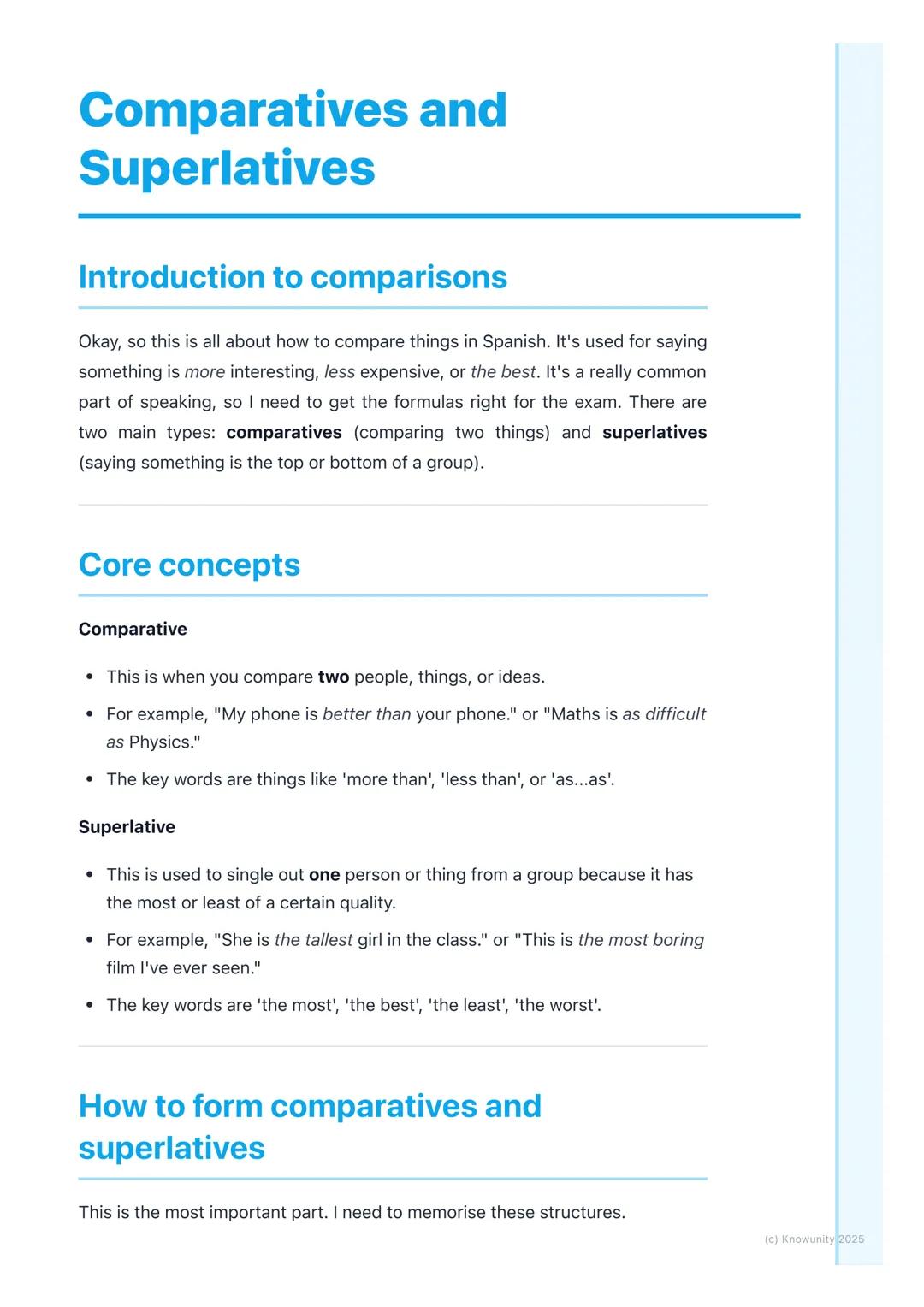
Introduction to Spanish Comparisons
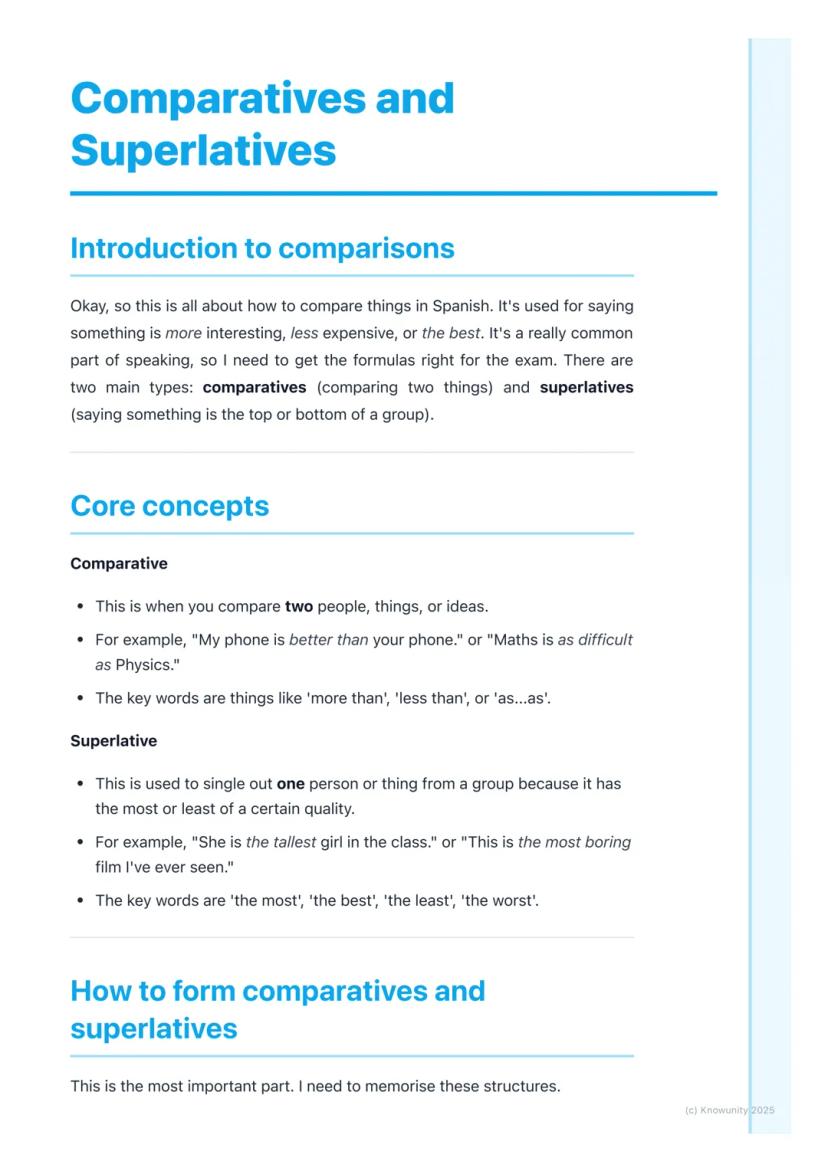
Ever wondered how to say your phone is better than your mate's or that maths is as difficult as physics in Spanish? Comparatives and superlatives are your answer, and they're absolutely everywhere in conversation.
Comparatives let you compare two things directly - like saying one thing is more expensive, less interesting, or as good as another. Think of it as putting two things side by side and deciding which comes out on top.
Superlatives are when you want to single out the absolute best or worst from a group. Instead of comparing just two things, you're saying something is the most boring film ever or the tallest person in your class.
Quick Tip: The key difference is simple - comparatives use words like "more than" and "as...as", while superlatives always use "the most" or "the least".
2
of 5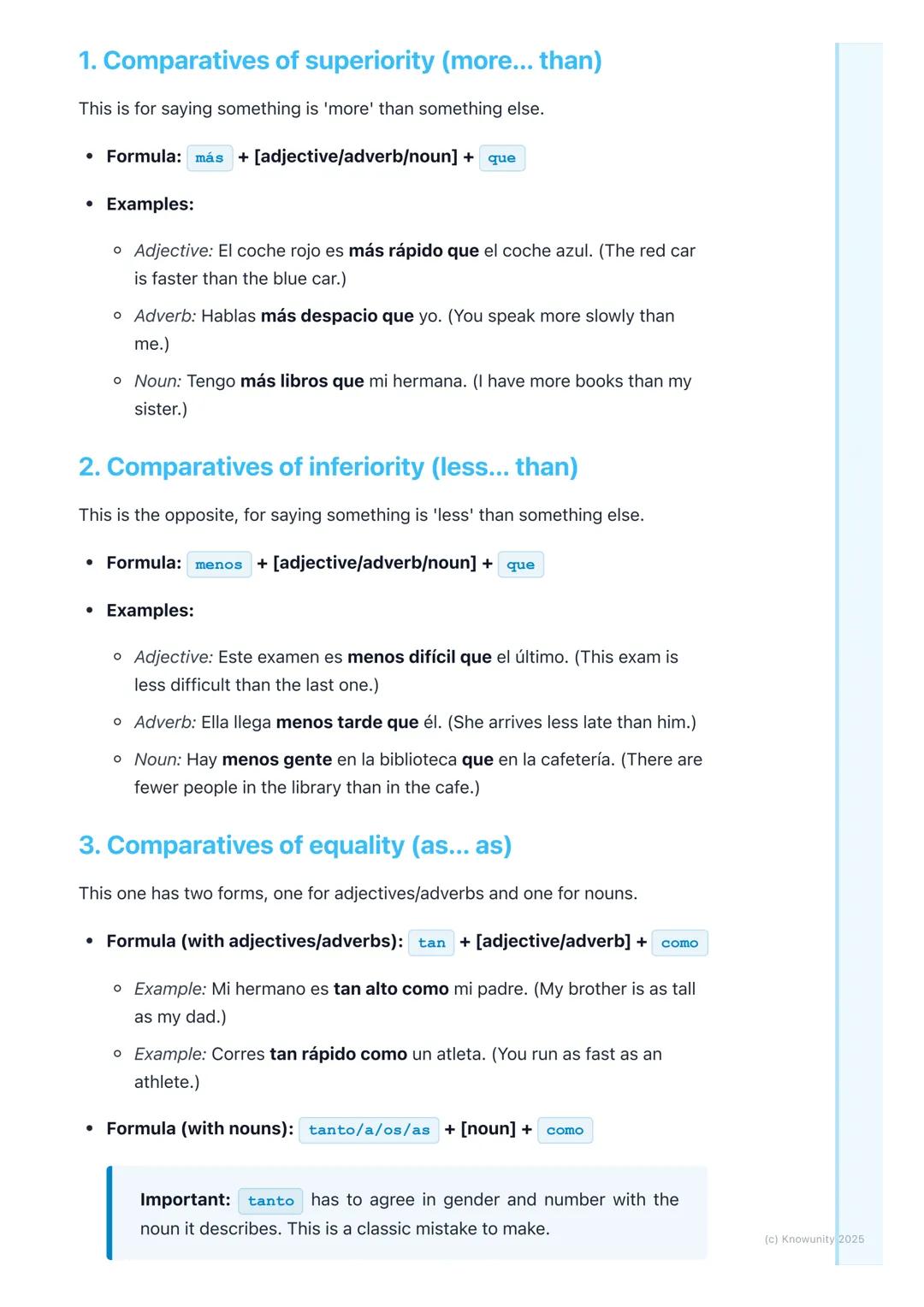
Comparatives: More Than and Less Than
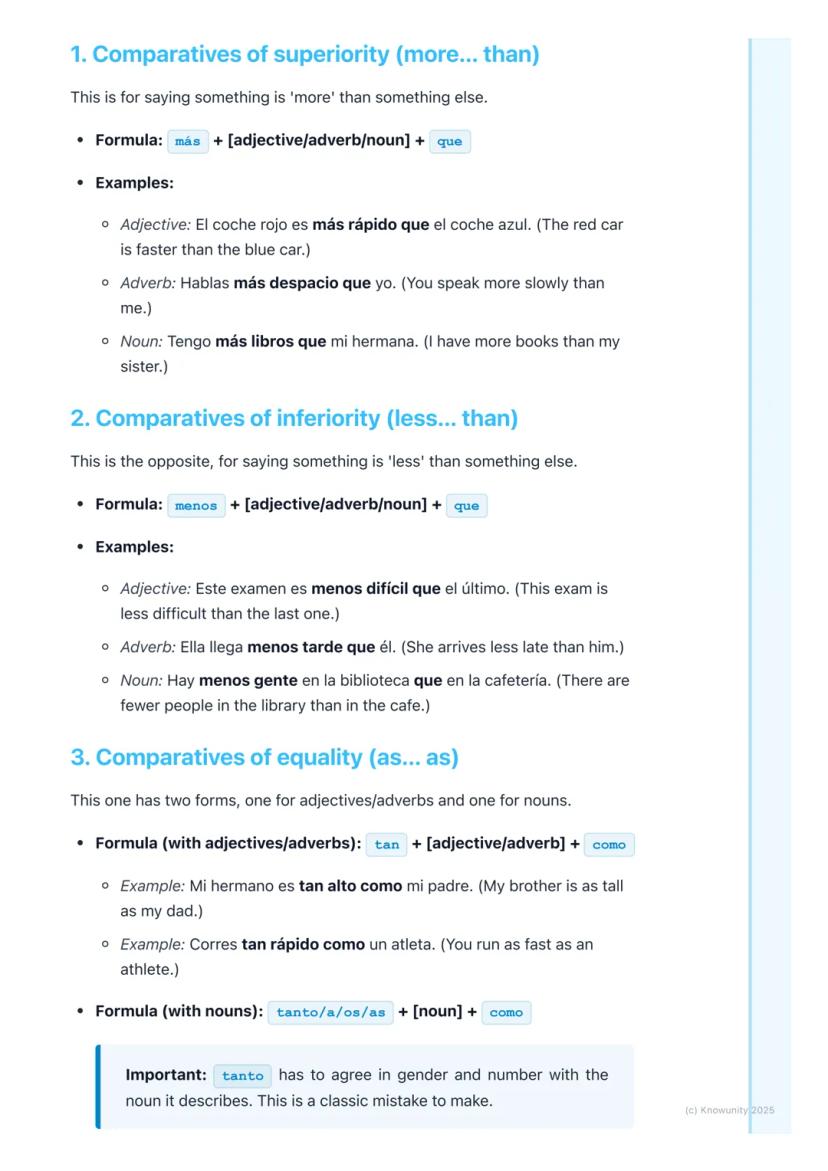
When you want to say something is superior (better, faster, more expensive), Spanish uses a dead simple formula: más + adjective + que. So "the red car is faster than the blue car" becomes El coche rojo es más rápido que el coche azul.
For the opposite effect - when something is inferior - just swap más for menos. "This exam is less difficult than the last one" translates to Este examen es menos difícil que el último. Easy as that.
The beauty of these structures is they work with adjectives (más rápido), adverbs (más despacio - more slowly), and even nouns (más libros - more books). Once you've got the pattern down, you can compare absolutely anything.
Remember: Always use "que" (than) after your comparison - never "de" in these structures!
3
of 5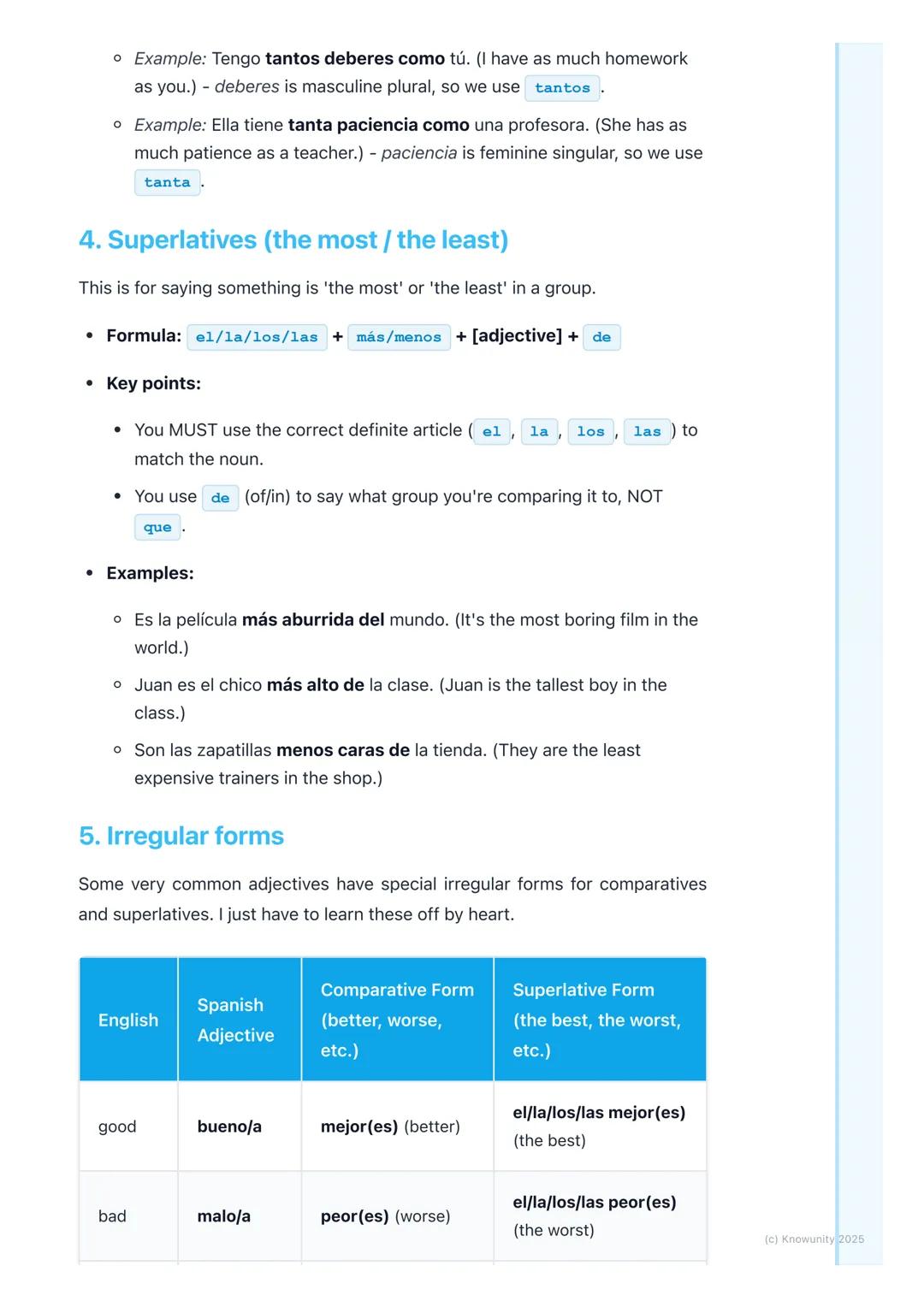
Comparatives of Equality: As Good As
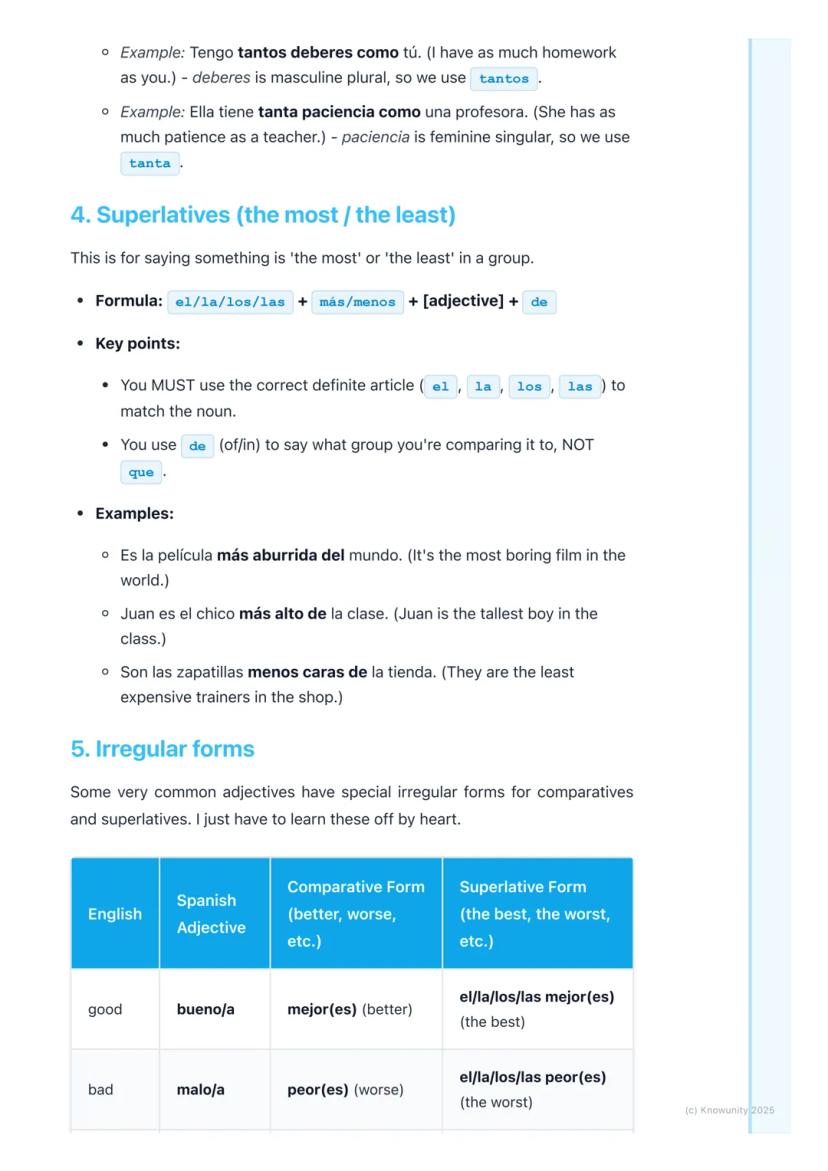
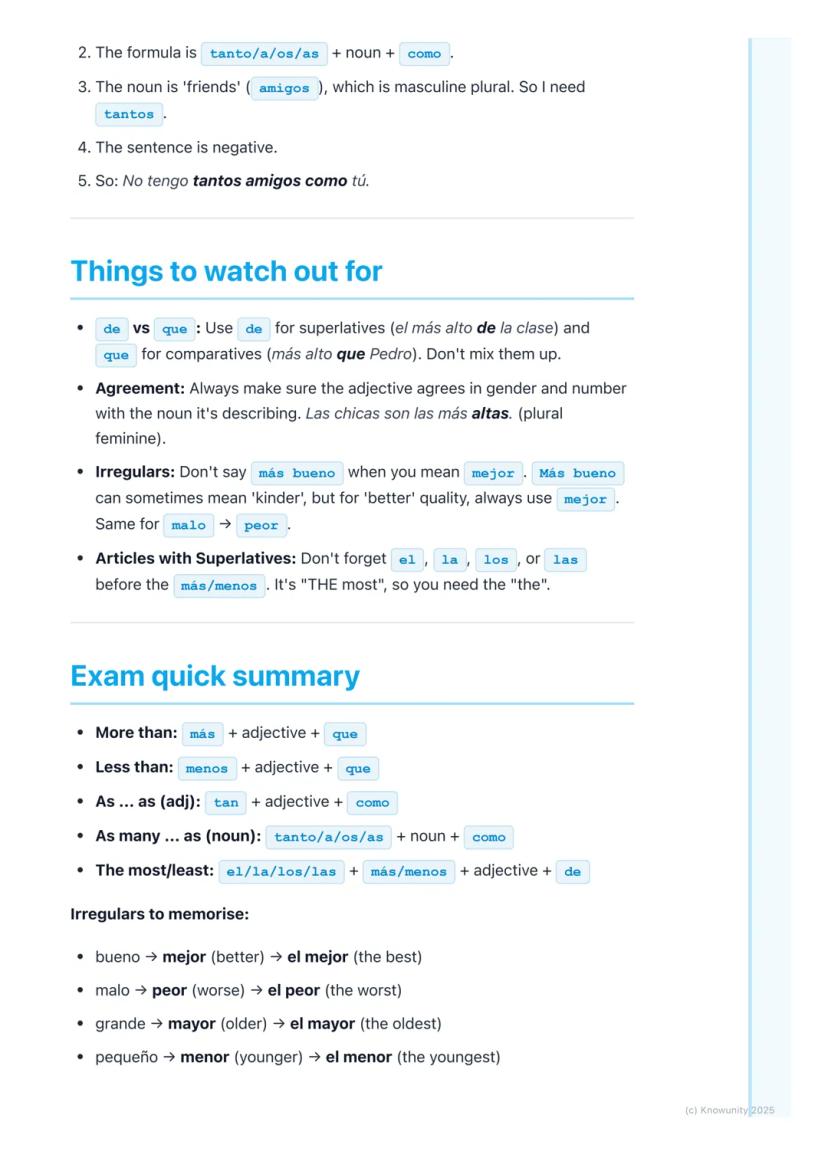
Sometimes things are equal, and that's where tan...como and tanto...como come in handy. For adjectives and adverbs, use tan + adjective/adverb + como. So "my brother is as tall as my dad" becomes Mi hermano es tan alto como mi padre.
But here's where it gets slightly trickier - with nouns, you need tanto/a/os/as + noun + como. The tricky bit? Tanto has to agree with the noun it's describing, just like any Spanish adjective.
If you're talking about homework , you'd say tantos deberes. But if it's patience , it's tanta paciencia. This agreement rule trips up loads of students, so double-check every time.
Watch Out: Tanto agreement is a classic exam mistake - always match it to your noun's gender and number!
4
of 5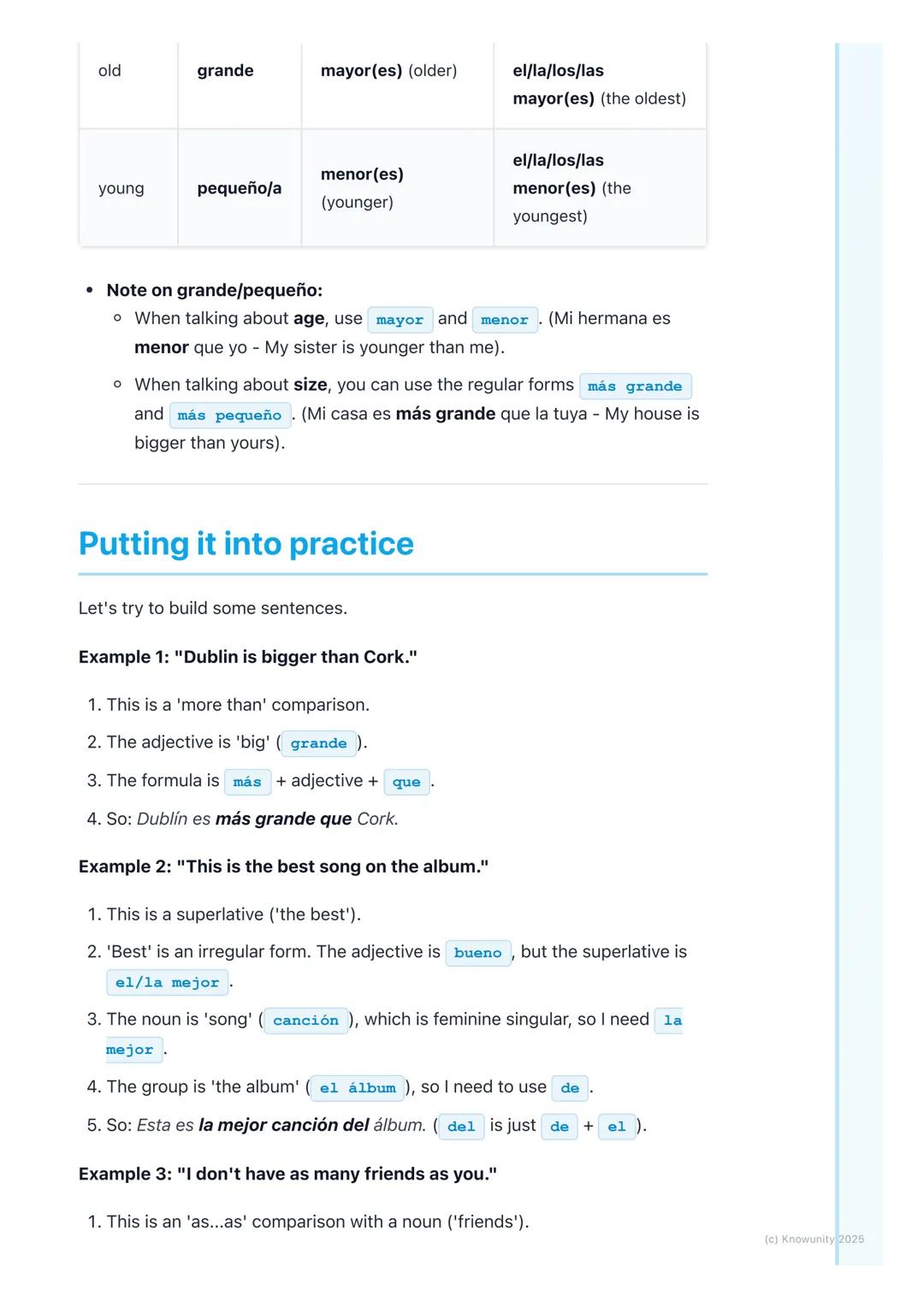
Superlatives: The Best of the Best
When you want to say something is the most or the least in its group, superlatives follow this pattern: el/la/los/las + más/menos + adjective + de. Notice you're using de now, not que - this catches out loads of students.
The definite article (el, la, los, las) must match your noun perfectly. "She's the most intelligent girl in the class" becomes Ella es la chica más inteligente de la clase - feminine singular because we're talking about la chica.
Here's the crucial difference from comparatives: you use de to show what group you're comparing within. "The most boring film in the world" is la película más aburrida del mundo .
Key Point: Superlatives always need "the" and use "de" for the group, never "que"!
5
of 5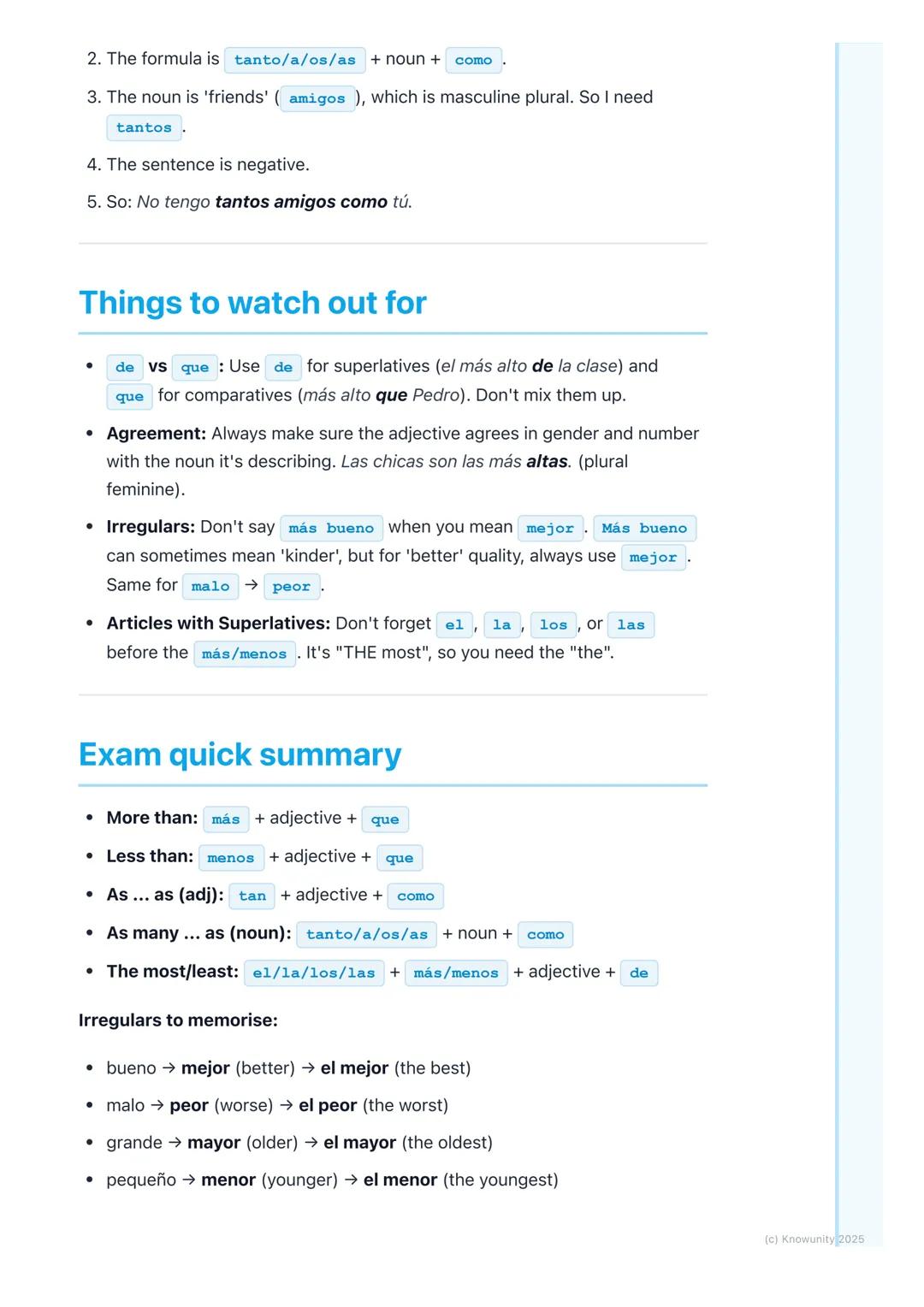
Irregular Forms You Must Memorise
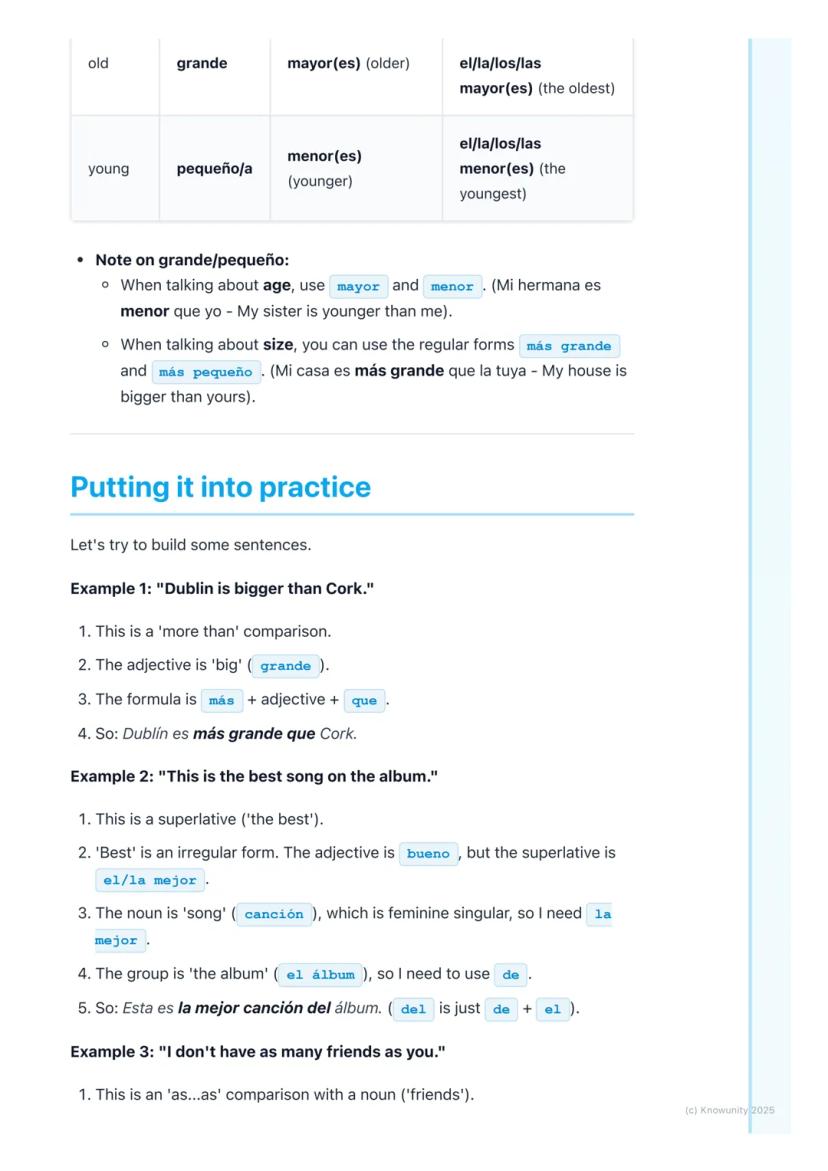
Some super common adjectives throw the rulebook out the window and have their own special forms. Bueno (good) becomes mejor (better) and el mejor (the best) - never say más bueno when you mean better quality.
Malo (bad) works the same way: peor (worse) and el peor (the worst). For age comparisons, grande becomes mayor (older) and pequeño becomes menor (younger). So "my sister is younger than me" is Mi hermana es menor que yo.
But here's a handy trick - when you're talking about physical size rather than age, you can still use the regular forms. "My house is bigger than yours" can be Mi casa es más grande que la tuya.
Memory Trick: These four irregulars (mejor, peor, mayor, menor) are used constantly in Spanish - they're worth learning by heart for instant recall!
Si on te demande...
Qu'est-ce que le compagnon IA de Knowunity ?
Notre compagnon IA est spécialement conçu pour répondre aux besoins des étudiants. Sur la base des millions d'éléments de contenu que nous avons sur la plateforme, nous pouvons fournir des réponses vraiment significatives et pertinentes aux étudiants. Mais il ne s'agit pas seulement de réponses, le compagnon a encore plus pour but de guider les élèves dans leurs défis d'apprentissage quotidiens, avec des plans d'étude personnalisés, des quiz ou des éléments de contenu dans le chat et une personnalisation à 100% basée sur les compétences et les développements de l'étudiant.
Où puis-je télécharger l'appli Knowunity ?
Tu peux télécharger l'application dans Google Play Store et dans l'App Store d'Apple.
L'application est-elle vraiment gratuite ?
Oui, tu as un accès entièrement gratuit à tous les contenus de l'appli, tu peux chatter ou suivre les créateurs à tout moment. De plus, nous proposons Knowunity Premium, qui te permet de réviser sans limites!
Contenus les plus populaires en Spanish
1Contenus les plus populaires
9 Irish
IrishIrish oral questions and answers
Questions and answers for the leaving cert oral
5th Year4264
 English
Key Quotes : Sive
Key Quotes and explanations: Sive
6th Year2842
IrishIrish oral questions
Outline of oral questions
5th Year2055
IrishIníon- le hÁine Durkin
Aine Durkin’s poem, Iníon: Themes & summary
5th Year850
IrishIrish poetry 2027
Iníon + Dínit an Bhróin
5th Year1133
IrishLC HL notes- Iníon (poem)
Includes poem in English and Irish, theme, key words & phrases
5th Year2284
EnglishCultural Context : Shawshank Redemption : Sive : Small Things Like These
Comparative Study : Cultural Context : Shawshank Redemption, Sive and Small Things Like These
6th Year1430
IrishMo Ghrá-sa (Idir Lúibíní)
Notes on mo ghrá-sa
5th Year380
IrishAn Gaeilge Aiste
Irish Language essay
6th Year1320
Rien ne te convient ? Explore d'autres matières.
Les étudiants nous adorent — il ne manque plus que toi.
4.6/5App Store
4.7/5Google Play
L'application est très facile d'utilisation et bien conçue. Jusqu'à présent, j'ai trouvé tout ce que je cherchais et j'ai pu apprendre beaucoup de choses grâce aux présentations ! Je vais certainement utiliser l'application pour un travail en classe ! Et comme source d'inspiration personnelle, elle est bien sûr aussi très utile.
Stefan Sutilisateur iOS
Cette application est vraiment super. Il y a tellement de fiches de révision et d'aide, [...]. Par exemple, la matière qui me pose problème est le français et l'appli a un choix d'aide très large. Grâce à cette application, je me suis améliorée en français. Je la recommanderais à tout le monde.
Samantha Klichutilisatrice Android
Waouh, je suis vraiment abasourdi. J'ai essayé l'application parce que je l'avais déjà vue plusieurs fois dans la publicité et j'ai été absolument choquée. Cette appli est L'AIDE dont on rêve pour l'école et surtout, elle propose tellement de choses, comme des rédactions et des fiches qui m'ont personnellement TRÈS bien aidé.
Annautilisatrice iOS
Spanish7 vues·Mis à jour Jun 4, 2026·5 pagesAprende Comparativos y Superlativos en Español
Comparing things is something you do every day - "this film is better than that one" or "she's the tallest in our year". In Spanish, there are specific formulas you need to master for comparatives and superlatives, and once you...
1
of 5
Inscris-toi pour voir le contenu. C'est gratuit!
- Accès à tous les documents
- Améliore tes notes
- Rejoins des millions d'étudiants
Introduction to Spanish Comparisons
Ever wondered how to say your phone is better than your mate's or that maths is as difficult as physics in Spanish? Comparatives and superlatives are your answer, and they're absolutely everywhere in conversation.
Comparatives let you compare two things directly - like saying one thing is more expensive, less interesting, or as good as another. Think of it as putting two things side by side and deciding which comes out on top.
Superlatives are when you want to single out the absolute best or worst from a group. Instead of comparing just two things, you're saying something is the most boring film ever or the tallest person in your class.
Quick Tip: The key difference is simple - comparatives use words like "more than" and "as...as", while superlatives always use "the most" or "the least".
2
of 5Inscris-toi pour voir le contenu. C'est gratuit!
- Accès à tous les documents
- Améliore tes notes
- Rejoins des millions d'étudiants
Comparatives: More Than and Less Than
When you want to say something is superior (better, faster, more expensive), Spanish uses a dead simple formula: más + adjective + que. So "the red car is faster than the blue car" becomes El coche rojo es más rápido que el coche azul.
For the opposite effect - when something is inferior - just swap más for menos. "This exam is less difficult than the last one" translates to Este examen es menos difícil que el último. Easy as that.
The beauty of these structures is they work with adjectives (más rápido), adverbs (más despacio - more slowly), and even nouns (más libros - more books). Once you've got the pattern down, you can compare absolutely anything.
Remember: Always use "que" (than) after your comparison - never "de" in these structures!
3
of 5Inscris-toi pour voir le contenu. C'est gratuit!
- Accès à tous les documents
- Améliore tes notes
- Rejoins des millions d'étudiants
Comparatives of Equality: As Good As
Sometimes things are equal, and that's where tan...como and tanto...como come in handy. For adjectives and adverbs, use tan + adjective/adverb + como. So "my brother is as tall as my dad" becomes Mi hermano es tan alto como mi padre.
But here's where it gets slightly trickier - with nouns, you need tanto/a/os/as + noun + como. The tricky bit? Tanto has to agree with the noun it's describing, just like any Spanish adjective.
If you're talking about homework , you'd say tantos deberes. But if it's patience , it's tanta paciencia. This agreement rule trips up loads of students, so double-check every time.
Watch Out: Tanto agreement is a classic exam mistake - always match it to your noun's gender and number!
4
of 5Inscris-toi pour voir le contenu. C'est gratuit!
- Accès à tous les documents
- Améliore tes notes
- Rejoins des millions d'étudiants
Superlatives: The Best of the Best
When you want to say something is the most or the least in its group, superlatives follow this pattern: el/la/los/las + más/menos + adjective + de. Notice you're using de now, not que - this catches out loads of students.
The definite article (el, la, los, las) must match your noun perfectly. "She's the most intelligent girl in the class" becomes Ella es la chica más inteligente de la clase - feminine singular because we're talking about la chica.
Here's the crucial difference from comparatives: you use de to show what group you're comparing within. "The most boring film in the world" is la película más aburrida del mundo .
Key Point: Superlatives always need "the" and use "de" for the group, never "que"!
5
of 5Inscris-toi pour voir le contenu. C'est gratuit!
- Accès à tous les documents
- Améliore tes notes
- Rejoins des millions d'étudiants
Irregular Forms You Must Memorise
Some super common adjectives throw the rulebook out the window and have their own special forms. Bueno (good) becomes mejor (better) and el mejor (the best) - never say más bueno when you mean better quality.
Malo (bad) works the same way: peor (worse) and el peor (the worst). For age comparisons, grande becomes mayor (older) and pequeño becomes menor (younger). So "my sister is younger than me" is Mi hermana es menor que yo.
But here's a handy trick - when you're talking about physical size rather than age, you can still use the regular forms. "My house is bigger than yours" can be Mi casa es más grande que la tuya.
Memory Trick: These four irregulars (mejor, peor, mayor, menor) are used constantly in Spanish - they're worth learning by heart for instant recall!
Si on te demande...
Qu'est-ce que le compagnon IA de Knowunity ?
Notre compagnon IA est spécialement conçu pour répondre aux besoins des étudiants. Sur la base des millions d'éléments de contenu que nous avons sur la plateforme, nous pouvons fournir des réponses vraiment significatives et pertinentes aux étudiants. Mais il ne s'agit pas seulement de réponses, le compagnon a encore plus pour but de guider les élèves dans leurs défis d'apprentissage quotidiens, avec des plans d'étude personnalisés, des quiz ou des éléments de contenu dans le chat et une personnalisation à 100% basée sur les compétences et les développements de l'étudiant.
Où puis-je télécharger l'appli Knowunity ?
Tu peux télécharger l'application dans Google Play Store et dans l'App Store d'Apple.
L'application est-elle vraiment gratuite ?
Oui, tu as un accès entièrement gratuit à tous les contenus de l'appli, tu peux chatter ou suivre les créateurs à tout moment. De plus, nous proposons Knowunity Premium, qui te permet de réviser sans limites!
Contenus les plus populaires en Spanish
1Contenus les plus populaires
9IrishIrish oral questions and answers
Questions and answers for the leaving cert oral
5th Year4264
EnglishKey Quotes : Sive
Key Quotes and explanations: Sive
6th Year2842
IrishIrish oral questions
Outline of oral questions
5th Year2055
IrishIníon- le hÁine Durkin
Aine Durkin’s poem, Iníon: Themes & summary
5th Year850
IrishIrish poetry 2027
Iníon + Dínit an Bhróin
5th Year1133
IrishLC HL notes- Iníon (poem)
Includes poem in English and Irish, theme, key words & phrases
5th Year2284
EnglishCultural Context : Shawshank Redemption : Sive : Small Things Like These
Comparative Study : Cultural Context : Shawshank Redemption, Sive and Small Things Like These
6th Year1430
IrishMo Ghrá-sa (Idir Lúibíní)
Notes on mo ghrá-sa
5th Year380
IrishAn Gaeilge Aiste
Irish Language essay
6th Year1320
Rien ne te convient ? Explore d'autres matières.
Les étudiants nous adorent — il ne manque plus que toi.
4.6/5App Store
4.7/5Google Play
L'application est très facile d'utilisation et bien conçue. Jusqu'à présent, j'ai trouvé tout ce que je cherchais et j'ai pu apprendre beaucoup de choses grâce aux présentations ! Je vais certainement utiliser l'application pour un travail en classe ! Et comme source d'inspiration personnelle, elle est bien sûr aussi très utile.
Stefan Sutilisateur iOS
Cette application est vraiment super. Il y a tellement de fiches de révision et d'aide, [...]. Par exemple, la matière qui me pose problème est le français et l'appli a un choix d'aide très large. Grâce à cette application, je me suis améliorée en français. Je la recommanderais à tout le monde.
Samantha Klichutilisatrice Android
Waouh, je suis vraiment abasourdi. J'ai essayé l'application parce que je l'avais déjà vue plusieurs fois dans la publicité et j'ai été absolument choquée. Cette appli est L'AIDE dont on rêve pour l'école et surtout, elle propose tellement de choses, comme des rédactions et des fiches qui m'ont personnellement TRÈS bien aidé.
Annautilisatrice iOS