
Philippine poetry is like a time machine that shows us... Affiche plus
 Iba pa
 Practical Research
 Filipino
 Science
 Econ
EconInscris-toi pour voir le contenuC'est gratuit!
Accès à tous les documents
Améliore tes notes
Rejoins des millions d'étudiants
Knowunity AI
Matières
Triangle Congruence and Similarity Theorems
Triangle Properties and Classification
Linear Equations and Graphs
Geometric Angle Relationships
Trigonometric Functions and Identities
Equation Solving Techniques
Circle Geometry Fundamentals
Division Operations and Methods
Basic Differentiation Rules
Exponent and Logarithm Properties
Affiche tous les sujets
Human Organ Systems
Reproductive Cell Cycles
Biological Sciences Subdisciplines
Cellular Energy Metabolism
Autotrophic Energy Processes
Inheritance Patterns and Principles
Biomolecular Structure and Organization
Cell Cycle and Division Mechanics
Cellular Organization and Development
Biological Structural Organization
Affiche tous les sujets
Chemical Sciences and Applications
Atomic Structure and Composition
Molecular Electron Structure Representation
Atomic Electron Behavior
Matter Properties and Water
Mole Concept and Calculations
Gas Laws and Behavior
Periodic Table Organization
Chemical Thermodynamics Fundamentals
Chemical Bond Types and Properties
Affiche tous les sujets
European Renaissance and Enlightenment
European Cultural Movements 800-1920
American Revolution Era 1763-1797
American Civil War 1861-1865
Global Imperial Systems
Mongol and Chinese Dynasties
U.S. Presidents and World Leaders
Historical Sources and Documentation
World Wars Era and Impact
World Religious Systems
Affiche tous les sujets
Classic and Contemporary Novels
Literary Character Analysis
Rhetorical Theory and Practice
Classic Literary Narratives
Reading Analysis and Interpretation
Narrative Structure and Techniques
English Language Components
Influential English-Language Authors
Basic Sentence Structure
Narrative Voice and Perspective
Affiche tous les sujets
459
•
Mis à jour Mar 20, 2026
•
Philippine poetry is like a time machine that shows us... Affiche plus
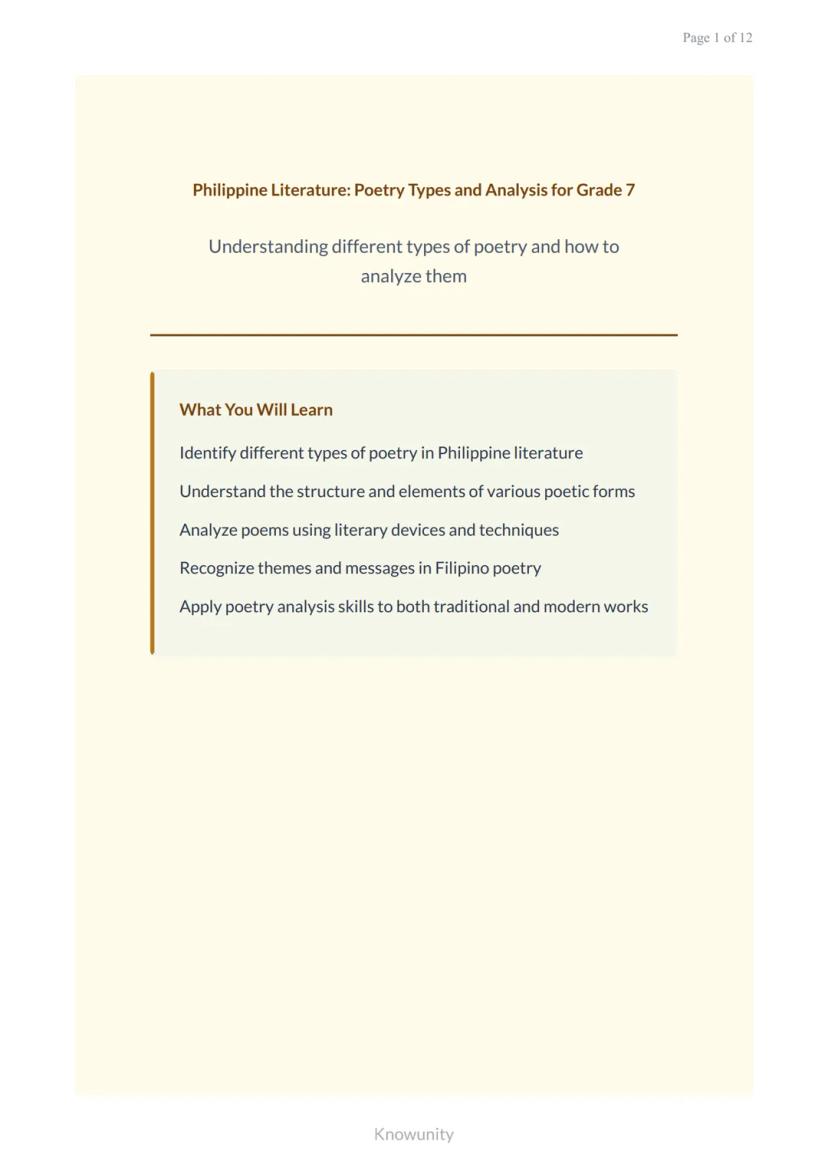

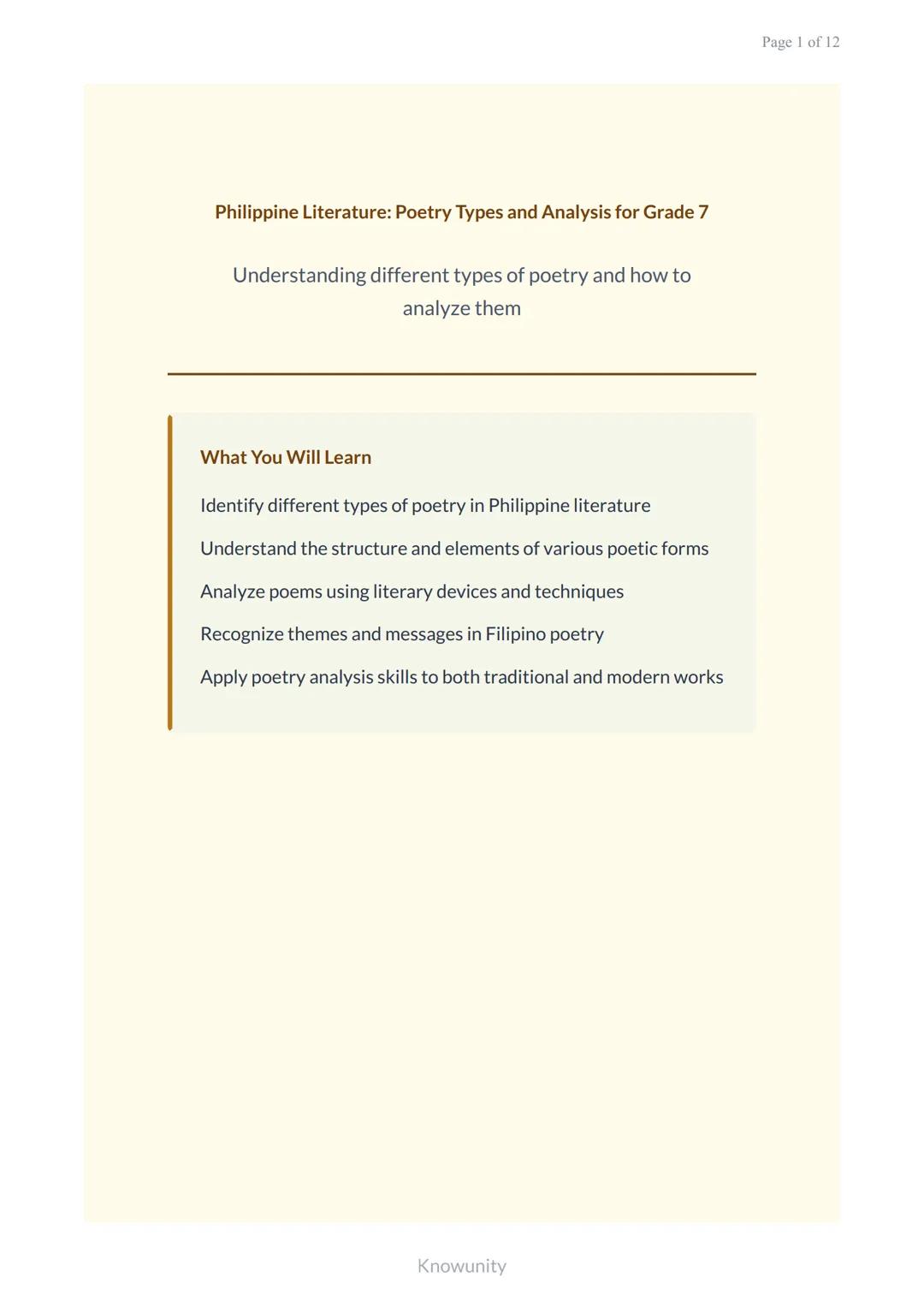
You're about to discover the amazing world of Filipino poetry, where every verse tells a story about who we are as a people. This journey will help you understand different poetic forms, from traditional structures to modern free verse, whilst developing your skills in analysing what poets really mean beneath their carefully chosen words.
By the end of this topic, you'll be able to spot the difference between a tanaga and a haiku, understand how literary devices work their magic, and confidently analyse any poem that comes your way. These skills aren't just for English class - they'll help you appreciate the beauty of language and understand your cultural heritage better.
Quick Tip: Poetry analysis might seem tricky at first, but once you learn the basic steps, you'll find patterns everywhere and start noticing the clever ways poets communicate their messages.
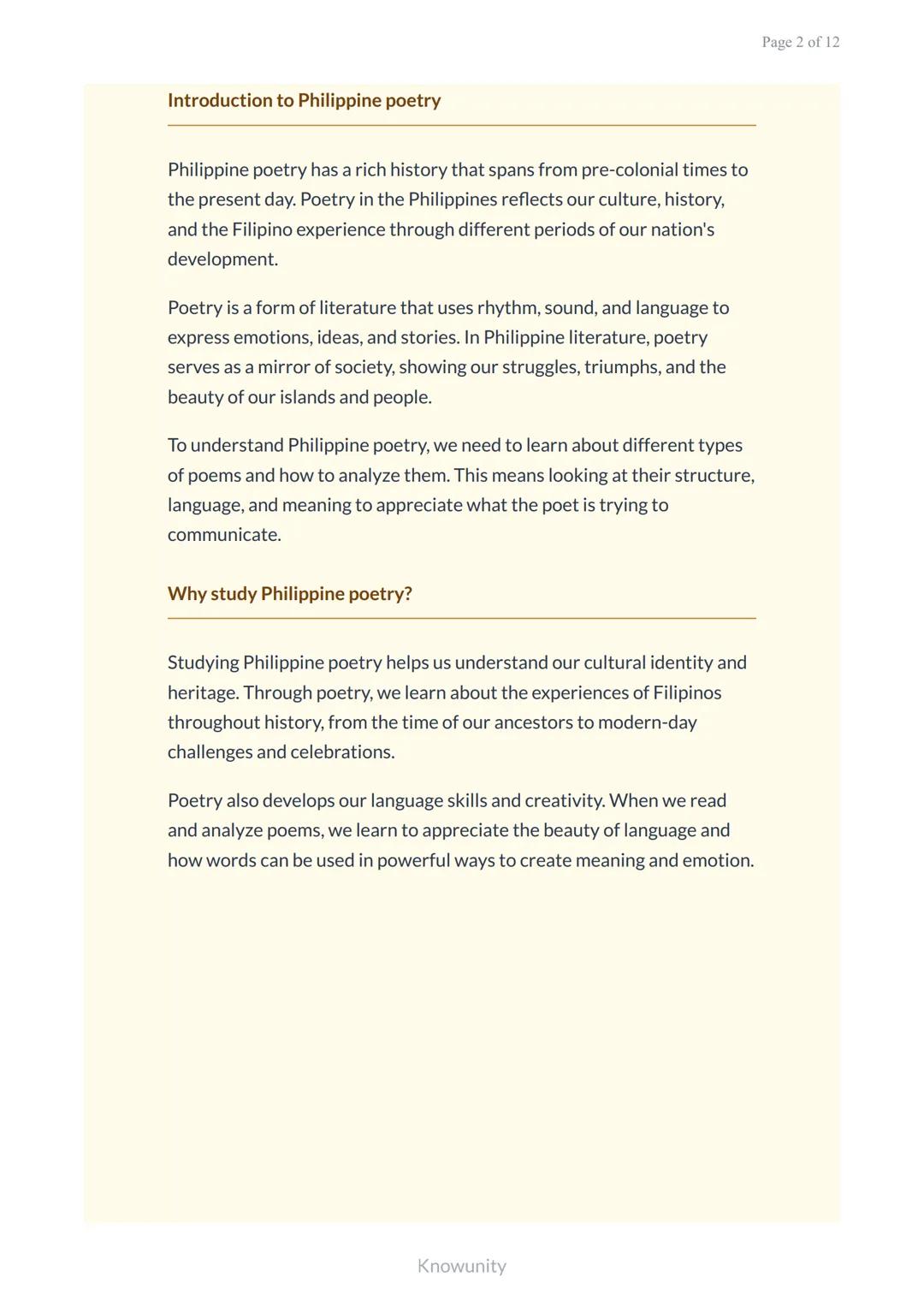
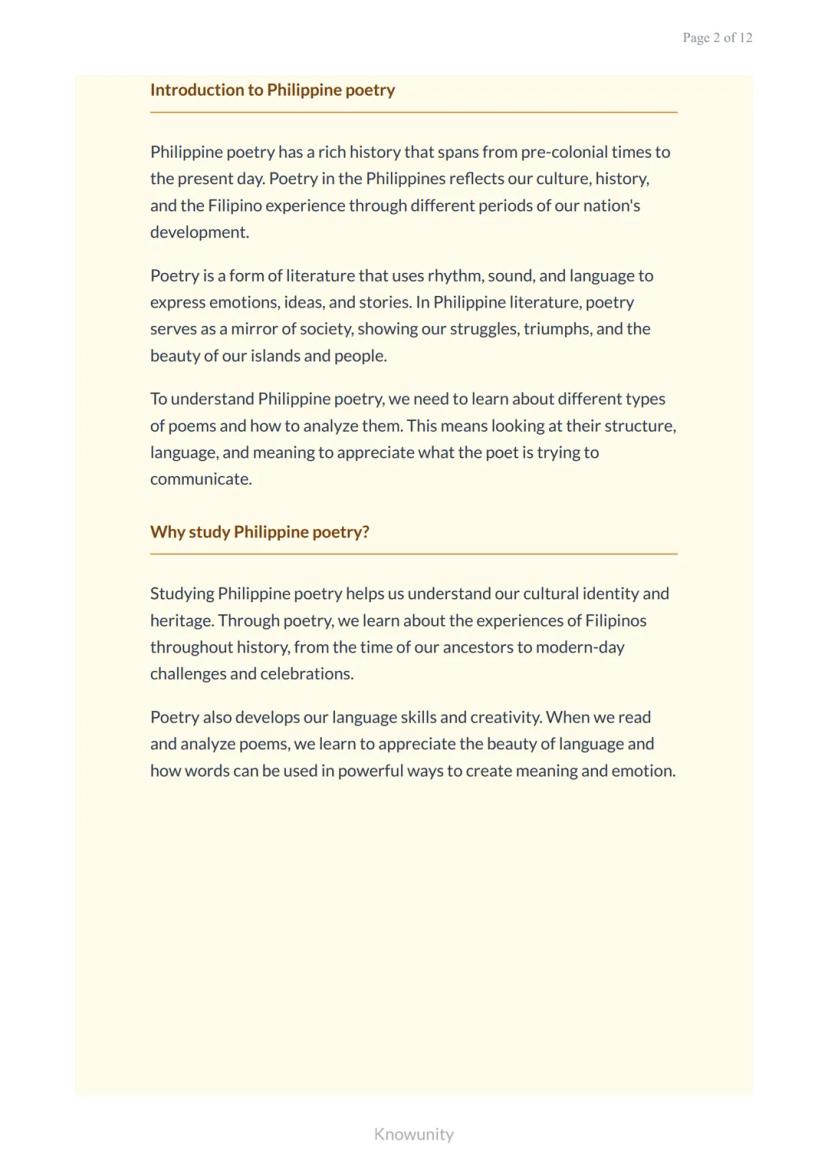
Philippine poetry isn't just words on a page - it's the voice of our entire nation speaking across centuries. From pre-colonial times when our ancestors shared wisdom through verse, to today's spoken word artists addressing modern issues, Filipino poetry has always been our way of making sense of the world around us.
Poetry uses rhythm, sound, and language in special ways that regular writing doesn't. Think of it like music made from words, where every syllable and pause has a purpose. Filipino poets have used this art form to capture everything from the beauty of our islands to the struggles of our people throughout different periods in history.
When you study Philippine poetry, you're not just learning about literature - you're connecting with your cultural identity. These poems show you how Filipinos have always found ways to express hope, love, frustration, and joy through the power of carefully chosen words.
Remember: Every poem is like a window into the poet's world and the time period they lived in. You're basically becoming a detective of emotions and cultural history!
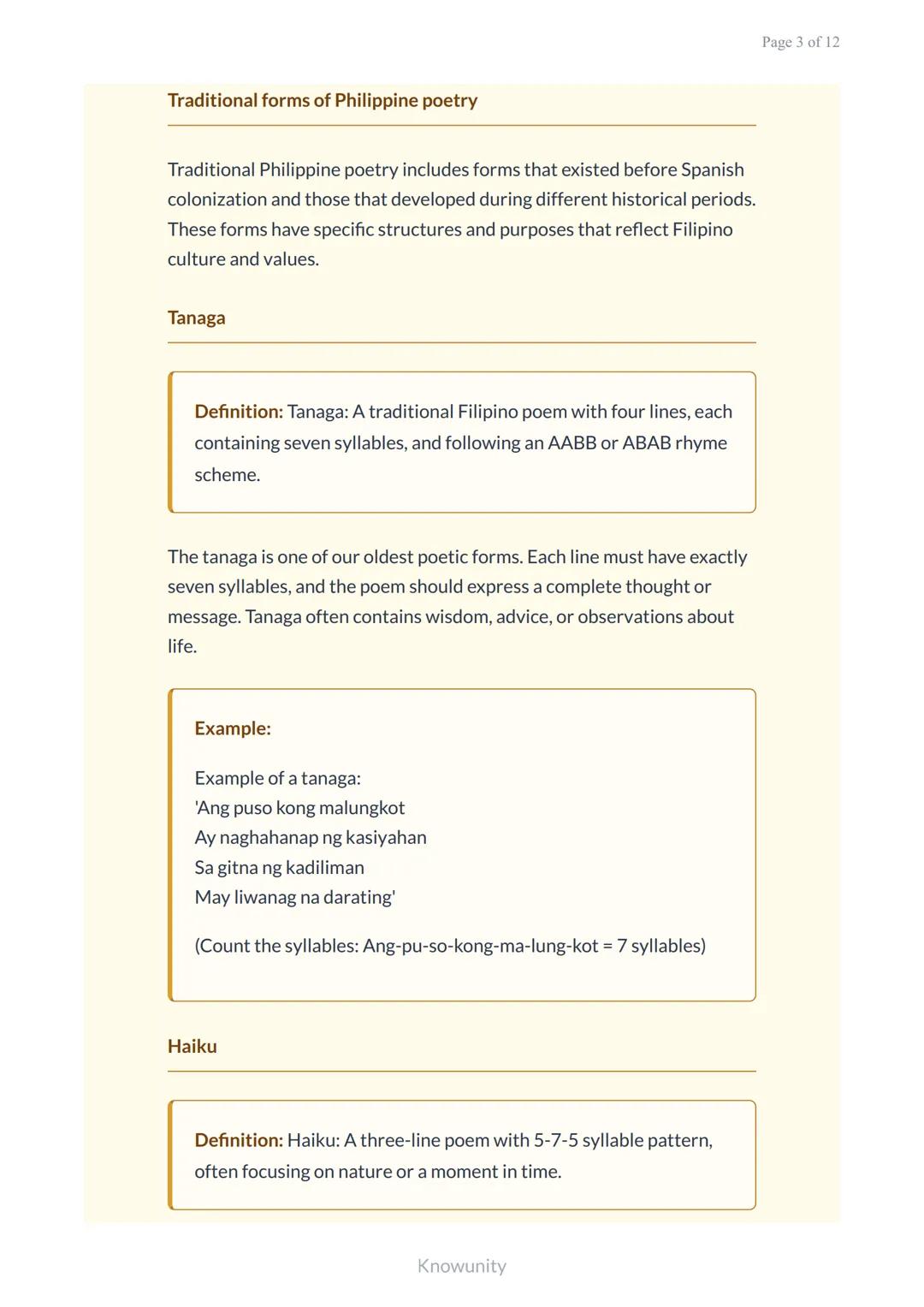
Traditional Filipino poetry follows specific rules that have been passed down through generations, and understanding these forms is like learning the building blocks of our literary heritage. These aren't just random patterns - each structure serves a purpose and reflects how our ancestors organised their thoughts and wisdom.
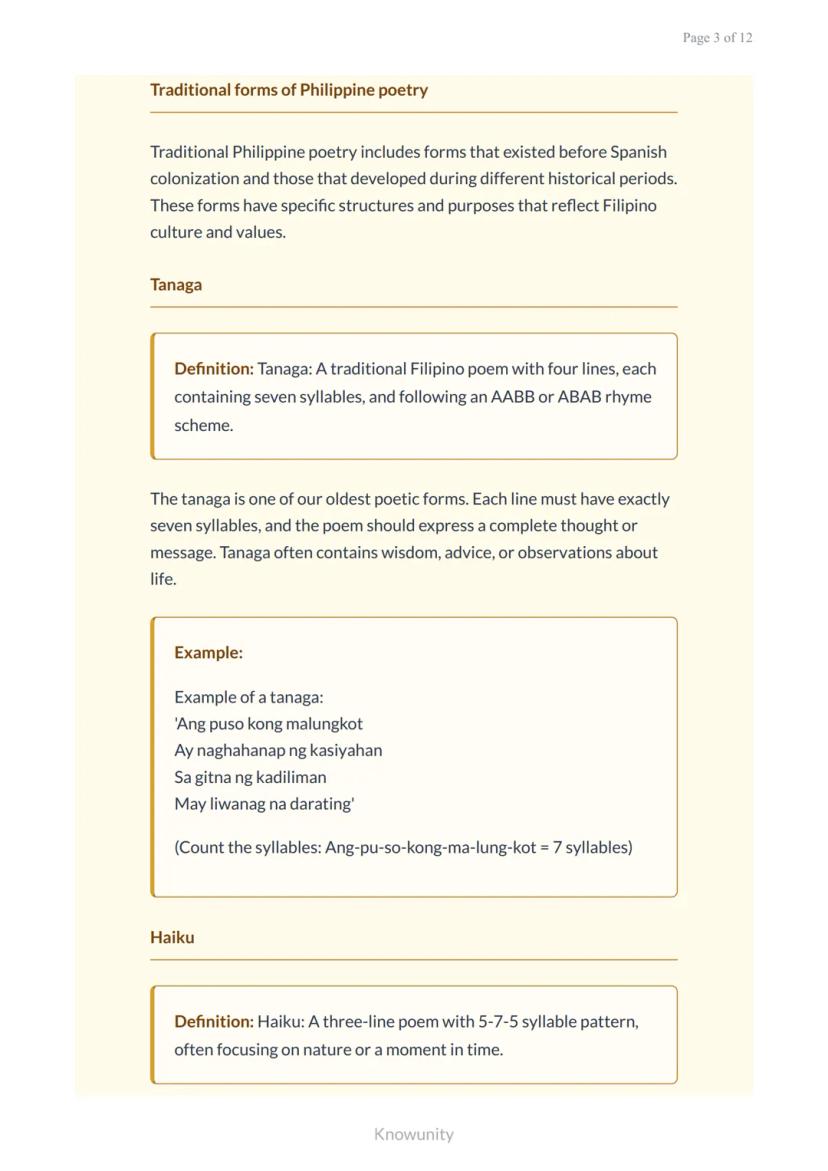
Tanaga is probably the most famous traditional form you'll encounter. It's like a perfectly crafted puzzle with four lines of exactly seven syllables each, following either an AABB or ABAB rhyme scheme. The challenge for poets is fitting a complete thought or piece of wisdom into this tight structure.
Here's how it works: 'Ang puso kong malungkot / Ay naghahanap ng kasiyahan / Sa gitna ng kadiliman / May liwanag na darating.' Count those syllables carefully - each line has exactly seven, and the poem tells a complete story about hope in darkness.
Haiku might have come from Japan originally, but Filipino poets have made it their own by focusing on our tropical environment and cultural experiences. With its 5-7-5 syllable pattern, it captures single moments or observations about nature in just three lines.
Pro Tip: When counting syllables in Filipino poetry, say each word out loud slowly. This helps you hear the natural rhythm and makes sure you're counting correctly.
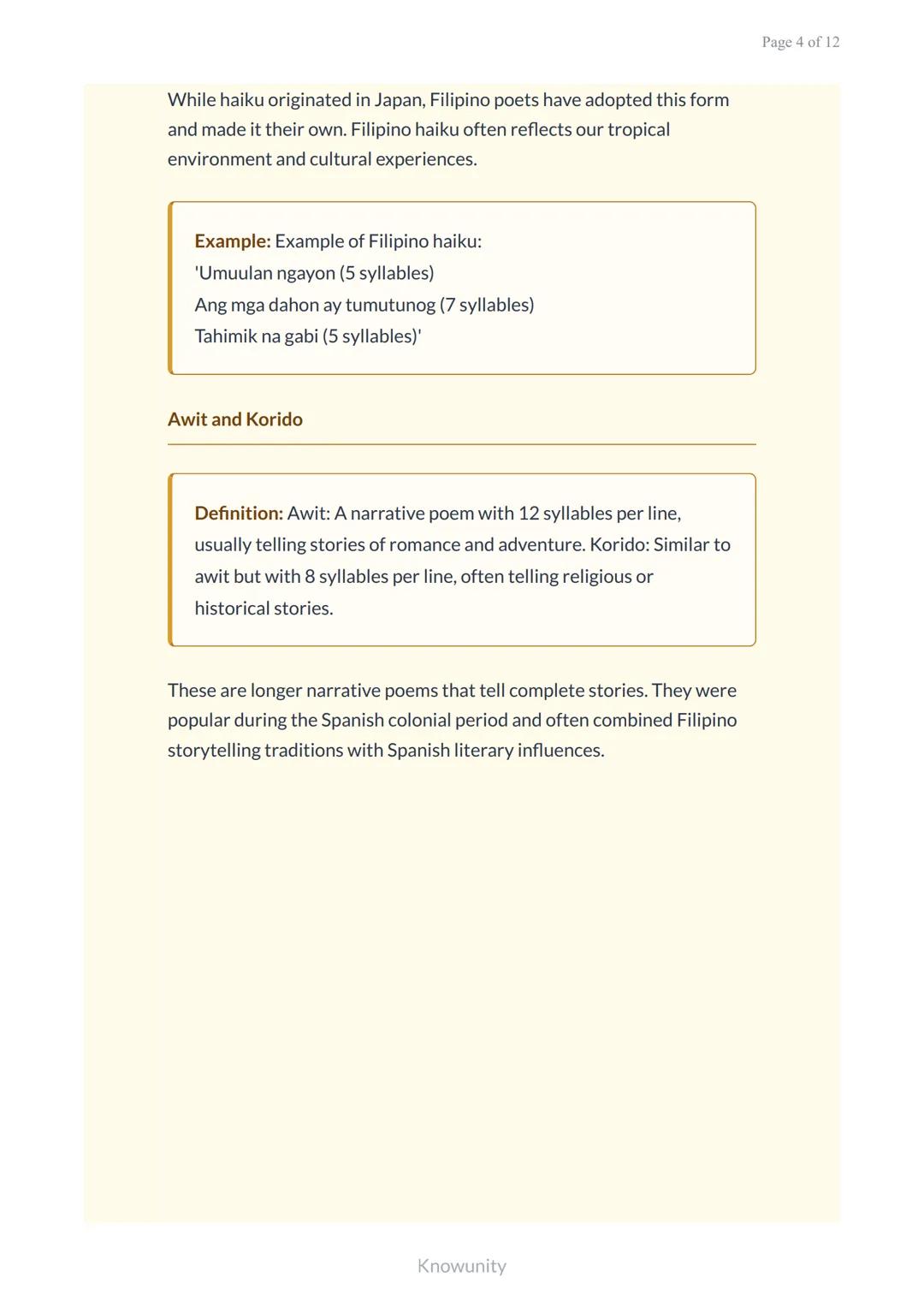
Filipino narrative poetry gets really interesting with awit and korido, which are like the Netflix series of traditional literature - they tell complete stories with characters, plots, and adventures that kept audiences entertained for hours.
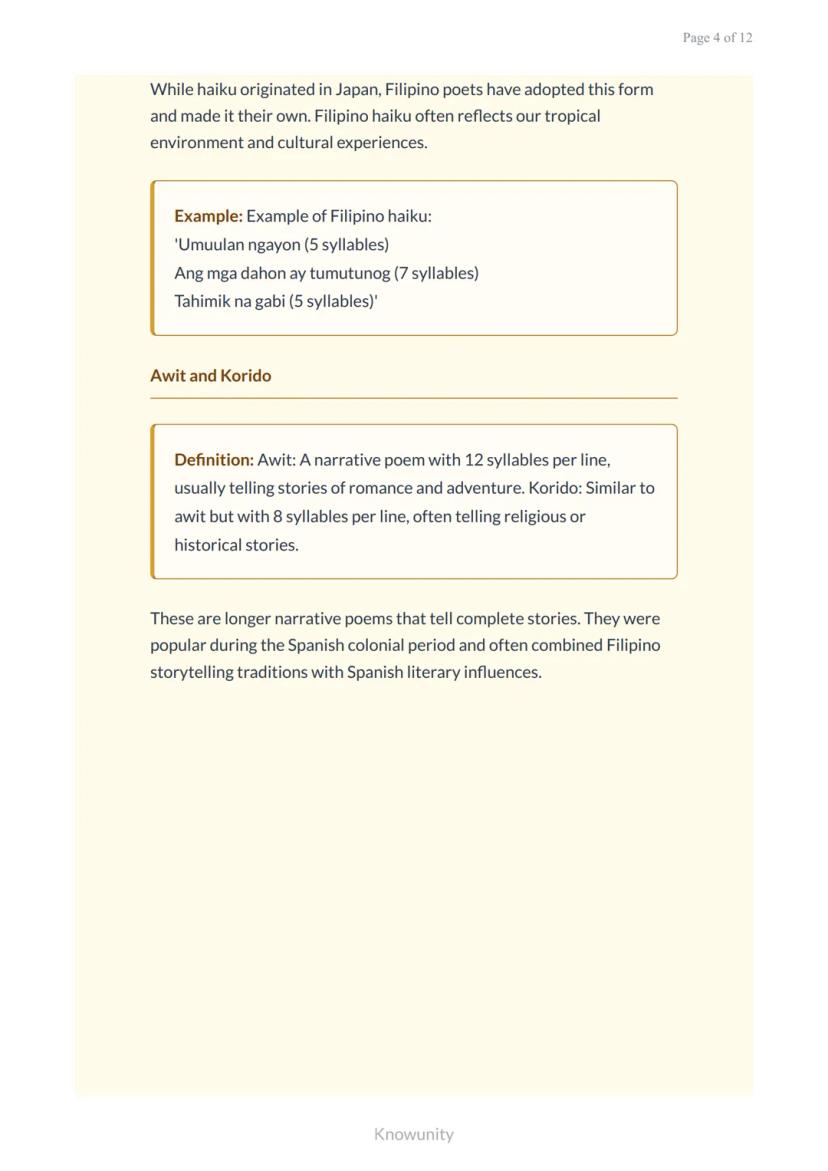
Awit poems have twelve syllables per line and usually focus on romantic adventures and heroic tales. Think of them as the original Filipino romance novels, but written in verse form. These poems were incredibly popular because they combined entertainment with moral lessons.
Korido, on the other hand, uses eight syllables per line and often tells religious or historical stories. These poems were like the news and educational programmes of their time, helping people learn about important events and moral teachings through memorable verses.
Both forms became especially popular during the Spanish colonial period, showing how Filipino poets adapted and blended our storytelling traditions with new influences. They prove that Filipinos have always been brilliant at taking outside ideas and making them uniquely our own.
Think About It: These long narrative poems were performed aloud, often with music. Imagine how different your experience of stories would be if you learned them through sung poetry instead of books or films!
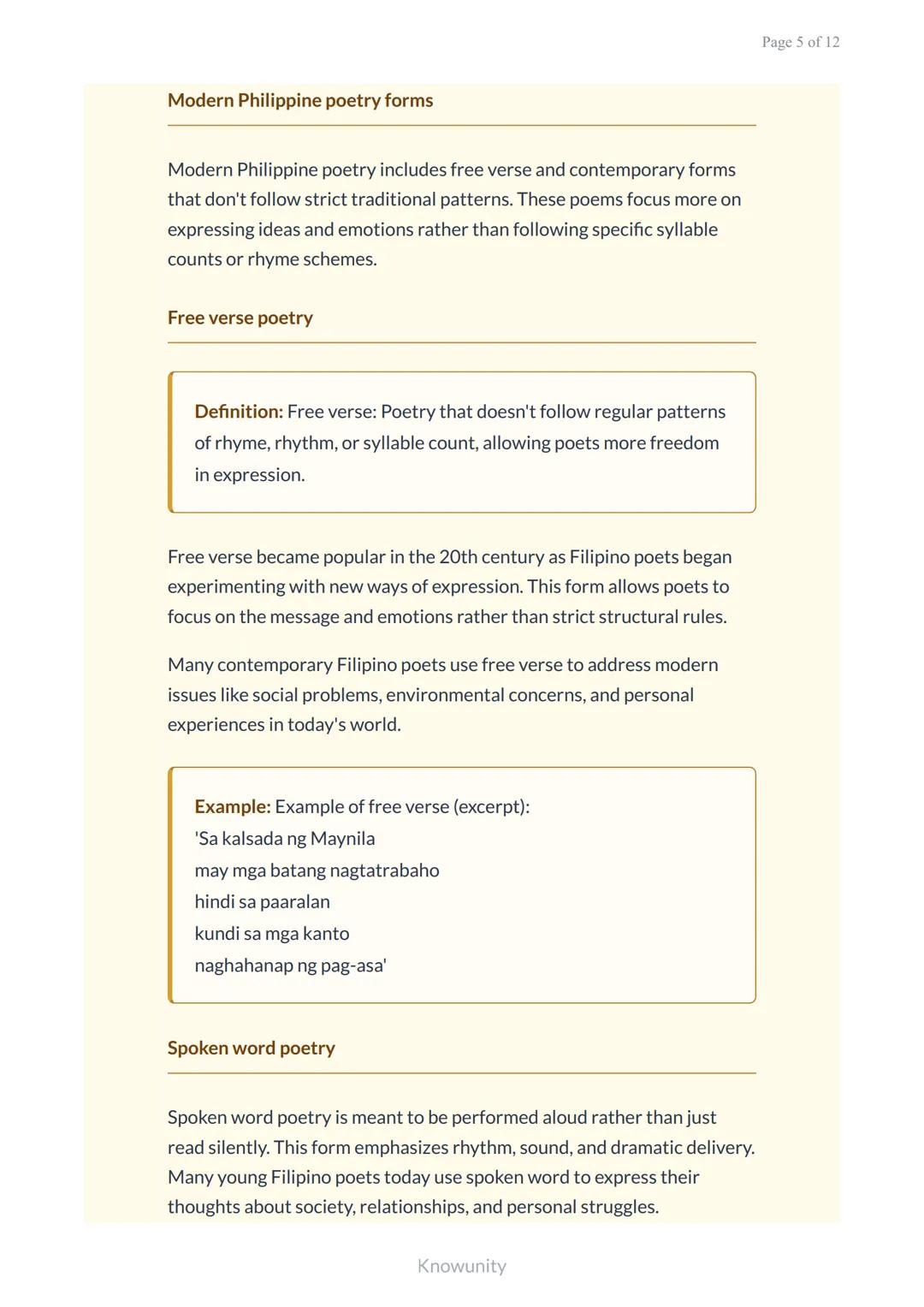
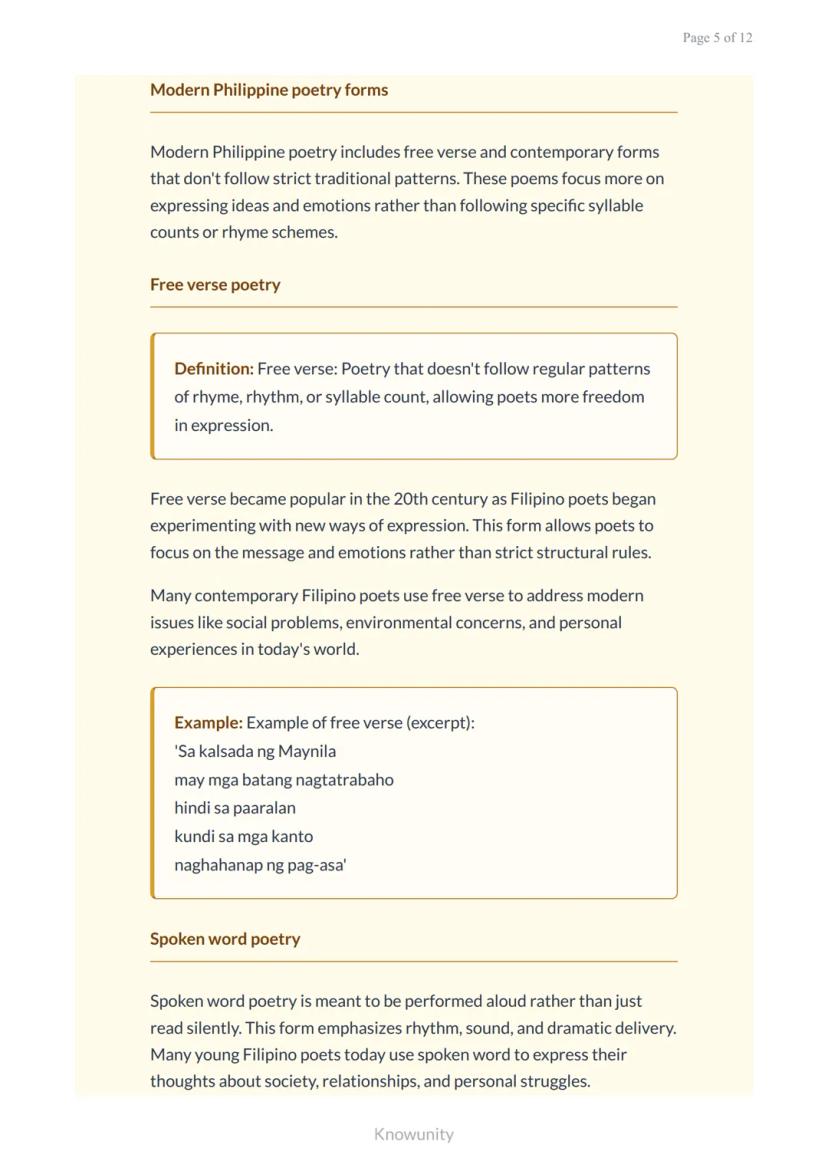
Modern Philippine poetry threw the rulebook out the window, and that's exactly what makes it so exciting and relevant to your generation. Free verse poetry doesn't worry about counting syllables or following strict rhyme schemes - instead, it focuses on expressing ideas and emotions in the most powerful way possible.
This freedom allows contemporary Filipino poets to tackle issues that matter right now: social problems, environmental concerns, relationships, and personal struggles that traditional forms might not capture as effectively. The rhythm comes from the natural flow of speech rather than predetermined patterns.
Spoken word poetry takes this even further by being designed specifically for performance. It's poetry that comes alive when spoken aloud, emphasising rhythm, sound, and dramatic delivery. Many young Filipinos today use spoken word to express their thoughts about society and personal experiences.
You'll find spoken word competitions in schools and communities across the Philippines, giving young people like you a platform to share your voices. It's poetry that connects directly with audiences and often addresses real-world issues that affect your generation.
Did You Know: Many spoken word poems that go viral on social media started in small community events or school competitions. Your voice and experiences could be the next to inspire thousands of people!
Spoken word poetry has transformed how we think about verse in the Philippines, turning quiet reading into dynamic performance art that connects directly with audiences. This isn't just about reading poems aloud - it's about using your voice, gestures, and timing to bring words to life in ways that silent reading simply cannot achieve.
The beauty of spoken word lies in its immediacy and emotional impact. When a poet performs their work, you experience not just their words but their passion, frustration, hope, or anger in real time. This direct connection between poet and audience creates a powerful shared experience.
Young Filipino poets have embraced this form because it allows them to address contemporary issues with urgency and authenticity. Topics like social inequality, mental health, environmental destruction, and personal identity come alive through passionate performance.
The growth of spoken word events across the Philippines has created communities where young voices can be heard and validated. These aren't just artistic events - they're spaces for social commentary and personal expression that often lead to real conversations about change.
Challenge Yourself: Try reading a poem aloud versus silently. Notice how your understanding and emotional response changes when you engage your voice and hearing along with your eyes.
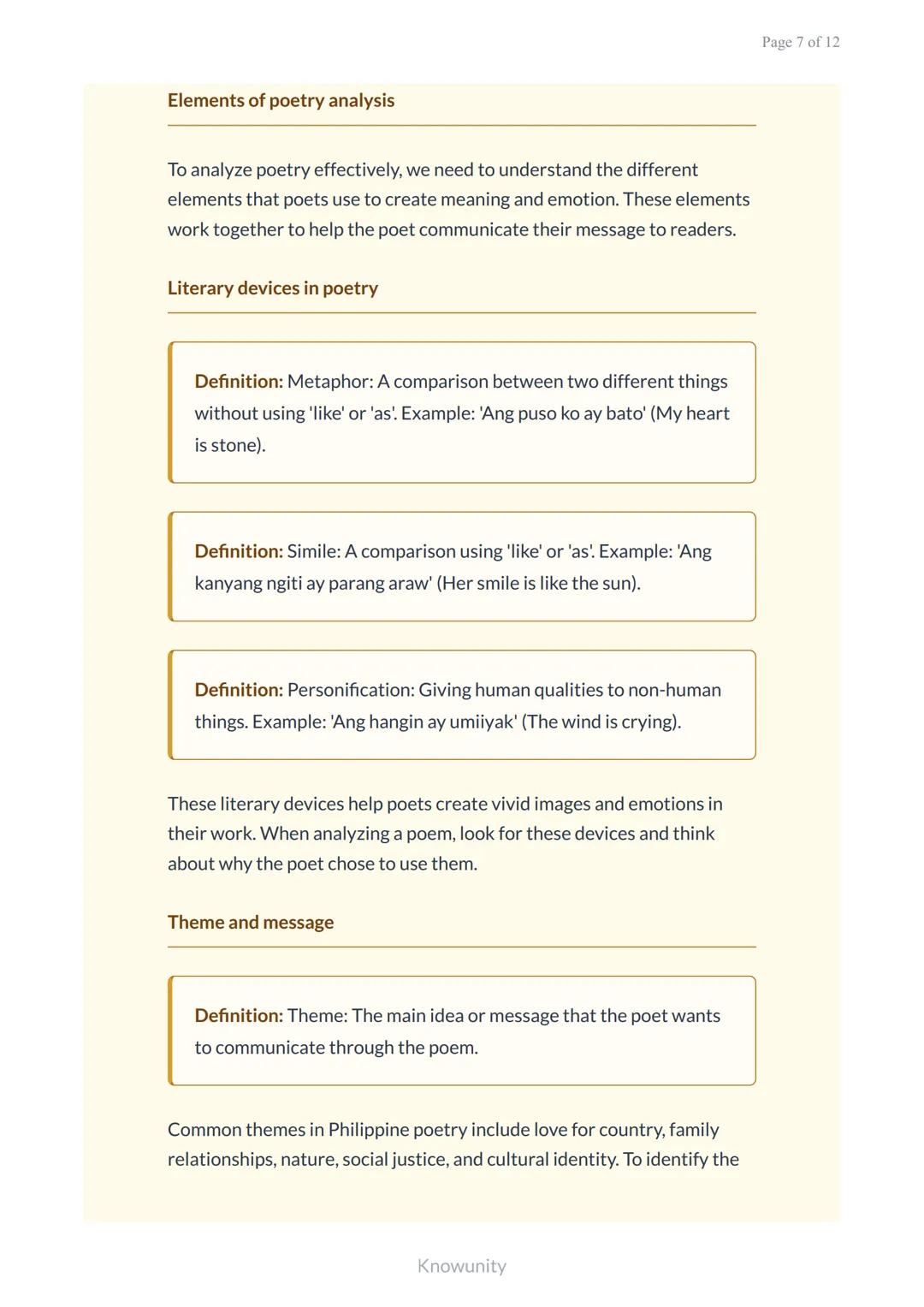
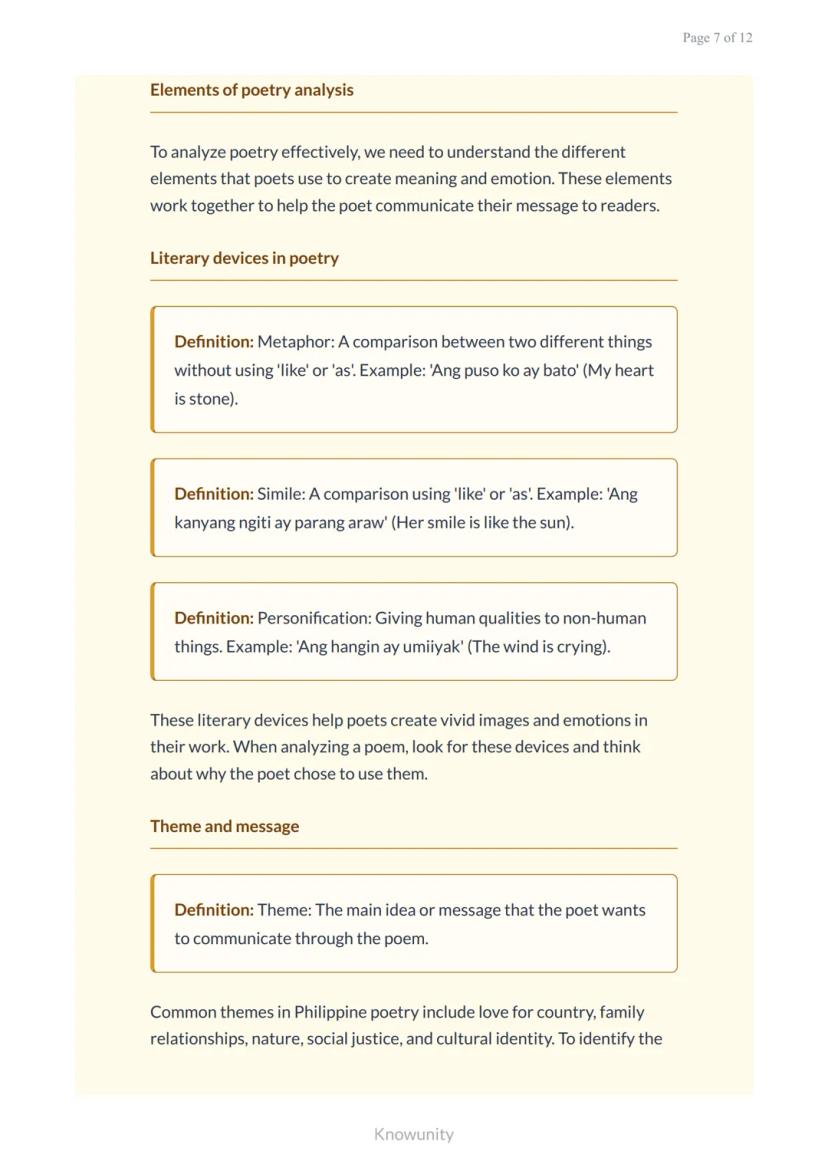
Understanding literary devices is like having a decoder ring for poetry - suddenly you can see how poets create those powerful emotions and vivid images that stick in your mind long after reading. These aren't just fancy writing tricks; they're tools that help poets communicate complex ideas and feelings in memorable ways.
Metaphors create direct comparisons without using 'like' or 'as' - when a poet writes 'Ang puso ko ay bato' (My heart is stone), they're not literally claiming their heart is made of rock, but showing how emotionally hardened they feel. Similes make similar comparisons but use connecting words: 'Ang kanyang ngiti ay parang araw' (Her smile is like the sun).
Personification brings non-human things to life by giving them human qualities. When you read 'Ang hangin ay umiiyak' (The wind is crying), the poet helps you feel the sadness in a storm by describing it in human terms you can relate to.
These devices work together to create the theme - the main message the poet wants you to understand. Filipino poetry often explores themes like love for country, family bonds, nature's beauty, social justice, and cultural identity through these powerful literary tools.
Spot the Pattern: Once you start recognising these devices, you'll find them everywhere - in songs, advertisements, and even everyday conversations. Poets just use them more intentionally and artistically.
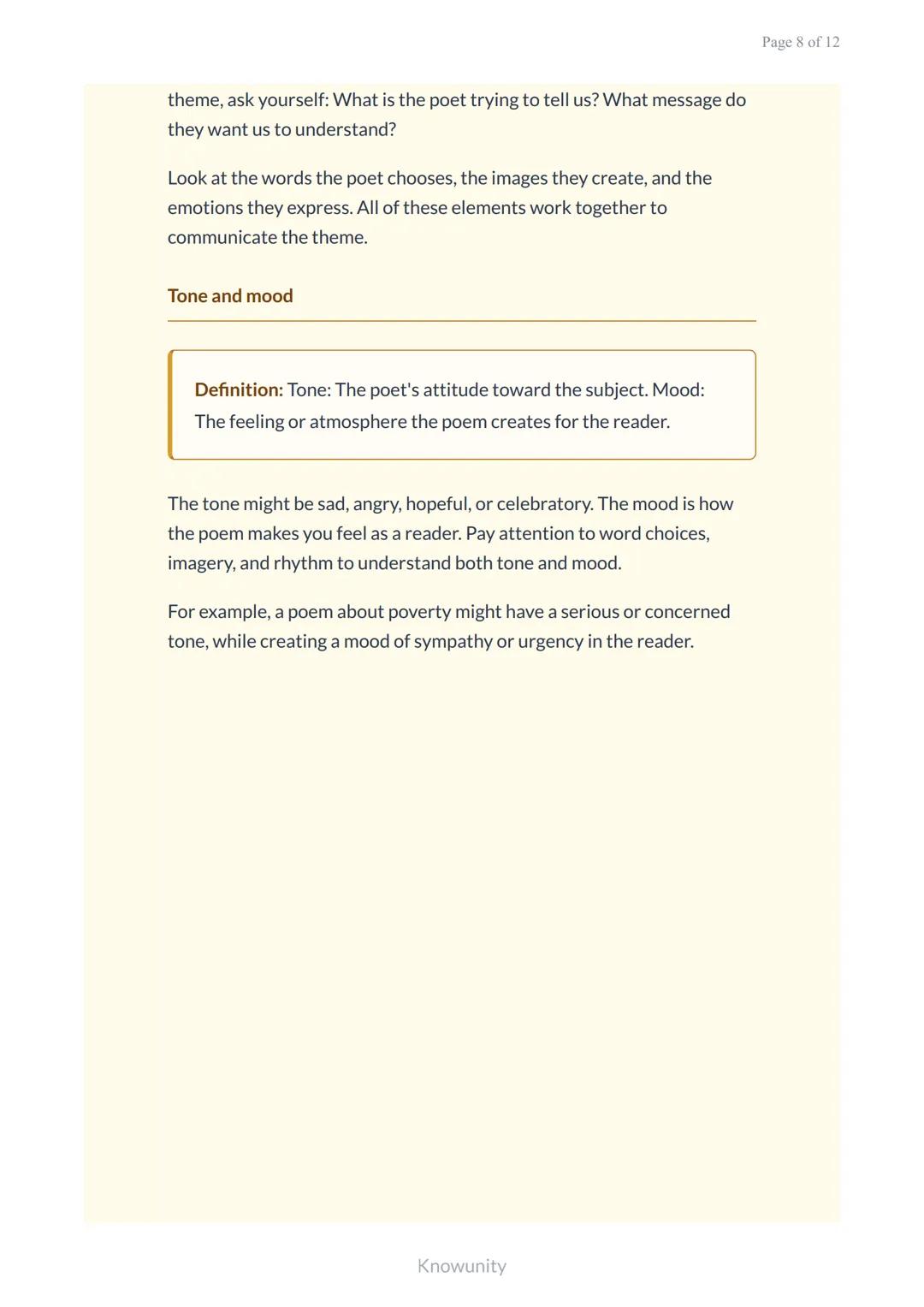
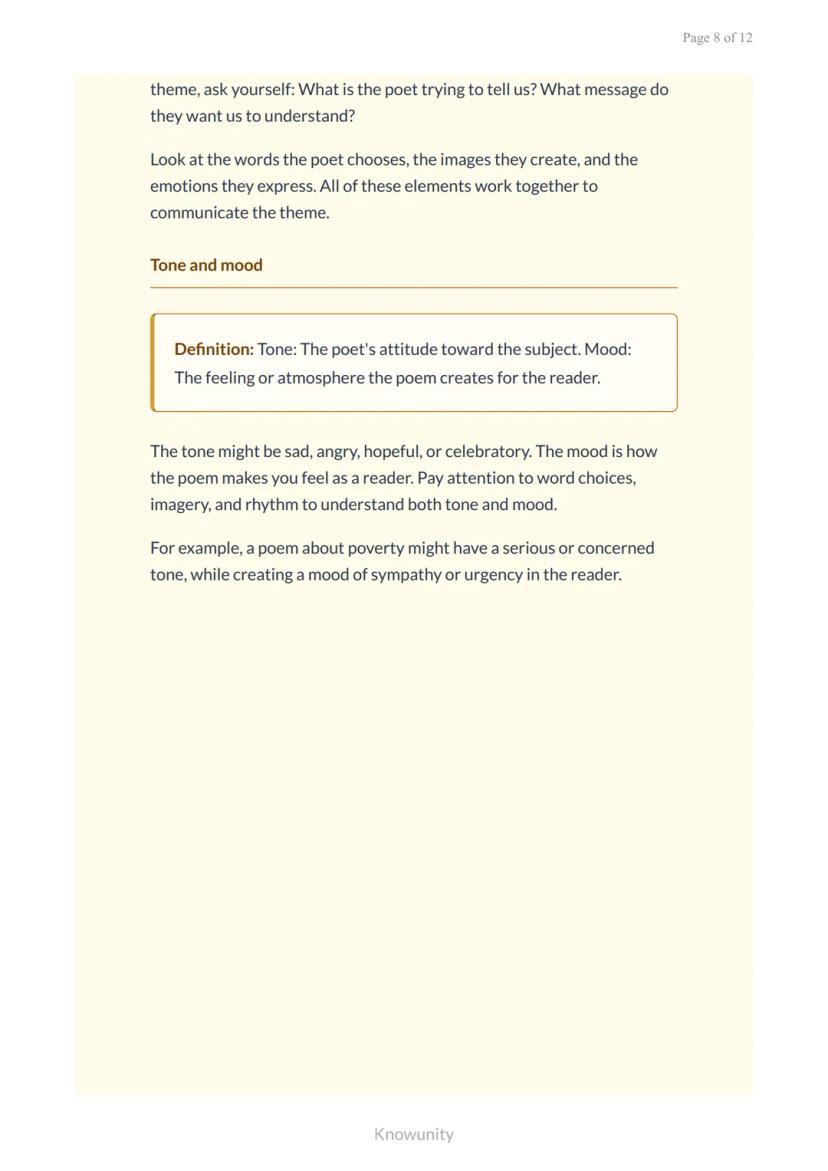
Tone and mood are like the emotional soundtrack of a poem, and learning to identify them helps you understand not just what a poet is saying, but how they feel about it and how they want you to feel too. These elements work together to create the poem's emotional impact.
Tone reflects the poet's attitude toward their subject - it might be angry, hopeful, sad, celebratory, or sarcastic. You can detect tone through word choices, imagery, and the overall approach the poet takes to their topic.
Mood, on the other hand, is the emotional atmosphere the poem creates for you as the reader. A poem about poverty might have a serious or concerned tone from the poet, while creating a mood of sympathy or urgency in you as you read it.
Pay attention to specific words, the images they create in your mind, and the rhythm of the lines. All these elements combine to establish both tone and mood. A poem with short, sharp lines and harsh sounds might create tension, while flowing, gentle language might create calm or peace.
Reading Tip: Try reading the same poem in different emotional states - when you're happy, sad, or stressed. Notice how your own mood can influence how you perceive the poem's tone and mood.
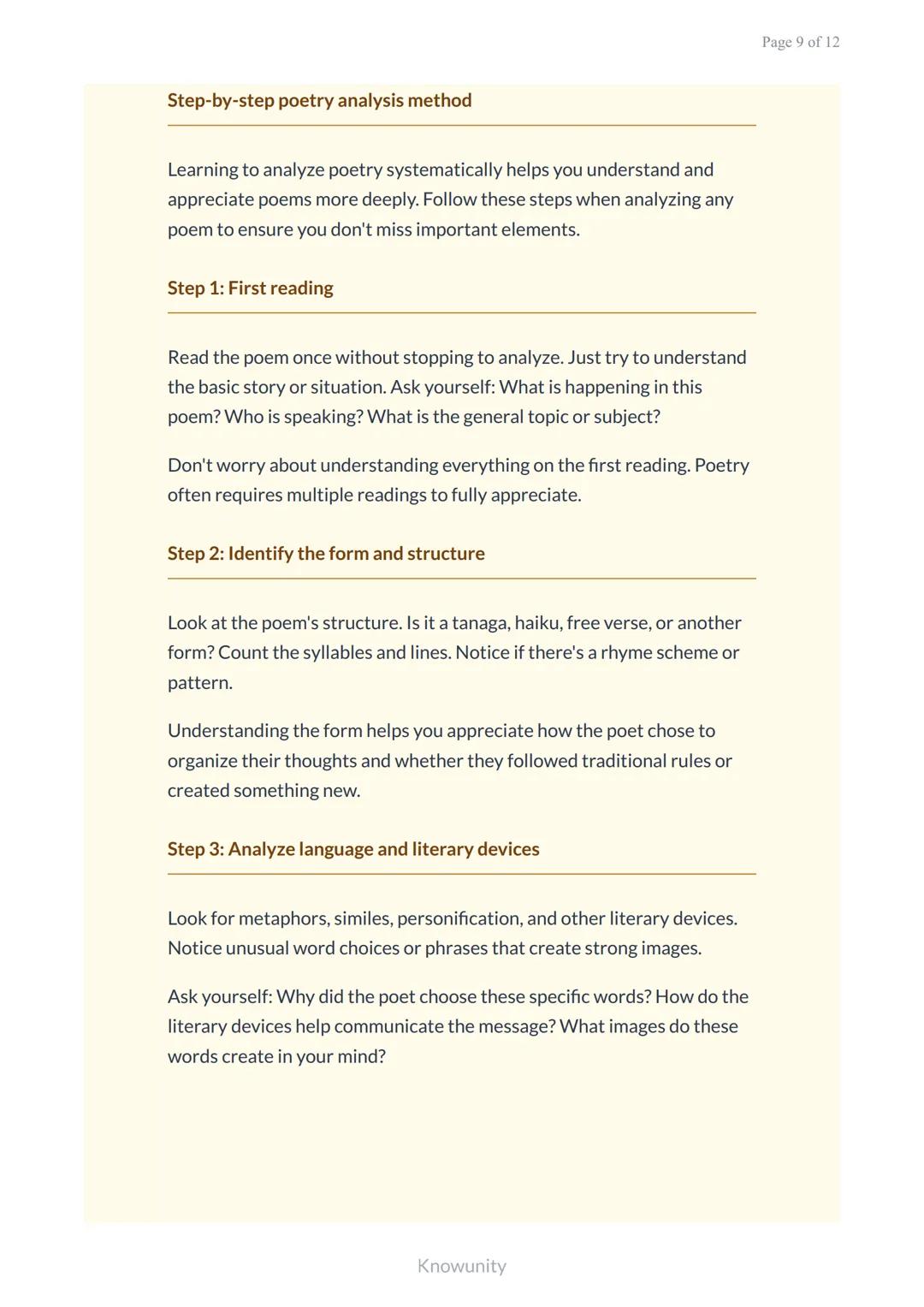
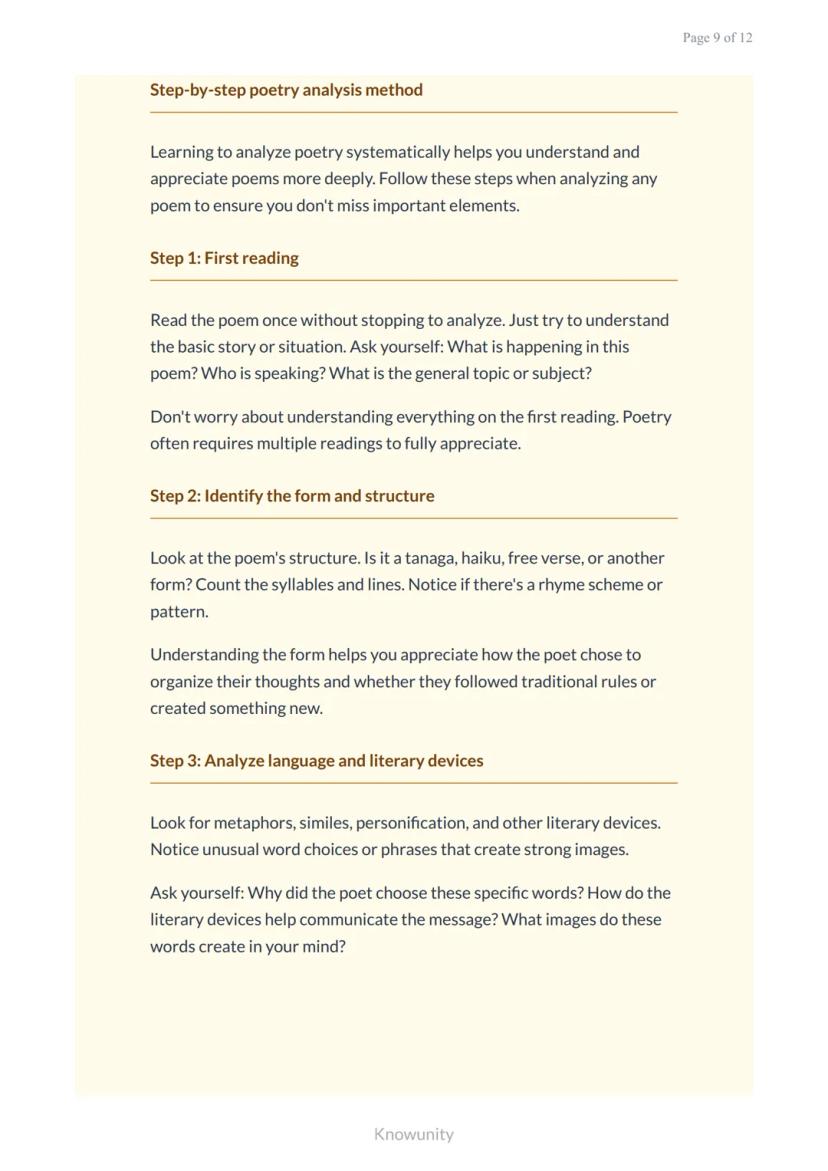
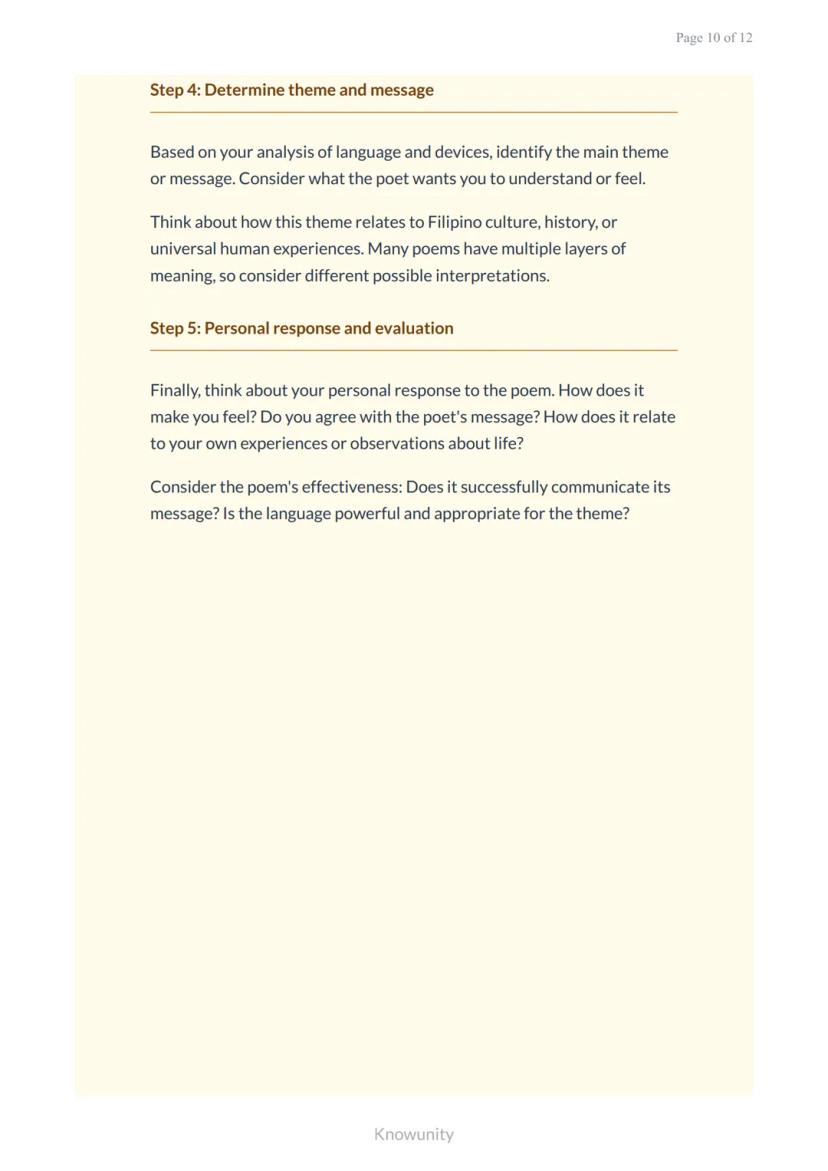
Learning to analyse poetry systematically transforms you from someone who just reads poems to someone who truly understands and appreciates them. This step-by-step method ensures you don't miss important elements and helps build your confidence in tackling any poem.
Step 1: First Reading - Don't try to analyse anything yet. Just read through once to get the basic story or situation. Ask yourself: What's happening? Who's speaking? What's the general topic? Poetry often requires multiple readings, so don't worry if you don't understand everything immediately.
Step 2: Identify Form and Structure - Look at how the poem is organised. Is it a tanaga, haiku, free verse, or another form? Count syllables and lines if relevant. Notice rhyme schemes or patterns. Understanding the structure helps you appreciate the poet's choices.
Step 3: Analyse Language and Literary Devices - Hunt for metaphors, similes, personification, and other devices. Notice unusual word choices or phrases that create strong images. Ask why the poet chose specific words and how they help communicate the message.
Study Smart: Create a simple checklist of these steps and use it for every poem you analyse. Soon it'll become automatic, and you'll find yourself naturally noticing these elements in any poetry you read.
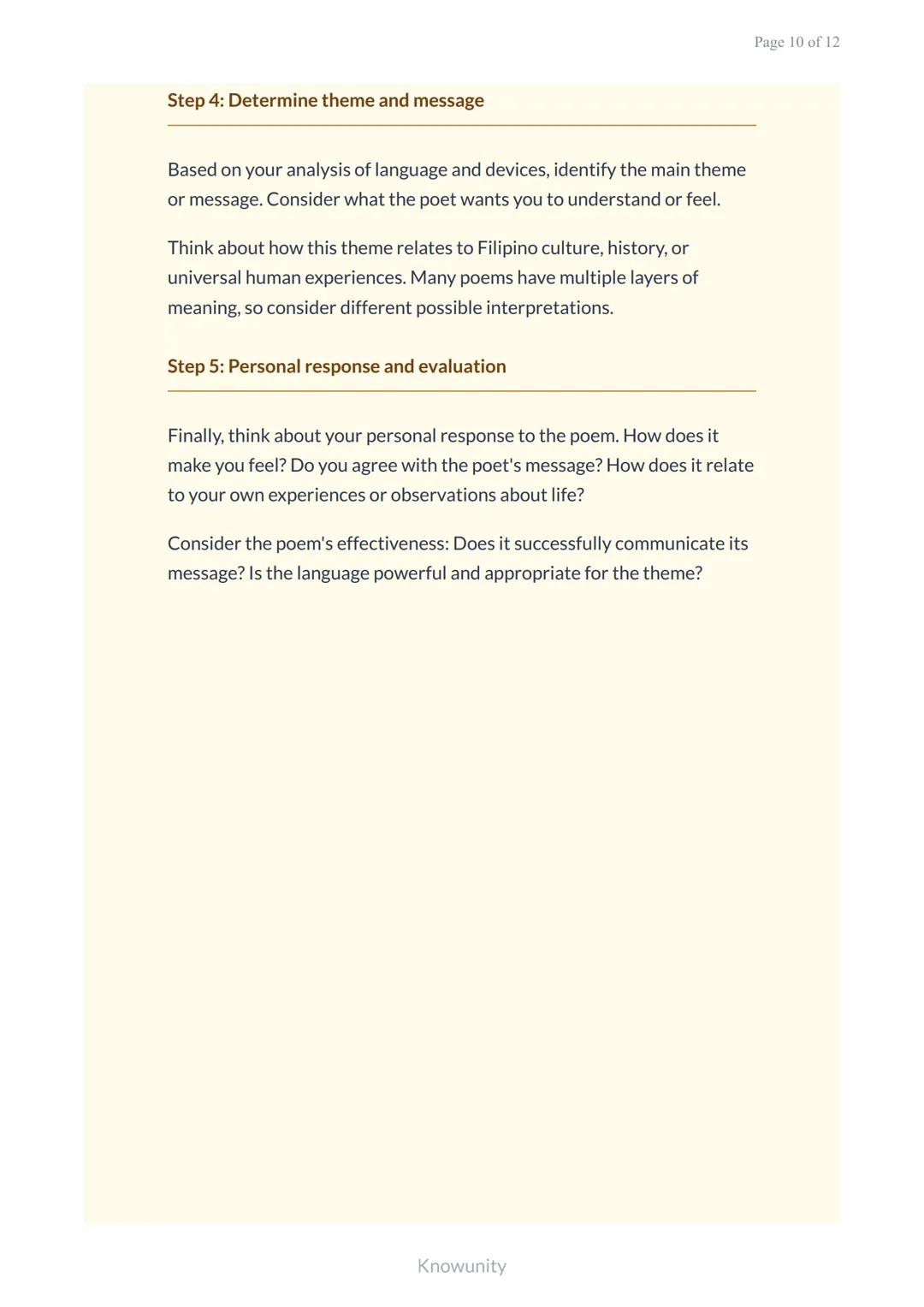
The final steps of poetry analysis help you move from understanding what the poet did to appreciating why it matters and how it affects you personally. This is where your critical thinking skills really develop, as you learn to form and express your own informed opinions about literature.
Step 4: Determine Theme and Message - Use everything you've discovered about language, devices, and structure to identify the main theme. Consider how this connects to Filipino culture, history, or universal human experiences. Remember that good poems often have multiple layers of meaning, so stay open to different interpretations.
Step 5: Personal Response and Evaluation - This is your chance to engage personally with the poem. How does it make you feel? Do you connect with the poet's message? How does it relate to your own experiences or observations about life?
Think critically about the poem's effectiveness: Does it successfully communicate its message? Is the language powerful and appropriate for the theme? Would you recommend this poem to others, and why?
This final step is crucial because it transforms you from a passive reader into an active participant in the literary conversation. Your insights and responses are valuable and contribute to the ongoing discussion about what makes poetry meaningful and powerful.
Remember: There's no single "correct" interpretation of a poem. What matters is that you can support your reading with evidence from the text and explain your reasoning clearly.
Notre compagnon IA est spécialement conçu pour répondre aux besoins des étudiants. Sur la base des millions d'éléments de contenu que nous avons sur la plateforme, nous pouvons fournir des réponses vraiment significatives et pertinentes aux étudiants. Mais il ne s'agit pas seulement de réponses, le compagnon a encore plus pour but de guider les élèves dans leurs défis d'apprentissage quotidiens, avec des plans d'étude personnalisés, des quiz ou des éléments de contenu dans le chat et une personnalisation à 100% basée sur les compétences et les développements de l'étudiant.
Tu peux télécharger l'application dans Google Play Store et dans l'App Store d'Apple.
Oui, tu as un accès entièrement gratuit à tous les contenus de l'appli, tu peux chatter ou suivre les créateurs à tout moment. De plus, nous proposons Knowunity Premium, qui te permet de réviser sans limites!
App Store
Google Play
L'application est très facile d'utilisation et bien conçue. Jusqu'à présent, j'ai trouvé tout ce que je cherchais et j'ai pu apprendre beaucoup de choses grâce aux présentations ! Je vais certainement utiliser l'application pour un travail en classe ! Et comme source d'inspiration personnelle, elle est bien sûr aussi très utile.
Stefan S
utilisateur iOS
Cette application est vraiment super. Il y a tellement de fiches de révision et d'aide, [...]. Par exemple, la matière qui me pose problème est le français et l'appli a un choix d'aide très large. Grâce à cette application, je me suis améliorée en français. Je la recommanderais à tout le monde.
Samantha Klich
utilisatrice Android
Waouh, je suis vraiment abasourdi. J'ai essayé l'application parce que je l'avais déjà vue plusieurs fois dans la publicité et j'ai été absolument choquée. Cette appli est L'AIDE dont on rêve pour l'école et surtout, elle propose tellement de choses, comme des rédactions et des fiches qui m'ont personnellement TRÈS bien aidé.
Anna
utilisatrice iOS
Meilleur application je voulais m'entraîner pour mes maths puis j'ai tout compris d'un coup c'est mon nouveau prof maintenant 🤣🤣
Thomas R
utilisateur d' Android
super application pour réviser je révise tout les soirs
Esteban M
utilisateur d'Android
Permet de vraiment comprendre les cours sous forme de fiches de révisions déjà faites ! Incroyable, je recommande vraiment
Leny
utilisateur d'Android
L'application est tout simplement géniale ! Il me suffit de taper mon sujet dans la barre de recherche et je le vérifie très rapidement. Je ne dois plus regarder 10 vidéos YouTube pour comprendre quelque chose et j'économise ainsi mon temps. Je te le recommande !
Sudenaz Ocak
utilisateur Android
Cette application m'a vraiment fait m'améliorer ! J'étais vraiment nul en maths à l'école et grâce à l'appli, je suis meilleur en maths ! Je suis tellement reconnaissante que vous ayez créé cette application.
Greenlight Bonnie
utilisateur Android
PARFAIT 🌟 💕🔥 ça facilite Vrmt la révision avec des fiches de révisions fascinants✨🥰
Khady
utilisatrice d'Android
Je conseille vraiment ! je galère à avoir des cours clairs et ça aide énormément !!
Claire
utilisatrice iOS
LES QUIZ ET CARTES MÉMOIRE SONT TROP UTILES ET J'ADORE Knowunity IA. C'EST LITTÉRALEMENT COMME CHATGPT MAIS EN PLUS INTELLIGENT !! ÇA M'A AIDÉ AVEC MES PROBLÈMES DE MASCARA AUSSI !! AINSI QUE MES VRAIES MATIÈRES ! ÉVIDEMMENT 😍😁😲🤑💗✨🎀😮
Raoul
utilisateur IOS
Knowunity est vraiment une application incroyable elle est pour tous les âges et s’adapte à tous les niveaux.Elle permet de mieux comprendre et apprendre. Cette application est super pour les devoirs et pour les contrôles je la recommande à tous le monde petit ou grands
Ella
utilisatrice iOS
L'application est très facile d'utilisation et bien conçue. Jusqu'à présent, j'ai trouvé tout ce que je cherchais et j'ai pu apprendre beaucoup de choses grâce aux présentations ! Je vais certainement utiliser l'application pour un travail en classe ! Et comme source d'inspiration personnelle, elle est bien sûr aussi très utile.
Stefan S
utilisateur iOS
Cette application est vraiment super. Il y a tellement de fiches de révision et d'aide, [...]. Par exemple, la matière qui me pose problème est le français et l'appli a un choix d'aide très large. Grâce à cette application, je me suis améliorée en français. Je la recommanderais à tout le monde.
Samantha Klich
utilisatrice Android
Waouh, je suis vraiment abasourdi. J'ai essayé l'application parce que je l'avais déjà vue plusieurs fois dans la publicité et j'ai été absolument choquée. Cette appli est L'AIDE dont on rêve pour l'école et surtout, elle propose tellement de choses, comme des rédactions et des fiches qui m'ont personnellement TRÈS bien aidé.
Anna
utilisatrice iOS
Meilleur application je voulais m'entraîner pour mes maths puis j'ai tout compris d'un coup c'est mon nouveau prof maintenant 🤣🤣
Thomas R
utilisateur d' Android
super application pour réviser je révise tout les soirs
Esteban M
utilisateur d'Android
Permet de vraiment comprendre les cours sous forme de fiches de révisions déjà faites ! Incroyable, je recommande vraiment
Leny
utilisateur d'Android
L'application est tout simplement géniale ! Il me suffit de taper mon sujet dans la barre de recherche et je le vérifie très rapidement. Je ne dois plus regarder 10 vidéos YouTube pour comprendre quelque chose et j'économise ainsi mon temps. Je te le recommande !
Sudenaz Ocak
utilisateur Android
Cette application m'a vraiment fait m'améliorer ! J'étais vraiment nul en maths à l'école et grâce à l'appli, je suis meilleur en maths ! Je suis tellement reconnaissante que vous ayez créé cette application.
Greenlight Bonnie
utilisateur Android
PARFAIT 🌟 💕🔥 ça facilite Vrmt la révision avec des fiches de révisions fascinants✨🥰
Khady
utilisatrice d'Android
Je conseille vraiment ! je galère à avoir des cours clairs et ça aide énormément !!
Claire
utilisatrice iOS
LES QUIZ ET CARTES MÉMOIRE SONT TROP UTILES ET J'ADORE Knowunity IA. C'EST LITTÉRALEMENT COMME CHATGPT MAIS EN PLUS INTELLIGENT !! ÇA M'A AIDÉ AVEC MES PROBLÈMES DE MASCARA AUSSI !! AINSI QUE MES VRAIES MATIÈRES ! ÉVIDEMMENT 😍😁😲🤑💗✨🎀😮
Raoul
utilisateur IOS
Knowunity est vraiment une application incroyable elle est pour tous les âges et s’adapte à tous les niveaux.Elle permet de mieux comprendre et apprendre. Cette application est super pour les devoirs et pour les contrôles je la recommande à tous le monde petit ou grands
Ella
utilisatrice iOS
Philippine poetry is like a time machine that shows us the heart and soul of Filipino culture throughout history. From ancient tanaga poems with their precise seven-syllable lines to modern spoken word performances, Filipino poets have used rhythm, rhyme, and... Affiche plus
Accès à tous les documents
Améliore tes notes
Rejoins des millions d'étudiants
You're about to discover the amazing world of Filipino poetry, where every verse tells a story about who we are as a people. This journey will help you understand different poetic forms, from traditional structures to modern free verse, whilst developing your skills in analysing what poets really mean beneath their carefully chosen words.
By the end of this topic, you'll be able to spot the difference between a tanaga and a haiku, understand how literary devices work their magic, and confidently analyse any poem that comes your way. These skills aren't just for English class - they'll help you appreciate the beauty of language and understand your cultural heritage better.
Quick Tip: Poetry analysis might seem tricky at first, but once you learn the basic steps, you'll find patterns everywhere and start noticing the clever ways poets communicate their messages.
Accès à tous les documents
Améliore tes notes
Rejoins des millions d'étudiants
Philippine poetry isn't just words on a page - it's the voice of our entire nation speaking across centuries. From pre-colonial times when our ancestors shared wisdom through verse, to today's spoken word artists addressing modern issues, Filipino poetry has always been our way of making sense of the world around us.
Poetry uses rhythm, sound, and language in special ways that regular writing doesn't. Think of it like music made from words, where every syllable and pause has a purpose. Filipino poets have used this art form to capture everything from the beauty of our islands to the struggles of our people throughout different periods in history.
When you study Philippine poetry, you're not just learning about literature - you're connecting with your cultural identity. These poems show you how Filipinos have always found ways to express hope, love, frustration, and joy through the power of carefully chosen words.
Remember: Every poem is like a window into the poet's world and the time period they lived in. You're basically becoming a detective of emotions and cultural history!
Accès à tous les documents
Améliore tes notes
Rejoins des millions d'étudiants
Traditional Filipino poetry follows specific rules that have been passed down through generations, and understanding these forms is like learning the building blocks of our literary heritage. These aren't just random patterns - each structure serves a purpose and reflects how our ancestors organised their thoughts and wisdom.
Tanaga is probably the most famous traditional form you'll encounter. It's like a perfectly crafted puzzle with four lines of exactly seven syllables each, following either an AABB or ABAB rhyme scheme. The challenge for poets is fitting a complete thought or piece of wisdom into this tight structure.
Here's how it works: 'Ang puso kong malungkot / Ay naghahanap ng kasiyahan / Sa gitna ng kadiliman / May liwanag na darating.' Count those syllables carefully - each line has exactly seven, and the poem tells a complete story about hope in darkness.
Haiku might have come from Japan originally, but Filipino poets have made it their own by focusing on our tropical environment and cultural experiences. With its 5-7-5 syllable pattern, it captures single moments or observations about nature in just three lines.
Pro Tip: When counting syllables in Filipino poetry, say each word out loud slowly. This helps you hear the natural rhythm and makes sure you're counting correctly.
Accès à tous les documents
Améliore tes notes
Rejoins des millions d'étudiants
Filipino narrative poetry gets really interesting with awit and korido, which are like the Netflix series of traditional literature - they tell complete stories with characters, plots, and adventures that kept audiences entertained for hours.
Awit poems have twelve syllables per line and usually focus on romantic adventures and heroic tales. Think of them as the original Filipino romance novels, but written in verse form. These poems were incredibly popular because they combined entertainment with moral lessons.
Korido, on the other hand, uses eight syllables per line and often tells religious or historical stories. These poems were like the news and educational programmes of their time, helping people learn about important events and moral teachings through memorable verses.
Both forms became especially popular during the Spanish colonial period, showing how Filipino poets adapted and blended our storytelling traditions with new influences. They prove that Filipinos have always been brilliant at taking outside ideas and making them uniquely our own.
Think About It: These long narrative poems were performed aloud, often with music. Imagine how different your experience of stories would be if you learned them through sung poetry instead of books or films!
Accès à tous les documents
Améliore tes notes
Rejoins des millions d'étudiants
Modern Philippine poetry threw the rulebook out the window, and that's exactly what makes it so exciting and relevant to your generation. Free verse poetry doesn't worry about counting syllables or following strict rhyme schemes - instead, it focuses on expressing ideas and emotions in the most powerful way possible.
This freedom allows contemporary Filipino poets to tackle issues that matter right now: social problems, environmental concerns, relationships, and personal struggles that traditional forms might not capture as effectively. The rhythm comes from the natural flow of speech rather than predetermined patterns.
Spoken word poetry takes this even further by being designed specifically for performance. It's poetry that comes alive when spoken aloud, emphasising rhythm, sound, and dramatic delivery. Many young Filipinos today use spoken word to express their thoughts about society and personal experiences.
You'll find spoken word competitions in schools and communities across the Philippines, giving young people like you a platform to share your voices. It's poetry that connects directly with audiences and often addresses real-world issues that affect your generation.
Did You Know: Many spoken word poems that go viral on social media started in small community events or school competitions. Your voice and experiences could be the next to inspire thousands of people!
Accès à tous les documents
Améliore tes notes
Rejoins des millions d'étudiants
Spoken word poetry has transformed how we think about verse in the Philippines, turning quiet reading into dynamic performance art that connects directly with audiences. This isn't just about reading poems aloud - it's about using your voice, gestures, and timing to bring words to life in ways that silent reading simply cannot achieve.
The beauty of spoken word lies in its immediacy and emotional impact. When a poet performs their work, you experience not just their words but their passion, frustration, hope, or anger in real time. This direct connection between poet and audience creates a powerful shared experience.
Young Filipino poets have embraced this form because it allows them to address contemporary issues with urgency and authenticity. Topics like social inequality, mental health, environmental destruction, and personal identity come alive through passionate performance.
The growth of spoken word events across the Philippines has created communities where young voices can be heard and validated. These aren't just artistic events - they're spaces for social commentary and personal expression that often lead to real conversations about change.
Challenge Yourself: Try reading a poem aloud versus silently. Notice how your understanding and emotional response changes when you engage your voice and hearing along with your eyes.
Accès à tous les documents
Améliore tes notes
Rejoins des millions d'étudiants
Understanding literary devices is like having a decoder ring for poetry - suddenly you can see how poets create those powerful emotions and vivid images that stick in your mind long after reading. These aren't just fancy writing tricks; they're tools that help poets communicate complex ideas and feelings in memorable ways.
Metaphors create direct comparisons without using 'like' or 'as' - when a poet writes 'Ang puso ko ay bato' (My heart is stone), they're not literally claiming their heart is made of rock, but showing how emotionally hardened they feel. Similes make similar comparisons but use connecting words: 'Ang kanyang ngiti ay parang araw' (Her smile is like the sun).
Personification brings non-human things to life by giving them human qualities. When you read 'Ang hangin ay umiiyak' (The wind is crying), the poet helps you feel the sadness in a storm by describing it in human terms you can relate to.
These devices work together to create the theme - the main message the poet wants you to understand. Filipino poetry often explores themes like love for country, family bonds, nature's beauty, social justice, and cultural identity through these powerful literary tools.
Spot the Pattern: Once you start recognising these devices, you'll find them everywhere - in songs, advertisements, and even everyday conversations. Poets just use them more intentionally and artistically.
Accès à tous les documents
Améliore tes notes
Rejoins des millions d'étudiants
Tone and mood are like the emotional soundtrack of a poem, and learning to identify them helps you understand not just what a poet is saying, but how they feel about it and how they want you to feel too. These elements work together to create the poem's emotional impact.
Tone reflects the poet's attitude toward their subject - it might be angry, hopeful, sad, celebratory, or sarcastic. You can detect tone through word choices, imagery, and the overall approach the poet takes to their topic.
Mood, on the other hand, is the emotional atmosphere the poem creates for you as the reader. A poem about poverty might have a serious or concerned tone from the poet, while creating a mood of sympathy or urgency in you as you read it.
Pay attention to specific words, the images they create in your mind, and the rhythm of the lines. All these elements combine to establish both tone and mood. A poem with short, sharp lines and harsh sounds might create tension, while flowing, gentle language might create calm or peace.
Reading Tip: Try reading the same poem in different emotional states - when you're happy, sad, or stressed. Notice how your own mood can influence how you perceive the poem's tone and mood.
Accès à tous les documents
Améliore tes notes
Rejoins des millions d'étudiants
Learning to analyse poetry systematically transforms you from someone who just reads poems to someone who truly understands and appreciates them. This step-by-step method ensures you don't miss important elements and helps build your confidence in tackling any poem.
Step 1: First Reading - Don't try to analyse anything yet. Just read through once to get the basic story or situation. Ask yourself: What's happening? Who's speaking? What's the general topic? Poetry often requires multiple readings, so don't worry if you don't understand everything immediately.
Step 2: Identify Form and Structure - Look at how the poem is organised. Is it a tanaga, haiku, free verse, or another form? Count syllables and lines if relevant. Notice rhyme schemes or patterns. Understanding the structure helps you appreciate the poet's choices.
Step 3: Analyse Language and Literary Devices - Hunt for metaphors, similes, personification, and other devices. Notice unusual word choices or phrases that create strong images. Ask why the poet chose specific words and how they help communicate the message.
Study Smart: Create a simple checklist of these steps and use it for every poem you analyse. Soon it'll become automatic, and you'll find yourself naturally noticing these elements in any poetry you read.
Accès à tous les documents
Améliore tes notes
Rejoins des millions d'étudiants
The final steps of poetry analysis help you move from understanding what the poet did to appreciating why it matters and how it affects you personally. This is where your critical thinking skills really develop, as you learn to form and express your own informed opinions about literature.
Step 4: Determine Theme and Message - Use everything you've discovered about language, devices, and structure to identify the main theme. Consider how this connects to Filipino culture, history, or universal human experiences. Remember that good poems often have multiple layers of meaning, so stay open to different interpretations.
Step 5: Personal Response and Evaluation - This is your chance to engage personally with the poem. How does it make you feel? Do you connect with the poet's message? How does it relate to your own experiences or observations about life?
Think critically about the poem's effectiveness: Does it successfully communicate its message? Is the language powerful and appropriate for the theme? Would you recommend this poem to others, and why?
This final step is crucial because it transforms you from a passive reader into an active participant in the literary conversation. Your insights and responses are valuable and contribute to the ongoing discussion about what makes poetry meaningful and powerful.
Remember: There's no single "correct" interpretation of a poem. What matters is that you can support your reading with evidence from the text and explain your reasoning clearly.
Notre compagnon IA est spécialement conçu pour répondre aux besoins des étudiants. Sur la base des millions d'éléments de contenu que nous avons sur la plateforme, nous pouvons fournir des réponses vraiment significatives et pertinentes aux étudiants. Mais il ne s'agit pas seulement de réponses, le compagnon a encore plus pour but de guider les élèves dans leurs défis d'apprentissage quotidiens, avec des plans d'étude personnalisés, des quiz ou des éléments de contenu dans le chat et une personnalisation à 100% basée sur les compétences et les développements de l'étudiant.
Tu peux télécharger l'application dans Google Play Store et dans l'App Store d'Apple.
Oui, tu as un accès entièrement gratuit à tous les contenus de l'appli, tu peux chatter ou suivre les créateurs à tout moment. De plus, nous proposons Knowunity Premium, qui te permet de réviser sans limites!
5
Outils Intelligents NOUVEAU
Transforme cette fiche en : ✓ 50+ Questions d'Entraînement ✓ Cartes Mémoire Interactives ✓ Examen blanc complet ✓ Plans de Dissertation
App Store
Google Play
L'application est très facile d'utilisation et bien conçue. Jusqu'à présent, j'ai trouvé tout ce que je cherchais et j'ai pu apprendre beaucoup de choses grâce aux présentations ! Je vais certainement utiliser l'application pour un travail en classe ! Et comme source d'inspiration personnelle, elle est bien sûr aussi très utile.
Stefan S
utilisateur iOS
Cette application est vraiment super. Il y a tellement de fiches de révision et d'aide, [...]. Par exemple, la matière qui me pose problème est le français et l'appli a un choix d'aide très large. Grâce à cette application, je me suis améliorée en français. Je la recommanderais à tout le monde.
Samantha Klich
utilisatrice Android
Waouh, je suis vraiment abasourdi. J'ai essayé l'application parce que je l'avais déjà vue plusieurs fois dans la publicité et j'ai été absolument choquée. Cette appli est L'AIDE dont on rêve pour l'école et surtout, elle propose tellement de choses, comme des rédactions et des fiches qui m'ont personnellement TRÈS bien aidé.
Anna
utilisatrice iOS
Meilleur application je voulais m'entraîner pour mes maths puis j'ai tout compris d'un coup c'est mon nouveau prof maintenant 🤣🤣
Thomas R
utilisateur d' Android
super application pour réviser je révise tout les soirs
Esteban M
utilisateur d'Android
Permet de vraiment comprendre les cours sous forme de fiches de révisions déjà faites ! Incroyable, je recommande vraiment
Leny
utilisateur d'Android
L'application est tout simplement géniale ! Il me suffit de taper mon sujet dans la barre de recherche et je le vérifie très rapidement. Je ne dois plus regarder 10 vidéos YouTube pour comprendre quelque chose et j'économise ainsi mon temps. Je te le recommande !
Sudenaz Ocak
utilisateur Android
Cette application m'a vraiment fait m'améliorer ! J'étais vraiment nul en maths à l'école et grâce à l'appli, je suis meilleur en maths ! Je suis tellement reconnaissante que vous ayez créé cette application.
Greenlight Bonnie
utilisateur Android
PARFAIT 🌟 💕🔥 ça facilite Vrmt la révision avec des fiches de révisions fascinants✨🥰
Khady
utilisatrice d'Android
Je conseille vraiment ! je galère à avoir des cours clairs et ça aide énormément !!
Claire
utilisatrice iOS
LES QUIZ ET CARTES MÉMOIRE SONT TROP UTILES ET J'ADORE Knowunity IA. C'EST LITTÉRALEMENT COMME CHATGPT MAIS EN PLUS INTELLIGENT !! ÇA M'A AIDÉ AVEC MES PROBLÈMES DE MASCARA AUSSI !! AINSI QUE MES VRAIES MATIÈRES ! ÉVIDEMMENT 😍😁😲🤑💗✨🎀😮
Raoul
utilisateur IOS
Knowunity est vraiment une application incroyable elle est pour tous les âges et s’adapte à tous les niveaux.Elle permet de mieux comprendre et apprendre. Cette application est super pour les devoirs et pour les contrôles je la recommande à tous le monde petit ou grands
Ella
utilisatrice iOS
L'application est très facile d'utilisation et bien conçue. Jusqu'à présent, j'ai trouvé tout ce que je cherchais et j'ai pu apprendre beaucoup de choses grâce aux présentations ! Je vais certainement utiliser l'application pour un travail en classe ! Et comme source d'inspiration personnelle, elle est bien sûr aussi très utile.
Stefan S
utilisateur iOS
Cette application est vraiment super. Il y a tellement de fiches de révision et d'aide, [...]. Par exemple, la matière qui me pose problème est le français et l'appli a un choix d'aide très large. Grâce à cette application, je me suis améliorée en français. Je la recommanderais à tout le monde.
Samantha Klich
utilisatrice Android
Waouh, je suis vraiment abasourdi. J'ai essayé l'application parce que je l'avais déjà vue plusieurs fois dans la publicité et j'ai été absolument choquée. Cette appli est L'AIDE dont on rêve pour l'école et surtout, elle propose tellement de choses, comme des rédactions et des fiches qui m'ont personnellement TRÈS bien aidé.
Anna
utilisatrice iOS
Meilleur application je voulais m'entraîner pour mes maths puis j'ai tout compris d'un coup c'est mon nouveau prof maintenant 🤣🤣
Thomas R
utilisateur d' Android
super application pour réviser je révise tout les soirs
Esteban M
utilisateur d'Android
Permet de vraiment comprendre les cours sous forme de fiches de révisions déjà faites ! Incroyable, je recommande vraiment
Leny
utilisateur d'Android
L'application est tout simplement géniale ! Il me suffit de taper mon sujet dans la barre de recherche et je le vérifie très rapidement. Je ne dois plus regarder 10 vidéos YouTube pour comprendre quelque chose et j'économise ainsi mon temps. Je te le recommande !
Sudenaz Ocak
utilisateur Android
Cette application m'a vraiment fait m'améliorer ! J'étais vraiment nul en maths à l'école et grâce à l'appli, je suis meilleur en maths ! Je suis tellement reconnaissante que vous ayez créé cette application.
Greenlight Bonnie
utilisateur Android
PARFAIT 🌟 💕🔥 ça facilite Vrmt la révision avec des fiches de révisions fascinants✨🥰
Khady
utilisatrice d'Android
Je conseille vraiment ! je galère à avoir des cours clairs et ça aide énormément !!
Claire
utilisatrice iOS
LES QUIZ ET CARTES MÉMOIRE SONT TROP UTILES ET J'ADORE Knowunity IA. C'EST LITTÉRALEMENT COMME CHATGPT MAIS EN PLUS INTELLIGENT !! ÇA M'A AIDÉ AVEC MES PROBLÈMES DE MASCARA AUSSI !! AINSI QUE MES VRAIES MATIÈRES ! ÉVIDEMMENT 😍😁😲🤑💗✨🎀😮
Raoul
utilisateur IOS
Knowunity est vraiment une application incroyable elle est pour tous les âges et s’adapte à tous les niveaux.Elle permet de mieux comprendre et apprendre. Cette application est super pour les devoirs et pour les contrôles je la recommande à tous le monde petit ou grands
Ella
utilisatrice iOS