
Art speaks every language but in different ways! Learning about...
 Visual Art3 vues·Mis à jour Jun 16, 2026·6 pages
Exploring Cultural Art from Around the World
1 / 6
1
of 6
Understanding Art from Different Cultures
Ever wondered why art looks so different around the world? It's because every culture has its own way of seeing beauty and meaning. When you study art from other cultures, you're basically learning their visual language - and it's way more exciting than any textbook could tell you.
Culture isn't just about the art itself - it's the whole package of beliefs, customs, and ways of life that shape how people create. Think of it as the invisible hand guiding every brushstroke, carving, or pattern. Tradition keeps these artistic techniques and meanings alive, passing them down through generations like family recipes.
Here's where it gets interesting: symbolism means that nothing is just what it seems. A simple circle might represent a campsite, a spiritual place, or the cycle of life. Context is your best friend here - knowing who made something, when, where, and why completely changes how you understand it.
Remember: There's a huge difference between cultural appreciation (respectfully learning about other cultures) and cultural appropriation (taking without understanding or respect). You're doing the first one!
2
of 6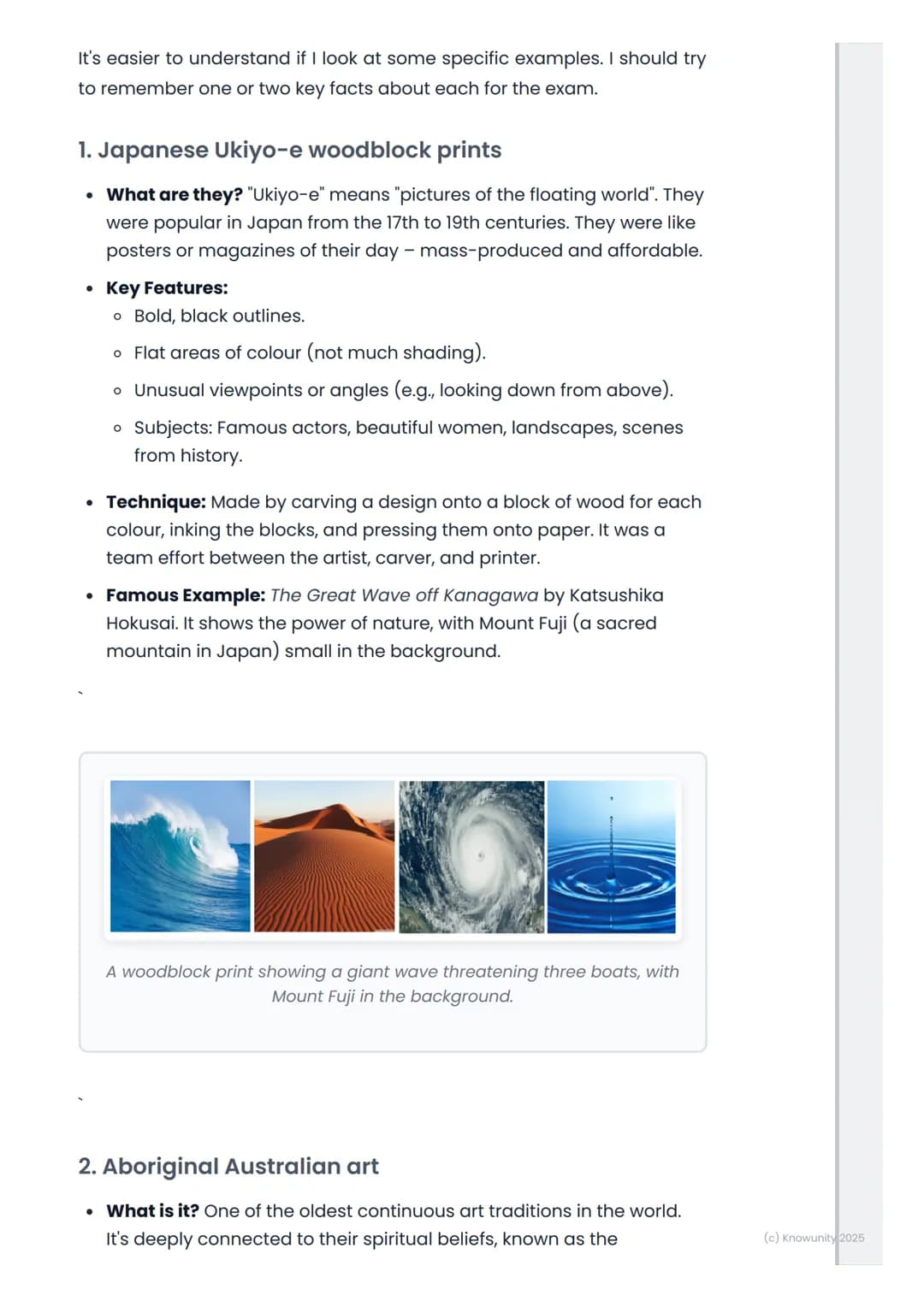
Japanese Ukiyo-e Woodblock Prints
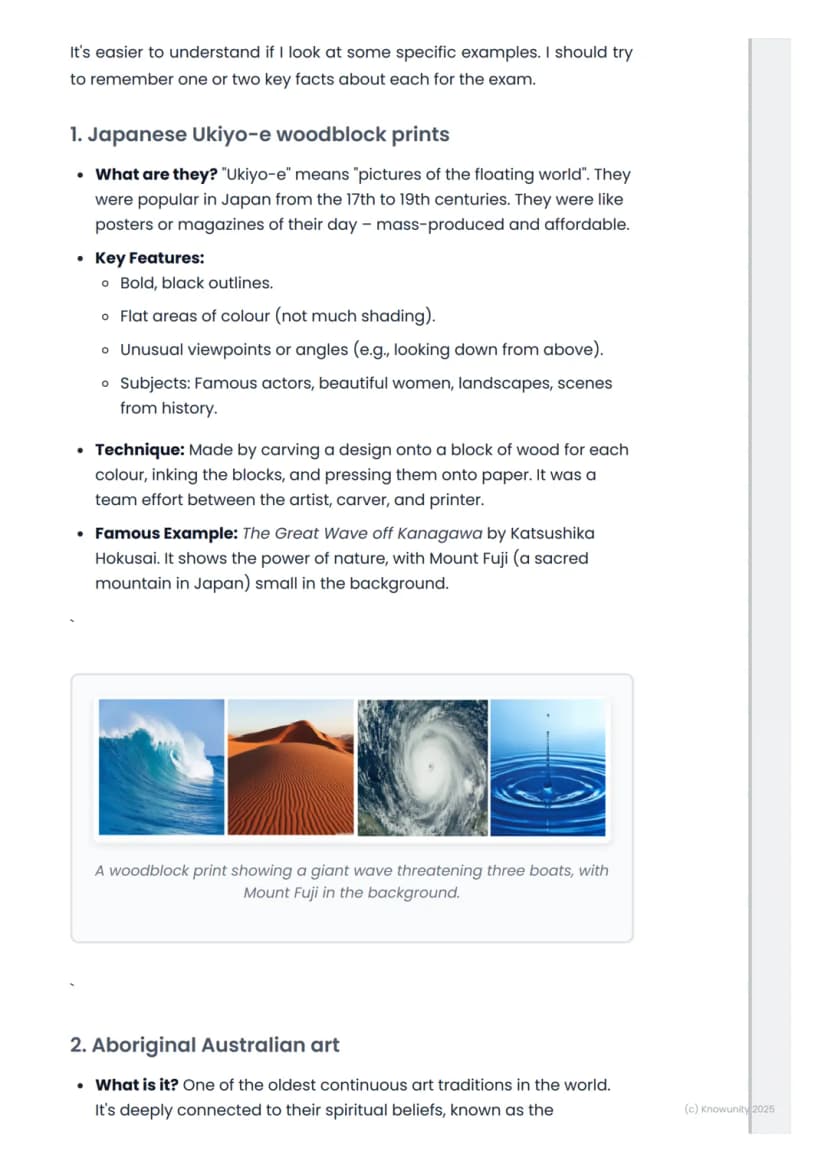
Picture this: 17th-century Japan had no Instagram, but they had something even cooler - Ukiyo-e prints, meaning "pictures of the floating world." These were basically the social media of their time, showing everything from celebrity actors to stunning landscapes.
The technique is mind-blowing. Artists, carvers, and printers worked as a team, creating separate wooden blocks for each colour. The result? Those bold, black outlines and flat areas of colour that make Ukiyo-e instantly recognisable. No fancy shading needed - just pure, powerful simplicity.
The most famous example is Hokusai's The Great Wave off Kanagawa. That massive wave isn't just showing off nature's power - it's a cultural statement about humans versus the natural world, with Mount Fuji sitting calmly in the background like it's seen it all before.
These prints used unusual angles and viewpoints that would later blow European artists' minds. They weren't trying to copy reality perfectly - they were creating their own visual language that captured the energy and spirit of Japanese life.
3
of 6
Aboriginal Australian Art and Benin Bronzes
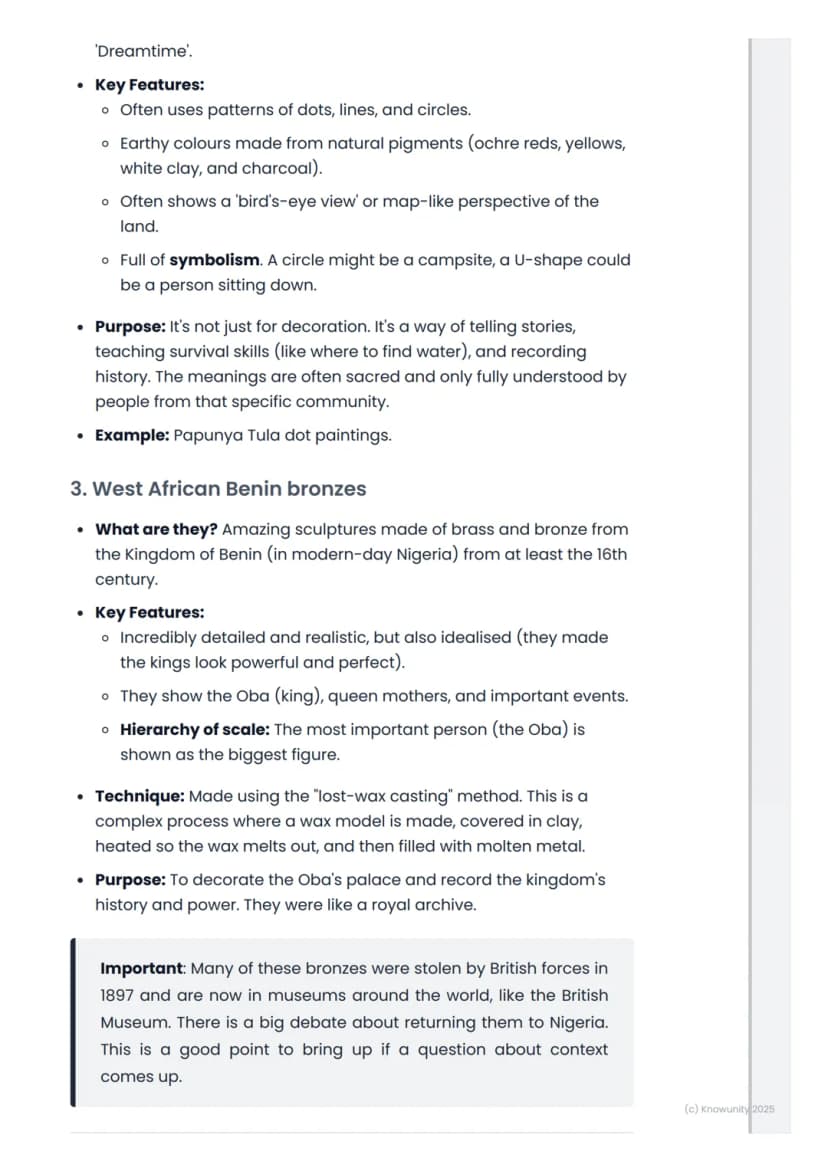
Aboriginal art holds the record for the world's oldest continuous art tradition - we're talking tens of thousands of years! This isn't just decoration; it's a sacred storytelling system connected to the Dreamtime, their spiritual understanding of the world.
Those famous dot paintings aren't random patterns. Each dot, circle, and line has meaning - circles might show campsites or waterholes, while lines could represent ancestral paths. The bird's-eye view perspective shows the land like a living map, teaching survival skills and recording history in one beautiful package.
Meanwhile, in West Africa, the Benin bronzes from Nigeria showcase incredible metalworking skills. These brass and bronze sculptures recorded royal history using the lost-wax casting technique - a complex process where artists created wax models, covered them in clay, melted out the wax, and poured in molten metal.
Context matters: Many Benin bronzes were stolen by British forces in 1897 and are still in museums worldwide. This ongoing debate about returning cultural treasures shows why understanding art history isn't just academic - it's about justice.
4
of 6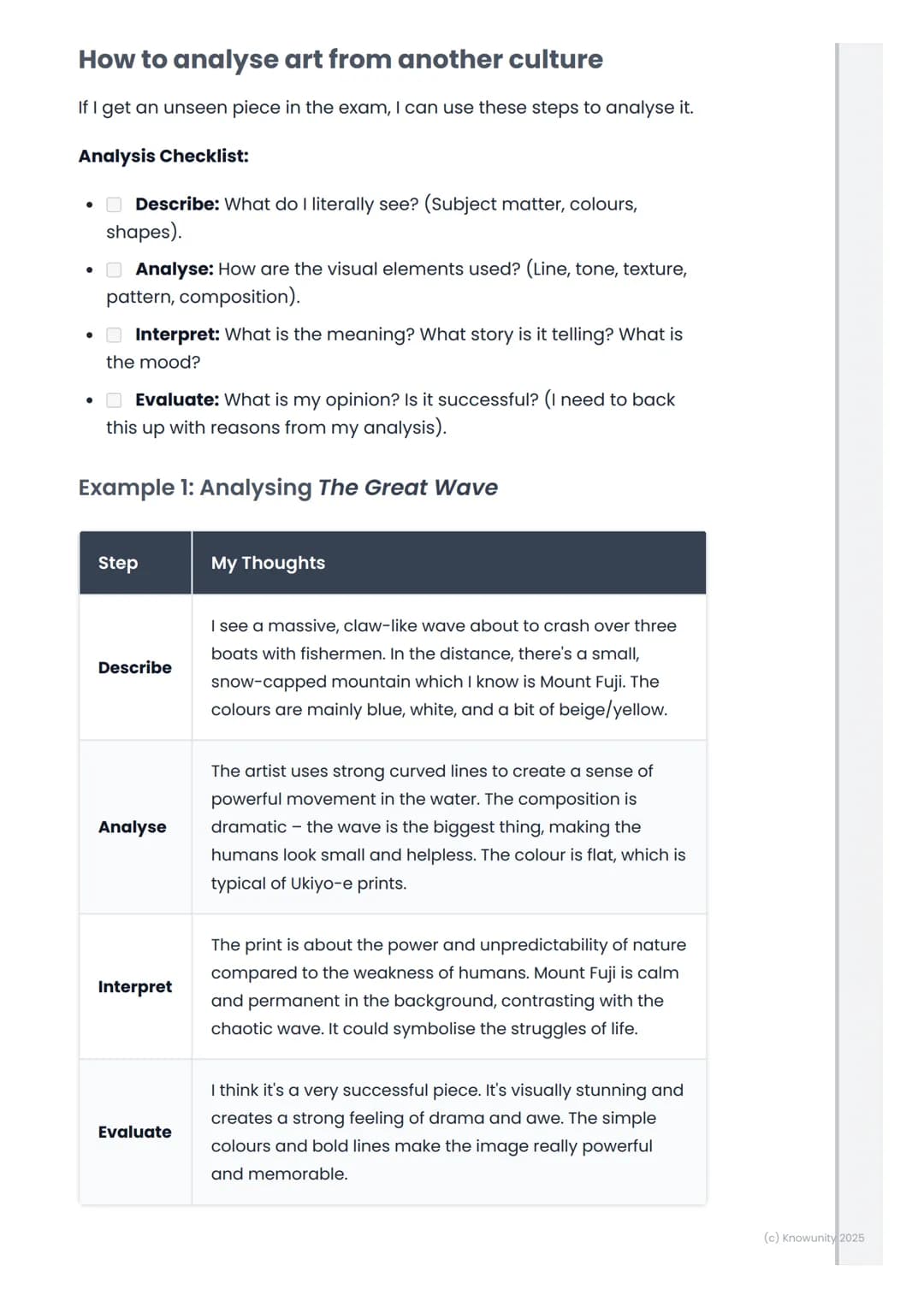
How to Analyse Cultural Art
When you're faced with an artwork from another culture in your exam, don't panic! You've got a foolproof system: Describe, Analyse, Interpret, Evaluate. Think of it as your cultural art detective toolkit.
Describe what you literally see - colours, shapes, subjects. Don't overthink it yet. Then analyse how the visual elements work together. Are the lines bold or delicate? How's the composition arranged? What's the biggest element?
Interpretation is where it gets interesting. What story might this be telling? What could the symbols mean? Even if you don't know the specific cultural meanings, you can make educated guesses based on what you've learned about that culture's values and beliefs.
Finally, evaluate the artwork's success. Does it achieve what it seems to be trying to do? Back up your opinions with evidence from your analysis. Remember, you're not judging it by your own cultural standards - you're trying to understand it on its own terms.
Pro tip: Always mention the cultural context in your analysis. An Aboriginal dot painting isn't just pretty patterns - it's a complex information system that connects art, spirituality, and survival knowledge.
5
of 6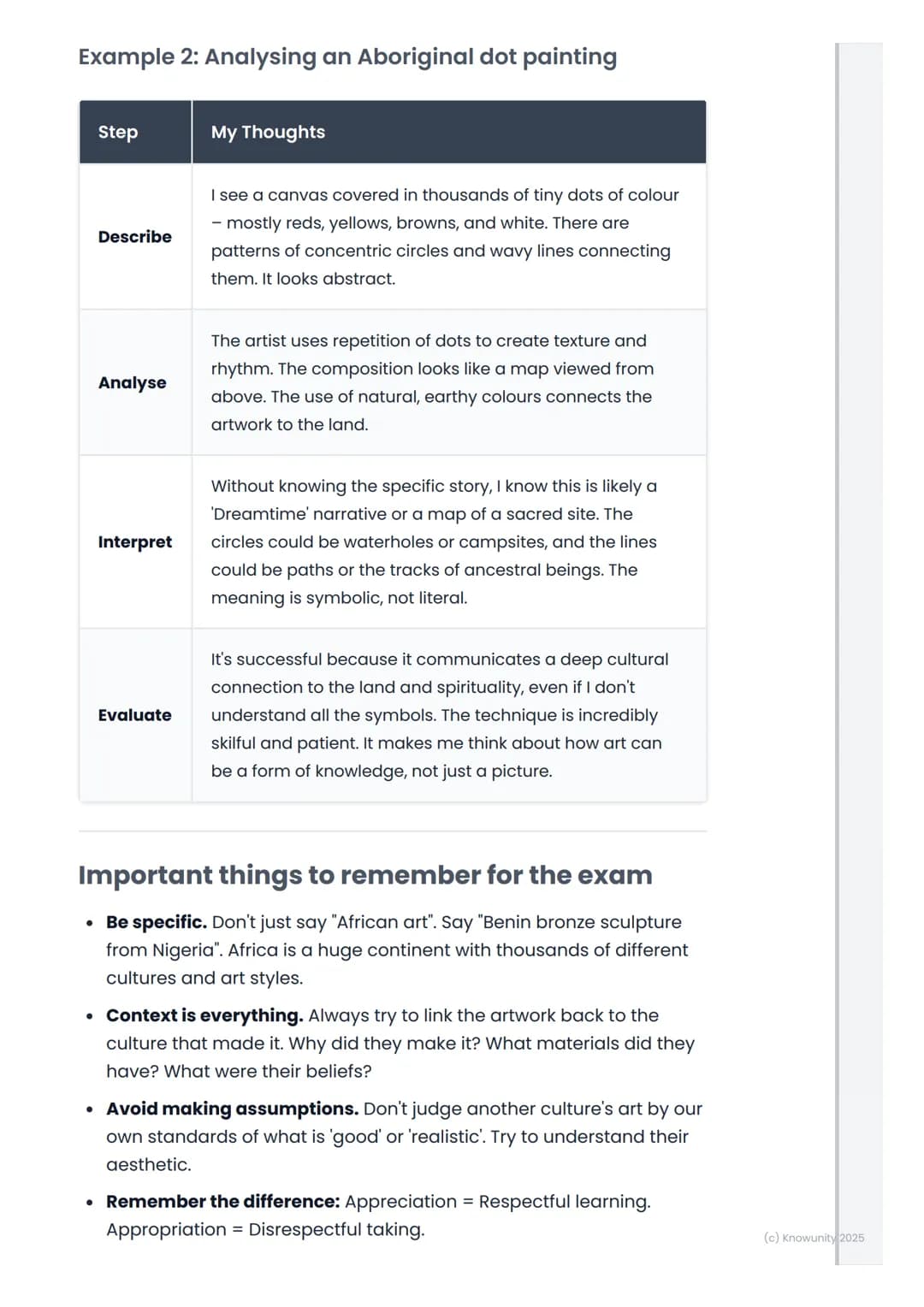
Putting It All Together - Analysis Examples
Let's see this system in action with Hokusai's Great Wave. You'd describe the massive wave threatening tiny boats with Mount Fuji in the background. Analysing the visual elements, you'd note the strong curved lines creating movement and the dramatic composition that makes humans look powerless.
For interpretation, think about Japanese culture's relationship with nature - this isn't just a scary wave, it's about the eternal struggle between human ambition and natural forces. Mount Fuji represents permanence and spiritual calm against the chaos.
Evaluating the piece, you might say it's incredibly successful because it creates immediate emotional impact while telling a deeper story about Japanese philosophy and the human condition.
Aboriginal dot paintings work differently but follow the same analysis pattern. Those thousands of dots create texture and rhythm, while the map-like composition connects viewers to sacred landscape knowledge. Even without knowing specific meanings, you can appreciate the incredible skill and cultural significance.
Exam success tip: Be specific! Don't just say "African art" - say "Benin bronze sculpture from Nigeria." Show you understand that cultures have distinct artistic traditions, even within the same continent.
6
of 6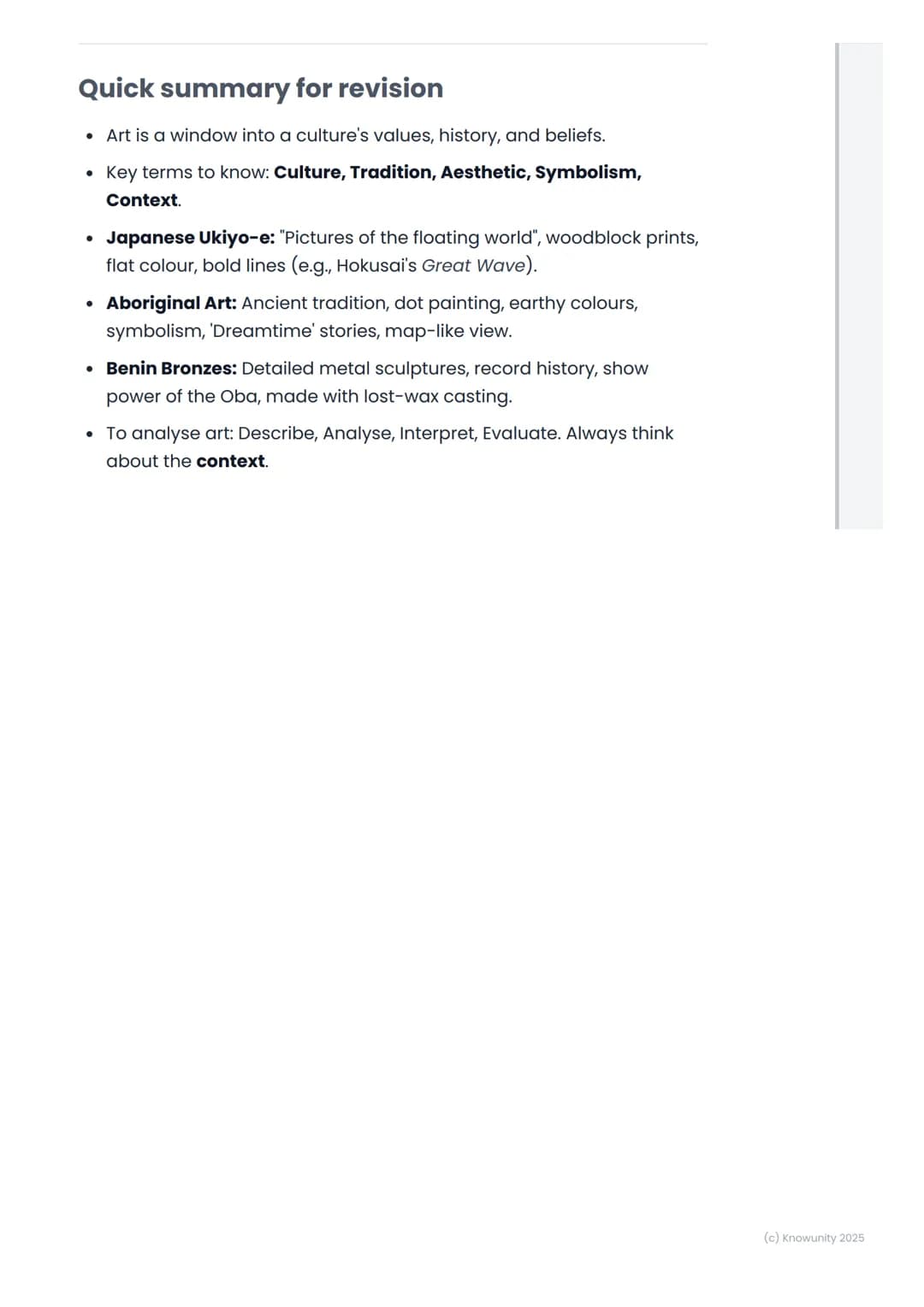
Quick Revision Summary
You're now equipped to tackle any cultural art analysis! Remember that art is a window into cultural values - every technique, symbol, and colour choice tells you something about the people who created it.
Your key terms are sorted: Culture (way of life), Tradition , Aesthetic (what they consider beautiful), Symbolism (deeper meanings), and Context (background info that changes everything).
The three major examples you need: Japanese Ukiyo-e (woodblock prints with flat colours and bold lines), Aboriginal art (ancient dot paintings telling Dreamtime stories), and Benin bronzes (detailed metal sculptures recording royal history).
Your analysis method is Describe, Analyse, Interpret, Evaluate - and always, always consider the cultural context. You're not just looking at pretty objects; you're decoding entire worldviews and ways of understanding life.
Final thought: The difference between appreciation and appropriation is respect and understanding. By studying these artworks properly, you're showing genuine respect for the cultures that created them.
Si on te demande...
Qu'est-ce que le compagnon IA de Knowunity ?
Notre compagnon IA est spécialement conçu pour répondre aux besoins des étudiants. Sur la base des millions d'éléments de contenu que nous avons sur la plateforme, nous pouvons fournir des réponses vraiment significatives et pertinentes aux étudiants. Mais il ne s'agit pas seulement de réponses, le compagnon a encore plus pour but de guider les élèves dans leurs défis d'apprentissage quotidiens, avec des plans d'étude personnalisés, des quiz ou des éléments de contenu dans le chat et une personnalisation à 100% basée sur les compétences et les développements de l'étudiant.
Où puis-je télécharger l'appli Knowunity ?
Tu peux télécharger l'application dans Google Play Store et dans l'App Store d'Apple.
L'application est-elle vraiment gratuite ?
Oui, tu as un accès entièrement gratuit à tous les contenus de l'appli, tu peux chatter ou suivre les créateurs à tout moment. De plus, nous proposons Knowunity Premium, qui te permet de réviser sans limites!
Contenus les plus populaires
9 Irish
IrishIrish oral questions and answers
Questions and answers for the leaving cert oral
5th Year4264
 English
Key Quotes : Sive
Key Quotes and explanations: Sive
6th Year2842
IrishIrish oral questions
Outline of oral questions
5th Year2055
IrishIníon- le hÁine Durkin
Aine Durkin’s poem, Iníon: Themes & summary
5th Year890
IrishIrish poetry 2027
Iníon + Dínit an Bhróin
5th Year1153
IrishLC HL notes- Iníon (poem)
Includes poem in English and Irish, theme, key words & phrases
5th Year2304
EnglishCultural Context : Shawshank Redemption : Sive : Small Things Like These
Comparative Study : Cultural Context : Shawshank Redemption, Sive and Small Things Like These
6th Year1430
IrishMo Ghrá-sa (Idir Lúibíní)
Notes on mo ghrá-sa
5th Year380
IrishAn Gaeilge Aiste
Irish Language essay
6th Year1320
Rien ne te convient ? Explore d'autres matières.
Les étudiants nous adorent — il ne manque plus que toi.
4.6/5App Store
4.7/5Google Play
L'application est très facile d'utilisation et bien conçue. Jusqu'à présent, j'ai trouvé tout ce que je cherchais et j'ai pu apprendre beaucoup de choses grâce aux présentations ! Je vais certainement utiliser l'application pour un travail en classe ! Et comme source d'inspiration personnelle, elle est bien sûr aussi très utile.
Stefan Sutilisateur iOS
Cette application est vraiment super. Il y a tellement de fiches de révision et d'aide, [...]. Par exemple, la matière qui me pose problème est le français et l'appli a un choix d'aide très large. Grâce à cette application, je me suis améliorée en français. Je la recommanderais à tout le monde.
Samantha Klichutilisatrice Android
Waouh, je suis vraiment abasourdi. J'ai essayé l'application parce que je l'avais déjà vue plusieurs fois dans la publicité et j'ai été absolument choquée. Cette appli est L'AIDE dont on rêve pour l'école et surtout, elle propose tellement de choses, comme des rédactions et des fiches qui m'ont personnellement TRÈS bien aidé.
Annautilisatrice iOS
Visual Art3 vues·Mis à jour Jun 16, 2026·6 pagesExploring Cultural Art from Around the World
Art speaks every language but in different ways! Learning about art from different cultures isn't just about pretty pictures - it's your chance to become a cultural detective, uncovering stories, beliefs, and ways of life from around the world.
1
of 6
Inscris-toi pour voir le contenu. C'est gratuit!
- Accès à tous les documents
- Améliore tes notes
- Rejoins des millions d'étudiants
Understanding Art from Different Cultures
Ever wondered why art looks so different around the world? It's because every culture has its own way of seeing beauty and meaning. When you study art from other cultures, you're basically learning their visual language - and it's way more exciting than any textbook could tell you.
Culture isn't just about the art itself - it's the whole package of beliefs, customs, and ways of life that shape how people create. Think of it as the invisible hand guiding every brushstroke, carving, or pattern. Tradition keeps these artistic techniques and meanings alive, passing them down through generations like family recipes.
Here's where it gets interesting: symbolism means that nothing is just what it seems. A simple circle might represent a campsite, a spiritual place, or the cycle of life. Context is your best friend here - knowing who made something, when, where, and why completely changes how you understand it.
Remember: There's a huge difference between cultural appreciation (respectfully learning about other cultures) and cultural appropriation (taking without understanding or respect). You're doing the first one!
2
of 6Inscris-toi pour voir le contenu. C'est gratuit!
- Accès à tous les documents
- Améliore tes notes
- Rejoins des millions d'étudiants
Japanese Ukiyo-e Woodblock Prints
Picture this: 17th-century Japan had no Instagram, but they had something even cooler - Ukiyo-e prints, meaning "pictures of the floating world." These were basically the social media of their time, showing everything from celebrity actors to stunning landscapes.
The technique is mind-blowing. Artists, carvers, and printers worked as a team, creating separate wooden blocks for each colour. The result? Those bold, black outlines and flat areas of colour that make Ukiyo-e instantly recognisable. No fancy shading needed - just pure, powerful simplicity.
The most famous example is Hokusai's The Great Wave off Kanagawa. That massive wave isn't just showing off nature's power - it's a cultural statement about humans versus the natural world, with Mount Fuji sitting calmly in the background like it's seen it all before.
These prints used unusual angles and viewpoints that would later blow European artists' minds. They weren't trying to copy reality perfectly - they were creating their own visual language that captured the energy and spirit of Japanese life.
3
of 6Inscris-toi pour voir le contenu. C'est gratuit!
- Accès à tous les documents
- Améliore tes notes
- Rejoins des millions d'étudiants
Aboriginal Australian Art and Benin Bronzes
Aboriginal art holds the record for the world's oldest continuous art tradition - we're talking tens of thousands of years! This isn't just decoration; it's a sacred storytelling system connected to the Dreamtime, their spiritual understanding of the world.
Those famous dot paintings aren't random patterns. Each dot, circle, and line has meaning - circles might show campsites or waterholes, while lines could represent ancestral paths. The bird's-eye view perspective shows the land like a living map, teaching survival skills and recording history in one beautiful package.
Meanwhile, in West Africa, the Benin bronzes from Nigeria showcase incredible metalworking skills. These brass and bronze sculptures recorded royal history using the lost-wax casting technique - a complex process where artists created wax models, covered them in clay, melted out the wax, and poured in molten metal.
Context matters: Many Benin bronzes were stolen by British forces in 1897 and are still in museums worldwide. This ongoing debate about returning cultural treasures shows why understanding art history isn't just academic - it's about justice.
4
of 6Inscris-toi pour voir le contenu. C'est gratuit!
- Accès à tous les documents
- Améliore tes notes
- Rejoins des millions d'étudiants
How to Analyse Cultural Art
When you're faced with an artwork from another culture in your exam, don't panic! You've got a foolproof system: Describe, Analyse, Interpret, Evaluate. Think of it as your cultural art detective toolkit.
Describe what you literally see - colours, shapes, subjects. Don't overthink it yet. Then analyse how the visual elements work together. Are the lines bold or delicate? How's the composition arranged? What's the biggest element?
Interpretation is where it gets interesting. What story might this be telling? What could the symbols mean? Even if you don't know the specific cultural meanings, you can make educated guesses based on what you've learned about that culture's values and beliefs.
Finally, evaluate the artwork's success. Does it achieve what it seems to be trying to do? Back up your opinions with evidence from your analysis. Remember, you're not judging it by your own cultural standards - you're trying to understand it on its own terms.
Pro tip: Always mention the cultural context in your analysis. An Aboriginal dot painting isn't just pretty patterns - it's a complex information system that connects art, spirituality, and survival knowledge.
5
of 6Inscris-toi pour voir le contenu. C'est gratuit!
- Accès à tous les documents
- Améliore tes notes
- Rejoins des millions d'étudiants
Putting It All Together - Analysis Examples
Let's see this system in action with Hokusai's Great Wave. You'd describe the massive wave threatening tiny boats with Mount Fuji in the background. Analysing the visual elements, you'd note the strong curved lines creating movement and the dramatic composition that makes humans look powerless.
For interpretation, think about Japanese culture's relationship with nature - this isn't just a scary wave, it's about the eternal struggle between human ambition and natural forces. Mount Fuji represents permanence and spiritual calm against the chaos.
Evaluating the piece, you might say it's incredibly successful because it creates immediate emotional impact while telling a deeper story about Japanese philosophy and the human condition.
Aboriginal dot paintings work differently but follow the same analysis pattern. Those thousands of dots create texture and rhythm, while the map-like composition connects viewers to sacred landscape knowledge. Even without knowing specific meanings, you can appreciate the incredible skill and cultural significance.
Exam success tip: Be specific! Don't just say "African art" - say "Benin bronze sculpture from Nigeria." Show you understand that cultures have distinct artistic traditions, even within the same continent.
6
of 6Inscris-toi pour voir le contenu. C'est gratuit!
- Accès à tous les documents
- Améliore tes notes
- Rejoins des millions d'étudiants
Quick Revision Summary
You're now equipped to tackle any cultural art analysis! Remember that art is a window into cultural values - every technique, symbol, and colour choice tells you something about the people who created it.
Your key terms are sorted: Culture (way of life), Tradition , Aesthetic (what they consider beautiful), Symbolism (deeper meanings), and Context (background info that changes everything).
The three major examples you need: Japanese Ukiyo-e (woodblock prints with flat colours and bold lines), Aboriginal art (ancient dot paintings telling Dreamtime stories), and Benin bronzes (detailed metal sculptures recording royal history).
Your analysis method is Describe, Analyse, Interpret, Evaluate - and always, always consider the cultural context. You're not just looking at pretty objects; you're decoding entire worldviews and ways of understanding life.
Final thought: The difference between appreciation and appropriation is respect and understanding. By studying these artworks properly, you're showing genuine respect for the cultures that created them.
Si on te demande...
Qu'est-ce que le compagnon IA de Knowunity ?
Notre compagnon IA est spécialement conçu pour répondre aux besoins des étudiants. Sur la base des millions d'éléments de contenu que nous avons sur la plateforme, nous pouvons fournir des réponses vraiment significatives et pertinentes aux étudiants. Mais il ne s'agit pas seulement de réponses, le compagnon a encore plus pour but de guider les élèves dans leurs défis d'apprentissage quotidiens, avec des plans d'étude personnalisés, des quiz ou des éléments de contenu dans le chat et une personnalisation à 100% basée sur les compétences et les développements de l'étudiant.
Où puis-je télécharger l'appli Knowunity ?
Tu peux télécharger l'application dans Google Play Store et dans l'App Store d'Apple.
L'application est-elle vraiment gratuite ?
Oui, tu as un accès entièrement gratuit à tous les contenus de l'appli, tu peux chatter ou suivre les créateurs à tout moment. De plus, nous proposons Knowunity Premium, qui te permet de réviser sans limites!
Contenus les plus populaires
9IrishIrish oral questions and answers
Questions and answers for the leaving cert oral
5th Year4264
EnglishKey Quotes : Sive
Key Quotes and explanations: Sive
6th Year2842
IrishIrish oral questions
Outline of oral questions
5th Year2055
IrishIníon- le hÁine Durkin
Aine Durkin’s poem, Iníon: Themes & summary
5th Year890
IrishIrish poetry 2027
Iníon + Dínit an Bhróin
5th Year1153
IrishLC HL notes- Iníon (poem)
Includes poem in English and Irish, theme, key words & phrases
5th Year2304
EnglishCultural Context : Shawshank Redemption : Sive : Small Things Like These
Comparative Study : Cultural Context : Shawshank Redemption, Sive and Small Things Like These
6th Year1430
IrishMo Ghrá-sa (Idir Lúibíní)
Notes on mo ghrá-sa
5th Year380
IrishAn Gaeilge Aiste
Irish Language essay
6th Year1320
Rien ne te convient ? Explore d'autres matières.
Les étudiants nous adorent — il ne manque plus que toi.
4.6/5App Store
4.7/5Google Play
L'application est très facile d'utilisation et bien conçue. Jusqu'à présent, j'ai trouvé tout ce que je cherchais et j'ai pu apprendre beaucoup de choses grâce aux présentations ! Je vais certainement utiliser l'application pour un travail en classe ! Et comme source d'inspiration personnelle, elle est bien sûr aussi très utile.
Stefan Sutilisateur iOS
Cette application est vraiment super. Il y a tellement de fiches de révision et d'aide, [...]. Par exemple, la matière qui me pose problème est le français et l'appli a un choix d'aide très large. Grâce à cette application, je me suis améliorée en français. Je la recommanderais à tout le monde.
Samantha Klichutilisatrice Android
Waouh, je suis vraiment abasourdi. J'ai essayé l'application parce que je l'avais déjà vue plusieurs fois dans la publicité et j'ai été absolument choquée. Cette appli est L'AIDE dont on rêve pour l'école et surtout, elle propose tellement de choses, comme des rédactions et des fiches qui m'ont personnellement TRÈS bien aidé.
Annautilisatrice iOS