Capacitor Charging and Discharging in RC Circuits
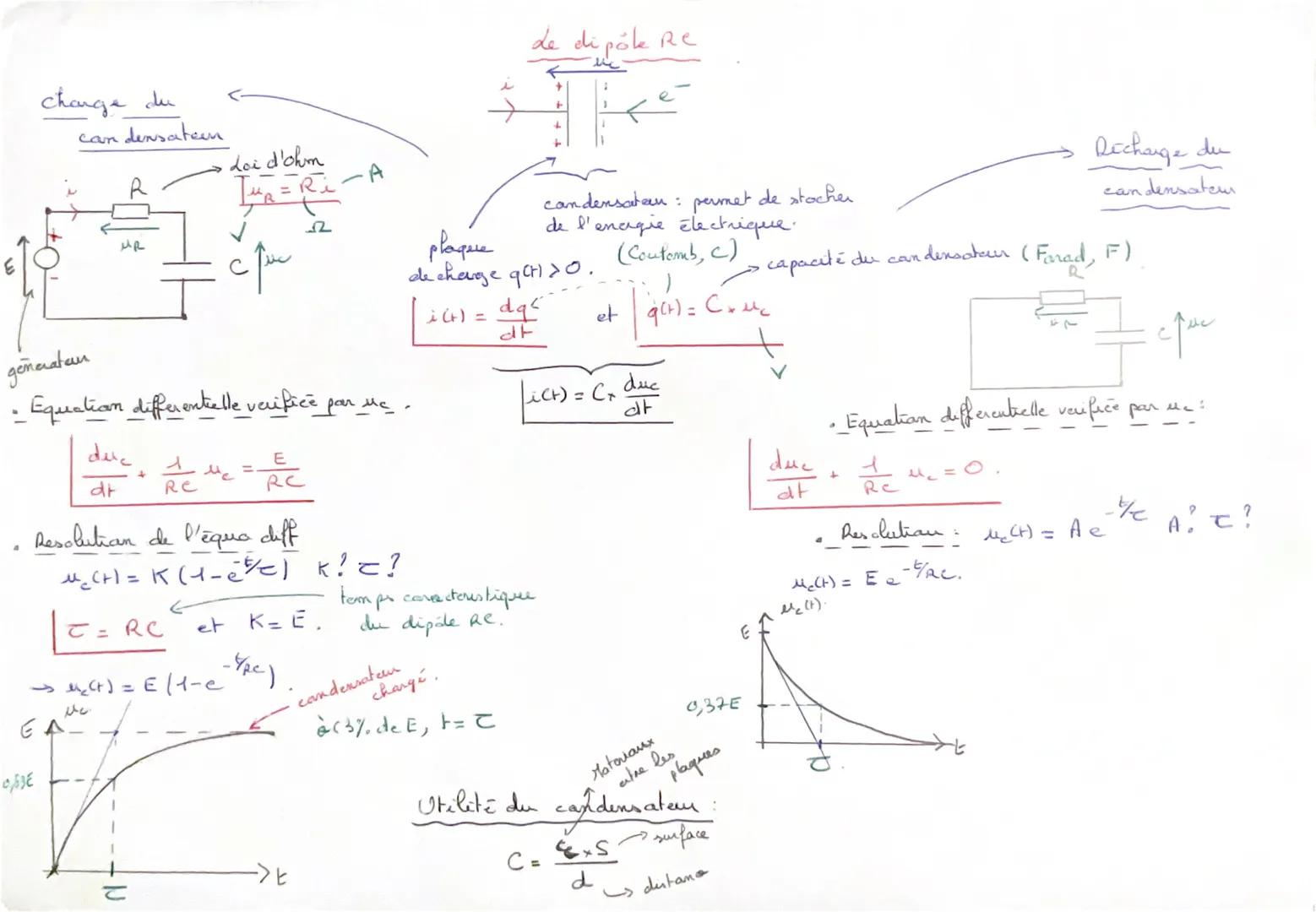
This page provides a comprehensive overview of capacitor behavior in RC circuits, focusing on the charging and discharging processes. The content covers essential concepts such as the charge condensateur formule, décharge condensateur circuit RC, and the circuit RC équation différentielle.
The document begins by presenting the differential equation that describes the capacitor voltage during charging. It then proceeds to solve this equation, revealing the exponential nature of the charging process. The solution for the capacitor voltage is given as uc(t) = E1−e(−t/RC), where E is the applied voltage, R is the resistance, and C is the capacitance.
Definition: A capacitor is a device that stores electrical energy, with its capacity measured in Farads (F).
The page also discusses the current in the circuit during charging, which is described by the equation i(t) = E/Re^−t/RC. This equation shows how the current decreases exponentially as the capacitor charges.
Highlight: The time constant of an RC circuit, denoted as τ = RC, is a crucial parameter that determines the charging and discharging rates of the capacitor.
The document explains that after a time equal to 5τ, the capacitor is considered fully charged, reaching approximately 99% of the applied voltage. It also notes that at t = τ, the capacitor voltage reaches about 63% of the final value.
Vocabulary: The temps de charge condensateur formule refers to the equation describing how long it takes for a capacitor to charge to a certain voltage level.
The page concludes with information about capacitor construction, noting that the capacitance depends on the surface area of the plates, the distance between them, and the dielectric material used. It also briefly mentions the utility of capacitors in electrical circuits.
Example: In a circuit with R = 1000 Ω and C = 1 μF, the time constant τ = RC = 1 ms. After 5 ms, the capacitor will be nearly fully charged.
This comprehensive explanation provides students with a solid foundation for understanding capacitor behavior in RC circuits, essential for further studies in electrical engineering and physics.

 Physique/Chimie
 Maths
Maths Histoire
 Philosophie
 HGGSP
HGGSP Français
 Ens. Scient.
 ST2S
ST2S